


DrumBeat: November 27, 2006
Posted by threadbot on November 27, 2006 - 9:30am
Insurgents target oil sources, cause massive infernos
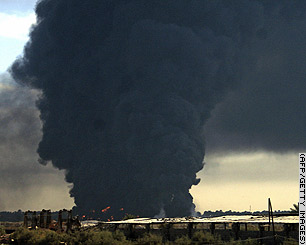
BAGHDAD, Iraq (CNN) -- Insurgents Monday targeted key oil sites in Iraq, firing mortar rounds into an oil distribution center in northern Iraq and bombing a pipeline in a southern suburb of Baghdad, Iraqi officials said.The attack on the oil distribution center triggered a massive fire that halted the flow of crude oil to Iraq's largest refinery, a Kirkuk police official said.
On November 25, our own Dave Cohen was a guest on Jim Puplava's show, Financial Sense Newshour. You can download the audio here. Dave is in the fourth hour, about 2/3 of the way through.
The first hour, where Matthew Simmons discusses the CERA report, may also be of interest.
NATO eyes greater role in energy security
NATO leaders will study at a summit starting on Tuesday whether the alliance should take more action to avert potential threats to energy supplies, for example by mounting patrols of key shipping lanes.
U.S. auto sales slowing say forecasts: report
After a string of strong years, U.S. auto sales are slowing and an increasing number of forecasts say sales could fall next year to their lowest in nearly a decade, the Wall Street Journal reported on its Web site on Monday.
Raymond J. Learsy: The Willy Sutton Theory of Oil Pricing
Expanding on Willy Sutton, America's notorious bank bandito's famed dictum, "that's where the money is" today's oil industry rationale for the pricing of oil could be capsulated by, "that's where the money is, but hey, don't worry, the system is still working"!
Now is the time to think local first
I am currently reading Bill McKibben's new book, (due out in March) "Deep Economy." As usual, Bill has written a compelling book – this time about the benefits of thinking and acting on a local scale. He points to climate change and peak oil as the compelling forces behind this proposed shift. We need to move towards localism to both stave off the worst effects of these circumstances and to cope with them.
Concerns arise as Oman oil futures gain viability
SINGAPORE: Oil industry enthusiasm over Oman’s landmark pledge to use a new futures contract is being tempered by concerns over the fine print, which may yet rob the market of its best hope for a more vibrant marker.
FOCUS - Sinopec-Saudi refinery deal to boost Aramco foothold in China
China Petroleum & Chemical Corp (Sinopec) is expected to sell a 25 pct stake in an east China refinery to Saudi Aramco in a deal that analysts said will give the Saudi company a major boost in China's fast growing market.
New Saudi alignment with China could challenge US
China’s insatiable demand for oil — and Saudi Arabia’s position as the world’s top exporter—have become the basis for a trade partnership that analysts say could upset Riyadh’s decades-old oil-for-security relationship with Washington.
The GTL-Gas To Liquids World Comes Together at GTLtec07 in Doha Qatar
U.S. Opposes Long-Term Gas Deliveries from Iran to Georgia
U.S. Ambassador to Georgia John Tefft announced that his country is opposed to a long term strategic cooperation between Georgia and Iran regarding natural gas deliveries.
Lighting the key to energy saving
A global switch to efficient lighting systems would trim the world's electricity bill by nearly one-tenth.
How mirrors can light up the world: Scientists say the global energy crisis can be solved by using the desert sun
Making renewable energy a reality
Clean Coal Power Plant Planned For 2011 In Norway
OSLO - An international group of companies launched a plan on Monday to build a novel coal-fired power plant in Norway by 2011 that would curb global warming by capturing 95 percent of all greenhouse gases emitted.
GM set to detail shift to fuel-saving technology
LOS ANGELES - Stung by criticism that it conspired to kill the electric car, General Motors Corp. (NYSE:GM - news) is preparing to detail its commitment to new fuel-saving technologies, including new electric vehicles, according to people familiar with the automaker's plans.
Alternative energy powers up new jobs: Rising demand for solar, wind, biofuels brightens outlook for manufacturing in U.S.
Transition Culture Interview with Richard Heinberg - Part One… Peak Oil
Pickens Predicts Record 2007 Oil Price
"I keep thinking we're right at the bottom on oil," Pickens, who has correctly predicted rising energy prices for the past three years, said in a Nov. 22 interview. "I don't see why the run is over if the global economy continues to grow." When the prices for oil, fuels and natural gas start to rise may depend on how quickly winter weather spreads across the U.S., Pickens said. So far, warm temperatures have kept demand for heating fuels in check.
Iraq declares war on petroleum smuggling
BAGHDAD, Iraq - Smugglers were loading gasoline on a ship at an illegal port in southern Iraq when police surprised them with a raid that ended with five smugglers and two policemen dead.The October clash at Abu Flus was one of many attempts by security forces trying to stop smuggling of Iraqi petroleum products to neighboring countries, a practice that is costing the country billions of dollars every year.
Charges advised in oil-for-food probe
CANBERRA, Australia - An Australian inquiry on Monday recommended police pursue criminal charges against 12 business officials in connection with multimillion-dollar kickbacks that the country's monopoly wheat exporter paid under the U.N.'s Iraqi oil-for-food program.
Toyota engineer who helped develop Prius dies in plane crash
Leftist economist wins Ecuador election: Chavez-friendly candidate trounces Bible-toting banana tycoon in presidential runoff.
Contact
- Content: editors at theoildrum dot com
- Tech support: support at theoildrum dot com
License

This work is licensed under a Creative Commons Attribution-Share Alike 3.0 United States License.
The Denver Post from Colorado:
And this is when the economy is "expanding" and when we have "low" unemployment. It seems to me that someone with the initials JHK predicted all of this.
And more SUVs parked in front of the house than drivers living in it is not a sign of insanity, it is a measure of how much your neighbors will envy you.
Ah, the American Dream.
Only a tiny fringe can imagine this becoming a nightmare, it seems, and they are easily ignored, right?
But as an opinion, I am not sure Kunstler has really thought out what it means when this all comes crashing down, as he so fervently desires - watching his problems dealing with a local weather related disruption a year ago, I'm not sure he has actually understood what he predicts.
http://www.denverpost.com/business/ci_4719353
It looks half-local to me. The other half is the unfortunate combination of a housing bubble coinciding with a collapse of lending standards. These poor people should not have been given loans.
I'm pretty sure they were given them because the debt is somehow passed through to FDIC insured CDs:
https://bank.countrywide.com/scontent.aspx?cmtag=Content-cds
I have a CD like that. Did I give those unfortunates a loan with 100% financing and adjustable rate? Maybe. And sad if that's what happened.
In Ohio, we didn't really see much of a boom in real estate and so we've avoided a bust. Home prices are just flat. I guess that's one good thing about living in a dull state to which no one would reloacte unless they had to. Anyway, there are a lot of these neighborhoods where people were given loans they never should have received. The problem of unloading these forclosed homes is exacerbated by the fact that the builders are still building the exact same house in the next phase of the development. Who wants to buy a 2 or 3 year old foreclosed home when you can buy the exact same home brand new. the thing that puzzles me about it is that with the most obnoxious lending practices, the builder is also the lender. Ohio has laws forbidding these predatory type loans but has an exception when it is "for sale by owner", so these big builders build 10's of thousands of homes then they act as the bank when it sells so that it can be FSBO and they can avoid these laws. So what i don't understand is how they can continue to give out these loans and hold all these forclosed homes. They're not screwing the bank, bc/ they are the bank, they're screwing themselves. Any real estate moguls here that explain to me what I'm missing here?
You, as an individual, can buy a small $100,000 slice of a Ginnie Mae. China is one of the big buyers (higher yield than US T-Bills). I am unsure of the sophisicated methods of reducing risk (they are there) and layering defaults. (One can buy the last xx% of value in a portfolio, so that mortgage losses hit those that hold the upper layers).
Hope this helps,
Alan
BTW, Housing bubble burst is good for New Orleans. Should drive down cost of materials and we will get migrant construction workers.
I know, I know- just save your comments about the cost of RV'ing and the future of RV parks. My in-laws are doing very well right now and they're in their 60's. They just need to make it a few more years then they'll retire. Irrespective of PO, no one in the younger generation is willing to take over the family business from them when they retire.
I think his idea was that people in or around the international business community was more caught up in this thing than others.
(I think it was "Irrational Exuberance" by Robert Shiller. I see that I talked about the book here back in March.)
A Short History of Financial Euphoria
by Galbraith which is worth the read IMO
Read this one for the process. Really good I think. Here is just a snippet.
If These Are Bubbles, Where Is All That Hot-Air Money Coming From?
November 25, 2006 by Katy Delay
http://www.prudentbear.com/archive_comm_article.asp?category=Guest+Commentary&content_idx=60572
John
All this means to me is that when things unravel, the poor, regressively taxed taxpayer gets saddled with the bill from bailing out the fed. agencies (S&L crisis writ large), at the same time they are on the street because their over-financed home has been repo'd. Kind of like the Dragon swallowing its tail here.
SOOOOO, Joe Sixpack walks on his house, foreclosure.
THEN the Pension funds where Joe works/used to work, now have losses because of foreclosure.
Joe has no pension, because the pensions bought the securitized bonds.
In essence, Joe's purchase of the house he can't afford, ruins his pension fund.
Financial Wizardry & Collapse
It is in no way a local problem. There is a nationwide housing glut and we are on the cusp of a nationwide housing bubble bust.
And real estate does not always go up. In Los Angeles in the last cycle, prices peaked in 1989 and bottomed out in 1997. In that interval, L.A. lost 40% of its real value. But they are back up again now and headed for an even greater collapse. The same thing happened in Texas when oil prices collapsed in the 1990s. Billions were lost in Houston and Dallas real estate when prices collapsed.
Ron Patterson
http://www.msnbc.msn.com/id/15416909/
Ron Patterson
Some neighborhoods which had been undesirable in the past have been able to use their new boom-equity to give themselves makeovers, to bootstrap themselves a bit. It would be sad to see those sink back post-boom.
The problem this time round is not how regional various markets are, but the sheer scale of financial investment, and the lack of any alternative to that financial structure, which seems to be built mainly on sand - 11 trillion dollars of conjured 'equity,' which is just starting to be recognized as 11 trillion dollars of additional debt that somebody is holding the bag to.
Some people seem to think that the Chinese are the unlucky ones, but I don't really think so - after all, they still make things other people want to buy. And they own the debt, they don't have to pay it back - unless Americans have finally gotten to the point that they will simply walk away from any obligations concerning the future.
Oh. Hmmm.
This is not my field and something I can barely puzzle about, but I wonder what fraction of the debt is in unbacked securities (and derivatives?). In a widespread default, they'd get burned ... but maybe not take the backed securities with them?
Mortgages : $12.6 trillion
Treasury bonds : 4.8
Corporate " : 3.1
Municipal " : 2.3
Consumer Credit: 2.3
Other : 2.5
------------------------------------
Sub-Total $27.6 Trillion
That's the non-financial sector of the economy only.
Here's the debt of the financial sector:
Corporate bonds : $ 4.5 trillion
Agcy+GSE mtg. pools : 3.8
GSE bonds : 2.7
Open mkt. paper : 1.5
Other : 1.0
-------------------------------------
Sub-total : $13.5 trillion
Grand Total : $41.1 trillion
That's 41.1 with 12 zeros after it.
Never before in the history of mankind have so many zeros meant so little to so many people.
Seriously, I think there is a collective madness to this.
hmm then how about
1,75C,D65,00B,000
no i guess that doesn't work either?
We won't have to worry until we reach महाशंख.
Ohmmmmm...Ohmmmmmmm.....
(not that I'm doubting their accuracy).
They don't include US trade deficit, or do they? And they don't include the trillions of future Social Security and Medicare obligations.
See here
It is a PDF file.
If you wish to see even more of such statistics see here. The relevant section is "Flow of Funds Accounts". The rest of the sections are very interesting, too.
The trade deficit is not debt, it's the imbalance between imports and exports. It does have influence on the debt, but not directly.
The debt of the govt. is 9 trillion, when the social security so called "trust fund" debt is included. It all depends on how you do the accounting.
For your guide, $41.1 trillion is abt. 330% of GDP and it is atrocious. By FAR the largest overall debt of any nation.
Is the level of US corporate debt higher than other countries? Is it too high? Should corporations reduce debt levels? I think the answer is no in all three cases.
US mortgage debt is high because their is a large percentage of homeowners and they have access to capital markets. There is nothing wrong with people holding mortgages and nothing on the face of it.
If Americans owe each other debt, it is not necessarily a problem at all. The level of US foreign debt, the government's balance of payments shortfall and the low level of savings among Americans are real issues. But the parade of numbers above is basically meaningless.
Leaving aside much complexity again, America has tended to buy things like plasma TVs or Ipods or jet skis or Nikes or SUVs or clothing or toys or granite counter tops, or whatever else would reflect classic consumer consumption.
What they haven't seem to bought is factories, maintained infrastructure, or improved things like public health systems. For example, check out the infrastructure along the Gulf Coast - if America had gone into massive debt to restore what was destroyed, that would be one thing, but to simply keep building more houses in the desert is something else.
And another thing which is somewhat different with debt in the U.S. and other countries - the normal level of credit card interest would be illegal as usury in most other countries - and the amount of money Americans spend servicing their personal debt is much higher than in other countries. But as noted, in America, that works out, since the Americans that can't do math are paying the good salaries of those who know how to make money from that fact.
However, transferring money is not quite the same thing as investing it in an electrical system which can handle the challenges which America will all too clearly be facing in the next decade.
Debt (leaving aside the issue of debt peonage at the personal or national level) can be considered neutral - it is the purpose of the debt that is important.
Debt can be considered neutral. In some applications (corporate debt, mortgages, student loans), it is frequently good. In some it is bad (usury, excessive consumption, to spend more than one makes - whether a government or an individual)
I don't deny that there are several aspects of the American debt situation that are enormous problems. Using credit cards to buy stuff that costs more than one will earn is a clear example. I do think it is going to come to a screeching halt at some point as it seems clear that the US can not borrow to consume forever.
None-the-less, just stacking up total US debt and getting scared by the enormity of the figure is not constructive. Nor does it present an accurate depiction of reality. The massive figure in the original post contains both good and bad debt - although I may admit the overall picture is worse than neutral.
I don't think it is entirely accurate to say that the US has bought only big screen TVs and invested nothing in infrastructure or equipment. A large portion of mortage debt is good. I am sure most of the corporate debt is going to productive purposes (debt is subject to greater scrutiny than equity spending). Google is worth more than the GDP of Thailand or Indonesia - and probably more than all of their factories. The US has also invested in a lot of manufacturing capacity. The just chose to locate it in China.
The Economist recently observed that modern business realized that the value creation process could be divided into three steps: design, production and marketing. Of these production is the least important, most volatile and most easily replaced. That is why US business has wisely chosen to outsource them and keep the high value aspects. I think this presents a huge, and potentially insurmountable, problem for the class of Americans who would work in factories. However at a system level, I don't think it is a problem.
I know people love to fixate on the idea that the US has completely lost its ability to "attach uppers to lowers" and whatever else they do in factories. It is a common belief that making something solid, like a cigarette lighters or washing machines is good, but making something intangible such as software, design or finance is bad. I don't agree. Comparative advantage is alive and well.
None of this is to say that the US is in great shape (I don't think it is) or that debt doesn't present a problem (I think it does). Just that the uneducated and hysterical obsession with an imminent American crash that fill the comments here is closer to wishful thinking than analysis.
And in turn, you can see how well having factories works compared to the engineering talent - the Russians shipped home every factory they could get their hands on at the end of WWII, both in Germany and in the parts of Japanese owned China, and they still make the same basically 1942 knock-off BMWs under a couple of different names.
There was an interesting book which ties both of these threads together in a more than tangential way, 'The Japan That Can Say No' - a good overview is found at http://en.wikipedia.org/wiki/The_Japan_That_Can_Say_No Intriguingly, according to the less than always reliable Wikipedia, 'The authorized 1991 Simon & Schuster translation by Frank Baldwin (out of print) did not include the essays by Morita.' That is, the writing of Sony chairman Akio Morita somehow slipped through the cracks, according to his own wishes. And the other author, Shintaro Ishihara is a fairly prominent political figure still. Of course, it was a book written at the peak of Japan's economic boom, at the very end of the Cold War, and parts of it seem to be filled with hubris of the sort which precedes a great fall. And it is hard to know if it was written merely for a domestic Japanese argument.
I do know that in the mid 1980s, as the Japanese started to dominate chip manufacture, especially of chips used in things like cruise missiles, that the U.S. created Sematech in response. A good book review can be found here - www.hbs.edu/bhr/archives/bookreviews/76/2002springadavies.pdf
However, living around DC, the emphasis I remember most was on ensuring that America could fight a war without relying on foreign manufacturers providing the components, which is where the point of the Japanese book comes in.
The thing is, the clear recognition of a challenge based on reality (a cruise missile requires x chips, we require y cruise missiles, and no one in America makes chip x) and the meeting of that challenge (forget ideology, how can we best foster a doemstic industry making chip x) currently seems to be the sort of thing which America is no longer capable of. Not that it can't do it, merely that it is very difficult to imagine it in today's America. Especially one that is used to ignoring the future while spending today.
As this is straying quite far from debt, suffice it to say, domestic manufacturers, like domestic food production, and a lack of external debt, are classic measures of strength in a geopolitical sense.
I've followed the debt/housing bubble thing for some time. I always like to point out that a large part of this debt is owned by South Koreans. American banks sell it. Simmons says - so goes Arabia, so goes the world. I say, so goes the US, so goes the world. And the world doesn't want to go down. Hello?
But let's examine a few things:
- "Debt is canceled out because is owed to one another" is a well-worn palliative - "pour epater les p'tits bourgeois", if you will excuse my french. In fact, 1% of the richest Americans own 38% of all financial assets and 2% own 55% - so everyone owes, alright, but an extremely tiny minority owns most of the interest on that debt. Anyone for storming the Bastille?
- As expat has pointed out very well, it does matter greatly to what use debt is put to. Examining only home mortgage debt, between the end of 2000 and 2Q2006 it rose by $4.73 trillion or 92%. In the same time, the total value of new home sales was $1.55 trillion. Assuming 80% was financed at 90% debt/equity this required a total of $1.12 trillion in new mortgages debt. Where did the other $3.61 trillion (=4.73-1.12) go? a)consumption via equity loans and b)raising existing home prices, ie pumping the bubble. Not good at all, as home prices are now dropping fast and these loans are very exposed.
- Debt size matters in the economy. In the USA between 1950 and 2005:
Total energy use (in BTU) up 2.9 times.Real GDP up 6.2 times.
Total real debt up 14.1 times.
This is scary, but it gets scarier when you see a time graph of those three together (one of these days I have to learn how to post them here). Most of the debt rise has come after 1980 and has accelerated even more sharply since 2000. In particular, the rise in the financial sector's debt has been exponential: in 1980 such debt was a small 11.2% of GDP, in 2000 82.7% and today a whopping 117%. Back in 1950 it was a minuscule 0.5% of GDP.
I do not wish to expand on this further here, but one can also obtain rather interesting insights as to the makeup of current GDP from these numbers and their relationships. In one word: flufferfluff.
Your comments mixes up so many points, it is hard to address them. The disparity of wealth in America is a problem because it is a disparity of wealth. If people should revolt, it is because the rich are too rich. The link to debt is fairly weak.
Debt in the financial sector has presumably grown because of the enormous and positive growth of the US financial sector. I am sure you would find the same thing in England, where London has come to rival New York. Also, as debt instruments become more sophisticated they are more useful and more widely used. Sounds good to me.
Debt that Americans owe to other Americans is one issue and can be a problem when it is so high they can not service it. It does not directly impact the dollar and it is not accurate to say that a small amount is good and a larger amount is bad. The optimal level of debt is not zero.
As I noted, there are elements of the US debt situation that are a huge concern. Because your comment is so broad-based, of course you touch on them. Basically, it is good to borrow money when they return one can earn on the debt is higher than the cost of the debt.
Clearly a large number of American household and large parts of the US governmnet have not followed this rule. It is clear that there will be pain involved in sorting it out. When and how much is still in the future and is unknown.
But my point still stands, you have lumped a bunch of good stuff with a bunch of bad stuff and are pointing to it all as a giant problem. The issue is more complex and requires a more careful analysis if your objective is other than scare-mongering.
As to "mixing up" issues I am sorry if they seemed disparate, I was just attempting to address your own points.
If you wish you can leave comments on my own "place", where debt and such, figure more prominently. Please do not construe this to be advertising. I have zero interest in attracting "blog readership".
Regards
I think the discussion is more effective when it focusses on specific "hot spots' and how they may cause the whole thing to unravel. I will take a look at your blog at some point and certainly think there is absolutely nothing wrong with your pointing to it.
Of course Smedkovo's name calling is also a fine addition to the intellectual content of the site and in line with Professors Goose's admonitions regarding childish attacks on other posters.
I'm not sure the number should be personalized to that degree. The pdf cited lists total debt at 4 neel as well.
Using this handy calculator, it looks like total debt (by the Federal Reserve's calculation) is growing at 8.71% annually. This, while the GDP grows at around 2-3%?
That doesn't sound good.
There are claims that presidents and central bankers have stated exactly that.
As with the first time, my mistake.
I am very well aware of the fact that real estate goes down - it happened in Northern Virginia and the DC area in the later 1980s - an expression then was 'God, give me another real estate boom and I promise not to piss it away' or some such.
We all know how that turns out - 'God, give us another planet ....'
Interesting the things like slope detection etc that allow some cross-use between FSM and ASM (frequency sarcasm modulation and amplitude sarcasm modulation)
Sarcasm does not do well on the Net. Humor just barely makes it - if it gave you the yuks in 6th grade, it will play well on the Net.
This is why smileys were invented! They go back to Teletype days so they are better than being misunderstood.
People do realize that the % of debt to value of homes has remained roughly the same from 2000 to today, right?
As a percentage of GDP it has gone from 65% to 93%.
A majority (slim perhaps) of homeowners have not moved in the last 6 years or extracted cash via refinancing their home. (One can refinance at a lower % and keep same balance, a prudent move).
They owe less today, are closer to payoff and have an asset that has appreciated substantially. They are in better shape than 6 years ago. Their debt/equity is about half what it was just 6 years ago. Housing prices can decline 50% and they are still "OK".
"The other half" (probably <50%) bought at higher prices, with lower down payments or have used their house as an ATM machine. A good % of these will be in trouble in a stable economy. Add a downturn (caused by housing & energy) and the % in trouble climbs. Add to these the "investment" buyers.
IMHO, it only takes 10% of the market either in foreclosure, panic sellers, or "have to" sellers to crater a market. Perhaps less than 10%. And if buyers get the idea that their own home is not the "American Dream", at least right now, buying pressure can be reduced.
Best Hopes,
Alan
The percent ratio remained constant, but the 'value' grew, making the owner that much richer. Or to look at it a bit differently, the debt grew, backed by an asset which had doubled in price while it depreciated in terms of its physical condition, and increased its owner's tax burden (real estate assessments went up, after all, as did the tax bill).
That 'value' is the source of my 11 trillion dollars, the difference in the worth of those houses between roughly 2000 and 2005 - magically, houses being lived in became ever more valuable for the simple fact they existed. And newly built houses became ever more valuable for the simple fact they were built, leading to more building of ever more valuable properties. America is a great country - nowhere else in the world does the real estate market work that way, unless it is in the grip of a speculative fever, which always ends in a speculative bust. As it did in Fairfax, VA in the later 1980s, for a non-3rd world example.
I think the expression for that sort of math then was 'stupid.' This was also when the Bush family was handling the S&L crisis (remember that? - corrupt banking practices leading to the greatest financial bail-out in history - how easily America can surpass itself these days, with minimal effort) - on both sides. That is, Bush I as the president who handled the clean-up, and a child or two of his with their fingers in the S&L self-dealing pie, before the RTC bail-out.
"Saw this, thought of you."
(That actually happened once. I heard it on Paul Harvey.)
Ron Patterson
That is LOL funny! With half the couples in this country divorced perhaps we could harness that sentiment to leverage the Peakoil Outreach. See my posting downthread near the bottom on TOD copyrighting next year's PET ROCK--but TOD would have to get going soon if we want to make the next XMAS season! It would also make a great year-round gag-gift like the gift-wrapped road apples.
But I bet it would make people read the book or watch the CD.Other marketing ideas w/attached book or CD:
A gascan that cannot be filled with a big gauge always reading empty.
Shoes with Peakoil or Global Warming carved into the soles so the walker leaves a message in the dirt, mud, or sand.
Chewing Gum labeled as 'Starvation Rations'.
Ringtones announcing Peakoil is coming, Peakoil is coming.
My favorite:
A beermug that shouts out Peakoil when the glass reaches half-empty!I wish I knew how to bring this stuff to market, but I bet us TODers have sufficient brainpower to copyright and find mfgs and marketers for this stuff. TOD could really use the money to compete against CERA and the Iron Triangle.
Bob Shaw in Phx,Az Are Humans Smarter than Yeast?
> crashing down
Indeed one of my first thoughts was: Where do all these people live NOW - after foreclosure or selling at (too) low prices?
Moving back in with mom and dad is the classic way to deal with a financial setback.
Growing up in the 70s, I could never figure out the "catch" to that show (I now know the catch was that they were very poor) they seemed to eat a lot better than we did, had a working car at least most of the time, weren't sweating to make the high rent to a slumlord, etc.
Just for the record it took me a while to figure out The Honeymooners were considered to be living in squalor too.
properties if layered properly with newspapers
Kunstler goes over, in almost every Daily Grunt and CF Nation entry how horrible it would be if some ill were to befall his People, such as attacks on, or a decrease in US funding to, Israel, but then he gets right back to talking about how those horrible fried-pork eatin' goyim are going to get it.
He does not write for us, he writes to make money from us. I've bought his book, a neighbor borrowed it then moved away and I don't miss it because while it's great reading the first time through, it's not one of those books that you go back to read again and again.
And half a million dollars for a house with only one bathroom? Around here, old houses with only one bathroom are tough to sell.
It does make it harder, but... there's always been a lot of demand here, for as long as I've lived here. MoCo is where many of the congressmen, ambassadors, and lobbyists choose to keep their families in suburban housing. It's chock full of professional federal workers - we get a lot of those, while NoVa gets a most of the defense contractors, and more-affordable PG county gets most of the people working support infrastructure for the first two groups.
We have one of the busiest transport corridors @ the triple threat of i-270, Rockville Pike(aka a dozen other names depending on stretch) and Red Line Metro / MARC train. I've noticed a ton of additional transit oriented development, perhaps 50x 10+ story buildings put up in the last 5 years in Rockville / Silver Spring - especially the warm and fuzzy planned type with streetlevel shops. Meanwhile Bethesda and Silver Spring have been full-grown urban entities in their own right for years, and have seen significant development as well.
The suburbs don't disappear when confronted with TOD, they simply rise in property value in proportion to the amount of development nearby, being closer to more potential work and shopping while still having a 'faux-country-backyard-driveway-shadetrees' appeal. And whereas you can now shell out a million for an unassuming suburban 2500sf 4b/2ba house with no sidewalks, but within walking distance of Rockville Town Center (which is taking on almost the shape of the explicitly planned new urbanist Reston Town Center), the people that can't afford that have to live somewhere. Some move upwards into apartments, while others move outwards - the classic suburban developers are moving further north and east, they're eating farmland and unused fields about 15-20 miles out from the corridor now, like locusts.
My girlfriend lives in a crappy old VA-project 1700sf 1 bath 3BR on 1/6 acre that's apparently worth around 300k, mainly because it's right next to a bus line and a mile or three out from Silver Spring Metro station. That's considered an average house in one of the two or three low-income, gang-infested neighorhoods in the county.
Eveyone in an extended family could designate a debt that that we like to see reduced (e.g., a credit card balance or mortgage) or a charity that they would like to see supported (e.g., a local food bank).
Then family members do a "Secret Santa" drawing,and write a check, in an amount you are comfortable with, to the designated financial institution or charity.
Think of how much easier it would be to clean up after opening the presents.
We have been doing something like this on our own for a while--sending donations to the local food bank in people's names.
Start on reducing debt in your own family and/or on increasing the use of alternatives (chip in and buy Gramma a Solar Radiant Floor system for Xmas).
In regard to creditor/debtor status, IMO China is to the US now as the US was to the UK in 1956, during the Suez crisis.
http://en.wikipedia.org/wiki/Suez_Crisis
In essence, the U.S. was threatening to withhold Texas oil from Britain and France in 1956. Texas showed large production increases, 7% plus, during the 1956 and 1967 wars, because of threatened Arab oil embargoes. By the time the third Arab oil embargo rolled around, Texas had started declining.
So, if some large US creditor threatens to sell dollars, if we don't do their bidding;
And if oil exporters threaten not to sell us oil if we don't do their bidding;
Remember that we did the same thing when we were a creditor and an oil exporter.
If Saudi/China deployed those threats against the US, can we be assured that the same would be true?
Thus Deffeyes' predction that we would see a war for remaining oil reserves; he just hoped that it would be fought with dollars and not with nukes.
Even prior to the election, Bush started talking more about oil as a reason for staying in Iraq. Like many others, I expect to hear more explicit talk about oil security as a reason for sending young Americans off to die in the Middle East (and there is the "little" matter of hundreds of thousands of dead Iraqi).
'Solitudinem fecerunt, pacem appelunt'
'You make a desert and call it peace'
- From Tacitus. Attributed to Calgacus the Caledonian Chieftan on the eve of the battle of Mons Graupius (Grampius?...)
Except there is no 'pacem' worth a damn.
Blair and Bush are no students of history, despite their expensive edyacashuns.
An excerpt: "...And the Americans have been meeting unofficially in Iraq and outside Iraq, people from the resistance. And a year ago there were meetings in Cairo between the Iraqi Government and member of the resistance. And none of this has ever amounted to anything, because Shias own Iraq now. Sunnis can never get it back. There's nothing Americans can do about this.
So, for Sunnis, whether these reports are true or not, for Sunnis to ever imagine that they could ever regain power, that the Baathists could ever be restored to power, that Americans actually matter in Iraq anymore is naïve in the extreme. Iraq is Shia now. They have the majority, the security forces, they have the militias. What you are going to see in Iraq I think, in Baghdad especially, is a virtual genocide of the Sunnis. And the Americans are going to be unable to stop that." (emphasis added.)
Convention on the
Prevention and Punishment
of the Crime of Genocide
Adopted by Resolution 260 (III) A of the United Nations General Assembly on 9 December 1948.
Article 1
The Contracting Parties confirm that genocide, whether committed in time of peace or in time of war, is a crime under international law which they undertake to prevent and to punish.
Article 2
In the present Convention, genocide means any of the following acts committed with intent to destroy, in whole or in part, a national, ethnical, racial or religious group, as such:
(a) Killing members of the group;
(b) Causing serious bodily or mental harm to members of the group;
(c) Deliberately inflicting on the group conditions of life calculated to bring about its physical destruction in whole or in part;
(d) Imposing measures intended to prevent births within the group;
(e) Forcibly transferring children of the group to another group.
Another point to note here is this - FDR signed his agreements with the House of Saud in exchange for access to oil. What did the US promise? To protect the House of Saud as rulers of Saudi Arabia "in perpetuity". If the House of Saud now fears that the US cannot or will not perform that obligation, they are likely to look for yet another mercenary arm willing to do their bidding (put down and control revolts against the royal family). China is well suited to step into that void, thus the likelihood will be that the Saudis will talk out of both sides of their mouths, trying to reassure the US while actually moving towards China.
Finally, there have been rumors about what Valerie Plame was really after before her status at the CIA was blown. Those same rumors said that it was not Joseph Wilson who was the target of outing Plame, but Plame herself. Allegedly, Plame was trying to confirm White House fears that KSA oil supplies were dwindling faster than reported. She was identified by KSA security and the White House "threw her to the wolves" to cover their own tracks, claiming it was an unauthorized CIA action. If true (and even if not true but believed inside Saudi Arabia) then the House of Saud would be very wary of anything the US says or does right now. Add in the very public divisions between Saudi Arabia and the US over Israel and you have multiple reasons for the House of Saud to seek Chinese cover.
Insurgents target oil sources, cause massive infernos
http://www.cnn.com/2006/WORLD/meast/11/27/iraq.main/index.html
I'd like to see you expand on this. I don't see any evidence that China is at all willing or even capable of playing some sort of Saudi domestic policing or regime support role. What FDR could offer decades ago in very different times is not necessarily what another power can offer now. And anyway, what's in it for China? The House of Saud goes down the tubes and the new rulers sell their oil to the people with the money ... including, yes, China. Why bother taking on such a liability, when there is no need to, and when you couldn't in any case?
I am not disputing what you say regarding positioning re Saudi Arabia / China, I just think you are likely to be wrong about what exactly is on offer.
After Decades, A Solar Pioneer Sees Spark in Sales
I find it interesting that Robert Stempel, a former CEO of General Motors, is in charge of this firm:
http://findarticles.com/p/articles/mi_m3374/is_7_24/ai_86141603
So our energy problems are solved. We can all go home and stop worrying.
Go take a gander at the graph at
http://www.kitcometals.com/charts/zinc_historical.html
Anyone interested in a lucid and complete discussion of solar should take a look at a new book: "Solar Revolution" by Travis Bradford. It disects the comparative economics of PV vs. other energy sources historically and in the author's vision of the future.
Also, note news citation above regarding industrial-strenght solar generating stations in the desert using concentrating mirrors and traditional steam generators. Very interesting, IMHO.
New Saudi alignment with China could challenge US
http://www.khaleejtimes.com/DisplayArticle.asp?xfile=data/todaysfeatures/2006/November/todaysfeature s_November57.xml§ion=todaysfeatures
More divination still needed to know whether Cheney is still the operative President or if he's been sent on this one to be shamed by Bush 41. It doesn't matter. This wretched gang has nothing left to offer anyone.
News on FT for anyone that was in the mood for a wee laugh or needed cheered up...
http://www.ft.com/cms/s/f860ff6a-7d7d-11db-9fa2-0000779e2340.html
'Caspian region to produce 25% more.'
Let me do a quick tranlation.:
"Production costs are spiralling, the project is pushed back again until 2009. Better feed those anal-ists and he shareholders and those peak oil geeks some BS".
Marco.
I had exactly the same reaction. This article was on the front page of today's FT and anyone not familiar with the background would have got the impression that it was very positive news.
As you reached about half way through the blurb you realised that this was a PR piece which was disguising bad news as good. This reflects very badly on the editorial staff of the FT who should cast a more critical eye over what they publish (just laziness, or Westexas's Iron Triangle at work?).
Reading between the lines, I certainly get the feeling that investors are being softened up for the news that Kashagan won't come online until 2010 or even later.
November 27, 2006
http://www.kunstler.com/mags_diary19.html
No one can say that James Howard Kunstler didn't warn us.
Kunstler is not politically correct to the point of blindness. He sees the Radical Islamic Fuse that is about to be lit in the middle east and doesn't make excuses for it.
And so begins the Great American Energy Race (from yesterday's thread on "stimuli" for the Space Race-like efforts)...
"You run and you run
to catch up with the Sun
but it's sinking
and racing around, to come up behind you again..."
Too late Saps. TimezUp.
- Here is a quote from Israeli Prime Minister Ehud Olmert last Wednesday regarding Iran: "We have heard these voices in the past, of leaders of nations, they are talking about the liquidation of the Jewish people. We can't afford to acquiesce, to listen and not to react. And we can't allow anyone, in any place in the world, to continue the routine without responding to the moral challenge of those who are threatening of the very lives of the Jewish people and the State of Israel."
- There has been a shift in the rhetoric of the Israeli government on this issue. As recently as about two months ago, they never discussed the Iranian nuclear issue without emphasizing that this was an international problem. Clearly, Israel wanted someone else, probably the U.S., to take the lead on the issue. I think Israel now realizes that the U.S. is not going to be able to do this.
- Olmert met with Bush in Washington after the congressional elections. Bush then told Jacque Chirac of France that he would "understand" if Israel carried out a strike against Iran's nuclear installations.
- Also last week, Russia began delivery of the TOR-M1 Air Defense System to Iran. It will take a certain amount of time - probably a few months - for Iran to make this system fully operational, but when it is operational, it will greatly complicate any air attack against Iranian nuclear installations.
- Next week Bush will fly to Jordan, just minutes away from Jerusalem, but will not meet with anyone from Israel.
Now moving to the realm of speculation - Bush may feel constrained from attacking Iran, but he clearly is not constrained from giving Israel a green light to do this. The U.S. controls the airspace over Iraq, which Israel would likely need to overfly. If Israel does have the green light, then it is in Bush's interest to distance himself from them between now and then, to avoid the appearance of complicity in the attack.I think the chance of a U.S. attack on Iran now is quite low, but the chance for an Israeli attack may have gone up. The next few months, while the nights are long and the new Iranian air defense system is still not operational, may be a critical time.
Having said all that, an attack on Iran is such a perilous prospect that I've never really believed anyone would do it. But it seems to me that the chances have recently gone up.
The Tor-M1 would be effective against cruise missiles. But Israel, which has not been given access to the American Tomahawk, has only a homegrown cruise missile with a 300 km range.
If the Israeli weapon is also capable of air-launch then it would appear they are within target range of Iran.
But what exactly would be the target? Potential Iranian targets are widely dispersed around the country. There are multiple facilities. This would not be as simple as the 3 or 4 plane raid against the Iraqui reactor. And if you have half the Israeli air force transiting Iraqui airspace unopposed, then I think the Iranians will suspect US complicity.
If you are going to stir up a hornet's nest then I think you want to ensure that you do the job right the first time. The only ones with the force structure for that would appear to be the USAF and Navy.
They could wait until they are attacked in Iraq and then respond as a defensive move or join in the fray after Israel initiates it.
Didn't the US just call for troop levels to increase again in Iraq?
Phase T1 - "the unexpected might become the rule and the orderly 'Pre-Peak' rapidly give way to some chaotic 'Post-Peak.' "
The Radical Islamic Army of Iranistan is counting on the "chaotic" part. That's the prelude to the return of their 12th Imam and the conversion of the entire world to Islam ("death to the infidels!").
Good thing Iran's president sent letters to Angela Merkel and Bush to warn them!
If we were not at Peak Oil I would also never believe anyone would attack Iran.
But then again, if we were not at Peak Oil, and if Iran was not ruled by radical islamist who see Peak Oil as the Key to Chaos and the return of their 12th Imam, Iran would not be a threat.
And in that case no one would be thinking of pre-emptively attacking them.
IMO, JHK is underrated as a writer. His line about suburbia depreciating five minutes after it is sold (like a new car) was classic.
Isn't anyone buying the spin from the weekend's retail data that said we were up some 19% over last year? Perhaps folks are tired of getting dizzy.
U.S. Thanksgiving Spending Increases 19% on Discounts (Update3)
http://www.bloomberg.com/apps/news?pid=20601087&sid=a8krzZmaOZBM&refer=home
I think the behavior this year was to buy up the "loss leaders" which may well be 19% up this year, but to not buy all the other stuff that's normally inhaled along with the loss leaders.
profit-taking [please don't rely on me for advice].
The stock market is only occasionally linked with reality these days. The traders are looking for a rally into year end, barring a catastrophe, because the big money boys [mutual funds, pension funds and hedge funds] are way behind the curve and need to improve their performance.
I just moved into my new/bigger apt and realized I'd need a table, and something for a printer stand. I also want a table for outdoors on the patio. I got one table at Willie's for about $17, huge thing, and a pain to put together - I ran over to OSH and got a Craftsman wrench that cost me more than the table and worth every penny. The printer stand is an old thing, made at least back in the 60s if not earlier, it was one of a pair of bedside things, you know the things, but was sitting there alone at Willie's. I also got a new office chair, new/used from a surplus place, I'm sure it was well over $100 when it was new in the 1980s or so, and only needed some new machine screws on the bottom.
I love finding furniture that someone made by hand, for their own use, then ends up in the thrift store. There's a basic honesty to it and it's made of generally better wood than the commercial stuff. I may well build the table/workbench I want for outdoors myself.
Of Iraq, that is. The question now appears to be not if we should "cut and run," but when and how.
The Next Step? Think Vietnam.
Mr. Gates' Options
It still amazes me that the opposite of the neocons are the "realists"...and they say that as if it's a bad thing.
The bipartisan committee was apparently leaning toward asking Iran and Syria to help out in Iraq...but Cheney flatly refuses that option.
In addition to the Kirkuk refinery hit by mortar attack in the article posted up top, a pipeline was attacked near Baghdad.
Bomb sets fire to oil pipeline in Iraq
Oil is up.
Unfortunately, kicking us out, which they're doing, only means we'll be replaced by the Chinese, who have millions of throw-away young males and no compunctions about simply replacing Iraq's population with them.
The time to change this was about ...... I dunno.... 50 years ago?
What bollocks. How successful has China been in replacing the Uighur and Tibetan populations, in areas which it sees as historically being part of China? That tells you how little a lack of compunction matters in such things. And where has China shown the logistic capacity to shift the necessary half million plus troops to Iraq? Or the stupidity to bother doing such a thing, especially after having watched its friend the US go broke and get laughed at the world over after its ridiculous Iraq misadventure?
Just recently al-Shahristani admitted that the northern pipeline was dead for the foreseeable future.
Perhaps that's what led to yesterday's festivities.
Kissinger or any realist of his ilk being involved in Iraq in any way, shape, or form is a really, really, bad sign. For example, 'Kissinger made several controversial statements regarding Chile's government, stating that "the issues are much too important for the Chilean voters to be left to decide for themselves" and "I don't see why we need to stand by and watch a country go communist due to the irresponsibility of its people."' - from http://en.wikipedia.org/wiki/Henry_Kissinger#Augusto_Pinochet.27s_1973_coup
This is a bit over the top, but then, so was Kissinger, 1973 Nobel Peace Prize Laureate and a man with more blood on his hands than most. Intriguingly, the North Vietnamese Nobel co-winner, negotiator Le Duc Tho, declined the prize, saying that a true peace did not yet exist in Vietnam - remember, the war went on for 2 more years after Kissinger got to buff his reputation as a peace maker.
A solid overview -
'President Richard Nixon, Henry Kissinger, and the Bombing of Cambodia' excerpted from the book 'Lying for Empire How to Commit War Crimes With A Straight Face' by David Model
Common Courage Press, 2005, paper
p54
'Cambodia: The Secret Bombing
In the first few weeks of the new administration, Kissinger ordered the Pentagon to present a highly classified briefing on bombing options available in the Vietnam War. The task fell to Air Force Colonel Ray B. Sitton, an experienced Strategic Air Command officer serving the Joint Chiefs of Staff. Sitton was known in the Pentagon as "Mr. B-52."
It was an unusual exercise, Sitton says. "I drew up a big list-on a board about three feet high and eight or nine feet wide-of military steps you might make that would signal North Vietnam that we meant business. Kissinger wanted them to know that we were serious about possible escalation."
Nixon and Kissinger had found the right signal to send: By mid-March 1969 they would secretly begin bombing Cambodia with B-52s: aircraft, the eight-engine jets that were the core of the strategic bombing fleet. The bombing became a turning point not only in the war but also in the mentality of the White House. The secret of that bombing-and hundreds of later missions- would be kept for five years. Eventually, the secret became more important to the White House than the bombing.
There was, in the Pentagon's view, a legitimate military reason to assault Cambodia directly. Tens of thousands of North Vietnamese soldiers had established bases and supply depots there and were using the sanctuaries as jumping-off points for ground battles in South Vietnam, just across the border. Somewhere in that area, too, was the Communist headquarters for the guerrilla war in South Vietnam, known as the Central Office for South Vietnam, or COSVN. The Cambodian sanctuaries had been made necessary in part by the heavy bombings inside South Vietnam.
The Joint Chiefs of Staff had long urged the Johnson White House to divert some of the B-52s: missions from South Vietnam to the Cambodian sanctuaries, but without success. The political arguments against such bombing were obvious. The United States was not at war with Cambodia, whose government was headed by Prince Norodom Sihanouk. The official American position was one of respect for Sihanouk's neutrality, as North Vietnam's was also. Sihanouk was engaged in a diplomatic balancing act whose goal was to insulate his nation of seven million from the Vietnam War. And, of course, there was the antiwar movement at home to be considered.'
http://www.thirdworldtraveler.com/Kissinger/Cambodia_SecretBomb_TPOP.html
Now that is realism in action - using B-52s to bomb a neutral country to send a signal of strength, and then spending years trying to keep it secret - as if the people being bombed didn't know what was going on.
If you want any proof of how morally bankrupt the Bush government is, consulting a man like Kissinger for advice is a sure sign of it. Now, if they asked Carter for help, it would be at least a step in the right direction in terms of someone who actually seems to believe that peace is a Christian goal, regardless of how effective he would be.
As a note, for those who wonder about my attitudes - this is the reality of the nation I grew up in. As with energy shortages, somehow that reality simply disappeared like the fog as a new morning dawned in America, restoring America's faith in itself, its grateful consumers looking to the hopeful future, and not the shameful past where American citizens actually thought their government was headed by lying criminals who would do anything to retain power, regardless of the cost in human lives, unless they were challenged publicly at every turn by the truth of their crimes and actions.
I'd venture to say that almost any American male who was in his twenties during the late 1960s and early 1970s would share the same view of Henry Kissinger, aka Prince of Darkness. His receipt of the Nobel Peace Prize in my mind ranks as one of the most obscene awards of the Twentieth Century.
The very fact that His Evilness is currently advising the White House speaks volumes about why we are in the mess that we are in and why we are only going to make it worse.
Yet, the media obviously loves him. They fight over each other to wheel him out whenever there's a crucial foreign policy issue to discuss. The last time I saw him pontificating on the Lerer News Hour I wasn't sure whether he had taken too many meds or not enough. The guy looked almost catatonic and had to be prodded to give an even halfway cogent answer. Lord knows how much he got paid for just showing his face.
It would really do my heart good to seem him arrested for war crimes while attempting to visit some European country. But he's too shrewd for that. Maybe they could kidnap him and 'rendition' him to a European court.
As an aside, remember that Paul Bremer, one of the chief screw-ups of post-war Iraq was an associate of Kissinger's global consulting firm. It never ceases to amaze me how much harm a person can do once they are in a position of serious power.
So, is the analogy beyond you?
If nothing else, you are subtle!
But yes, if it were the 'Irish', we'd all be up in arms. But it's not, and we aren't; and that in itself tells the whole story.
This is the main reason why I don't have great hope that the Democratic Congress will correct the situation: they are as tied to your 'Irish' as the
Republicans, but in a different way and for different reasons. But nonetheless, it's pretty much still the same ol ball game.
After all, the same group runs the media and banking, which are overarching in the US, no matter what party you're a member of, Peace & Freedom, whatever, if the Chosen consider you to be at cross-purposes with them, you'll be lucky if you only find yourself living under a bridge.
As an impressionable school kid, this seemed like a triumph of America's system, showing that even if the executive branch was taken over by murdering liars who were not restrained by any consideration of human decency or morality, the Constituion still allowed citizens the chance to restore the system to a better state.
But as with most childhood dreams, as time went on, I learned that those around me considered this period a low point of American history, one which good consumers needed to put firmly behind them, since talking about the reality of what happened was simply bad taste, if not more than faintly unpatriotic. Or worse, it disturbed their opinion of America as a specially blessed beacon of goodness, in a world filled with danger, deceit, and evil.
After all, if the American government decides to kill hundreds of thousands for reasons which are lies, it is the duty of good Americans to go along with it - after all, if it hadn't been for its citizens exercising their Constitutional rights, America would have won in Vietnam, right?
And you don't want America to lose, do you? I mean, a few hundred thousand more bodies is a small price for America to remain a winner, right?
Or even more disturbing note, who would be unpatriotic enough to want the price of gasoline to go up another 50 cents these days?
"... "I don't see why the run is over if the global economy continues to grow."
Does The Price of Necessities always decline during recessions?
Look at the chart of "Miles Traveled vs Oil Prices" here. Notice that prices do not always drop during Recessions (grey zones on the chart)...
Prices of Necessities do not always decline during economic contractions. The contraction might get rid of Discretionary Use of Necessities like Oil (e.g. the Sunday Drive).
But the non-discretionary use of Necessities will continue to drive up prices as supply continues to decline.
Large numbers of people employed in the discretionary side of the economy (the majority of Americans) are not going to be happy campers.
I'm starting to read "Little House in The Big Woods" (precursor to "Little House on the Prairie") to my children, who want X-Boxes and assorted plastic toys for Christ's Mass.
They desperately need a crash course in Thrift and Necessities.
They are getting a goat and a butter churn for X-mas.
It's amazing what a "little hobby" can do for children's business acumen.
Declining Oil Exports & Tanker Rates
Notice that every time the Saudis talk about production these days, they mention lower production ahead?
BTW, I'm talking about the short term. Longer term, the Saudis are still making happy face production comments, much like the allegedly serious Texas State Geologist, who is predicting much higher oil production ahead for Texas because--drumroll please--the use of vastly improved technology.
As I have previously noted, the top three net oil exporters--KSA; Russia and Norway--are way past the 50% of Qt mark, based on their HL plots. Collectively, they are well into producing the last half of their reserves.
In the last two years just about every class of tanker has spent more time at rates near or below $40,000/day (March - September 2005 & March 2006 than above $80,000/day October 2005 - February 2005). The most expensive ship class, Very Large Crude Carriers only pushed above $80,000/day briefly in July and August.
By my count rates have crossed between 40 and $80,000/day ten times since September, 2004. A reduction is shipping rates is exactly what one would expect with a price driven reduction in demand.
I expect you can find the data publicly, probably on the websites of large tanker operators.
I follow Dry Bulk more closely. For daily updates on the Baltic Dry Index, I use these sites
http://www.dryships.com/index.cfm?get=report
http://www.lloydslist.com/
The Lloyd's has a tanker index, but no historic data.
Remind me next week and I will track down some tankers sites. I'm a bit overwhelmed this week.
Forgive my ignorance, but I just don't understand how tankers could run a near full capacity regardless of rates.
Rates would drop when exports drop due to less demand for tankers. If you have less exports you can't fill up the same number of ships you did when rates where high (and utilization was 100%). Unless when rates are high and utilization is 100% you are not exporting everything you produce.
Do you half fill tankers?
How do you balance exports with tanker numbers?
Thanks
However, the competitive situation is the same. Since fixed costs are so high, it is better to run a tanker at a very low rate than to not run one at all. Operators have little pricing power and will take $40,000 per day this week, even though they got $80,000 last week. My point us that a drop from $80,000 to $40,000 per day is not unusual. As I noted above the switch has occurred ten times in two and a half years.
You are right, of course, that when exports drop, tanker demand drops. But it is equally accurate to say that when imports drop, tanker demand drops. Which is the case now? I would say you have to look at the price for a clue. If prices are rising, the drop off would be supply driven, if prices are falling, demand driven.
I do not think that there is any information in falling tanker rates that supports an export constraint story. Given the fact that prices are significantly below recent levels and have not moved upwards with the supply drop, it seems that demand is a better explanation.
I would guess that an oil producer signs up something near its minimum likely production levels on time charters, which probably set rates for at least a year. When demand pushes production above expectations, they are forced to look to the spot market for additional ships.
In an up market, they have to pay quite a lot and the tanker operators make a fortune on those ships exposed to spot. When production drops, for whatever reason, they can depend on the ships they have chartered for longer periods.
If production volume falls below chartered in volume (on an industry basis), there could be no need for additional spot capacity at all. If production volume exceeds both chartered and spot capacity, rates can skyrocket.
Anyway,
for whatever reason the producers export less oil.
Producers need fewer tankers to carry the oil. So tanker utilization drops. But you now have stranded ships with high fixed costs.
or
There are more tankers than oil, so they half fill the tankers. Tanker utilization stays near 100%. You now have no stranded tankers.
Did I get it?
This leads to a follow up question. If the tanker fleet is utilized at near 100% capacity all the time (you original post) then what do you do when demand increases? How do you get more oil to market? Unless you routinely run tankers half full and have spare capacity for demand surges (seeing as it takes so long to make a new tanker).
Very interesting post! A tanker could be
half fullof crude, then they pump the ballast tanks full of seawater to convince the onshore tanker-spotters that they are shipping afull loadof crude. If any of these 'tricks' are going on--the shipping data we get is totally out of whack with actual 'insider knowledge'.Any experts out there to further elaborate or dispute this idea?
Bob Shaw in Phx,Az Are Humans Smarter than Yeast?
As I mentioned above, when demand falls below the quantity of capacity on long-term contracts, there should essentially no demand for spot market vessels. When demand is above the level of both contracted and spot capacity, the rates for spot capacity would shoot through the roof.
It doesn't seem to make much sense to run half full tankers, so I imagine the situation is that there are more tankers bidding for work than can be filled. None are actually stranded, but get less time than they would like.
I don't know how close we have come to completely maxing out capacity to transport oil. I do expect the some adjustments can be made (running ships faster, more rapid turnaround in ports on both ends). I would guess that if demand for oil exceeded the ability to transport it, spot rates would go up to very high levels, which would be passed through to prices until consumers couldn't bear it.
For purposes of TOS and the original comment, I think it matters greatly whether the fall off in volume transported is demand or supply driven. The original assertion was that an inability to provide supply was leading to a massive fall off in tanker rates. My point in posting was to show that:
For a chart on tanker rates you may wish to see the Baltic Dirty Tanker index chart ignore the language, unless it familiar to you, that is...
Note the strong seasonality in the rates.
It seems that it bottoms out Jul/Augish and peaks Dec/Janish in the past (2002-2005).
But in 2006 it peaks in Jul Aug and is sinking going into Nov.
This chart is what exactly? Tanker numbers?
Why is this year different?
BTW what language is that anyway?
The chart is an index of spot charter rates, i.e. how much it costs per day to hire a tanker to go from point A to point B if you were to enter today into a one-voyage contract. The absolute number is meaningless, really, just like the S&P 500, the direction and relative performance is important.
The 2006 peak in tanker rates matches perfectly with the spot price of crude oil. And therein lies a tale of oil price manipulation, maybe (well...not so maybe). You see, oil tankers are a rather excellent way to store oil on the q.t. or, to be more exact, to delay from delivering it where it gets counted as inventory. Or other such nice games.
Let me give a common example.
Oil trader A buys a load of oil from Saudi Arabia on the spot mkt. and plans to sell it to a chinese buyer B. OK, he charters a tanker to sail Ras Tanura to Ningbo at $65.000/day; the oil gets loaded and ship sails. Keep in mind that the oil can change owners several times during the ship's voyage. Now, the ship can also be ordered to go someplace else, or decrease speed, go to a nice little bay, drop anchor and WAIT. All subject to price negotiation with the tanker owner of course, but it is common practice.
Obviously if tankers just sit there full of oil or go slower it takes cargo capacity out of the spot market and rates rise overall.
Get the picture?
So tankers can manipulate oil prices. Too many ships doing a slow down and you remove transport capacity. This raises shipping rates. The price of oil goes up.
I wonder if all those people blaming hedge funds knew about that.
Wow, the things I learn reading TOD.
Thanks
One good size tanker carries 2 million barrels of crude, so even a $1 move makes a big difference.
Fixating on weekly oil inventory and drawdown numbers is, shall we say, not profitable. Unless, of course, you are the entity determining what the number will look like.
~Devil's Advocate
What's also interesting is that they know this far in advance that the tankers won't be fully booked.
Citing rising fuel costs, Southwest Airlines hikes fares
Ford puts company on the line - Collateral for $18B loan: U.S. assets
BTW...I have another Business Transformation meeting today. It was just announced. We are having them more frequently as the 4th QTR progresses. Every time, we discuss the loss/merger of another department usually leading to severances given to few select individuals.
Fun...
BTW...the meeting was to announce my boss is leaving for another position as part of the overall reorg. It's not clear if the position will be backfilled. They will most likely combine my group under another boss that already has a full plate.
LOL!--just imagine if the Native Americans could have afforded this back then.
Bob Shaw in Phx,Az Are Humans Smarter than Yeast?
Could corn ethanol make it even harder for non-FF permaculture to blossom nationwide due to local area manure shortages and rising unemployment? This article is fascinating:
-------------------------------------
High grain prices leave swine industry reeling
Corn prices expected to rise to $4 a bushel
By RANDY MUDGETT, Messenger staff writer
AMES -- The numbers are clear, but the future is not as clear for Iowa pork producers.
With the increasing rise in corn prices, agricultural economists fear the pork and poultry sectors will shrink as prices rise in the wake of more ethanol demand. The resulting shift from food and feed supplier to energy provider, pork producers look to take the biggest hit.
John Lawrence, Iowa State University Extension livestock economist, said if corn prices continue to rise to $4 a bushel as expected, the pork industry will lose from 10 to 15 percent of its animals nationwide.
``Looking at this from a job creation scenario, we are not gaining much if we shift to making ethanol,'' Lawrence said. ``In fact, if you used the same 37 million bushels of corn that creates 100 million gallons of ethanol and fed it to hogs instead, the number of jobs created isn't even close. Those bushels create 800 jobs in the pork industry and just 80 jobs in the ethanol industry.''------------------------------------------------
Could some potPeak urban areas be mostly entirely vegetables only with miniscule amounts of animal protein for sale? Recall that it is not energy-efficient to ship plant biomass very far. How does animal manure compare to composting in permaculture?
Bob Shaw in Phx,Az Are Humans Smarter than Yeast?
piggies all the DDGs ( dsitilelrs dried grains )
Triff ..
piggies all the DDGs ( distillers dried grains )
Triff ..
Only if the farm animals are near the ethanol plants does this make energy smart sense. Then you still got the problems of hauling the manure to the permaculture farms across the country to those areas that can't grow corn. IMO, far better to decrease the ethanol binge, and employ far more people grazing farm animals in pasture like in the olden days.
Bob Shaw in Phx,Az Are Humans Smarter than Yeast?
Actually, they're supposed to be talking about that guy who was poisoned with polonium. But they started out with natural gas. Satter said no matter how outraged the British are over this murder, there's nothing they can do. Russia has them by the short hairs, because of the depletion of the North Sea. They need energy, and Russia's the only one that can provide it. He said Putin has made it clear that he's not afraid to throw his weight around, and he doesn't care how outraged people are.
Goldman thinks we can exert some influence on Russia by excluding them from the G8 and such. Satter doesn't buy it. He says there's a big power shift going on in Europe now, and energy supplies are the reason.
Why does it feel like the wheels are flying off the cart?
I sure as heck need some.
Actually, Europe could achieve much higher results by relaxing and enjoying. Discard the cold-war-style rhetoric, dissolve NATO, open the europian market for russian companies and you will get friendly Russia.
As for Mr. Litvinenko, he was a traitor - dog's death is for a dog.
It is self evident that Russia does not have a society that is compatiable with that of Europe.
Alan
I don't think anyone has any business here throwing stones at the Russians for the flaws in their political life. Russia collapsed and then we came along and gave them a good kick in the teeth for good measure. Predictably, Russia turned into a gangster capitalist state, and is now being held together by experts in Realpolitik - much to the chagrin of those in the West who would like to keep looting the place.
Anyway, the US itself is a complete outlier in terms of 'European' values. Even the UK and the rest of the Anglosphere are odd ones out, but they all still somehow count as culturally part of the West. And that stuff Fleam comes out with about the Russians being 'Asiatic' ... spare us.
Interesting statement. Litvinenko is viewed as a traitor among Putin's crowd, is that the point of view elsewhere as well? Could you please expand?
And yes, it is self-evident that Russian "civilization" is not compatible with the West. Historically, there have been Russians, of European stock, who have been from the educated classes and have been able to escape to the West and have done fine. But overall it's an Asiatic society with Asiatic values and mores. I'm sure the only thing Putin's followers regret is that the "dog" died having escaped their Empire, as opposed to being hung by their own intestines in Red Square and left for the crows. This is how Russia has always operated - if you said something about the Czar or Stalin or whichever thug was in charge, you died and as slowly and painfully as could be arranged. Solzenitzyn has remarked on this many times, that the general atmosphere and way of doing things has not changed over the centuries.
It's intresting thing that today Solzenitzyn is among the strongest suppoters of Putin.
I do know Solz. is a supporter of the Russia for Russians strain of thought.......
Just to be a little picky. The U.S. is an advanced society, but if one is to judge by it's ruling class, it's hardly a civilized country. The U.S. increased military spendings significantly after the cold war, thus initiating a new race - "our biggest fear has been dismantled, lets buy more guns".
Also, i don't think a country practicing torture (or insisting to define torture unilateral) could be called civilized. The military commision act of 2006 is a disgrace.
But yes, i know the U.S. is more than it's ruling class. Had the pleasure of visiting California some time ago, a great place with a friendly population.
An `Izvestia' newspaper poll:
What do you think about who Litvinenko was?
52% - a victim of Berezovski (self-exiled oligarh)
15% - a target of russian special services
5% - an anti-Putin fighter
28% - I don't know who is this.
http://www.izvestia.ru/votes.html (in russian)
Wheat is War, and US enjoys a Triumph without scrutiny
Here is the link
Bob Shaw in Phx,Az Are Humans Smarter than Yeast?
Yep--how sadly true! My email to the National PTA org. about three years ago now, asking them to study and teach the Thermo-Gene Collision concepts in Dieoff.com went nowhere either. Yet this website is totally free for anyone to reproduce if used for education. Bummer!!
Bob Shaw in Phx,Az Are Humans Smarter than Yeast?
I was pondering a way to make people want to
not illuminatethe outside of their houses with Xmas lighting, and for shopping malls not to waste energy on Xmas decorations when the next wild & crazy idea popped into my head. I reposted below the text of the letter I just sent to the shopping mall nearest my house called Paradise Valley Mall:---------------------------------------------------------
Attn: to the Directors & Shopkeepers of Paradise Valley Mall
Hello and thank you for any reply I receive from you,
I am vitally concerned about Peakoil and Global Warming. I have been studying these topics for over 3 years now at these websites and forums listed immediately below, among others:
TheOildrum.com, EnergyBulletin.net, Dieoff.com, and LifeAfterTheOilCrash.net
Please read & study these critical websites. Now onward to my marketing suggestion:
A new Holiday Season Promotion Idea for free!
Your stores spend no money on Holiday decorations or lighting, but donate a similar amount to the local charities of your choice, and encourage your customers to do the same. The benefit for your mall is greatly reduced decoration labor costs and energy savings from not lighting these displays [less chance of a fire,too]. Additionally, you would not have to worry about stocking and selling Xmas lighting, decorations, and other doodads and knicknacks, only to have to sell this stuff at a greatly reduced discount after the Xmas shopping season. Your shopkeepers would be free to sell the normal demand items that people need daily or weather-climate related.
Your ad campaigns highlight this generosity, and promote similar actions from your consumers. Perhaps, you could also encourage sales by offering to donate a certain percentage of profits if total sales jump because so many customers will agree with your new campaign. I would also encourage you to offer free space for area charities too so they could tell shoppers what a generous mall this is compared to other Phx malls.
I am sure your marketing department could come up with better 'catch phrases' than:
Xmas lights out, but our hearts are shining brightly!
Don't spend time and energy lighting the outside of your house, spend your savings at the PV mall and charitable donations!
Jesus Christ--his manger was cold and dark-- because he was shopping at PV mall to help the poor!
What I saved on electricity--I donated at my local Paradise!
I fully realize that pre-planning for the 2007 Holiday Season begins shortly after this present Xmas Crush: Hopefully this early suggestion of mine will facilitate early actions on your part to achieve maximum labor and energy savings, vastly increased sales, and huge donations to area charities. I wish you great success! I will post this letter on TheOilDrum.com [TOD] where thousands of members will anxiously await your reply. Thank you for considering this idea as we go postPeak, and Merry Christmas and Season's Greetings to the staff at PV Mall!
Bob Shaw in Phx,Az Are Humans Smarter than Yeast?
If my PV Mall jumps on this
wild & crazy idea, it would generate huge local, statewide, and national media attention! I would encourage all TODers who online shop to seriously consider purchasing items from these stores next Xmas to show our support. Stay tuned: I hope the Directors of PV Mall post their reply on TOD! If I get more than an software generated auto-reply email--I will repost it on TOD.Bob Shaw in Phx,Az Are Humans Smarter than Yeast?
Paradise Valley Mall, you say? How cute! One wonders what their competitors around Phoenix call themselves. Asphalt Wasteland Mall? Del Webb's Dominion? Aw, heck - who wouldn't shop at a place called Paradise Valley? After all, living in the Valley of the Sun must be paradise, right? All kidding aside, good luck to you!
Thxs for responding. My neighborhood jiffylube, mufflershop, pump repair store, autopart supply, etc, doesn't redecorate for the Xmas season to hopefully juice sales, but I am sure they would be happy to take cold, hard cash in exchange for a gift certificate. I am merely suggesting my local mall to try the same thing, with a donation kicker to slightly transform the
mindless consumer's 'consumption hyperdrive'into athoughtful citizen's 'shopping experience'.Who knows, maybe my earlier posting suggesting that
stockings filled with coal or charcoal, and an attached Peakoil CD or book could be next year's Pet Rock!!! with the proceeds going to TOD to help finance further growth, Peakoil Conferences, and professional PR people. I would encourage TOD to copyright this idea ASAP! Would other TODers like to help research this marketing idea for TOD?Bob Shaw in Phx,Az Are Humans Smarter than Yeast?
Christmas lighting is a rather trivial concern, TBH. If you want to make a dent though, encourage them to use and stock only LED christmas lights, and perhaps decrease signage on the basis of too much of it being ugly (hard battle there, but not impossible, local coding commission has won it in a nearby shopping center).
While we're on the subject of lighting, and no-compromise improvements, a far greater effect could be had by pushing a mix of metal halide and fluorescent store lights at all times, not just Christmas - the MH lamps focus as well as halogens (incredibly important for displays) at 4-6 times the efficiency, and a tunable high-fidelity white. And recent improvements in ceramic MH lamp envelopes make them much easier to mass produce than the old blown-quartz variety.
As far as conservation goes, my standpoint is that compromise is a likely stance in expensive-energy environments, but nearly impossible in any significant amount (for Game Theory reasons) in a cheap-energy environment. Much more likely to be adopted are the conservation improvements which are equal or superior technologies, but obscure or which payoff in long-term thinking that has been considered.
Housing insulation, for example, saves more money in the long term than it costs in 95% of all housing construction climates, and has no immediately apparent inconveniences. Point this out, and you're a hero. Tell people that they should wear sweaters, and you Hate the American Way of Life, because that's less conveniant.
Thxs for responding. When one consider how large the electric bills must be for these malls--I would imagine that they have hired professional lighting engineers to minimize most of these costs already. Hopefully my idea is forwarded to the lighting engineers for PV Mall, and they can show the Directors just how much money they can save by
not whole-hog lighting the place up next year.LED Xmas lights are a good idea too, but a better idea is not to burn any lights unnecessarily. Nothing wrong with paper ribbons and popcorn on a 'living' tree, then planting the tree after Xmas and feeding the popcorn to the pigeons.
Bob Shaw in Phx,Az Are Humans Smarter than Yeast?
Rat
This is an excellent opinion piece by a Mexican citizen called,
"Mexico: on the Volcano"He talks about how the three El Presidentes' are analogous to the forces tearing his country apart. Just add Mexican Peakoil and the crash of Cantarell to complete the disaster that lies ahead for these people. Here is the link and the first paragraph reproduced below:
----------------------------------
Those of us who live in Mexico have had the feeling, for quite some time, of walking on a volcano of political and social conflict that might become active at any moment. The causes of this atmosphere are personified in the three presidents who will share the stage until 1 December 2006 (afterwards, only two will remain).
-----------------------------------
Any predictions on when Mexico will only have one El Presidente? Recall that it took a gut-wrenching American Civil War to whittle 1/2 of our Presidents from power. Jefferson Davis and Mexico's AMLO could be twins through distance and time:
------------------------------------------------
Davis was an incredibly strong believer in the rights of the people to "
alter or abolish governments whenever they become destructive of the ends for which they were established," noting such in his first inaugural address. Sam Houston of Texas uttered perhaps the most succinct characterization of Davis when he said the Mississippian was "ambitious as Lucifer and cold as a lizard."--------------------------------------------------
Bob Shaw in Phx,Az Are Humans Smarter than Yeast?