


Revenge of the Shia?
Posted by Dave Cohen on January 17, 2007 - 12:53pm
In December 2004, as the United Nations Security Council began to grapple with the challenge of Iran’s nuclear ambitions and as Iraq started its slow topple into civil war, one of the closest and most trusted American allies in the Middle East began to warn publicly of the emergence of a “Shia crescent” in the region. Jordan’s King Abdullah, a Sunni who claims direct descent from the Prophet Muhammad, sounded the alarm that a vast swath of the region, stretching from the Mediterranean Sea to the Indian Ocean and from the oil-rich Caspian Sea to the even richer Persian Gulf, was coming under the sway of the Shia branch of Islam. More ominously, he implied that this looming Shia empire would take its direction from Tehran. President Hosni Mubarak of Egypt echoed this warning last year when he said, during an interview on al-Arabiya television, “Most of the Shias are loyal to Iran, and not to the countries they are living in.”The geopolitical situation in the Middle East is becoming more complicated and riskier all the time. This article primarily discusses Iran's geopolitical strategy, energy policies and energy predicament. In the final analysis sections, Saudi Arabia's reactions, in the context of the Iraqi civil war, are discussed. The outcomes are not known but it is not a pretty picture, especially for Japan, China and the EU, which depend on Iranian oil exports. Nor, probably, for the rest of us.
Abdullah and Mubarak, two of the most prominent Sunni leaders, have, along with senior Saudi officials, evoked the specter of a new Middle East divided along sectarian lines. It would set the long-downtrodden Shia against their traditional Sunni masters, rulers, and landlords. If the first battlefield was Iraq, the two leaders suggested, the next would be the oil-endowed regions of the Persian Gulf, southern Iraq, and Azerbaijan, where Shia happen to live. In this scenario, the ayatollahs of Shiite Iran could then secure control of the Iraqi, Saudi, and Caspian oil and gas fields by placing them under the protection of their own nuclear arsenal, thus establishing the first Islamic state to achieve great-power status since the collapse of the Ottoman Empire in 1918.To understand the "Shia Crescent" and the fears of Saudi Arabia, it almost suffices to look at a good map.

The geography of the Islamic Sunni and Shiite sects
Figure 1 — Click to enlarge
I shall return to the plausibility of the nightmarish scenario suggested by Figure 1 at the end. What is important, however, is that 1) Iran has both potential geopolitical advantages and serious obstacles to overcome; and 2) Saudi Arabia perceives the Shia uprising outcome as a realistic possibility and has good reasons to fear it. See Stuart Staniford's A Credible Threat? for background regarding the second point.
Iranian Oil Production and Exports
While Iraq is the trigger, Iran is the key. It is quite impossible to discuss Iran's political policies outside the context of their oil production, yet this is done all the time. Usually the talk is framed as worry about their nuclear ambitions. However, even this pending capability can not be understood unless you have also grasped the economic and energy pressures Iran is facing. Therefore, let's examine Iran's anticipated oil production, as well as related issues concerning domestic consumption, natural gas and downstream capabilities, in some detail.

From the EIA Country Brief
Figure 2
The issue is Iran's oil exports —these are forecast to decline. A spate of news stories accompanied the release of The Iranian petroleum crisis and United States national security by Roger Stern, who is in the Department of Geography and Environmental Engineering at The Johns Hopkins University. Stern's analysis provides a springboard for a proper analysis of Iran's oil production. Here's the summary.
The U.S. case against Iran is based on Iran’s deceptions regarding nuclear weapons development. This case is buttressed by assertions that a state so petroleum-rich cannot need nuclear power to preserve exports, as Iran claims. The U.S. infers, therefore, that Iran’s entire nuclear technology program must pertain to weapons development. However, some industry analysts project an Irani oil export decline [e.g., Clark, J.R. (2005) Oil & Gas Journal 103(18):34–39 (subscription)]. If such a decline is occurring, Iran’s claim to need nuclear power could be genuine. Because Iran’s government relies on monopoly proceeds from oil exports for most revenue, it could become politically vulnerable if exports decline. Here, we survey the political economy of Irani petroleum for evidence of this decline. We define Iran’s export decline rate (edr) as its summed rates of depletion and domestic demand growth, which we find equals 10–12%. We estimate marginal cost per barrel for additions to Irani production capacity, from which we derive the ‘‘standstill’’ investment required to offset edr. We then compare the standstill investment to actual investment, which has been inadequate to offset edr. Even if a relatively optimistic schedule of future capacity addition is met, the ratio of 2011 to 2006 exports will be only 0.40–0.52. A more probable scenario is that, absent some change in Irani policy, this ratio will be 0.33–0.46 with exports declining to zero by 2014–2015. Energy subsidies, hostility to foreign investment, and inefficiencies of its state-planned economy underlie Iran’s problem, which has no relation to ‘‘peak oil.’’Note: — Stern refers to depletion, which is the estimated amount of oil in place (OIP) that has been produced. Regarding depletion, the overall global recovery factor is about 37% which means that, on average, when reservoirs are depleted (produced) to that extent, all of the recoverable oil that can be produced has been produced. What Stern actually means is Iran's decline rate in existing production, as will be made clear below.
Iran's export decline rate, the edr, is calculated by assuming an annual, constant 8% decline in existing production flows "plus its domestic demand growth rate (5%) (from Clark) expressed as a percentage of total production (2%), i.e., 10%." Stern assumes Iran's current production is about 4.0 mbd with exports amounting to about 2.5 mbd—see Figure 2. In this scenario, Iran's exports will just about disappear by 2015. I made the same conjecture in November, 2005, here at The Oil Drum and used exactly the same decline rate. See the article for the details.
Interestly enough, Stern states that his conclusion has no relation to ‘‘peak oil’’, the only reference in his paper to this loaded phrase. Au contraire, Roger. First, the EIA tells us that "roughly 60 percent of Iran’s oil production comes from fields more than half a century old." Consequently, Clark's Oil & Gas Journal article op cit states that Iran is losing 350 kbd of oil production and the declines "could increase to 500,000 b/d/year by the end of the decade. Onshore decline rates have risen to 8%/year from 7%/year and offshore decline rates to 13%/year." Futhermore, the EIA states that "the [existing] fields are in need of upgrading, modernization, and enhanced oil recovery (EOR) efforts such as gas reinjection. Current recovery rates are just 24-27 percent."
Clark, citing Dr. Fereidun Fesharaki, head of FACTS Global Energy, describes the ongoing debate within Iran concerning natural gas exports. The argument made by Iran's elected representatives is that all of Iran's available gas production — if not lost in flaring and wet gas shrinkage — will be needed to meet domestic consumption needs and for enhanced oil recovery to achieve higher incremental production flows. Here is the country with the 2nd largest natural gas reserves in the world debating whether they can afford to export gas. Amazing.
Opponents to gas exports, led by Kamal Daneshyar, head of the Energy Committee of the Majlis (parliament), say Iran has 30 fields in need of gas injection totaling 12-14 bcfd. Only 3 bcfd currently is being injected. All of the 20 bcfd the opponents say will be needed for injection by 2010 to avert a massive decline in oil production would come from South Pars.Stern is annoyed that the National Iranian Oil Company (NIOC) has begun exporting gas in the last few years. It seems irrational to him that NIOC is not devoting more of the available natural gas to enhanced oil recovery, let alone investing to produce more of it. Instead, more and more gas is being used for generating electricity and other non-essential stuff like that. What Stern seems to be unaware of is that such EOR techniques come with a limited warranty — injecting gas for post-primary oil recovery to boost reservoir pressure will work for some years, but the end will come and declines will likely be steep, as has apparently happened at Cantarell (NO2 injection since the mid-1990's). At that point, you don't have the oil and you haven't sold the gas, either, though you may have been able to recycle some of the gas in the recovery. On the other hand, perhaps it makes more sense, in the world of the future, to boost revenues by creating a healthy natural gas export business, a business that could generate profits for decades.
If these are not ‘‘peak oil’’ issues, perhaps I do not understand what is meant by this phrase.
What A Mess!
Dr. Stern scolds Iran for making foreign investment difficult, if not impossible, blaming them entirely for their oil production problems. This is the familiar refrain of the IEA and the international oil companies. Stern is upset that Iran is not cooperating to allow the much greater production which would presumably follow on greater investment. And, there's more. Here, I shall cite his editorial Iran actually is short of oil — Muddled mullahs. See his full article published by the National Academy of Sciences for the details.This [oil production decline] is what is happening in Iran, which has failed to reinvest in new production. Why?So, Iran's leadership is also culpable for using its oil revenues to subsidize internal consumption. That's not how it's taught in Econ 101 and, of course, it's true because Iran's oil production is not sustainable — they don't teach that in Econ 101, either. Slowing domestic demand by relaxing subsidies and more liberal political policies encouraging investment would buy time, but that's all. Importantly, such a policy would not make Iranian President Mahmoud Ahmadinejad or Supreme Leader Ayatollah Ali Khamenei very popular.For the mullahs, the short-run political return on investment in oil production is zero. They are reluctant to wait the 4 to 6 years it takes for a drilling investment to yield revenue. So rather than reinvest to refresh production, the Islamic Republic starves its petroleum sector, diverting oil profits to a vast, inefficient welfare state.
Employment in the loss-making state-supported firms of this welfare state is essential to the regime's political survival.
Another threat to exports is the growth in domestic demand. Iranian oil demand is not just growing, it's exploding, driven by a subsidized gasoline price of about 9 cents a liter. This has created a 6 percent growth in demand, the highest in the world.
So Iran burns its candle at both ends, producing less and less while consuming more and more [Note: — my emphasis, I couldn't have stated this so-called ‘‘peak oil’’ issue better myself -- DC].
Yes, Iran does run a "welfare state", they subsidize gasoline and even import it due to lack of refining capacity. Yes, Iran makes foreign investment difficult, because they are negotiating the most favorable terms they can get. It is their oil. Part of the truth, however, is not all of the truth. It is also very helpful to look at U.S. puts squeeze on Iran's oil fields from the Los Angeles Times (January 7, 2007), where we learn —
As Washington wages a very public battle against Iran's quest for nuclear power, it is quietly gaining ground on another energy front: the oil fields that are the Islamic Republic's lifeblood.The devil is in the details. Here are some.Iran's oil industry has raked in record amounts of cash during three years of high oil prices. But a new U.S. campaign to dry up financing for oil and natural gas development poses a threat to the republic's ability to continue exporting oil over the next two decades, many analysts say.
The campaign comes at a moment of unique vulnerability for Iran's oil industry, which also faces challenges from rising domestic energy consumption, international isolation, a populist spending spree by President Mahmoud Ahmadinejad and trouble closing contracts with foreign oil companies — a recipe for potential disaster in a nation with one of the world's largest reservoirs of oil.
"If the government does not control the consumption of oil products in Iran … and at the same time, if the projects for increasing the capacity of the oil and protection of the oil wells will not happen, within 10 years, there will not be any oil for export," Mohammed Hadi Nejad-Hosseinian, Iran's deputy oil minister for international affairs, said in a telephone interview.
-
Stern references Chris Skrebowski's Megaprojects schedule. As first pointed out by Ace, there is an error in the database. Yadavaran and Kushk/Hosseinieh (300 kbd) are the same oil field, but Skrebowski counts them separately.
Given this revision, let's assume that Iran can pare down internal consumption and successfully uses gas injection EOR to revive their old fields — getting down to an overall decline rate of 8%, not 10%. If all the projects on Skrebowski's list were implemented as scheduled, and assuming a 2006 productive capacity of 4.0 mbd, then Iran's production would be 3.815 mbd in 2013. Not sustainable, even in a perfect world. Alas, the world is not perfect. As for the edr, this will go down regardless but the decline depends on how much new production is added, as Mohammed Hadi Nejad-Hosseinian says. It sits at about 61% now. In the worst case, assumed by Stern, no new capacity is added.
- In his "Muddled Mullahs" story, Stern talks about the Azedegan project.
Investment in Iran has become so unattractive that even energy-desperate states have quit trying. Japan's Inpex, for example, just abandoned a seven- year negotiation for the Azadegan field [2009, 125 kbd]. Had Iran been a better negotiating partner, Azadegan oil would be flowing today.
What really happened was that Japan couldn't find any investment partners to develop Azedegan. As the LA Times story op cit states:More than two decades of U.S. sanctions have had little effect on Iran's oil industry — U.S.-based companies have been replaced, largely by Europeans. But this new attack on financing [by the US] has rapidly started to dry up potential loans on dozens of projects, according to oil industry insiders in Tehran and the West.
This is the real story, as has been verified by a number of other sources. Removing land mines left over from the Iran/Iraq war was one of the key issues — and that costs money, although it is not a standard item on the E&P expense ledger.One of them is reportedly the giant Azadegan oil field in southwestern Iran near the Iraqi border. Japan's INPEX Holdings Inc. in October pulled out of all but a 10% stake in the $2-billion project under U.S. pressure, and alternative financing from foreign banks has failed to materialize, said one source with close connections to the Iranian Oil Ministry.
- Reading Stern, one would think that Iran engages in no foreign investment at all. This is not true. ENI is the operator at Darquain (= Darqoein, Darkhovin), where 55 kbd are currently produced. Phase 2 is delayed — Skrebowski has it in 2006 — but will produce 160 kbd when completed. Now, ENI is negotiating with Iran to operate the Azedegan field.
Furthermore, China's Sinopec has signed on to develop Yadavaran (2011). However, there are problems. Clark op cit reports that the 300 kbd target has been exaggerated by Iran's NIOC in order to attract the investment. Now, Sinopec and NIOC are haggling over the Chinese rate of return. Yes, Iran prefers "buyback" contracts and is tough to negotiate with. See Stern's paper for details.
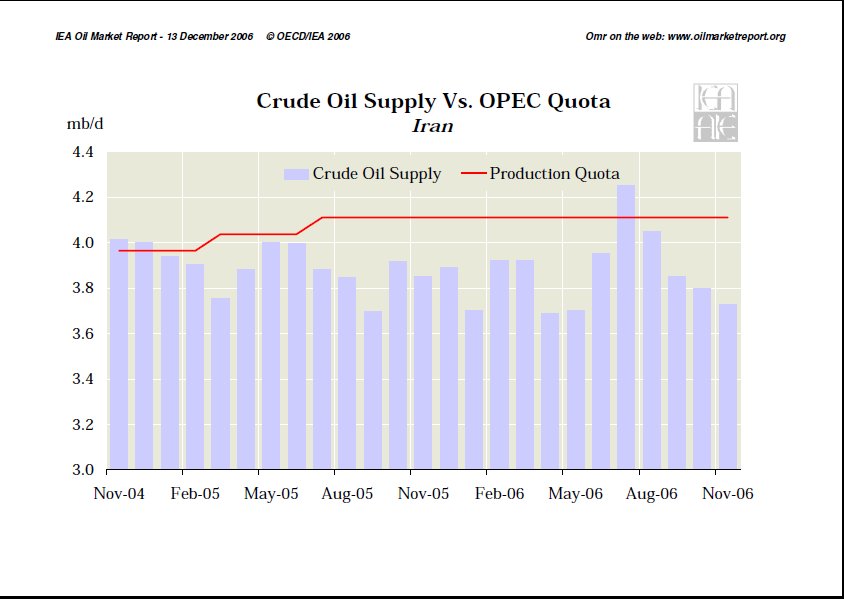
Iran — crude oil supply versus OPEC quota
Figure 3 — Click to enlarge
As far as I know, both data sets pertain to liquids, including NGLs. The dip in November is attributed to oil field maintenance.
What a mess! Generally speaking, it is advantageous to know something about the oil & gas business when discussing it on NPR. Let's now turn to the main theme — the geopolitical outcome of Iraq's civil war, Iran's strategic position, the role of the United States and the Saudi Arabian reaction to these unstable factors.
Geopolitical Analysis & Saudi Arabia
Now that we have a pretty good understanding of the pressures Iran is under, it is time to ask: What would you do if you were Iran's leadership? Here is the situation, which is presented as accurately as possible, keeping spin to a minimum. Earthshaking geopolitical events affecting the oil supply from the Middle East are indeed possible in the next few years. That the oil markets have decided to ignore the dangers there for the time being does not make the dangers any less real.- Iraq is a failed state. The Sunni/Shia civil war proceeds apace. The Iraqi government will collapse once the U.S. starts the inevitable withdrawal of its troops. There is little popular support for the occupation in America. The Kurds have carved out a de facto independent state in the north, along with a separate oil policy. The planned oil law to allow exploitation of Iraq's oil resources by foreign companies is surreal.
- Iran is enriching uranium and, if left alone, are likely a decade away from being a full-fledged nuclear power. The U.S. and Israel will never permit that to happen, but the outcome is well down the road at this point. In the meantime, Iran will have less and less ability to finance their economy through oil export revenues. The U.S. is waging economic war on Iran which affects their ability to put new oil production onstream. As the major Shia power in the Islamic world, Iran wields great influence in other Shiite regions including Iraq, where a retired four-star general told Seymour Hersch that Iran could take Basra with "ten mullahs and one sound truck".
The Iranian "nuclear threat" is overblown, a red herring. It has been used politically in the U.S. by neoconservatives to create another external enemy in the "Axis of Evil". A bomb is many years away and, in any case, the Western powers would never permit it. Other attempts to explain it also fail. From Stern —
The allure of nuclear power to a regime in such straits [Iran] is obvious. First, Russians are financing the new capacity, something foreigners are increasingly unwilling to do for oil and gas. [Note: — this is false, as shown above]. Second, Russian reactors will substitute for power now generated by petroleum, freeing petroleum for export. Although the prospective nuclear power capacity is insignificant to Iran’s total energy budget, it is part of a larger if ill managed plan to preserve exports. For example, ambitious goals have been set for power generation capacity additions from coal (38), hydro (39), solar, and thermal (40) resources. Just as with petroleum, however, foreign investment in power generation has been inadequate (38). The power generation problem has become so acute has that the unprecedented step was recently taken to partially privatize it....Iran's refineries produce around 30% fuel oil (as opposed to 16% gasoline) and they have large gross exports of this oil grade. Iran's electricity is generated as follows.To summarize, Iran’s claim that its nuclear technology is entirely peaceful appears to be false (insofar as we can judge from the statements of arms control officials). However, the oil export decline we project implies that Iran’s claim to need nuclear power to preserve exports is genuine....

Iran had installed power generation capacity (2004) of
about around 34.3 gigawatts (GW). Of this total, over
three-quarters was natural gas-fired, with the remainder
either hydroelectric (7 percent) or oil-fired (18%). For
2005, Iranian power generation capacity is expected to
reach 36 GW). Source: EIA — Figure 4
Most likely, nuclear power would substitute for natural gas, thus freeing it up for export or EOR. In part, it could substitute (along with coal, etc.) for fuel oil but the potential savings would be relatively small. Therefore, one must look to political reasons for Ahmadinejad's focus on Iran's nuclear capability. As Iran's leadership has basically said all along, it is a nationalistic point of pride cynically meant for internal political consumption to appease the populist conservative base of a leadership propped up by the Islamic Revolutionary Guards. See Iranian presidential election, 2005 for some insights. Because Iran faces the economic crisis created by declining oil export revenues — endangering subsidies — the government's popular support will weaken further (especially among Iran's poor) over the next decade. Hence, the nuclear rallying cry becomes ever more crucial to those in power to solidify that support. Conveniently, declining revenues can be blamed on America, the Great Satan. There is even some truth to the assertion, as discussed above.
Let us now turn to the real issue, which is perceived correctly by Saudi Arabia — Iranian influence in Southern Iraq and in other Shia regions, including the minority population in the Kingdom itself (see Figure 1 at the top). What will Iran really do in the face of declining oil exports? Will they just roll over, or as a friend told me, fade quietly away saying "Oh, well, we had a good run ... but it's all over now." First, this ethnically diverse country is Persia, a country with a very long history. Secondly, de facto control over Iraq's southern oil fields would substitute very nicely for failing future oil exports. Third, fomenting rebellion in Shia Saudi Arabi in the Gulf region would be potentially disruptive to the Kingdom's oil production. It is not unprecedented.
Shia came to occupy the lowest rung of the socioeconomic ladder in the newly formed Saudi state. They were excluded from the upper levels of the civil bureaucracy and rarely recruited by the military or the police; none was recruited by the national guard. The discovery of oil brought them employment, if not much of a share in the contracting and subcontracting wealth that the petroleum industry generated. Shia have formed the bulk of the skilled and semiskilled workers employed by Saudi Aramco. Members of the older generation of Shia were sufficiently content with their lot as Aramco employees not to participate in the labor disturbances of the 1950s and 1960s.Martin Walker (op cit at the top) expresses doubts about the scenario outlined here, stating that "in Saudi Arabia, despite the Wahhabi clerics and their claims of Shia heresy, the monarchy has chosen to conciliate its Shia minority, easing some of the restrictions it had placed upon them." I'll bet they have.In 1979 Shia opposition to the royal family was encouraged by the example of Ayatollah Sayyid Ruhollah Musavi Khomeini's revolutionary ideology from Iran and by the Sunni Islamist (sometimes seen as fundamentalist) groups' attack on the Grand Mosque in Mecca in November. During the months that followed, conservative ulama and Ikhwan groups in the Eastern Province, as well as Shia, began to make their criticisms of government heard. On November 28, 1979, as the Mecca incident continued, the Shia of Qatif and two other towns in the Eastern Province tried to observe Ashura publicly. When the national guard intervened, rioting ensued, resulting in a number of deaths. Two months later, another riot in Al Qatif by Shia was quelled by the national guard, but more deaths occurred. Among the criticisms expressed by Shia were the close ties of the Al Saud with and their dependency on the West, corruption, and deviance from the sharia.
Saudis Adjust Long-Term Oil Strategy (Rigzone, Jan. 10, 2007) describes the reactions of KSA to the possible revenge of the Shia.
Saudi Arabia's growing fear of Iranian hegemony in the Middle East may be driving the world's largest crude oil exporter to prepare a more aggressive long-term political oil strategy that could subvert an Iranian ascendancy, insiders and analysts say.As noted above, an Iranian nuclear weapon by 2011 is not an issue — Saudi fears of an emerging Shi'a crescent is the problem. Let us first dispense with the "spare capacity" argument. There is no possibility that Saudi Arabia could flood the oil market to wage economic war on Iran, which is facing a decreasing edr anyway. Greater Saudi production would make up for Iranian shortfalls within OPEC. Increased Asian demand (China & India) is relentless and could eat up any new oil released to the market. Here, it is off-topic as to whether Saudi Arabia can actually implement their accelerated plans to increase productive capacity. What is important is that they believe they can. In any case, the time frame (by 2011) doesn't work as far as spare capacity in the global oil supply goes.Under a new, accelerated production program, the kingdom could increase its spare oil drilling capacity to at least 3 million barrels a day by 2011, up from around 2 million now. Intelligence experts estimate Iran might have the capability to develop nuclear weapons by then. Additional spare capacity could give the Saudis greater leverage as a political tool.
Iran's alleged aim to develop nuclear weapons and its interference in Iraqi and Lebanese politics and conflicts are feeding fears among the Sunni states in the region, particularly Saudi Arabia, that Iranian ascendancy might tip the balance of power towards a Shi'ite domination of the Middle East.
"Fear of an emerging Shi'a crescent has been reflected in speeches by Egypt's President (Hosni) Mubarak, Saudi princes and clergy, and other Sunni Arab heads of states," says Mordechai Abir, a senior Middle East analyst for Burnham Securities.
That anxiety, along with concerns for domestic security, has spurred Saudi Arabia to boost its defense spending to between $50 billion and $60 billion in the next several years for a major upgrade of its entire military.
The first phase, increasing production to 12.5 million barrels a day from current capacity of 11.3 million barrels a day, has been placed on an accelerated timeline. The second phase - to grow capacity as high as 13.5 million barrels a day by 2011 - is in the planning stage.Influence prices? Not downward. War with Iran? The loss of Iranian (and Saudi) exports resulting from such a war? These are real possibilities. Moreover, the Saudi's oppose any U.S. troop withdrawal — naturally — and are fearful of what may happen later this year or next year in this regard. Still, it appears that anything Saudi Arabia could do by politicizing their oil policy and increasing spare capacity would be too little, too late.With that kind of capacity, the country could be in a better position to influence prices....
By the middle of the year, [Saad] Rahim [Country Strategies Manager at PFC Energy] said, Saudis' spare capacity will be able to compensate for a complete loss of Iranian exports of around 2.5 million barrels a day. "But that essentially soaks up global excess capacity," he said. "So any other disruptions (such as from Nigeria or Venezuela) would really stretch the system."
Shibley Telhami, a senior fellow with Washington think tank the Brookings Institute, said the Saudis are unlikely to use their capacity as a weapon unless they have ruled out all other diplomatic means.
"The Saudis want Iran contained, there's no doubt," said Telhami, "But they're also very worried about war with Iran," not least because it might prompt an uprising from their own Shi'a population.
Conclusion
As the American Iraq quagmire draws to a close, as it inevitably must, the countries of the Persian Gulf region, and their residents, will be left to fend for themselves in a destabilized region. Iran will attempt to take advantage of the situation, given their declining exports and the economic leverage now being applied against them by the United States. I have not touched on the Spring scenario for an Israeli attack on Iran, but that remains a possibility. Such an action would merely accelerate the chain of events outlined here. Iran might even welcome such an attack.
Dave Cohen
Senior Contributor
The Oil Drum
davec @ linkvoyager.com
Contact
- Content: editors at theoildrum dot com
- Tech support: support at theoildrum dot com
License

This work is licensed under a Creative Commons Attribution-Share Alike 3.0 United States License.
I have previously expressed the opinion that if what is going on in the Middle East does not scare the crap out of you, you are not paying close enough attention.
The New York Times described the "best case" in Iraq as something akin to the Spanish Civil War, with the worst case more akin to a world war. I wonder if the Sunni attack on the most sacred Shia shrine might be analogous to the assassination of Archduke Ferdinand? (I have often wondered if the attack on the shrine was actually orchestrated by Iran.)
President Disaster's actions only make any sense if one believes his strategy is divide and conquer. His goal is to keep the Sunni vs. Shia thing going so that al Qaeda is preoccupied fighting Shia thereby diverting resources from attacks on the West. It also makes SA and the other gulf states dependant on U.S. military protection, giving us influence over the disposition of their oil. This strategy, although I think it will be another disaster like 911 and New Orleans, might be thought of as the Revenge of the Americans. My philosophy is if you see a cow pie don't step in it, but others will disagree.
Have to disagree here, President Disaster didn't have a clear plan at all and this is blowback. He's destroyed Iraq, destabilized Pakistan, may well draw KSA into Iraq, and handed the whip to Iran. The gulf is already dependent on the US military, and I doubt al Qaeda are preoccupied fighting the Shia. They're focused on secular Sunni, we did a nice job for them taking out Iraq, and Pervez Musharraf is walking a knife edge. This may all blow up into Shia vs Sunni, but I'm very skeptical that that was Bush's plan -- if only because widespread sectarian war would make the cost of doing oil business in the ME and the price of gas back home prohibitive.
Perhaps the 'death squad' approach was not planned at the outset. But after the initial failure of the occupation, it became Plan B. The so-called 'Salvador option for Iraq' was explicitly announced almost two years ago, in Newsweek magazine, by John "death squad" Negroponte, who helped to engineer similar US-supported death squads in Central America the 1980's. Now perhaps we are getting ready for Plan C.
The war in Iraq can now only be won by those who are willing to be the most ruthless and inflict the most terror on the people. Is the US military willing to take on this role? If not, get out.
Al Qaeda attack on the West will kill maybe a few hundred of us per hit. As long as the IT people have got good back up plans, this will mean very little. An effective attack on some critical target in the Middle East could mean world economic disaster. George Bush should either reinstated the draft and send a hundred thousand troops there or get out and ensure the US gets cured of the oil addiction.
Here is something to keep in mind about the situation in the Middle East (from: http://www.csis.org/media/csis/pubs/sns_military.pdf)
"The Middle East and North Africa are a long-term demographic nightmare. The US Census Bureau estimates that the Middle East is a region where the population will nearly double between now and 2030. The total population of the Gulf has grown from 30 million in 1950 to 39 million in 1960, 52 million in 1970, 74 million in 1980, 109 million in 1990, and 139 million in 2000. Conservative projections put it at 172 million in 2010, 211 million in 2020, 249 million in 2030, 287 million in 2040, and 321 million in 2050."
According to the EIA, the one year increase in Saudi petroleum consumption from 2004 to 2005 was 360,000 bpd (Total liquids, from 1.64 mbpd to 2.0 mbpd)--a 22% year over year increase. And the average Saudi family has something like six or seven kids.
KSA population is forecast to grow by 40%. The state is responsible for providing housing, food, jobs, etc.
WT: Trivia: KSA uses 74% as much oil as India (whose economy is 10.5X larger).
Actually something that the Iranians are doing right is maintaining a very low Total Fertility Rate (1.8 for 2006). They do have a fairly young population, however, which means the actual population won't level off very soon. I suspect that the small family size was 'in the works' already, but the mullahs have helped it along by encouraging people to have fewer children, unlike other areas of the ME.
"the mullahs have helped it along by encouraging people to have fewer children"
Ahmadinejad urges Iranians to have more kids
(Oct 22, 2006)
http://www.msnbc.msn.com/id/10663272/
Ahmadinejad urges Iranian baby boom to challenge west
http://www.guardian.co.uk/iran/story/0,,1929364,00.html?gusrc=rss&feed=1
Every government in Europe is 'encouraging' mothers to have more kids and will give them anything (but enough money or tax credits) to do so. Is Iran's birth rate per mother over or under the replacement rate of 2.1%?
I know that it is difficult for a lot of people to understand this. However, the people running Iran really take their religion seriously and simply don't think the way you seem to.
But the Sunni sect would attack the most sacred Shia mosque?
So, it's okay for one Moslem sect to attack another Moslem sect, but Iran would not orchestrate an attack that would serve its national interest of getting the US out of the Middle East?
Iran's basic interest is stability, same as for most nations. Putting a fist in the tar baby is not their interest. Finding Iran's hand in anything that makes Emperor Bush unhappy is silliness.
The mosque contains the crypts of two of the 12 sacred Imams. For a Shia to destroy this particular mosque would be very improbable. It would be like a Catholic blowing up the Vatican.
westtexas. I really trying hard not to get dragged into this - I speak Arabic and Farsi.
Essentially, you can look at the Shia as being Catholics and the Sunnis as Protestants. The Shia draw beautiful pictures of their most revered saints as you can see by doing a search for Ali bin abi Taleb. The Sunnis do not - because the 10 Commandments forbids it according to their interpretation. There are a lot of other differences of course - mostly tribal/national/racial. I hardly need remind you of the slaughter between Catholics and Protestant during a long period of European history.
Whereas in the USA it is not beyond the realm of the possible that 9/11 was orchestrated by Cheney and friends, and, whereas it is not beyond the realm of the possible that Putin and friends blew up some apartment blocks so as to get elected, similar behaviour is extremely unlikely in the guys running Iran. They are simply not wired up that way. A big part of the problem the USA has in Iraq has to do with imagining that the people there are like the folk back home - they are not. They are very religious/superstitious and anyway even making a suggestion like your would lead to ostracism.
In fact, a lot of people believe that the USA perpetuated the destruction of these holy places as the USA wanted to divide and rule - an old British policy in the area.
I hardly need point out that the creation of uniformed Shia death squads can be directly attributed to the USA - Mr John Negroponte is a bit of a past master at that type of thing by all reports. Furthermore, I note in today's papers that Maliki is asking for heavy weaponry so that the US can go home sooner. More of the same I guess.
Personally, I do not know what to believe about 9/11, the Moscow apartments and the recent poisonings. I took no part and don't know anyone who did. However, I can assure you that the Iranians did not destroy these sacred buildings.
Alfred said:
"I do not know what to believe about 9/11"
If you are not sure that 9/11 was accomplished by Arab terrorists mostly from SA and that perhaps it was just a conspiracy then I can't really take what you say about all rest seriously.
You use the example of Ireland but you submit that the Islamist are different. They don't saw peoples heads off on camera?
I don't buy it. Sorry ,you would have to rewrite history first.
I don't think its wise to trust that fool in Iran with nuclear weapons either.
Check what your scientists in London are saying about the Doomsday clock as of yesterday.
"They don't saw peoples heads off on camera?"
You are just pointing out a cultural difference. Many cultures find any form of execution barbaric.
I did not mention Ireland. The big fight between Protestants and Catholics took place in mainland Europe and engulfed many countries for over 100 years.
Who mentioned Islamists as being different? The fact that you do not differentiate between Islamists (who may be Iraqis or not) and other Iraqis shows how little you grasp of the history and peoples of the region. I wrote that Iraqis are different. Ten per cent of Iraqis were Christian. Now it is much less because of events that the USA triggered. Let me be quite clear about this, the Christians of Iraq are Arabs. Huge numbers of them are now refugees and scattered. Ironically, many have sought refuge in Syria - that other "Axis of Terror". Iraq is their homeland and the occupation of their country has made them suspect in the eyes of their compatriots. I guess that telling the world that one is launching a "crusade" was not a very smart move when one is attacking a country with a sizeable minority of Christians.
Lastly, I am not selling anything. The peoples of the Middle East are survivors and they will be around when most of us are long forgotten. They will outlast artificial societies like the USA and Canada, in my humble opinion.
Personally, I am much more worried about the fool in the Beltway. There are plenty of fools in Iran but they cannot act unilaterally. They are easily reined in by more sensible, experienced and educated people. Is that the case in the USA and UK?
Al have you been splitting acid hits with OH? Iran is the one of if not the most autocratic theocracies in in the world. Since when did the mullahs allow their citizens to practice a free society. You show a true inablity to see the 800 lb. hegemony gorillas in the Iranian room. Do we need to list all the terrorists acts their minions the Hezbollah have transacted. How naive to think that they for a moment would not pervert their religion in the name of seeking more power. To think otherwise would place them above the human race since its inception and they don't even come close to deserving that. Any country that would deny the holocaust and call for the total annihiation of another county isn't getting the benefit of the doubt for not being incapable of any atrocity.
OMG by inference I can speak spanish so I am able to understand freaking Castro,Hugo, Evo, and Daniel. Are you trying to outdo Pete Domenici so Kunstler has to change his mind?
"I did not mention Ireland."
By implication you did since its part of Europe and they are very divided on the issues that tend to be tied in with those two religions. You are trying to nitpick.
They do saw peoples, heads off on video which is released to the various media. We have all seen it.
I've been very concerned since Friday January 13, 1995
http://www.prosefights.org/baltimoresun/shanebowman.htm#buehlerlet
Without this high tech stuff, our legal project would be in SERIOUS TROUBLE.
http://mywebpages.comcast.net/bpayne37/index.htm
Interesting I noted a "senior consultant" to Saudi Arabia's former ambassador Prince Turki, Nawaf Obaid was fired after an explosive op-ed piece in the Washington Post 11/29/06 in which he suggested KSA would have no choice but to defend Sunnis in Iraq if the Americans withdrew.
"To turn a blind eye to the massacre of Iraqi Sunnis would be to abandon the principles upon which the kingdom was founded."
http://www.washingtonpost.com/wp-dyn/content/article/2006/11/28/AR200611...
There are rumors that Nawaf Obaid's firing also had something to do with Turki's resignation.
I don't think I'm going out on a limb here in suggesting that KSA is thinking seriously about raising oil output to destablize Iran. Yes, it would hurt their economy, but KSA views the Shia as a greater threat. Dick Cheney has been to KSA twice in the last month.
Whether they have the resources to do so is as Dave Cohen alluded to, is another question.
Really it is such a quagmire in Iraq that you can some up the situation by stating: If oil prices drop, the US wins, if oil prices stay high, the US loses.
And straight from the horse's mouth:
According to the NY Times:
"A member of the Saudi royal family with knowledge of the discussions between Mr. Cheney and King Abdullah said the king had presented Mr. Cheney with a plan to raise oil production to force down the price, in hopes of causing economic turmoil for Iran without becoming directly involved in a confrontation."
http://www.nytimes.com/2006/12/22/world/middleeast/22saudi.html?pagewant...
Thanks for the link. The article contains nothing that contradicts my own analysis of the situation and much that supports it.
As I hope I made clear, the issue is the power vacuum in Iraq, and only secondarily Iran's confrontational nuclear policy. The Saudis are obviously quite worried about Iran's influence in Iraq after the occupation has ended. As I said, I am not impressed by KSA's ability to deflate the oil price. In order for that to be effective — even if it were possible in the short term — how low would the price have to get to jeopardize Iran's economy?
All oil producers would be hurt by a much lower oil price. From the peak oil viewpoint, our fate would be sealed — if it isn't already.
And I would add that I'm not sure if KSA can raise its oil output effectively now because mainly spare capacity is Arab Light, which has a high sulphur content. Refineries are running at maximum capacity now -- although expansions are coming online, it will take a few years. If KSA increased capacity now, it wouldn't impact the gasoline price, but would cause a huge spread between Arab Light and sweet grades.
Leaving aside environmental concerns, it is obvious to an even semi-objective observer that our dependence on oil, in particular oil from this part of the world, is a policy that can only bring more and greater disaster in the future.
That vested interests and cultural predispositions have not only kept us on our current path of continued dependence but have also consistently prevented even attempting to BEGIN a transition away from oil is a PhD dissertation waiting to be written. Maybe they'll call that dissertation 'Stupid Chimps'.
"...a PhD dissertation waiting to be written..."
The beginnings of which are already set up with "Who Killed the Electric Car"
If this is what we are fighting then I want gasoline at $10.00 a gallon to get Oil Co. and car manufacture's CEO's running scared for thier very lives.
If this movie doesn't make you mad for the lives of our young servicemen and women then you are a heartless SOB.
IMHO this will be some of the worst decision making that the US will pay dearly for down the road.
Iran has had a total fertility rate below population replacement level for years. Their (poorly) planned economy can't supply enough jobs for the population and so not only are people not having children, they are leaving the country in droves. Even Iraq has an economy with a better growth rate than Iran. Maybe I need to read this posting again, but I don't see how the Shia are the big threat you say they are-they can't even take care of the one country they dominate-Iran.
Can you clarify this statement too:
'The Iranian "nuclear threat" is overblown, a red herring. It has been used politically in the U.S. by neoconservatives to create another external enemy in the "Axis of Evil". A bomb is many years away and, in any case, the Western powers would never permit it.
The only Western powers trying to 'not permit' a nuclear Iran are the neoconservatives in the US. How can a nuclear Iran be both a red herring and a real threat that the Western powers (i.e. neoconservatives) are trying to prevent?
There are two issues, Iran expanding and Iran causing problems in Iraq. On the second issue, with Iran's meddling, the US can't move forward in Iraq. According to the think tank CSIS: http://www.csis.org/media/csis/pubs/060406_iraqsaudi.pdf
"According to a senior general in the Iraqi Defense Ministry and a critic of Iran, the Iranians have set up the most sophisticated intelligence-gathering network in the country, to the extent that they have infiltrated “every major Iraqi ministry and security service.” There is also an intelligence directorate that has been set up within the Revolutionary Guard that is under the command of the al-Quds Forces devoted exclusively to monitoring the movements of US and Allied forces in Iraq."
Of no significant consequence.
These are oil and gas commodity economies.
Who controls the populace doesn't matter that much.
Who controls the integrity of the oil pipelines and the integrity of the oil lading points and sea lanes matters ENTIRELY.
Iraq didn't 'ask' for 'protection' from USA.
USA was always going to 'give' it. USA will guarentee Iraqi oil and gas supply integrity, i.e. uninterruptible. In turn, Iraqis will eat; a relative few will eat very well indeed.
Right now, Iraqi bands of brotherhood are sorting out whose band and 'top echelon' will feast.
USA has unilaterally created a 'bilateral' supply agreement with Iraq.
Sure, the details are shaking down (aka 'insurgency', 'resistance', whatever), and they will continue to 'shake down' for some years. Suburban Iraq will never be peaceful; but oil production will continue and expand when final agreement with local 'hoods is reached.
Any idea that USA will quit Iraq is fantasy.
Yes, the 'burbs will be essentially quit. The vast USA bases never will be quit. Well, not until the last drop of oil is produced, anyway.
USA needs Mexico, and it is beginning to fade. It needs Saudi, and is co-dependant with it. It needs Venezuela...It needs its own internal supply, but as it is tanking slowly, can't do much about that.
Iraq is America's guarantee of a 'fairly goodish' oil supply going forward.
USA still don't have a realistic 'Plan B' for fading oil economy - but then, neither does anyone else.
I congratulate USA's foresight in securing one of the largest - if not THE largest - bilateral long term oil supply 'agreement' that has ever been 'secured'.
The *real* measure of USA will be what they will do with the slightly increased time USA has bought itself.
Lorenzo
Thank you for your words of congratulations, Lorenzo. This stuff doesn't come easy, it takes a lot of hard work by a lot of people. We would like to thank our mother, Great Britain; without her encouragement, we wouldn't be here. Australia, Spain, Italy-thanks for believing in us. A shout out to Canada and Mexico, we laughed, we cried, we did NAFTA. Of course, we have to thank France--the Seige of Yorktown, the Ardennes--we go way back but pick up the phone and call already! Got the Statue of Liberty you sent-looove it! There are many others I am forgetting, but thank you all.
Why, we'll pizz it away just like we did the rest of it.
Actually Iran's population growth rate is 1.1% according to the CIA Worldfactbook. US's is 0.91%, Germany is slightly negative.
When I was last in Iran, in 1980, the population was around 35 million. It is now 70 millions. That gives me a growth rate over this period of around 2.7% per year according to Excel. More than 2/3 of the population is under 30. To put things in perspective, it was around 10 million in 1900.I agree that the mullahs started belatedly teaching birth-control and making the tools (no pun intended) available. This has led to a drastic reduction in population increase.
However, the arthmetic of population growth are well understood. Even if all youngsters were to have only 2 kids per couple, the population would continue growing for decades to come. The only way to avoid that is to implement the Chinese approach.
Ireland went from having Europe's oldest population to youngest and most rapidly growing in one generation, and to having lower than replacement of 2.1 children per mother in another generation. Things change. Iran's population grew rapidly, but are they still having 4 children per mother?
America's population is only growing because of immigrants, immigrants having children, and to a lesser extent immigrant's children having children. Population growth among pre 1965 population is southerners, blacks, and american indians. Well, some Orthodox and Mennonites, too.
Total fertility rate and growth rate are two different measurements. Your total fertility rate can drop below ~2.1 and your population will still grow as long as the population is of child bearing age (think baby boom echo). BUT, have enough years of a total fertility rate that is below replacement and your population will age and then start to decrease. Total fertility rate and population growth rate are related but not the same thing. Google around and you will find a better explanation than the one I just gave.
My point is that the low TFR, high emigration rate (especially the smart ones), reduced oil export, poor economic performance etc. points to a decreased influence in the world in the future. This is the Oil Drum so I suppose I should end with some kind of dark cloud for this silver lining, so here goes: With all of these problems, Iran will lash out in dangerous and unpredictable ways in the future. This could be the end of the world.
Iran will get the bomb. There is nothing anyone can do about that, except pre-emptive nuking. It will not be very dangerous. And it makes sense, from Iran's viewpoint. In the east, China, India and Pakistan have the bomb. In the North, Russia has it. In the west, Israel has it. In all other directions there is a certain army, that also has it, and that doesn't like them. The only remarkable thing is that they stay so calm about their situation..
I think the "overblown" comment is in reference to estimates by intelligence services and the IAEA that Iran is, in the best case scenario, at least 5 years away from creating a nuclear weapon. This has been plastered throughout the major news outlets (New York Times, Newsweek, The Economist, etc.) for the past year, but no one seems to read it...
Are you an idiot? The US has had a fertility rate under replacement (substantially so among whites) for more than thirty years, and so have all rich countries. Does that mean they all have poorly planned economies that can't supply jobs for the population?
Perhaps you, Fraudy Nutter, Hoosegow and Jack-ass should form your own think tank.
How naive by inference Russia which would parallel your economic and population argument wouldn't have been much of a threat either. Seems to me for over 45 years they violated and oppressed Eastern Europe and caused a whole load of trouble in Korea, Vietnam, China, Cuba, and Afganistan to name a few.
If Iran only wanted nuclear power they could have it the fact that they wish to enrich is the 800 lb. gorilla and indicates they want to proliferate.
This is such a mess I hate to even comment on it. It could be that the KSA is trying to increase production for a number of reasons, to fight declines, also so that in the event of an inevitable war with Iran they can stabilize the market somewhat. That is assuming they themselves are not disrupted by a war.
A war would be good for the PTB in D.C. because of all the arms they could sell and all the oil they could exploit from Iraq. What I don't understand is this whole Bush-Miliki thing. Miliki isn't trustworthy, and Bush should know that. Why is Bush giving him control? If anything it would make sense to back Talabani. This thing is so intricate and muddled, it doesn't make sense. I think that must be what they are shooting for.
I heard the KSA oil minister talking on a video, he must have used the phrase "the market" fifty times in the press release. I have a sneaking suspicion that SA may be manipulating the oil futures market down with their money. Go figure. They sure aren't surprised by the price decline. [/tinfoil hat]
What? The world's largest oil exporter manipulating oil prices? And...(gasp)..profiting from the futures markets?
I am shocked! Shocked! [/ straw boater hat
Sell, sell, sell, sell, sell! Eddie Murphy, Trading Places.
Move Oil price down - Phase II.
Phase I was the agreement with Bush Sr and KSA I believe during Reagan's reign. Bankrupt Russia.
This time move it down to strap Iran.
Worked Once.
(Oh, also the first time they also moved Gold down with the help of Canada selling huge amounts. Gold and Oil were Russia's hard currency makers back in the 80's I believe)
That's how it looks to me.
This time it's tougher.
Demand:
- China and India
- Middle East Growth, North Africa, FSU
Supply:
- 3 of 4 giant oil fields peaked (maybe 4 of 4)
- KSA has less surplus capacity
Other complications: Middle East is not very wealthy now vs early 1980's:
From: http://www.csis.org/media/csis/pubs/sns_military.pdf
“Oil wealth” has always been relative, and can no longer sustain any country in the region except for Qatar, the UAE, and possibly Kuwait. The present boom in oil revenues has greatly eased the financial pressures on many oil-exporting states, but such developments are cyclical and uncertain. Real per capita oil wealth is now only about 15%-30% of its peak in 1980. For example, Saudi Arabia’s per capita petroleum exports in 2002 had less than one tenth of their peak value from $24,000 in 1980 to $2,300 in 2002.
• In spite of decades of reform plans and foreign aid, there are no globally competitive economies in any of the MENA states
Far too many countries have a sustained debt and budget crisis. Most states already cannot afford many of the expenditures they should make or have national budgets under great strain.
And here is where things start to get crunchy. KSA has to support the 4,000 princes plus it has to support (find jobs, feed, house, build infrastructure for) a rapidly growing population, a population that looks down on the jobs performed by a large population of guest workers. And KSA has at the same time to increase its arms purchases and also increase oil field CAPEX and they have to do all this in the face of a declining price for oil which represents their only source of national income.
Suppose Yergin is halfway correct. Suppose the ethanol, PV, windy future comes into focus and folks buy bicycles by the bucketload and move back into urban centres and rediscover the sweater. How many years would it take before KSA blew itself apart due to internal stressors?
Repeat post
Sigh.
This is myth, not history.
Documented in the book: Victory: The Reagan Administration's Secret Strategy That Hastened the Collapse of the Soviet Union http://www.amazon.com/Victory-Administrations-Strategy-Hastened-Collapse...
The die was cast years ago with "the peaceful atom" program. If fission was not an acceptible way to make power for civilians, the only purpose for a fission plant would be research or making bombs.
Recommended book - "The Shia Revival" by Vali Nasr (W.W. Norton - 2006). Very well written and covers a lot of ground. (Nasr teaches at the Naval Postgraduate School.) Although there is nothing about oil in the book, provides a good understanding about why both sides hate eachothers' guts.
A great book on how the Shia historically see the Sunni is Frank Herbert's "Dune". The sci-fi part is just a veneer.
Davet,
Great book but it has been a while since I read it. If I remember right, there were some dirty desert denizens with eyes that glowed. They were poor but fought really well. And then there were the rich dudes that built palaces. Right? If this is right, which are Sunni and which are Shiite?
The good guys (desert dwellers) are the Shia, their leader Paul something-or-other the Hidden Imam returned from Occultation, coming, as he does, from a green, water-filled planet which is basically a desert-dweller's concept of Paradise in the Heavens. Many of the ideas (such as the Doctrine of Dissimulation) are taken straight from Shia history, and while the desert dwellers (I want to call them Fremen, but I may be thinking of something else -- it's been a while) may be dirty and downtrodden, they will prevail since they are pure of heart.
The bad guys are an amalgamation of the Sunni caliphate, historically Ummayad, Abbasid, and Ottoman, but to the Shia all are unimaginably wealthy, powerful, arrogant, and fatally decadent.
Your memory is pretty good:
http://en.wikipedia.org/wiki/Fremen
Furthermore, the "Muad'dib" --- (of course, meant to be the Mahdi) --- defeated the corrupt caliphs with a fanatic army and the aggressive use of nuclear weaponry.
And by doing so they obtained complete control over the stupendously valuable natural resource which was critical to transportation and held hostage the economy of the galaxy and even the fleet masters.......
quite an uncomfortable parallel, no?
There were nukes in Dune, but I recall Fremen/Atreides army using "weirding modules" - sound weapons - against the "lasbeams" of the Sardaukar.
Hmm, Sardaukar ... elite units drafted by devshirme and brought up in seclusion to be totally devoted to the Emperor and unused to defeat. Sounds just like the Ottoman Janissary Corps! In their heyday they were feared throughout Europe and the Middle East, and lost only one major battle -- to Timur the Lame (aka Tamerlane) at Ankara in 1402.
This sunni/shiite conflict is not something I claim to have any personal knowledge on.
But for what it's worth, I do recall an article written a few months ago by Universtity of Michigan Middle East expert, Juan Cole, which claimed that throughout most of history the sunni/shiite split rarely resulted in actual armed conflict and that on the rare occassions it did, it was usually little more than localized tribal squabbles.
In Iraq, at least, the tensions between Sunnis and Shiites began to intensify only when Saddam came to power and started giving all the power and all the goodies to his cronies who just happened to be Sunnis. Then it sort of became like the situation between the protestants and catholics in Northern Ireland.
Juan Cole's contention is that the fundamental nature of this conflict has been way overblown by the media and is not supported by the historical record. Again, I'm just repeating what professor Cole has said.
There of course is a bloody civil war taking place in Iraq, but professor Cole's point is that this is the result of relatively recent developments rather than centuries-old deep hatred.
Cole is probably right (with exceptions). Mostly the Sunni were vastly more powerful than the Shia, and the later Shia Imams were effectively under house arrest. After the twelfth Imam, the office was extinguished (to Twelver Shia, the twelfth Imam went into "Occultation" and will eventually return to lead the faithful to victory over the Sunni. In fact he was probably poisoned by the Sunni authorities. But not all Shia are Twelvers -- there are Fivers, Sixers, Seveners ..., depending on when they believe the Imam either went into Occultation or formed a new line, though most modern Shia are Twelvers. Non-twelvers are often known by other names: the Yemeni Zaidi are IIRC Fivers, the Ismailis aka the medieval Assasins were Sixers (? it's been a while), the Druze are Ismaili offshoots, etc. BTW, the reason that Iran persecutes the Bahai with special vehemence is that the Bahai are followers of one who essentially claimed to be the Imam returned from Occultation and who basically told the Shia authorities that they had gotten it all wrong) Anyway, the Shia were seldom powerful enough to challenge the Sunni except in peripheral tribal fights.
But there are exceptions. The reason Iran is Shia is because Shiism was largely established there by the Safavids, who made it the state religion. The Safavids might genuinely have been Shia by conviction, but it certainly helped to define them in opposition to the Ottomans on the West and the Uzbeks to the Northeast (it probably also helped that they were Persians while both of their powerful neighbors were Turkic). They did engage in many battles with the Ottomans and the Uzbeks, occasionally even winning. Eastern Iraq, including Baghdad, was repeatedly conquered and lost by and to the Ottomans and Safavids, which is why modern Iraq has such a high Shia population. But these wars were political and not religious.
It's good to see someone here knows some history.
Being vulnerable on the oil exports front — the nuclear issue being mostly moot, at this point — Iran must use whatever leverage it has. My point is that the raging Shia/Sunni conflict in Iraq can be exploited by Iran to its advantage. Also, responding to the comment you have replied to, I would like to read this Juan Cole article. Link? In any case, the Iraqi Shia in the South have close ties to Iran.
juancole.com
Professor Cole is a cautious and conservative academic. He frequently cites his many family connections to the US military. Since getting steady gigs at NPR and other MSM outlets he has become even more careful about what he says.
There are times when basic knowledge is radical.
We certainly live in times when Power finds Ignorance a Virtue.
From where I sit the character writing for the Wilson Quarterly is a fantasist. Much play given to Zarqawi. There was an actual Zarqawi, his legend and his many reported deaths all staged by Rove/Fox/miscellaneous lowlife conmen.
This is all pretty simplistic, speaking of Sunni and Shia, it's like talking about Christians or Protestants and Catholics and acting like they're all the same. The Shia in Iraq are Arabs and the Arab/Persian split is much greater than Sunni/Shia.
It all goes to show why America has absolutely no business interfering, because we're ignorant as all hell and that's what we've created. Don't mistake, it has been the United States that has created the biggest division between Sunni and Shia in Iraq - think about that.
Yes, Iraq and the Middle East were such peaceful places before we showed up. Pleeeasse! Take a look at this site to see the many ways people can divide themselves into 'us' versus 'them'.
http://www.mapsofwar.com/ind/imperial-history.html
Cute animated maps. If that's your evidence the ME is always at war, sorry. There will be changes in the course of 5000 years. Your link makes the ME seem pacific.
Did say Iraq and Middle East were peaceful places before we showed up? I said understand that the US has helped propagate the Sunni/Shia split in Iraq, not the same is it? Understand it.
Is not Pakistan Shia in some portion? The map associated with Dave's article seems to indicate that the border regions at least are Shia. Pakistan has the bomb. How would Pakistani Shia react if they were to see co-religionists under attack by the west?
No, they are a small minority and more numerous in parts of the Punjab, practically absent from NWFP.
But similarly in Yugoslavia, there were authentic, real and nasty nationalists/genocidaires who stoked the fires of this supposedly essentialist hatred and greivances between, e.g. Croats and Serbs and Albanians. Even though in reality it was hardly so much of a problem (as Croats & Serbs frequently intermarried)
I.e. the notion of some ancient hatred and problems were intentionally used by modern-day demagogues who did stir up and cause major sectarian fighting.
In this sense, it doesn't matter whether or not these were actual historical truths---only whether they seemed that way and were useful in propaganda for the contemporaneous wars.
One other wild card in this is China. As noted in the January 22 issue of Time magazine, "In December, China signed a $16B contract with Iran to buy natural gas and help develop some oil fields, and it has consistently joined Russia in refusing to back the tough sanctions against Tehran..." China clearly has an interest in what happens regarding Iran.
Given China's FX holdings, I have to believe that they hold a card that the US doesn't want played if things impact them in the wrong way.
Not directly related to Dave's piece, but for all the amateur analysts out there, google has provided us with very nifty new tool.
http://tools.google.com/gapminder/
The blog, Economonitor, calls it the best chart ever.
THAT IS AWESOME! (sorry for the caps)
I just lost 30 min looking at various plots.
Dear Dave, An excellent piece. Here are just some rough thoughts and reactions. I'll start by saying that I find the current situation in the Middle East incredibly dagerous, demoralizing and grotesque.
Personally I don't believe the U.S. will ever really leave Iraq or the Middle East. The die has been cast. Having a powerful army in the middle of, and controlling access to so much oil is a temptation way too alluring and valuable to walk away from.
Given current projections relating to increasing U.S. and world demand for oil in the coming decades, the Middle East is going to become even more important as the supposed source of most the readily available extra supply.
However, we now come to a tricky problem. According to the Bush/Cheney plan "America's oil" is under the sand and just waiting to be pumped out. A safety net for our way of life. But the current extraction rate is just too low to satisfy our current, and most importantly, our future needs. If oil production in the region has to double in the coming decades we really need to take the whole region by the scruff of the neck and shake it up good. That means massively increased infrastructure investment, greater efficiency, new technology provided and controlled by us, and what really ammounts to something close to a "re-colonisation" of the whole region, or at the very least the instalation of "modern" "democratic" and friendly regimes willing to accept our "help" with their development.
How to do all this in an area of such instability, and after the invasion of Iraq, is going to be a bit of a problem though. One could of course start a massive regional war, using nukes, and simply crush any opposition for decades to come. Access to this enormous oil bounty would be a lot easier in a totally devastated Middle East, with only Israel and the U.S. left standing after the radioactive dust has settled, so to speak. After all it's only these to countries who currently have nuclear weapons and are prepared to use them when push comes to shove.
This is, of course, a very high risk strategy, not to mention; criminal, imoral and just plain wrong! What I'm describing is something pretty close to the logic and morality of the Nazis, who, it will be remembered, were perfectly willing to kill millions in their insane dream of creating a new world in their own ghastly image. Our rapacious thirst for cheap and easily available energy can be compared to the Nazi "need" for "room to live". Is it really appopriate of me to compare George Bush and his neoconservative followers with Hitler and the Nazis? Well, to be frank, I believe it is. I used to think it wasn't, but I've changed my mind, especially as I believe we're gearing up to attack Iran, and heaven knows what that might lead to.
I'm not sure the U.S. as we know and love it, will recover and be recognizable after yet another, illegal, unprovoked and agressive war, only this time with Iran, and ultimately about access and control of oil supplies. It'll be like Caesar crossing the Rubicon and destroying the Roman Republic. Wasn't the Constitution written to stop the rise of a Caesar?
I think Bush is arguably the most dangerous, and certainly the most agressive Western leader since Adolf Hitler. Increasingly he reminds me of Hitler in his Berlin bunker, irritated with his own people, who don't deserve a man of destiny with vision. A man with a direct line to God and ready to do his work. Perhaps the American people need to be saved from themselves by such a Leader and providence? Why don't they appreciate and understand the need for such a man to sacrifice some of them in the eternal crusade against evil for the glory of my God?
But enough of such macabre musings! It would really be a terrible, tragic irony if the great oil prize under the sand wasn't really there at all! If there was only more sand. Start WW3 for a boobie prize!
What a marvelous comment writerman.
For a long time, I've been persuaded that even the W regime could not be so irrrational as to attack Iran. Even a minimal response of embargoing all exports would cause economic pain around the world. They seem to have the potential to close the Straight of Hormuz (40% of world oil exports pass thru here IIRC), they have the potential to attack and destroy Saudi and Kuwaiti oil production/loading facilities.
If that's not enough, they have Russian HARM anti-ship missiles which I understand the US has no counter-measure for (so they can sink US Navy ships and tankers). Then they can potentially let go the leash now restraining the Shia's in southern Iraq, and close supply lines to the occupying US forces overnight. Finally, they have a conventional army that can march into Iraq, and capture the entire occupying US force outright; US forces are deployed in numerous Foward Operating Bases configured to fight "insurgents". They are not configured or equipped to fight a conventional army. See-
http://www.lewrockwell.com/lind/lind111.html
So these are the reasons I've thought "No way would W, or TPTB permit, an attack on Iran".
With the new developments Dave mentions, and your missive, I'm feeling rather more queasy than usual.
I think it's a pretty big exaggeration to say that the current US army in Iraq would easily be defeated by an Iranian Army attack.
Of course it is having problems achieving its objectives thanks to the guerillas, but in an all-out war against Iranian regulars on the attack things are different---that is what the US army is configured for and trained for, not urban guerilla warfare and intelligence.
Many Iranian tanks, in the open, rolling down the highways without air cover?
In such a circumstance, Saudi Arabia would certainly allow its air bases to be used by the US (they did not for attacking Iraq), and perhaps Turkey as well.
It would in some ways be a relief for the US troops, they'd like it if they had a clear idea whom to shoot at.
Ouch. Normally I'd want to invoke Godwin's rule, but I think you're onto something here!
Welcome back, Writerman.
BTW,last April you were all worried that the U.S. was imminently ready to attack Iran, possibly with Nukes. I said "Hooey!" then, and I say it again.
The U.S. is not going to attack Iran any time during the next ten years, and if we do, I shall eat every one of the six hats I own.
I do so like it that we cannot go back and edit out what we have so confidently predicted in the past;-)
Don-
Fair enough point. But I think what prevented the Iran gambit happening then was a revolt in the military, described by Sy Hersch. Bush and crew sacrificed Rumsfeld, but have in the meantime been purging generals -- not just for the surge, but for Iran.
Who would have thought they could ever invade Iraq in face of the worldwide opposition at the time? But they just rolled over it. This tells you something fundamental about Western democracy, or at least its current condition.
Don,
As I noted yesterday, an interesting theory was discussed on MSNBC, to-wit, that Bush/Cheney were building up the Iranian threat, to use it as an excuse for having to redeploy US forces to more secure bases and out of the Civil War (while maintaining a strong presence), i.e., if it weren't for the Iranian interference, Bush/Cheney could have brought peace and prosperity to the Iraq.
A corollary is that they could also blame the Democrats for forcing Bush/Cheney to redeploy. In other words, Iranians = Terrorists. Democrats = Iranians. Therefore, Democrats = Terrorists.
A problem with this theory is that the Saudis will not be happy to see the Shia slaughtering the Sunnis.
Writerman's comments come closest to reflecting my feelings on the matter. Bush (and crew)has more power at his disposal than Hitler, and has nuclear weapons in particular, though not the monopoly they desire. He does not act without support of the elite any more than Hitler did, even though there are divisions and nervousness (but the nervous rarely succeed in unseating the zealot).
Iran's behavior, problems, etc. -- indeed the behavior, problems of the entire Middle East -- are not the deepest issue: the deepest issue is the oil and US determination to control it at any cost. There is a logic to what these guys are doing: it's do-or-die time from their point of view. The empire goes down the tubes without control of the oil -- control meaning not just the right to appropriate but also deny.
To worry about Iranian hegemony would be like worrying about Russion hegemony just prior to the Nazi invasion. I have no idea how the thing will play out, but I see many ways in which disaster might come. In any case there are or will be two carrier groups in the Gulf, traps and provocations are being set. The can only be one end to it. Saddam's hanging tells Iran (and anyone else who noticed) what the stakes are and the value of concession and capitulation. The very scariest part is that these guys are not done with the idea of shock-and-awe. How can that be re-established? We stand at the edge of an abyss in my opinion, at the very gates of hell.
Fully and respectfully disagree with the Shiite /Sunnite vision of the problem. The so called “sectarian violence” is a fictitious creation of those promoting internal divisions to spoil the oil and gas resources with advantage.
Maps showing the Shiite/Sunnite supposedly “areas of influence” are as useful and trustable as to show maps of Catholics/Protestants in Europe to explain World War I or II.
This is a false debate, promoted by the manger and trough Western media (that being fed in the manger and trough of the stables whose owners have REAL interests behind the exploitation of the oil resources and its appropriation for what it rests.
If you look at existing reserves, the fact that most of the remaining trillion barrels left (if any) are in the gulf, has very likely prompted the guzzling countries, specially the Empire, to try to place themselves there.
Your points of view are sometimes alarming and reflect mostly the points of view of the glutton side.
Phrases like “The wild card is China” depict a classical American, worried only because its 23 barrels per capita and year may be at stake; because the “yellow danger” is trying to copy them and aspiring to consume 2 barrels per capita and year. No signs of guilt or self regret. Only seen as potential aggression from the Chinese.
Comments of the sort 'if Islamic Iran is trying to build up an atomic program, is either because they are thinking in building atomics weapons –because they have so much oil- or because they are really running out of oil within few decades'. Nothing to comment about the 20+ nuclear power plants planned by the genocide Sha of Iran with the full support of the Western powers, when Iran was for sure much more self sufficient than today in energy. No one national regret from the commentators on the fact that “we” have the atomic bombs; that “we” have been the only country in using them against civil population and want to keep the exclusivity. Partial and shellfish points of view of a global problem. Or what is probably worst, believing that nuclear power plants may one day replace oil.
It needs a great deal of cynicism to say “Iran expanding and Iran causing problems in Iraq” made by a national whose Army has demolished Iraq, then invaded it and it is still occupying it, with the result of tenths of thousands of civil victims every year, that of course, are automatically charged, without any regret or conscience problem, to the own victims, be them Shiites or Sunnites, accusing them of being violent among them by nature, as if no one will be pushing form the rearguard.
Others, comment that “the Middle East and North Africa are a long-term demographic nightmare”, who knows if to justify later that a wide reaping would perhaps “stabilize” the region and convert the present "nightmare" in a future "dream" (I guess for who).
Conclusion:
Pay a visit to the chart below and check the dependencies of the Middle East; specially the present ones.
Considering that for giants and wild consumerists like Europe, the US, and now the modest but worrying –for the Westerners- Indian and Chinese newcomers, the problem is not 25 million lives in Iraq of 70 million lives in Iran;
considering that a death toll of 3,000 in more than 3 years is quite affordable, for a country that took 40,000 dead soldiers to quit from a country that had no apparent resources, like Vietnam;
considering that the US is the less dependant and the most consumerist of all the big five at present, but that it will certainly be the most dependent of the big five from the Middle East remaining reserves within a decade or two (by then the 90+% of the world oil exports will flow from this region);
considering that the real enemy of a big consumerist is another one big consumerist, rather than a scientifically starved people,
then it is clear why the US is interested in keeping the deception of the Shiite/Sunnite sectarian violence and the Shiite nuclear crescent false debates, and why it could well provoke a sudden closure of the Hormuz Strait for a much longer period than the strategic limited reserves of the giants can afford. This will be a perfect method of eliminating competitors, important competitors, by removing the blood from their veins now, just now. The US can afford today to loose a 12.3 percent of their oil blood and survive. That is their today dependence from this Strait. Look at Japan with a 86.7 percent of dependence; look at Europe, with a 21.5 percent, China, with a 20.6 percent or India, with a 34.7 percent.
<>Columns <>:
Data in MToe/year<>Production<>Consump.<>Export.-Import.<>% Imp.on/ consump.<>Middle East Imp.<>% Imp. on/Total import.<>% Imp. on/ Total consum.
EE.UU.<>310.2<> 944.6<>-634.4<>67.2 %<>-116.5<>18.4 %<>12.3 %
Europe<>252.8<>727.3<>-474.5<>65.2 %<>-156.1<>32.9 %<>21.5 %
Japan<>0.0<>244.2<>-244.2<>100 %<>-211.7<>86.7 %<>86.7 %
China<>180.8<>327.3<>146.5<>44.8 %<>-67.4<>46.0 %<>20.6 %
India<>36.2<>115.7<>-79.5<>68.7 %<>-40.1<>50.4 %<>34.7 %
Russia<>470.0<>130.0<>340.0<>0 %<>0<>0.0 %<>0 %
Source: British Petroleum. Statistical Review 2006. (2005 Data)
Interesting perspective. I do have to quibble with this point: considering that the real enemy of a big consumerist is another one big consumerist, rather than a scientifically starved people
All those countries you list sell each other a LOT of stuff. They are not enemies, they are business partners.
Business partners until stuff starts getting hard to come by.
PPP,
If you had actually taken the time to read my post above vis-a-vis China, my point was that I anticipate China using it's "influence" to preclude any military action upon Iran. I really take offense at your comments using my post.
Todd
Todd wrote:
Apologies, Todd. The mention to the wild card of China I quoted, was certainly out of context.
Keithster 100 wrote:
I agree. The big consumerists are the main enemies among themselves when it comes to real, permanent and growing energy scarcity, rather than the conflict between big consumers and big producers, but small consumers. Big consumerists effectively sell each other lot of stuff and they are all big business partners, but when the very survival of a given society is at stake, because the level they may reach in their oil bleeding rates if Hormuz is closed, the international trade becomes a second priority issue
I've never been one to think that the U.S. purposely stirred up sectarian violence in Iraq. I think the goal of the U.S. invasion was to conquer Iraq and use democratic elections to put a friendly U.S. puppet regime in power. Sectarian violence and civil war run counter to this goal. Now that the policy of installing a, "Chalabi" or an, "Allawi" in power has completely failed, however, and with Bush's recent speech, I'm starting to wonder. I think the main reason Bush is now focussing on Al Sadr is that Al Sadr is an Iraqi nationalist who has repeatedly reached out to Sunnis to try to form a broad, non-sectarian, anti-american alliance. His main goal has always been to drive the U.S. out of Iraq and assert Iraqi independence. He's been very clear about this. You can imagine how hard it is, given the current civil war, to reach accross sectarian lines to attempt to form alliances, but he's had the courage to do it (thus his immense popularity). Of course, Al Sadr and his militia have been caught up in Shia-Sunni violence, but I think it's fair to say that Al Sadr responded to Sunni (Al Quaida?) attacks on Shia, not instigated them. Al Qaida wants sectarian violence in Iraq, Al Sadr wants a strong, anti-american, anti-zionist, Iraqi state. Iran also wants a strong, anti-american, anti-zionist, Iraqi state. Al Sadr and Iran have a lot in common. They both support majority rule in Iraq (yes, the majority of Iraqis are Shia). They both want the U.S. out of Iraq. They both want the Iraqi government to represent the views of the Iraqi people (i.e., very anti-american, pro-iranian, anti-israel, pro-hammas, etc.). Now Bush has pointed to Al Sadr and his militias and Iran as two of the main targets of his new offensive. This obviously isn't an offensive against sectarian violence, it's an offensive against the threat of an independent Iraqi government and those who support it. There wasn't ever even supposed to be an idependent Iraqi government. Chalabi (or similar) was supposed to be in as a puppet. Iraq was supposed to be peaceful and prosperous (just like SA). Exxon and Halliburton were supposed to be all over the place by now and oil production up to 4 or 5 million bpd. No one planned on an insurgency, sectarian violence, or civil war. The point is that Bush didn't want a civil war in Iraq or an independent Iraqi government. Now he has both. If he has to chose between using American military might to try to end the civil war or to try to end Iraqi independence, he will use it to try to end Iraqi independence.
A few notes after re-reading what I just posted:
Some people will probably object to the idea that this Iraqi government is independent. I think we can agree that there are degrees of independence and that the Iraqi government is more independent than Bush would like. Al Sadr represents an extreme of Iraqi independence. He wants the U.S. military out altogther and to engage in cooperative relations with the rest of the region (Iran, Syria, etc.). Bush is trying to correct that.
Bush now wants to equate Sunni insurgents and Al Quaida with Shia militias. There are two important differences. One, the Sunnis started it. Two, the Shia support majority rule (this is called democracy, right?)
Generally a state can't stand on it's own two feet (or even exist for long) unless it has a monopoly on organized violence. So, from the US perspective the militias have to go, or at least be weakened substantially.
Two, the Shia support majority rule (this is called democracy, right?
Not really. Hitler was popular, too. Modern democracies include lots of checks and balances to keep the majority under control. We have the Founding Fathers to thank for that. They were scared shitless that the majority would become a rampaging mob and engineered gov institutions to try to prevent it.
My guess is that the surge is not meant to destroy Al Sadr but to force him to operate within official institutions.
The goal is emphatically a pro-Western state as you say. And it is very intriguing to speculate what might happen if he doesn't play along.
[Al Sadr] wants the U.S. military out altogther and to engage in cooperative relations with the rest of the region (Iran, Syria, etc.)
The US out, of course. But the rest sounds kinda pollyanna. Probably best just to say he's a smart player.
Majority rules is one view of democracy, but it is by no means the only view of democracy.
The United State's closest friend to the north, Canada, is a consociational democracy, as are many European nations. If it were not, it would have torn apart long ago.
Canada is made up of two very distinct and different founding groups, French Catholics and English Protestants. Today, the French component of Canada represents only 28% of the population, but it enjoys equal protection under the law. The majority cannot vote those protections away. This is not a constitutional protection, it is simply how our democracy is set up and understood to operate.
For Iraq to stabilize under anything less than a "strong man," would require a similar system. It isn't easy to create (the founding provinces of Canada were very suspicious of each other), and it isn't easy to maintain. It takes a world view that even many Canadians don't share.
Wake up. Moqtada al-Sadr has been the most powerful man in Iraq since the day US invaded. The pre-eminent Shia leader without contest. And one smart SOB or he'd be dead by now. MSM ignores him or builds him up, doesn't matter. Bush still thinks of him as generic bogeyman. Not.
I agree with you, oilhippie. Al Sadr is the one Iraqi political figure who's done everything right. His credentials as far as fighting off the americans and demanding Iraqi independence are impecable, but he's also managed to very effectivley involve himself in Iraqi democracy and also reach out across sectarian lines. As you say, he will be the most powerful man in Iraq for years to come. He has a lot of balls and maturity for such a young guy, and if the saying, "smarter than he looks," applies to anyone, it's him.
I don't know why you two are starting a AlSadr love fest maybe you can provide me with some reading material on why you think he isn't one of the biggest problems we have in Iraq. The fact that he isn't dead pretty well damns all your U.S. conspiracy theroy's for our manipulation of the political scene in Iraq. He could have been assinated at any time in the last couple of years. IMO he is an Iranian stooge that is causing the deaths of hundreds of innocents all across Iraq. I will agree with you on one thing he must smarter than he looks.
Not a love fest. A reality fest. And while the US is GD f--ing dumb enough to try to off al-Sadr doing that would make the situation even worse.
Does anyone here know how bad Iraq is? There are corpses laying in the street being eaten by dogs. I'll say that again. There are corpses laying in the street being eaten by dogs. Today and every day. The civilized world looks into the faces of those dogs and sees America.
The American defeat in Iraq is complete. For a millenium to come, if you think there is a millenium to come, America will be seen as savage Crusaders, bloodthirsty infidels. Nothing can change that. It does not get better. It is only beginning.
I wrote an on topic generic piece here.
Very good post! Does it matter what decisions are made by the Iranian theocracy next? I don't think so. They will be replaced in the near future.
Below are two more articles relating to Iran.
The first states that the "current Iranian diplomatic offices in Iraq are affiliated to the Iranian Revolutionary Guard, the military body of the Iranian revolution" and "as the majority of production comes from oil wells that have been in service for over fifty years. The main wells will be reduced at a rate of 13% annually; moreover, Iran had not been able to develop its infrastructure in the oil sector and what has been invested there is considered insignificant in comparison to what is actually required"
The second article states that "Oil provides Iran nearly 90% of its budget and 40% of its GDP. To say it is the lifeblood of Iran's economy is an understatement. Without oil revenues, the government might collapse" and "we hope Iran's people take matters into their own hands and get rid of their dangerous rulers".
If Iran does try to become the dominant presence in the middle east then the USA will implement a regime change in Iran. If Iran does not try to become the dominant presence and does not give up nuclear development then the USA will implement a regime change. If Iran does not try to become the dominant presence and gives up nuclear development then due to field decline rates of 8-13%, the economy will go into recession and the Iranian people will implement a regime change.
In other words, it doesn't matter what decisions are made by the current theocratic regime, they will be replaced by either the USA or by the Iranian people.
http://www.ncr-iran.org/content/view/2772/1/
Iranian diplomatic offices in Iraq are affiliated to its Revolutionary Guard - daily
Wednesday, 17 January 2007
By Hussein Shobokshi
Asharq Alawsat daily, January 16 - The magnitude of Iranian interference in Iraqi internal affairs is no longer a hidden secret and it is public knowledge that the current Iranian diplomatic offices in Iraq are affiliated to the Iranian Revolutionary Guard, the military body of the Iranian revolution. As if Iraq does not endure enough frivolity at the hands of the American occupation and the naivety of the Iraqi administration, it also suffers from the sectarian and politicized Iranian interference in the country, adding to the wounds by further bloodshed and agony. Such interference is evident through various forms, from the employment of certain figures to highly sensitive positions to adopting policies that are grave and influential.
In the past, a number of figures that were considered members of the Iraqi Dawa Party have enjoyed the support and protection of Iranian authorities during the rule of Saddam Hussein. Among the most prominent of such figures are Abdul Aziz al Hakim, Nuri al Maliki and Ibrahim al Jaafari. Nevertheless, Iranian surprises in Iraq continue one after another. Recently, Sadeq al Musawi, the senior media official of the Iraqi government admitted that his real name is Tariq Hisham Matar and that he submitted a request for Iraqi citizenship in 2004. Furthermore, there are rumors of another official in the current Iraqi government whose real name is Karim Shahburi and that the real name of one of the officials who attended the execution of Saddam Hussein is Ali Yazdi.
The policy of interference in Iraq in particular and in many other countries in the region in general is supported by the current status of Iran as a result of revenues from the rise in oil prices. However, these prices are in continuous decline and the imminent economic disorder is not confined to this factor only. There are a number of pivotal and substantial points that will play a noticeable role in the economic future of Iran. The most prominent of these points is the sharp decline in the rates of oil production as the majority of production comes from oil wells that have been in service for over fifty years. The main wells will be reduced at a rate of 13% annually; moreover, Iran had not been able to develop its infrastructure in the oil sector and what has been invested there is considered insignificant in comparison to what is actually required. In turn, this increases pressure on Iranian politicians as well as on those who export its ideology who feel the urge to intensify their presence in regions of influence. The opening for economic opportunities, which enables Iran to have more influence and increase authority for its allies, has become limited and dependent upon the price of oil. Iran has a project in the region. Its basic project is to transform the Middle East into a place where its ideological and cultural project can be spread, whether through an Iraqi government that will be completely subjected to Iran as its main religious reference, or through ardent organizations in other parts of the world that play the role of “the dissident partner” to strengthen Tehran’s influence in the region.
There comes one image after another and information after information that emphasize the magnitude of Iranian ambitions in the region and it is visible that it supports resistance and the nuclear project. However, its distinct signs that cannot be ignored are the seditions in Palestine and Lebanon, sectarianism in Iraq, interference in Bahrain and Sudan, and occupation in the United Arab Emirates.
AND
http://www.investors.com/editorial/editorialcontent.asp?secid=1501&statu...
The Circle Closes
INVESTOR'S BUSINESS DAILY
Posted 1/17/2007
Axis Of Evil: Through a mix of economics, diplomacy and the threat of military action, the U.S. has tried to isolate Iran's ruling mullahs. It seems to be working.
It was clear in the speech President Bush made last week: The U.S. will not let Tehran interfere in the affairs of Iraq. Nor will we let it build a nuclear weapon. The only question was: Apart from ratcheting up the rhetoric, could Bush make the threat stick? Turns out, maybe he can. Several developments this week show Bush is quite serious about turning up the heat. The mullahs are looking pretty lonely.
On Tuesday, after meeting with Secretary of State Condoleezza Rice, America's six allies in the Persian Gulf (yes, we have some) approved Bush's new Iraq strategy. So did Jordan and Egypt. This was a clear diplomatic defeat for Iran, since the meeting's official communique criticized nations that meddle in Iraq's domestic affairs — a not-so-thinly-veiled reference to Iran and Syria.
Then on Wednesday, new U.S. intelligence chief Robert Gates traveled to Saudi Arabia. Clearly, the U.S. wants the Saudis on board for what is under way in Iraq and what is planned in Iran.
It makes sense: The Saudis and Iranians are longtime enemies, coming from different cultures and branches of Islam, and the Saudis fear what might happen to their kingdom should Iran get the bomb. They are aware that the mullahs may not use it just to annihilate Israel, but to settle old scores with some of their neighbors.
All this took place as the U.S. prepared to confront Iran militarily. We noted last week that the U.S. already has launched a number of attacks on Iranian cells in Iraq, nabbing a handful of terror planners in the process.
Bush is also sending a second battle-carrier group, led by the USS Eisenhower, to the region. This week Britain announced it would chip in, and now it has several minesweepers steaming toward the Gulf. Get the feeling something is afoot? So do we.
With the almost 20% drop in oil prices, we also have been wondering why Saudi Arabia suddenly has become so dovish — actually saying, in the face of recent price declines, that it has at least 3 million barrels a day in spare capacity it can dump on the market.
Perhaps not coincidentally, that's about how many barrels Iran sells on the world market each day. As oil nears $50 a barrel, the Saudis' comments make sense only if one supposes they want to punish Iran — where oil output has been dropping sharply, and which desperately needs hard currency from oil sales to buy weapons and nuclear know-how.
Remember: Oil provides Iran nearly 90% of its budget and 40% of its GDP. To say it is the lifeblood of Iran's economy is an understatement. Without oil revenues, the government might collapse.
The people of Iran are already angry at their fundamentalist rulers for increasing food shortages, a lack of housing and jobs, soaring prices and growing repression. Despite the threat of a crackdown, criticism has started coming from all sides against President Mahmoud Ahmadinejad.
As Bush continues to pressure Tehran, we hope Iran's people take matters into their own hands and get rid of their dangerous rulers. If not, the U.S. and its allies look to have tools at their disposal to make Iran behave.
Your USA can't implement a damn thing.
What on earth would Iran gain by nuking the Saudi's, or for that matter, Israël?
Disagree here. The US may want to implement regime change, but actively doing so will only strengthen the current regime. We have burned so much political and moral capital there's no way we'd succeed. If we really want to see regime change there, we'd stay out of their business, and let them fall by their own shortcomings. Making such strong public statements during their last election only strengthened Ahmadinejad's and Khamenei's hands.
All interesting comments--I'd add one more line on Iran. Considering the importance of oil to its economy, its current demographic situation (roughly 30% unemployment for those between the age of 20-30), and the its internal political friction between the ruling theocracy and more moderate elements, the Iranian leadership needs external conflict just as bad as the politicians in America do. I'll offer an untestable hypothesis (i.e. non-scientific):
H1: This does not bode well.
Of course, and they know where the throttle is: need more conflict --> say something nasty about Israel; need less conflict --> invite inspectors to control nuclear programs.
Congratulations Dave, a great post with sound research behind it.
I just want to say that for the last centuries there haven’t been major expansionist movements from what is now Iran. Although political influence might grow, I do not expect military movements towards neighbouring regions. I believe something like the support given to Hezbollah, favouring other local religious institutions, will be the major line of action.
Hello Dave Cohen,
IMO, Absolutely essential reading--terrific keypost! Care to comment on Iran's Pres. Ahmadinejihad recent trip to visit Venezuela's Chavez?
My guess is that he initially was trying to get Chavez to decrease exports to the US to counter the pressure that the US is putting on Iran. I think this idea was a no-go from the get-go because Chavez needs the income to keep his populist programs going.
Failing that, he probably asked Chavez to stop US exports completely if Iran is attacked by the US. Chavez might do that, because if the US is busily engaged in the ME, the US cannot attack him, and he would have no problem selling for TOP $$$$ the oil to China, Japan, Europe, etc.
In the eyes of his Venezuelan countrymen: Bush attacking Iran would confirm Chavez's well-reported warning of smelling sulphur from the UN podium that Bush earlier used. Also, I don't think even Bush & Cheney want the world to suffer that much from BOTH the ME & Venezuela being OFFLINE at the same time; the US can live off the SPR & domestic production for awhile [if cutoff from Chavez's crude], but China, Japan, etc would truly freak if Venezuela was gone too.
Not sure at all how Ahmadinejihad could enlist Chavez's help against KSA in a ME Sunni-Shia hostile outbreak. US Navy would never allow Venezuelan tankers to resupply Iran if KSA attacked Iran's FFs' infrastructure. Chinese navy and air force too weak to be a bluewater threat to the US & NATO forces; China couldn't come to Iran's aid unless they marched overland--but once they did, Sunni-Shia conflict will be a minor problem-->everything would then move to a global nuclear staredown over FFs--too frightening to contemplate.
My guess is that Russia, due to their self-sufficiency, would be neutral in a Sunni-Shia outbreak, but would rapidly escalate if it thought the US or China were rapidly moving to the endgame of the Grand Chessboard. Three player [or more] geopolitical chess is too complex for me.
Bob Shaw in Phx,Az Are Humans Smarter than Yeast?
It is interesting and hopeful to see the change in sentiment expressed by our American friends here at TOD. I remember it wasn't so long ago, just a few years, when such sentiments could not be raised. There was a "political thought censorship" prevailing in America. You were either "with us or a traitor."
Vocal opposition to government policy is not a right, it is a responsibility. Here in Canada our system of government consists of the Government and the Loyal Opposition. The opposition is loyal to Canada but opposes even the best legislative proposals because debate makes good laws better, and bad laws palatable.
The recent Democratic win, and the new sentiment in the US, has helped the American people to remember that loyal debate is a right and a responsibility. When fear masked as patriotism suborns that responsibility, the right can quickly be lost.
As to a war with Iran, I don't know. We are not politicians and the best we can do is hope and speculate.
As for the view from the ME, in today's Al Jazeera headline, Bush’s Gulf War IV strategy!!!, there is clearly a lot of mistrust. These are very delicate times.
Two words I didn't see in this thread, (but I just skimmed):
DEPLETED URANIUM
We're turning Iraq, and the ME, into a radioactive waste dump. The region will simply not be habitable much longer. And those radioactive particles don't stay there, ya know...
Discussing the ME without including the effects of DU is like discussing the Iraq War without even mentioning oil.
Rather than just reposting this same comment in every thread, relevant or not, why don't you address the earlier relpies that said your facts are wrong?
http://www.theoildrum.com/node/2195#comment-149702
Hello TODers,
This thread, started by Dave Cohen, has probably now gone stale, but for what it is worth:
http://news.yahoo.com/s/csm/20070118/wl_csm/osaudishia
-----------------------------------------------------------
Saudi Arabia casts wary eye on its Shiites
Sadek al-Jubran says he's all too familiar with fatwas that declare him an infidel.
As a member of a religious minority in a country without religious freedom, Mr. Jubran grew up with discrimination. It's something Shiites like him have regularly faced in this conservative Sunni-ruled kingdom - in the streets and at school, in courtrooms and at the office.
Over the past decade, however, Shiites have managed to gain a larger stake in Saudi Arabian society. They've seen incremental reforms, getting elected to local councils and being allowed to observe religious holidays openly.
But now, many worry that their steady progress is being checked. With a Sunni-Shiite cold war descending on the region, Saudi Arabia appears to be hardening its sectarian battle lines. That, experts say, could mean that it once again will regard its Shiite minority, mainly clustered in eastern oases like this one, solely as enemies of the state.
---------------------------------------------
Bob Shaw in Phx,Az Are Humans Smarter than Yeast?