


Our World Is Finite: The Implications of Resource Limitations
Posted by Gail the Actuary on October 24, 2007 - 10:00am
We all know the world is finite. The number of atoms is finite, and these atoms combine to form a finite number of molecules. The mix of molecules may change over time, but in total, the number of molecules is also finite.
We also know that growth is central to our way of life. Businesses are expected to grow. Every day new businesses are formed and new products are developed. The world population is also growing, so all this adds up to a huge utilization of resources.
At some point, growth in resource utilization must collide with the fact that the world is finite. We have grown up thinking that the world is so large that limits will never be an issue. But now, we are starting to bump up against limits.
What are earth's limits? Are we reaching them?
ED Note by PG: Note that this is an updated version of an article that was run about six months ago. With all of the new folks (Welcome!) around, it seemed like a good time for an article like this. We appreciate your sharing this and all the work here at The Oil Drum with the people you care about.
1. Oil
Oil is a finite resource, since it is no longer being formed (at least in any meaningful quantity). Oil production in a given area tends to increase for a time, then begins to decline, as geological limits are reached. Oil production in the United States has followed this pattern (Figure 1).

Oil production in the North Sea (Figure 2) has also followed this pattern.

The declines in both the United States and the North Sea took place in spite of technology improvements. There is now serious concern that world oil production will begin to decline ("peak"), just as it has in the United States and the North Sea.
The US Government Accountability Office studied this issue, and issued are report in the spring of 2007 titled CRUDE OIL: Uncertainty about Future Supply Makes It Important to Develop a Strategy for Addressing a Peak and Decline in Oil Production. The US Department of Energy also asked the National Petroleum Council to look into this issue. Its report, Facing Hard Truths about Energy, further confirms the importance of this issue.
Exactly how soon the decline in oil production will begin is not certain, but many predict that the decline may begin within the next few years. There is even some evidence that the decline may have begun in 2005.
Even if oil production were not to decline, but simply remain level, there is sufficiently strong growth in demand that the shortfall would be a serious issue. Matt Simmons talks about this issue in his talk at the Houston meeting of the Association for the Study of Peak Oil. Also, a recent report called Lighting the Way: Toward a Sustainable Energy Future by the Interacademy Council states:
Overwhelming scientific evidence shows that current energy trends are unsustainable.
2. Natural Gas
Natural gas in North America is also reaching its limits. United States natural gas production reached its peak in 1973. Each year, more and more wells are drilled, but the average amount of gas produced per well declines. This occurs because the best sites were developed first, and the later sites are more marginal. The United States has been importing more and more natural gas from Canada, but Canadian production is beginning to decline as well. Because of these issues, the total amount of natural gas available to the United States is likely to decline in the next few years - quite possibly leading to shortages.
3. Fresh Water
Fresh water is needed for drinking and irrigation, but here too we are reaching limits. Water from melting ice caps is declining in quantity because of global warming. Water is being pumped from aquifers much faster than it is being replaced, and water tables are dropping by one to three meters a year in many areas. Some rivers, especially in China and Australia, are close to dry because of diversion for agriculture and a warming climate. In the United States, water limitations are especially important in the Southwest and in the more arid part of the Plains States.
4. Top soil
The topsoil we depend on for agriculture is created very slowly - about one inch in 300 to 500 years, depending on the location. The extensive tilling of the earth's soil that is now being done results in many stresses on this topsoil, including erosion, loss of organic matter, and chemical degradation. Frequent irrigation often results in salination, as well. As society tries to feed more and more people, and produce biofuel as well, there is pressure to push soil to its limits--use land in areas subject to erosion; use more and more fertilizer, herbicides, and pesticides; and remove the organic material needed to build up the soil.
Are there indirect impacts as well?
Besides depleting oil, natural gas, fresh water, and top soil, the intensive use of the earth's resources is resulting in pollution of air and water, and appears to be contributing to global warming as well.
Can technology overcome these finite world issues?
While we have been trying to develop solutions, success has been limited to date. When we have tried to find substitutes, we have mostly managed to trade one problem for another:
Ethanol from corn
Current production methods usually require large amounts of natural gas and fresh water, both of which are in short supply. Increasing production may require the use of land which has been set aside in the Conservation Reserve Program because of its tendency to erode. The amount if ethanol produced is tiny compared to our fuel need, but still drives up the cost of all types of food.
Oil from oil sands and oil shale
Oil from oil sands requires large energy inputs, currently from natural gas, as well as fresh water, and creates pollution issues. Oil from oil shale is expected to require even more energy and fresh water.
Coal to liquid and coal substitution for natural gas
"Clean coal" and sequestration of carbon dioxide from coal are not yet commercially available, and are expected to be very expensive if they become available. Thus, coal production is likely to exacerbate global warming and raise pollution levels. If coal is used to replace both oil and natural gas, it is likely to deplete within a few decades, like the natural gas and oil it replaces.
Deeper wells for fresh water
If deeper wells are used, they will requires more energy to pump the water farther. In locations that use aquifers that replenish over thousands of years, the available water will eventually be depleted.
There are a number of promising technologies — including solar, wind, wave power, and geothermal — but the amount of energy from these sources is tiny at this time. Nuclear power also seems to have promise, but has toxic waste issues and is difficult to scale up quickly. A general introduction to alternative technologies is provided in What Are Our Alternatives If Fossil Fuels Are a Problem?
What if we don't find technological solutions?
We can't know for sure what will happen, but these are some hypotheses:
1. Initially, higher prices for energy and food items and a major recession.
If the supply of oil lags behind demand, we can expect rising prices for oil and gasoline and possibly other types of energy. Prices for food may also rise, because oil is used in the production and transportation of food. Recession is likely to follow, because people will cut down on their purchases of discretionary items, so as to be able to afford the necessities. Layoffs will follow. People laid off will find it difficult to pay mortgages and other debt, so banks and other creditors will find themselves in increasing financial difficulty.
2. Longer term, a decline in economic activity.
With fewer resources, economic activity is likely to decline. We will need to find replacements for many products in a relatively short time frame — heating fuel, transportation fuel, plastics, synthetic fabrics, fertilizer (currently made from natural gas), and asphalt, among other things. Living standards are likely to drop, because we don’t have infinite resources for replacing all the things that are declining in availability.
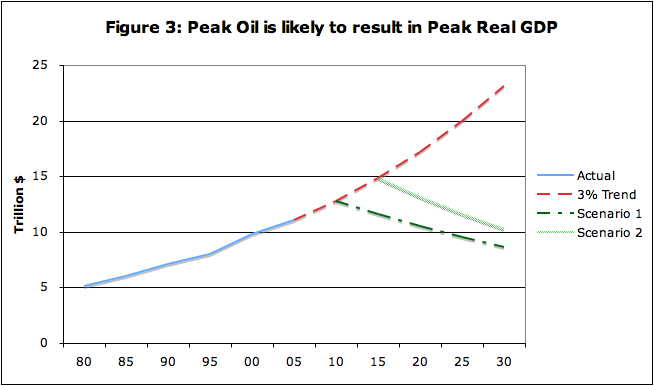
A graphic representation of how this might happen is shown in Figure 3. Real gross domestic product (GDP) gives a measure of how much goods and services the United States is producing in a year, in constant (year 2000) dollars. The 3 per cent trend line in Figure 3 shows the expected growth in real GDP, if growth continues as in the past. Scenarios 1 and 2 show two examples of how limitations on oil and natural gas might impact future real GDP. Scenario 1 shows a fairly rapid decline, starting very soon. Scenario 2 shows a slower decline, starting in 2020. If the downturn is still several years away, we have longer to plan, and a better chance that the decline will be more gradual.
3. Transportation difficulties and electrical outages.
Since transportation generally uses petroleum products for fuel, a reduction in the amount of oil available is likely to cause transportation difficulties. These difficulties may extend to all forms of transportation--automobile, trucks, airplanes, boats, and railroads, to the extent that fuel is unavailable due to shortages, cost, or rationing.
If natural gas supplies decline, electrical outages are likely, especially during high-use times of the year. Electrical outages may also result from interruption of transportation of other fuel, such as coal, to power plants, because of petroleum shortages. Outages may be one time events, or may be planned outages at certain times of the day, to compensate for an inadequacy in the fuel supply.
4. Possible collapse of the monetary system.
This is perhaps the biggest single issue, and the most difficult to understand.
There is a huge amount of debt in the world today. When loans were made, the expectation of the lenders was that the economy would continue to grow as in the past--that is like the 3 percent trend line in Figure 3 above. If this continued growth occurred, people, on average, would be a little better off financially when the time came to pay off their loans than they were when the loans were taken out, so they would have a reasonable chance of paying off the loans with interest. Corporations would continue to grow, and because of this continued growth, most would be able to pay off their debt with interest.
What happens if a scenario like that shown as Scenario 1 or Scenario 2 on Figure 3 occurs? When it comes time to repay the loans, people and corporations will be on average, worse off, rather than better off, than when they took them out. It is likely that many people will be unemployed, and cannot pay back their debt. Companies manufacturing goods that are no longer in demand are likely to be bankrupt, and thus will be unable to repay their debt. Organizations holding this debt, such as banks, insurance companies, and pension funds will find themselves in financial difficulty, because of the many defaults on the loans that are the assets of these organizations.
Two possible outcomes of widespread defaults come to mind. One is that there is so much debt that cannot be repaid that banks, insurance companies, and in fact the whole monetary system fails. The other alternative is that the government guarantees all the debt, so that the institutions do not fail. The latter approach would likely lead to hyper-inflation.
In either event, people and businesses would lose their savings, because money either would either be no longer available (first approach), or would be worth very little due to inflation (second approach). In either event, foreign countries would be unlikely to accept our currency in trade. Simple transactions, such as purchasing food or paying an employee, would become very difficult. Eventually, some approach would likely be found to circumvent these difficulties--perhaps a more barter-based approach--but this would be a huge change from our current system.
5. Failure of economic assumptions to hold.
We have been raised in a world where supply and demand are generally in balance. An increase in demand results in a greater price, which in turn leads to a greater supply. If the particular item isn’t available, substitution is generally available.
Once we reach geological limits, these basic principles seem much less likely to hold. An increase in energy demand isn't likely to translate into greater supply. Distribution of the limited available supply seems likely to reflect considerations other than price, such as rationing and long-term alliances. There may also be military conflict over available supplies.
I talk more about the economic implications of peak oil in a three part series: Part 1, Part 2, and Part 3.
6. Changed emphasis to more local production.
Two factors are likely to encourage local production and discourage international trade. One is the higher cost and/or unavailability of fuels used for transportation. The other is difficulty with the monetary system--either hyper-inflation or complete failure of the system. If there are monetary system problems, other countries are likely to want actual goods in trade, rather than IOUs or money. This requirement is likely to greatly reduce the amount of trade with foreign countries.
Food production is likely to be more localized, since this insures a continuous supply, and reduces the amount of fuel needed for transportation. If there are problems with shortages, people may choose to have gardens, so as to grow a few of the foods they need themselves.
7. Reduced emphasis on debt.
Once it is clear that future production is likely to be less than current production, as in either Scenario 1 or Scenario 2 of Figure 3, it will be very difficult to find any lender willing to provide long term loans, since if the loan is paid back at all, it is likely to be paid back in money that is worth very much less than it was at the time the loan was taken out.
If governments still have debt at this point, they will find it difficult to sell new bonds to replace the ones that mature. Businesses desiring to build new plants may find it necessary to accumulate resources for new plants in advance of their construction. Mortgages may not be available for prospective home owners, either.
8. Reduced emphasis on insurance and pensions.
If there are difficulties with the monetary system, insurance companies and pension plans will be among the hardest hit, since thy take in funds and invest them, and pay benefits later.
It is possible that a limited form of Social Security coverage may continue, but this is by no means certain. If a high level of inflation occurs (see point 4 above), benefits that have been promised to date will be worth very little. If a new monetary system is in place, it will be up to the government at that time to determine the level of benefits. Because total goods and services will be lower in the future (Figure 3 above), benefits to retirees will almost certainly be lower as well.
9. More people will perform manual labor.
As the amount of oil and natural gas becomes less available, more work will need to be done by hand, since the fuels to run machines will be less available. In order to encourage people to take jobs involving manual labor, manual labor will pay better in relationship to desk jobs. Because food is such an important commodity, farming may be particularly highly valued, and may pay especially well.
10. Resource wars and migration conflicts.
If there is is an inadequate amount of a resource (water, oil, natural gas, or food), countries may fight over the limited supplies that are available. Conflicts are likely to spring up regarding areas where resources are plentiful.
Alternatively, people may choose to migrate from an area if resources become less abundant--for example, migration may occur if water supplies dry up, or if land is flooded due to global warming, or if declining oil supplies limit transportation. Receiving areas may not welcome the newcomers, leading to more conflict.
11. Changes in family relationships.
Families are likely to see more of each other, because of reduced transportation availability. Families may work more closely together, tending gardens and running small family businesses. Co-operation may be more highly valued by society. Divorce rates may decline.
12. Eventual population decline.
The food supply produced in the world today is many times greater than the food supply 100 years ago, before oil and natural gas were used in tilling crops, pumping water for irrigation, making fertilizer and pesticides, and transporting food to market. As oil and natural gas become less available, the food supply is likely to decline. Eventually, world population is also likely to decline, reflecting the lower food supply.
Conclusion
We cannot know exactly what the future will hold, if technology is not able to overcome the many issues associated with a finite world, including declining oil and natural gas supply, decreasing fresh water supply, and climate change. Whatever changes occur are likely to differ from location to location, as the world activity becomes more localized.
We tend to think of governments as fairly stable, but these too may change. Countries may subdivide into smaller units. Some have even suggested that groups of states may break away from the United States.
Educational institutions will most likely change. Fewer students will probably attend colleges and universities, and the subjects of interest will likely change. The sciences and agriculture or permaculture are likely to be topics of interest. More students may want to live on campus, if transportation is a problem. Adult education may become more important, as people seek to develop skills for a changing world.
Businesses will also change. Local businesses will become more important, while multinational companies recede in importance. Manufacturing will become less important, and recycling will become more important. Providing necessities will get top priority, while nice-to-have items will not sell well. Barter, or a new monetary system that substitutes for barter, may be the way business is done.
People may choose to live closer to work, or may work at home, so as to minimize costs associated with commuting. Some people may choose to live with relatives or friends, so as to save on utility costs. Eventually, many homes in undesirable locations may be left empty, and the parts of these unoccupied homes that can be used elsewhere will be recycled.
The next 50 years will certainly be interesting ones. Perhaps, with technological advances, some of the potential problems can be avoided. But we will need to work hard, starting now, to develop ways to work around the problems which seem to be ahead.
To Learn More
The Power of Community: How Cuba Survived Peak Oil 53 minute film, available for $20, tells the story of how Cuba adapted to losing over half of its petroleum imports after the collapse of the Soviet Union.
Closing the Collapse Gap: The USSR Was Better Prepared for Peak Oil than the United States Humorous talk by Dmitry Orlov
The Long Emergency: Surviving the End of Oil, Climate Change, and Other Converging Catastrophes of the Twenty-First Century Book by James Howard Kunstler
Discussion Questions
1. What are five things that might improve after world oil production begins to decline? (Hint: Consider exercise, weight problems, family situations, etc.)
2. If there is a decline in oil and gas production, how do you expect the large amount of debt outstanding to resolve itself? Do you think there will be monetary collapse, hyper-inflation, or some other solution?
3. Do you expect that families will have more or fewer children after oil and natural gas production begin to decline? Why?
4. How can businesses prepare for interruptions in electrical service?
5. What types of buildings are best adapted to frequent outages of electrical service? Which buildings are likely to have the most problems?
6. What vocations appear to be most likely to be useful for supporting a family, after oil and gas production begin to decline?
7. What changes might a college make to its curriculum, to better prepare students for the changing world situation expected after production of oil and natural gas begin to decline?
8. In Figure 3, real GDP in Scenarios 1 and 2 are shown as changing in relatively straight lines. Could alternative scenarios have the lines zig-zag or drop suddenly? What real world situations might cause different patterns?
Contact
- Content: editors at theoildrum dot com
- Tech support: support at theoildrum dot com
License

This work is licensed under a Creative Commons Attribution-Share Alike 3.0 United States License.
Thanks very much for this summary of the challenges that face us. History suggests that our society will meet that challenge in the same way that previous societies have done: the sum of individual self-preservation and acquisitiveness of the members of our society will likely create another dust bunny in the dust-bin of history. If anyone is around to write the history, that is.
Interesting that the government propaganda is so strong, and our capacity for self-deception so highly developed that you can make such a statement. Which government in recent memory is "stable?"
Increasing lack of cheap energy will make local connections and local production more viable-- so there is certainly hope on a small scale. The vision of a harmonious, globalized ("Christian" in most versions of that nightmare) economy and society is going to have to be given up. And none too soon, in my opinion.
Gail,
On discussion question number 4, How can businesses prepare for interruptions in electrical service?
A growing number of businesses are installing solar power. These include Alcoa, Walmart, Costco, Khols, FedEX, GM, Macys, Gap, Frito-Lays, Hall's Warehouse, and others. You can follow some of the developments at environmentalleader.com.
Chris
Those solar installations are probably grid tied, no battery storage...so if the power/grid goes so does their solar power.
Most of the time businesses are open is during the day time. If the solar panels would help keep the lights on and cash registers working then, they would be helpful.
I have seen pictures of programmers in India doing their work using computers with a solar panel attached .
The businesses are installing solar to save money on power but if grid reliability becomes an issue, I'd guess they would make any modification that might be needed to avoid losing business. We expect to have a manual switch that allows operation when the grid is down (but the Sun is not) for our residential systems. A three phase setup might be a little more complex, but likely a smaller cost relative to power output.
Chris
I think before plugin hybrid cars we might see homes and offices with large UPS (uninterruptible power supply) batteries. The talk is they will be able to get 20 kilowatt hours into a suitcase sized battery. That will keep the puters and CF lights going but not the AC.
The talk is they will be able to get 20 kilowatt hours into a suitcase sized battery. That will keep the puters and CF lights going but not the AC.
Consider a smallish well-insulated suburban house with an 18,000 BTU air conditioner (1.5 tons), 16 SEER (you can get more efficient units these days), that runs 8 hrs/day during the worst of the season. That works out to 9.0 kWh/day, so that suitcase-sized battery could run it for a couple of days. If we're talking about lots of short outages, such a battery could carry you over; if we're talking about days-long outages, that's a different matter.
A patent for such a battery that can be sold at a reasonable price (say, less than $3K just as a point to talk around) that can be made reasonably rugged is going to make someone very rich. One such battery gives you roughly a 60-mile all-electric range in a hybrid auto (assuming you don't want to run the battery below about 25% charged); three of them give you a two-day backup for the typical 30 kWh/day suburban household; three days if that household has done the easy things like CFL and reduced their load to 20 kWh/day. In at least some parts of the US, four such batteries, split between the house and cars -- if deployed ubiquitously -- would be enough to allow local solar/wind to power home and personal transportation needs.
Not my goal to be a contrarian but let me pose this question.
Just exactly **why** do we require 'growth'?
Why can't folks live with a life that doesn't have growth in it? Would it be far more peaceable to live in an unchanging neighborhood? Taxes never rise,prices likewise and so on.
Back in the 50s it seemed that way to me.Most people were satisfied with just a good job, nice house and quality food to eat.Neighborhood schools nearby, no strife and traffic not that bad.
Most of that is the way many rural folks live,except for the rising cost of food,gas and medicine.
Just exactly WHY does a company/corp HAVE to grow? If they paid a good dividend as a result of making profits then their stockholders would not always be trading their stock,and would be satisfied with the stock.But instead some kind of cosmic shift said that dividends were out and growth in value was everything and hence we arrive on this runaway roller coaster.
Who and why does anyone have to compete with the Joneses?
Someone or some agency,perhaps the mass media , has forced most of this on us. Frenzied life,,soccer moms exhausting everyone and everything, Doctors promising everything and the list goes on.
Right now it seems that after the chaos to come that we will all have to live a more slow and less changing lifestyle.
I submit that we don't even think of life anymore in that vein and so this is what it brings...*peak everything*. No one is satisfied with normalcy.
Of course! Most don't want to get down on their hands and knees and work in the soil of a home garden or farm based lifestyle...what fun is that? Getting up later, not having to rush hither and yon on vague stupid trips for nonsensical toys and junk. Actually looking up at stars at night. Breathing better air.....yes...so very very boring.
Where is it written that we 'must' have growth? Who voted this bill in? Who hatched this inanity?
Airdale
Ditto, airdale!
I keep saying that if we want to avoid outright extinction, then we WILL be ending up with a zero-growth sustainable economy built on a 100% renewable resource base. There simply is no other alternative, whether we like it or not.
Knowing where we are heading, the only useful questions worth discussing involve: how to get to there from here? Or, since we WILL be getting there one way or another, more specifically: how to get there in the least painful and distressing way possible?
Growth might have been fun, for those who benefited from it, while it lasted. It's had a good run, but the fat lady is singing now, and it's time to go home.
and Ditto WNC!
Might be interesting to graph the increase in disparity of incomes in the world against the growth of things like population, CO2 etc or against the decrease in things like general personal satisfaction with life.
Vancouver in the 50's and 60's was a pretty slow growth place and the greatest city in the world to live in IMO. After Expo in the 80's it turned into a great investment area and just another city to get out of.
WNC Observer,
I agree we need to get to a zero-growth sustainable economy. For now we can use non-renewable resources, but these will deplete over time.
I wish we didn't have so many problems to deal with simultaneously, including:
- Soon to be declining fossil fuels
- A monetary system that needs growth to continue
- Global warming
- Fresh water shortages
- Soil problems
- Serious balance of payment problems (import more than we export)
- A debt system that is out of control
- Population overshoot
- Elected officials who are unwilling to deal with the situation
If we only had one problem, the task of trying to fix it might be reasonable. As we discover more and more problems, it is harder to see how one might find a solution and implement it on a broad scale. Relocalization would work much better as a solution if we had a stable climate, higher water tables, and fewer people.
Yes, we need to get to zero growth sustainability but I now think this is unlikely. Just reading many of the comments in this and other TOD posts, it is clear that even those who understand the threat posed by resource depletion still hope for some technological solution to just the energy problem, without regard for what continued growth has done to our world. The latest GEO report from the UN (actually from 390 scientists, reviewed by a thousand others) shows continued degradation of our planet in the face of continued economic prosperity and population growth. Everyone wants to find a solution but no-one wants to do anything about it.
So long as we continue to use resources beyond their renewal rates and continue to emit waste materials faster than the rest of nature can deal with them, there is no way we can head for a soft landing, no matter how many substitutions we make for the resources that are already running out.
WNC, you have expressed the exact same points Hubbert did in his 1976 paper "Exponential growth as a transient phenomenon in human history" at http://www.hubbertpeak.com/hubbert/wwf1976/
"we are now in a period of transition between a past ... and a future also characterized by slow rates of change, but by means of utilization of the world's largest source of energy, that of inexhaustible sunshine," (by which Hubbert was referring to both direct and indirect utilization of sunshine, i.e. including hydro, wind and bio.)
"It appears therefore that one of the foremost problems confronting humanity today is how to make the transition from the precarious state that we are now in to this optimum future state by a least catastrophic progression. Our principal impediments at present ... are cultural. During the last two centuries we have known nothing but exponential growth and in parallel we have evolved what amounts to an exponential-growth culture, a culture so heavily dependent upon the continuance of exponential growth for its stability that it is incapable of reckoning with problems of nongrowth."
I also suggest reading his 1949 work "Energy from fossil fuels" at
http://www.hubbertpeak.com/hubbert/science1949/
Notably, on page 108 he repeatedly raises the possibility of future "cultural degeneration" (predicting a Mad Max scenario in 1949!) whereby the final steady state could end up being roughly the pre-industrial one.
Airdale,
Why is growth necessary?
Part of the reason for growth is simply to pay back all of the debt with interest. If you stop the growth cycle, there isn't going to be enough money to pay back the debt with interest. When limitations on oil make growth more difficult, one way around the problem is to just borrow more, to keep up the illusion of growth. I think that this is what has happened recently, and is part of the reason that the whole system is coming close to collapse.
Another reason for growth is that all of the economic models are predicated on growth. Stock values reflect the net present value of future earnings (at least sort of). If earnings are rising it is easy to justify a high stock price. If earnings are level, the price is lower. If earnings are expected to decline year after year in the future, the stock price goes in the toilet.
A third reason for growth is that benefit programs like Social Security and Medicare were priced assuming that there would be more and more people paying into the system, and that they would be earning more and more, so that the benefits would not be excessive in relationship to the future earnings of the people who will be paying into the system at the later date. If we don't have growth, the benefit programs cannot be funded at the promised levels.
Pension programs have some of the same issue as Social Security and medicare (won't work unless there is growth), but the reason is different. Pension programs are usually funded using stocks and bonds. If there are major defaults on bonds because of lack of growth (leading to an inability to pay back the interest plus principal), or the stock values fail to grow by the assumed rates, the pension plans will not have enough funds in them when it comes time to pay benefits.
One thing people did do back in the 50's was have lots of children. This has been part of the growth cycle too.
Hi Gail good show!
About debt ,I feel it is merely an outgrowth of original communal living. We began by doing for each other communally , if for instance a barn or house needed building the community would do it. (for brevity(and maybe other reasons:) this is rather a simplistic model). As communes grew to cities basic community was lost but houses etc were still needed. Debt is merely a substitute for what each member of a commune owed each other member.
I think what one might see from this that interest on a loan is unnecessary and in reality a theft by nonproductive middlemen.
Thanks for the reply.
Gail said :
"One thing people did do back in the 50's was have lots of children."
Mhhh...when the war was over and my father returned..sometime in 1945-6 or so.we lived in Ky still..some trips back and forth to city living but briefly...and yes, I agree that on the farm people did have more children BUT that was a biological necessity for in order to continue to farm one needed offspring..to carry on and in case of disablity or accidents and to take care of the parents in their old age. Far better to have a few sons to help out..and daughters to marry well and increase the kinship and extended families that are so important in the rural outback.
And it did happen that way, where the offspring housed and cared for the elders...in fact to this very day you see it happening albeit to a far lesser degree. But old habits and customs die slow..
So then in 1949 my father came to the farm and hauled us up to St. Louis county to something that looked weird..suburbs..the very very early beginning of suburbs...
And I an my brother(the only two offspring) were set admidst a lot of other families BUT looking back most all of them either had no children, or two children and in the odd case three children. Most had two.
I dated girls and had lots of friends back in those days as a teenager and most of those early suburban families usually had just two children.
So where did the huge increases come from then? Was it that divorce became common and therefore new 'mixmaster' families were created...like my wifes? One from a previous and two from the original? The sexual revolution?
Or was it new arrivals in our country? Or illegal immigrants?
Mostly in the burbs where I then lived and grew up..2 was usual and 3 did happen and 0 was there as well.
My wife and I had two. That was all.
My grandfather and grandmother had 14!! Most all of those 14 aunts and uncles had at most 2. And of the males none had another male except for one and so me and my brother were two and he never married..of my two, a boy and a girl..my daughter has only one and no more..my son will never marry.
So out of 14 total that line is about to die out..and in fact no male children of those 14 offspring..only 2 males were born and they never propgated,except for me.
I find this in many kinfolk around here...so I am at a lose as to the dynamics of childbirth of those who have been here for some time...I am 5th generation on my grandfathers side and 12 generation on my grandmothers. Mostly on both sides we are slowly disappearing instead of increasing.
Perhaps my experiences are just far different.
As for Social Security..those of us who are on it surely recognize that the day will come , and not too far , when there will be no more EFTs deposited in the bank. We all pretty much know that its a ponzi scheme.
My feelings on SS is that a lot, a whole lot, more recipents have been 'added' to the roles than those who paid in. All for political gain I think. And then there was those who never paid in but get benefits anyway. Forget the name of that program. Then children were added and so on .....
airdale
... on the farm people did have more children BUT that was a biological necessity for in order to continue to farm one needed offspring ...
You've answered your own question there. It is in the nature of biologicals to reproduce. And the "Economy" is thought of in similar grow-or-die terms. We are victims of the success of humanity.
As a side note, I think your family tree is typical. My own is similar: Dad came from a family of 5, 2 of whom were male. None of his sisters ever had children, nor did my brother, and he has a total of 1 grandchild (my child). It doesn't look like she's interested in propagating, so his brother's kids, and theirs, are the only outcome of 3 or 4 generations of our family. His brother's widow is so obnoxious we don't talk to her very often -- I'm not sure how many descendants they have. Dad's other siblings and most of their spouses have passed.
| The problem will solve itself.
| But not in a nice way.
Airdale,
You and I are in 100% agreement today. There has been a fundimental shift in values in our civilisation over the last 60 or 70 years, and the winning set of values aren't values that will help us survive in a more resource constrained world. What is being mislabeled as capitalism and democracy is actually greed and materialism, and its about to strangle us all. The Islamic conflict with the West is to a very large extent revulsion with this part of our society and an attempt to return to values that are 1400 years old. Unfortunately, they don't work well either with the modern world, and don't include tolerance.
I put the blame on how we get our information. Its pretty unfortunate, but televisions rule most households in America, they are on on a constant basis. And, television isn't an information medium or an entertainment medium, its an advertising medium with that other stuff just to keep us hooked.
We're not that far from the same age. I'll be 56 on Tuesday, November 6 and I think from the things you've said you are about 15 years older than I, but we can both remember the changes that came in society between about 1960 and 1975, when TV pretty well took over. Before then, people satisfied their need for a feeling of community by participating in the community, by being members of churches, local political organisations, local social organisations like lodges or service clubs like the Rotary or J.C.'s. At any rate, they went out and actively participated with actual people in making their communities a better place. People often had their families living near, perhaps a relic of most people having a farm.
But around 1960 the sitcom ideal on television started to make people who didn't live in a big house with two family cars feel inferior, so Mom got a job so the family could purchase these things, and they did. Credit expanded, and instead of people saving up to buy a house, they purchased it with a down payment and a twenty year note. And instead of Mom being home when the children came home from school, even cooking dinner and eating waited on her coming back from her job. And, our society became much more fearful from the advent of all the cop shows on television. Kids weren't allowed to play outside until after dusk.
And because of exhaustion, we left the TV on and didn't talk to each other any more. So we've sowed the wind, and reaped the whirwind. People seem to have forgotten that they only wear one pair of pants at once and sleep in on bed. We are fixing to start the third generation of people who seldom eat home cooking and have no idea of how to grow a tomato. Even churches have become giant megachurches on television, instead of groups of friends and neighbors doing their charity at home and working on community problems.
Peak oil though has the potential to reverse this process and set us back on the right path as humans. Its going to be such a huge shock to materialism that people wil be forced to look within themselves for the answers, rather than seeking other places to put the blame. The survivalist hole up in the woods with sardines and canned pinto beans and enough guns and ammo to terrorise the world mentality won't be nearly as succesful as organising a community garden and setting up jitney routes to the local train station. In one you have friends and neighbors, in the other you've got to worry about someone to watch your back when you sleep. What has more social status-a 12 MPG Hummer with an empty tank and no ration left or an electric bike that recharges from a solar cell set up on the garage roof? Bob Ebersole
Bob,
I am in my late 60s but I feel more like late 50s.
We agree on a lot more than we likely disagree on.
But to answer my own question, after thinking about it some,I would assume the big change was the 'baby boomers'.
Must have shepherded in a new order of thinking perhaps.
I remember that even when TV came along..we might watch Howdy Doody and a bit of the other but mostly we preferred to be outdoors and the burbs hadn't yet killed off everything,,then later I joined the Boy Scouts and found my outdoors environment there,,then later hunting,fishing and canoeing, then spelunking in caves and on and on but always a hankering to return to living on a farm.
Straddling two far different ways of living , I am more comfortable with the rural lifestyle even though I still work on computers for some of the businesses in town and keep my hand in electronics.
airdale-watching as the future approaches on the horizon
I, too, am from the not-so-young group. I remember the days before television and having lots of cousins and aunts and uncles around when growing up. My grandparents lived on a farm, and my mother grew up on a farm. I sometimes visited a one-room school with my cousins.
I have never watched much TV - can't understand how some folks have it on night and day. We have a TV in the basement and watch it when we are there because of tornado warnings. Once in a blue moon there is a particular program I want to watch, and go to the basement and see it.
You are probably right that peak oil has the potential to set society back on the right path again. The story of economics and capitalism and "buy more" has been so pervasive that many people do not recognize it as anything other than the "truth" and the way things are.
The question of societal change, and particularly of when and how and why we started changing for the worse, is an interesting one. I suspect that it is a complex set of factors, and can't be put down to any one factor.
Whole books have been written about this, and many more will undoubtedly follow in the future. Here are just a few fragmentary, incomplete thoughts:
Television certainly has played a role. Of course, it was around in the 1950s, but not everyone had a set, the programming was all black & white, and except for a few classics the programming was really not very good - inferior to the old radio programs in some ways. I am old enough to remember turning on the TV and seeing test patterns, so it wasn't on ALL the time. And speaking of radio, of course that filled the niche that television supplanted. It is strange, but listening to the radio seemed to be more of a family and even neighborhood social event than was television. Part of it might have been that an entire room could hear a radio program, while you had to sit pretty close to view TV in the old days -- large screen televisions are a relatively modern invention, in the 1950s the screens were SMALL. Since it didn't require watching, one could be doing other things while listening to the radio: knitting, darning socks, shelling peas, whittling, building a model airplane, etc.; thus, families could be sharing work at the same time that they were sharing the experience of listening to the radio. Maybe there is something deep about visuals + sound hooking our attention in a way that sound alone doesn't. Then too, remember that people were used to watching visuals + sound already -- they had been going to the cinema for years. Even when one went as a group, one sat in individual seats all facing the screen, and everyone's attention was focused on the screen (well, except for the young couples making out in back). Thus, television became more of a cinema-in-the-home instead of a visual radio, and family television time didn't work the same way that family radio time did.
The Kennedy assassination seems to have been some sort of turning point, maybe even a tipping point. I'm not sure why. Lots of people loved him, but in retrospect he was only so-so as a President, and certainly had his share of personal flaws. Yet, it seems to have hit a lot of people pretty hard. The whole psyche of America did seem to change in some sort of strange way after that; I'm not sure how or why, I just know that I felt it at the time.
Of course, the Vietnam fiasco was another thing which damaged the country terribly. We're still paying the price for that in so many ways. Prior to that, I think there was a pretty high level of genuine patriotism and of trust and respect for the government and for those in positions of leadership. That all pretty much died with Vietnam. What patriotism one sees today seems to me to be somewhat forced rather than flowing naturally. Government and people in positions of leadership are despised, not respected, and certainly not trusted. It also permanently damaged the relationships between the generations. Even today, one can still sometime sense a certain strain in interactions between boomers and the elderly. This might have something to do with the decline of civic clubs and other organizations. Most of these are dominated by the elderly, you see very few young members. It is not just the case, I suspect, that people are not active in their communities any more (though there is truth to that); I suspect that a lot of boomers became alienated from these organizations during the Vietnam era, and have never come back around. Unfortunately, they never got around to forming their own alternatives to replace them.
Kids stopped playing in the neighborhood unsupervised and stopped walking or biking to school in the 70s. School consolidations and interracial busing played a small part in ending the practice of kids walking or biking to school. However, the really big factor was that this was when a lot of crimes against children started making the news, and parents freaked out. Why did the crimes start happening in the 70s? Certainly their were mentally deranged people around before then? Yes, but there were also plenty of stay-at-home mothers around then. As a kid, you knew that if you got too out of line, somebody's mother was likely to march out of their house, intervene, send you home, and call YOUR mother to report on you. Everyone's parents knew that they could count on each other to keep an eye out for the general safety of the neighborhood kids. Of course, when women started entering the workforce in increasing numbers, that went by the wayside.
I'm not so sure that it was the case in the late 60s or early 70s that Mom went to work because the family needed the money. Remember that by then, most of the boomers were at least teenagers, so increasing numbers of mothers at last felt free to be out of the house and at work during the day. Since they now also had washing machines, dryers, dishwashers, etc., there really wasn't all that much for them to do all day in the house. Remember, too, that they had seen THEIR mothers work during WWII, so the thought that they might too didn't seem so strange. I'm not sure if the women's lib movement is what prompted many women to take the plunge and head to work, or if it was the fact that increasing numbers were already heading back to work that made the ground fertile for the women's lib movement. Maybe it was a mutual feedback system. In any case, it was only a few years after women started working in greater numbers when the 1973 oil embargo hit, and inflation started spiraling out of control. What had at first been a discretionary thing became a necessity.
WNC and Gail,
How odd it is that we are all of about the same age group and view our society almost exactly the same!! Well it reinforces to me the changes and how we can recall so clearly how it all was back then.
I agree totally with both of your inputs and views.
When I try to talk to the younger generations about 'how it was' and what might work and why do they do what they do....
I get this very huge 'disconnect'. They just seem to completely lose the whole thread and their attention is always somewhere else..usually due to their cell phone going off..
..and the odd thing is that they consider the cell phone call,,even if irrelevant.to be far more important to answer than to even pay attention to what the other party is saying...its very dismissive..and I usually about then say to myself "well screw them then"..and a bit goes out of our relationship at that point..
I also remember that sitting with my wife when she was always so completely absorbed with nonsense on the TV that I would say something to her and she would not even turn her head,,just give an off the cuff reply..
And so when she started staying more and more away from the farm where we lived...I finally disconnected the satellite and eventually removed the tv...I got the idea then that what was on TV was more important than what her husband of 45 years had to say.
She still sits for many many lost hours watching the TV and the nonsense on it..and thinks that what they say is the
'absolute truth'. Since she lives in N.Carolina now I took the tv down to her for good but I stayed here on the farm.
Perhaps the boomers raised on TV think that everything they hear by the MSM is in fact the truth!!
airdale
WNC Observer,
Your post brings back lots of memories. I was still in high school when Kennedy was shot.
I walked to and from school, or rode my bicycle, every day through high school. My mother was always at home, with the seven children. My mother said as long as she was home with one, she might as well be home with several. Also, the first five were girls, and my parents wanted a boy. (The seventh one was unplanned - another girl.)
My mother worked until a few weeks before I was born. She had a master's degree, and was in charge of the medical laboratory in a large hospital. She hid her pregnancy with her lab coat-thought she might be fired. She never worked after I was born.
Some time in the mid to late sixty's, there was quite a bit of publicity about it not being desirable for women to have so many children, so the birth rate declined . When women only had one or two children, working outside the home became easier. The US Statistical Abstract (Table 76) shows that there was a big drop in the birth rate between 1957 and 1972. This big drop in the birth rate, together with the other conveniences, made it easier to work outside of the home.
The usual pattern was for women to work full time and leave their children in day care (or with relatives) for long hours. I was fortunate enough to be in a position where I didn't need to do this. I chose to work fewer hours, and pay someone to come to the house and help with cooking and cleaning (mostly while kids were at school) and do some child care. This way I was able to spend almost as many hours with my children as a stay-at-home mom, and avoid quite a bit of the household chores. This approach was not a method of maximizing net income, but it was closer to what I was used to growing up.
We can know what the future holds, particularly when it comes to the issue of technology saving our butts.
Not going to happen. Technology is not energy, nor water, nor topsoil, nor any other finite element that allows us to live in our current farcical way.
But what really chaps my ass is your statement:
Oh lord, what a high crime it would be if we didn't pay back the fictive element known as "interest."
Economists lose all credibility when they start touting the idea that "interest" is more important than the actual PLANET!!!!!!!
To me, the tone above is a bit like a parent patiently explaining to a child that the reason we tithe the slithing toves is because the Wanderal Wraiths are loath to come to the fourth plane of existence and breath the loamy air of Barthing Time. Of course, this explanation is being given even as they are about to be ripped to pieces by an onrushing tornado.
These fictive financial devices are artful conceits and nothing more. With a pen-stroke, we could simply write them away like so many tears in the rain. The problem is many very greedy, uncaring people who are largely responsible for our situation want what they feel is rightfully theirs, and damn the planet!
I say we declare a Jubilee Year, or Decade!!
Let's increase taxes on the rich to 75%. Growth on a finite planet is just short of retarded, perhaps criminal, so let's just wipe out these criminals and put ourselves to work building an actually sustainable world.
Oh lord, what a high crime it would be if we didn't pay back the fictive element known as "interest."
Great stuff.
For anyone wanting to know how we (in the US) got into this, read a little history about it. It will be good for you.
AMERICA'S FORGOTTEN WAR AGAINST THE CENTRAL BANKS
john
Take much care Cherenkov!.. you are not doffing cap and tugging forelock in suitable manner. There are even now intractable forces that have entered loamy air of Barthing Time, they are watching, watching!! :)
The only reason for interest on debt is that the fix is in. As I was trying to say, in a bit of a rush above, is that debt itself is a substitute for the help one has from and is returned to ones fellow tribe, commune, village, mates. No interest paid then Why now? It is just a way for leaches to suck much blood. A fee for service okay but interest is a crock and if (big, big if) any civilization worthy of the name should develop after the great undoing (polite form for dieoff..must be careful careful), it would be a fine thing for it to develop keeping that in mind.
Read here in Hubbert's notes about a steady state economy that interest rates in a non-growing industrial system have to be zero:
http://www.hubbertpeak.com/hubbert/hubecon.htm
An extract:
Yes, this is the same Hubbert who predicted peak oil in the US in 1970
Hey Matt,
Zero interst??!! who is this Hubbert guy? Sounds pretty much a commie to me. Let guys like that on this site and who knows where that will lead, geez get real Matt, you'll get 'that guy Hubbert' on here talking about PO in relationship to liberating Palestine or some weirdo stuff like that next!
It's the same guy who gave the Hubbert's peak its name. Oildrum is a peak oil site. Why don't you go here:
http://www.hubbertpeak.com/
and have a look. It has nothing to do with communism.
There's his problem. The money supply does not increase because of compound interest, but because of the movement of loaned funds through a multi-bank fractional reserve system. Eliminate fractional reserve banking, and you can end up with a stable money supply (which is what you want in a zero-growth sustainable economy). With a relatively fixed money supply, loaning some money out with interest does not change the money supply, it just changes who has the money initially, and who has it later.
With zero interest, the supply for loans would be zero - no incentive to loan money out.
Can a sustainable economy remain sustainable with no loans? Borrowing can (and arguably should) be a way to spread the cost of an asset over the lifetime of the asset, matching its costs with its benefits. If you don't do this, you can run up into issues of intergenerational equity. For example, why should people save up for most of their lives (i.e., make sacrifices by consuming less than what they had the means for) in order to pay for an asset that will only benefit the generations that follow? Yet, if such saving and investing is not done, how is the economy going to sustain itself? Even in a zero-growth economy, productive assets wear out and need to be replaced.
I think that a sustainable, zero-growth economy does need a positive rate of interest. All resources, including money, need to have a "rental value" so that they will be used efficiently and carefully.
WNC
If you have an obligation to society and I have an obligation to society why should we be paying interest on this obligation to a third party?
In the military buildings are not insured using this same reasoning. Why should they pay money to a third party when they can use their own resources to insure their property and save the insurance costs?
Both insurance and interest are used in situations that are intrinsically dysfunctional due to lack of cooperation (for a variety of reasons).
There are other ways other than the use of 'interest' for assuring that resources will be used effectively, as I am sure, while a child, you learned one way or another:)
You say there would be no incentive for loans if there were no loans. As Dickens said in Hard Times:
'It was a fundamental principle of the Gradgrind philosophy that everything was to be paid for. Nobody was ever on any account to give anybody anything, or render anybody help without purchase. Gratitude was to be abolished, and the virtues springing from it were not to be. Every inch of the existence of mankind, from birth to death, was to be a bargain across a counter. And if we didn’t get to Heaven that way, it was not a politico-economical place, and we had no business there.'
And if that philosophy is the one we wish to take with us then I guess then the use of interest is quite correct.
Interest and insurance arose as expanding communications, transport and commerce linked together people that did not live near each other and no longer knew each other.
If you presume that all of those are going away and that we'll contract back down to the local village level, then yes, it is possible for everyone to just pitch in for the common good and help each other out as needed.
Possible, but how likely? When I look at most of the people I have encountered for most of my life up to now, I'd have to say: Not very likely.
I think we'll have to contract substantially to the local level, but I'm hopeful that we won't have to end up completely isolating ourselves into small little clusters. That will mean the end of just about everything that we've discovered & invented over the last 3000 years. While I think a decline and contraction is inevitable, I am not yet convinced that a contraction to that extreme level is necessarilly inevitable.
Yes I agree and have stated much the same same couple of times on TOD but the statement doesn't seem to hold true for organizations like military ones. Yes, of course, these organization hold together together through authoritarian forms of central control but couldn't that be substituted with self control by the individual?
If there is a great change including a massive dieoff coming should we continue to carry all socio/economic apparatus that bought us to this hi tech point. Might it not be better to drop it much like a space shuttle drops its boosters.
I don't think it would be necessary to drop 'everything' as you say here: That will mean the end of just about everything that we've discovered & invented over the last 3000 years, discoveries and inventions can be stored on stainless steel gold plated disks if necessary:) What we really need to do is look at how we relate to and nurture each other. That is the new field of human exploration that I think needs working on. We have enough hard science to be going on with for the moment how about a bit of the soft kind that we need to survive with even more than we need new forms of energy.
BTW for fun try reading Aldous Huxley's ISLAND if you haven't already. Set with a fight for oil resources too!
It was panned by reviewers when it came out, I believe as considered too Utopian, not enough grit in it to produce tears in the steely eyed:(
WNC, the easiest way to see this issue is by thinking in terms of the currencies used for several thousand years, gold and silver (without fractional reserve banking, of course). With them, the money supply was almost fixed before the Industrial Revolution (the annual rate of growth of above-ground gold stocks was 0.11 % from 1200 BC to 600 BC and again from 300 BC to 500 AD, dropping to 0.05 % during the Middle Ages).
When that was the monetary system, it was in full effect the biblical prohibition of interest. Which obviously did not affect the sustainability of economies.
Loans are not the only or primary way to finance an enterprise. Equity is.
One word.
Greed
Buddhists would take that one word--greed--and go another step: illusion.
They suggest that our illusions are mainly threefold with one fundamental illusion beneath it all. The three illusions at the heart of our dilemma?
The fundamental illusion beneath these threefold illusions is that we are not connected and interdependent.
Greed, it seems to me, stems from the abiding illusion that there is something out there that will bring happiness. Greed is someone going to an extreme to try and make the illusion come true.
The third illusion above is the toughest one to fathom, because the reality of "no-self" is so counterintuitive.
Peak oil and its probable consequences, it seems to me, are going to rip apart the illusions of permanence, happiness-through-acquisition, and disconnected independence. Waking up to reality is going to be painful.
As it always is.
"It is up to the most conscious member of the relationship to create the space for the relationship to grow." Ram Dass
Seems to me growth is essential. It's built-in. All living things grow. And, in general, when an organism stops growing, it dies.
It appears that businesses have to grow, too. Think about it: There has to be a starting point. From that point, the business develops--in essence, it grows.
It would be an interesting system where full-fledged businesses were just dropped in running full-fledged at top efficiency with all essential personnel in place and never changing. Sort of like Lego pieces. Civilization Lego pieces. Pre-made and ready to go. Need a hardware store? Click. There ya go!
It seems to me that growth is one of those fundamental "laws" of nature, like thermodynamics. Indeed, growth appears to be a happenstance of thermodynamics. Growth is a way of dealing with entropic processes, a way of maintaining a kind of order (organism), but, likely due to resource limitations, growth can only work for a limited time before it has to begin anew.
Civilizations are born, mature and fade away. Maybe as Bob Shaw so often emphasizes, humanity need to accept this fact (Asimov's Foundation priciples) and learn how to channel these changes in a less disruptive manner? I also suggest reading "A Mote in God's Eye" by Niven and Pournelle, an excellent portrayal of a civilization (in this case alien) that's aware of the growth cycle.
Just a few thoughts.
-best,
graywulffe in Corvallis, OR
There is a mixing of metaphors in graywulffe's post; All living things grow, but they also die. The same could be said for businesses, but economists assume most businesses continue 'living' after a certain critical mass growth. I've read "A Mote in God's Eye", but a fictional work hardly counts as evidence to support such a position.
One of the issues with growth stems from population growth, not just wealth accumulation.
Growth included a huge population increase.
What was the population "in the 50's" compared to now?
What was the debt "in the 50's" compared to now?
Therein lies the problem.
I think you are right on the money. You may like this if you aren't already aware of it. I think she had it right.
Places to Intervene in a System
By Donella H. Meadows
http://challenge.bfi.org/reference/PlacesToIntervene.pdf
BTW I disconnected the boob tube in my home about two years ago. I no longer buy as much superfluous stuff, I still own a motor vehicle but use it as little as possible and walk and ride my bicycle more. Last weekend my girlfriend and I kayaked out to a nice 3000 year old coral reef off of Fort Lauderdale Florida (this is where I live)and did some scuba diving. The lobster this time of year are scrumptious indeed. Well I did buy a nice Californian Pinot Grigio to go with the pasta and lobster, which I cooked myself. I know I should have used the solar cooker, maybe next time. Cheers!
Thanks for that.
I wasn't aware and enjoyed the read very much. I particularly enjoyed the analogies.
Point 5 is very telling.
Scarce resources and a feedback loop has been demonstrated repeatedly. The human race will never learn.
I would like to read a professionals' (psychologist) insight into where human nature(personally and collectively)is likely to take us post peak.
I wonder about many things and here are a few.....
Will the majority act altruistically?
Will the have's adopt the FYJ principle? Will they bunker down?
What will armed starving people do to feed their families?
What mitigation methods are states and or countries likely to adopt?
Will black markets develop if rationing is adopted? Will crime increase? Will draconian counter measures to crime be expected and adopted?
Will perceived energy wasters be attacked or marginalized?
What would happen if governments were to explain in detail and in advertising campaigns the oil situation right now?
Gail, another (unsurprisingly) insightful article. Each of the topics you discuss could be (and most are) books in their own right. Tying them together provides the big picture (along with peak potash, peak potassium, and other resource peaks) is also the theme of some recent books, Heinburg's being the best known.
What this means to the future of individuals, their families, their communities, their regions, and their nation would be a superb subject for indepth articles here at TOD. Discussion of each of the questions above would be a good starting point.
Gail---
Any smart 10 year old can grasp this immediately.
A capitalists will never get it, as it is his or hers God given right to prosperity
that is the basis for this delusion. That, and the Free Market as the chosen path.
Evolution will soon correct this problem with the gene pool.
http://science.reddit.com/info/5z0nd/comments/
Thanks for your support. Reddit helps us spread our work around the web--so go have a click if you are so inclined.
I think we are at a turning point and it just occured today:
http://edition.cnn.com/2007/BUSINESS/10/24/oil.decline/index.html
This story was on the Drumbeat a couple of days ago. This tells you how quick CNN is on the uptake. This also tells you why I check TOD for my news FIRST.
True, I saw it before on TOD but what is striking is the story is linked on the CNN homepage and is the most explicit reference I know of on CNN to peak oil and that it is here or looming
It's linked on CNN's international homepage http://edition.cnn.com/.
Try finding the story on the US homepage www.cnn.com. I can't.
Yes, it is no longer there - it was there for most of the morning but it has been removed. Interesting.
Lets hope you are right.
It does indeed look like a sort of breakthrough into the mainstream.
As long as nothing really important happens this week - like Paris Hilton getting caught smoking pot - there is good chance this will make a lasting impression on the wider public consciousness.
Good that they didn't repeat the 7% decline error that the Guardian reported. A "modest" 3% is more likely to be taken seriously.
Dont panic we will copy
Some of our future cars
http://freeweb.deltha.hu/zastava.in.hu/wood-gas.htm
http://www.theaircar.com/
And on climate change Im worried more aboute new ice age more than global warming
http://en.wikipedia.org/wiki/Little_Ice_Age
I have a question for all you survivalists out there. What do we really need oil for? I know we can't run our uparmorred home away from home SUVs without it, but what do we really need it for. I know suburbia was built on cheap gas and subsidized freeways but that isn't the same as the collapse of civilization. Please don't tell me cosmetics. The ancient Egyptians had cosmetics five thousand years ago. Let's go down the list.
Transportation- convert to electric.
Fertilyzer- electrolyze water to hydrogen. Hydrogen to ammonia to nitrates.
Plastics- recycle the plastic we already have. Virgin FF is currently cheaper but that can change. We didn't have plastics until the 20th century.
Pesticides and other high energy chemicals- besides the fact oil won't simply run out, we can produce hydrocarbons by the sabatier process. These are high value chemicals. The other possibility is ladybugs and other organic farming techniques.
Aviation- general aviation can be electric. Commercial aviation can be either biofuels or electrolyzed hydrogen. We can't run 10% of our cars on biofuels if we want to eat but we can run a good proportion of our airlines. The other possibility is electrified bullet trains which already exist in the world.
Home heating- better insulation and passive solar. What heat is still required can be had by burning wood pellets. Or youawl can move to Tucson.
Asphalt- Highways can be concrete. Roof tiles can be ceramic.
Heavy earth moving equipment- On a construction site, bigass electric motors and a long extension cord. Out in the middle of nowhere, it would have to be chemically powered. Why do we want heavy equipment tearing up our wilderness anyways?
Sure there's going to be changes. The price of food will go up. Joyriding will be a luxury. The mass of vehicles will go down. But the end of civilization? Our parents survived the great depression and WWII. There's some resilliancy left in this country. Don't underestimate our ability to respond to a challenge. Even the generation Z, addicted to gameboy crowd if we stopped pampering the brats and had to get up off their fatasses.
RobertInTucson
I haven't escaped from reality. I have a daypass.
What we don't have is the resources to convert to all of these things. It would take a huge amount of oil and other energy resources for the conversion. Just building the battery operated cars, and the concrete roads, imply the use of huge amounts of oil.
Right now, we are importing vastly more than we are exporting. This cannot keep on forever. If we need to start building what we need, with resources we have ourselves (or can pay for with real exports), we will be able to build a lot less than we can today. I don't see how we will go from a service economy, to one building all kinds of stuff we don't have, with declining oil supply.
"I don't see how we will go from a service economy, to one building all kinds of stuff we don't have, with declining oil supply."
Well the idea that the west is totally a 'service' economy is incorrect. The EU and the US are still number 1 and 2 respectively in regards to industrial GDP. The EU industrial sector comprising approximately 30% of total GDP.
It is not as if oil is going to run out over night and I am sure a rationing system will limit personal consumption and prioritize oil from key sectors and agriculture. There is also a lot of wasted consumption of oil in the system that can be reduced before we reach critical levels.
The information is provided all the time on how to convert and the progress that is being made towards conversion.
Why not run some scenarios on conversion yourself ?
I and many others have provided this before but you have chosen to ignore them, since you put out the same articles over and over.
Run some scenarios for 2008 through 2030. Year by year.
When you do so keep in mind that dealing with 20000 to 200,000 tons of nuclear waste per year is a lot better than allowing economic collapse. Minor steps like passing a climate change bill to make coal more expensive can triple the rate of nuclear and renewable power plant additions.
http://www.uic.com.au/reactors.htm
The US still builds a lot of stuff. Over 2 million homes, power plants, millions of cars etc...
for water look at desalinization
http://advancednano.blogspot.com/2006/04/state-of-desalination.html
http://advancednano.blogspot.com/2006/05/more-desalination-carbon-nanotu...
http://en.wikipedia.org/wiki/Desalination
http://www.the-infoshop.com/study/gwi47246-desalination.html
The global desalination industry is set to grow from 39.9 million m3/d (a cubic meter is one ton, so tons per day) at the beginning of 2006 to 64.3 million m3/d in 2010, and to 97.5 million m3/d in 2015.
Look at thermoelectronics for improving the efficiency of vehicles and industry
http://advancednano.blogspot.com/2007/10/thermoelectronics-for-cars-truc...
Look at the work at the DOE for improving vehicle efficiency not just with thermoelectronics but with other engine and vehicle improvements (it not just batteries)
http://www1.eere.energy.gov/vehiclesandfuels/
Look at the global battery stats
http://www.batteryuniversity.com/print-parttwo-55.htm
The global battery market is about $50 billion US, of which roughly $5.5 billion is allocated to rechargeable (secondary) batteries. The growth is estimated at 6% annually [growing battery production]through 2006. China, India, Brazil, the Czech Republic and South Korea will record some of the strongest market gains. The Freedonia Group, Inc. predicts a US demand of primary and secondary batteries of $US 14 billion by the year 2007.
===========
http://advancednano.blogspot.com
I suggest that you read the Hirsch Report, prepared for the Department of Energy in February 2005.
Robert Hirsch, Roger Bezdek, and Robert Wending looked at how long it would take to mitigate a expected shortfall in oil supply, using existing technologies (coal to liquid, gas to liquid, heavy oil sands, and enhanced oil recovery). The authors found that for complete mitigation, it took 20 years. Partial mitigation could be accomplished in 10 years.
One thing the study showed is that It takes a very long time to get the needed infrastructure in place - not just the factories themselves, but the additional railroads and other infrastructure needed. There is also the need for trained staff.
A later analysis showed this mitigation effort would cost $20 trillion.
If we attempt to use new technologies, the cost and timing are likely to be even worse.
So what? All that means is people have to work again for several decades and loose the cheap plastic crap for a while.
This isn't 'end of industrial civilization' or end of growth. Its just some temporary inflationary pain, and thats if the Hirsch report is even remotely accurate in its projections.
On a finite planet, growth must end. That's only natural. What you appear to yearn for is something that is unnatural and, therefore, unattainable. And it isn't just about peak oil, gas and coal (though those things would be enormously difficult to replace). The latest UN GEO report shows what unfettered economic and population growth brings. But most people just want that unsustainable global industrial economy to go on just a little longer.
This is a stupid strawman. No one is denying there's an eventual end to growth. Of course growth must end at some point, but theres no clear indication we're anywhere near the ceiling. We use less than 1/10000th the solar insolation, 1 billionth of the fissionable supply. And theres no clear sign that we'll be limited to just this planet for the next thousand years anyways.
The end is somewhere between tomarrow and the heat death of the universe, but drawing the line at the day after tomarrow is absurd.
And the US economy is $13 trillion per year now.
And the world economy is $50 trillion per year now.
So a $20 trillion shift is affordable.
Plus I was indicating a prompt but non-crisis mode 20-25 year shift.
If the peaking clearly starts happening sooner and the transition is being pressured, then we would drill ANWR and the california coast and other areas to buy more time. 1 million barrels per day in the 2013-2015 time frame.
If the constraints and downward spiral started to occur then all known sources would be tapped, existing technology would be used, more aggressive drilling would be performed and nuclear and wind would be agressively pursued. Plus conservation and efficiency would be less optional and more and more required. Strong conservation could lop energy usage in half in the USA without the economy falling apart. 5-10 years for a serious WW2 mobilization style transition effort.
Plus there is movement now and at worst we are on a plateau now.
=============
http://advancednano.blogspot.com
National Energy board forecast for canada's oilsands
http://www.neb.gc.ca/clf-nsi/rnrgynfmtn/nrgyrprt/lsnd/pprtntsndchllngs20...
Canada and the USA would be the main places tapping this oil.
pipelines for oilsands oil
The USA has ANWR and the new gulf oil discoveries.
A discussion about sliding into economic catastrophe or dieback that does not first say, and then
1) We had fuel rationing and forced conservation
2) we drilled and used up ANWR and every other known source of oil and
3) mobilized to scale up oilsands and oil shale
4) and built nuclear plants and wind turbines instead of some cars
5) shifted to small and more fuel efficient cars
and it accomplished X but still allowed a recession/depression for Y years until the transition was complete or was disrupted by global conflict or something else is not realistic.
=======
http://advancednano.blogspot.com
IEA book on simple measures to save 7-10% of energy with little pain across the world economy.
http://www.oecdobserver.org/news/fullstory.php/aid/1666/Saving_energy_in...
In the US during the 1970s fuel shortage, a national speed limit of 55mph (90km/h) showed an estimated saving of 363,000 barrels of oil a day.
Other steps, such as rationing petrol or even rationing car use, are primarily useful in emergency situations. Yet all measures, including telecommuting, eco-driving and car-pooling, can be implemented on short notice–if governments are ready.
Saving Electricity in a Hurry from The International Energy Agency describes some of the recent power shortfalls, from Norway to New Zealand, from Tokyo to Arizona, and the policies these regions used to reduce their power consumption quickly. How did the Swedes cut their power consumption by 4% in only three days? How did California save 14% of their electricity supply in only a few months?
=========
http://advancednano.blogspot.com
So in with the period of technological solutions is also the policy solutions (conservation etc..).
Plus you dismiss oilsands with (but water). It just shows that those reasons will be ignored to get the oil. If there is plenty of oil then but water, but waste, but lets not drill ANWR hold up. But once the S**T starts to hit the fan all of those things go out the window.
Conservation will work even better than in the 1970's because it will be easier to park the SUV and switch to a new or used econo-box.
Non-emergency small car shift
http://online.wsj.com/public/article/SB119299934651966234-tBywvkljGkDiys...
========================
http://advancednano.blogspot.com
advancednano,
those are happy thoughts. I agree, although I don't think its going to be nearly as painless as you think. The main problem is going to be overcoming inertia to get started.
We're in a real bind right now as we are importing 68% of the oil that we use in this country, over 13 million barrels per day. And about half of those imports are from countries that hate us.
In the first two OPEC embargos the US was importing about 30% of our total oil usesage.The strategic petroleum reserve contains about 2 months worth of our imports. Meanwhile, after the conquest of Afganistan and the attempted conquest of Iraq the whole Islamic worldis going to be convinced that America is in a crusade against Islam. I know I am, and I'm Episcopalian. We can't defend against the Turkish invasion in northern Iraq or follow through on the threats against Iran by Cheney and Rice. They've destroyed any possibility of a decent outcome by torture and murdering a million Iraqui civilians. My conclusion is that the neocons are traitors, putting their personal economic interests above the interests of the country. Bob Ebersole
advancednano,
those are happy thoughts. I agree, although I don't think its going to be nearly as painless as you think. The main problem is going to be overcoming inertia to get started.
We're in a real bind right now as we are importing 68% of the oil that we use in this country, over 13 million barrels per day. And about half of those imports are from countries that hate us.
In the first two OPEC embargos the US was importing about 30% of our total oil usesage.The strategic petroleum reserve contains about 2 months worth of our imports. Meanwhile, after the conquest of Afganistan and the attempted conquest of Iraq the whole Islamic worldis going to be convinced that America is in a crusade against Islam. I know I am, and I'm Episcopalian. We can't defend against the Turkish invasion in northern Iraq or follow through on the threats against Iran by Cheney and Rice. They've destroyed any possibility of a decent outcome by torture and murdering a million Iraqui civilians. My conclusion is that the neocons are traitors, putting their personal economic interests above the interests of the country. Bob Ebersole
Gail...I suggest you actually read your own link.
I have quoted the very same report numerous times on Peakoil.com to show mitigation options are available.
The capital requirement is estimated at $2.6 trillion of investment over the course of the 20-year program for a 14 m bbd effective increase in production at the end. This in ONLY in the US. Also looking at one of the mot recent Oil Drum forecasts http://europe.theoildrum.com/node/3060#more , we can see there might still be up to 60 million barrels per day being produced in 2030. 23 years away.
I am sorry Gail but your perception has a negative bias. I like The Oil Drum for its objective articles but this (and the one on population yesterday) seems to make a whole host of negative assumptions and is simply your own speculation. Even though it is just speculation, you present it as a foregone conclusion ignoring a whole host of reasons why this might not be the outcome from this unknown event.
Peak oil looks to be here now, or very soon, and we haven't even started on mitigation.
Another major issue is that we are currently using 25% of the world's petroleum (perhaps more, if you consider imports of other types that use oil for production), but have somewhat less than 5% of the world's population. We are running a huge balance of payments deficit, so we are paying for our imported oil with IOUs. This situation is unsustainable.
This is one graph I put together showing possible future US per capita oil consumption. The big issue is how much oil we can import. It doesn't matter if there are 60 million barrels a day produced in 2030, if no one will take more of our IOUs that we are trying to use to pay for it.
I really don't know how fast imports will go down. They could drop pretty quickly, if we start having hyperinflation and the value of the dollar drops a lot.
US national debt since WW2
Brookings institute on the US debt and foreign holdings
http://www.brookings.edu/testimony/2007/0626budgetdeficit_rogoff.aspx
25% of the petroleum and about 25% of the worlds GDP on an exchange weighted basis. Money buys oil and indicates economic activity. The oil used is proportional to the economic activity.
The trade deficit is 5% of GDP. It is a correctable situation. If imports do down it is also something that can be handled. Plus in the real world, the US does have the biggest military and would pursuade other countries to export oil. Again in your world the worlds biggest military just lets stuff happen and takes it lying down, it also goes along with a country and people letting their economy and civilization go to crap without making any changes.
There is no indication that the US is at risk of hyperinflation
http://en.wikipedia.org/wiki/Hyperinflation#Root_causes_of_hyperinflation
In your chart, it would be pretty clear by 2010-2012 if you are right. By 2009, we will know if I am right about one of the climate bills passing, which would firmly set things on track for triple the nuclear and renewable power by 2030. Even without that there has been the full loan guarantees for nuclear and non-fossil fuel options. The first 32 new nuclear reactors are therefore on track for 2015-2022.
Through 2025, strong conservation measures can manage the transition. Plus I doubt that your projection brings in ANWR and does not address alternative fuels. There is a projection of about 1 million barrels per day of biofuels in the US by 2015. There are about 1 million hybrids now. Through 2020 there is going to be increasing high efficiency diesel, hybrid, and electric vehicles.
Even if your projection is right it does not look like that bad a transition and I do think that your projection is wrong.
Plus you are assuming that other countries like China can not have the US consumer to export to and not have problems. China is hooked on exports to the US. Without strong employment China's rural areas go into unrest and the current leadership gets lynched. Oil producing nations also have economic incentive to not let the USA tank.
=============================================
http://advancednano.blogspot.com
btw: a study on water and energy usage from 2007 to 2030 in the USA
http://www.netl.doe.gov/technologies/coalpower/ewr/pubs/2007WaterNeedsAn...
enhanced oil recovery tech from the National Energy Technology Laboratory
http://www.netl.doe.gov/technologies/oil-gas/EP_Technologies/ImprovedRec...
The labs plan for getting more oil and energy
http://www.netl.doe.gov/technologies/oil-gas/EPAct2005/Sec999_2007_Annua...
=========
http://advancednano.blogspot.com
But we have made a lot of progress thinking about what would work. The hand wringing does not help. We need to be thinking about solutions: nuclear power, renewables, conservation, electric vehicles, telecommuting software, local jobs, and many more.
We need to think big about a World War II level mitigation effort. In 1944 the US spent 38% of GDP on the war effort. We probably need to spend 25% of GDP for ten years on our effort (or maybe spread it over 20 years). That's about $30 trillion dollars for the US. It would cost about $5 trillion for the roughly 1,500 nuclear reactors that would be equivalent to all today's US energy sources. We might need to draft people into the effort. Commandeer private resources. Devote the majority of available oil and gas to the effort. Build new industries. Build new training institutes. Marshall public opinion. Real leadership, to work hard to save the world. It can be done.
But we have started down the mitigation path.
We are building wind farms, we are installing power, we are increasing the efficiency of appliances/machines/etc.
Are we moving at an optimal pace? Most likely not.
Can we move fast enough to prevent the massive die-off of humanity? Most likely.
Massive die-off would not happen one day at 2:37 in the afternoon. Instead it would start in places where fighting over tight supplies occur (think water in Darfur).
People will want answers, the problems will be discussed. People (in the affluent areas will get a better understanding of how it could happen to them (think Gore's movie), and the pressure to speed up mitigation will grow.
Some people will die. Every time a new disease pops up we don't get really serious about stopping it until the possibility of death strikes us here in the developed world. And then we get busy.
It's going to be a lot easier to mitigate oil supply drops than a new unknown disease. We know how to make electricity without oil.
Its these kind of unprovable assertions laid out as fact that makes the whole peak oil crowd regarded as more than a little loony.
Er, leverage existing infrastructure, oil substitutes, nuclear power, and watch as demand destruction takes care of the superfluous fat (airline travel, single person commuting, exurbs)
It sort of astounds me that people who actually are the product of an industrial revolution built on nearly no infrastructure and an agricultural economy cant possibly imagine simply leveraging existing infrastructure to make use of other resources more efficiently. The first time around was much harder.
My thesis is that life as we know it doesn't have to come to an end. Whether or not everybody decides to stock up on ammunition and shoot it out with his neighbors isn't up to me.
Of course we have the resources. We simply choose to spend it on designer clothes and accessories, $50K cars and trucks, half a million dollar homes, and half a trillion dollars a year in tchokes from Asia. 20 trillion dollars over 20 years is a trillion dollars a year. We take all the money we spend on more roads, more subdivisions, more cars and devote it to harvesting the only low entropy source of new energy we have. The sun. There's enough sunlight for everyone to make it.
People don't plan to fail. They just fail to plan.
RobertInTucson
I haven't escaped from reality. I have a daypass.
Robert in Tuscon.
I suggest you study up on the first and second laws of thermodynamics.
Your statements suggest you have no clue about how energy works in this universe.
Its dumbass statements by brainless dilletantes like this that make me cringe.
Where are these suggestions violating thermodynamics? Do you even know what the word means?
We don't have the lead, or the nickel, to convert to battery operated cars.
We can build sodium sulfur batteries to store solar power for off peak use. We aren't going to run out of sodium or sulfur.
But electric cars aren't going to happen. Electric bikes even can't happen, since each electric bike uses as much lead as a ordinary gasoline car, and we are already running short of lead.
Lithium batteries use cobalt. That's short, too. They are working on ones that use iron to replace the cobalt, which would mean we could build lots more lithium batteries, if we could get some more Lithium. Which we can.
Cerium flow cells might also work. Cerium is a rare earth element, but rare earth elements aren't actually rare. Lots and lots.
So if either technological breakthrough happens, we can build several million battery cars each year. Not a hundred million, of course, but every little bit helps.
I'd go with synfuel cars myself.
I have an electric bike. Someone forgot to tell me they can't happen. Mine takes no lead and has a lithium battery. We aren't geologically constrained of any non-platinum group metal. Nickel and cobalt are expensive stuff but I'll hold off on saying we simple don't have enough. Lithium batteries are moving to lithium phosphate instead of today's nickel or cobalt because of safety and cost concerns.
There's a lot of battery chemistries out there. More or less any two dissimilar metals will work if we aren't concerned about performance or costs. Sodium can replace lithium and we aren't running out of sodium. Zebra batteries or NaNiCl or sodium sulfer or who knows.
Lead is an extremely abundant element. Pb-208 is doubly magic and therefore the biggest stable nuclei. We are using less of it because of toxicity concerns but we aren't running out of it. About 90% of lead is used for batteries today as lead has been phased out of paints, gasoline, solder etc.
I consider hydrogen cars a subspecies of electric cars. Since it makes no sense to burn NG generated hydrogen rather than make natural gas burning vehicles in the first place. I'm not a fan of electrolyzed hydrogen vehicles because of the inefficiencies but it certainly is possible. if the alternative is ten dollar gasoline, it starts to look pretty good.
All rechargeable batteries are recycleable. Like plastics, whether they actually do get recycled depends on economics but they don't use up any metals.
What do synfuel cars run on?
RobertInTucson
I haven't escaped from reality. I have a daypass.
China built 19 million electric bicycles last year. They are already jacking up the price of lead and they only used enough lead to build 1 million lead battery cars. That's why they can't happen. Not enough lead to build 100 million lead battery cars each year.
Though, come to think of it, we really only need to build enough electric batteries for our current fleet of cars. The lead is recycled every year of so as the batteries get older and have less range. Say, 200 million lead batteries for cars?
Synfuels use limestone, water, silicon solar cells, aluminum, and cement. We won't run out of silicon, limestone, cement, sunlight, aluminum oxides (don't have to have bauxite to make aluminum, though it keeps the price down). Water isn't a constraint either. Water for electrolysis costs so much (due to purity requirements) that making it from seawater is not particularly more expensive.
But it's still going to cost 10$ a gallon, five times the wholesale price today.
Unless we make it from coal. That's cheaper. Maybe only 5$ a gallon. Maybe.
I still don't know what synfuel is but it seems to meet my definition of a generalized electric car. Anything that moves the wheels using electricity as the primary energy source. Whether the storage mechanism is batteries or hydrogen or synfuel or compressed air or whatever. Or if there is no storage at all but we electrify the streets.
www.dnpm.gov.br/enportal/assets/galeriadocumento/SumarioMineral2003en/Ch...
We have 140 million tons of lead reserves. We can put a ton of lead into 140 million cars if we wanted to. Anyways, I don't care if we use lead acid batteries or not. My point is we can power our vehicles by electricity. We don't really have any other choice.
RobertInTucson
I haven't escaped from reality. I have a daypass.
Growth is not needed. Its just the matrix woven around you to make you work off your *** so they can sit and enjoy.
Why is it always assumed in an interest-based debt that all debts would be used for business and all businesses would have profit, none have a loss? How on earth can a man's need for money to buy life saving medicine, minimal food to survive etc be another man's opportunity to 'invest' and 'grow' (the sub prime lending 'market')?
To be fair if your money is used in somebody's business you must share the profit AND the loss. You shouldn't be a parasite who live on its victim's blood.
As is said in quran do the people who give money on interest-based debt think their money give births. Also said in quran that you think interest increase money, it don't. By accumulating wealth in a few hands it reduce the life-blood supply to the working class that eventually result in their weakness and death.
So how do it accumulate wealth in a few hands? Simple, one very very tiny minority in society are so selfish that they only want to enjoy the fruits and want no share whatsoever in losses. So, all the others have to keep feeding these parasites by giving them the good and themselves bearing all the bad. When this keep on happening for years their money grow to the level that they control almost everything, even the govt, the media, the health care, the housing, the food supply, the transport, you name it.
So how do we survive that bad a system for so long? As its obvious the growing economy of the world due to geological reasons of growing output of fossil fuels gave living space to the working class, while the rich become richer the poor not become poorer and actually become less poor. As energy peak those sucking parasites would literally eat the economy to death except if that brutal system is somehow stopped.
Beware, no capital grow by itself, its the wisdom of where to invest AND human labor that increase the capital. While the socialists made the mistake to give all the fruits to the labor the capitalists made the other mistake and gave all the fruits to the entreprenuer, oh wait a sec...its even worse than that...they gave the benefits to not the entreprenuer but to the blood sucking interest eating lender who not even have head to tell where to invest the money.
The best way is the middle way. Both entreprenuer and labor must share the fruits, probably half each. Nothing ever should go to the interest black hole to feed the parasite.
To make you consume all that you produce by hard work they make use of advertisments to force feed you what you never need. They have no care about the ecology and environment. They only care about themselves. For their benefit if they have to destroy the whole arable land with chemicals, strip mine entire provinces, fight wars etc they will, because in every cycle their wealth grow, no problem for them is it make life way too complicated for you and demand harder and harder longer and longer working hours from you, they just don't care.
It's convenient to look back a few years to a 'golden' local optimum and complain that all growth since then has been based on corporate greed-driven selfish consumption of crap.
The thing is people have been doing this forever. Candles were a selfish waste of money when you could use a torch, gaslight a waste when you could use candles, electric lights a waste when gaslight worked fine, just like super low power x-ray laser beams (or whatever the future holds) will be a useless innovation relative to current technology. At each stage someone had to advertise the superiority of their product (which was usually not that great in the first stages) over competitors. When you look back you only see the winners and you miss all the crap people had to put up with at the time. Just think classical music - for every Mozart or Beethoven there were thousands of lousy court musicians that left no record. We think of music from back then as being 'classy' and high quality but we've just filtered out the garbage in retrospect. In 200 years there will be no record of Entertainment Tonight or $5000 Coach handbags, but everyone will know about the information revolution and study Harry Potter in English 101 - Classics of English Literature.
People spending their cash gorging on BigMacs may seem frivolous and shallow to you, but ask a peasant 1000 years ago what he would give for a steady supply of 1500 Calorie meals available for 20 minutes worth of the lowest labour.
When Capital and labour split things 50-50 you end up with a few people (capital) very rich and a lot of people (labour) slightly better off. Capital's 50% share is then split between intellectual/sweat and investors so that a few people get 25% of the money without doing anything at all -- except for being good at picking the winners and putting their money where their mouth is (if you could do that, you would be rich too).
Thanks, Gail. So few who comment in the media or online these days have a grasp of the obvious (or what should be obvious). You not only grasp it, but are capable of writing about it -- doubly rare.
So thanks.
Thanks for your comment.
I wrote an article that has some similarities to this one for the May-June Issue of Contingencies magazine-the magazine of the American Academy of Actuaries. This is a link to the article.
Another article which is fairly similar will be published in the November issue of "Actuary of the Future", published by the Society of Actuaries.
I am occasionally interviewed on radio shows. I am scheduled to be interviewed by Per Fagereng on KBOO in Portland, Oregon this Friday at 10:00 am.
Gail, Love your writing. Thank you.
When you have written/spoken to Actuaries circles, what has been the response?
You folks look out many years and plot. Are they starting to see the trends you portray?
John
Mixed. I have gotten quite a few nice e-mails and phone calls back, with regard to my writing. Others I am certain think I am nuts.
Just this afternoon I responded to a survey regarding suggested topics for future actuarial programs. I suggested talking about the whether the infinite growth model is still appropriate. I will see if I get any response back.
@3. Do you expect that families will have more or fewer children after oil and natural gas production begin to decline? Why?
I think that initially people will continue the trend of having less children, because of to busy jobs, or a to tight purse.
But later on, for my kids for example, more kids will be needed as they have lesser chances, are a household workforce, and will be their parents pension
Also, if contraceptives are not available, there may be more children.
What a very strange reply. And not at all helpful to a reasoned discussion.
BTW, world birth rate dropped from 2.65 per woman in 2000 to 2.55 per woman in 2006.
Replacement birth rate is 2.33.
Unless we've got a very large number of potential "frequent breeders" waiting in the wings we're headed toward the end of population growth within the next foreseeable future.
A bit less "abstinence only" education and we might get there sooner.
Good article, but this bit needs work:
Did you mean that the amount of fresh water stored in ice is decreasing due to melting caused by global warming?
If so then there are two distinct impacts from that:
1. Sea levels are rising due to melting ice caps. Note that this does not apply to the arctic ice as it is already floating sea-ice, only the greenland and antarctic ice caps are primarily over land and thus could contribute significantly to sea levels rising.
2. Major rivers fed by glaciers will eventually see yearly flows decrease due to the diminished volume of ice, but in the short-to-medium term flows could increase due to greater amounts of meltwater.
Related to #2, but not quite the same: areas that depend on summer flows of water provided by yearly snowpack could see drier conditions due to either a) less precipitation or b) more precipitation falling as rain and not snow, either one of which could be the result of local climate changes due to global warming.
Hope this helps.
Cheers,
Jerry
You are correct. I was thinking that because the glaciers had already melted, there was less ice to melt, but this is not quite the explanation. We know that lakes and seas are shrinking and water tables are declining. The are no doubt a number of mechanisms leading to this result.
The sun is a finite mass. And yet, it is blindingly bright from 93 million miles away. It has kept this up for billions of years-- with no significant change in size or mass. This is the power of atomic energy.
This limitless energy source can be harnessed through nuclear fusion or fission-based breeder reactors.
Or solar energy, Hahahahaha. Uh, ha, hum, uh, pardon.
Cheap too. But not good for killing people. Tooooo bad- won't be funded.
Or Biofuels (photosynthesis), wind (differential heating), hydroelectric (moisture evaporation). Unfortunately, capturing energy when its spread out over billions of square miles has proven quite difficult. We've had alittle more success with hydro-- a river concentrates more when rain falls into a river basin.
Yet countless people in the environmental movement dismiss nuclear power as a matter of ideological purity and orthodoxy. The physics behind safe, sustainable nuclear is WELL KNOWN. Given the shit staring us in the face, I just cannot fathom the arguments against nuclear power when advanced reactors / fuel cycles can address waste volume, the longevity of high-level radioactivy and weapons proliferation. Even the technology in its current form offers benefits that far exceed the externalities of fossil fuels and the implications of fossil-fuel shortages without alternatives.
Sorry for this strong opinion, but it is insanity to oppose nuclear power when you look at what we are facing on one hand (power-down, food production shortages, energy resource wars etc.), and the prospect runaway global warming if we keep the system propped up by burning coal with abandon. Not only do we need to replace oil lost to depletion, but we also need to shut down the majority of coal-fired electricity generation at the same time!!!!! I'm sorry, but there is no way that can be done with wind turbines and solar panels alone.
We need a crash program to build nuclear plants, and a concomitant shift to an electricity-based economy, especially using advanced nuclear (fast spectrum reactors) NOW! I know this will take a generation or two, so in the meantime conservation / efficiency will have to reign supreme, and we'll need everything renewables can offer during the fossil fuel descent, e.g. wind, hydro, solar, geothermal, etc.
[Oh, I forogt, any appeal to technology is doomed to fail according to the Orthodoxy. Let the die-off begin! /snark]
When you look at what we achieved as a unified society during WWII, this thing can be handled with a full-scale mobilization. We just need LEADERSHIP that is not compromised by corrupt vested interests nor held hostage to a political base wedded to superstition, hatred and fear. We need leadership dedicated acting on science using rationality as the basis of action in the name of the Public Good.
OK, this is a good remark and deserves serious commentary.
So, just go back (in my case, a long time) to when we were young and intent and put in places where we had to pay due respect to Newton, Maxwell, Fourier, Fermi, and all those fine people, and we were given a real problem to solve.
What we did first was get together in a bunch, find out who had what skills, have a big all-out idea session in which all crazy ideas were welcome, sort out the most promising ones, divvy up the tasks to the appropriate people, and go to it. And after a while we either got a solution or had a very hard case for there being no solution to be got.
What we did NOT do was to close out anything too quickly, or just take off blindly on one pet idea. And what I did, as an engineering manager, was make sure that the enthusiasts for any one idea got the wherewithall to work on it, and that there were several such, not just one, so that everybody was kept honest by the hoots and hollers of triumph or disaster from the guys in the next cell.
Sure, there is a good case for nuclear. There is also a very good case for solar ( note any prejudice here?) But, I agree, the real problem is not just what path(s) leads to salvation, but whether to bother to take any path at all.
For me, it would be no sacrifice (quite the opposite, in fact) to give up on a new car ( I have neither the intent nor desire to ever buy another one), and electric billboards, and soda pop coolers, and the tons of crap catalogs and--on and on, and put the same effort and material into a solution to the energy/environment problem.
Yep, leadership is the big lack. OK, people, let's get going on this problem. Now, which one of you is a Leader?
I believe the biggest aspect of the coming crisis will be political.
We have the tools and the knowledge to handle a lot on the energy supply side (conservation, efficiency, renewables, nuclear), but even that will likely not be enough. Given the scale of the problem, demand will likely need to be slashed. This means restructuring how we live and work. This means continuous growth within a consumer-based economic order must go. This will have big implications for how we organize and run our society. For example, the current economic order based on a debt-based monetary and banking system, which is predicated on the assumption of continuous growth, will have to be reformed.
Perhaps most importantly, we will need a moral and philosophical cultural shift at the same time to imbue our collective mission of reforming our society with meaning and sense of purpose. The survival of humanity, living in a sustainable relationship with the natural world, will be accomplished when we are all called to a higher purpose, one that transcends greedy narrow-minded self-interests.
We have a leadership crisis first and foremost.
If we continue this conversation, and get involved in the political process (including donating money to people who get it), us little people x millions can drive the required social and political change. But each an every one of us has to get involved in some way.
I believe the biggest aspect of the coming crisis will be political.
You are absolutely right that social organization is the key to the long term survival of humanity on this planet. Unfortunately very little imagination about this issue is displayed on TOD. The minute a significant degree of specialization of labor develops the whole idea of the economic independence of individuals or families becomes nonsense. If the greatest entrepreneur in the history of the world was transported along with his accumulated fortune in the form of gold bars to a planet devoid of intelligent life his wealth would vanish. His mountain of gold bars would be meaningless. He would have to grow is own food, find his own medicinal plants, manufacture his own clothes, build his own shelter and furniture, and extract any energy he used with his own hands. He would be rich no more forever. The only true source of long term wealth is a healthy, functioning economic community with skilled, educated workers along with the necessary support of a sustainable resource base. In any rational economic system the primary task of economic actors would be to insure the health of the true sources of their wealth. Instead we have created an economic system in which the primary task of each economic actor is to engage in competition with other economic actors to ‘store up value’ for their own personal security and the security of their immediate family. All so called ‘stores of value’ are merely claims against the output of the economic community. As the health of the community declines so must the worth of such stores of value decline. In fact, the catastrophic collapse of purely monetary stores of value is almost certain in the coming resource crisis. And yet any attempt to suggest that our economic system should explicitly acknowledge the objective fact of our state of mutual dependence is ridiculed as idiotic socialism which history has conclusively shown to be incompatible with human nature. The level of discussion about issues of social organization on TOD largely supports this assertion. However, when I consider the fact that life first emerged on this planet 3.5 billion years ago but that colonization of the surface of the land began only 400 million year ago, so that three billion years of history were insufficient to prove what life was ultimately capable of, I think that I will reserve final judgement on the incompatibility of democratic, cooperative economic production and large scale social organization for a while longer yet.
It is strange how we got ourselves into such a predicament. Maybe the great advances we thought we were making were not really so great!
It would be great if we could find a good leader in this regard. We would need to first find such a person, then get him/her elected. Both of these steps would likely be difficult.
To meet our energy needs on solar would require 220,000 square kilometers of solar panels. To put the cost of this into perspective, covering a small roof in solar panels costs $30,000.
At first, this might still seem remotely plausible assuming we get some incredible political leadership and technologiccal breakthroughs behind the mass construction and implementation of these panels, and miraculously discover incredible quantities of silicon in the earth.
But a careful analysis reveals otherwise. A single dust storm could wipe out the electric grid for months, if not years. Do you have any idea how much work would be required to wipe clean the dirt and dibris clouding out 220,000 sq. km. of surface area?! Ath then there's the not-so-minor problem of storing the energy for when it isn't noon in June. Or cloudy. Or the energy needed to power the cleaning equipment to remove all the dirt and debris from all the dust clouding out the panels due to global warming-drought. The question with solar isn't how much energy would we get, IT'S HOW MUCH WOULD WE LOSE!!!
Gail, excellent article! You've really captured reality in a nutshell! I certainly hope electrical outages won't be a one time event. In that case, if wide spread enough, it's probable the die-off will begin in earnest. Without electricty, everything else won't even matter.
Thanks, The Raven
I think that you are right about electricity being key.
One of the keys to keeping the electricity going is keeping the grid in good repair. I think that this may be more difficult that people think, if roads are not in good repair, and the amount of imported goods is down greatly.
Another key to keeping electricity going is to somehow increase supply to keep up with demand. If natural gas is in short supply, a lot of people will want to heat their homes with electricity. (I am not in favor of this--but that is the easiest option, if natural gas fails.) We also hear about the possibility of making cars to operate off the grid. If there is not enough electricity for everyone, some sort of rationing will be needed.
A third issue is storing all of the new intermittent (solar and wind) power. I know pumped storage and other approaches are possible, but we have a long way to go on actually implementing them. Here in Atlanta, I don't think we have a lot of extra water to pump anywhere.
For pumped hydro, sewage works just fine. Aerates it too, Smell? What smell.
Ain't there some sort of big rock hill just right outside Atlanta? I remember seeing it when I was a kid, moving from the home hills of Tennessee to the swamps of Louisiana. Put it up there.
Hello Gail! If our society is defined by infrastucture and this infrastructure was designed, built and maintained on the assumption of continous power, then we may be in deep trouble.
For example, I live in Northern Michigan, I'm depending on continous power. If the power should be interupted for any lenght of time during the winter months, the water line leading from my well into the house will begin to freeze, since the ground around the line is frozen. Like the electricty, I must maintain a continous flow of water to prevent freeze-up. To make matters worse, I heat with propane but without the use of the electrical blower motor, that unit is useless.
Rolling black-outs are not an option here, not even for 6 hours..... There are millions and millions of other people in the same situation. Furthermore, there are many cities,(Detroit, Chicago, New York, Boston, etc.), that are relying on the very same concept. Water mains below the roadways where the frost has been driven down to encompass the line, must not ever be interrupted without a flow of water.
Back-up power plants,(diesel) are only designed to be well, back-ups, most of them cannot do the job the hugh electrical motors can do. In the case of a regional black out, how could we even begin to refuel these hundreds of thousands of back-ups? Not only are we talking about your electrical but water supply(to control fire), hospitals, prisons,etc. I think you might be getting the picture here...
Our only hope is to fix the problems quick enough,(time being of the essence), before they cascade into something insurmountable. Electricity coming from the grid is utilized the second it's produced, there's no storing it...
Thanks, The Raven
I was at an Energy Symposium at Georgia Tech today. One of the speakers was talking about the fact that a lot of our power plants are old, and in need of replacement. If there are new pollution control and carbon-related requirements, it may no longer may economic sense to continue operating these older plants. This situation will lead to the need for even more new power plants. If coal is not considered to be an option, and nuclear and natural gas have different problems, many replacement plants may not get built.
Hello Gail, thank you for you're reply. I know almost nothing about the exsisting condition of electrical generation power plants or the grids that deliever this energy to make our daily lives possible. One nuclear generating plant has just been dismantled here in Northern Michigan... I know of no replacement. I did read that regulations (State or Federal?), made this plant no longer feasible.
However, I do have an extensive knowledge about what it might mean to our society if we should loose this vehicle that delievers the energy needed to substain our society. This knowledge that I obtained over 35 years ago, is as true today, as it was back then. It's certainly not for everyone, and I would have to consider it long and hard to present it here on a site such as the TOD.
As Jay Hanson argues, most people can only think "progressively". Most would not be able to comphrend of what I'm talking about. Thanks again, and I'll be watching for further articles from you. Excellent job!
Thanks, The Raven
Hello Gail, I just learned of a coal fired electrical power plant being proposed on the east end of the Northern Lower Peninsula.....Maybe there is hope after all! I was just stunned to find this out! As almost all new plants being proposed are gas fired....Hope you get this message.
Thanks, The Raven
Gail,
You do not quantify any of the the downside issues that you point out.
Why not ? How big are the various problems ?
You say nuclear energy has a problem with nuclear waste. You do not quantify it and indicate what it means or how it compares to point 4 in your article about possible economic collapse.
You note problems with the oilsands. Lack of Water. Yet again you do not quantify it. What does it mean for your projection ? How many million barrels per day of oilsands do you think there will be ? You think that Canada will not trade with the USA because the USA will have hyper inflation and a deflated currency ? What do you think will happen to Canada's economy then ?
There are a million barrels per day of oilsands oil. So the problems have not been show stoppers. In my previous article and comments I have found references to the amount of water in Alberta and how much the oilsands can be scaled up. I think it will be a lot. What is your figure ?
I thought the oildrum was all about numbers and timing.
Why don't you make your case as to why the solutions will be insufficient and exactly how insufficient they will be ?
US trade with Canada in 2006
TOTAL 230,656.0 302,437.9 -71,781.8
http://www.census.gov/foreign-trade/balance/c1220.html#2006
http://en.wikipedia.org/wiki/Economy_of_Canada
79% of Canada's exports are to the USA.
Over 25% of Canada's GDP is trade with the USA.
The implication in your article since you go on to claim all sorts of quite bad results. Power outages. Decline of the USA etc... is that the problems with the potential solutions are insurmountable or that they will limit the potential solutions so that the bad result happens.
I would like to see your comparison of the downsides of the various potential solutions with the potential downside scenarios.
I know I believe that the downsides of nuclear waste is a very manageable problem. Nuclear power plants are being built worldwide now and will be built in the United States. I hate coal (it kills a lot of people with pollution) but I also recognize that the killing has been going on a long time and it seems to be proven that if it is a choice of causing 100,000 pollution deaths per year and crimping the economy the choice is to allow 100,000 pollution deaths.
Replacement plants will be built. Some coal plants are getting canceled but others are proceeding. The next most affordable plants after coal and natural gas are nuclear plants and wind (depending upon location)
=================
http://advancednano.blogspot.com
A 1,000 MW coal fired power plant will require the geo-sequestration of 150 kb/d of liquid CO2 into deep ocean sediments to be safe. For coastal States I encourage everyone to calculate what the requirements would be if the existing coal plants were retrofitted with geo-sequestration or replaced by modern plants with carbon capture and sequestration (CCS). For the Australian State of NSW alone with 12,500 MWe I have estimated (roughly) that the capacity of such a CO2 removal and storage industry (geological surveys, drilling, exploring suitable basins, pipelines, drilling rigs, compression of CO2 etc) would have to be 4 (four) times the size of the whole Australian oil industry.
I strongly recommend that when you plan to buy a new computer consider a laptop.
And don't throw away used car batteries. One day you might want to revive them again for emergency lighting.
There's also the approach of keeping demand down to supply.
It's called conservation and it's the most efficient thing that we can do.
Most folks could cut a huge percentage off their electricity usage and not change their lifestyles at all.
One of the keys to keeping the electricity going is keeping the grid in good repair.
Gail
Notice the Copper thiefs? I would predict that out lying areas may have trouble "Keeping the Grid Up". 20-50 miles of back roads, and there's a good chance that the copper will be "Dropped" and taken leaving the town it connects without power for a while.
John
Electricity only flows in the skin of a conductor. They got a new wire that reduces cable theft. They make it out of copper clad steel or aluminum. Same amount of work to steal it but a lot less payback at the smelter. If copper were truly geologically constrained, this is a workaround for that too.
Smelters are like pawnshops. They buy a lot of stolen property unwittingly or not.
RobertInTucson
I haven't escaped from reality. I have a daypass.
Here's PNM CEO Jeff Sterba astride his segway scooter

attending, for a while,
We're on a first name basis with these guys.
Especially Evelin Wheeler.
These guys can make a difference.
November 27, 2007 meeting may look to be the time to register concerns.
We'll try to register some concerns with Wright-Patt, hopefully by email tomorrow.
Hey, Persian readers, let's try to resolve these unfortunate matters peacefully.
And get the guys who did it. Legally, of course.
Y'all Gonna Die
Ok, I'm intentionally stiring the pot. But, at the same time, I'm not being facetious.
I speak at pesticide applicator continuing education seminars in northern CA - CA requires a certain number of these hours to renew one's license/certificate. Today, I spoke at one in Santa Rosa, CA. Over the years, I've covered enerything from the Food Quality Protection Act to endocrine disrupers to GMO crops to turf maintainence.
SR/Sonoma County where I spoke is in a major wine producing area...but it is not a food producing area. Essentially, everything, including most food, is trucked in.
Now, I live in the boondocks far north of there and I looked at what is going on there and it is clear that I live in a different reality. In a way, the SR area has all the attributes the JHK argues for but they will starve when TSHTF. Wine grapes require different climates and management techniques than food.
The people living there will not survive even a moderate societal collapse. By moderate I mean things cost more and are not always available. There is no resilency! (sp).
Returning to different realities, I cannot envision lines of traffic that don't move. I can't envision not being able to grow what you need. Tomorrow I'm felling a tan oak for next year's firewood - it's just something you do. These people don't have enough trees to stay warm for a winter. Plus, their water supply is close to being insufficient just for household use.
Hell, if gas isn't available, I'll just weld up a woodgas generator for our vehicles and equipment.
So, They all gonna die. And, for those that think that these starving masses will just move up the road, I would say that since they can't seem to get their heads around what is coming, that they'll all just hang out where they are waiting for FEMA to truck in what they need. Of course, if they move out en mass, we'll close the roads and whack those few that get through. Having said this, please don't start the perpetual arguements regarding this kind of action. TOD has been through it before.
Todd
Gail,
Thanks for the usual GOOD STUFF!
Anyone who has read Jared Diamond's book Collapse, knows that societies do not always make the right choices to prevent destabilizing environmental devastation. As I see it, there are a lot of wonderful people who are thinking about all of the right questions and answers to chart our optimal course. However, overcoming the conflicting political pressures each country faces seems daunting.
Worldwide consensus is building, but we must build a dominating consensus in order to make the kind of tough and binding choices needed to properly manage our commons and resources.
This is a political race we cannot afford to lose.
Chevron CTO Says Peak Oil Won't Be a Disaster
"The question is will there be peak oil? Yes," said Paul, who also is a Chevron vice president. "But will it be the disaster [some people] expect? I don't think it has to be. We have other ways of making fuel."
http://www.greentechmedia.com/articles/chevron-cto-says-peak-oil-wont-be...
It would be great if he were right. It seems like a lot of people who have looked closely at scaling up renewables say that it will be a slow process, and that they will not replace more than a small percentage of other fuels. We also have lots of issues besides oil - natural gas, fresh water, climate change, monetary system, you name it. It is hard to see how it will work out well.
Gail, you overstate the problem.
1. Energy is more than fossil fuels. Solar, Wind, Tidal, Geothermal, Hydro and Nuclear are all major and/or growing sources of electrical energy.
2. The market will allocate limited fossil fuel supplies to those uses with the ability to pay - i.e., those that contribute most to global growth. Those uses that are unprofitable or that have non-fossil-fuel substitutes will cease or switch.
Example: As natural gas costs rise, gas-derived fertilizers will grow expensive. That will make food more expensive. If it turns out that natural-gas is the only good way to make such fertilizer, does that mean we will starve? No - because people will pay (more) for food, and will cut back natural-gas consumption in other areas. How? I expect that in the next two years we will see the collapse of the gas-fired furnace, oven/stove, and hot-water heater markets. New construction will be all-electric, and the cost of switching from gas TO electricity is very low. Voila! Food is (slightly) more expensive, but nobody starves or freezes in the winter.
How do we know this will happen? Because natural gas costs are only a small fraction of total food prices, but cover 80% or more of the natural gas bill for gas users. If gas prices rise 50%, consumer food prices might rise only 5-10%. Home gas bills will jump 50%. Who is going to reduce consumption first here?
3. "Cheap Oil" is already gone, yet the world economy keeps growing. "Expensive oil" will not disappear overnight - it will last for decades post peak.
4. I think it far better to ask not about the resource constraints of oil, but the impending political constraints from global warming. We should instead ask about the effects of the coming self-imposed "Peak Carbon".
Electricity is generated by burning fossil fuels and throwing two thirds of the energy away. Electric heat is therefore three time as expensive as natural gas. And it has a EROI of one meaning as the price of natural gas rises, so will the price of electricity.
As I wrote in my Vision of the Future, heating will be by burning biomass, either whole logs or waste sawdust depending on where you live. Or other waste biomass. Beats throwing it in a landfill.
Nothing prevents us from turning our country into the next Lebanon or Iraq. But is civilization predestined to fall? No. With enough perserverence, community spirit, and pitching in we are all going to make it. RobertInTucson
I haven't escaped from reality. I have a daypass.
Well, maybe you need to look at your utility bills again.
I checked mine, along with the costs per MBTU in this article:
http://www.google.com/url?sa=t&ct=res&cd=21&url=http%3A%2F%2Fwww.engext....
HOLY CRAP!!!
Turns out that if I bought a new 95% efficiency gas furnace, I'd be paying $12.11 per MBTU of heat.
If I buy a new high-efficiency air heat-pump (HSPF of 9.4), I'd be paying $6.38 per MBTU.
HALF. TODAY.
I know what I'm doing later this month....
If I bought my electricity from the utility, my cost per kWh is off their charts.
RobertInTucson
I haven't escaped from reality. I have a daypass.
Ethanss says: "2. The market will allocate limited fossil fuel supplies to those uses with the ability to pay - i.e., those that contribute most to global growth. Those uses that are unprofitable or that have non-fossil-fuel substitutes will cease or switch."
Unfortunatley that will include feeding millions of people, as it is 80-90 dollar oil is hitting aid programmes hard,
Eric
Memorial gifts!
Gail,
On discussion question 7. What changes might a college make to its curriculum, to better prepare students for the changing world situation expected after production of oil and natural gas begin to decline?
This is not college, but Van Jones is working to get people trained up for green collar jobs. Thomas Freidman wrote about what he is doing on the 17th.
Working on renewable fuel installation is a good choice, so is working in some of the fossil fuels, and maybe nuclear. Installing more installation, and retrofitting homes to be tighter is needed, too. We also need a lot of people to learn more about growing food.
I listen to my friend whose garden did well in Georgia this summer. Foot and a half deep of terra perta. Not the best year owing to a once in 300 years drought, but productive. He says it is a lot of work to do permaculture. Then I think of how table scraps from downtown Taipei get to pigs in the countryside with little apparent effort. I suspect that there are fairly low labor methods of organic agriculture. Our problem is that our machines currently run us rather than the other way around. Designing to make organic farming easy would be a good thing to learn. These guys are building too big but they are onto something.
An interesting possibility is , that as metals become more scare and valuable, that people will start stripping infrastructure for a cheap buck, basically Tony Soprano, nicking the copper from power cables. This has had a major impact on Power supply in Baghdad.
Eric
Memorial gifts
Thanks for the Malthusian scare. At least it's polite and not a rant as many are.
Growth is many different things: quantity or quality in many aspects. What they have in common is that some [few] have both the desire and the means to implement this change. Many others do not and often resent the growth. The change-averse. Other changes happen because of external events. Plague, pestilence, drought and famine. These happen because very few have the means to resist even though many have the desire.
In these near-peak times, we are not facing even an oil-drought. There will be lots of oil for a decades. But not as much as we would have liked. Absent rationing or other govt interference, the price will go high enough to reduce demand to fit the avilable supply.
High prices are a powerful incentive to develop alternatives. My best bets right now are thorium fast-breeder reactors or perhaps solar (space or terrestrial). If we find nothing (which I highly doubt), then things will have to change like Kunstlers Kontraction. The question is how much pain will it take before we change.
But given essentially free power (whence free hydrogen), high value hydrocarbons (petrochem, lubes and maybe jet) are not a problem. They can be made by hydrogenating biomass. Ground transport would likely be batteries [cheaper]. I can see a world of 6-10 billion people living at current N.American standards. A bigger problem is likely to be peripheral requirements like helium and copper.
-- Robert the Refiner in Houston
Wrong, Wrong, wrong!
Energy is not finite! Resources are not finite.
Let me quote from George Reisman's masterpiece 'Capitalism' (page 63). This book has been called 'most rigorous and relentless case for laissez-faire capitalism' and 'a magnum opus on the nature of capitalism'. So it should have something deep and profound to say on the subject, I think we all agree on that:
So there, you see : human ingenuity and technology can provide limitless energy and matter. No problem! The more people there are, the more inventors there are! The more need there is, the higher incentive there is to invent new energy sources. Free markets will solve ALL problems. ALL.
Besides, who knows what the laws of physics will be in the 100 years. Maybe that EROEI stuff won't matter at all?
* If you didn't notice that this is a parody (although with an exact verbatim quote from Reisman's 'masterpiece'), you need to turn off your CNBC/Bloomberg and start a relationship with reality.
I apologize that this isn't in the correct format. I wrote it as an answer to someone else's email question to me.
Her question was "What best case scenario can you think of to mitigate the coming crisis?"
Best case: The government wakes up, becomes
intelligent leaders, and passes immediate rationing
laws for gasoline and fuel which set our availability
of fuel down to 50% of current consumption levels.
They pass additional laws forcing corporations to
coordinate with schools and local municipalities to
provide transportation services to people, and loaner
cars for people to run errands at work.
All advertising of products is banned outside of 200
miles from the production point. The people who work
in advertising would be paid to stay home and educate
their children.
Insurance companies would be outlawed except as a
luxury. All basic risk services would be consolidated
into a single agency (probably the Medicare
department) so that everyone is treated equally, as is
required by the Constitution. This would eliminate
many people continuing to work at jobs simply to
obtain benefits. Many people would be free then to
grow food by hand and compost materials.
Nothing would be produced in factories that isn't
useful or repairable for at least a generation.
The flush toilet would be banned except in hospitals.
All human waste would be collected and composted for
fertilizer, separated from the industrial waste.
No company would be allowed to produce a product that
wasn't 95% recyclable or at least burnable for heat or
power.
Dioxins would be banned, so plastic use would have to
be drastically reduced.
Speaking of cities: Most coastal cities would have to
start evacuation plans now for climate change based
upon a 20 foot sea level rise minimum. Say goodbye to
Florida, New York, and Washington, L.A., and many
other places. Best scenario is to use these people to
husband the lands by tearing down suburbs and
rebuilding villages and towns.
We have spent 100 years replacing agrarian living with
petroleum. Time to put people back on the land.
One child per couple until further notice. Plenty of
hands to be put to work already.
Pull everyone and everything out of Iraq and use the
military equipment and technology to build windmills,
ocean wave generators, small villages and towns,
railroads, electric vehicles, hand tools, installing
insulation in homes, digging earth sheltered homes,
and possibly a few nuclear power plants, but only as a
last choice.
Shut down the patent office. We don't need anything
that encourages more resource consumption, and we need
cooperation instead of competition on all ideas.
Instead of issuing patents, we issue jobs to people
with good ideas that reduce consumption or increase
future potential usefulness without increasing
consumption.
Computer development would be frozen temporarily and a
small working group established to standardize all
basic interfaces, operating systems, and
communications protocols. We have more than enough
computing power for the next 20 centuries if we just
stop wasting it.
Movies and music would be removed from the internet.
They're a waste of energy and bandwidth. The servers
could be reduced by 2/3rds if we got rid of that junk.
Military planes would be grounded except for immediate
defense, and future plans would eliminate complexity
in favor of simplicity and reliability, speed, and efficiency.
Doing these things MIGHT get us close to energy
independence very quickly. We just have to get rid of
the anachronistic ideas of competition and perpetual
growth.
Bottom line: socialize food, medicine, transportation,
and militarize urban housing (set up chain of
leadership for command and inspections). Negotiate
with other countries in good faith once again. Reduce
population through normal attrition (including
negotiating with Russia, which is underpopulated, and
Cuba, which is underfed and well educated.)
In the coming crisis, people need to think in the
order of nature's priorities: Water, food, shelter.
Live, love, learn, leave a legacy that isn't toxic.