
 | When Will Russia (and the World) Decline? | The Oil Drum | The needs and use of water for power, industrial plants and people |  |
DrumBeat: November 6, 2007
Posted by Leanan on November 6, 2007 - 10:06am
On the Road to $100: The Historical High for Oil is Actually $99.04 Per Barrel; “Back to the Future”
With eyes focused on whether and when oil breaks through the $100 barrier, it turns out that $100 a barrel is really $99.04, at least in terms of the all-time record, according to Cambridge Energy Research Associates (CERA).CERA, an IHS company, finds that the inflation-adjusted high of $99.04 in today's dollars -- $39.50 in 1980 dollars - was reached during the spring of 1980 when geopolitical turbulence in the Middle East, and Iran in particular, created acute uncertainty about the reliability and adequacy of oil supplies from the world's most important oil exporting region.
Peak Oil Again? - Is "social meltdown" imminent?
At the heart of the EWG analysis is its drastic downward revision of estimated world oil reserves. The Oil & Gas Journal estimates that world oil reserves are 1.3 trillion barrels and BP offers an estimate of 1.2 trillion barrels. By including unconventional sources of oil, Cambridge Energy Research Associates (CERA) triples reserves to 3.7 trillion. The EWG derives its figures by joining other peak oil proponents skeptical of Middle Eastern reserve claims. Like other oil peakists, they believe that Middle Eastern governments are lying about how much oil they have in the ground and, as a result, slash over 300 billion barrels from their total, calculating world reserves at only 854 billion barrels.First, a bit of perspective. Daniel Yergin, chairman of CERA, noted that this is the fifth time the world is said to be running out of oil. "Each time—whether it was the 'gasoline famine' at the end of World War I or the 'permanent shortage' of the 1970s—technology and the opening of new frontier areas has banished the specter of decline," asserted Yergin. "There's no reason to think technology is finished this time."
U.S. sharply raises 2008 oil price forecast
The U.S. government on Tuesday sharply raised its 2008 oil price forecast to nearly $80 a barrel and said extra OPEC production may fail to stanch falling inventories.The U.S. Energy Information Administration, the statistical arm of the Department of Energy, raised its forecast for U.S. oil prices to $79.92 per barrel from $73.50 per barrel in its previous forecast.
EIA sees pressure on OPEC to bridge supply gap
Rising oil consumption and the realization that additional OPEC production may not be sufficient to arrest the inventory decline are keeping markets firm.
It doesn't cost big oil companies anywhere near $90 to produce a barrel of crude. But they buy more crude than they pump, so the rising cost of a barrel cuts both ways.
Valero 3rd-qtr net falls; puts refinery on block
Independent refiner Valero Energy Corp said on Tuesday its quarterly earnings fell 20 percent, but its shares rose on news it was considering selling its Aruba refinery.That refinery, with processing capacity of 285,000 barrels per day, does not produce gasoline, the company said, and has suffered power outages that would require Valero to spend heavily to upgrade the plant.
Ralph Nader: Who Determines the Price of Oil?
Question of the day: who and what is determining the price of oil and your gasoline and home heating bills? Don't ask Uncle Sam, because George W. Bush and Dick Cheney are running a regime marinated in oil that does not issue reports which explain the real determinants of petroleum pricing beyond the conventional supply-demand curves.
They are all quite mad and we are all living in an insane asylum...
It was predicted that peak oil would occur around 1995/2000, but the price hike from the OPEC countries in the 70’s pushed that estimate a further few years into the future. Some estimates put the peak oil time at 2007/2010, and others say 2020. Whatever the true date, it is certain to come and the civilization built on cheap oil will no longer be viable.
US natural gas proved reserves hit 30-year high
U.S. crude oil proved reserves declined 4 percent in 2006. The Gulf of Mexico Federal Offshore and Alaska, two of the largest oil producing areas, respectively reported 10 and 7 percent declines in crude oil proved reserves.
UK: Bills pave way for nuclear power
Energy, planning and climate change bills in the Queen's Speech pave the way for new UK nuclear power stations.The plans, part of Gordon Brown's first programme as PM, are said to be aimed at cutting carbon emissions and getting the best energy mix for the UK.
Syria to build two refineries worth a combined USD 5.6 billion
The country's refining capacity should increase by 240 000 barrels per day following the construction of two new refineries.
Analysis: Chinese arms and African oil
China has been promoting arms-for-oil deals with Africa as the continent is becoming one of its major sources of oil. Since last year, top Chinese leaders and military officers have made frequent visits to Africa. And at the Zhuhai Air Show under way this week in southern China's Guangdong province, military delegations from African countries including Sudan, Angola and Zimbabwe have made frequent appearances.
Coal conversion dilemma for US
The US is the world's greatest per capita emitter of carbon dioxide with each US citizen responsible for 20 tonnes of gas annually - the world average is less than four.As global warming campaigners increase pressure on the White House to cut emissions, policymakers in the US have other concerns: they say there is a threat not just from climate security but from what is known as energy security.
Aviation, the "fastest growing source of greenhouse gases"
The airplane has become, for many, climate change public enemy number one. And for good reason, say environmentalists. The air travel sector now carries the label of "the world's fastest growing source of greenhouse gases" according to Friends of the Earth (FoE), with airplanes pumping out more than 600 million tons of carbon dioxide (CO2) every year. That's nearly as much CO2 as the African continent annually expels.
Oil hits $97 on bombs, demand predictions
NEW YORK - Oil futures jumped to a new record of $97 a barrel Tuesday after bombings in Afghanistan and an attack on a Yemeni oil pipeline compounded the supply concerns that have driven crude prices higher in recent weeks.Those concerns were further fed by a government prediction on Tuesday that domestic oil inventories will fall further this year while consumption rises.
Also: Oil Rises to a Record as North Sea Platforms Closed for Storm
What Is Energy Security? Definitions And Concepts
The energy literature and numerous statements by officials of oil-producing and oil-consuming countries indicate that the concept of energy security is elusive. Definitions of energy security range from uninterrupted oil supplies to the physical security of energy facilities to support for bio-fuels and renewable energy resources. Historically, experts and politicians referred to “security of oil supplies” as “energy security”. Only recently policy makers started worrying about the security of natural gas and LNG supplies.
UK: Drivers hit by fuel problems
MOTORISTS in Suffolk were left high and dry today after a fuel shortage hit the county.Garages across Ipswich and in Woodbridge, Felixstowe and Stowupland reported shortages, following a fire at a large oil refinery at Coryton, Essex, last week.
Indonesia: Govt may limit fuel sales to private vehicles
With further increases to the fuel subsidy as a result of skyrocketing oil prices, the government is considering limiting sales of subsidized fuels to private vehicles.
Africa: Global Agencies Forecast Looming Fuel Shortage
International agencies have forecast an oil supply shortage next month, signalling a possible leap in crude prices to a new record high.The International Energy Agency (IEA), the Energy Information Agency (EIA) and the Organisation for Petroleum Exporting Countries (Opec) forecasts all pointed to a looming oil supply shortfall as the year draws to a close, citing strong demand and fears of supply disruptions.
In case of oil supply disruption, coal offers abundant alternative
Given rising oil prices and the vulnerability of the country to events that could disrupt foreign supplies, one would think the government would be pulling out all the stops to bring to fruition one potentially significant alternative source of liquid fuels. Coal, which the United States has in abundance, is the chemical equivalent of petroleum, except it is in solid form. The technology to convert coal to a liquid fuel has been known for more than 60 years. But a planned coal-to-liquid fuel plant in Schuylkill County, first proposed 15 years ago, continues to wait upon the Bush administration to come through with a promised loan guarantee.
Fuel Fraud Latest In Army Contracting Woes
So far two former employees of Kellogg, Brown and Root have been arrested for their part in a scheme worthy of Tony Soprano.The two KBR men, who worked for the U.S. military at Bagram, forged receipts for 80 tanker loads trucked in but never delivered, according to court documents. The Pentagon paid for the undelivered fuel while the drivers sold it on the black market. For their role in the scheme, KBR employees divvyed up an estimated $800,000 in kick backs.
Uganda: That Tree On Your Land Can Give You Electricity
Simply put, gasification is a conversion of solid fuels into a combustible gas. Wood-gas generators, called gasogene, were used to power motor vehicles in Europe during World War II fuel shortages.
Oil firms need a new game plan
Justified or not, PetroChina's huge stock market value makes it a stronger company and gives it greater access to capital to make acquisitions. It builds on PetroChina's advantage relative to IOCs in places such as Africa, where it is ready to spend on infrastructure to complement its energy investments. With a strong stock price, it can afford to pay up, if it chooses, for Husky Energy Inc.
As U.S. oil companies suffer their steepest profit declines in five years, American consumers should be sadder than the tycoons in 10-gallon hats. Lower earnings mean less investment in our own sources of energy.
Preparedness for what? Comparing terrorism and peak oil.
The threat from energy scarcity should be of paramount importance – we should invoke the Precautionary Principle - yet it is poorly understood and only recently begun to be articulated by public health leaders. This emerging attention is of critical importance. A critical risk factor, however, is how much time we have for mitigation and preparation.
Storm warning for western Norway
BP, which has operations in the Valhall field in the North Sea, was sending oil workers ashore from its platform there for safety reasons....On Tuesday afternoon BP and Conoco Philips were discussing evacuating all non-essential personnel from their platforms in the Ekofisk and Valhall fields, which would affect a total of 1,500 employees.
What does Peak Oil mean for Investors?
The concept of a coming peak and then decline of oil supplies has been ridiculed because those who knew the numbers of how much is in the ground have been able to easily argue that all it takes, is for a higher price to encourage people to either move into substitutes or for explorers to drill for more.This is right up to a point. But the supplies from the largest fields are flagging now and it is getting harder and harder to find more oil economically. That means that the appetite of investors for risk is being sorely tested. Fewer wells yield a successful outcome and oil companies are becoming more selective where they look. Not enough capital is now available to meet our appetite.
Perryman: Oil at $100 could have psychological impact on consumers
"Oil could easily hit $100 a barrel," said Economist M. Ray Perryman, visiting the University of Texas of the Permian Basin Monday to discuss energy issues with the university's business faculty.Oil at $100, he continued, "could have a psychological impact" on consumers and oil traders alike.
A leading climate change scientist gives his prediction of what living with the effects of climate change could be like within 50 years.
Feds cutting climate studies: Nobel winners
Nobel Prize-winning scientists from Canada say the Harper government has shut down a federal climate change research network and blocked new studies on the impact of rising greenhouse-gas emissions.The scientists, among a few dozen Canadians on the Intergovernmental Panel on Climate Change that won the Nobel Peace Prize for its report on global warming, say the atmosphere is changing faster than anticipated. But without adequate research, Harper and other world leaders won't know what policies or targets to adopt.
Uganda: Energy Crisis Caused By Climate Change - Migereko
INDUSTRIALISED nations should provide mitigation measures to Africa's energy crisis because they are the major contributors to climate change, which has affected the continent's hydro-power generation.
Exxon Sees Rising CO2 Emissions Despite More Renewable Fuels
It's hardly surprising that Exxon Mobil forecasts continued steady growth in petroleum demand for decades to come.But the oil giant also sees alternative sources of energy rapidly expanding their share of the market, even if they require a big push in the form of government subsidies and legislation.
Solar-Power Fever May Not Last - Japan's Tokuyama
The world's current fever for solar power may not be sustainable and could be a bubble, an executive at Japanese silicon maker Tokuyama Corp said on Monday.
Cycling is often lauded as the panacea for a range of problems, from peak oil and parking to congested roads and declining fitness levels, the Nelson Mail said in an editorial on Tuesday.However, it has its downside. The intrinsic health benefits are many and obvious, but wearing a suddenly opened car door is not one of them. Latest statistics from the police and ACC make the point yet again that, despite cycling's many positives, those who do it are at risk.
Coastal shipping gets recognition, deserves more
"We are pleased the Government has finally woken up to the fact that nurturing and developing coastal shipping is a critical part of future proofing New Zealand against the joint impacts of peak oil and climate change," Greens' Spokesperson for Regional Economic Development Sue Bradford says.
UK: Radical emissions reductions achievable and cost-effective
"The government claims that seriously curbing our emissions means damaging the economy, and that nuclear power has a crucial role to play in securing our energy future. Today's report shows this not to be true."
The western appetite for biofuels is causing starvation in the poor world
Developing nations are being pushed to grow crops for ethanol, rather than food - all thanks to political expediency.
Sweden's sustainable finance system (transcript of a previously-posted audio interview)
Andi Hazelwood: So how does JAK bank work that's different than the conventional system?Oscar Kjellberg: It's an interest-free savings and loan system, and it's a cooperative bank. The members borrow at no interest, and the loans are financed by the members' deposits.
ExxonMobil breaks ground for largest petrochemical complex in Singapore
US energy giant ExxonMobil on Tuesday began building the world's largest petrochemical complex in Singapore, which is expected to be ready by 2011.
Brent crude hits record high $92.31
The price of Brent crude oil struck an historic peak of 92.36 dollars per barrel in trading Tuesday on concerns over tight global energy supplies.That beat a previous high of 92.31 dollars, struck on Monday.
..."If the inventory figures are bad again then it (New York crude) could push up to around the 97 dollar level," said CMC Markets trader Nas Nijjar.
"It still feels as though there will be a test of the 100 dollars level ... We're not seeing any large sellers in this market."
A Brief History of Oil (Profits)
Don't believe the hype. The real reason for high oil prices is (gasp) that they bring in more profits for oil companies and Wall Street.
Telling the Whole Truth About Oil
World oil output is nearing 90 million b/d now, but it is never going to reach 100 million b/d. “Peak oil” may be just a few years away, or it may be right now. (You will never know until after the fact, since it is the point at which global oil production goes into gradual but irreversible decline.)It is still deeply unpopular in the oil industry to talk about peak oil, but essentially what de Margerie was saying, albeit in a cautious and coded way, is that it is here or nearly here. The same sort of talk is coming from Rex Tillerson, chairman of ExxonMobil, who told the Financial Times earlier this year that he believed oil production from sources outside the Organization of Petroleum Exporting Countries could see “a little more growth” but would soon level off. And OPEC is generally assumed to be pumping very close to maximum capacity.
Scramble to insure against more oil price rises
Energy consumers and speculators are scrambling to take out options contracts to insure themselves against oil prices rising above $100 a barrel – a further sign of growing expectations of a spike in the crude market.Some have even taken out contracts to protect themselves against prices rising to $250 a barrel in the next two years.
The buying frenzy has been “extraordinarily” strong in the past week as oil prices rose to a record high of $96.24 a barrel, according to traders and bankers.
“Options calls of strikes well over $100 a barrel are being bought by the thousands,” said Nauman Barakat of Macquarie Futures in New York.
Is it just me? Or is the world ending?
This year isn’t wrapping up very well. In fact, I’ll be honest with you. I’m scared. I feel like I’m in one of those video games I used to play when I was on a PC platform, the kind in which you have to run very fast over a lake of fire to get to a safe zone on the other side. In my mind, that area of relative comfort has a banner over it that says 2008. Everything else before that is just, well… fire and brimstone.
OPEC to take no decision on oil market - Algeria
Algerian Minister of Energy and Mines Chakib Khelil predicted here Monday that the OPEC would take no decision on the oil market ahead of its extraordinary ministerial meeting in Abu Dhabi on December 5.He also expected that oil prices would remain at their current level until the second quarter of next year amid forecasts of a drop in international demand for oil by two million barrels per day.
Nigerian oil review may redirect investment flows
Nigeria's planned review of oil contracts will bring more foreign investment to the Niger Delta where output has fallen, but make the fast-growing offshore less attractive, investors said on Tuesday.
China's oil giants pledge to increase supplies of refined oil
China's two leading oil giants have promised to increase production and supplies of refined oil to ease shortages on the domestic market, the government planning agency said Tuesday.
China's edible oil firms urged again to be reasonable in price-setting
China's major edible oil manufacturers and traders were urged again on Tuesday by the central government to exercise self-discipline and to be reasonable in price-setting in the wake of rising market prices for the product.In a harshly-worded statement, the National Development and Reform Commission (NDRC), the nation's top economic planning agency which oversees price affairs and other economic and social matters, said edible oil producers and traders would face punishment, including fines of up to 300,000 yuan (40,000 U.S. dollars), and have their business licenses revoked for violation of price laws and regulations.
Coast Guard: Oil Spilling Into Gulf
U.S. Coast Guard officials say about 2,000 gallons of crude oil have been released into the Gulf of Mexico after a pipeline ruptured near Port Arthur.
Egypt seeks to head table of 'Arab nuclear family'
Egypt has emerged at the forefront of a new push by Arab nations to build nuclear power plants in the volatile Middle East even as the West is locked in a standoff with Iran over its atomic drive.
Clean green NZ battles climate change threat to trade, tourism
New Zealand is famous for its clean air and pristine environment but finds itself fighting for the future of its top export moneyspinners because of global climate change fears.
Clinton sees opportunity in climate woes
The battle against global warming means big economic opportunities as well as challenges for the U.S., Democrat Hillary Rodham Clinton said Monday, touting her energy proposals as she campaigned in Iowa."For this generation, climate change is our space race," said Clinton, speaking in a cavernous factory with giant wind turbines in the background.
Contact
- Content: editors at theoildrum dot com
- Tech support: support at theoildrum dot com
License

This work is licensed under a Creative Commons Attribution-Share Alike 3.0 United States License.
A new Energy & Environment Round-Up has been posted at TOD:Canada.
The dominant theme today is water, notably the effects of too much or too little of it. Climate change is predicted to impact on water supplies severely in many places, through both diminished rainfall and increased evaporation, while in other areas rainfall may increase to dangerous levels. Food supplies are also likely to be impacted. This has significant implications for the stability of the human societies affected, which has been recognized as a security issue for wider areas.
On the Canadian energy scene, resource royalties, pipeline construction and a reduction in natural gas drilling stand out. Oil and gas exploration continues in the Orphan Basin in the Newfoundland and Labrador deep offshore, and Alberta research institutes get excited about biodiesel from canola.
Noel whips Atlantic Canada, leaves thousands with no power
carritera estatal cd.pemex- macuspana KM 19 hundimiento circulacionen solo carril
The Babelfish translation:
state carritera 19 cd.pemex- macuspana km collapse circulacionen single track
Someone here do better Spanish than that?
It comes from this interactive map of Tabasco here:
http://aplicaciones.tabasco.gob.mx/contingencia2007/carreteras_afectadas...
Scroll over the red points for the state of affected areas.
Photos from aqui (here):
http://aguadetabascovino.blogspot.com/
Gracias,
James
Arkansaw of Samuel L Clemens
State highway from Pemex City to Macuspana: road subsides at Km 19 leaving single track circulation only
Muchas Gracias.
Makes perfect sense now.
Hasta luego, amador,
Jaime
Arkansaw of Samuel L Clemens
Can someone please explain to me the anomoly regarding gasoline pricing. I was trying to explain the "peak oil" concept" to my brother in law and told him that oil had been just above $10 a barrel in early 1999 and was now approching $100 a barrel. He told me that he distinctly remembered paying $.43 a litre for gas here in Canada in January of 1999 and asked me why oil had increased in price about nine times and gasoline had only little more that doubled over that time frame. Gasoline was just about $1.00 a litre at the time we were speaking last month. I was completely at a loss for an explanation and he was not at all concerned that peak oil was anything he should worry about. Can anyone out there explaing this?
Jack
Refineries compete with each other for oil to refine. There is less oil than refinery demand, so oil prices are going up even with refinery utilization dropping.
Refineries also compete to sell refined product. This is the slow-demand season for gasoline, and although cold weather seems to be beginning, we're nowhere near the peak of heating oil demand. So, to sell their refined product, refineries are undercutting each other.
The problem is so bad for refineries that at least two that I'm aware of have announced they've been operating at a loss. Obviously, that can't continue.
As winter comes on and heating oil demand goes up, and especially as summer driving season comes on, product prices will go up sharply.
In the long run, as oil production declines, we will begin to see refineries have to close. There won't be enough oil to keep all of them in operation.
Overall, over-supply of refineries will mitigate product prices for consumers for some time. This will help keep demand for oil high. It is sending the wrong signal to consumers about future supply.
It may have a lot to do with taxes and also a percentages thing...think about gas at say, $1.50/gal and $3.00/gal twice the price.
If the entire barrel were converted to gasoline, and the price at the pump was only related to the gasoline then at $1.50 the barrel would be worth $63. If at $3.00/gal then the barrel would be worth $126.
However, lets say... $0.50 per gallon is taxes - state, federal - but a flat tax on the gallon. Of that $1.50/gal, only $1.00 is the actual fuel cost and of the $3.00/gal only $2.50 is the actual fuel cost. See what's happened? The price you see - what you put into your car with the nozzle has increased 2 times, but hidden by taxes the actual price of the fuel has increased 2.5 times.
Percentages. Refiners are probably letting go of a bit of profit...there are others better in the know but imagine this for the time being: Pretend for a moment the refiners are getting the full price you see at the pump and that $1.50 and $3.00/gal translate to the $63/bbl and $126/bbl that I showed before. Now at $1.50/gal gasoline they may have been picking up crude at $43/bbl (then selling at the aforementioned $63) for a profit of $20/bbl. Then at $3.00/gal perhaps they're getting crude for $106/bbl (and selling at the aforementioned $126/bbl) for a profit of $20/bbl! (In this example!) They're making the same amount per barrel at $1.50 as they are $3.00/gal! They've eaten some of their potential profit. At $1.50/gal gas and $43/bbl crude they're making near a 50% profit...yet at $3.00/gal gas and $126/bbl crude they're only making 16% profit. Their profit margin has dropped like a rock.
Also, I think you're starting at the wrong place. I believe it's generally accepted that prices in the 90's were more in the $15 - 20/bbl range most of the time bringing you to more like a 5X to 6X frame of reference rather than 10X.
Here's a question. What is the price of a barrel of crude in the USA inventory?
Yes.
TPTB are desperate to hold the status quo.
Keep the Stock Market Up.
Keep interest rates where they're at.
Keep gasoline and cigarettes cheap.
All else follows.
Arkansaw of Samuel L Clemens
(sarcasm)Ah...c'mon!!! That would mean that our financial system is being manipulated. You conspiracy theorist(/sarcasm)
(not sarcasm)Don...Don...where are you? I don't mean to focus on you Don. But, in these times, it would sure be nice to have an Economist contribute to explain what is going on.(/not sarcasm)
Why call for an economist? Its not they can ACTUALLY tell you why.
I was one of the 50,000 or so in metro Halifax who lost power due to Noel. In my case, the lights flickered out 05h00 Sunday morning and didn't come back on until 17h30 that evening. I think most Haligonians were reasonably well prepared this time around, thanks to Hurricane Juan (Juan plunged virtually the entire province into darkness and many residents remained without service for up to two weeks).
My friends and family mock me for this, but I have a written check list of twenty-five or so items I run through whenever a major storm approaches. For example, I withdraw extra cash from the ATM, top of my vehicles, put away the patio furniture, test the generator, crank the refrigerator to "max" and freeze two-litre containers of water (additional cold storage and a backup supply of drinking water), turn up the heat and DHW tank, and so on.
The kitchen pantry and vehicles are stocked with a first aid kit, extra batteries, flash lights, candles, matches, a crank or battery operated radio, a list of prescriptions and important contact numbers, etc. Each vehicle is further equipped with a cell phone charger, blankets and an "overnight" bag containing various sundries, snacks and a change of clothes. Nine times out of ten I'll never need any of this, but there's bound to be the odd occasion when one or more of these items will prove helpful.
Cheers,
Paul
An important loose end which should be tied up:
In Nov. 2005, Stuart Staniford wrote an analysis claiming that the likely decline rate for fields in place (FIP) is 8%. Attached was the following graph predicting production given various decline rates:
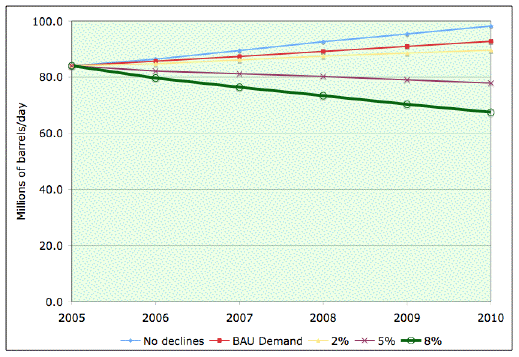
At the time, Stuart listed 3 possibilities:
Enough time has now passed to treat Stuart's forecast as a learning opportunity. Clearly, possibility 3 did not pan out. The 8% line predicts production of roughly 75mbd for 2007, even though actual production is roughly 84-85mbd.
So... I'm curious. Where did your analysis go wrong, Stuart? Did Chris Skrebowski miss most of the volume? Or is it the case that Andrew Gould is smoking dope, Exxon, Iran, and Saudi Arabia are an anomalously bad piece of the production mix, and the average decline rate is really much lower?
I think that Stuart was looking at month to month data. The average annual decline rate, at the time that Stuart did the post, was much lower.
In any case, fourth quarter Saudi production will determine the production decline rate for 2007. Probably the best case is that Saudi finishes up 2007 with a C+C rate of 8.7 mbpd, versus 9.2 for 2006 and 9.6 for 2005.
Note that the initial decline rates for both Texas and the Lower 48 were quite low. I think that the key difference is that Ghawar accounted for a much larger percentage of production than did the East Texas Field, in Texas.
As I have previously noted, it's plausible that we would see an initial steep decline in Saudi production, followed by a rebound to a production level lower than the 2005 peak. But we have seen that in other post-peak regions.
I was just showing the comparative curves to a professor this morning to compare the US (and Texas) peak to the global and Saudi Arabian production and apparent peak.
I think you are correct, if you look at month-to-month you see a fairly pronounced drop and then a brief recovery after the peak (US in particular) and that gives the look of a fairly substantial drop immediately. Plugging the Saudi data in gives a comparable curve.
However, smoothing through the recursed averaging technique shows that globally we are at just about the same point with slightly less decline if you are looking at the global C+C production (note the smoothed recursed peak occurs in November 2005 even though the maximum production month occurs in May 2005). However, if the characteristics are "similar" we are approaching the rollover point on the curve where the decline curve begins to become more and more evident.
However, I pointed out that the concern is not necessarily the old fields (unless they outright collapse because of the water flood and the use of MCWWs), it's the new ones and the deepwater ones that show a quick peak and then decline that can be pretty steep regardless of the the EOR techniques used. The spreadsheets I've put together for the UK, Norway, and the US GOM tell the tale of the greater and greater levels of drilling required just to hold the decline at bay or to slow it down.
I remember that discussion. Even then I disagreed with Stuart who was assuming a constant decline rate. A constant rate of decline is simply too counter-intuitive:
1) Not every field is on the same stage of decline. Some fields have just peaked (Ghawar?), some are crashing (North Sea) and some are even rising or on plateau. It's a dynamic system and the overall effect should be low initial decline rates, which slowly accelerate over time, as more and more fields move from rising/plateau to decline/crashing category.
2) Constant decline rate ignores the effect of economics - rising prices will certainly result in enormous (desperate?) efforts to boost production or at least reduce decline rates. The overall effect should be the same - low decline rates or even slight output increase initially, then decline rates accelerating over time.
You should turn to more recent models that Stuart has worked on, IIRC he has not used the simplistic constant decline model recently.
From the 'cats in a sack' department:
http://www.monbiot.com/archives/2007/11/06/an-agricultural-crime-against...
Well that is one way to get the world population down. Starvation.
After TSHTF, demand destruction will have many faces. A reduction of a million barrels per day for the those on the bottom of the pile will require many fewer faces than a million less for the jet set stretch Hummer riders on the top.
E. Swanson
Ireland exported grain during the potato famine in the 1840's, too.
The problem is not the absolute number of calories available being split evenly during a famine, but rather that the landless agriculture workers cannot afford to purchase any food.
Look at the pictures of the starving in refugee camps and notice the disproportionate numbers of women and infants. Who needs a god, devils and hell when we can allow this sort of thing to happen on earth?
Bob Ebersole
And sadly, this is truth of being human, that it has ever been and ever will be, for an unknowable number of us.
When I was in Western Ireland, one of the striking things noted about the famine was how dead people were found on the side of the road with coins in their pockets.
The British had distributed money in an attempt to help with the misery (though yes, food was exported too), but the failure of the potato crops made a market economy meaningless - it had not really existed before the famine in that part of Ireland anyways.
From the draft of the Khebab/Brown report on Net Exports by the Top Five:
If we see confirmed production declines by the world's two largest producers and net exporters (Saudi Arabia and Russia), which the HL models indicated that we would see, it would seem to support our concerns about future net exports. This is the key point: our model and recent case histories indicate that net export decline rates tend to accelerate with time.
A comment from one of the links which bears repeating:
And that the US barely made it thru the Depression w/o revolution and that the Depression was only ended
by Pearl Harbor.
Meaning we never "solved" the problem of the Great Depression.
$96.17 per barrel now.
Arkansaw of Samuel L Clemens
A challenge you to show me any HARD proof that the US was on the verge of a revolution prior to Pearl Harbor.
Do you not consider the plot that Smedly Butler was involved with not proof?
If Smedly Butler is the best proof, then like I thought we never really came close to a revolution. Maybe a few rich guys in a room saying it might be a good idea, but a few guys running their mouths a revolution does not make.
Rich guys in a room run capitalist societies. Many coups have happened in lands to our south on the say-so of the fatcats. Remember the US Army only had 80,000 men at the time of the coup, while the National Guards were much more under the control of state governors then, and many state governors were the private property of Big Business. (Texas and Oklahoma had a border war in the '30s between their National Guards over an oil field.)
Our capitalists were plenty evil enough. Ford and Hearst were not the only open admirers of Hitler, who only needed the support of Germany's fatcats to complete his own coup. I recall Cokie Roberts' aristocratic mom telling an interviewer that the elite of Louisiana used to get together and talk about killing Huey Long, and lo and behold, it happened.
Maybe it isn't technology that you are a shill for, but capitalism.
Hearst/Kane;
'You supply the Headline, I'll supply the war.'
Wasn't GHW Bush's Dad, Prescott Bush, involved in a plot to assassinate Roosevelt?
... Prescott Bush, involved in a plot to assassinate Roosevelt?
See my post further down.
At the time, the number of combat veterans (World War I) in the US army was much smaller than the number of combat veterans in the United Coal Workers.
There were no assault rifles. Military rifles were what we today call 'deer rifles'. There were very few tanks, no helicopters, very few fighters, and the gold reserves were in the major cities, as well as the telex and railroad centers.
A military coup in the 1930s was not going to happen.
Movement to create the State of Jefferson out of parts of SW Oregon and NW California was gaining momentum in the time up to WWII. Pearl Harbor, which essentially unified the US, effectively killed this movement.
See: State of Jefferson
-best,
graywulffe in CVO, OR
May we quote you on this the next time you make a post about the revolutionary nature of some patented technology that has yet come to market?
Roosevelt stepped up and saved the upper class. With the consent of a very frightened industrial elite he told the Supreme Court to allow drastic changes in social and monetary policy or they would be flooded with extra appointees who would force the issue. The rise of Fascism, Nazism Socialism and Communism was such that without a change in course todays precious market economy would look a lot more like Europe and possibly even the pre-Perestroika Soviet Bloc.
How Roosevelt Saved Capitalism
Gary-
I agree, Roosevelt and Keynes saved Capitalism. It was so discredited after 1929, and shift from a less superstition based economic system was unfolding.
The proof is Pearl Harbor.
Even as the Commander was complaining of lack of aircover the Lexington sails away-the last carrier in Pearl.
And you used the word "verge". If verge is Post 1939.
OK.
The US Economy began to pick up after the Lend Lease deal
with Britain which financed the US MIC and gave us Britain's
Empire at the same time.
$96.84 We're i a Recession right now.
Depression by Christmas.
Arkansaw of Samuel L Clemens
LOL, where do you get this stuff? Is that before our after Mexico halts all exports by the end of the year?
Mexico has already halted all exports, due to the floods in Tabasco. The question is how much gets put back on line quickly. The North Sea is at least 1/3rd shut in due to a huge winter storm, too.
Bob Ebersole
Yes, but there's no indications that it will last.
There is also no solid eta on when they will come back on line either, if at all.
And here's the bottomline:
Triangulation of Death by a thousand cuts.
By tieing a chain from truck to a treepost and then hooking thru to the object to be pulled. you increase your leverage/work
by multiples. Thru Triangulation.
While oil is $97 climate in Tabasco like places is the multiplier along with 4gw to bring Complexity to its knees.
"Allow me to sum it up: the money's lost, folks. You can't borrow more and pretend you made the money back. All those trillions in bad debt and derivatives are already lost. The Ministry of Propaganda is in a tizzy, trying to mask the meltdown and offer up a facade of normalcy. But the money's already lost.
Here are a few predictions( as prediction make fools of us all):
1. The Dow Jones Industrials will drop hundreds of points in a day, very soon, losing at least 3,000 points within the next few weeks.
2. The Shanghai stock market will lose half its value, dropping from 5,800 to under 3,000.
3. Major banks will be declared insolvent.
4. Major lay-offs will occur as U.S. retail, auto and house sales plummet.
5. The tech high-fliers (RIMM, GOOG and AAPL) fall will precipitously
As I have noted here last week, trading curbs (and the uptick rule on shorting) have both been abolished. There are no constraints on the market falling; a free-fall of several thousand points in a single day is now possible...."
http://www.oftwominds.com/blog.html
Depression by Christmas and Mexico oil production
is 100 000's of barrels less from now on.
Arkansaw of Samuel L Clemens
My prediction...TBTB are pretty powerful. They will hold off the wolves until after the shopping season. Look for 1Q 2008 to be ugly.
Yes they are.
But notice the ads and WalMart are coming out weeks early.
Not good.
The problem is that we/they can't extract resources faster than they are/have been.
The $ is no longer the World's Reserve Currency.
At what point does the price of oil rise high enough to
fill the US Inventory.
I don't think there is a price anymore that can do that.
Will TPTB rig the Inventory Report is the question now.
And if we have the oil where is it?
But 1Q 2008 will be ugly you're right.
Arkansaw of Samuel L Clemens
If Gulf Coast crude oil inventories drop to a low enough level, Bush will open up the SPR. So, short term, no problemo.
Longer term, the problem with using emergency reserves as a swing producer is replenishing the reserves. The SPR may die the death of a thousand cuts.
Or the death of a thousand water cuts.
So then you accept the rest of the post as correct.
Glad you actually learned something on TOD.
And that the question about there being an almost revolution is correct.
Oh, and how you, The antidoomer was wrong.
Eric, I simply believe what I wrote. I'll make you a bet if by January 1, 2008, there are still no exports coming out of mexico and the US is in a depression i'll stop posting for 6 months, if the opposite is true you do the same. I'm very confident these things will not happen (99% confident).
Eric, I simply believe what I wrote.
You did not challenge:
Therefore your initial resquest:
Was met, answered, and you left it stand as being correct.
Some of us don't believe that inflation was a mere 0.8% during the third quarter. If it was 5%, we're in a recession now. I'd guess 10% inflation is closer to the truth, but I'm no economist-at least I made some good choices when I was younger.
The 0.8% inflation and 3.9% real GDP growth are linked, and based on a weird accounting system that [i]subtracts[/i] the price rise of imports from the calculated inflation. During Q3, oil prices rose substantialy but retail gasoline prices actually declined slightly. This decoupling reduced calculated inflation by about 1.3%. Hence, more representative numbers would be 2.1% inflation, 2.6% growth. See http://www.marketwatch.com/news/story/inflation-low-because-oil-prices/s...
I also know that a bunch of people believe that the government's inflation calculations are deliberately manipulated to be low, but I'm not enough of an expert to know whether they're right.
peace,
lilnev
I think theantidoomer has a point on this one. Depression in the next 49 days? Hey, nothing is impossible. But really, that's unlikely to say the least.
A naysayer is sometimes useful to keep us honest and point out when we say something outlandish.
Recession ?
Absolutely out of the question, according to the IMF.
Just found this on Bloomberg
http://www.bloomberg.com/apps/news?pid=20602099&sid=aVy3VSJzUqXo&refer=e...
There are some absolute gems in this piece, such as
and
and my personal favourite
Have I stumbled into OZ or did it somehow become rational to completely decouple demand from supply?
"The proof is Pearl Harbor.
Even as the Commander was complaining of lack of aircover the Lexington sails away-the last carrier in Pearl."
Um, you may not know this, but land based aircraft always has speed and range advantages over sea based aircraft. What we didn't have was enough modern fighters, or the factories that built them for that matter. That the officer in charge of the radar overruled the corporal with experience, and shut down the radar so they could go to breakfast, was an additional factor.
The conservatives tried to keep America from rearming for fear that it would end the Depression and make their household servants uppity. The conservatives tried to limit US fighter purchases for the Armed Forces to 56.
Per year.
They got outvoted, thank god. We started ramping up in 1939 and just kept ramping. See Ellis in 'Brute Force' to get the idea on munitions trends duuring the war.
I'm not sure how close the Bonus March could be said to be "on the verge of revolution", but it sure must have looked like it to some folks at the time. It certainly made even the biggest Vietnam-era marches on Washington look mild by comparison:
Bonus Army
If one were to have some fun with counterfactual scenarios: I wonder what would have happened if the regular troops had decided to side with the vets rather than to obey orders and move against them? It could have happened, you know. The army was pretty small and, except for the top officers, not all that professional. The natural sympathies of the troops would probably have been more with what they perceived to be fellow soldiers than with Hoover.
Via:
http://www.angelfire.com/pa3/ericblair/MEMORIESOF1984.html
The link to:
http://www.whatreallyhappened.com/coup.html
What was the hard proof that Russia was on the verge of a revolution in 1916 or that France was on the verge of a revolution in 1788? Us poor folks (unlike the rich folks covered in my other reply) are never listened to, so that's why we revolt. In 1979 the CIA was caught completely flat-footed by a revolution against our number one stooge, the Shah of Iran.
But here's some bad signs:
Iowa (Republican) farmers were forming mobs to attack process servers from the banks trying to foreclose their lands.
An avowed Socialist, Upton Sinclair, won the Democratic nomination for governor of California in 1934 and ran on a radical platform of wealth distribution, going way beyond the New Deal. He was doing well until FDR betrayed him, realizing that the Democratic Party coalition would fall apart. FDR ganged up with the California GOP to destroy Lewis with a smear campaign ahead of its time - right-wing Hollywood studios provided propaganda newsreels, some of which I've seen. FDR's quid pro quo: that the state GOP stop resisting the New Deal.
Oil-rich Louisiana had already elected a leftist in 1928, Huey Long, whose story eerily resembles that of Chavez in Venezuela. You know how Long's story ended, with him gunned down as he planned to create a nationwide socialist movement.
Douglas MacArthur led tanks and infantry to crush an encampment of destitute war veterans and their families in Washington DC itself in 1932, claiming it was the beginning of a Bolshevik revolution.
Poor Americans were regarding ruthless criminals like Dillinger and Capone as heroes.
Like Germany at the same time, and like Pakistan a couple of years ago, the regional rebellions had begun in America by 1932. Unfortunately Musharraf is no FDR.
Really, Antidoomer, the question you should answer is, under the objective conditions of life for many in 1932, why shouldn't a rational man turn to revolution? The aforementioned troublemakers at least took up arms against a sea of real troubles, while we at the Oil Drum gasp with dismay at the indifference and ignorance of an increasingly enslaved citizenry. Enslaved by greed and technology. You presented yourself as a nonpartisan advocate of technology, but your fear of the facts of the massive betrayal of the innocent by capitalism in the '30s tells me that you do indeed have a politial agenda. Stop hiding behind those fuel cells and admit that you are opposed to redistribution of wealth.
Oh and take a read on this one.
Coup in America in '34??
snip
http://www.commondreams.org/archive/2007/08/02/2933/
Quite a read. Not many know about it.
Yeah, that's what I was thinking of--thank you.
I hadn't heard about the planned 500,000 man militia. If the bad guys had enough bankers behind them they certainly could have obtained the payroll. This is really interesting from a military standpoint. Like I said above, the state governors were mostly in the pockets of big business, so the only National Guard who would have taken the side of the Left was maybe Louisiana.
Not only was the Regular Army down to 80,000 men, but it was in sad shape, as we all know from the stories about the runup to WW2. It had reverted from trucks to horses. It lacked submachine guns and flamethrowers, two innovations of 1918 that surely would be exploited by a wealthy revolutionary intent on street fighting. Amazing at a time that the world was awash in surplus weaponry. Now if MacArthur was still in charge of the Army that would be as powerful as the Spanish Fascists having Franco in their camp. Perhaps the Army would have quickly switched sides to the coup plotters.
Militarily, it sounds like the bad guys made only one mistake; trusting Smedley Butler.
And as for all you right-wing bigots who accuse FDR of every sin you can imagine, he had plenty of opportunities like this Congressional investigation to argue for truly dictatorial powers and radical redistribution, Chavez-style, but he passed them up to maintain the predominance of bourgeoise control. While Bush has seized greater power on far flimsier evidence of a real threat to the Republic's survival.
The quashed 1934 coup was delayed about 66 years when it finally came to pass in 2000 with the Supreme Court installation of Bush as President. The 1934 corporatist's dreams have essentially been implemented in US law since 2001. See Naomi Wolf's latest book.
The 1934 corporatist's dreams have essentially been implemented in US law since 2001. See Naomi Wolf's latest book.
I found it ironic that Kerry's Wife Teresa Heinz was married to John Heinz whose father was one of the ones involved in the 1934 story I posted above along with George Jr's connection.
John Kerry (Heinz) / George Bush Jr. Both have connections to the 1934 coup in a weird way.
6 degrees of the 1934 coup?
So Heinz and Bush's coup of take over came about in a strange way.
jc
Samsara, Kerry lookss like the straw man of the 2000 election!
James Gervais
Revolutionary thought based on the poverty of only being able to sock away a grand a month? Not bad for someone able to play on the internet all day.
Sounds like a well financed Beverly Hills revolution. :-)
I'm a temp, Musashi. I was unemployed during much of the so-called Clinton boom and the current bubble economy. I have a Master's Degree in International Relations from Michigan and I have never had a job that paid more than $14 an hour. I save $1000 a month off of that income because I assume that it's the last decent job I'll ever have. Being only half-white, I guess I must have more economic discipline than the white people who you think are the only Americans of "merit". But I'll be damned if I will work hard for their system if I can fool them into thinking I'm busy.
The thing that keeps me working is what I'm planning to do to some of those people once there's no longer an economy or a government. I don't expect to survive very long. But when I look upon the character of my enemies I take heart.
If we were to meet personally we could have a interesting conversation.
I have no special education other then 20+ years in the military and a talent to pick details out of the woodwork on the fly and I have been lucky in life by backing into things.
I don't work for the system either, in fact I'll be damned if I do at this point, but we probably have quite different ideas on who controls the system and what the problems in the civilian environment are, based on percentages.
Way it goes, nothing personal.
The irritating and frustrating thing is, we do have the ability and at the moment the resources to begin to tackle many of our problems, be it climate change, or the challange of Peak Oil. Only were not applying ourselves to these issues, instead we're wasting collosal ammounts on the bogus war on terror, which in reality is a grab for control of what's left of the world's fossil fuels.
Recently Peter Orszag, who is the chief of the Congressional Budget Office, spoke before the Congressional Budget Committee. He told them the war and occupation of Iraq was going to cost around $2.4 trillion dollars over the coming decade. Others put the figure far higher over a longer period, manly because of the massive cost of looking after the severely wounded.
Anyway the members of the committee expressed "astonishment" and some were "staggered" at these numbers. Some apparently wondering whether this level of expenditure was sustainable, even for a country as rich as the United States.
Now, this is $2.4 trillion dollars that never needed to be spent. Saddam was ruling Iraq with a rod of iron, but Iraq was relatively stable and no threat to the United States. This vast fortune could have been used instead in the United States far more productively. Instead the ruling-class decided to piss all this money away in the sand, for a lie drapped in an illusion. And this is the future they offer the American people, endless war, and bankruptcy at the end of it!
What we need is something to impose shock and awe on the ruling-class. I'd like to see the whole dishonest bunch put on public trial; Bush, Cheney, Rice, Powell, Rumsfeld... the entire gang in the dock together. Not only that all their assets should be confiscated by the government and put into a fund to help maintain wounded US soldiers over the next sixty odd years. It's not enough, but it would be a historic start and perhaps make these bastards think twice about starting more wars, if they were really held to account for their actions!
Thanks for opportunity to remind all today is Election Day.
Sure, sure, it doesn't matter. But for example in NJ we have two bond issues, a stem-cell initiative (because guess-who restricted Federal funding) and preservation of open space.
We can rant 24/7/365 but only vote just one day a year, and however meager the options, that's the way the imperfect system works right now.
As Bob Shaw keeps pointing out:
From 3 Days of the Condor:
If Iraq's reserves turn out to be worth $30 trillion or more as estimated, $2.4 trillion will be a great return on investment.
They didn't piss it away. They simply transferred it from the taxpayers to the wealthy ruling class of the country.
http://www.lexrex.com/enlightened/articles/warisaracket.htm
This link to Smedley Butler's book shows that he would have agreed with you!
Meaning we never "solved" the problem of the Great Depression.
Oh, in many ways we did. By the time the war effort began, GDP had been growing since 1933 with a mild dip in 1938. It was larger in 1936 than in 1929.
http://research.stlouisfed.org/fred2/series/GDPCA/chart?cid=106&fgid=&fg...
When people talk about WWII ending the depression in the US, they are mostly referring to the end of elevated unemployment and the return of extremely rapid growth.
Don't forget the oil demand from the war, which ment there was alot of oil waiting to be sold (excess production) when WWII was over.
I absolutely agree with you that we must stop smearing the lifeboat that the New Deal provided, leaky though it was. But without WW2, how long could our greedy population have endured even the survivable poverty of the later New Deal days before some proto-Reaganite hustler came along and dismantled it all with tax cuts and stealth debt? With its chronic double-digit unemployment and shaky stock market, late '30s America looked a lot like Europe in the '90s. More to the point, it looks a lot like America after Peak Oil.
As a student of the Depression, I've followed this thread with interest. I would say that without WW2 the US would have developed a strong participatory democracy of the sort we see in Venezuela, which would have defeated the technologically enabled manufacturing of consent that was made possible by the tech advances birthed by the war. As it stands now, the public is in favor of many policies the Establishment is not going to implement because those policies lessen profits. Period. Chomsky uses the phrase "business dominated society," which became entrenched during the "triumph of conservatism" during the so-called "progressive era."
The thread above mentions the 2.9Trillion longterm Iraq Holocaust cost. I posted about two years ago here that we could provide one Trillion dollars per Year for global warming and peak oil mitigation projects if the US Empire was comepletely rolled-back. Of course, if you observe the presidential candidates from both parties, they are almost universal in their call for expanded Empire. Kennedy's book, "The Rise and Fall of Great Nations," predicted how the US Empire would meet its demise; and it's following his predicted trajectory pretty closely. The point being we do have choices and available resources to resolve the multiple crises we face; but none of those choices allow for Business As Usual, nor will the needed resources be made available if BAU continues. Peace or War; Civilization or Destruction. History tells us war doesn't work, especially in the age of nuclear weapons. And as most here realize, Peace has never really been given a chance. I'm reminded of the end of the movie "Outlaw Josie Whales" when Eastwood states matterofactly that the natives and his group can live in peaceful co-existence or kill each other off with their guns. As I see it, this is the point we are at now with the rest of the world.
Karlof1 said;
Of course, if you observe the presidential candidates from both parties, they are almost universal in their call for expanded Empire.
Something someone posted on another board fits in here I think.
"As usual, the public will have the Bilderburg approved Republican in column A and the Bilderburg approved Democrat in column B with no real difference between them, and the press will pretend to wonder why the public is alienated and most stay home and don't vote."
RON PAUL Raised $4 Million Dollars yesterday from 35,000 patriot citizens. A NEW Record.
http://www.dailypaul.com/
Support Ron Paul if nothing else to DRIVE'EM NUTS !!!
Remember Remember the 5th of November !!
Alan Greenspan, history's greatest Used Car Salesman, gives us a hint at what is coming...
(i.e. prepare for Hyperinflation)
When Greeny said the following, I wonder if he was including the excess inventory that will be washing ashore throughout the coming year as more subprimes go bust?
How ironic, this coming from the Clown Wizard who just a few short years ago was pumping the housing bubble as fast as he could while encouraging bankers to lower their lending standards.
And this hilarious quote, from the Fed chairmen who excelled at creating asset bubbles using his "strong monetary policy"...:
http://news.yahoo.com/s/ap/20071106/ap_on_bi_ge/japan_us_greenspan;_ylt=...
I really wish Greenspan would STFU. What he did is bad enough; hogging the spotlight and undercutting Bernanke (not that I'm fond of him either) is just too much.
Greenspan is on tour pushing his book...which will be a large part of his defense at the Hague...
I expect to find him drilling holes in some Corps of Engineers dikes in the South to get rid of that excess housing inventory.
My Obsession
My family, who could not care less about anything concerning peak oil, often asks me why I am so obsessed with the subject. Well Roger Conner put it this way as a footnote to one of his posts yesterday.
Exactly! When you are watching the prelude to the end of the world as we know it, it is just damn hard to take your eyes off it.
Yes, I know Roger was talking about the price volity of oil and not the end of the world as we know it, but the line fit so perfectly that I just could not resist.
Ron Patterson
Exactly my situation Ron, Cannot take my eyes of the 100... car collision that is happening in front of my eyes.
I am struggling to get out of the way and pick a safe lane.
The End of Western Civ. As we have known it for 100+ years and all of it's growth paradigms and more coming to an end in REAL TIME.
GameBoy has NOTHING on this.
John Carr
Thank God, I thought I was alone in obsessing about this. I was trying to remember how I stumbled on Peak Oil. It was back in 2004 and I don't know what search string I used but I happened upon the topic quite by accident. Little did I know I would be one of the few to understand what is about to happen to modern civilization. And to this day people still refuse to even entertain the idea of peak oil. They just don't care - but soon they will.
So my question to the group is how/when did you discover or learn about the topic of peak oil? Maybe we can figure out how to spread the news to all of those with their ears still closed.
I'd say that 9/11, in its very dislocating manner, is the event that brought me to Peak Oil awareness. Not instantly, but gradually over the years afterward.
I first encountered the problem of PO around 1997, when I worked in energy analysis at the Lawrence Berkeley National Laboratory. Near-future problems with oil production came up during a casual conversation I had with my supervisor. He mentioned that we might be seeing serious oil-price increases around 2007, give or take a couple of years. I can't recall where he got his information, but that conversation stands out eerily from the late-1990s boom-times now that prices are, indeed, escalating dramatically.
At the time, I hadn't grasped many of the more dire implications of high oil prices. I mainly thought in terms of having to pay more to drive, and what my response would be. Greater awareness happened after 9/11.
-best,
graywulffe in CVO, OR
I followed a link on the gasbuddy website. Gasbuddy is a website that tracks retail gas prices in most cities in North America in case you don't know. I don't know what site I ended up at but I came across a reference to peak oil. It was used in such a way as to assume the reader knew what it meant. I wiki'd peak oil and within a few days of browsing, landed at The Oil Drum. I've been a spectator to this slow motion train wreck ever since. My sister now calls me 'doom and gloom'.
Picked up Paul Ehrlich's book "The End of Affluence" in 1975 from the book mobile. I may as well been named Alice.
Michael Moore used to have a link to peak oil information on his website.
I utterly despised him at the time but still thought I might as well research some of his claims to see if they had any merit.
I have had quite a radical transformation in my thinking since then including a political flip-flop.
Read an article about three years ago in a UK newspaper that discussed the era of coal and then oil. In fact the sentence that caught my interest was somehing on the lines of 'just as in the 20th century coal started as king to be replaced by oil so the 21st century will see oil loose its kingly status'
That prompted me to ask the question how much oil is left? I quickly got to the BP statistical review and a quick division of known reserves by current production cam in at less than 40 years. My immediate reaction to that was this is going to get very 'geopolitocal' by 2015 - 2020 as the end is in sight. (Further down the line you realise the geopolical aspect has been going on years and is ratching up a few notches now)
Of course further reading brought me to 'Peak Oil' and of course Hubbert etc. I immediately saw the reasoning but decided if this was half true, read more and research the arguments for and against. As many here will agree the more you read and understand the more evident it is that this is real and we have a problem of immense proportions.
btw I am not of an acedemic background just working class UK. So how have I 'got it' while many more intellegent people round me haven't? I think the answer lies in the tunnel vision of many people and the main concern being their immediate environment. "I'm alright Jack" and as long as nothing affects me personally and my 'world' is fine whats the problem? I think people are conditioned into a system where pleasure, entertainment and material progression are seen as the goals and the MSM feeds these perceived 'needs'. This is why I think it will be some big event that finally wakes up the majority of the population, long past any period of half easy remedy. Its also why I fall in the 'doomer' camp. Sorry to ramble..
Come now, Sangiovese, no false modesty on TOD please !
The intellectual path of discovery you describe could only have been followed by an unusually intelligent person, and you know it.
The reason why I lot of "more intelligent" people haven't got it - and I would include the vast majority of elected politicians in this category - is that they are certainly not "more intelligent" than you. Quite the reverse, in fact.
Hi
I know exactly what you mean. I work with very high IQ IT professionals. I have been following Peak Oil since early 2005 I drive around in an electric car and spout statistics oil prices and references to everyone. It's so simple but..
can't .. make .. them .. understand! Argh
I think Nate Hagens puts his finger on it when he says the analysis needs to come from an authority figure.
Even today someone told me high oil prices were gouging even though I had just explained that I have spent 3 hours a day reading about PO for 2 1/2 years. Did he really think his snap common sense beats that? He won't even look.
These are smart people. I hold my head in my hands in despair!
Carbon, Coventry, UK
shortly after Katrina and the spot shortages of gasoline, the Dub said in a speach (paraphrase) "what America needs to take home from this is that we need more refining capacity." i was a 29-year old, booze sucking, coke snorting white guy, but something about that statement didn't seem right. i had never cared much about politics, environment, or anything for that matter. I guess GWB awakened me from my apathy about the world around me (amazing how many other people he has affected like that.) That got me reading, eventually picking up the Long Emergency in a bookstore. 18 months of depression followed. and now I can say the best part of having a firm grasp of reality is being able to enjoy the present.
I've known about peak oil since the mid-90's. I can credit Jay Hanson for his incredible insights on this. It's been clear to me for decades that we can't keep growing and are headed for a Malthusian catastrophe at some point. When I discovered Jay's writings I immediately said A-ha this is what's going to bring the whole thing down.
So I've had the advantage of many years to prepare. Not that it'll probably do me much good.
I think you can forget about trying to convince people. The vast majority are simply incapable of understanding what's happening. I bet even a lot of TOD readers don't really understand the concept of Net Energy.
Most people will go to an early grave without ever even understanding what happened to them.
How/when?
Well, I sort of knew about it in a general sense in the early 70s. Between the Limits to Growth, Ehrlich's Population, Resources, Environment, the course in Environmental Economics I took in college, and a lot of the stuff read during the energy crisis, I was well aware that there was a finite amount of oil that would eventually deplete, as would any non-renewable resource. What I didn't know was when to expect the peak, though I suspected it was at least a few decades off.
I had kind of kept that info in the back of my mind over the past couple of decades. Then I saw Ken Deffeyes talking about one of his books on CSPAN last year, that caught my attention. No big revelation, I knew instantly what he was talking about. Just "Oh, I guess we're about there, then." That's when I started doing more internet research to update my knowledge base and get up to speed.
I came across Peak Oil while browsing around on "crooksandliars" about a year ago. I followed the link to LATOC, and read the whole thing in one sitting. I was floored, and depressed for a week, but immediately predisposed to accept it. I was a math and physics person in college, and had actually studied quite a bit of geology. I even remember discussing oil issues in my mineralogy class around '81. All we ever did though was a simple P/R calculation. It yielded 40 years left. No problem! So I promptly forgot about it. How easy it was for that youngster to completely miss the enormous amount of detail that had to be overlooked to arrive at that comforting number. Funny though, I can remember doing logistical functions in biology, looking at predator/prey population curves. It never occurred to me that the same general mathematical principles used to analyze how, for instance, the population of wolves pursuing a limited prey base could be invoked to understand the data on the "hunt" for, and production of, oil. But as soon as I saw that bell curve I knew. It was like an enormous gong had rung in my head, it was so obvious. I was drawing the implications before I had even finished my first primer. Nowadays, after a year of lurking on the Oildrum, I feel a lot better. Information , even if it is of a dire nature, is better than ignorance. I have been able to do A LOT of preparation (Thanks for the ELP, WT). I had hoped for a couple more years, but I already live in the country on a good piece of land, so I started with a built-in head start. But like many of you I have had a hard time convincing others. It only took a few rebuffs for me to get the message to back off. But now some people that thought I was goofy a year ago are starting to come around a bit. In the community college I teach at I have become a charter member of the "sustainability" committee. I think they want to talk recycling. I know a Power Point show by Gail the Actuary would probably still get me canned, but nonetheless, I think I can finally start to crack the awareness barrier as $100 dollar oil provides the perfect "teachable moment". Wish me luck. If somebody has created a toned-down presentation for introducing people to the subject, I would love to use it! I'll close this now. It is bad form for newbies to ramble on. I don't even know if this post will land in the right place in the thread, since I hardly ever comment anywhere! (Forgive me if I miss Leanan)
2001ish. In a Mike Ruppert www.FromTheWilderness.com article. Couldn't find much on it. Then found www.dieoff.com and it's been downhill ever since :-).
It took me a year to get my head around it.
After doing the preaching thing for a few years, with the normal 5% penetration rate (of just people who understood it, and believed it), and the 5% penetration of THAT 5% of people who will actually change their path/life.
I have got to the point of only trying to awaken those who give it an ear.
You Can Lead A Man To Knowledge,
But You Can't Make Him Think
Good luck with Family and Loved Ones.
It's DAMN Hard.
I started reading TOD a few months ago, and am trying to absorb some of the technical aspects. However, even without related technical knowledge, it's not that difficult to understand the general trend, and the fact that oil prices are now approaching $100/barrel (and will probably keep right on increasing) and the fact that articles are now starting to mention supply issues certainly underscores the situation. Interestingly, my guess is the developing situation is still not on the radar for most people. Being kept too busy with bread & circuses I suspect.
I mentioned it to my (84 year old) mother who follows politics quite closely; to my surprise her reaction was "oh well, nothing we can do about it, and it's so unpleasant, let's change the subject." Argh! Maybe it's just that contemplating a complete shift in the direction of our culture/civilization is just too much to deal with for most.
Thankfully my husband and son 'get it'. My husband is a great believer in frugality anyway, my son is anti-consumerism, and ever since the 2000 selection of W I've been returning more & more to my more 1960s style of thinking. So ELP is on our agenda. And I'm trying to wrap my brain around options in the event the whenever TSHTF we are prepared from many angles.
Read a review of the Party's Over in Home Power Magazine. Ordered the book immediately. Wife and I started thinking of where to go and getting out then. Found TOD during their excellent coverage of Katrina and Rita. Amazed friends with predictions of gas price hikes and shortages, gleaned from TOD, but most of them remain Peak Oil deniers, though one is more into JHK than even I am.
I can't abandon all hope though. I have two teenage daughters.
I read Jim Kunstler's article in Rolling Stone, and started my quest to find out more on this subject, I tried to educate my co workers and family about this, giving them copies of articles et cet, a few people took some passing interest but most folks just do not want to hear, none are as deaf as those who will not hear.
I am not very sanguine about people picking up on this, not for a while at least. I saw the news today o boy it had a piece about oil prices, it was full of the same old song and dance, Problems with Iran, Iraq, Nigeria about OPEC having capacity i.e. the KSA and Venezuela but holding back oil, it was about every thing but peak oil,
Oil is less than $4 away from $100.00 a barrel. At that point I think it might enter into the public consciousness that something is amiss. Perhaps then people will come to realize that is is a geological event more than a geopolitical event.
Had given a lot of thought to Malthus and energy/food flows in '70-72. Eventual crash obvious unless practical fusion or O'Neill's space colonies altered things. I worked on both a bit.
In '74, was doing field seismic research for oil while sending my paychecks to save whales, in a bit of an existential quandary. The marsh buggy broke down and I volunteered to stay with it, as a way to get away from the rednecks I worked with and be alone. As the roar and clank of the other buggy receded in the distance, a light rain blew into my face and the marsh came back to life in a hundred ways. I turned my mind to the intersection of oil reserves and Malthus, which I had consciously avoided.
I quit the next day and undertook the saving of endangered species, to try to get them past the near-inevitable human energy crash and dieoff. I estimated it then at year 2040, which was probably overoptimistic, but I was doing back-of-the-envelope mental estimates. That would have been mid-'74.
I then studiously ignored the subject itself until the end of 2005 when my wife became ill, and dusted off some of my old outlines for books so I might write one while caring for her. Decided that it was time for "Emergentcy" (working name) about how the world was gonna crash due to the intersection of various dire causes. (the working title was since I planned to stress 'emergent' phenomena.) Anyhow, I mentioned it to a board member and he said "sounds like Kunstler's book". I got that & read it, realizing that (a) my assumption that nobody else would ever get a clue was incorrect, (b) that Kunstler was a better writer than I was anyhow, and that (c) there existed people actually discussing this stuff! A heady thought.
I was catching a flight and looking for a book to read and ran into "The Oil Factor" by Stephen Leeb. The book's focus was explaining the concept of peak oil and then hypothecating ways to profit from it (invest in oil companies, solar energy companies, Encana, Toyota, etc.). My reaction was 'if this is real, then investing is the least of anyone's worries'. I started researching on the web and then reading every book out at the time on peak oil and became convinced it was real. I know a lot of people diss Kunstler's negativism in "The Long Emergency", but I have difficulty refuting his analysis.
Despite my enthusiasm for the subject and constant discussions with people, I have found it very difficult to interest others in peak oil or in its potential impact, and I don't know how to get through to them. It seems I am either preaching to the choir or to a brick wall, so preaching has become somewhat irrelevant. Instead I focus on trying to personally prepare by developing a sustainable, energy and food self-sufficient farm. To that end, I have designed and built a passive-solar house heated with a masonry heater and geothermal heat pump and powered with PV. I am learning to farm with horses (and acquire the equipment necessary to do so), raise and can my own food, mill my own logs into timbers to build my outbuildings, and raise grass-fed animals. I'll still discuss peak oil (and the credit crisis) with people but do so with little hope for convincing them to change their conduct or to prepare. Hopefully, by living the changes necessary, I can at least provide an example (maybe a "do as I should have done, not as I did" example) for those so inclined, but I have run out of hope of convincing people through speech.
I'd say that I heard about peak oil from Kunstler's film "The Death of Suburbia" which was shown by a sustainability group on my college campus. I started reading TOD the week after Katrina hit. Kinda just stumbled upon it, actually, and it provided some rational information to a gut feeling I've had for a while. I've been mostly lurking ever since. I think that there is going to be some radical change in the world, and it is slowly happening on a grassroots but global scale. People all over the planet are mostly fed up with the status quo and are ready for and beginning to change. Though there may be hardship, the rampant doomerism here on TOD makes me rather discouraged. It is easy to be a doomer when you're in your 50's and only have to look forward to maybe 20 years of this before you "starve to death in your unheated hovel" like so many predict here. Others like myself aren't so "lucky". You folks have created this mess, and it is up to those of us in their teens and twenties to pick up the pieces. Thanks a lot. A lot more of the youth has an idea of what is going on, but they don't know where to apply their energies to get something done. I am sure we'll figure out something. To Malthusian die-off, I say f*ck that. I'd rather pretend that there is a chance and die trying than to go calmly into that dark night. At least then I can "die in my hovel" and be at peace with myself and the universe.
"They almost had it. A global, interconnected civilization. Vast repositories of knowledge. But they never figured out how to love each other. Stupid f*ckers."
-Alien Archaeologist visiting earth, 3279 CE
I do not remember the specifics of how I became a peak oiler, but I have always had a pretty conservative economic mindset, so I have always been "ready" for the message. I never believed Malthus was wrong - clearly he was right in principle, just the timing was unknown.
I read The Long Emergency about when it came out (was still on the "new" shelves at the library). I cannot remember if I went looking for it or if I just happened to see it there and found it interesting enough to check out. Wow, my memory is shit!
In 2003, I remember arguing that war with Iraq was something we couldn't afford.
I remember at the beginning of 2006 I became a gold bug in a big way because I thought (for some reason I can't remember) that the economy was teetering on the brink.
Around that time, I found TOD - probably via a link on reddit, and the quality of the stories here was immediately obvious. Scroll forward a year for me to really get my whole head around the issues.
Beginning of 2007, I wrote a letter to my family, who are spread out around the country, warning them of what was coming wrt peak oil, and pushed for a family discussion of the issue as well as discussion of ways the family could prepare. My father, mother, and brother were interested, but not the same sort of "interested" that I am. I do not know how to describe other than to say, for me, peak oil is something that I know will dominate my life and everything about it, every decision I make from now on, whereas for them, it was something that was interesting to talk about. I lost heart though, as they are technocopians, except for my dad who acknowledges we're completely screwed so let's go play bridge.
I had a recent breakthrough with my in-laws though. During a conversation about peak oil and all, they asked, why can't america just do what Brazil does and make ethanol? I told them an amazing statistic - that the US currently creates more ethanol than Brazil does and that it is simply an irrelevant amount because of how much more oil we use than Brazil uses.
They were stunned. They had no comeback. For half an hour afterwards, they talked like utter doomers, wondering how in the world the US would avoid becoming a third world country.
I am in awe of the power of the accidental statistic or fact to remove all opposition in a mind, and in the way one can never know what will get through all the roadblocks of a non-believer.
About 2002/03 when oil crashed $30. Bit of a web
surfing nerd, googled(or whatever the temporal equivalent
was at the time) and found ASPO. Got it real quick.
Found TOD from there. Been hanging around here three
years(maybe four? ahhh--the years run together at
my age, turned 45 today) come February. And believe me, this place is a major addiction. I understand guys like
Stuart and Robert. Had to take six months off myself
at one point, but came back. Have to watch this
show unfold, afterall.
1998, disinfo.com led me to dieoff.org. I remember reading the 1998 colin campbell scientific american article at a bookstore, but didn't purchase the magazine, wish I would have. I was 20 at the time.
Fuel cell/hybrid cars: I wanted to know if a clean way of driving could exist. The rising oil price in 2004 was praised in theses circles as it made the coming of the hybrid/fuel cell cars more realistic.
I turned more doomerish since then.
When you said "100 ... car collision" for a minute I was reminded of the 100 car collision that actually occurred in Fresno, CA last week. http://www.fresnobee.com/multimedia/story/183310.html
Two miles of cars and trucks strewn on the freeway. Apt metaphor?
Kuntsler, The Long Emergency
I backed into it.
Downsized by choice over 4 years ago, just to KISS.
Then at some point I ran into a link to here somewhere and read about PO.
Now we watch everything going pedal to the metal into a brick wall. Way it goes, we will see what's left when it hits.
It's interesting how we all came to this place. Age and background made a huge difference for me. How the Depression impacted my family made me aways aware that things can go down the tubes. My paternal grandfather lost his business and went from lower upper class to poor and my mom's folks had people living everywhere in their house.
I was also impacted by rising to just below a VP in the company I worked for to realize that people didn't mean shit and would be cast aside to make a buck.
Finally, I was very much impacted by the envirnomental movement.
So, in 1972 I said the hell with it. Our plan, even then, was to separate ourselves from the system.
When we bought our current place in 1979, one thought that went though my mind every time I came home was...damn, we have firewood forever.
None of this is a surprise to me. It's really just a continuation from what I saw 35 years ago.
Todd
In my case, running (being run by?) my small business and finding out that no matter how hard I worked or how much I made, it wasn't enough. I realized I was richer when I was making $5 an hour. I got into the car-free movement for a while and from that wandered into PO. I think an important moment for me was when I was thinking about the overall energy flow - like, does this whole high-tech world depend on farmers and the sun? Wait, that's not enough energy to run everything, hold it a minute, the extra energy that makes us more advanced than the Incas or Mesopotamians has to be oil, coal, etc which has to be extracted and used 1000's of times faster than it's created.... uh-oh.
When in 2006 things started to go sour business-wise I just vowed to work even harder, when things really went sour in 07 here it's been something I fought but it's also been welcome in a funny way. OK I've tried my best now I can just go be a bum lol.
It is, without a doubt, the most fascinating spectacle that I have ever witnessed. I, too, have become an addict. Perhaps someone will start a group...Maybe POA...similar to AA with a multistep program but for peakaholics? Like while watching great films or plays I find myself thinking ahead to likely endings. Since it probably will be the last great entertainment for homo sapiens, and the production stage is the world, how could anyone tolorate missing it?
I sympathize with your attitude. There is a macabre fasination connected to this whole subject, at least for us, for now. Others, who are on the sharp end may not appriciate the grotesque nature of the "game"!
There's also the effect all this "voyeurism" may have on one over the longer term to consider. We've got front row seats, but were sitting in the Colosseum, and are about to be "entertained" by watching innocent people torn to pieces by wild animals.
Problem is that this is an audience participation event. Just because you're in the seats doesn't mean the lion isn't going to jump up and bite your head off.
- Scott
"Winter is coming"
You don't need to outrun the lion - you only need to outrun your neighbor :-).
writerman, artaxt, I know that I am an observer that will soon be involved in the play. So will my children and grandchildren. I have done what I can to prepare, I can do no more, I dont worry about those things that I can do nothing about...and, no one is paying me to solve this problem that I did not create... I am no more guilty because I watch the proceedings in a curious manner than I would be if I stood on a soap box holding a sign in the air...We are all equally innocent and guilty for this disaster. Well, perhaps there are some politicians, lobbyists, bureaucrats, etc, that are a bit more to blame than others...But most are 1/6.5bn parts guilty.
So sit back and enjoy the show till the day you are thrust into the fray...
Yup if you can grasp the complexitys of the situation, it's more entertaining then tv and most movies.
I know what you mean. Since I learned about PO and became regular TOD visitor, I've barely watched movies, sitcoms and similar entertaining stuff. Maybe news and documentaries, but even that much less than before. Once you know it's all Matrix illusion, only thing that matters is real stuff.
Not to say that Matrix doesn't have its pleasantries ("hmm, juicy and delicious steak..")
Voice from the country of two lane highways and still inflating housing bubble
Ron, there is more to it than that. The species finally gets its comeuppance. You are a misanthrope!!
I say that affectionately, you grumpy old coot! :-)
(Have seen you quote Straw Dogs, one of my favorite books and a strangely enjoyable and relaxing one)
Ace, nothing could be further than the truth. I love mankind. I hate to admit this but more than once I have just sat down and cried when contemplating the fate of mankind. I see my grandchildren twenty years from now and it just tears my heart out.
And I do not believe that the species is getting anything it deserves. No one deserves such a fate. We are victims of circumstance, the sole product of our heredity and environment.
You said you liked the “Straw Dogs” quote by John Gray. Let me give you another one that better exemplifies my opinion:
I am a determinist Ace, that means I do not blame! We find ourselves in this terrible because of our nature. It is simply in our nature to behave the way we do. And we do not deserve our fate, whatever that fate may be. We simply get the hand that was dealt us and we play it the only way we know how.
Ron Patterson
I can certainly sympathize with anxiety over the future of loved ones. Similarly with the reluctance to blame.
Sorry for the misanthrope label. I was projecting.
For myself, I'm definitely apathetic about the species long term future. If a time traveler informed me that the earth's population in 3000 was only a million stone age types, I would be more intrigued than dismayed.
This thing of ours -- global complex society -- has had a good run. I don't want its health to decline rapidly. But that's for practical reasons. My main affection is for the wild earth.
"Do not speak of what men deserve. For we each of us deserve everything, every luxury that was ever piled in the tombs of the dead Kings, and we each of us deserve nothing, not a mouthful of bread in hunger. Have we not eaten while another starved? Will you punish us for that? Will you reward us for the virtue of starving while others ate? No man earns punishment, no man earns reward. Free your mind of the idea of *deserving*, of *earning*, and you will begin to be able to think."
-- Odo, The Prison Letters (Ursula LeGuin, "The Dispossessed")
Le Guin is a truly gifted author.
Indeed, and "The Dispossessed" one of the most incredible books I've ever had the good fortune to read. You picked out one of several life-changing (for me) passages from the book.
I almost decided to get my copy, read first when I was maybe 25, to help set the scene of the old miner with his whispering, raspy voice, entering the disagreement between mother and son, like an oar.
so in that line of thinking we should not lay blame on ourselves for being so foolish to dump tons of carbon dioxide into the air triggering the next great mass exteintion? While at the same time we continue to live in and use parts of the system that is causeing it?
This kind of thinking has to be the dumbest i have seen on this site. you CAN'T solve a problem or adapt to a change in living conditions WITHOUT placing the blame who/what caused the problem or what caused the change in living conditions you have to adapt too.
Maybe you should go ranting against that which you haven't even bothered to try to understand.
Can we blame the water for making us wet?
Can we blame the biosphere for having seasons, requiring humans to continually adapt and upset our other plans?
So we should wage war on water? And then eviscerate the environment?
Oh, wait, that's what humans are currently doing.
If you want to know whom to blame first, gaze upon your reflection in the oil slick.
IMO, speek, The Possessed is a much better book.
James Gervais
Dostoevsky and Le Guin actually have some parallels in the themes they deal with. Dostoevsky is awesome and chilling, but I relate better to the more modern Le Guin and the less religious approach to the problems.
I think you are answering Bob Shaw's question.
Yes, it is fascinating, and also sad and frightening (when I think of my children). There is a strange dichotomy between those parts of the process that seem to be happening amazingly fast, and those that seem to be taking forever. I try to look at it as the theme that will define the rest of my days, and that of my children, and see some amount of hope that from it will come a better society. I only hope the rate of change does not become too great to keep up with.
I'm waiting for someone to write...
"Alice Through the Bottle Neck"
"...waking up one morning Alice discovers that ___________________ has happened triggering _____________________ and the world is thrown into turmoil."
for this it the event that I am absolutely obsessed on.
Into the Bottleneck
What scenario would unfold if this nuclear explosion went unclaimed by the actual attackers?
-best
graywulffe in CVO, OR
Thanks for responding graywulffe
interesting choice of location
for my parents sake I hope this remains fiction.
cheers!
Indeed, I most certainly hope that such events stay in the realm of fiction!
-best
I am also a PO addict now. I too believe that it's human nature and instinct that is driving us over this cliff. We're like a fish that gorges on food as long as it can find it. It can't think about the future and regulating its behavior. It's also the herd instinct. It shows once again that humans have the power to reason, but they don't actually act or live by reason. Reason is only a tool to be used to satisfy the basic animal drives to survive, procreate and excercise power. It's true that some humans rise above that level some of the time, and some have done it spectacularly well, but on the whole the world does not contain many in this day and age.
-Don
For all of you determinists, I have challenge for you. Please understand that I am not saying you are wrong. Nor am I saying your opposites on the free will side are wrong. So, here is your challenge.
For a deterministic view of the world to "make sense" it must somehow account for the apparently universal perception that as individual actors we have a choice (e.g., to get out of bed now, or in 5 minutes). Note that saying that we are determined by our genetics and environment to perceive choice is not sufficient. So, how do you account for this perception that choice exists?
(And no, I don't claim to know the answer, or even have a dog in the race)
So, how do you account for this perception that choice exists?
Because it's useful.
One prejudice we have to shake, if we want to understand ourselves, is that truth is more valuable than error. Our evolution and development suggests "no". It's not always thus.
So, perception of choice (which not everybody shares even on a deep instinctive level) could be in some ways not unlike a belief in virgins in heaven for martyrs. However it came about, it's friggin' useful and powerful. And it's not leaving.
A utilitarian determinist? That's interesting!
Not really. I'm not advancing any theory about what is good. My language was sloppy above.
I'm really saying it confers advantage. Sgage put it really well below.
That's just evolution's way of keeping your head in the game
Except that I'm less willing to say that evolution is the source.
Again, not saying your wrong, but the question that is begged by this approach is - advantage for what? If it is all already determined, than it is _all_ already determined. An advantage is useless in a determined setting, except possibly as a (forgive the judgment) rather weak means of post observation explanation.
On the other hand, Sgage's response leaves plenty of room for interpretation, including the notion that this perception really doesn't have any influence, it's just an observer and it is ego that makes us believe that we have any choice - sort of a Hindu approach. But I'm not sure that's what he means.
"But I'm not sure that's what he means."
He's not exactly sure what he means, either. ;-)
I think that the world is so complex that whatever the "mechanisms of determinism" might be, it might as well be free will as far as we're concerned. It would sure be an adaptive advantage for a population of strange apes to feel as though they could effect real change in the world according to their "free will". It gets a bit recursive if you think about it a bit.
The whole issue of human consciousness and our sense of "I-ness" and purpose and free will is one of those things that, in my opinion, is beyond science to comprehend. Not getting religious or anything, but it's just so complex.
To paraphrase the late great (and sometimes delightfully wacky) Terence McKenna, "where is it written that talking monkeys should be able to comprehend the Universe in all its glory?".
Never forget - we are talking monkeys (well, apes, technically speaking). We are animals, mammals, primates. We're muddling our way along...
Again, not saying your wrong, but the question that is begged by this approach is - advantage for what?
A competitive advantage. To the extent that natural selection is at issue, we are talking about producing viable offspring. But it could be a competitive advantage in a clash of cultures.
An advantage is useless in a determined setting...
I'm not sure what you mean. You have to remember that when we use words like 'advantage' and 'useful, we sneak in some connotations -- value judgments -- that aren't intended. But it's probably impossible to talk without them.
For instance, I can say "The ecological conditions on this rocky hilltop give oaks an advantage over maples". Obviously nobody is talking about free will. It's all determined.
Similarly I can say "A deep intuition that one can make free choices gives group X an advantage over group Y (who don't have it)". i.e. I expect that group X will thrive in some demonstrable way that group Y won't. (they will control more resources, for instance).
"So, how do you account for this perception that choice exists?"
That's just evolution's way of keeping your head in the game :-)
I think it's quite simple, it's a feature of the way evolution has to start with basic things and build up.
The concious mind is developed by the outer cortex of the brain, but this cortex is a wrapper around a primitive reptile brain.
Perception and the concept of "self" comes from the higher order conciousness. Since introspection cannot reach into the primitive reptile brain, the sense of self includes mainly the concious brain, the reptile brain is dimly seen by the concious mind - although the reptile brain drives our deep motives. The concious brain is forced to rationalise the unconcious influence of the reptile brain. So when the reptile brain causes us to act, the higher brain says "I must have decided to do that because ...".
Of course, if you were designing a mind from scratch, you would probably have the intellgent part control all the low level functions. But evolution can't start with a fully functioning intelligent brain, it starts with a handful of neurons. Another counter example to ID, if any were needed.
Interesting. While your "evolution to consciousness" approach is fairly straight forward, I love the twist. Essentially, the perception of free will on the part of the individual is nothing more than a rationalization to explain the determined aspects of our existence.
It does make me wonder, though, what to do with those things which are the product of the "higher" brain? Or is rationalization it's only true function?
The last paragraph is absolutely wonderful. Let me paraphrase - we're stuck being determined, but if we could design our world we'd build in free will. Did I get that right?
I probably should not have answered as I am not really a determinist, but I wanted to comment on the "human nature and instinct" angle. I'm really an evolutionist ;)
Dawkins likened the human brain to an onboard computer, which is very apt. The advantage of the higher brain is to enable decisions to be made in real time, instead of waiting for the process of evolution to create variations and allow the environment to select what works best over many generations. However most of the time we operate on auto and let the reptile brain drive. Reptile brain says "I'm hungry!", the higher brain handles the task of picking up the phone and ordering a pizza. I think someone used the analogy of a very small parent in control of a very large 2 year old. The parent can try to guide the child, but if the child has a tantrum has no choice but to pacify it. The parent performs complex tasks for the child. The parent would say it is in charge of the child, but are they really?
I would not say we are stuck with being determined, but that we are stuck with our primitive brain. It takes effort to override it and behave rationally.
What I meant by my last paragraph was that if I was designing a mind, I would put the intelligent part in charge of all the functions of the brain, so it would have proper free will, instead of being driven by primitive desires which usurp the intelligent part.
Without knowing about the reptile brain, religions ascribe the source of immoral desires to "evil", or the devil. According to religion, the task of the higher brain is to reject immoral desires and chose the correct, moral path. All religions I think emphasize the need to control our desires, and put them to the proper use (worshipping God). Quite probably the reason for religions is to provide a way to tame the reptile brain and make large cooperative societies of humans possible. The degree to which non-kin humans cooperate is I believe unprecedented in nature. A society with intelligence but no morals would be much less successful.
Whether you are religious or not, the challenge for mankind is to override our genetic programming and live in better harmony with the planet.
Well said.
I think religions at their deepest are an effort to live more logically, according to the "onboard computer" rather than that nasty old reptile or the only slightly less nasty mammalian layer between the computer and the reptile.
A funny example of this layered structure in my life is, one night I awoke to find myself rolling around in bed and pawing at the air defensively, at the flashes of a friggin humongous thunder and lightning storm. Basically my conscious mind awoke to find my body/reptile doing its best to deal with the situation, and in a way that's very silly too. You can't paw at a lightning flash and expect it to go away, after all. The thing to do, logically, is to curl up under the covers and enjoy the show while drifting off to sleep again, which is what I did.
Thermodynamic Reasons for Perception--Action Cycles
Mmmm, word soup. Assertions float like croutons on a rich broth of misunderstanding.
It's obviously difficult to read but it makes perfect sense once you plow through it.
The painstaking language makes misunderstanding difficult.
Of course it is just easier to dismiss it in an off-hand way. Hard thinking consumes 1.5 calories a minute.
Oh, sure I did the thinking but saved energy on the typing. I understand what he is saying, but he is wrong.
I "plowed through it" as you aptly put it, it is very much like wading through a field of mud trying to find edible nuggets. The author makes several assumptions about existing theories, eg. regarding evolution, which are just his misunderstanding. He also makes assertions that are unjustified, eg. that the Earth has evolved as a super-organism, and Darwinian evolution can't explain it. Not even Lovelock still claims that the Earth is a super-organism, Lovelock says that was only ever an analogy and not meant to be literally true, but lots of misguided supporters take it as gospel.
He bases his "theory of evolution" on animals, but what about plants??
So having set up several straw men, he makes some bald assertions and then he is off to cuckoo land. This is one of those papers that on the surface doesn't immediately make sense, but when you read carefully it is just wrong. Evolution is a pretty well worked science, psychology has not progressed much from quacks like Freud, it's hardly in a position to challenge Darwin, and doesn't here.
Examining what motivates evolution is not the same as discrediting it. Darwinian evolution does not offer any solution as to what motivates the process itself. Like the quote always floating around here says, a problem can't be solved on the level at which it was created.
The reason that this paper deals with animals is because the topic is the development of perception-action cycles.
"Lovelock says that was only ever an analogy and not meant to be literally true, but lots of misguided supporters take it as gospel."
Yet you continue to take any mention of such an analogy as proof that the author means it literally. Furthermore you misuderstood the paper to be an attack on Darwin, which it is not. Bob, you didn't understand it.
Whatever.
Swenson's novel theories about thermodynamics are regarded as BS by physicists, but disciplines outside of physics lap it up.
I think this is a false choice brought up by our illusion of individualism.
An individual is in a constant relationship with his environment - whether he takes the decisions or the environment causes him do it is a meaningless question - these are both factors affecting the final result.
An individual may increase his/her ability to affect the outcome of his actions by getting to know him/herself, the environment and how he/she interacts with it - which represents the process of self-awareness.
The problem seems to be that going up the social hierarchy the level of awareness seems to go down. For example almost all people as individuals agree war is an incredibly dumb thing to do. This unfortunately does not stop whole states to go to war all the time, all through the history.
The underlying reason should be looked up in our group behavior - when we are forming groups and organizations we seem to fail to understand that group actions are also subject to the same principles as individual actions. Different groups within the society or the humanity as a whole are in a constant competition for resources and this causes the ethics keeping individuals in balance on micro level to becomes weaker between the groups. There is no ethics without responsibility and within groups the responsibility for clearly adverse external actions is easy to smear and/or rationalize with some convenient ideology. With time the competition for resources grows stronger and the intergroup ethics - correspondingly weaker. This fracturing makes it further impossible to take rational actions on higher levels of human organization (e.g. UN).
The bottom line is that at individual level a person may achieve a certain level of self-awareness, but at group level we are more or less acting like a mindless herd.
If I am to design a way out of this I would target the root of all evil - the competition for resources and the formation of groups of interests around it. There won't be a future for the humanity if it does not find a way to distribute resources in a more sustainable way and much more fairly than it does now. Depletion of resources (PO) and environmental degradation clearly show that we are all together into this - and if we are to go extinct it will be all of us together too.
LevinK, you said:
However, without competition, the weeding out of inferior DNA won't happen, with the likelihood of poor specimens increasing.
The result will be an evolutionary cul de sac.
Now, if anyone thinks I'm advocating the innate superiority of any group, please disabuse yourself of this notion. I think that the libertarian model is the one to follow - everybody is equal and the only way for the individual to progress beyond others is through his own superior individual abilities. Just remember that very hard times WILL reoccur, and a weakened humanity will not survive.
James Gervais
IMO the overfocus on competition is the primary flow of all evolutionist theories.
Yes, competition is the driving force upwards for a certain species, but there are always limits to growth in every environment and in every system or subsystem. In nature over time species develop equilibrium with the environment over the very long term via "negative" natural selection. In it too successful species tend to overshoot and die in the long term. To put it the other way competition is just one side of the equation, on the other we must have it balanced by cooperation and adherence to some common good.
In nature the common good is the long-term ecological equilibrium - from equilibrium POV neither the predator nor the hunt are "good" or "bad" as species, they all have roles in maintaining the long term stability of the system.
In society the common good is pretty much the same (long-term stability and prosperity) but the means to achieve it are different - we've got social organizations, laws, morality even religion. My whole point is that growth driven by competition must be effectively counter-balanced by those mechanisms, otherwise we will follow the faith of the too successful dinosaurs.
I can't quantify it but I think it is obvious that within our system competition and growth are given enormous, almost superstitious priority over cooperation and regulation. The latter are viewed more like "necessary evil" and avoided at all cost, despite them being the critical part of maintaining our society in balance. We are going to see the results of this in the near future, likely first with the advent of PO.
Well then >levinK, I suggest that we are political opposites.
While it is unfair in that Communtarianism has never been tried, nevertheless, the near attempts at it {USSR, Red China, etc..} have all failed. IMO, that's because the societies rewarded the wrong people - bullies [ie. bureaucrats] not leaders.
Also, IMO, it is precisely because there is cooperation and regulation that overpopulation has occurred. The example I would like to propose is the USA where the TPTC [the powers that control] have encouraged rule of law, various forms of welfare, immigration, and class favouritism, thus leading to overpopulation.
True competition, not the muted kind favoured by civilized societies, keeps the population in check by rooting out the weaker. This process is quite apparent in the untamed areas of the world. Our overpopulation is the result of lack of serious competition - we're just too damn cooperative.
What will happen in a few decades when the actual crunch comes, is that the genetically stronger will finally prevail unless artificially prevented by charity and forebearance, two of the three vices extolled by Christianity at alia.
James Gervais
Which, of course, is why the overpopulated USA is so dependent on food imports from those more competitive, "untamed" parts of the world.
What's that, Lassie? The USA is a major food exporter, those "untamed" parts are the ones with the worst overpopulation, and the parent poster is delusional?
Oh. Well, then.
The above assertions are contradicted by reality.
Welfare states like in Western Europe and partially USA have zero or negative population growth.
It is underdeveloped, "wild competition" states that continue flooding the world with more people. And sometimes regulation can directly address the overpopulation problem - e.g. the success of the "one child policy" in China.
"Rooting out the weaker" is not an effective way to address the population growth nowadays. In our civilization the weaker are the poorer and the poorer tend to breed more. So it is the other way around - the weaker are outbreeding. So we must address poverty, and welfare states are actually the good guy here.
If you are assuming war or famine as population regulators I have to question your ethics and in addition your adequateness. Even the WWII succeeded to kill "just" 2% of the world population. That was easily overwhelmed by population growth, so during WWII world population kept growing.
The fact of US being exporting food state is irrelevant. Food surplus does not directly lead to population growth and I don't decide to have kids because there is more food on the table. Besides US is exporting food for pure commercial reasons, the food aids is just a minor portion of its surplus. I guess by your logic we shouldn't have even that - just stop it and hope the poor bastards die from hunger.
Just so we're clear here: the assertions you're replying to are the same ones I was replying to, and not mine, despite what the phrasing of your rebuttal seems to suggest.
Given how you lumped together what I said and what ImSceptical said, I think you may have gotten that confused.
I am sorry, I totally confused your statement with that of ImSceptical - I thought you joined him and replied both of you together.
Sorry, was reading carelessly.
It happens; no worries.
Shaman, it would be impossible for me, in a short paragraph or two, to explain very much. All I could do would be to confuse the situation with a couple of paragraphs.
Several years ago however, I wrote an eight page essay on the subject. Anyone who semds me their address and requests it, I will be glad to post it to them.
It is in Word format but if you cannot opea a Word file I can copy and paste it into an email. It is called "The Grand Illusion". The illusion is of course, that we have free will.
Ron Patterson
ReadYourDarwin@yahoo.com
After 9/11...I started looking outside MSM for insights as to what might really be going on...the trail has lead me to Peak Oil as the only explanation to tie a bunch of random pieces together.
Don't bite my head off here...and with a little sarcasm...I believe that 9/11 was KSA's way of signalling BushCo that PO had arrived and it was OK for them to start their "militarization" of the world.
I knew stuff was gonna get ugly re: climate change about ten years ago. I found TOD on the basis of a link from Jerome a Paris on http://dailykos.com and began reading.
I was raised rural and after the 7/5 PEMEX bombing I packed my stuff and moved back home from a city of 500k to a village of less than 1k.
I can talk to folks about housing prices, inflation, and depression ... but not peak oil. Their ears are plugged with the wax of easy living, even those who are struggling by U.S. standards.
So I am prepping as best I can ... and I got good news tonight on the energy front - next spring, assuming the world doesn't fly to bits before then, I'll be able to see fifty of those two megawatt wind turbines off to the west if I go out the balcony door and stand on the peak of the roof :-) A guy I went to high school with is a wind turbine maintainer and instructor at the local two year college in their wind energy program - something called "PPM" won't do less than a hundred megawatts for a project, and they've picked the empty fields west of town on the Emmet/Dickinson county border for their next project.
I am very glad that I live in Iowa, where wind, water, and culture may conspire to keep us all in one piece as other parts of the world come apart.
This ship is unsinkable...Cliff thought, while cold sea water swirled around his feet and he continued rearranging deck chairs aboard the Titanic.
"I have worked in the transportation field since 1990. Currently, I work for Yellow Freight (YRC Worldwide). I can tell you that volume has dropped drastically over the past year and it is very slow right now considering this is the busy time of year for transportation. Our volume has dropped down to; half of what it was last year at this time. I believe we are in a recession because people are not buying. I also believe the Fed is lying to the general public in regards to the state of the economy. Earnings are dropping at all transportation carriers. You know as well as I do that the transportation companies are leading indicators for the state of the economy."
After hearing the above response from another passenger Cliff replied: 'We are at a turning point, as soon as the pumps are turned on all this cold sea water will disappear...BTW, can you give me a hand with these chairs?'
http://www.gold-eagle.com/gold_digest_05/droke071907.html
If the politicians have their way, and if Jim Rogers is right, the Chinese currency will double in value to reduce US imports from China and fix our trade deficit. In that event, oil, from China's perspective, would drop from a cost of $100/bbl to $50/bbl. So, using westexas' model, I wonder who would get the lions share of the decreasing amount of oil that would be exported?
The reality is that the US needs to open up all domestic areas for oil exploration now, or else TSHTF here worse than any other country in the world because our entire way of life is built on oil.
The reality is that the US needs to open up all domestic areas for oil exploration now, or else TSHTF here worse than any other country in the world because our entire way of life is built on oil.
And when the newly opened up oil is gone - then what?
J: Jim Rogers has never claimed that doubling the value of the Yuan would fix the USA trade deficit. It won't. Increasing the price of a TV, etc. is not going to cause TV production factories to be set up in the USA. It will cause the oil price to skyrocket.
Jim Rogers doesn't have to make that claim. The rising RMB (against a basket of currencies) will make TVs more expensive for americans and they will buy fewer of them. That is, imports will decrease. The weakening US dollar (against a basket of currencies) makes US exports more competitive in the world markets, thus more exports. Thus, the trade deficit is reduced.
John: I am literally amazed that any adult could believe such nonsense. The USA trade deficit is structural- improving it simply through devaluing the currency is like burning down your house to kill the rats. I guess the oil import cost will be inconsequential in your universe.
I believe John was describing the changes over time, not instantaneously. Correcting the currency imbalances is like fixing the holes in your foundation to get rid of the rats, not burning the house down. Over time, not very long probably, the rising oil import cost will also work itself out. When people can't afford to use it, they won't. It will really suck for those no longer able to afford it, but so it goes.
Since most people think the Chinese have helped create the structural trade deficit through a cheap yuan policy, what's your explanation, since you're saying it would be amazing for adults to believe that it's a cheap yuan causing the changes?
Kjm: "Most people think the Chinese created the structural trade deficit of the USA through a cheap yuan policy". Great. IMO, anyone that thinks this has not thought very long on this one. Are you even aware of the wage disparity between China and the USA? Are you aware of the differing labour laws? Fixing the holes in your foundation? It appears that many Americans are so used to thinking of the greenback as a constant that they literally refuse to comprehend what its devaluation entails. All positives, no negatives. Just keep printing and eventually all Americans will be multi-millionaires and the country will have a giant trade surplus with full employment. Sure.
The US dollar will renormalise to the point that we export enough to pay for our imports. Of course, our imports may shrink a great deal in the process...
So when do the Republicans stop propping up the dollar? Do they really think they can keep things going for the next year, till after the elections?
Of course, the dollar might have to drop by 90% before any of this happens. Unless you think something will magically keep the dollar from dropping? Seriously. The dollar will lose a zero..or two...and our imports will come into balance with our exports.
Think about what happened to Newfoundland in the Depression as a model. The Democrats have the reputation as the fiscal rectitude party. Will they pledge their reputation to get enough money for the US to reindustrialise? From whom?
Whoops - thought BrianT was referring to me when he said John, now I see that it was another John.
I'm not sure which nonsense it is you are speaking of. The accounting, or the wisdom. The accounting is what it is. The wisdom is terrible.
However, wise or not, it has been the policy of this administration since 2001 to have a weak dollar, in spite of what ever rhetoric Paulson spews in public.
The US is virtually bankrupt and is selling its children down the river. That doesn't, however, mean that a "certain class" of American can't prosper.
Take the cost of oil imports, for instance. It doesn't really matter so much what oil costs, if it is only an input to production and its cost is then exported with the production, whether it is weapons or agriculture. There is still a profit to be made by Raytheon or ADM.
That doesn't mean to say that Joe Consumer will be able to purchase oil products. This administration appears to have chosen a path that is good for corporate america at the cost of the consumer. Of the developed nations, the greatest oil demand destruction is likely to occur in the US, and it will be consumer's no longer able to afford to drive their SUVs.
When a nation is virtually bankrupt, there are few options. One option, is devaluation of the currency. Other options, less painful to the consumer (although clearly not without some pain) have been proposed by the St. Louis Fed. I guess the issue for the US is, who prospers, the (multi-national) corporations or the little guy on the street?
John: I do agree with you that eventually the USA trade deficit will be eliminated through the impoverishment of the population. IMO it still has a long way to go (down).
I can see two problems here -
One, we don't know how elastic demand is for all these products made in China. The price of gasoline went way up but we didn't cut back our consumption proportionately, so our trade deficit went up. Now we assume that our spending on Chinese crap is discretionary, but if we are sufficiently dependent on these goods and they are flimsy and short-lived, then we're stuck. When they break, we buy replacements. If we're short on cash, we buy the cheapest replacement available, and that will still be Chinese because all other currencies are also rising against the $. The process only stops when we've exhausted all available sources of debt, which perhaps we have.
Two, wealth is very polarized in this country. If all foreign goods get more expensive, then the people who could afford European and Japanese goods in the past might now substitute Chinese goods. They're trading off reliability, but Americans seem to do that a lot. But the Chinese are working hard to move upmarket anyway because they know the upper and upper-middle classes are addicted to spending and have tons of rapidly-depreciating dollars. So America's trade deficit might get redistributed among our trading partners without China losing out all that much.
I think that sometimes a society can just screw up too much to be bailed out by "balancing mechanisms" in the marketplace.
There are plenty of big European countries, and Japan, that import 100% of their oil.
The US at least has some production - IMO it's easier to think of a way forward with some oil rather than no oil!
Xeroid.
Jim Rogers said last week that he expects Chinese currency to appreciate three to four times against the US dollar over the next 10 to 20 years.
Let's say he is right, and in 20 years the RMB is worth four times the US dollar.
That means in twenty years the price of oil to the US economy could look like $400/bbl and to the Chinese economy like $100/bbl.
Now suppose the US opens its protected territories and starts developing its oil reserves in those locations. If globalisation and the WTO still exist, who do you expect will get those oil reserves twenty years from now?
While this would be good for the US economy and go a long way towards solving the current account mess, and it just might pay for medicare and medicaid, it still leaves room for there to be a very large number of very poor US citizens.
The only part of your post that makes any sense is the last half of the last paragraph.
No, the US needs to get really serious about energy efficiency, especially in the transportation sector.
Our entire way of life is indeed built on oil, which is why our entire way of life does need to change -- and it will, one way or another.
If by "efficiency", you mean "using less", then I agree.
Efficiency may be a step towards using less, but not necessarily.
So far, efficiency has only been a driver of growth.
Thank you Mr. Petroleum Industry Lobbyist sir ...
The only supergiant field left to discover is the cancellation of America's driving habit. Drilling the ANWR makes a mess, wastes a precious (medicines & plastics) resource, and accomplishes nothing except keeping some clowns in the money two years longer than would otherwise be possible.
Even if Congress did allow the pillaging of the ANWR all it would do is put off the crisis two years. I might agree to it ... after I see a massive move to electric rail and a $2,000/liter tax for any vehicle above 1.0 liters displacement ...
And even if Congress approved the drilling of ANWR tomorrow, we still won't see one drop of that oil for at least ten years. Not to mention that AGW is turning the land up there into the consistency of puppy-poo for months at a time...
So do we now use the acronym "AGW" for anthropogenic global warming instead of "GW" because that's too easily confused with "GWB", the other mindless force that's screwing up everybody's lives and destroying the future?
Do you think an extra $8000 on the price of a 5 liter SUV is going to dissuade many from purchasing one? That's only a 20% increase on a $40,000 vehicle.
I think you'd be better off taxing the gas directly, so it's an ongoing pain every time you fill up, rather that a big pain at purchase and then you are off the hook.
Interesting link from metafilter about Jay-Z using Euros instead of Dollars in his latest video signaling a recession.
Also, a supermodel doesn't want to be paid in Dollars.
http://www.metafilter.com/66218/They-see-dollar-fallin-they-hatin
Recipient of AA, Alberta Advantage
Maybe we've all just bought enough junk, and don't need any more.
On September 9, I posted a comment here that I had gone hiking with an employee at El Paso Electric Company. He told me that the company had just two small experimental wind towers, and had decided that wind was NOT the way to go, and they had no further plans to expand wind generating. That comment was posted here.
So low and behold, I'm listening to the radio yesterday and El Paso Electric is boasting how they're producing clean and safe wind power, and that this is the way of the future. I've been told that they are also running this ad on TV (I don't have a TV, so I haven't seen it). I'm told that the ad features video footage of one of the two wind towers. They make no mention of the fact that they only have two towers, and have scrapped plans to build more.
Best of all, they invite you to go to their web site here to learn more about renewable electric power, and to "sign up" for the program - which means that you get charged extra to use their fossil-fuel generated power.
I've got to hand it to them - they've got balls.
I wouldn't bet on it, and of course it depends on what's happens today, but it looks to me like we're one disconcerting Wednesday petroleum report away from $100 oil. The last few weeks oil seems to gain a lot of momentum on Wednesdays.
One more reason to move to Austin.
Too bad that balls don't generate much electricity. . .
At the end of the article entitled 'Oil Rises to a Record as North Sea Platforms Closed for Storm' that Leanan posted near the top of the drumbeat, it says:
Can anyone explain to me exactly what this means, because at first sight it seems quite surprising!
Maybe they mean the biggest discount ever?
They've been doing that for awhile - offering the US lower prices than they charge Asia. Just an infrastructure thing, I think.
If by "infrastructure" you mean "providing the monarchy with sufficient military support to keep going," I would agree with you.
A lot of people suspect that, but I'm not convinced. The Saudis do this every month: adjust prices to Europe, Asia, and the US. Asia has been high recently, the US low, and Europe kind of up and down. I don't think it's political. It's related to infrastructure - the ability to transport the oil, and the receiving countries' ability to refine it. Oil is not perfectly fungible. The US price is relatively low because we do have something of a refining bottleneck.
Just saw it hit $97.03 a few minutes ago on CNBC.
Keep a lookout for that shifty, slippery, "inflation-adjusted 1980 peak of $101.70."
Everybody expects oil to hit 100 US$.
Maybe it will hit 100 US$, but I think it will drop back to 80$
And touching $100 may be what causes a collapse back to the $80s. As much as I believe in the "fundamentals" of high oil prices, the markets are still driven in the immediate terms by psychology. If you're talking about the "right now, as we speak" term, speculators certainly drive the market.
What would suck is if it hits 100 in overseas trading during the night.
I want to be tuned to CNBC and hear the whole nymex trading floor chant "Go!! go!! go!!" like they have done at other benchmarks. I think they're going to go completely apeshit for a few secs at least.
Does it have to be WTI at $100, or can it be Tapis?
Tapis is currently at $98.12, I think it will make $100 before WTI.
Xeroid.
What I find odd is that a couple of the things driving prices higher have been known for several days, but are only now starting to affect prices.
I posted the article about the Yemen pipeline blast Sunday morning, but it claimed that the explosion wouldn't affect exports. That turns out to be untrue; it did carry oil for export.
Production from Mexico is suddenly a concern today, and I think the predicted shortfall - less than 2 million barrels - may turn out to be optimistic. Pemex is being strangely quiet about the situation in Tabasco. No press releases at all this week, in English or Spanish.
I think that you, and the TOD regulars, are far better informed about the state of production, etc. than most traders, who get all their news from Bloomberg, Dow Jones, and gossip.
Leanan this silence in the US media about the Tabasco situation amazes me. It's creepy.
Maybe I really ought to get to work learning Spanish. The silence in Spanish media is extra-creepy, but normally there's far more coverage of real news available in Spanish than in American. There's a lot of Spanish programming on shortwave radio too.
Is the fuel-cell car dead?
As I think about it, I just don't see much media buzz about the hydrogen economy any more.
It's always baffled me why car companies spend so much time developing for a fuel source that does not exist. Not just that it doesn't exist in mass quantity, like LPG or ethanol, but doesn't exist at all. HEV, PHEV, PEV all make more sense than HFC.
I thought they would focus much more on mass market solutions.
I go back and forth between my 'Half Full' answer and my 'Half Empty' one for the 'Great Hydrogen Economy'
Half Full - Hydrogen 'seems' clean and simple.. back to basics, as it were.
Half Empty - Energy Suppliers want to find controllable sources that ordinary Joe cannot craft for himself. Nuclear, Hydrogen (in any significant amount), refined products, etc. Hard to charge a decent markup if you can't limit the supply.
Bob
Completely empty: the US auto companies were willing to spend some money to create an illusion that they ARE working to solve the problem, in a way that maintains our right to drive huge guzzlers of course. Meanwhile evading both the pressure to raise fuel economy (i.e. make smaller cars) and, for a while, the possible fall-off in sales of Suburban assaUlt Vehicles.
This tack has now been replaced with the talk about "greens and yellows", and the making of a few guzzlers that guzzle a bit moderately thanks to hybrid tech.
Because it's a red herring. The Oil company's would not block it because it uses Oil to generate the power. With the Oil Inc's blessing there is no way Detroit can be on board.
For the Oil company Nat Gas becomes the new oil.
I received a bulletin from Ron Paul's myspace team this morning. I wrote them back asking how I can get Congressman Paul to be the first candidate to understand and bring up Peak Oil in their campaign. I just received this reply...
I would write a letter to either his congressional office which can be found at http://www.house.gov/paul or by writing to campaign hq via ronpaul2008.com. Perhaps he has already addressed that issue and you can be directed to a paper or speech in his archives. Although, I have not personally seen one yet.
Sincerely Yours,
Greg Chamberlain
MySpace Moderator for Ron Paul
With all of the recent main stream media coverage on oil and gasoline prices, it's never been a better time to shape media coverage on Peak Oil than it it right now.
Here's a proposed outlet list for our Peak Oil Awareness Campaign in the US...
1. Submit Letters to the Editor to your local newspapers about the economic and social impacts of Peak Oil, and letters on the real reason why oil and gas prices are rising.
2. Call, write, and email your local tv news outlets and tell them they've got a hot scoop on the real reason behind the rising gas prices... Peak Oil.
3. Add comments about Peak Oil on every oil related online news article.
4. Call, write, and email each of the presidential candidates to ask them for position on Peak Oil and ask them to address PO in their campaign.
5. Call, write, and email your elected representatives to ask them for their position on Peak Oil.
6. Suggest that students you know in middle school, high school, and college write papers on Peak Oil in as many different classes as they can. Recommend they use Dr. Mills page as their Peak Oil reference base - http://www.drmillslmu.com/peakoil.htm.
7. Get Peak Oil to be one of Keith Olbermann's top 5 stories on the Countdown (countdown@msnbc.com), and get Wolf Blitzer to have segments on Peak Oil on The Situation Room .
8. Record 1 to 3 minute video clips about your position on Peak Oil and upload the clips to YouTube so that the rest of the world can learn from you.
If others come to your mind, add a reply.
Christian
_______
myspace
The "MySpace Moderator"s function is probably simply to add/delete friends, delete offensive comments, post blogs, and post bulletins and pretty much nothing else so his reply isn't exactly worth much.
Don't hate on myspace just because you don't know how to utilize it. I regularly send video embedded emails to thousands of people in an instant and they in turn forward it to tens of thousands of more people and so on. You'd be surprised to learn how many people are PO aware on myspace. Get on board and add me as a friend.
Have you emailed Basil Gelpky back and forth several times through myspace regarding marketing A Crude Awakening yet?
I'm way out of the league as far as technicalities on PO go, but I can help firing up the troops.
________
myspace
Don't hate on myspace just because you don't know how to utilize it.
http://www.google.com/search?ie=UTF8&q=dropping+docs
http://www.metafilter.com/66285/falafelfilter-FBI-data-mining-bad-ideas
How about flash? Flash content is not useable by the visually impaired. (Upside - you don't SEE the ugly of many myspace pages)
What I'm doing is making the educated guess that Ol' Ron Paul there is running the Myspace page like a band would. When you have a large number of visitors and a bunch of "friends" that you don't actually know, and there are far too many to keep up with...you "employ" a moderator. Someone who will befriend non-porn pages, who'll keep the blogs updates, keep the schedule updated, and intensively watch the comments (both pictures and profile) for advertisements, foul language/pictures, sneak attacks from adversaries, etc. When there's a couple thousand "friends" things can get out of hand. My point being that the person you contacted may have almost nothing to do with Ron Paul himself, and simply be tasked with maintaining the website.
In a Mar 17, 2006 interview with Jay Taylor
Ron Paul said;
"And then there is all the talk about "peak oil." I don't worry about peak oil as much as I do about geopolitics and inflation."
http://www.321gold.com/editorials/taylor/taylor031706.html
But I have high hopes he will say more about PO soon and will have a podium to speak from.
I gave
"I don't worry about peak oil as much as I do about geopolitics and inflation."
That's like the old saying, it's not the falling off of a tall building, it's hitting the ground that hurts.
Peak Oil Addicts' first conference call
Today I see being discussed in public what some of us have been talking about in private. While this board is full of information there are some conversations that are better had as conversations.
I have no particular time in mind, but if enough people respond to this such that it indicates to me we will have a quorum, I will set up a POA conference call via FreeConference.com for either later today or some time tomorrow ...
I'm in. peakaware dot com
We need to have some timing discussions here - some can talk at work, others want to wait until afterward, the U.S. is four time zones wide, and if we work around that we keep the Europeans up until all hours if they want to listen in ...
I've done one string of conference calls like this for a similar interest group in the past. It works best if we pick a time good for many, then put it on a weekly or monthly schedule ...
How about local meetups? Anyone in the Dallas area?
I'm in the same time zone :-) I think there is a Texas contingent here but I'd like to see many people from all over if we're going to do it.
Yeah, but Texas is BIG and we want to be well represented. I'm for getting it going now in Central Time and working it from there. Certainly a skill for the now and future is being able to adapt... quicker than your neighbor.
I would be interested depending on date and time. It would definitely have to be US evening time for me though. I am in the Central time zone at the moment.
"The greatest shortcoming of the human race is our inability to understand the exponential function." -- Dr. Albert Bartlett
Into the Grey Zone
I'd like to participate. Pacific Time zone here.
-best,
Poor, poor Robert.
I like you, and I very much thank you for all the analysis that you've contributed.
But, even though I feel your pain ($97+3), I must say that I'm glad that you are getting so very close to losing the bet :)
Don't cry for Robert. He said he was going to hedge his bet by investing in oil futures, so whoever bet against him won't be taking food from the mouths of his children.
Are you sure he hedged? Wouldn't look good on RR.
If he hedged it immediately, then he was lying when he described his reasons for saying oil would not reach $100.
If he hedged it afterward, then he changed he mind at that moment and was crying "uncle" the moment he bought the hedge.
I didn't take RR as the "hot gas" type of pundit who never acts on his supposed opinions.
I didn't hedge directly, because I am hedged indirectly. Hedging was always an option, if the $1,000 was going to be painful to lose. I could have bought an option as oil closed in on $100, and then sold at $100 (in fact, I would have sold just before $100, because everyone and their dog probably intends to sell at $100). But my hedge is my job. As oil prices rise, so does the value of my company stock. And that appreciation dwarfs the $1,000. So that is my hedge.
What we are witnessing right now is a perfect storm. After seeing the reports from Mexico, I knew this week was probably it. And I was sitting in Norway today with a group when the decision was made to shut down and evacuate the Norwegian sector of the North Sea. I frequently have some pretty good inside information like that, but obviously can't trade on it. So, best thing for me is to stay out of the commodities business.
I still think - and I know many others who firmly believe we have already peaked, but think the same thing - that oil has overextended itself. I think we are likely to crack $100 and sell off. And then we will make another assault on it next year, this time probably to stay.
Well, technically job can't be the hedge because the job is your main position!
Maybe a more accurate way to put it would be that on account of your job, you are long oil. When you made the bet, you become just a little less long.
EDIT:
In effect, you sold a (rather weird) covered call against your main long position in oil. Which in the trading biz, is regarded as a very conservative strategy suitable for non-gamblers like yourself.
Robert,
We have had a number of "perfect storms" over the last several years. I know that you believe that oil has not peaked yet you do believe peak is close. Have you considered the possibility that the current May 2005 peak may end up being the overall peak just because of above ground factors? If you are correct about a slightly later peak then that makes the plateau a bit longer (and thus gives people a few more months or years to prepare). But I was curious about whether you have assessed that possibility and what your opinion of it might be.
"The greatest shortcoming of the human race is our inability to understand the exponential function." -- Dr. Albert Bartlett
Into the Grey Zone
Have you considered the possibility that the current May 2005 peak may end up being the overall peak just because of above ground factors?
Sure. I wonder about that quite a lot. It is also becoming increasingly obvious to me that even if Saudi does have some spare production, they are opposed by (at least) Iran, Nigeria, and Venezuela, who all want to see oil at $100. I think Saudi was the sole voice calling for an increase at the last OPEC meeting. It also occurs to me that they may have misjudged demand, and are bringing new projects online, but later than would have been needed to keep supply growing.
There are a lot of variables here. I think about them every day. In fact, I have regular visitors from Saudi Aramco on my blog, and I have only half in jest asked them to e-mail me and let me know what was going on. Believe me, I wish I knew. But this is about to all be resolved. If Saudi has the crude, the world is calling for it. And while practically all other OPEC members have said "We aren't raising production", I haven't heard Saudi say it. But they are going to be in the minority if that's their intention.
In fact, I have regular visitors from Saudi Aramco on my blog...
They are trying to figure out if any real competition from biofuels is popping up.
RR, you realize, don't you, that you yourself could shave a few bucks off the price of oil by coming out decisively for some newfangled biofuel as the solution to world dependence on oil.
An administration official will contact you in next few hours. Pitch in and take one for the team!
I asked that question some time ago during the great Ghawar debate, even if KSA has spare capacity, with the rest of OPEC pumping at max, would the rest of the OPEC allow KSA to increase quota to bring it to market - increasing the market share for KSA and depressing the profits for other producers.
My guess was that KSA would stay in tune with the cartel.
SA is the cartel - or was when it was really a swing producer. Everybody is producing close to max, higher sa quota this month is because sa told everybody else precisely what their new project would produce and, therefore, what their new quota will be... note that they made 80% of the cuts as prod declined, now are making 80% of the increase... in this case imo they were not bullies, every member is simply all out... which is not to say that they are all going full bore for new production, better to line pockets/distribute to masses and stay in power. Of course, neither are the IOC's, who see a better return in buying back shares than drilling more expensive, dry holes.
OPEC is dead, they're all flat out, but it suits them to continue meeting in vienna, a good excuse for ministers to get free five star (with dancing girls) vacations in the decadent west. Also, they can visit their money, add a bit more...
"they are opposed by (at least) Iran, Nigeria, and Venezuela, who all want to see oil at $100. "
That's just like a local taxi driver told me recently, "Those greedy persians, africans and south americans. They're to blame for this, not so stupid peak oil"
Boy, now I'm glad I did not argue with him.
"because everyone and their dog probably intends to sell at $100"
IMO everybody and dog has been selling steadily. only front month is at 96.70, futures steadily lower, down 20% by mar 09. So, who has it to sell?
Well, producers (like you) do, of course. The view of those on tod that think prices will be ever higher is not, of course, shared by producers, again including you, and no doubt based on past experience that says high price is always unstable. As I said in the past, every producer on the planet is selling every barrel possible to net this price... one look at futures says, and has said all year, sell it now because it will be cheaper tomorrow.
We are seeing reluctant buying only as refiners think stocks are going too low. Those speculators that sold the futures three months ago are booking losses as they cover... the thought that speculators are driving price higher completely ignores lower futures, the overall speculator vote is, and has been, clearly for lower prices. If oil goes to 100 wed, where will sellers get the oil to sell on thur? They'll just have to borrow more, of course will need to be covered later.
The problem is simply supply and demand. Supply is stagnant, demand flat only in US, chindia wants ever more, no shortage of dollars there to pay for it. The only solution is to crush a little more demand every day... what we need here is a major recession, IMO coming but will not be acknowledged until mid 08, plenty more demand coming this winter.
Whenever everyone and his brother agree on a direction for the market, it's usually wrong.
If everyone and his dog believe a sell-off will come at $100, and I agree that's what they think, they aren't waiting for $100 to sell. They'll anticipate that they can't unload that many contracts in the selling rush without seriously hurting their selling price. They're selling now, while the price is still rising, and slowing the rise to $100.
I think the factor that is more likely to shake down the price in the short-term is the dollar. I got emails from two analysts today: One said the dollar was due for a 3-7 day rally, and that the rally was certain to knock down the price of oil. The other said that the dollar was certainly going to continue to sink, and that the steady decline would knock down the price of oil, lol.
Just $17 away from triple Yergin.
i am going to make a bold prediction : $86 before $100
( i have been wrong before - hell one time i just thought i was wrong and i was wrong about that)
If you're making a prediction you should be able to back it up with some sort of reasoning. It sounds like you're making a guess on the outside chance that you might turn out to be right, in which case, you'll tell everyone that you were prescient and courageous in your insight.
and what is your prediction/(guess) ?
and as far as my reasoning - i cant tell you that, you're not authorized.
http://www.scoop.co.nz/stories/HL0711/S00101.htm
Thanks for the link eric.
My only comment is give solar and winds this same deal. I don't think they will because solar and wind are not an aggregation of power as central nuke plants.
the federal government provided $2 billion in risk insurance for application costs, thereby protecting energy companies
WHOA !!
A company submits a faulty application, makes a bonehead mistake (they do do this even with billion dollar projects) and the regulator has to pay if they call them on it !?!
in addition to loan guarantees that would cover about 80 percent of construction costs
So some VERY poorly managed company builds a POS nuclear power plant that fails EVERY standard of nuke quality (see Zimmer, see Bellefonte) and, again, the regulator has to pay 80% of the money wasted !?!
Ok, but give the US Gov't the option to buy 50% of the nuke at any time for the depreciated cost. And the US Gov't can auction off this option if they chose. Something on the upside for the "silent partner".
Alan
I was hoping for comments on one of the top stories yesterday, on Range Fuels, but did not notice any. http://www.forbes.com/technology/2007/11/03/energy-khosla-fuels-tech-cz_...
It is getting alot of play, and the stories mention a "proprietary catalyst", secret ingredient sort of thing. Robert Rapier, in his "How can we outlive our Way of Life" post (http://www.theoildrum.com/node/3033) downplays Range Fuels as essentially a BTL venture using biomass gasification and woodwaste, subject to high capital costs and short transport distances for feedstock.
Range Fuels, from the article, states "Then the syngas is mixed with a proprietary catalyst that turns it into ethanol." Kind of an abbra ka dabbra, magic wand thing. Any other thoughts? What are the claimed yields, what about the separation issues Robert mentions.
Well, mixing syngas (CO and H2) with catalysts is in fact how you make synfuels. Methanol and DiMethylEther are the usual suspects. You can run the Methanol through another catalyst or zeolite to get standard gasoline hydrocarbons and stuff.
Ya'll don't suppose that the record prices might have something to do with this do ya?
We are now 1.5 mbpd below the all time peak of 85.467 mbpd set in July '06.
Hmmm...I never noticed before, but there is a support level at about 84mbpd that has held ever since we entered the peak plateau. We're challenging that level now. If we break through (i.e. if we drop much below 84), oil prices could get really interesting (not to mention shortages, riots, etc).
"...but there is a support level at about 84mbpd that has held ever since we entered the peak plateau..."
This is a question to anyone who'd like to answer:
Given that, and the oil-production graphic in Booch's post, what is a good point to mark the plateau's beginning?
- Oct 2004, when 84mbpd was first crossed?
- Jan 2005, when the 1-yr moving avg first passed 84mbpd?
- May 2005, at peak monthly production to date?
- Someplace else?
Note that if one chooses the first definition, then we've been on plateau for three years, and we're close to three years on the second definition.
-best,
graywulffe in CVO, OR
Oct 04.
Looking at C+C (EIA - world), you have to go back to Aug 04 to find a month lower than Aug 07.
Check the graph more carefully. Stuart noted this two years ago - we broke into the 84 mbpd range in July 2004, not October. Because of this I personally date the onset of plateau from July 2004. There were a few slips below that and a few climbs above 85 but the trend line is clearly in the 84 mbpd range. Once we slip below 84, expect it to bounce for several months until it finally settles and stays below 84. Once we break below 84 and do not return above it, the decline has begun in earnest. At that point your time to react, plan, do anything, is almost over. If you are going to take action, from building a bunker in the remote stretches of Alaska to investing in GM sponsored fuel cells, you need to do it before we are permanently under 83. Every single one of you reading this forum has a different idea of how to respond to this crisis. Every single one of you is probably at least a little bit right and somewhat wrong in some aspect of your analysis. If I can recommend one thing going forward into the fog of tomorrow, I would recommend that you not get fixated on particular outcomes and be instantly willing to re-assess your position. I also recommend that you hedge against your primary belief. If you believe in collapse, hedge against that and bet on a bright future (as a hedge, not as your primary direction). And if you believe tomorrow is the Singularity, then hedge by covering your arse against the collapse of society. Most of you will not hedge because you believe that you and only you are right. Therefore most of you are about to get burned. And for those of you wise enough to hedge your bets, I wish you good luck!
"The greatest shortcoming of the human race is our inability to understand the exponential function." -- Dr. Albert Bartlett
Into the Grey Zone
I'm planning to be a flesh eating zombie.
Bring it on!
Future bumber sticker(bike).
Eat the Rich
Stack your preparation. An economic catastrophe, a miltary catastrophe, and a climatic catastrophe are three very different things.
Some of us are too poor to do much of anything. ELP is it for me. Thanks for the good luck.
Stuart thinks we are in for a slow squeeze rather than near-term sudden collapse, and I think so too. Nothing magic will happen at 83, or 80, either. Gasoline at 5/g will not, on its own, sink the economy or push millions off their jobs. Europe is used to 6-8/g, and we are not, so those prices will certainly bite here.
10% cut in consumption (74Mb/d) will not result in world wide depression. However, IMO credit curtailment at banks will push us into a severe recession by mid 08. People will not starve even as unemployment rises sharply. Demand will be down arresting prices, even if they don't actually fall... some will say supply is falling to match lower demand. IMO the recession won't end until mid 2010, we won't even know po came and went until 2013 at the earliest.
IMO society will hold together for a long time, certainly until production is down by 1/3 or so, will see some substitution then. Meanwhile, money will be more useful than farmland you don't know how to use, even if the dollar drops in half from here. Small US oil E&P's (ARD/GPOR), a little gold producer (AUY), hedge with a few US bonds and bear funds (BEARX/SRPIX/SKF) will likely enhance your position, certainly in dollar terms.
Watch out for an accelerating net export decline rate.
what you fail to see here is that a 10% reduction in supply world-wide (alongside the ELM ) may render a doubling of the oilprice or worse - How much ? I dunno.. ask Yergin
Grey Zone
I like the idea of hedging, but for most people, like myself, there are barely enough resources to make a go of plan A. My plan A is to plan for total collapse, because I THINK that I can deal with anything less than that. I independently arrived at The Chimp Who Can Drive's position regarding debt avoidance and self-sufficiency long before Peak Oil actually gave me a reason to do so. However, I was never much of a saver, so plan A has pretty much sucked me dry, minus enough to pay some future taxes. (A meteor could wipe out 90% of the population at once, but some tax man will still exist to suck you dry when you need it most) So plan B, if there is one, is to make stuff up as I go along using whatever comes to hand, and hope that I can adapt quickly enough to rapidly changing circumstances. I bet that for most people, that IS plan A.
I agree. As I've said before, probably the best preparation one can make is to be alert and mentally agile, and embrace coming changes. There are simply too many things happening at once to be able to predict short term outcomes, so any plan will likely need to be modified.
Keep in mind, everyone, that there is a certain random noise, margin of error factor involved here. Someone (Khebab? Ace?) indicated a couple of months ago that it was maybe +/- 0.5 Mbpd. The one thing I think that we can all definitely agree on is that we have definitely been on a "peak plateau" for the past couple of years now. I'm not sure we can rule out the possibility of a one-off spike that establishes a new "peak", but it is unlikely to be much more than just background noise. The reverse also hold true - a one month drop below 84 Mbpd might not be anything more than background noise either, so be careful not to read too much into it the first time it happens.
I'm just curious.
Why would you use the one year moving average to smooth the production data?
If you were to use a polynomial trendline you would get a good fit and a definite peak, not a plateau, I think.
What is the best technique to use here to get more meaning from the data?
Xeroid.
I'm sorry if this is placed wrongly or has been mentioned earlier in a recent Drumbeat.
http://money.cnn.tv/2007/10/30/magazines/fortune/Oil_from_stone.fortune/...
The ICP process for producing kerogen from shale is being touted again. It's a nice three page write-up. I thought this process was given up on.
Your thoughts?
the article is a rehash of previously published babble. it would appear that the insitu retort can produce some oil, but they are still talking about that goofy freeze wall, (and how about a freeze ceiling and freeze floor ?) it may be that the freeze wall is nothing but a placebo (to satisfy the gullible public - but i doubt that will work either).
From The Shape of Things to Come linked above:
"This year's UN Intergovernmental Panel on Climate Change reports show that rising global temperatures will alter the geography of where we live, whether it is in cities, flood plains or the coast. How and where the next generation will move is a major issue for international governments, even if they don't know it yet." (Emphasis mine.)
I'm thinking that mass migrations in the future will be pretty problematic, as they always have been in the past. I'm a student, getting ready to declare a major soon, and trying to figure out what to study in order to become part of the solution to this problem. I love statistics and the social sciences, have strong linguistic aptitude, have had some fiction published, have not particularly enjoyed studying biology and chemistry.
Do any of you wise and learned people have suggestions for what I should study?
I'd recommend some sort of energy policy degree, materials engineering, etc. Most people on this board will recommend basket weaving, fishing, gardening, etc.
You seem to know alot about degrees in basket weaving, fishing, gardening, etc.
Was that your major?
Geology.
Wow. A degree in flint knapping. No wonder you find technology so enchanting that you make posts here. And your lack of depth of understanding thus explains why, when asked for a response you clam up.
Wow, Antidoomer, it must really require a lot of self discipline to never participate in geology discussions on a site dominated by geology when your major was geology.
Unfortunately I concentrated mostly on environmental geology, groundwater cleanup etc. I WISH I had done Petroleum geology i'd be rolling in cash right now.
Money isn't everything. Your specialization is a more noble cause that will be more and more needed in the future.
True True.
More needed in theory perhaps, but if the times are tough repairing the environment might be a luxury that it is decided we can no longer afford.
I'm in the same business, from the regulatory end, and that's my worry.
Something related to food and/or energy.
anthropologist or sociologist with emphasis in ecology/environment.
Depends. You wanna make money? Become one of the 'government protected' monopolies (Lawyer, Doctor, PE (Professional Engineer)). Bonus if you can insert yourself in the process so you make money no matter how the transaction turns out, like the stock broker or banker or gun runner.
Look into Power Electronics/switching of higher current, back in the 1980's there was no such thing as a solid state circuit that could switch 125amps, today that is a sub $100 part. (or was the last time I bought one) "The Market" could use a low cost do-dad that could go inbetween individual battery cells to provide switching out of batteries that are at 1.0vDC as an example.
Jim
In the near future, being a physician may not be a self-evident way to be financially secure. In order to increase your income, it requires the patient have the ability to pay you. Medicare is a 2/3's discount, losing money on each patient makes it difficult to make it up in volume. Being required to answer ER requests, and still being liable for problems ($95,000/yr), once there is no pay, we will stop showing up!!! Given the choice of a morgage payment vrs an insurance payment, the choice is obvious for most.
If you're a cornucopian, study law. Big corp always needs more lawyers.
If you think our civilization can muddle along, something like petroleum geology or hydrology would be a good career. Anything in the medical field would be OK.
If you're a doomer, study agriculture. You'll need to grow your own food.
If you're a real hardcore doomer, study gunsmithing. You might want to learn about crossbows too (for when we run out of ammo).
cheers,
Oz
Stoneworking.
Maybe if we build some really, really big stone heads....
cfm in Gray, ME
Remember that Ag and gunsmitthing can fall under the 'hobby' label also....
I'm biased toward forestry, forest science, and wood science and engineering. Wood is essential to the functioning of civilization. However, this area of expertise my not be your forte. :o)
Note that I'm heading off to grad school soon... Despite what I know about PO and related events... So I'm close to the internal dilemma about education that you must be going through. It's hard to prepare for an uncertain future. Then again, a "certain future" has probably always been an illusion.
-best,
graywulffe in CVO, OR
Anyone interested in forestry (and even those who aren't) should read this:
The particulars of the major do not matter. You are not (despite what others may say) in college to train for a job. You are in college to be educated, to learn how to think, and to be introduced to the intellectual conversation that humans have carried on for thousands of years. Do that, put your heart in it, do as well as you can, and you will be fine.
Becoming multilingual is a big plus--Spanish, Russian, Chinese, is what I'd suggest. A big problem needing attention will be reorganizing suburia in regions where some form of sustainable relocalization is possible, which is a job requiring many skill sets. Pragmatism suggests learning a skill that will remain/increase in demand given your perception of events going forward. Knowing how to teach people to read, write, add, and subtract, and how to understand and manage complex systems peacefully will continue to be fruitful, but initially in low demand. My daughter loves rocks and travel, so I advised her to become a petroleum geologist, which is a very hard major. If you know what your "bliss" is, then try to find someway of applying it in your percetion of what the future holds. Above all in these conversations with yourself, be brutally honest in your assessments and plan for worst case scenarios.
Master of Business in Creepy Mercenary Enterprises.
Because that's how countries are going to combat mass migration.
Thanks for the input, everyone! Someone else mentioned analytical philosophy if I want to end up in a think tank. I want my education to have as broad a base as possible, so. I'm not 100% doomer, but I don't have a problem with preparing for the worst. I'll keep researching with all the advice I've gotten here in mind. But, super390, I don't want to combat migration, I want to think of ways to make it less chaotic in specific situations.
My advice is always study what interests you the most, that way you are most likely to get good grades. Studying something "for the sake of it" sucks. Honestly, a few years out of college noone really cares what you studied, and good grades can be a ticket into any field.
civil engineering (but dont get stuck designing infastructure for more damn 'burbs)
Coastal trade under sail. Sail will be coming back big when FF is gone and roads fall into disrepair...not to mention highway bandits. A good example is the St Johns River in Florida...at one time the largest city in Fl was Palatka because it was the trading hub on the waterway with an outlet to the Atlantic at Jacksonville. A 4 masted coasting schooner with a 4-5 man crew can move a lot of freight (lumber, guano, citrus, sugar, rum, etc).
If trade slows you can make like a Viking...
Can anyone explain this quote from the bloomberg article Oil Rises to a Record as North Sea Platforms Closed for Storm
" Prices should also come down because the Saudis are cutting prices to key customers.''
Saudi Aramco, the world's largest state oil company, cut its December official selling prices to the U.S. to the lowest ever."
Lowest price ever to the U.S.?!!
It sounds like Dubya put on the kneepads and went a-begging. But I don't see how it affects global supply and demand. It seems like it is just a way of transferring money from Saudi Arabia to the US.
I'm guessing it is just for replenishing the SPR. Since we're going to attack Iran (in part) for the KSA, I guess they're helping pre-fund the war.
I asked the same question a bit further up the drumbeat. Scroll upwards and you will see Leanan's response.
So the Saudis are selling their oil to the US at $20 per barrel or less, then?
UPDATE: Oil Prices Threaten French Growth - Budget Minister
http://www.fxstreet.com/news/forex-news/article.aspx?StoryId=f4d45820-85...
"get used to paying for more expensive oil" in "a different economy."? I wonder what he means by that?
Christine Lagarde, as posted by Leannan on Friday and Sunday, suggested walking and driving bicycles I think. A different economy for sure.
The economy could also be modified if something goes wrong in November in France.
This company reported 115 square miles of bitumen leases containing bitumen at a par value of four cents a barrel:
http://www.aboilsands.ca/
Some of the leased bitumen thicknesses were in excess of 50 meters.
Latest EIA outlook is out:
Short-Term Energy Outlook
http://www.eia.doe.gov/emeu/steo/pub/contents.html
Here's 2006 numbers from the EIA on crude oil, lease condensates, natural gas liquids, other liquids, and refinery gain.
Thousand barrels per day
Now let's say that all EXPORTS stop TOMORROW!!
THerefore there are no imports!!
I would think that Japan, Germany, South Korea, France & Italy would be in a very bad spot.
The U.S. would hurt but would end up in better shape.
Could an american cut his/her oil use by 60% and survive?
Could most of Europe cut 90 to 95% and survive?
Ed
Off Grid, Off Mainland, current profession:Beach Bum
It won't be tomorrow ... but how long 'til say only 50% of current 'net exports'? ... not as long as you might hope I suspect ... imports increasingly difficult due to above ground events and human nature? ... Certainly not BAU for Europe at least :-((
Xeroid.
I'm not sure they would be worse off.
From my reading(never been there), Europe is a more rail orientated society, has been very protective of their small local farms, plus they have tougher building codes that require more insulation.
We on the other hand, have all our food produced elsewhere and all commute from the suburbs.
Europe's biggest advantage is they seem to be more aware of their vulnerability while the USA is in 90% denial.
Europe has Russia, Norway, Britain, and the 'stans. They are also quite close to the Arabs, and have lots of stuff the Arabs want to buy.
I think that if there is an oil supply crisis, we will do worst.
I've been in Oil Futures for about a month and have had extreme difficulty finding informed advice. I'd be thrilled if someone could advise me.
I'm very long oil. I expect $300 oil in 4 years
I also don't want to get wiped out if there is a temporary swing in the wrong direction. So I'm going the options route and buying 1 year out.
I bought Dec 2008 at $5030 per contract at 90 strike price.
My question is. At what stage am I wise to sell and reinvest the profit?
My general strategy is to have a $5k contract, have it in the money by $5k and then buy 2 contracts at $5k. Do the same thing over and over until oil reaches $300. 4 contracts, 8 contracts and so on.
I'm up $1500 on the contract so far. When is the best time to reinvest. At a 25% gain, 100% gain etc... I don't want to tread water as i am paying high premiums for the protection of being 1 year out.
Sorry in advance for the snark.. but as God said to Noah,
"How Long can you tread water?"
I don't pretend to have trading advice, but I hope you have some diversity in your investments.. or at least in your cupboards.
Best,
Bob
EscapeArtist,
I've been in futures trading for several years now. I would advise you to buy a 2012 or even a 2015 contract if you are in it at the long haul. Those are trading in the low 80's right now. I would also advise you against trying to predict the market in the short run. Finally, and most important, I would urge you not to invest 100% of your capital in futures. Can you afford it if crude goes down $20 dollars? That's $20,000 lost per contract. I typically keep a cushion of at least 20 dollars/barrel just in case, but as you, I am in it for the long haul and am long several 2012 and 2015 futures.
Philip
escapeartist, you have to figure out your selling strategy before you buy.
Nobody can answer your question because they have no idea how much risk you can take on this wager, and how big a percentage of your bankroll this wager represents. Nor can anybody predict with certainty the direction or timing of future prices.
You might want to read a book on trading strategies titled "Way of the Turtle," by Curtis Faith. I assume you've already read good books on options.
escapeartist, I am not an investment advisor. And you need to do some homework before you buy again. But since you've got a long time on your options before expiration, if you have a strong enough stomach to ride out a possible correction, and if this does not represent all your savings, I wouldn't sell at this point. That doesn't mean things are guaranteed to work out for you.
In May I bought a Dec07 80 call for $1300.
About 10 days ago I sold it for $5300.
Now I could sell it for $12000.
$12000 would have been better, my wife says.
I think that there may be a limited period during which naked crude calls will even continue to be available to small investors, so I think I'm going to ride 'em most of the way.
The thing I'm teaching myself is to ignore my broker. I'm playing the trend, he's used to playing the volatility.
YMMV
Up the thread Darwinian you mentioned that we don't deserve the fate which is coming to us in the near future. I couldn't disagree more. The universe and everything in it operates under exacting law. Mankind has chosen to steal life for it's own purposes and will suffer the consequences. It's all very just.
For everything we do or express there will be an effect. It would have been very helpful for us to consider early on how to harmonize with the exacting laws that are the controlling factor in our universe. We've made our bed, now we have to sleep in it!
It's no good taking a moralist position like this in response to Darwinian. He's a determinist. "Deserves" doesn't exist in a deterministic universe. It's a moralistic concept dependent on the idea of free will.
Right!
Ron Patterson
No, morals do not depend on free will, since free will does not exist.
Morals and ethics are byproducts of the complexity of human thought.
The universe may be deterministic, but it is unpredictable in the sense that we have historically desired in our quest for control through linear application of science.
However ... our complex, self-organizing mental and emotional abilities have the capacity to learn from experience.
Words like "deserve" and "earn" have places in our vocabulary, but these words are always relative and referential to an individual's understanding of their own individual morals and ethics.
I think the concept of "free will" deserves its place on the historical theoretical trash heap with things like the Theory of Bodily Humors.
Quick question - what time (US local time) does the US inventory data come out?
Thanks in advance........
There is no US local time. The US covers several time zones.
The weekly inventory report is supposed to be released at 10:30 am eastern time.
Thanks Leanan. By local time I meant Eastern, Central etc. Bit hard for us single time zoners a day ahead of you guys.
Rick: If it's December 1941 in Casablanca, what time is it in New York?
Sam: What? My watch stopped.
Rick: I'd bet they're asleep in New York. I'd bet they're asleep all over America.
~~~~~~~~~~~~~~
Major Strasser: You give him credit for too much cleverness. My impression was that he's just another blundering American.
Captain Renault: We musn't underestimate American blundering. I was with them when they blundered into Berlin in 1918.
The Norwegian energy blog “Kveldssong for hydrokarbonar” recently posted some diagrams in English here for global, Russian and Saudi Arabian oil supplies (all liquids), NGL supplies and oilprice developments.
All based on data published by EIA (International Petroleum Monthly, November 2007) 06. November 2007.
Good post at Econbrowser by economist James Hamilton:
Well then, would $100 a barrel worry you?
This chart shows what the oil efficiency of US GDP would have looked like if oil had been $100 or even $150 in 2007.
At $150, things start looking a lot like 1980.
However.......
But, geez, those "dramatic developments" are almost a certainty.
Just $1.09 gets you a shiny, new Canadian dollar today ... get 'em now, 'cause the price will be higher tomorrow!
http://finance.yahoo.com/currency/convert?from=CAD&to=USD&amt=1&t=1y
Dude, just so you know, the Sierra Nevada is spoken for. Don't even think about it. Got dibbs. And I'm looking into something in upstate New York. The Adirondacks are lovely in the fall. But I think the rest of it is pretty much open. Don't recommend the coasts, though.
Y'know, I threw a bunch of what (unfortunately paltry) savings I had into the ETF "FXC" a month ago, assuming that the loonie might be a better bet than the US$. I had no idea how MUCH better and in what a short time.
Now if only everything else I owned wasn't denominated in monopoly money....
(and yes, I bought more FXC today even though it would seem it "can't go any higher". I've stubbed my toe on that fallacy before...)
and say, the US dollar index is set to break below 76. Is that good?
http://quotes.ino.com/chart/?s=NYBOT_DX&v=dmax
Is anyone else getting an uneasy feeling about rapidly eroding dollar? Fed's action to date in pumping M3 to save banker's asses would seem to leave them rather vulnerable to a concerted attack ala Soros' Black Wednesday. Currency traders would seem to have access to even vaster piles of loot today to mount such an attack. In 92 the high German interest rates related to re-unification helped create unstable environment ripe for exploitation by a motivated gamer. Similarly, today an absurdly undervalued yuan, an overextended Fed, and volatile prices would seem to make a concerted attack on the dollar a strategy with every prospect of success.
Tapis is now $US99.95/barrel
Minas is in second place at $US98.20/barrel
http://www.upstreamonline.com/market_data/?id=markets_crude
Unfortunately, the USD keeps falling
http://quotes.ino.com/chart/?s=NYBOT_DX
Wow!
$99.95... Guess we could round that to $100.00. What's a nickel between friends, eh? ;o)
I'll be watching WTI all day tomorrow...
-best,
graywulffe in CVO, OR
Tapis now $US100.05/barrel!!!
http://www.upstreamonline.com/market_data/?id=markets_crude
Next oil price target $110
Then the triple-Yergin follows: $114/bbl.
-best
We've got a new record for NYMEX crude. $97.62 or thereabouts.
BTW, folks, we're doing server maintenance tonight at 11pm EST. Don't be surprised if the site is down for an hour or so.
And Tapis hit 100.05 at 2:20 GMT.
BTW --Is TOD hitting new record highs on unique visits?
Somehow I had wished this $100/bbl landmark day would never come.
It ain't just oil. The Canadian dollar now buys 1.095 US.
This is just fugged up.
Just a month ago I was in San Fran eating sour dough bread with the dollar at parity.
"U.S. crude hit a life high of $97.89 a barrel in early Asian trade."
oil breaks 100, dollar now at 75.68, and gold is busting out at 834 dollars.
tomorrow will sure be interesting in NY.
PO on History channel:
Edit, here's the web site: http://www.history.com/shows.do?action=detail&episodeId=251195
If we haven't posted this already, it's a good read of Jim Puplava's transcript from last Saturday:
Financial Sense Newshour - The BIG Picture Transcript from 11/3/07
- Part 1
- $125 Oil: Further Evidence of Peaking
- The Land of Oz
- Q-Calls