
 | Telework Pros and Cons: 28 Reasons To "Telework"--With Data To Back Them Up | The Oil Drum | POLL: CLU08 went through $127/bbl today..so, in the next 60 days, the front month price of CL will... |  |
DrumBeat: July 23, 2008
Posted by Leanan on July 23, 2008 - 9:14am
Arctic's oil could meet world demand for 3 years
WASHINGTON (Reuters) - The Arctic Circle holds an estimated 90 billion barrels of recoverable oil, enough supply to meet current world demand for almost three years, the U.S. Geological Survey forecast on Wednesday.The forecast comes as Russia is competing with Canada, Denmark, Norway and the United States to grab a chunk of the huge energy resources in the Arctic, an area growing more accessible due to global warming melting the ice.
Lehman slashes world oil demand growth forecast
NEW YORK (Reuters) - Investment bank Lehman Brothers said Wednesday it slashed its forecast for 2008 world oil demand growth due to a steeper-than-expected slowdown in energy consumption in the United States and other OECD countries.Lehman added it believes the oil market is "approaching a tipping point" with prices expected to decline to an average of $90 a barrel in the first quarter of 2009.
Pemex production rises after pipelines repaired
LOS ANGELES -- State-owned Petroleos Mexicanos said it increased production by 41,000 b/d in June to 2.84 million b/d, a slight improvement over May but still below the company's target of 2.9 million b/d for 2008.Pemex said the improvements came after it repaired an offshore pipeline in the Southeast marine region. The repairs enabled an 11.5% increase in June to 535,937 b/d.
Militants say they will destroy Nigerian oil pipelines within 30 days
LAGOS, Nigeria: Nigeria's main militant group threatened Wednesday to destroy the nation's major oil pipelines within 30 days to counter allegations it had struck a $12 million deal with the government to protect them.The state-run oil company, however, denied the existence of such a deal and said local media had misquoted company officials.
Visionaries or cranks? How can you tell?
I had an e-mail exchange this morning with Jim Kunstler, as part of an interview for a project the editorial page is doing on the peak oil controversy. Jim told me that his college audiences across the South are very hostile to his Long Emergency ideas -- a hostility Jim chalks up to their not being happy being told that their car-based way of life is going to change radically. I suspect Jim's right, but then again, I agree with Jim's basic take on the energy situation. We all know that Jim's got a colorful, hyperbolic way of expressing himself, so it's possible that some of the harsh reaction comes from his Old Testament prophetic style.
UK's nuclear clean-up industry in turmoil, report reveals
Chaos at the heart of Britain's nuclear clean-up industry has been laid bare by an internal audit undertaken by the Department for Business, Enterprise and Regulatory Reform (DBERR), following embarrassing cost overruns that forced the department to find £400m worth of emergency funds from other budgets to balance the books.
Rebuilding a Dutch Tradition, One Windmill at a Time
ROTTERDAM, the Netherlands — The Dutch are building windmills again. Up and down the coast, out from port cities like this one, you can see them: white and tall and slender as pencils, their three slim blades turning lazily in the North Sea breeze.These generate electricity, of course, rather than grind grain. The government has already built one enormous farm of mills far off the coast, where they’re inoffensive to tourists, and there are plans for a second farm. Yet it is also building, and rebuilding, mills like the squat, homely ones that have seemingly always dotted the Dutch countryside, and reflect as much the nature of the country as do tulips or Gouda cheese.
Monbiot: Global warming is a brutal truth
Channel 4's dismissal of Ofcom's damning verdict about its flawed programme is the usual professional self-deception.
Russia is key to North Korea's plight
The sharp rise of oil and gas prices has enabled Moscow to utilize its mammoth energy reserves to achieve domestic and foreign policy goals. The new Russian "power politics" have already been tested on the Baltic States, Belarus, Ukraine and recently the Czech Republic. Russia's Far Eastern frontier is now turning into the place where energy export becomes a political tool in shaping the country's relations with regional neighbors.China, the two Koreas and Japan are hungry for energy, natural resources and, at the same time, strive for economic and political cooperation. In such circumstances, the opportunities offered by trans-national railroads and pipelines appear to be more powerful than weapons. Given this new leverage and understanding, can Russia exert its soft and hard power on North Korea in promoting the goals set in the six-party talks on Pyongyang's nuclear program?
Israel's slap in the face from America
The average American is much more concerned about spiraling gasoline prices than about Iran's nuclear ambitions. Of all the steps U.S. President George W. Bush has undertaken to solve his country's energy crisis, the rapprochement with Iran has emerged as the most effective of all. At a cost of only one airline ticket for William J. Burns, the U.S. State Department's third-ranking official, the administration in Washington achieved an almost-immediate 12-percent drop in oil prices.
Olympics: factories and mines shut down to reduce smog
Beijing (AsiaNews/Agencies) – Coal shortages, low prices imposed on electricity and greater demands from Beijing because of the Olympics have led to the worst energy shortage in years. To reduce pollution the authorities have also shut down many plants or limited their operating time for two months, starting on 20 July.All cement producers in Beijing are closed, so are more than 200 quarries and lime producers, all in an effort to improve air quality. Chemical and petrochemical plants also have to reduce emissions by 30 per cent. Some steel producers have to relocate to neighbouring provinces.
America Needs A (Shale) Oil Change
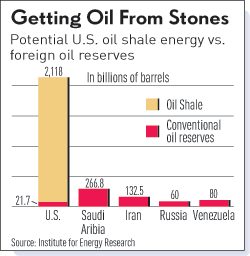
The quantity of oil to be found in this shale is almost unfathomable. The government conservatively puts it at 800 billion barrels. Other estimates say we have as much as 2 trillion barrels, though some of that wouldn't be recoverable.As the chart shows, that could potentially give the U.S. oil reserves equal to three times those of Saudi Arabia. Indeed, it would be more oil than in Saudi Arabia, Iran, Russia, Venezuela, Iraq and Mexico combined.
Oil Myths, Oil Facts Part Two (video)
Kunstler: "We have a big to-do list of other things we have to pay attention to, not just how are we going to run all our cars, because the truth is, we're not going to be able to run all the cars by other means whether we like it or not."
Crude reality: There’s more to oil spike than speculation
The world seems to be perplexed as to why crude oil prices are cruising upwards. The global leaders also failed to come to a conclusion in their meet in Jeddah on June 22 as to how to tame the galloping price-baby back to its cradle.Interestingly, albeit rather unfortunately, the influx of speculative element in oil prices and a slump in dollar rate have been used as excuses by OPEC to shrug off its stakes in oil price determination. But is that the real reason why OPEC has lost its control on crude oil prices?
Why gold and silver are table-thumping buys
All this at a time when the geological impediments of 'peak oil' seem to be an increasing reality. Thus the demand destruction and fall of oil and gas prices of the late 1970s is unlikely to be repeated to disempower OPEC and these strategic competitors.Indeed, mother nature's bounty seems to have been pushed to the brink and we are now facing a world of increasingly depleted natural resources. The global population has risen from 3 billion to over 6 billion in just 30 years. It is projected to increase by another 3 billion in the coming 30 years. Although, tragically, the dismal Malthus' theories might end up derailing these projections.
No matter how much the U.S. is criticized, we will still have a net 50 percent increase in population (primarily through immigration) over the next 30 years to about 450 million. Our fellow humans will want to heat and cool their homes and they will need transportation fuels.Likewise, the rest of the world's demand for various forms of energy is not going to be static.
Long Term Energy Plans Can Be Short Term Solutions
As T. Boone Pickens in the Wall Street Journal described his master plan for solving an aspect of the US energy crisis: dependence on foreign oil. At its core, this solution was really only a swap of foreign energy sources from oil to natural gas.
Sprott Energy has diverse mix of plays
The $341-million Sprott Energy Fund is run by manager Eric Sprott, also chief executive officer of Sprott Asset Management Inc. He subscribes to the "peak oil" theory, which calls for crude prices rising forever because of global demand outstripping supplies.That has led him to search for unconventional energy stories in addition to stocks that can be potential multi-baggers. The fund invests mainly in stocks of smaller companies.
Indonesia: Experts doubt feasibility of govt goals to shift to renewable energy
The barriers to developing renewable energy still exist despite the government having already launched the energy mix policy two years ago, said Zuhal, professor of electricity engineering at the University of Indonesia (UI)."We are still facing financial and market barriers and other barriers like cheaper technology, as well as the tough problem of the people's reluctance to move on to renewable energy," he said at a renewable energy workshop here on Tuesday.
AS we face $4.50 a gallon gas, we also know that alternative energy sources — coal, oil shale, ethanol, wind and ground-based solar — are either of limited potential, very expensive, require huge energy storage systems or harm the environment. There is, however, one potential future energy source that is environmentally friendly, has essentially unlimited potential and can be cost competitive with any renewable source: space solar power.
Traffic deaths fall as gas prices climb
COLUMBUS, Ohio (AP) — Rising prices at the gas pump appear to be having at least one positive effect: Traffic deaths around the country are plummeting, just as they did during the Arab oil embargo three decades ago.Researchers with the National Safety Council report a 9 percent drop in motor vehicle deaths overall through May compared with the first five months of 2007, including a drop of 18 percent in March and 14 percent in April.
Preliminary figures obtained by The Associated Press show that some states have reported declines of 20 percent or more. Thirty-one states have seen declines of at least 10 percent, and eight states have reported an increase, according to the council.
Congress Pursues $80 Oil With Trading Limits, Disclosure Rules
(Bloomberg) -- Congress may outlaw elements of oil futures trading that lawmakers found distorted demand and contributed to the 69 percent surge in prices in the past year.U.S. legislators are considering limits on the number of oil contracts an investor can hold and may increase disclosure requirements. Speculators such as Goldman Sachs Group Inc. use the practices to bet on price swings, which may drive up prices, though they have no intention of taking delivery of underlying goods, lawmakers say.
Fundamentals led to $130 oil - report
NEW YORK (AP) -- A federal task force set up to examine the sharp run-up in oil prices says in an interim report that fundamental supply-and-demand factors are most likely to blame.
Peak oil a myth, claims geoscientist
Predictions that oil production will peak in a few years' time and then taper off have been dismissed by a leading geoscientist.Dr Peter McCabe, from the CSIRO, says predictions of a peak oil phenomenon date back to the 1920s but are no more relevant today than they were then.
So here we are, well into sustaining three digit prices. Is there any hope that oil will moderate and come down to more earthy affordable levels?Matthew Simmons, a US oil expert, thinks there is no chance. He is the author of an extraordinarily well-researched book Twilight in the Desert: The Coming Oil Shock and the World Economy, that caused shock waves in the energy world. He has meticulously gathered data on the world’s biggest oilfields and finds just over a hundred account for half the world’s production. These are being overexploited to maintain current production levels. Simmons sees production levelling off in the near future — he estimates a 10 to 15- year window. If consumption grows at the present rate, there just will not be anywhere near enough oil and the shortfall between potential demand and supply could be as high as 50 per cent with all the frightening implications it has for price.
Pickens sees $300 oil unless U.S. cuts crude imports
WASHINGTON (Reuters) - Oil prices will hit $300 a barrel in 10 years if the United States fails to reduce its dependence on foreign imports, billionaire oil investor T. Boone Pickens told U.S. lawmakers on Tuesday.The United States imports nearly 70 percent of its oil and Pickens said the world's top petroleum-consuming nation would import 80 percent in a decade if it does not aggressively tap its own natural gas and renewable resources.
In oil-rich Norway, petrol prices most expensive in Europe
OSLO (AFP) - In Norway, many motorists are up in arms over why they have to pay the highest petrol (gasoline) prices in Europe when the country is the world's fifth-largest oil exporter and a recent tax hike has done little to cool tempers."It is really strange: we have lots of oil and we're a rich country. Why do we have to pay so much?" asks Per-Arne Skjerpingstad, a 38-year-old hospital porter as he fills up the tank of his Peugeot 307 at an Oslo gas station for 750 kroner (94 euros, 148 dollars).
Merrill Lynch’s North American Economist Warns ‘Brutal Winter Coming for Utility Bills’
Merrill Lynch’s North American economist, David A. Rosenberg, issued a warning Monday that a “brutal winter (is) coming for utility bills.”...“This is going to be huge,” Rosenberg wrote. As it stands, he noted, “in states like New York, shutoffs of utilities services for households in arrears on their bills were up 41% through April.”
Doug Henwood says supply and demand alone cannot account for record-high gas prices. Steven E. Landsburg says oil speculators may be doing us a favor.
Natural Gas Drilling: Is New York Ready?
NEW YORK, NY — The Marcellus Shale is what industry people call an unconventional play. It’s loaded with natural gas, from Eastern Ohio to the Catskill Mountains. But the gas is very hard to extract. It’s packed tight 7,000 feet deep.Today, with energy prices at record highs, extracting that gas looks to be affordable, and energy companies and landowners are lining up to reap profits potentially worth billions.
Dianne Feinstein: Offshore drilling is a false promise
The vast majority of the outer continental shelf is already open to oil exploration: Areas containing an estimated 82 percent of all of the natural gas and 79 percent of the oil are today available to energy companies through existing federal leases.Federal agencies are issuing drilling permits at three times the rate they were in 1999 – but that hasn't slowed oil prices during the climb from $19 to beyond $140 a barrel.
Exxon shuts 12,000 bpd oil, 100 MMCFD due Dolly
HOUSTON (Reuters) - Exxon Mobil Corp said 12,000 barrels per day (bpd) in oil production and 100 million cubic feet per day (mmcfd) in natural gas output in Gulf of Mexico and south Texas was shut on Tuesday ahead of Hurricane Dolly.
Nigerian oil group admits paying millions to militants
LAGOS (AFP) - Nigerian oil group NNPC has acknowledged paying 12 million dollars (7.56 million euros) in protection fees to Niger Delta militants to enable the repair of a damaged key crude supply pipeline."They said we should pay 100 million dollars. But we negotiated and came down to six million dollars" a month, Nigerian National Petroleum Corp. boss Abubakar Yar'Adua told a parliamentary hearing on Tuesday.
4 Commodities Ready To Shock Investors – #3: A War In Africa May Cause Phosphate Price Shock
As if the oil price shock that has thrown the world into turmoil isn’t bad enough, there’s reason to believe at least four more commodity price shocks may be headed straight for investors’ portfolios.Next up: phosphate, a critical component in fertilizer, which based on an analysis that appeared last week on the web site The Oil Drum, could be in for a price explosion.
Why Foreign Investors Love Landmarks Like the Chrysler Building
Unlike Americans, even oil-rich foreigners recognize that high energy prices and global warming will enhance the value of U.S. cities that offer alternatives to the auto. New York's mass transit may be antiquated, but it works. Angelenos pump $4.50 gas into their cars to go nowhere, thanks to world-class congestion.
Iraqi Oil Exports Through Turkey Stop For 17 Hours Tuesday
ISTANBUL -(Dow Jones)- The flow of Iraqi oil exports through the Kirkuk-Ceyhan pipeline stopped Tuesday for 17 hours, an official from the Turkish state-run BOTAS gas company told Ihlas News Agency, or IHA, Wednesday."The flow halted from 0200 GMT to 1900 GMT," he said, adding that the cause of the halt was some reason like a production problem or power outage in Iraq, but he gave no further details.
He also said the stoppage had nothing to do with Iraq's debt to Turkey.
Shipping: The greening of the ocean waves
Although not included in the Kyoto Protocol, the maritime industry's CO2 emissions rival those of aviation. But new initiatives from port authorities look set to make shipping more eco-friendly.
Contact
- Content: editors at theoildrum dot com
- Tech support: support at theoildrum dot com
License

This work is licensed under a Creative Commons Attribution-Share Alike 3.0 United States License.
Re: Peak Oil a Myth (linked uptop)
True, it is self-evident that all production declines are due to political instability in producing regions--such as the Midland based Communist takeover of Texas oil fields in the Seventies, and the radical tofu wielding Vegan takeover of North Sea oil fields in 2000:
http://www.theoildrum.com/files/TexasAndNorthSea.png
In fact, if private oil companies--using the best available technology, with virtually no restriction on drilling--had remained in charge of Texas and the North Sea, these two regions would probably be producing in excess of 10 mbpd by now--and perhaps in excess of 20 mbpd.
Gotta go now. I have to report in to the Politburo in Midland, Texas.
Gotta go now. I have to report in to the Politburo in Midland, Texas.
lol... lol... So, Comrade, LONG LIVE MARXISM-LENINISM! and OIL ADDICTION!
Was this posted yesterday?
http://www.bloomberg.com/apps/news?pid=20601087&sid=aLLrhZOGOD_M&refer=home
July 21 (Bloomberg) -- Petroleos Mexicanos, the state-owned energy company, said oil output fell 11 percent in June from a year earlier as new wells failed to keep pace with a four-year decline in the aging Cantarell field, the nation's largest.
Production dropped to 2.839 million barrels a day in June from 3.206 million a year earlier, the Mexico City-based company, known as Pemex, said today on its Web site. ....
Mexico's Congress wraps up 71 days of debate on Calderon's oil-reform bill tomorrow."
Holy oil Batman! 71 days of debate!
This very important news should be kept in mind when reading the third paragraph of the "Congress Pursues $80 Oil With Trading Limits, Disclosure Rules" item above.
Si, Señor Reyes Heroles. It must be so frustrating to see speculators driving the price up even as your company is flooding the market with oil.
This Peter McCabe has pretty impressive credentials. http://www.csiro.au/people/Peter.McCabe.html
Reportedly, he was just elected president of the American Geological Institute. He is a real geologist, unlike, say Bjorn Lombard, and he is pretty quantitative about his claims, and one imagines, has the data to back them up.
I enjoy the exchanges on the Oil Drum, and I learn a lot -- especially when the claims of supposed experts are examined by other experts. On the other hand, my field is not geology or oil -- and by analogy with dueling experts in my own field, I recognize that ego or greed sometimes trumps truth-- so I am not surprised when seemingly impossible claims are made.
Will someone who knows about this please enlighten the ignorant TOD readers such as myself?
Perhaps he is just confusing peak oil with running out of oil? Seems a rather basic mistake for someone of his background to make, but his 65 year estimate is the point where it is all gone at the present rate of consumption, and has nothing to say about the peak. In fact the point where half is gone, and so a peak is expected, is only 15 years away, and that is with his optimistic estimate of 2 trillion barrels still remaining.
Also note the misleading nature of the 65 year estimate, since it is "at the current level of world production". Simply maintaining current levels of production is not going to cut it.
This was the survey that applied the US reserve growth phenomena (of proven reserves) to world wide IHS database reserve data. The methodology has been discredited by multiple sources. You can read about it in detail in the Energy Watch Groups Oil Report
His membership/participation in that greatly distorted report really hurts his credibility. Oh, and his citing aboveground politics as the sole reason for oil price rise totally ignores the current reality of the production plateau. He might just as well have cited the abiotic hypothesis of oil origin.
Very astute observation, but let's not forget the devastation caused by gay marriage and the teaching of sex education and evolution in school! Surely, these evils are behind the rise in gasoline prices.
Above ground factors:
Chairman Tom Cole website@nrcc.org sent this:
(errr Americans are canceling vacations and that is 'inexcusable'?)
And someone doesn't like a state transportation czar...
http://gettingfrank.blogspot.com/
With leadership like this - who needs enemies?
I saw the Lady Minnesota Senator on Drill Drill Drill Magoo last night and she said "some Minnesotans aren't even going to their lakehouse this summer".....
I thought she was going to cry.
FF
Waaaah!!! Get used to it. However, my guess is that most of those who are fortunate enough to own an extra house, can afford these gas prices. By next summer, perhaps, they will have done something smart by buying an economy car.
The 'fortunates' are not paying their credit card bills, I doubt they will be buying more houses. In fact, I gazed into my crystal ball and asked that question...'will fat cats buy more houses'...My smart azz crystal ball replied...'out houses'. If I could get my nine bucks back from that gypsy I would return the ball...alas, they broke camp long ago.
'Today it's being engraved on the back of American Express charge plates and printed on outgoing cardmember statements informing hapless business owners and vacationers from Traverse City, MI to Ocala, FL that their credit lines have been slashed, their markers called in.
According to Chenault (CEO), cardmember spending, particularly among consumers, slowed sharply during the latter part of the quarter. "Credit indicators, as we signaled a few weeks ago, deteriorated beyond our expectations," Chenault glumly intoned, adding that "by almost any measure" the U.S. economy and business environment are much weaker than the assumptions made back in January and as recently as early June.
The awful kicker, especially for the luxury box set, is that the fallout was evident across all consumer segments. "Even our longer-term superprime Cardmembers," Chenault said. Consequently,given the environment, "we'll continue to scale back some card acquisition efforts and reduce credit lines selectively in the U.S.," he added.'
http://www.minyanville.com/articles/AAPL-AXP-UPS-TXN-bac-WB/index/a/18142
And a slightly increadable tale
http://www.rumormillnews.com/cgi-bin/forum.cgi?read=128361
(the current with all payments!!! - I wonder if they were not current in the past...)
Could have been worse. I heard one case of a family that was 3 payments behind on their Escalade. The were getting threatening letters and calls from the bank, then they got up one morning to find two Escalades in the driveway.
LOL !!
With oil prices going down, suddenly there's a lot more "peak oil is a myth" stuff.
Welcome to "Short Attention Span Theater"...
I noticed this during the last short-term decrease in price a couple of months ago: There was a whole bunch of articles about how we had finally found relief to the high oil prices. This time however I noticed there was a lag between the start in decrease in prices and the start of articles about how it was all a bad dream. Also, there was a bit of wariness about the decreases this time around, the language used in the AP and Reuters reports is more soft and less sure.
"Never underestimate the power of denial" (From "American Beauty")
Huh- I don't understand that last statement whatsoever.
FF
Actually, if you accept his numbers, his math is correct.
If we currently produce 73 mbpd crude, this is 26.645 Gb per year. If that is 1% of the total left, we have 2.67 trillion remaining. If we produce 26.645 Gb a year, that 2.67 trillion will last one hundred years. The math works if you suspend logic and geological/economic realities.
EDIT: I should have actually read what you wrote. What he said makes no sense.
It seems crazy to say that, if what has been presented on TOD is close to the truth. Who is Peter McCabe? He seems to be a real geologist if you can believe his resume'.
You sir are hopelessly out of date. It's the New Physics, which allows us, for example, to recover more than 100% of OOIP from a near zero matrix permeability producing formation. The New Physics is the key to the Huber/Lynch Field Concept; these are fields where discrete wells show production declines, but the total field production--the sum of the output of depleting discrete wells--increases forever.
Sure, laugh if you want Mr. Wiseguy, but you don't see the danger coming. Soon those exponentially increasing oil supplies will flood the planet with crude oil. As the planet increases in mass without a proportional increase in orbital velocity, we will begin a decaying orbit that will end with a spiral into the sun. THEN you won't be laughing anymore!
But think about the vastly improved solar energy that would become available! Not to mention that long-sought holy grail of energy, fusion!
The sad thing is, even if this were proven to be true, it wouldn't slow the doomers down. Think of how much worse climate change could be with infinite amounts of oil to be burned.
Wow!! Talk about knee-jerk rating reactions!
MY first post, so I am going to keep it factual.
Dr. McCabe is ( from this web site: http://www.csiro.au/people/Peter.McCabe.html )
From the theme website at:
http://www.csiro.au/org/CPROverview.html
Right. It's easy to get all that off the internet. But are there practicing geologists out there who know this man and his credentials on a more professional basis?
He seems to be spouting deceptive half-truths. What is going on, and what is in it for him?
imo, this geologist with a pedagree is just saying what the boss, el befuddleoso, wants to hear.
and an aquaintance who works for the govt tells me the same thing; career advancement depends on sucking up to the current regime. same as in private industry.
I decided to take it upon myself to email the main contact listed by the CSIRO website. Its text follows:
As noted, I will post any response I get.
I think that the 65-years thing makes perfect sense within its frame, and does not contradict the peak-in-10-years statement. McCabe said: if we've used 35% of the URR, and are extracting the remaining 65% at a rate of 1% per year, then it'll last 65 years if the rate could be maintained. That does not say that the rate CAN be maintained. It's just a way to quantitatively relate the reserves to production rate. And a common way to do it, too. It's just that here on TOD we dispute the URR (we're near 50% not 35%), and emphasize the fact that the real-world extraction rate will peak and decline. "It's not the size of the tank, it's the size of the tap".
You've distorted his quote, which I provided in full. He does not say "could." If fact, he infers "CAN." His words: "..., so we have about 65 years left of producing at the current level of world production [emphasis mine]."
What on God's Green Earth is:
'A Theme - Leader' ?
I thought I had a good grasp of Management -Psychobabble and Wank-Word Bingo, but this is new to me.
This piece, from the "National e-Science Center" in Edinburgh explains:
A theme typically consists of a connected series of events, visitors and workshops. It has to address e-Science research in a deep and sustained effort to advance knowledge and capability in its area...
A theme is driven by a Theme Leader (TL) who is in effect a funded long-term visitor to eSI and is committed to the topic for its duration.
Translating into plain English, a "theme" is a means of maintaining the oil price by creating an artificial demand for large quantities of airline tickets. As if the typical university didn't already do a fine job of that...
And right there is another more familiar Wank-Word meme, status elevation by e-prefix. Even the dullest dolt should immediately see that "e-Science" must be immeasurably superior to the unprefixed kind. Never mind that it's hopelessly stuck in the ancient past, operating on the medieval-fair model of hugely expensive physical visits to contrived "events", what with the "e-web", "e-mail", "e-fax", and even the "tel-e-phone" remaining yet to be invented.
Huh. How about that. I was just thinking the same question, clicked back onto the oil drum and saw this question. Knocked my respect for CSIRO down another couple of pegs.
"What on God's Green Earth is:
'A Theme - Leader' ?"
a team leader with a lisp ?
This epitomizes the media we now have and we asked for it.
Americans demand an excuse for denial more than they demand the truth.
Plausible-denial-ability
Leanan--Are you long in SUV futures?
NeverLNG - I can understand that you are confused. You are the same guy who thinks that you are paying 15.3% of employment taxes on your self-employed income. In fact, on line 27 of the front page of your 2008 Form 1040 you get to deduct 1/2 of that 15.3% whether or not you itemize.
Thanks for the encouragement, jb. I feel the fog clearing now.
You help me to understand that poor people really are to blame for their own misfortune. Silly me.
Jbunt is a fine source of magical thinking. He believes that people can be re-incarnated as an example of his magical, wishful thinking.
Never, what on earth brought that on? I see nothing in any of the above comments that even remotely indicates anyone is trying to blame poor people for their own misfortune. Therefore I must conclude your statement is nothing but unnecessary hyperbole designed to try to say JB, or someone else advocates a position that they never advocated.
No one is trying to blame the poor for their own misfortune. Try to be a little honest in your responses and you will gain a lot more respect on this list.
Ron Patterson
Mr. Patterson -- My initial question got separated from the start of this exchange. In response to Leanan's post upthread:
Welcome to "Short Attention Span Theater"...
I asked semi-seriously if she was long in SUV futures. Yes, I know SUV's are not traded on any commodity exchange -- but I wondered if she or anyone else expected the price of them (or their manufacturers' stock) to rise because of the brief downtick in oil prices and short public attention spans.
This brought on what I interpreted as a gratuitous attack by Mr. Bunt. My response was outraged -- he was referring to a series of posts from yesterday in which I was arguing that in my opinion, lower-income people paid a disproportionate percentage of their incomes in taxes, despite the sort of "information" that Mr. Rush Limbaugh offers up. Income taxes are not the only taxes we pay.
I will admit that it was not my most well-thought out response, but in fact, it was honest outrage.
I come to this forum for reliable information, not more of the same distortions that almost every other public and private medium provides. And while I am not really interested in increasing personal "respect", I do not want to give offense.
My apologies.
Apologies accepted Never. I came from dirt poor upbringings and as a result I am a Roosevelt Democrat and a tireless advocate for the poor and underprivileged. I too think the poor pay a disproportionate share of their income in taxes.
Ron Patterson
Very gracious reply Never.
However, GM stock has almost doubled from its low a week ago riding the seesaw on the oil price dip.
Wait. Now I am confused.
All Line 27 will do is help to get you into a lower tax bracket (lower the number on Line 43). When dealing with the tax table (page 63 on the 1040 Instructions), in my case 4K or so of a difference (as a result of the Line 27 deduction) only bought me about 1K in savings.
After all is said and done, you still have to add the 15.3% SE tax back on line 58. So while deducting 1/2 of the SE tax moves you to a lower brack and saves you a little, in the end you will still have to pay the full 15.3% SE tax.
Edit: Just to clarify, assume that multiplying my net profit (schedule C) times 15.3% is 10K. Deducting half of this 10K saves me ~1K from the tax table. This means instead of 10K, I pay 9K. People should not get the impression that if you are self-employed, you will save any significant amount of money (>=50%). In my case, it was closer to ~10% (or less). This is one of the realizations I came to after file SE for the first time and it was disappointing to say the least.
It seems the credits are where one can really rack up some big tax savings. Unfortunately, I did not have many to report.
I guess this just proves that those "Drill Here, Drill Now" bumper stickers really worked! We didn't even have to drill ANWR. We merely had to threaten to drill it, and oil prices came tumbling down.
Our nation owes a debt of gratitude to Sean Hannity. Without his bumper sticker campaign, we'd be facing a real energy crisis! So, we can all safely forget about Peak Oil until 2100. Think I'll rush out and buy a motorhome.
Now if those Chinese would stop drilling for oil in the Florida Keys (or is it downtown Miami - seems like it gets closer everyday), the USA could become another Saudi Arabia.
Where is the data on vacation cancellation? Not in my area in Colorado. Anyway, I guess congress should vote for drilling now to ensure vacation taking in ten years or so. Of course by then, however, since we will have done nothing on alternatives or implemented the Pickens plans, for example, no one will be taking vacations, except perhaps to their backyard.
'Democrats plan to adjourn work for a month-long vacation the first of August'...
I hope they don't forget to take the republicans with them. The More time those azz hats are out of DC the less damage they can do...
In more news about how a slow economy is altering career paths in America...
' Strippers jockey for pole position
By The Mogambo Guru
The inflation in the prices of stuff has now affected Americans to a material new degree for the first times in our lives; we are gambling less, we are driving less, we are eating in restaurants less, and we are (in general) suffering a falling standard of living because we can't buy as much stuff, and especially can't afford to buy as much pleasurable stuff, anymore, and believe me when I tell you that nobody is more grumpy about it than I.
One reason is made manifest when one notes that this includes, according to the AP, the Association of Club Executives, which is "a group that represents adult entertainment clubs" and whose spokesperson Angelina Spencer says she, "fields calls every day from strip-club owners feeling the pinch of a bad economy."
An adult-club owner named Joe Redner says that although business is down 25%, "the economy does have one upside for the business - it's bringing out more women willing to give pole dancing a try."...snip...
http://www.atimes.com/atimes/Global_Economy/JG24Dj01.html
People are going to start trying to stuff quarters in the G-strings instead of dollar bills.
Wow, a big spender using quarters. The 'girls' around here are used to nickles so if you come to town don't spoil them.
Some of these girls are a marvel. I saw one that was so ugly she had to sneak up on a glass to get a drink of water.
Wow, 4 negs! Thanks, there is no bad PR.
Perhaps I should have said that the girls in the mitty bars around here spend their tips on silicone, not plastic surgery on their faces. Maybe that would have been more politically correct?
This board has contracted the dreaded virus...PCBS.
Watsamatter...we can't tell stories about Butterface? She has a killer body and would be a 10...But her face is scary.
There are no ugly men and women in the world...only those that have features that are challenging... but at 2 am they all look great...it's all about keeping the lights low and saving energy.
or perhaps it was just WAY off topic and not funny.
There's a slot for the quarters.
Just for reference, Dolly now CAT 2 just about to make landfall.
For that track to be right Dolly will have to spin on a dime
right after landfall.
I say it goes N of Harlingen. IMHO ;}
Here's a very interesting Dolly discussion I've been following for the past 36 hours or so.
A good Dolly thread
Dolly's coming in as a Cat 2.
Farther north.
Looks like a buzz saw to me with minimal infringement on the
periphery.
Corpus Christi is getting some rain.
http://www.ssd.noaa.gov/goes/east/gmex/wv-l.jpg
Sadly, Hurr. Dolly will probably cause some damage and/or injuries, maybe some loss of life, too. But this is nothing compared to the mere explosion of 2,300 tons of nitrate fertilizer:
http://en.wikipedia.org/wiki/Texas_City_Disaster
----------------------
The Texas City Disaster of April 16, 1947, started with the mid-morning fire and detonation of approximately 2,300 tons[1] of ammonium nitrate on board the French-registered vessel SS Grandcamp in the port at Texas City, Texas, killing 581 people. It also triggered the first ever class action lawsuit against the United States government, under the then-recently enacted Federal Tort Claims Act (FTCA), on behalf of 8,485 victims.
..At 09:12, the ammonium nitrate reached an explosive threshold of 850°F (454°C). The vessel then detonated, causing great destruction and damage to the port and killing hundreds of people. Sightseeing airplanes flying nearby had their wings sheared off [3]. The blast caused people in Galveston, Texas, 10 miles (16 km) away, to drop to their knees. Windows were shattered in Houston, Texas, 40 miles (60 km) away. People felt the shock 250 miles (400 km) away in Louisiana. The explosion blew almost 6,350 tons of the ship's steel into the air, some at supersonic speed.
...A 2 ton anchor of Grandcamp was hurled 1.62 miles and found in a 10-foot crater. It now rests in a memorial park. The other main 5 ton anchor was hurled 1/2 mile to the entrance of the Texas City Dike, and rests on a Texas shaped memorial at the entrance. Burning wreckage ignited everything within miles, including dozens of oil storage tanks and chemical tanks.
--------------------------------------
Be sure to see the photos in the included links.
Bob Shaw in Phx,Az Are Humans Smarter than Yeast?
The networks seem a bit behind but local news channels in the area are reporting major disaster conditions. This storm is passing through relatively densely populated areas. Hundreds of thousands without power, major structural damage, horrendous flooding. This has been a bad, bad storm and has caught a lot of people unprepared.
http://www.newschannel5.tv/ still has streaming video coverage (although they are on emergency generators and keep dropping off).
Also http://www.kgbt4.com/ is still broadcasting at time of posting.
So far the lack of reported fatalities is the one bit of good news.
Building, Not Drilling, To Reduce Pain At The Pump
I wonder how long it will take Americans to realise that most of the policies they are now pursuing in their panic over gas prices are making them worse off by far.
I think most of the regular readers of TOD here can agree that speculators have relatively little, if any, impact on oil price (see poll by Prof Goose).
So when congress decides to not allow investors to speculate on the price of oil to the same degree that they are now, are they not undercutting one of the highest performing sectors in a weak and struggling US economy? Things are getting bad now, but they are pulling the rug out from underneath themselves with this idea.
Another policy that has been circulating is the offshore drilling and opening of ANWR. These ideas are ridiculously short sighted, moving more money into the hands of big oil, worsening the environmental impact (although IMO not to the degree some would testify), and would use up the remaining bits of American oil. Leave some in the ground so that when the price of oil hits $200, $300, or $400 a barrel the oil they've left in the ground will be worth several times as much now. The longer they leave it, the more it's worth. They should leave it in there (check to make sure it's there first) until true demand destruction occurs and there is a shift to electrification of transport. This is the only way America can obtain independence from foreign oil imports from hostile countries.
Congress and the White House don't seem to understand any of this... which is why I'm glad I'm up here in Canada.
Best hopes for someone in the White house with sense... but I guess that depends on Americans' policy of voting for the moron.
are they not undercutting one of the highest performing sectors in a weak and struggling US economy?
Sad that the debate has come down to claiming that sending FRN's out of the nation at a faster rate is considered a GOOD thing.
What are FRN's? I know them as Floating Rate Notes, but that doesn't seem to work in the context.
Federal Reserve Notes
Federal Reserve Notes.
I'm not sure I understand this comment...
The complaints from congress are that wall street is making too much money on speculation (Americans) and they will thus further regulate the commodities markets to make it harder or more costly for these wall street investors, so that a well performing group in the face of a recession is being forced to be less productive.
Translation:
Any type of rumor/intervention is allowed to push the stock and housing
markets up and oil markets down.
Any type of rumor/intervention is outlawed that is doing the inverse.
Of course, extreme price movements, command economy, and rationing
will be the rational outcome of this behavior.
" First, let us take a look at the first sign of future wealth destruction, the notice of default:
As you can see from the chart,
http://www.doctorhousingbubble.com/
notice of defaults have gone sky high in that past few quarters. We went from a relatively mild 2006, to a quickly deteriorating 2007, to the current record breaking problems in 2008. The reason notice of defaults are so important for future predictions is that these are homes that have yet to be taken back by lenders. These are early signs of trouble. What this means is lenders in the upcoming months better gear up for a tsunami of REOs."
Reminds me of the REO Speedwagon song, Riding the Storm Out.
"... and oil markets down." This tends to be true also for commodities other than oil. Shorting is condoned in the precious metals markets, longing is discouraged. So beware of longing for gold :)
I'm not sure I understand this comment...
I'll try again then.
The higher the price in FRN's for oil that is imported means more FRN's leave the country.
Those FRN's are then not able to be spent in the US of A where the Tax Man can take another piece of the transaction. Nor are they able to be spent by American citizens.
So higher prices are BAD for the American Economy.
Is that more understandable?
Now, if you want to prove your assertion about how valuable high prices and speculation on high prices are, do explain it VS just making a claim.
Montreal police adds small electric vehicles to its fleet partly in response to rising gas prices:
http://www.canada.com/montrealgazette/news/story.html?id=a767d108-4447-4...
Seems appropriate to post this here:
US utilities say grid will be able to handle rechargeable cars
.
To paraphrase: "We don't have the capacity, but we're hoping that these vehicles will spread slowly enough that we'll be able to keep up, and we'll force them to charge on off peak by adjusting the rates."
But there are no numbers in the article. How slow a rate of penetration are they assuming, and is that a fast enough rate to make any impact on gasoline usage?
Hi,
Didn't see this one up top:
NY Times: Uprising Against the Ethanol Mandate
http://www.nytimes.com/2008/07/23/business/23ethanol.html
I've been reading about conditions in the south after the civil war. I had never imagined how disruptive freeing the slaves was. From my reading, 1/3rd of the persons in the south were slaves.
Many of the owners had no practical skills as they relied on the slaves to do much of the highly skilled (and of course less skilled) labor.
After procuring freedom, there was an attitude among the newly free that hard physical labor was beneath a freeman. Education was often sought as a means to escape manual labor. (just as today)
Additionally many men of working age had been killed in the war.
All of this adds up to a massive labor shortage. As we lose our energy slaves, I wonder whether our future will look more like the great depression or the post war south.
As we lose our energy slaves, I wonder whether our future will look more like the great depression or the post war south.
Why not both? Doesn't have to be an OR clause.
I guess I am thinking that the Great Depression was characterized as an abundance of resources (other than food) and labor with a shortage of money.
In the post war south, it seems like there was an abundance of resources but a shortage of skilled labor, money.
I think that after peak oil, there will be a shortage of skilled labor as the skills that are valued will change quite a bit. In other words, being a middle manager isn't going to help the country much if there is a food shortage / transportation breakdown / electrical infrastructure problems.
It seems to me that you want to be in one (or more) of three key groups: (1) Net food producers; (2) Net energy producers; (3) Providers of essential non-food and/or non-energy goods & services. BTW, I have made the argument that launching a high school graduate on an expensive college education that does not result in skills that would apply to one of these key areas is akin to turning a weapon of personal financial destruction on one's self.
I totally agree...
I'm going to try to steer my daughter towards hands on design / implementation of solar heating systems.
I work in revenue realisation for a global telco. My reasoning is that communications will supplant travel and eventually, perhaps, traditional offices.
Flights, hotels, heating and cooling offices, car commuting - all these are spiralling up in cost. At the same time the cost and utility of remote conferencing and working is improving dramatically.
I remember the 70s - we all sat indoors, brewed our own beer and watched telly.
Amen. I have two nieces, one age 18 and the other 17.
They are soon to enter college. One wants to major in English with an eye towards becoming a teacher, while the other wants to study art. I suppose that art will be more useful - my artistic niece can entertain her fellow survivors around the campfire during cold winter nights. Future generations will ponder the meaning of those petroglyphs on the walls of the freeway underpass.
"Do you want onions on that?"
I thought I was a man of the world but I've never heard a prostitute say THAT before
I don't think there will be a labor shortage. I think those middle managers will be willing to do anything to feed their children, and they can probably learn to dig ditches, install solar panels, build hybrids, or whatever.
I think there will be shortage of jobs, because so much of our economy is based on discretionary income.
There may be a shortage of ditch digger jobs but will there be a shortage of skilled carpenters, seamstresses or cobbler positions when globalization breaks down?
I doubt it.
No, I don't think so. We have enough clothes, houses, and furniture to last for years. People won't have money to buy new clothes every season, just because they're out of style. Kids will do what their grandparents did: wear hand-me-downs.
By the time we really do need to know how to spin, weave, and sew, we'll have had time to learn. (And lots of practice, repairing our old stuff.)
That is a good point...
I guess we'll see soon enough ;)
I want to know how people are going to get above the fourth floor in their apartment and office buildings. And if thee is electricity to run the elevators, will there be parts and skilled labor to fix them?
But there is also a trap there - it may be that by the time we really do need to know how to spin, weave, and sew, we'll have had time to forget how.
On this point we differ Leanan. We will need to learn how to gin cotton by hand and someone will have to re-invent the hand cranked cotton gin. Hand picking the seed from cotton is intensely laborious and slow. Making spinning wheels and learning to spin yarn will not be nearly the challenge as making looms and weaving. Learning and building all this and rebuilding the infrastructure to do it will take decades. At least it will take far longer than old clothes will last.
But there will be even greater challenges. Who can make shoes anymore? And what would they make them from? Will there be enough cows for leather? What would they make the soles from? Who can make a wagon wheel?
And another problem that no one seems to have thought of. Wood will be the primary fuel for warmth and cooking. The forest will be stripped bare simply for fuel. What will be left for building wagons, barns, houses and all the other things needed for the new agrarian economy? I expect that there will not be enough wood for cooking and heating, leaving nothing to build wagons, looms, barns, and houses.
We could do all these things very easily 150 years ago, but the world's population has increased six fold since then. There are just too many people to ever return to a draft animal agrarian economy. It will take decades and when it finally arrives the population is likely to be well below the population of 150 years ago.
Ron Patterson
On this point we differ Leanan. We will need to learn how to gin cotton by hand and someone will have to re-invent the hand cranked cotton gin
Assuming no destruction of, oh say, patent offices or libraries - your claim is that the patented cotton gin will have to be RE invented?
A sad day for the founding fathers, what with the patent process existing to preserve knowledge.
(Myself - I'm looking towards the patented hemp fiber seperator. Lack a machine shop to make the parts tho.)
That is totally absurd, you excel yourself!
Next you will be claiming that gravity will no longer work and we will fly off into space.
I think more people know this stuff than you realize. The knowledge (and even the tools) are not lost. They're just the domain of hobbyists at the moment.
I know several women who are into spinning and weaving. (And that's not counting the SCA folk.) The county fair was last weekend, and they did their usual demonstration: making a sweater in a day, from shearing the sheep to modeling the finished garment.
I keep trying to brainstorm things like this so I can buy/download the books...
Cheers
This one, at least, is easy: tires. Until all the tires are gone, but suspect there are a great many old tired lying about. Unless people start building those dirt-filled tire Earthships...
Cheers
Daniel Day-Lewis can make shoes. Before starring as an oilman in "There Will Be Blood," he was working as a cobbler in Florence, Italy.
And the tinkers shall inherit the earth.
Anyone who can make something useful out of discarded old things will prosper.
I agree there are already way too many pieces of clothing on earth, especially for the smaller number of future humans.
RE; Too much cloth..
And as much as I wonder what pthalates I'm breathing when I wear it, I've seen polyester fleece endure for a godawful long time.. lord knows we've got a few thousand miles of sodabottles to go through, if we can still card and spin them down to that stuff. (Just watch out for candles!)
Bob
One of the common problems with the discussion about the future here and elswhere is some people talking the near future and others a longer term future. The above comment may be true sometime in the future but the near term will see plenty of FFs available for those who can pay. some businesses farmers and individuals will have no problem getting product in the short term. The rest of us won't be able to afford either energy or food. But some farmers will be trying to get rich using existing farming technology. Therre will be plenty of us looking for any work but these guys won't need extra labour right away. Unfortunately for them we will quickly move on to test the observation that "it is hard to be a rich man in a world of beggars". I suspect that the near short term will quickly dengerate into social and political instability of riots, police trying to protect the rich and gradual paralysis of the economy. The last 50 years of Argentinian history might give us a glimpse of this. Once all this gets sorted out we may know if we can still farm with machinery or need human/animal labour. Through all this on the small scale the human hand, hoe and wheelbarrow will be quite valuable as per ELP but on the big commercial scale it is hard to tell. Of course in the long term, maybe by the time my grand kids are my age, the above refered to shortages may apply.
As long as you don't mind those skilled carpenters, seamstresses and cobblers mostly being over the age of 65.
I don't mind at all. In fact, I'm a little embarressed to admit it, but after TOD, seamstresses-over-65 dot com is my favorite website!
You've never been to Maine, have you?
Cobblers? Well.. you got me there.. but those skills can transfer..
Perhaps there will be a flip-flop of world order and the first world will be desperately hoping that the third world will offer them some technology. Here in South America there are cobbler guys who make and sell shoes on the sidewalk outside of my house.
You can get loafer style shoes that are cow coloured.
Exactly Leanan, that is what I have been saying for years. I guess great minds think alike. ;-) As energy costs escalate people will have to cut back elsewhere. They will purchase less stuff and people who produced this stuff will be unemployed. Also they will use a lot fewer services. People will do things themselves instead of hiring it done and many service industry people will be unemployed. People will travel a lot less therefore the tourist industry will drop millions of employees.
All this will have a snowball effect. Unemployed people purchase even fewer goods and services. This will throw even more people out of work and the slide continues. But not to worry, everything will recover when energy prices drop to the level of the good old days. Of course some of us doomers say that day will never come but hope springs eternal in the minds of cornucopians or anti-doomers as they are sometimes called.
Ron Patterson
Armies of unemployed are grist for the mill of armies of the Empire. I feel a war coming on.
"I feel a war coming on."
who is the empire going to borrow money from for this one ?
People who directly produce durable goods should not have to worry. My Dad (depression-era baby, war-era teen) said if you have a white collar job you should still have a blue collar skill.
I think it's high time I learned a trade, while I still have a good engineering job. I think I'm better fixed than many will be, though.
LOL!! My experience with middle managers is that they became middle managers out a desire not to work, or they were incompetent and were not missed in the field/workplace, had very large egos, or all of the above. These types will do anything to avoid work (and blame) and I would not be surprised if they would rather starve or kill than become functional parts of society.
Consistent with Middle Managers not being fluent in any skills apart from coffee-drinking, they probably won't even figure out how to starve properly. ;)
"Which end of the knife is the sharp one?" :P
Kohesion...Don't believe for a minute that there was a lack of money in the south after the uncivil war. There was tons of money...but it was Confederate money. One more fiat currency had bitten the dust.
I was under the impression that by the time the war was over, they were back to using US dollars of which there was a shortage.
Can someone else corroborate this?
Yes, your statement is correct. Once the outcome of the war of aggression was no longer in doubt many in the south would not take Confederate notes...But, there were tons of Confederate notes in possession of the people. Hence, one more fiat currency had bitten the dust.
As I understand the problem was that before the civil war most of the South's investment capital was invested in slaves. So when they were set free it wiped out the regions capital base. What other capital assets they had were largely destroyed by Northern troops. So the South's problem was that there was no wealth there, and nothing to trade for money.
Biggest Gulf Dead Zone Ever
Thanks ethanol !
http://news.yahoo.com/s/ap/20080723/ap_on_sc/dead_zone
Alan
If you read that article from the New York Times about the ethanol subsidies that consumer linked to, you'll find this nugget:
So there you have it. Alan, you're a treasonous pinko commie tree-hugger! It's only a few dead fish in the Gulf and it's only a few million poor people who are being pinched by corn prices. True red, white and bold Americans fill up their SUVs with their mandated ethanol mixture with pride!
I believe that is "Senator Charles Grassley, of the Republic of Iowa." New York is a foreign country.
I am not a supporter of ethanol. However, has ethanol production significantly increased the use of fertilizer in those areas draining into the Mississippi? Or has it just reduced the amount of corn available for feed and food? My guess is that we would have a dead zone problem with or without ethanol, especially with the floods. According to testimony presented to Barbara Boxer's committee yesterday, you can blame global warming for much of the flooding. So, if we can't thank ethanol, we can blame oil consumption, coal consumption, and even fertilizer consumption (nitrogen) for global warming.
Cutting back on corn production and synthetic fertilizer would help the eutrophication and the dead zone problem. Ethanol might be making the problem worse, but one can also blame policies which encourage corn production, meat eating, and our almost total reliance on chemicals to produce our food. Organic farming techniques would be less harmful. More reliance on grass to feed the animals we eat would also help.
But it is all about the money. So, I guess we just have to get used to bigger and worse dead zones.
There is some evidence that formerly fallow land is being converted to grow corn as well as land normally considered unsuitable for it. Both of those mean more fertilizers than would be used otherwise I'm afraid.
Soybeans get little or no nitrogen fertilizer, wheat, cotton and other crops all use significantly less nitrogen fertilizer than corn.
Corn is a nitrogen junkie and nitrogen is, as I understand it, the primary cause of algae bloom.
Alan
How about potatoes?
I'm interested in the dilemma of starch production. I can grow and eat my own potatoes, but wheat is out of the question.
super390--Have you looked into beets or parsnips? Both were primary sources of dense carbs for Eurasia prior to the Columbian Exchange. From a nutritional POV, both are better than the potato because they provide a fuller spectrum of nutrients. Tubers are also more aligned with the initial diet of the human animal.
Lets here it for the Mangelwurzel:
http://www.viewimages.com/Search.aspx?mid=3141481&epmid=3
Thanks for that; you broadened my knowledge, http://en.wikipedia.org/wiki/Mangelwurzel
Hello Alan,
http://www.newswise.com/articles/view/542856/
--------------------
Study Predicts Crop-production Costs Will Jump Dramatically in 2009
...Costs to get crops in the ground will jump by about a third in 2009, fueled by fertilizer prices expected to surge 82 percent for corn and 117 percent for soybeans, said Gary Schnitkey, an agricultural economist who conducts the annual survey of input costs.
...Schnitkey says the per-acre costs are based on high-producing farmland in Central Illinois, but corn and soybean farmers across the country will see similar increases.
---------------------
My guess is that when a farmer crop rotates: the former corn topsoil is so depleted that a considerable primary NPK injection is needed to jumpstart the soybean growth.
Then, when switching back from soybeans to corn: less NPK [mostly N-products] is needed because of earlier soybean nitrogen fixing. Of course, soil testing is the best method to determine NPK needs.
Bob Shaw in Phx,Az Are Humans Smarter than Yeast?
nitrogen is, as I understand it, the primary cause of algae bloom.
http://www.watercare.net/wll/himp-algalblooms.html
Research indicates otherwise.
There was an interesting program on eutrophication on pbs in the Everglades.
http://www.pbs.org/newshour/bb/science/july-dec04/everglades_11-25.html
What caused the eutrophication(algae killing the ecosystem) of the Everglades was the elimination of wetlands and the channelizing of the Kissimmee river. The Army Corp has recently 'dechanneled' it
and restored the wetlands to remove nitrates and phosphates cleaning up Lake Okeechobee wonderfully. The excess fertilizers are almost gone.
No river has been more 'channelized' than the Mississippi with levees and its surrounding wetlands have been turned into farmland,etc. The river system shoots raw waste into the GOM. The solution is to slow the river, thus eliminating the dangerous erosion of the delta and return the banks to its normal wetlands role.
This would reduce river traffic and agricultural production along the river banks but it would restore the delta and GOM.
And with peak oil will we need so much river trade?
'dechanneled' it and restored the wetlands to remove nitrates and phosphates cleaning up Lake Okeechobee wonderfully. The excess fertilizers are almost gone. No river has been more 'channelized' than the Mississippi
Who to blame? The farmers, or the people who want to keep New Orleans the end of The Mississippi for shipping reasons?
Do we have to blame somebody?
They build levees to protect the land and they dredge(channelize) the river to protect navigation. The higher the levee the faster the water moves thru the river bed the less residence time for biological cleaning. Levees eliminate riparian wetlands that filter and treat river water.
(Actually there are still farmers dumping fertilizer runoff into the upper reaches of the Kissimmee River, so they haven't changed much of anything.)
Eh.. blame the Army Corp of Engineers for catering to our every want.
They are maximizing the use of the Mississippi river for OUR purposes.
From flood central (old haunts where I grew up), I read this missive to the editor stating it might be cheaper in the short and long run to create a natural floodplain. Don't know if the letter writer's figures are correct or not but it stuck in my brain as one of those "it figures" items: http://www.thehawkeye.com/Story/Richard-L--Beames-071108
Wouldn't it use less energy to move people / products downstream floating on a barge than by rail or road?
Upstream, of course, not so helpful.
What comes down the Mississippi now? Corn, soybeans. We'll still be growing corn and needing to distribute it for the forseable future.
A slackwater return route is via the Intercoastal Canal, Mobile and the Tenn-Tom Canal. During high spring flows, and high diesel prices, it can make sense.
Alan
Yes, that's it exactly. In D.C., up by great falls you can still see the works of the Chesapeake and Ohio canal they used to get the barges up river and past the rocks. They used mules to haul the boats.
Fixing up the Kissimmee and getting a more natural clean clean flow into Lake Okeechobee is important.
Equally important is getting a clean more natural flow out of the lake soutward towards Florida Bay.
To that end it's gonna take a lot of taxpayer dollars and some luck.
And the rich - who caused much of the mess at least South of the lake -will get richer.
Glades restoration plan hinges on land trade with Fanjul family
Florida needs 35,000 acres to make Glades flow a go
Pete
One big factor was eliminating the Florida sugar cane farming.
Alan
Um... if the seas are going to rise by a meter or more within a century... is there really any point to all this? I'm a former resident of Florida and have, in the past, been a big supporter of these plans... for decades. I have a hard time seeing the point of trying to save what will be going under the seas.
Cheers
Already about 1/3rd of the Mississippi River is diverted down the Atchafalaya Basin. There are a good set of plans to divert more to the swamps and the State of Louisiana has committed all new off-shore revenue to this.
A prototype
http://www.lacoast.gov/programs/DavisPond/
Unfortunately, nitrogen fertilizer is one of the last nutrients to be filtered out. Even the Atchafalaya, about 200 miles of slow moving water, dumps almost clear but nitrogen rich water into the Gulf.
Alan
However, has ethanol production significantly increased the use of fertilizer in those areas draining into the Mississippi?
Yes !
There was prediction of a record Dead Zone when the corn planting and nitrogen fertilizer #s came in last spring/summer.
Ethanol subsidy > more corn planted (this year a slight drop) > more nitrogen fertilizer > bigger Dead Zone.
Growing more soybeans for bio-diesel (or to eat) does not have the same effect since soybeans are natural nitrogen fixers and are not drowned with N fertilizer.
Alan
Scientists solve riddle of toxic algae blooms
Apparently, it's the phosphates that are the problem and not the nitrates so, if the fertilizer has no phosphates, it shouldn't be the source of the problem. On the other hand Bob Shaw call fertilizer nPk.
Alan from the islands
I guess we'll just have to quit Exporting corn and feeding/exporting beef (since that's where 80% of our corn goes.
You've got that the wrong way around, 20% of the U.S. corn crop is exported and 5.4% of the beef.
You're right; I wasn't clear. Almost 80% of our corn goes to feeding livestock. About 20% is exported (most of that goes to feeding livestock overseas, of course.) A very small % is actually consumed, directly, by Americans (high fructose corn syrup, corn flakes, a little corn meal, etc.)
Most of our beef is consumed at home.
So lets get the numbers right: The area we are talking about is about 80 miles by 100 miles or about the size of New Jersey. We are producing about 8 billion gallons of ethanol. That means 8/2.8 is the amount corn used or about 3 billion bushels out of a 13 billion bushel 2007 crop.
3 billion is about 23% of 13 billion. Now Allen claims that 23 percent of the corn used for ethanol causes the increase in dead zone. But the other 77 percent had no effect on the dead zone. How odd.
It's funny how all the corn fed in hog factories which have their manure pits emptied every year by spreading it on the ground doesn't make any difference in run off of nitrogen. Also strange how corn fed cattle manure doesn't run off too. And when chicken manure is spread all over the county as it is locally, that doesn't run off either.
But if corn is used for ethanol, the run off shoots straight down to New Orleans to increase the dead zone even though it is only 23 percent of corn use at the moment.
And of course export corn fertilizer doesn't cause run off either for some magic reason. Could it be that most of Midwest exported corn goes though New Orleans. Maybe the Port of New Orleans should stop accepting corn for export. Oh wait, that would affect the Big Easy economy. Can't propose that.
The Gulf can absorb, without dead zones, large amounts of nitrogen and other fertilizer run-off. The EXTRA nitrogen from the corn ethanol is what tipped it way over this year.
No one noticed a "Dead Zone" until a few decades ago. If one existed in , say 1960, is was too small and too short lived to notice.
A reasonable SWAG is that no 51 cents/gallon subsidy would cut the dead zone in half or more.
Best Hopes for SKY high nitrogen fertilizer prices, and dropping corn prices,
Alan
We know X will defend corn the way Senator Robert Byrd will defend coal, so let's accept that our well-intended corn subsidy policy was allowed to mutate into a selfish monster, first seeking an outlet in corn syrup sweetener, now in ethanol, and it's all bad for us.
Now if I were to call for the banning of corn syrup as sweetener, thus restoring junk food and soda to its natural price, let's see who screams bloody murder.
That's not a dead zone, its a future oil field. :-)
Um...This actually makes sense, x.
Add in the fertilizer runoff from suburban and exurban lawn expansions and stormwater runoff from roofs, driveways and roads, and the loss of wetlands and forests to soak it all up before it gets to the Gulf. Over fertilization of expanded corn crops must also factor into the problem but surely is not the sole source.
However we still need to stop putting hopes in corn ethanol. It's got poor EROEI, and is making food too expensive.
A dead zone here, a dead zone there, it doesn't really matter what ecozones they happen in so long as commerce continues until the deadzone is in your neighborhood. Right?
Lets just stop the 51 cents/gallon corn ethanol subsidy.
Alan
I'd thank the second 500 year flood on the Mississippi in fifteen years myself.
A record Dead Zone for 2008 was predicted in early summer 2007. Draining out the Spring 2008 fertilizer in Iowa early certainly did not help.
Alan
are we going to be paying a higher price for shrimp and crayfish also ?
ethanol is a cultural menace.
Crayfish come freshwater/swamps (half the crop is wild, half from rice fields) so they are OK. Oyster beds are wiped out if a dead zone drifts over them. Shrimp losses are heavy.
A decade or two ago, large fin fish (I heard, not fry & juveniles) could often swim away from dead zones, but now they develop so fast that many more die.
Best Hopes for less ethanol,
Alan
Beyond the plague of ethanol, best hopes for a paradigm shift in totally negligent corporate farming methods.
Alan:
There are many levels that humans are dumber than yeast. One thing about it, after the big dieoff because nothing was done in time, there won't be a problem in the Gulf.
Via Con Dios My Friends.
Just a note concerning Net Oil Exports
I downloaded the spreadsheet from the above link and did some figuring. This spreadsheet deals only with the 20 largest exporters which account for 93% of all oil exports. Of those 20 largest exporters 12 are OPEC and 8 are non-OPEC. Although OPEC accounts for only 45 percent of total crude oil production they account for two thirds of all exports. (66.73 % this month.)
Of the eight non-OPEC producers on the list, net oil exports have fallen by 1,572,000 barrels per day in the last 15 months, from 15,293,000 bp/d to 13,721 bp/d. That is a drop of over 10%. (The last figures for May and June are preliminary may be revised up or down slightly.) Russia accounts for 50% of the total for the 8 largest non-OPEC exporters. Norway is 14%, Mexico and Kazakhstan are about 8% each, Azerbaijan 6.1%, Canada 5.4%, Oman 4.9, and Equatorial Guinea 2.8%.
Ron Patterson
This is cool. Found it on your link. Hadn't seen it before.
Sunday, June 8, 2008
Matt Simmons responds to Henry Blodget
I haven't heard anything from Matt Simmons in a while, so I was quite surprised when reading an entry on Henry Blodget's new finance blog to see that his was the first response. Also amusing that the subject was Arun Murti (weren't we just talking about those two last week?)
Here's his response:
You really should research your terminology before you drop it about in your articles.
"On the supply side, we don't subscribe to the peak-oil view. We don't think the world has run out of oil."
Definition of Peak Oil:
"Peak oil, as part of the fossil fuel depletion, is the point in time when the maximum rate of global petroleum production is reached, after which the rate of production enters its terminal decline."
source - wikipedia.org
Peak Oil is about the "Peak" in oil production... we sir have peaked, we did so in 2006. We are in what's called an undulating plateau and will soon enter a irreversible decline in oil production.
We will NEVER run out of oil, we simply will run out of CHEAP oil... easy to find and produce oil... I hope this sinks in clearly.
We discovered oil, found large deposits of oil and we produced those first, they were the easiest to get at. Most of those fields are in decline now, we're now going after the more difficult, smaller deposits...
Please go to www.theoildrum.com and do a bit of reading.
Kind Regards,
M. Simmons
Year over year export changes for June 2008:
KSA: Up 9%
Russia: Down 3.2%
Norway: Down 2.8%
Iran: Up 1.5%
UAE: Up 2.5%
Venezuela: Down 8.4%
Kuwait: Up 9.1%
Nigeria: Down 8.9%
Algeria: Up 3.6%
And last, please to enjoy:
Mexico: Down 32.4% HFS, Batman!
It's good to be in the Middle East. As long as you are an oil exporter.
Not to mention Canada down 17.6%.
WT can you change it to VenMexCan?
In total, these three are down 19.2% YOY
I think that the key challenge this year is the 4P Effect--Problems with Proximal Petroleum Producers. Europe and the US are having (despite some decline in consumption) to offset net export declines from close producing areas like the North Sea and Russia and VenMex (and apparently to some degree Canada, which showed an annual net export decline last year) with increased exports from the Persian Gulf and Africa, while China is trying to increase imports to meet higher demand.
Regarding Saudi Arabia, it would appear that 2009 will tell the tale--as to whether they can match or exceed their 2005 average production rate--since it appears very likely that their 2008 average production rate will be below their 2005 rate. Regarding their net export numbers, here are the annual EIA numbers for Saudi Arabia, and my estmate for 2008:
2005: 9.1 mbpd
2006: 8.5
2007: 7.9
2008: 8.3 (estimated)
2009: ?
I estimate that if Saudi Arabia wanted (and were able), in 2009, to match their 2005 net export rate, they would probably have to boost total liquids production to about 11.8 mbpd (versus their 2005 rate of 11.1 mbpd).
Maybe VenMexCan't would be more appropriate.
Summary of Weekly Petroleum Data for the Week Ending July 18, 2008
And here is what they were expecting:
Crude inventories at 295 million barrels, are getting dangerously low as the winter approaches, while the oil price reaction has been tame so far, I believe by October prices will spike significantly higher if inventories remain this low, any comments?
Regards,
Nawar
I know that it's somewhat complicated, but the concept of "crack spread” and the range of products that comes from a barrel of oil needs more attention and coverage, not here but everywhere. Without TOD, I would have no understanding of the relationship between diesel and oil prices. Now, knowing that diesel is in high demand while gasoline demand (at present retail prices) flat, it is somewhat understandable why (1) gasoline prices have not grown “lock step” with oil prices, (2) why gasoline inventories are building, (3) why gasoline prices are not likely to drop significantly in the face of building inventory and lower domestic demand.
Could we hit a point where the U.S. exports gasoline as an unneeded byproduct of diesel production?
I thought the US was importing gasoline (because most of the cars here run on gasoline,) from places where motor fuel is mostly Diesel, and they have relatively less use for the stuff.
I wonder if oil furnaces could be converted to run on gasoline?
Keep in mind, we're using about 600,000 Barrels of Ethanol/day. That's about 4,200,000 barrels/week. Even if you used the most reactionary numbers that would be replacing 3 Million Gallons of Gasoline.
Actually, once accounting for EROEI (including Nebraska), about 10,000 to 15,000 barrels/day net. For over $4 billion/year in subsidies !
3,000,000 (too high) gallons/day is 71,428 barrels/day.
And if we stop feeding cattle "distillers grains", the EROEI is about negative.
Alan
Actually, in a perverse way, ethanol has made gasoline cheaper: the more ag and trucking activity, the more demand for diesel (and NG etc), keeping the price of crude high, but depressing the price of gasoline relative to crude due to it being a byproduct of the diesel production (as has been discussed here in the past). So we lose energy and money in total, and deplete aquifers and erode the soil, and pay more for food, but JSP only cares about the price of gasoline, thus ethanol is a smashing political success!
Meanwhile, the cost of parts of the rest of life is increased.
Converting oil furnaces to run on gasoline should help reduce the housing stock and the house occupier stock.
thirra...Don't break their bubble. Let them use gasoline to run their home frunaces. Anyone that dumb should be removed from the gene pool.
A company called Janitrol has been making very small heaters (furnaces) for small airplanes that use gasoline.
I notice that most of the build in Total Gasoline stocks is due to Blending Components, which I understand includes ethanol. Also, there's been a drop in Natural Gas Liquids, perhaps the result of increased production of unconventional natural gas since last year, such as coal seam methane. Propane inventories aren't increasing, with the quantity supplied being down from last year and the amount in storage still below last year at this date.
E. Swanson
Blackdog, Blending Components do not contain ethanol. Blending components are effectively unblended gasoline waiting to be blended with ethanol. Its somewhat confusing but I got a definition from the EIA a few months back that clarified this.
Price Elasticity of Demand
Products Supplied
4 Week Averages 08 vs. 07 plus % YTD 08 vs. 07
Finished Motor Gasoline . . 9,348 . 9,578. -2.4% -1.5%
Kerosene-Type Jet Fuel. . . . 1,623. . 1,665. -2.5%. . -3.3%
Distillate Fuel Oil . . . . . . . . . 4,191. . 4,044 +3.6%. . -1.9%
Residual Fuel Oil. . . . . . . . . . . 562 . . . 686 -18.1%. -19.0%
Propane/Propylene . . . . . . . . . 958 . . . 965. -0.7%. . -4.3%
Other Oils . . . . . . . . . . . . . . . . 3,573. . 3,742. -4.5%. . -5.5%
Total Products Supplied. . . 20,253. 20,679. -2.1% -3.3%
Alan
@Alan -
I always enjoy reading these Wednesday posts on the changes in supply disposition (I'm not sure it has always been you, but I'm guessing it is, because the format looks familiar).
One thing you might want to try is a table format. Microsoft offers a free blog-oriented application called LiveWriter which is probably not that unique or useful, but includes an awesome "table" feature which will create the html code that you could post here. Just fill in the numbers.
I would just post the code for you, but it wouldn't do you any good next week.
It takes me almost a half hour each time to make it look right ("1"s take less space than other numbers).
I would be interested in a time saving (and better looking) means of posting this data.
Unfortunately, later revisions are almost always down, so I question the validity of the data (YTD includes revised data).
Alan
Alan,
I'm not quite sure how to do it here but look into using an html tag to change the font of the text to a monotype font like courier. (link). Or maybe the table tag???
Cheers,
Gwydion
The details of the personal automobiles of the five oil executives that testified
before Congress with full registrations
http://webofdeception.com/#personalcars
Wow, everyone buys Toyotas these days. I guess the bad stories about Mercedes' quality control really hit hard.
I see swarms of Bentleys all over the Houston Galleria area like latter-day Monte Carlos; who is buying those things if every major oil company VP drives a Lexus?
If you get close enough to the Lexus, you can read the bumper sticker that says "My Ex-Wife drives a Bentley"
Something to be said for living in California: It's virtually impossible to just pull up somebody else's vehicle registration records.
This is a caveat from the last "Oil Exec," Peter James Robertson:
http://webofdeception.com/#personalcars
I am repeating myself here from yesterdays latenight DB. But I am still giddy from T Boone Pickens talk in the Capital yesterday. I am hoping there is a clip that CSPAN can offer (http://www.c-span.org/search.aspx?For=t%20boone%20pickens)
Anyway, it was pure poetry , music to my ears, finally a real discussion in Washington about energy policy. He talked about Hubbert's curve, Kunztler, Peak Oil, the dude was a talking Oil Drum!!
It was the greatest single act I have seen to date to try to engage Washington. T Boone has elevated the game to a new level. I liked Senator Lieberman's interaction with him. I almost felt like there was hope of doing something in Washington today...but alas...we know it will linger.
If it was anything remotely like one of Roscoe Bartlett's presentations, it's nice that he had a bigger audience. I couldn't watch the c-span video, seems to be a problem with the server or my isp. I watched Roscoe Bartlett's latest speech online and at one point, where he yields to a gentleman on the floor, you get a shot of the audience. Pathetic! I give Bartlett an "A" for persistence as, he has given this presentation somewhere in the region of 40 times in the last 3 years! Hopefully Pickens will get more traction.
Alan from the islands
THIS looks like the biggest story of the month, to me. Russia raises "Export" tariff on oil to almost $55.00/bbl.
http://en.rian.ru/business/20080722/114658329.html
If this sticks (and, I can't imagine why it wouldn't) it will, doubtlessly, reverberate around the planet. Bigtime.
From the story:
So is it really that significant? It sounds like they are simply adjusting duty to maintain it at a constant percentage of the price. The duty increase is around 20%, which roughly matches the overall price increase over the period.
If nothing else, it means increased tax revenues for the Russian government despite falling production. I don't have a problem with that, only where the increase is spent.
On a couple of reserve funds that are invested abroad. So this money is helping western economies in some part.
That's the Kudrin's Scissors in action - export tariff rises, oil price drops, oil companies feel the heat.
With price firmly heading lower, day after day, it does appear that the market is reacting to sizeable demand destruction from $4 a gallon gas in the US. Where will it end?
It does appear that we are moving through the various stages of the peak faster than I predicted. I had $100 a barrel as April, and we made in by Jan. Since then prices have consistently shot past expected rates, until now.
Personally I had prices under control until the Nov elections, with demand destruction causing a blip downwards after that. Here we are, at least 6 months early.
Well my next milestone was reduction in supply by OPEC to maintain prices, by April. Who wants to bet we will hit that in September now?
IMO, monthly price data give us a better idea of what is going on with supply & demand. Since May, 2007, oil prices on average have increased at about 6% per month, but we did see two months with price declines. And BTW, prices didn't average more than $100 for a full month until March. If you look at the average price to date for July, we are still above the June price, and the current price is only about $7 below the June average price.
Re: $100 - yes but I was predicting the first nose above the line, not the average.
Re: current price - its a question of where the base trend seems to be going I'd say its switch from upwards to downwards. Of course one good hurricane on track and it will rocket, but the drive does seem to be downwards. Whether that is real demand change or some politician playing cute for the election run up, we have yet to see. However it does seem real (and a good buy opportunity....)
As I noted over on Nate's thread, we seem to have lost Daniel Yergin as a future price indicator, so I have suggested the "CNBC Consensus" as a possible substitute. In any case, I found my 6/28/07 post on The Yergin Indicator:
Quack, quack, quack...It looks like a duck, it walks like a duck, it flys like a duck, it quacks like a duck...Duh, maybe it's a duck.
Have you heard that somewhere before?...but lets blame the bubble on Yergin...Yeah, it's all yergins fault. If he had not predicted that $60 oil, the price would never have reached $146.
It is simply stunning that when the US economy is headed for a serious train wreck that suddenly the commodity prices drop. There was no manipulation going on in commodites by governments, NOCs and/or large corporations. No, it was all supply and demand. Now there is a little demand destruction in the US but not so much elsewhere but the price of crude is dropping like a rock. How are you hot shot oil traders doing? Still long oil?
I hate to be the one that says 'I told you so'. No I don't. I told you so.
Yeah, it was all Yergin's fault. LOL...Yergin must be part duck.
I'm guessing this is a response to the post below garyp's. It is rather confusing. Gary didn't say anything about Yergin.
HARVEST ENERGY FROM THE SUN. "The New York Times" out does itself, and tomorrows headline will be "Aliens Replenish Depleted Oil Fields."
Anyone want to buy a bridge over in Brooklyn, NY that I'll sell you for only $100!
A link to your story: Harvest the Sun — From Space
The idea is not as ridiculous as it first appears.
Here is an overview of the concept:
Solar Power Satellites
The International Space Station is has been in orbit for several years and the Dextre robotic assembler is installed and working. We already possess most of the essential infrastructure to build a first generation of orbiting solar satellites.
The EROI of a SPS (Solar Power Satellite) can only be guessed at for now - here is an extract from the Wikepedia entry:
"Clearly for a system (including manufacture, launch and deployment) to provide net power it must repay the energy needed to construct it.
Solar satellites pay back the lift energy in a remarkably short time. It takes 14.75 kWh/kg for a 100% efficiency system to lift a kg from the surface of the earth to GEO. If the satellite generated a kW with 2kg of mass, the payback time would be 29.5 hours. Even with 3% efficient rockets, the energy payback time is only about 6 weeks."
A first generation SPS would likely be built in low earth orbit. A good place for a second generation SPS would be a Lagrange point between the Earth and Moon since it is orbitally stable and doesn't pass through the Earth's shadow. Third generation SPS's would orbit closer to the Sun where the energy flux is much higher.
The 21st century won't likely resemble the 20th century any more than the 20th century resembled the 19th century. Satellite technology is already a big business.
Given the choice between spending resources on polar/shale/deepsea oil or orbiting solar, my bet would be on orbiting solar. Better chance of success, better EROI, and unlimited lifetime.
Actually, I would argue that without including space resources, like space solar power, in our resource equation, that we can't solve the problems we, as a society, face, unless we are willing to sacrifice a significant amount in terms of quality of lifestyle.
The problem is, the likely sequence of events is that before we can build the satellites, we will indeed sacrifice a significant amount of quality of life during the next 10 years. I mean, we used debt to artificially raise it, and now it has to be paid back. But taxpayers under such strains will not allow NASA to get a bigger budget when raping Alaska sounds so much eaier. The government can't borrow any more for this project on top of its recessionary revenue losses. Wall Street is seizing up. So the problem is, no matter how feasible it is, no American will accept the risk to finance it.
I argued 25 years ago that Japan should develop these satellites instead of wasting it on US Treasury bonds and Hollywood studios, and look what happened instead. Now I will recommend it to China, Russia and the Arabs. They won't do it, because America's security elite will not allow anyone to gain such an enormous strategic asset that would free them from the US (see the Project for a New American Century). The mere attempt to build the satellites would be denounced from every US-controlled media outlet as a cover for killer satellites (Iran's nuclear program all over again). Only compliant Europe might be allowed to build it, and why should it bother when North African solar energy is so close by?
I don't believe we've quite reached the breaking point, such that we can't make this work. For example, while we are aware of the problems on Wall St, I wouldn't be so quick to write it off - if you look at what is happening in the investment region, with regards to space, things are moving forward - look at how Elon Musk is invest, how Jeff Bezos is investing, how John Carmack is investing
I don't agree that the investment has dried up. We can make this work, if we choose the right paths, now!
I dunno. With geosynchronous orbit, it's perfectly possible that the Chinese may just declare their territorial boundaries to extend to near space and lase anything crossing their boundaries, or knock down anything that threatens their new infrastructure.
While the US govt may not want to go for it, I suspect capitalists will gravitate to a high rate of return and do it anyway. Russia and China aren't going to care about US offensive capability after 2010, much like no-one was concerned about the disposition of the Red Army by spring of 1990.
Hey Calgary,
The National Security Space Office of the U.S. Department of Defense PLANS to study the transmission of solar energy from space (SES). The very high costs of space transport and maintenance will prohibit the commercial development of this technology.
Because SES is now approaching the study phase, it would be decades until DOD could implement it, even if were possible.
http://www.msnbc.msn.com/id/18056610/
Considering the energy spent in all of the space infrastructure, fuel, personnel, etc. the complete EROEI of C-EROEI would be sad :(
SES is so far down the totem pole that the U.S. Army Corps of Engineers overlooked in their study.
http://stinet.dtic.mil/cgi-bin/GetTRDoc?AD=A440265&Location=U2&doc=GetTR...
Hey, anyone want to buy some snake oil? Or how about that bridge over in Brookly, NY I been tellin you about??
Actually, they have already completed that study - Finished in October of last year. And, for the record, its Space Solar Power - SSP - rather than Solar energy from space (SES). And actually, we've studied it quite a bit for many years. The real push is now to actually try and do a demonstration model.
As per the high cost of space transport - the reality is that space transportation costs are prohibitively expensive is because of the way we operate space and space launch vehicles. There is no reason we can't bring the price down, substantially, to make it cost effective. In fact, there is at least already 1 commerical entity working on space solar power.
The other point is you are going to have to spend energy, for systems, and as yet, I haven't seen any large scale solution that is traditional alternative energy based (like terrestrial solar, wind, and so on) that doesn't result in massive changes in our lifestyle
cjwirth -
I can't believe this idea of a solar satellite, which has been around in one form or another since roughly the late 1960s, has come back to life.
To the best of my knowledge, the solar satellite was originally the brainchild of a Dr. Peter Glaser of Arthur D. Little, Inc. I recall that during the time I was with them in the 1970s Dr. Glaser got quite a bit of notoriety out of this, going to many international conferences to give talks on it, giving many interviews to popular magazines, writing many papers, etc.
Of course, one of the fundamental assumptions behind the whole solar satellite concept was that the cost of putting a payload into orbit would become but a fraction of what it was then. Unfortunately, that has not happened And with escalating energy and infrastructure costs going the way they are, I wouldn't hold my breath that orbital payload costs will ever be any cheaper than they are now.
Studying (or more accurately, restudying) this concept strikes me as one of those consultant make-work exercises, where you already know the answer in the back of the book but you go through the motions anyway because somebody is paying you to do so.
joule, do you know WHY spaceflight has been expensive? Or at least have a guess as to why?
I can tell you a number of reasons, mostly related to operational costs that are independant of the number of flights you run. However, to assume that you can build the infrastructure and run 100 times the number of flights per year to get costs down overnight is more than a little silly.
Its the long term source of industrial power I'm sure, but in the short run its far more cost effective to use nuclear or wind or even ground based solar.
I agree, it won't be overnight, but it can be done in a fairly short amount of time - look at how various prices related to computing has come down related to the computing industry.
Operations can be significantly streamlined, which will cause a massive reduction in price to orbit.
I would add that it won't be totally enough in the short term, and I would honestly suspect that a combination of nuclear, solar, and the likes will be needed, but they won't be enough to actually bring us to a level of zero emissions. Without something like SSP, zero emissions will only happen after a large percentage of the population die off.
Completely wrong comparison. You're suggesting making infrastructure buildup of a not just immature, but unborn industry replacing tens of trillions of dollars in capital that has observed lead time for infrastructure in decades. This isn't high tech advances to the rescue, its heavy industry which moves much more slowly.
I'm sure we'll get there someday, like next century.
Sure, after several decades of productivity enhancements.
Doubtful, but the notion that we're going to zero emissions this century is laughable fantasy also. We're going to keep burning for a while yet.
Not that you asked me but, AFAIK spaceflight is expensive because, it takes a significant amount of energy to make hundreds or thousands of pounds defy gravity and accelerate the same mass to a velocity that will allow it to remain in orbit. Even when energy was cheap, the fuel for the launch still cost a bundle. The bulk of a Saturn V was made up of fuel tanks and the external fuel tank of the shuttle is bigger than the shuttle itself. What does that tell you?
It'll get cheaper when we can figure out how to accelerate the launch vehicles, without having to carry the fuel necessary to do so on board.
Of course, if I could just sort out the glitches in my anti-gravity ray gun.........
Alan from the islands
But see, thats not the case - the price of the energy is actually trivial, compared to other aspect of space launch - fuel accounts for around 1% of the price in modern rockets.
The price of the rockets, tanks, and supporting infrastructure is not trivial, even if the fuel itself is (and I'm not sure about that).
True, but the cost of an airline, in the form of tanks, vehicles, and infrastructure isn't trivial either - the real issue is operations. A 747 is very expensive, but because you can amatorize the cost over multiple flights, and have a large capacity of customers, its within the realm of the average person to ride on one.
And if you don't believe me, go check out the cost of rocket fuel, compared to the cost of rocket flights. You'll be amazed.
Exactly!
Endeavor cost $1.7 billion (Nasa figures, from their FAQ) and has made 20 trips, with a $450 million dollar cost per launch (again, NASA figures)
Even with straight line depreciation, It's over 500 million dollars per trip to space. And this is with Nasa numbers, and even they admit their accounting is crappy (see congressional inquiries into Nasa cost accounting, etc.)
How to reduce that to the cost of a Chevy? Or even a 747?
But you're right, the cost of fuel is just one piece. I do have to add that the cost of fuel is putting airlines with all those average customers out of business quickly.
Part of my point was that, the amount of energy required for launch imposes a huge weight penalty for the launch vehicle, when the launch vehicle has to carry the fuel to provide the energy. The payload of the Saturn V was tiny compared to the total weight of the rocket and it's fuel. I would guess that the weight penalty adds tremendous cost to the size and complexity of the launch vehicles so, while the cost of the fuel is only 1% of the cost, it contributes to way more than that, in terms of cost of construction of a launch vehicle to carry that much fuel.
Alan from the islands
No. The cost is driven by operations, not the infrastructure. By far the largest cost of the rockets are the unabsorbed costs of R&D, which would be reduced if you mass produced the vehicals. And the cost of operations is still larger than that of the vehicals. You could make spaceflight quite cheap per launch if you wanted to launch a lot of things.
, which would be reduced if you mass produced the vehicals.
Autos are mass produced today, yet they are 'out of reach' for the average person.
Ferris wants space for the average person.
It strikes me that his wants are not going to be met. No matter how much wishing is done.
You post a lot of text. You ever gonna back 'em up with numbers?
It was also assumed that the cost per unit of solar cell would be so high that the extra efficiency they would get in space was worth the cost of putting them into orbit. Of course cells are becoming about as cheap as the infrastructure needed to support them, i.e. glass/metal.
But what we have going on is people with a very strong desire for spaceflight trying to dream up plausible applications for space. The other one is mining Helium 3 from the moon to feed fusion reactors. Assuming you could actually collect the stuff, and had fusion reactors that could actually burn the stuff, it would be worth the transportation costs.
But what we have going on is people with a very strong desire for spaceflight trying to dream up plausible applications for space.
At least he admits it.
Plenty of 'valid' reasons for rockets - getting weather watching birds, GPS and communications up would be 3 that few can say 'no' to. The military has their reasons, and citizens are not given a chance to say no.
But SSP (or SPS ) has been tore apart just by showing that regular old solar panels are only 1/2 as good as a SPS plan, and don't have the microwave risks nor the costs/risks of trying to get the SPS system into space.
Not even then. You would make it far more cheaply by neutron irradiation of lithium and waiting for the tritium to decay.
I love science fiction. However, I hate bad science. The solar power satellite concept's been around quite a while. Putting one into LEO or at the Earth-Moon Lagrange Point is about useless, as the ground track constantly changes. You can't move the antenna, so it's likely that the only location for these would be at GEO.
Regarding the comment about the energy required for "lifting" the mass, consider that the mass also must be accelerated in the direction parallel to the surface of the Earth. The mass won't stay at GEO unless it acquired the necessary delta V. Don't even talk about a space elevator, as that's a real "pie in the sky" concept. To build one, dozens of trips up from the surface would be required, each one adding a thin layer to the flat carbon nano-tube ribbon. That process would require near perfect bonding of layer upon layer over the entire length. Then, what happens to this ribbon when a storm passes and the ribbon gets wet and hit by lightning? The ribbon's made of carbon and will likely burn. Ever seen what a lightning strike will do to a tree? Or, seen pictures of the ground where lightning's hit and melted the sand into a mass of glass? These guys think there are newer, lighter weight PV cells, ignoring the fact that these are designed for use at the surface. Any idea how long these would last in a space environment?
There are so many problems with this idea that we will likely be way past Peak Oil before the first system could be built. Launching it would be even less likely as the Space Shuttle is due for retirement in the next few years, about the time the SST is finished. Space launch isn't cheap and is not likely to ever become so, especially where humans are the cargo. But, go ahead, keep dreaming.
E. Swanson
Getting oil from kilometres under the ocean floor used to be science fiction as well. There are a lot of concepts that can be made to work if you put enough resources into them.
This solution is for the *long term* - not the next couple of decades of peak oil. Resources that we use today such as offshore platforms and oil sands were the result of the *long term* planning of several decades ago.
What you call *dreaming* I call *planning*.
"x" was once considered impossible.
Now we can do "x".
Therefore, nothing is impossible.
I call *planning*.
Ok 'planner' - explain how adding energy inside the Earths atmosphere will not result in global warming.
Its not adding the energy, its the retention of that energy that is the problem - after all, significant energy gets added to the planet, in the form of solar energy - the problem is that the heat energy remains on the planet, rather then being reflected back to space. Having an increase in energy, which can then be utilized to provide for electrical power and transportation, would mean not using things like coal and oil. Further, and this I consider crucial, is the fact that we can USE that energy, to reduce the existing level of CO2, which would result in a reduction of energy influx to the earth.
reduce the existing level of CO2, which would result in a reduction of energy influx to the earth.
Amazing! Removing CO2 from the atmosphere will result in LESS solar influx to the earth.
Its not the solar flux that is the problem - its the retention of that heat - think when you go to a beach - who will be hotter - the man who wears a wool suit, or the woman in the bikini?
Heat retention is the larger issue, and a reduction in the current total levels of green house gases, not just a reduction in emissions, but a total reduction in their permeation of the atmosphere, will result in a decrease in global temperatures.
Its not the solar flux that is the problem
Ma'am, you said that less CO2 would result in less INFLUX of energy. Now, I don't know what world you live in, but in MY world there is no known connection between CO2 and the output of energy from the sun.
but a total reduction in their permeation of the atmosphere, will result in a decrease in global temperatures.
Only if the amount of energy input would be 'the same'. The placing of instruments in space to transmit power to the surface of the planet would result in in more energy being added inside the envelope.
But hey, I'm willing to be shown pubically wrong. So do show the math that backs up your claims you've made here on TOD in the whole 5 hours you've been here.
Mr. Blair,
Exactly where did I claim that less CO2 would result in les influx of energy? What I said is that the primary problem isn't changing energy from the sun, its the retention of that energy, via things like greenhouse gases.
As for the math, I will find it (I know its outside of my realm at the moment, but I've seen it, and so shall find it)
As for my short time on here - I only recently found out about the Oil Drum, while I was at Netroots Nation. For that I will have to plead ignorance.
I am planning on writing about SSP at some point, over at Dkos - when I do, I promise I'll have an answer for you.
Exactly where did I claim that less CO2 would result in les influx of energy?
http://www.theoildrum.com/node/4336#comment-384347
I am planning on writing about SSP at some point, over at Dkos - when I do, I promise I'll have an answer for you.
Please do have the math and modeling when you make the post as that will make a FAR more convincing argument than you have made thus far. Feel free to also cover your bases on the "average person" - show how they don't have a car but could afford actual space travel (and return from space alive) with something more than handwaving.
First, you don't have to transit directly to the ground - much like we use multiple com sats to bounce radio signals, we can use multiple sats to bounce the power around. The main transit points would be from GEO, but you could have the collectors at the Lagrange points, or even on the surface of the moon.
Second, looking at the space shuttle to be a large scale spaceflight system is a mistake. No one who works in the industry considers the shuttle for large scale space use. What makes more sense is stuff like the SpaceX vehicles, or the work being done by companies like XCOR, and Armadillo Aerospace.
Finally, as I posted above, I'd be careful when making comments like this
Do you know why spaceflight is expensive?
I think it's a fair bet this thing will have to be completely unmanned. We will have to put up small construction robots on the Moon to mine and launch the resources to carry out the entirety of the construction over a period of decades. That cuts way down on the terrestrial EROEI but it means we will have to be patient, and we aren't.
Now fabricating solar cells in a hard vacuum might have some advantages.
Could be because the promises of those pushing manned space flight were grossly optimistic. Or, it could be that those who pushed renewable space craft were grossly optimistic. Or, it could be that Congress chose a quick and cheap solution to the above, which cost more in the long run. Or, it could be all three.
E. Swanson
Or it could be, and I would argue is, that we have had significantly bad management, when it comes to space (which actually ties into point number 3). For example, lets look at the space shuttle - the problem with the shuttle is that it tried to do to many things for to many people, for something that really should have been a test craft. The required cross range the military wanted, which NASA could've done without, added significant complexity and cost to it. In addition, there were more and better options than the SRBs, but the reason they were chosen was to buy off a particular Senator from the West (I can't remember his name at the moment, but I can find out later tonight).
Idiocy and cost in-efficiency occur throughout the space industry, right now, but that is beginning to change
I think space flight is expensive because it is very difficult.
This is where technocopians go wrong (and why I, a former technocopian, ended up here at TOD). There's a belief that technology can improve exponentially, just because it did in the past.
But that's not how it works. The low-hanging fruit is picked first. So you see the easiest things, with the most benefit, at the beginning, which gives the illusion of explosive improvement. It doesn't last.
So within a decade or two of the Wright Brothers, someone was offering commercial flights. Thirty years after the Wright Brothers, we had Pan Am. My grandfather, who was a child when that flight took off at Kitty Hawk, lived to fly on a commercial jet and see man walk on the moon and the space shuttle launch.
Now here it is, nearly forty years after man walked on the moon...and there's no Pan Am for space travel. Not even close. And no, I don't blame NASA. If it were feasible, some other organization or government would have done it. The problem is, it's not feasible.
Space travel is a quantum leap more difficult than mere air travel. And trying to get to other solar systems or other galaxies would be even more difficult.
In short...there is a limit to science.
Yes, the airplane was first flown in 1903, and the first airliner began operations at around 1914 (at least when it comes to US airlines - German airlines came sooner, but my understanding is they were airship oriented, rather than plane oriented).
Yes, these things are difficult, on that I won't deny. But look at the reduction in price of developing and operating the sub-orbital Mercury capsules (Alan Shepard/Gus Grissom) and the X-15 vehicle, and then compare that with the SpaceShipOne vehicle
There is an issue of upfront capital - that has been the stumbling block, but its not difficult or impossible to do.
The problem isn't financing. It's engineering. Space travel is a classic example of Tainter's declining marginal returns.
But speaking of financing...good luck with that. If you think capital has been difficult to get before, just wait. You ain't seen nothing yet.
In terms of usable access to space, space ship one is pathetic. The difference in energy requirement to put something into orbit, versus chucking something up to a hundred kilometers is huge. Reaching escape velocity requires as much energy as lifting something against 1G for the radius of the earth (over 6000 KM). Low circular orbit requires half that, or the equivalent of raising something 3000KM against gravity. Thats thirty times as tough a job a space ship one accomplished.
Now I nothing but praise for the accomplishments of Burt Rutan, that is an amazing toy he has made. But it is so far from being a practical step towards affordable use of space as to be laughable.
"I think space flight is expensive because it is very difficult."
Bingo! Space flight is very difficult, and space is an incredibly harsh place. All this fiddling around with the ISS and all drives the space fanbois crazy, but it's HARD!
We're working on elementary engineering stuff in space. It's crazy harsh up there, and it sure as heck isn't a place for people to be. Just going up and down is a bitch. And all those problems with, say, the rotating solar panel on the ISS? We are still learning how to do lubrication in space. It's hard!
The space-cornucopians make it seem like a straightforward engineering exercise. No, we need lots more experience.
How can we possibly afford to build a fleet of solar-energy-gathering satellites to beam electricity down to Earth? Think it through. We can't keep our f**king roads paved, much less launch a fleet of solar-sats.
Sorry ferris, but I don't think you quite understand the resources at our command...
That is why I've always had trouble with most of the aliens invade earth scifi. Usually it is to use humans as food, or perhaps to steal the water, and oxygen. But any back of envelope calculation of EROEI, would show that it is astronomically small. The only concievable thing that could be mined at these sorts of distances is information.
Now leanan, there are some things we have been able to do much better. Computing being the most obvious technology. Someday go and watch 2001 a Space Odessy (1969 IIRC), with the view to judging the technology. The most obvious thing is that computers and computer displays today are ten thousand times better than predicted, and spaceflight technology is ten thousand times less advanced.
Shhh, don't look behind you - but here's an 'appeal to authority' argument that aliens exist....
http://www.dailymail.co.uk/sciencetech/article-1037471/Apollo-14-astrona...
Computing being the most obvious technology. Someday go and watch 2001 a Space Odessy (1969 IIRC), with the view to judging the technology. The most obvious thing is that computers and computer displays today are ten thousand times better than predicted, and spaceflight technology is ten thousand times less advanced.
The computer in 2001 was so smart that it killed the crew when they planned to disconnect it. I have yet to see any current AI (Microsoft Bob notwithstanding) that comes close to having the fictional capabilities of HAL.
The displays looked primitive in this 1969 film because the displays were primitive. I would argue that neither the computers, nor spaceflight have lived up to the imaginings of the esteemed Mr. Clark.
Computing technology is often touted as an example of "exponential" progress because CPU speeds have have consistently followed Moore's law, doubling every couple of years. I would argue that again, (hat tip to our wise moderator) most of the low hanging fruit has been picked. The computer on my desktop is faster with more memory than the PC I owned 10 years ago, but the actual functionality is very similar. I had spreadsheets, word processing, image editors, desktop publishing, programming tools, 3D modeling, laser printers, broadband Internet etc. Granted, the interface now has more bells and whistles and the rendering of graphics continues to improve, but functionality wise, the PC is still pretty similar to what was available a decade or two ago.
So while CPU and memory sizes continue to grow, so does the amount of code needed to program the operating systems and the applications. Is MS Word 2008 (or whatever the latest iteration is called) that much better than the word processors that were available 10 or 15 years ago? IMHO, the seat change was the invention of the word processor itself which occurred 4 decades ago. The second seat change occurred when the PC became cheap enough to become ubiquitous along with OS's that used graphical user interface allowing anyone to easily use a computer. What's occurred in the last 15 or 20 years has been marginal incremental improvements.
What has improved in this time period is computer networks, but again, mostly the improvements represent faster connections with the ability to push more data. Again, 10 years ago I could video teleconference, email, buy stuff on Amazon, view pornography, or play video games against people all over the world. The frames per minute rate for video has improved, email has HTML, Amazon sells more than just books, there's more porn available, and the games have better graphics, but it's really not all that much fancier than it was a decade ago.
Its not largely more difficult than air travel, and its very similar except for one giant difference. They both require economies of scale to aggregate R&D costs, they both have large fixed operations requirements, they both had R&D backing by the government for largely military purposes. The one giant difference between air travel and space travel is there is a huge market for air travel, while for space travel there isn't and so you cant aggregate the fixed R&D costs over the large sales, nor can you do the same with the fixed operations costs.
With air travel theres places to go, people to see, and military interests to defend. Theres none of that with space travel, in the same way people arent rushing to move to antarctica. Now if say the moon was a nice place to move to instead of an airless desert less welcoming than antarctica, or we had serious business advantages in space opposed to working on the ground, you could realize most of those economies of scale and the like.
Space travel is going to remain expensive not because its difficult but because, for today at least, its largely useless.
Could simply be that to get anything up to orbital speed takes enough energy to vaporize it many times over, even assuming 100% efficiency. That's not cheap. Could be that that's greatly compounded because getting it from a standing start on Earth to orbital speed using a rocket is monstrously inefficient, under 1%, largely because one must lift a gargantuan fuel tank to carry a tiny payload. That's even less cheap.
Many have pushed manned space flight, but it would be plain silly to push it for casual mass tourism. So I doubt that huge quantities of solar panels are going into orbit in any timeframe we need to consider seriously. Normally I wouldn't even recommend airfreighting the things, never mind shipping them at an orbital price which is destined to remain high for the foreseeable future.
Actually, PaulS, the energy costs, in a per dollar sense, are almost miniscule when it comes to any spaceflight - For example, fuel only accounts for around 1% of the total cost.
And that's precisely the point, isn't it?
Normally one wouldn't airfreight the things from California to New York because of the cost, and fuel is a good chunk of said cost. Airfreighting them into orbit is simply a joke unless you're using them to power an extremely high-value satellite, which is the only kind of satellite up there.
And then there's all those other costs. You need a container for the fuel, and some kind of expensive-to-fabricate device to direct the flame - one doesn't simply squirt the fuel into space from a cheap fire hose. Right now it seems to cost around $50,000,000 to put a GPS satellite, a mere couple of tons of material, into orbit. Spending that kind of money, or even several orders of magnitude less, to put up a pallet of solar panels solely for their utility as solar panels, would be absurd beyond words. Oh, and we're forgetting the mountings, wiring, control systems, beam-forming apparatus, microwave antennas, thermal shielding, and all that other stuff. Oops.
Oh, and there's something in outer space called "radiation". It's very hard on solar cells. You can palliate it by putting them behind glass, but glass is heavy. And you'll need a way to mount them to the glass, that can stand up to immense diurnal temperature changes for many years. Oh, I know, put the thing at Earth-Sun L1 or L2 so they're never shadowed. It's left as a trivial exercise for the reader, to figure out how to focus the beam accurately and safely from such distances.
And here on Earth there's something called microwave safety. Standards range from a remarkably lenient 50 watts per square meter (5 milliwatts per square centimeter) for microwave ovens in the USA, on down. And down. The ground array is going to be one helluva a monster - bigger than the corresponding ground-based solar array. Oh, I know, we'll ignore the rules and concentrate the beam. Good luck. If something can go wrong it will. So "it can't happen" won't wash socially, not with something that could blind a whole city with cataracts very quickly and with zero warning.
When all is said and done, space solar still looks like a DARPA-style boondoggle, yet another excuse to perpetually hold "conferences" in places that are pleasant to visit. I do suppose the airlines will be needing the business more and more. But I doubt that anyone reading this needs to worry about seeing the first 1000km2 up there within their lifetimes - and that would provide only an itty bitty downpayment on present-day human energy consumption. But I could be wrong. So it's an interesting discussion.
I see you've been here for 9 hours. Hang around, but listen sometimes. And give Popular Science and Popular Mechanics their (very limited) just due, and no more. They've been selling fascinating pipe dreams - including space solar - for many, many decades, but, unfortunately, only a very few of those dreams have come true.
No, actually, thats not the point - the point is, you can bring the price to space down, by several orders of magnitude, unrelated to material costs - the larger issue is operations - For example, Lockheed Martin's "small crew" I believe is 300 people (it might be 500 - I don't have that in front of me) - looking at what I know, that number of people can be brought down - for example, SpaceX I believe has less than 50 people, and the flight of SS1 even less.
As for ground arrays, actually, I would argue forn expanded large array, and then duel use the land.
As for Popsci and PopMech - believe me, this is much more than just that
No, actually, thats not the point
So lets see - a nice MEANINGFUL reply pointing out glass, radiation, weight, microwave safety and you say
Thank you in less than 24 hours to show yourself a wack-job.
Alan, I'm joining you. Too bad, I was looking forward to ripping ferris apart on the wattage on land arguments with the wattage of the schottky diode VS what he'd be claiming to need.
I leave it up to the rest of you to respond/attempt to educate yet another "the antidoomer"
Well, no, the point is not whether one can bring down the price of putting stuff into orbit. That's entirely irrelevant. After all, we know we can bring it down, simply because a lot of what we're doing is rather old-fashioned and overdesigned.
The point is can we make it so dirt-cheap that it simultaneously makes social, economic, and technical sense to:
1. launch solar arrays into orbit instead of installing them on the ground, in order to gain a factor of about 3 to 5 in areal efficiency (5 to 8 comparing ground area occupied to solar panel area at mid latitudes, but who cares, it's the arrays, not the ground, that cost real money?) depending on ground location, for geosynchronous orbit; or to gain a factor of about 1.7 to 3 for low earth orbit (where, remember, it'll be dark about half the time, almost the same as on the ground.) I'm not bothering about other choices because you're not going to stick the things into the Van Allen belts.
2. build the arrays expensively because they have to be built for conditions in space. For example, dissipating heat in a vacuum is a tad trickier than in air.
3. accept a much shorter operating life for said expensive arrays due to the radiation issue, which is mitigated by the atmosphere (and usually glass) for ground installations.
4. add in microwave generators of questionable efficiency - and dubious lifetime under space conditions. Remember, we're building this on an immense scale, so we can't possibly afford to build it the top-drawer ferociously expensive way we build space probes.
5. add in beam-forming apparatus of some sort, which will be really tricky from the 22,000-mile geosynchronous distance, which is where we need to put the array to get the really substantial gain in output, since in low orbit it will be dark nearly half the time, just about like on the ground.
6. cover enormous ground areas, far larger (for safety) than would be covered by ground based solar arrays, with microwave antennas spaced closely enough to absorb nearly all the radiation, and equipping all of them either with waveguides leading to microwave-to-DC converters, or with individual converters. The quibble here is not use of the ground area, it's the enormous expense of vast quantities of finicky apparatus.
7. accept losses in generating, transmitting (some will be lost in sidelobes) and capturing the microwaves. For the low-earth case, the losses may well easily exceed the gain from putting the array into space in the first place. For the geosynchronous case, it's hard to say because the immense distance may as a practical (not theoretical) matter outweigh the larger duty cycle.
8. oh, I was forgetting. How much of this stuff could go into geosynchronous orbit anyway before all the slots were filled? If there's a space expert around, maybe you can answer.
I dunno, I could be wrong, but this whole idea still seems preposterous in any time frame we need to concern ourselves about. It sounds like the sort of thing people get psychologically invested in when they spend too much time flying to "conferences" in pleasant places and immersing themselves in the echo chamber, and not enough time considering whether the noises heard in said chamber make any sense whatsoever.
yet another *clap* *clap* 2 of 'em today.
(and so the search engines have something to find:
Proof that ferris valyn is a flake wrong incorrect wacko. SSP is morally bankrupt. If I really cared about exposing a poor idea, I'd follow him to his haunts and post links back to this page about SSP.)
PaulS - I admit I don't have all the answer - I promise I will get them, or else I'll admit to being wrong.
Here's one more big problem to deal with that hasn't been mentioned.
Parking a satellite at 22,000 miles up is no guarantee that it will stay there. This is especially so for the SSP, which would of necessity have a very large area to mass ratio. Ever heard of "solar pressure"? How about "solar sails"? The force due to the light on the very large surface facing the sun will push the SPS out of orbit rather quickly, unless there is a continual use of station keeping rocket thrust to oppose the solar pressure. So, how much fuel will that take over the number of years of life for the SSP? Back when I was first starting out as an engineer, it was said that it took 10 pounds of fuel/ox to get to LEO for each pound delivered. Then, to reach escape velocity, it took another 10 pounds of fuel/ox for each pound ALREADY AT LEO. The physics requires somewhat less than 100 pounds of fuel on the ground for each pound delivered to GEO, but it's still a large amount. That rule of thumb relationship has been improved as the Shuttle engines were built to use liquid hydrogen, but there is still a large amount of fuel/energy required to lift and orbit anything to GEO.
So, run the numbers on the amount of fuel required AT GROUND LEVEL and the number of launches per year required to deliver the fuel in order to keep the SSP sitting at GEO for 10, 20, or 30 years...
E. Swanson
Not just psychologically; a wealthy potential contributor to a conservation project I was working on a year ago decided to take all her money and "invest" it in space-based power stations instead. D'oh! She felt that she'd not only save the world, but make big bucks. I'm a pretty space-techy guy who has been known to hang with astronauts & stuff and loves space exploration, and gave her a short lecture which hit many of the same points you just hit. She went away.
I used to enjoy Gerard O'Neill and the idea of spreading life beyond earth (and got to talk with him a fair bit back in the day), but in retrospect that sorta project couldn't have been done in a world where the richest nations were democracies at the crucial time. And at this point, giant space projects face a "threshold" of sustained complexity and energy investment to get past which is for all practical purposes insurmountable, a sort of evolution dielectric. (These threshold effects exist for earth projects too, but are a bit more subtle).
Anyhow, thanks for taking the time, PaulS, to lay out a good subset of the reasons it'll never happen.
The whole model of massive rockets, starting at rest at sea level, is a mistake. What we should be doing is building an electromagnetic-powered accelerator rail in the mountains to gradually boost smaller launch assemblages to an initial launch speed of nearly Mach 1 at 5K-10K feet above sea level. If you keep payloads small (and using unmanned robotics instead of manned space vehicles means that you can cut out everything you need for life support), then the rocket power you need to boost to orbital velocity is just a fraction of what you would need to boost the same payload from Canaveral.
Yes, it's because there is not continuous abort capability. That is, once you launch, you are committed to getting into orbit, otherwise you crash. The same on re-entry.
Therefore you need to get the launch exactly right, which entails a lot of expensive engineering and preparation. If you cut these costs, you pay the cost of launch failures.
The Holy Grail offered is mass production and operation, like the airline industry. (The computer industry model does not apply, do you know why?). To get to mass production you need to scale up. But a SSP plant 10, 100 or even 1000 miles up is useless. It really has to be in GEO, 22,000 miles.
Don't get me wrong, I love space. Technically it's a really neat idea. But economically it's unworkable. Any money invested in SSP would many times be better spent on terrestrial solar power.
BTW The reason the military is so keen, is so that they can continue to power all those military bases around the world. They don't care how much money is wasted. To paraphrase the study, "Global domination : priceless".
Actually, no, I would argue that you can incorporate a continuous abort capability, at least during launch. With regard to returning, thats a little more involved, but again, you can incorporate things to mitigate against this. The larger issue is operations.
Actually, no, I would argue that you can incorporate a continuous abort capability, at least during launch.
By 'argue' do you mean you are just saying so, or do you mean that you have actual engineering documents that back up your claim of "you can incorporate a continuous abort capability"?
Thus far, I see a whole lotta 'saying so' and not alot of 'backing up with facts'.
These aren't written by me, but I consider the reasoning, the math, and the engineering behind them to be solid
The Path not taken - yes, its written by Simberg, whose politics are not something I agree with by and large, but his engineering I do agree with
The Myth of 25x - by Jon Goff
Actually, Jon has a lot of essays that I feel are worthwhile, so I am just linking to his blog. For example, I suggest his Orbital Access Methodologies, for one
Your 1st link says nothing about power from space.
It also talks about 30+ billion dollars. How does a 30+ billion dollar project square with your past claim about 'reaching the average person' when said average people do not break a $5 a day wage? How can they afford the fuel for space travel, let alone pay a reasonable part of 30+ billion for a spaceship?
Finally, where is the math in the 1st article? You claim there is solid math and solid engineering. Where is the Finite element analysis? Where are the laplace transforms?
Here is an example of an actual argument:
http://mobjectivist.blogspot.com/2008/07/role-of-dispersive-discovery-in...
The question wasn't about power from space - it was about launch costs. So its not suppose to have anything on SSP.
Second - the average person won't have a personal stake with something like ISS - I agree - thats part of the problem.
And Jon tends to provide more math, in reality
it was about launch costs.
Hrmmm so 30+ billion is somehow going to be compatible with making space travel an option for the 'average' person?
Ok - DO show the math on this.
The whole scheme is pie in the sky. The NYT piece glosses over the energy losses during conversion to and from the transmission beam. Solar panels on earth generate electricity directly. Let's try installing solar panel farms on Earth before trying to launch them into space. Right now it does not look like even a half-decent fraction of the capacity needed will be installed.
You do realize that the amount of energy that you get on the surface of the earth. To borrow from the report I mentioned earlier
Sure, it's about 1/6 of the amount in space. But putting panels into space costs 40 times more. If launch costs can be slashed by 10 times it still barely breaks even. The numbers don't work.
We can put panels on Earth right now. Why bother investing trillions in SSP?
Show me the power calculation that we can, not only maintain our current lifestyle of living, but continue to bring the average person in the world up to our standard of living, but only using things like terrestrial solar and wind and geothermal, and so on. Traditional green energy must be able to handle current energy requirements, or, failing that, conservation methods cannot significantly impact our society.
If we can meet the criteria of increasing the standard of living for everyone as a whole, and also the required energy needed to clean up the mess, then I will freely shut up about SSP.
Show me the power calculation that we can, not only maintain our current lifestyle of living, but continue to bring the average person in the world up to our standard of living
Hint - its been hashed over on TOD (and elsewhere) and the past hashing says there won't be a-keeping of the current American lifestyle, more like a bringing down to what the present average is.
Traditional green energy must be able to handle current energy requirements, or, failing that, conservation methods cannot significantly impact our society.
Says you. Yet, you have been here less than a day.
Please, do yourself a favor. Read the data on TOD. Go back and read a months worth of drumbeats. Or one a week for the entire time the site has been up. Pay attention to:
Powerdown
Economic Growth models
Phosperous
Under pricing of oil
Extra credit for:
Fiat Money
Petrodollar
then I will freely shut up about SSP.
You can blather on all ya want about it. But, if you want your posts to have any authority, you are gonna have to show the math. So far, all you have is handwaving. Management here I'm sure would be happy to put a quality mangum opus on SSP on the front page - but you have to write one with actual data VS handwaving.
And if that is the case, (which it sounds like you agree with me), then what I am saying is we won't accept that - we (humanity in general, and the US in particular) will choose to open up ANWAR, use mountain top removal for lignite coal, and the like until we can't breath anymore, coupled with wars that make the Iraq situation look like a day in the park.
"we (humanity in general, and the US in particular) will choose to open up ANWAR, use mountain top removal for lignite coal, and the like until we can't breath anymore, coupled with wars that make the Iraq situation look like a day in the park."
I very much fear this is what will happen - it's already happening.
It is awful, it is evil, but it in no way means that power-from-space is doable.
If you are actually an engineering student you know that equations need a-balancing.
Power humans can use = number of humans X amount of power per person.
Thus if the power humans can use is dropping there are only two ways to balance the equation. Change the number of humans or change the amount of power each human uses.
You don't seem to accept that the amount per human is a changeable number, in fact you have stated it should grow. Thus there is only one other number to change.
Your desire to keep number of humans and amount of power the same ignores the non power parts of consumption. But hey, go ahead - lets magically say that man has energy. Show how the material consumption side is solved.
I accept that, in theory, its changeable - there are a lot of things that are changeable, from a scientific and engineering standpoint - but from a POLICY standpoint, its not changeable - look at the difficulty of just doing a gas tax, or a cap and trade system. I offered up what I though could be a workable gas tax, and I was laughed at, pretty much.
And yes, I do agree, there is only one number to change - number of humans - that is what is GOING to change, ultimately - it will be a zero equation.
"Show me the power calculation that we can, not only maintain our current lifestyle of living, but continue to bring the average person in the world up to our standard of living, but only using things like terrestrial solar and wind and geothermal, and so on."
We can't, that's the point. Get over it. Our "current lifestyle of living" is impossible in any remotely sustainable fashion, certainly not for 6-7 billion people.
Big problem! Maybe we, as a species, learn how to bring down our population. Maybe we, as a species, learn how to have a quite decent life at a fraction of the energy flux we command now.
But in any case, we need to move on, and not mentally masturbate over some insane "power from space", "off planet resources" scam. What a joke, what an utter distraction and waste of attention.
sgage - in that case, then I am sorry, but we will ride fossil fuels right into hell, and in a few years, we will be extinct - people won't accept it. Despite people realizing that drilling in ANWAR and the likes won't have any serious impact, we are losing that battle, because people don't want to give up their life styles - in short, we will choose extinction and ruining a planet over lose of life style.
Oh ferris,
we ARE losing the battle, and drilling ANWR won't have any impact, and people don't want to give up their lifestyles.
And this is why we must not hold out hopes of salvation from things like "power from space". We need to face some serious facts.
However, there is a distinction between collapse of our high-energy society and the extinction of humans.
I really consider schemes like "power from space" to be distractions from facing the facts.
People are going to learn that yes, their lifestyle is indeed negotiable.
But it is quite possible that we will ruin the planet, on some level. It really sucks, doesn't it?
Not anymore - as much as we'd like to think other wise, as we get squeezed for resources, bigger and more powerful weapons will get pulled out, resulting, I fear, in a nuclear/biological/chemical war - not just the loose of air quality, but of a radioactive surface, with bio agents like smallpox running rampant
Maybe a few people will survive, but I won't hold my breath.
So what? What are the losses during transmission beam conversion. Don't tell me they are 10%. Where are there any such devices in existence? If there were efficient electricity-via-beam devices there would be no power lines used. Looks like the best that can be done currently is some sort of heat engine. So there goes at least 67% of your solar constant *at one end*. There will be losses at the other end too: you have to convert electricity to microwave or laser output. To be generous I will pretend it is only 10% and the total loss is 77%. Neither microwaves nor lasers can penetrate water vapour without losses so the cloud problem is there in either case. You have to compare apples to apples and scale 314 watts/m^2 down by the same fraction. Of course clouds would not be such a big issue in desert locations which are the proper locations for ground based solar farms in the first place.
Not to mention what this would do to the Earth's heat budget. This may be a relatively small issue initially, but what about after several decades of exponential growth?
The Earth intersects a cross section of about 127 million sq. km. of sunlight, which as anyone can see, is the Earth's heat budget. SWAG it would take about 15000 sq. km. of 18% efficient solar cells at the Earth's orbital distance to replace essentially all of the planet's electrical needs(I don't remember RR's figures on this, I know he did some calculations). That's a little more than .01 percent. That may or may not affect the climate(AGW deniers claim similar order of magnitude differences in solar radiation cause any and all climate change we've thus far seen), but if it grew exponentially, as it almost certainly would with a greater than one EROEI, we could easily see that climb to one or two percent or more equivalent of the Earth's cross sectional area. With the exponential function this would probably even happen in like, a hundred years. Then we would cook. Even, especially, the AGW deniers that say any changes are related to insolation would have to agree this is a BAAAD idea.
The reason I say that we would almost certainly grow this exponentially, assuming greater than one EROEI, is that this would be the equivalent of FREE energy(EROEI would include energy expended in launch, but the true believers would grind up asteroids and shoot glass up from the moon's surface). I've contended before that our growth of the last couple centuries is the result of 50:1-100:1 EROEI fossil fuel being the equivalent of free energy, both to be used immediately and to subsidize the early part of the EROEI decline curve as I think Leanan pointed out yesterday re the energy embedded in our infrastructure. Give someone free energy and amazing things are possible, until some Leibig minimum is hit. Such as that you cook yourself.
But if we can undo the damage we've done to the earth, via the carbon we've added, then doesn't that give us a larger operating room? Furthermore, an investment in SSP would push more people off planet, thus allowing us to utilize off-planet resources, which reduces the load we force on this planet.
I kind of agree with Kim Stanley Robinson(Mars trilogy). Even if humans ultimately colonize the universe, and there are upteen quadrillions of humans "off world", very few of them would actually come from the Earth. There would be smallish numbers of colonists who would then multiply.
As to point number one, presumably less carbon burning would to some extent offset, but for what, like one decade of exponential growth? James Lovelock would know far better than I, but I would think by the time you've consistently increased effective insolation to the Earth by more than a tiny percentage you'd cause some major climatological effects.
"Furthermore, an investment in SSP would push more people off planet, thus allowing us to utilize off-planet resources, which reduces the load we force on this planet."
You are out of your mind. Seriously, do you have any idea of the physics (i.e., reality) involved in what you're talking about? Off planet resources? You're nuts.
Er, theres nothing in physics that says that this isn't gonna happen. Economics says its not likely this century.
The Space Colony was supposed to orbit at a Lagrangian point.
Like ethanol.
No doubt it will be immensely profitable for Bechtel or Halliburton or Boeing or some such contractor.
cfm in Gray, ME
Those of us in the space industry want nothing to do with the likes of Bechtel, Halliburton, and we have a fair amount of annoyance/hatred towards the likes of Boeing.
We need something that opens up space to the average person
We need something that opens up space to the average person
Errr, and how is this a need?
1/2 the world population as an 'income' of about $1 a day. (May be $5 what with the US Dollar being worth less)
The 'average' person lacks a car, yet you want them to have 'access' to space?
Yes, I do - without it, I would argue we can't solve the problems, especially the resource problems, that we face. Otherwise, I am convinced we will destroy ourselves, and quite possibly the planet.
Yes, I do
And that is very nice of you. To think that.
Yet, somehow, here on planet Earth, down in the gravity well, when 1/2 the population can't own a car to propel them at, oh say, 70 kmh, you want to see 'em in space?
Ok... I'm game. Other than wishing - how exactly will your 'plan' happen?
We start by investing in space development - the coming space economy can have an impact on society similar to the impact that the internet has had on society.
Key to that, IMHO, would be an investment in Space Solar Power - the number of people needed for long term space development, especially the implementation of SSP, will bring a significant number of the population out of poverty.
We start by investing in space development
"we" already "have" invested. Many billions of dollars. By many nations, all spending their billions.
And yet, it still costs far more than a car to put a man in space.
A car needs 1 person for watching it during operation from going from place A to B. Yet, I've never heard of a space shot being monitored by 1 person or less.
Now, care to explain how these costs and the cost of the energy to escape the gravity well will be reduced to a level LESS than a car/operation of a car so that 1/2 of the world can afford space travel - per your wish?
For cryin' out loud, developing space technology is not in any way analogous to internet technology. You see, the internet is virtual, and space is actual. I.e., real.
Yes, poverty stricken people all over the world will be saved by becoming engineers in the service of your star-struck vision.
You are delusional if you believe what you're posting.
developing space technology is not in any way analogous to internet technology.
not to mention the energy. Buy hey, he's gonna show us all the math. I look forward to the math about the escaping the gravity well, not to mention the math and accounting showing the air-tight and radiation proofing of these manned vessels to put the 'average' person in space, when right now the 'average' person can't even afford to run a car.
Yes, I look forward to that.
It seems to me that some people just can't seem to understand that just because you think something up - e.g., massive fleets of solar-sats beaming down power to Earth - it doesn't mean it is in any way possible.
Really, some people seem to think that anything that can be conceived is possible. I don't know if ferris is simply a troll or really believes the stuff he's spewing.
I actually hope he's a troll - I'd hate to think that anyone really believes this stuff...
I actually hope he's a troll
If she is, she spends a whole lotta posting energy in the pro Obama forums making noise. And really, if she is trolling, she's doing a poor job.
I'd hate to think that anyone really believes this stuff...
They believe it because they know not better. So lets try and educate her, convince her that TOD has almost every post ever made on line for a reason - so people can read and research what has been discussed. She's been here less than one solar cycle - she should actually READ the site and what's been said before.
Who knows, perhaps she's right and we are all wrong. But she'll need to become familiar with the past arguments so she'll know how to present facts to refute them.
VS just posting 'no you are wrong'.
Is ferris a "she"? If so, I surely do apologize for usage of incorrect pronouns.
I don't recall seeing her posting before today.
In any case, I've been aware of the physics/engineering of this "solar from space" fantasy since the mid-70's, and I guess I have a bit of a short fuse on the topic. Thank you for helping me catch my breath :-)
But remember...
"Thermodynamics - it's not just a good idea, it's the law".
:-)
Eric and Sgage - actually, its a he - Ferris is a male name - just look up the inventor of the Ferris Wheel :D
And Eric, I did look around for stuff on Space Solar power - I didn't see much - if you want something for me to look at, feel free to link
And Eric, I did look around for stuff on Space Solar power - I didn't see much
Its been mentioned 2-3 times.
if you want something for me to look at, feel free to link
Ok boys and girls, its time to start that "TOD for beginners" file.
Under the finances and how screwed up they are
http://theautomaticearth.blogspot.com/
Under It don't matter how much power you have there are other limits to a growth model:
http://www.energybulletin.net/node/33164
http://www.energybulletin.net/node/28720
http://www.theoildrum.com/node/2882
http://www.theoildrum.com/node/4275
http://europe.theoildrum.com/node/3086
http://www.theoildrum.com/node/4041
My profile has some snippits
http://www.theoildrum.com/user/eric+blair
Someone else has a best of oil drum
http://www.inspiringgreenleadership.com/blog/aangel/oil-drum-best-index
Oh and the powerdown argument:
http://www.theoildrum.com/story/2006/4/26/121441/891
http://transitionculture.org/essential-info/skilling-up-for-powerdown-co...
http://www.theoildrum.com/node/2423
http://www.relocalize.net/resources/energy
Eric - I didn't see any major analysis on site about SSP - I did see it linked to occasionally through the Drumbeat, and occasionally in the comments, but I didn't see any major, meaningful articles - if I missed one, PLEASE feel free to correct me.
You are not going to see comments on SSP because its a losing idea. Want to show its not? Show the math.
My set of links is to issues that need resolving that your SSP plan does not fix and would still need fixing even if your SSP plan did work.
If your whole fixation is going to be SSP and you are unwilling to address the physics of your plan, I'll be joining Alan on the 'not worth my time'.
I do not know. I'm unwilling to assume he or she, and rather than use the gender 'he' as the default I picked 'she'.
And yea, if you click on the name, you get a profile of the user. She showed up today and started posting on the 'lets put power in space' stuff right off the bat. (kids today. In *MY* day you either lurked or read archives to see if others had answered you POV then ya posted)
Look - perhaps she'll read the archives and have the ability to refute every argument with actual numbers and data. Or perhaps she'll come around and try to figure out how to make space flight still work - because like it or not, man has found parts of space really useful.
Or perhaps she'll keep posting the same stuff over and over and eventually we'll get bored and ignore her or she'll get banned.
I wanted to support you on this one as I think we can sometimes be too negative about future technologies that might mitigate a collapse. No one here has a crystal ball and what seems ridiculous today maybe pedestrian in a couple of decades. But have you thought about how cheap access to space and its ensuing resources might actually be worse for people and the ecosystem?
Will cheap access to space suddenly make us realize how shabbily we treat the biosphere? Or will it provide us with the energy and resources to grow the population even larger? Will it ensure that the poor are treated more equitably? Or will it create a narrower class of haves, and a larger class of have nots.
Cornucopians are quick to point out that today there is more food production in the world than at any other time in history. Yet there's something like a billion people who are chronically overfed while nearly that number are chronically underfed. I don't think cheap access to space will change this equation.
The only hope I see for humans banding together and everyone working for the common good, is if some external threat unites us all. Otherwise, we are all too happy to separate ourselves into meaningless divisions of country, race, political party, religion, etc.
I specifically am not betting on people coming together in harmony and working for the common good - that is in fact why I doubt that we can make traditional green energy (terrestrial solar, wind, geo-thermal, and so on) work, without significant changes in our lifestyle.
What I expect to happen is basic greed take over, or a version of enlightened self-interest, if you will. The major investors saw the money that could be made by investing in computer and internet technology. Similarly, the people on Wall St will see the money that can be made by investing in space, and will do so.
To make these things work will require more people to be employed. And the government needs to keep its role as a regulator, when things get out of balance
Your optimism is wonderful. What experience in "the space industry" provides such a blind view of the problems? My experience as an engineer in the space industry makes me think you are fooling yourself, especially after you pointed to that wikipedia page that's full of errors.
Besides, some of the ISS is nearing the end of it's design life. Here's just one recent comment..
E. Swanson
I don't believe I did point to said wikipedia article - I pointed to the NSSC report on Space Solar Power, from late last year. I don't agree that I am blind - I am looking at different parts of it - specifically, what is happening in the realm of NewSpace, with companies/groups like SpaceX, Armadillo Aerospace, XCOR, Bigelow Aerospace, Scaled Composites, Blue Origin, and so on, just to name a few.
And you are indeed right, parts of ISS are nearing th end of their design life. Luckily, ISS isn't the only station in orbit, and shortly won't be the only manned station in orbit.
ferris valyn,
Searching Google, I notice that you have posted quite a bit on various space related booster blogs. In the last 5 hours and 40 minutes since you joined this group, I have yet to see where you have offered us any evidence of your direct experience in space engineering. Perhaps you missed my request for such in my post up thread, so I will be more direct. Since you have chosen to establish yourself as a space expert, I ask again that you provide some proof of your expertise.
E. Swanson
*Clap* *clap*
In terms of what? Published articles? I wish I could offer some - unfortunately, I can't. I can offer up what I've written over at Dkos - click here. In particular, I suggest the articles the Space Economy (a 3 part series) and my diary on Space radiation.
As far as full fledged engineering credentials - all I can offer is that at this point, I remain the student, since I am currently majoring in Aerospace engineering. Since that has been an in progress kind of thing, I tended to focus on Space policy, rather than full technical work. I do know when I am outside my area of expertise when it comes to technical detail, but I tend to trust people like Jon Goff and Rand Simberg (at least when it comes to technical space stuff - policy is a different question).
I am currently majoring in Aerospace engineering. Since that has been an in progress kind of thing, I tended to focus on Space policy, rather than full technical work.
Now, is there any reason that you should not be seen as self-serving with your postings?
Absolutely - for the same reason any activist wants to get paid for what they do - they believe in it, but they also need to eat.
Lets assume that I were the owner of a solar panel manufacturer - if I go around saying that I think peak oil is an issue, it would be foolish not to claim that this isn't going to help my bottom line. At the same time, that doesn't mean that peak oil ISN'T a problem. In short, its the quandary faced by any true believing activist - proving that you are acting out of conviction, rather than pocket book.
Perhaps I should offer up why I think SSP should be consider - here has always been my concern (and I'll be up front - I would rather be wrong, even though it will have negative repercussions on space development, I'd accept it, because I'd argue that there other reasons for space development). This is my concern
If memory serves me correct, if everyone on the planet lived like an American, we would need the resources of 7 more habitable planets. If we assume that this trend continues, and more people use more energy, and given the fact that it takes energy to repair the planet, energy usage is likely to increase. Can traditional green energy, like terrestrial solar, and wind, and so forth, actually meet this level of power? I don't believe that it can. What about if we combine some level of conservation with the green energy? As I see it, we won't be able to conserve enough energy unless we are willing to grant drastic changes in our lifestyles - not just cars with higher mpg ratings, but real and total rationing of many things we take for granted. I know there are many who would like to believe that we can come together in the form of shared sacrifice, and everyone working together, like can be seen in the movie The Power of Community: How Cuba Survived Peak Oil, but I don't buy it - total global rationing, or even national rationing, inherently turns the system into a zero-sum game, which many people won't accept - they want a better life for themselves and their children. So what options are left, if we are to maintain our lifestyle? Things like coal, and frankly, more conflict over existing energy resources, but that will only hasten the ruining of the planet.
And if those 2 options are our only options - massive shared sacrifice, or ruining the planet for human life, I fear we'll choose the later. Now, if someone can show to me that wind/solar/etc, combine with basic conservation, that doesn't seriously impact our current life style, then I will shut up, and quite quickly - but I just don't see it.
Thats why I say Space Solar Power - it offers a third option.
"And if those 2 options are our only options - massive shared sacrifice, or ruining the planet for human life, I fear we'll choose the later. Now, if someone can show to me that wind/solar/etc, combine with basic conservation, that doesn't seriously impact our current life style, then I will shut up, and quite quickly - but I just don't see it.
Thats why I say Space Solar Power - it offers a third option."
Can you show us that Space Solar Power is in any way achievable? Is it realistically an option?
I've been following the physics and engineering of this idea since the mid-70's, and I honestly don't see how it's remotely possible.
I also must take exception to the "massive shared sacrifice" vs. "ruining the planet" dichotomy. Surely there are many, many shades of gray.
Though I firmly believe that humans will eat the planet, in the end, space power or no.
Just because it is repugnant doesn't mean that space power is possible.
Is it technically feasible? On that I would argue that absolutely we've proven enough to say it can be done. We've proven small scale wireless transmission, and we've proven basic solar
The more important question is, is it politically/economically/business feasible - That I will admit is a harder question. I would say it depends ultimately on what happens with what is going on in the NewSpace arena, with companies like XCOR, Armadillo Aerospace, Masten Space Systems, and so on. If they can truly open space for development (and, yes, I believe they can), then I think SSP will get developed, for the simple reason people will see its potential, and the ROI, and invest.
If they aren't successful, and they don't deliver cheap access, then I will admit I was wrong,
Is it technically feasible? On that I would argue that absolutely we've proven enough to say it can be done. We've proven small scale wireless transmission, and we've proven basic solar
You claim 'it is proven' so show the math.
And do show the equipment that will 'beam' power from space to the earth and the earth EQ to pick it up....given you claim the 'small scale' versions work.
Go ahead. Do something more than handwave. You asked me for links, and I provided. Now, time to man up and do the same. Show some links, show some math.
If they aren't successful, and they don't deliver cheap access, then I will admit I was wrong,
I see. And plan B is?
Your going to have to lay it out a little more than that - what math are you referring to? When I say we've proven it, well, as I said, we've proven solar power - I think most everyone here agrees with that. And, while we don't do much in terms of power transmissions, again, it has been demonstrated (more can be found here. So I don't quite follow what math your referring to - if you mean an EROEI analysis, that I can't provide you with (yet), but from a purely scientific and engineering standpoint, those 2 things, Solar energy to electricity conversion, and wireless power transmission, have BOTH been actually demonstrated.
It is true that the scale hasn't been demonstrated - beaming power over hundreds, thousands, or possibly millions of km, but we know the 2 base technologies exist. Thats one of the key points from the SBSP interim report which I linked to said.
But thats not enough - after all, we have the technology for something like a Space Fountain, but I'd be surprised if it EVER got built. So the question for SSP is, can we make the other stuff (policies/business/economic/etc) also work - without it, you have nothing more than a lot of pretty pictures.
As for plan B - I would argue that we are at the plan B (or even plan C) point - I'd love to offer a better option, but as I've said, if forced to choose between powerdown, and planet rape, we'll choose planet rape (and extinction then)
what math are you referring to?
If you have to have the math pointed out to you, then how effective a case do you actually have?
Lets start out with the energy to escape the gravity well. Include the weight needed to get the end target into space.
Micrometeor damage to space objects as a distribution function.
The amount of raw materials consumed/processed to place a space power thing in space.
Advanced 'cyphering - show the eMergy of the process.
Later, just to see if Alan will come back, you can talk about how other nations and people will feel about the geopolitics of having a 'death ray in space' under the control of, oh say, anyone.
How about the actual power levels transmitted. (Note - do start here. Because I know there is at least one power switching engineer on here and I look forward to you stating a power/M squared and how that will be done.)
you have nothing more than a lot of pretty pictures.
And thus far, you don't even have that. No numbers. No math. But do feel free to work up enough data to show what you propose CAN work on a scale to prevent non-powerdown.
if forced to choose between powerdown, and planet rape, we'll choose planet rape (and extinction then)
And a hardy welcome to TOD.
Ok, so you are talking about about EROEI, and the like - that, I would argue is a policy discussion, not a technical discussion.
As for the policy part - short version, I am working on that - as I have said, I would offer up the report from the NSSC as a good starting point.
ROFLMAO
Let's not be fatuous. You're talking about a primary energy source. This thing converts high-quality energy - fancy chemicals to manufacture and launch - into high-quality energy - electricity. And it's even more Rube Goldberg than corn ethanol, which converts coal or natural gas into a partial oil substitute. If it turns out to lose more than it gains, then it's just obviously rubbish, and we don't need more than about a nanosecond of pro forma policy discussion, and we don't even need that unless some blockheaded judge insists on it.
PaulS
I wasn't intending to be fatuous - to me, what you are talking about is a policy question, not a technical.
Thats just how I see things - I apologize for the confusion.
While I applaud your youthful enthusiasm, I've learned thru bitter experience that things usually aren't as simple as I thought they were. I made it past 2 engineering degrees 40 years ago and am still learning some hard lessons. I hope you will realize that these issues have been discussed and debated many times before and the physics hasn't changed. There's quite a bit of hype and bluster about space and it takes some effort to know the difference between a good idea and a bad one. May I suggest you let Simberg and his ilk do the blogging and get on with your studies. The policy questions need to be based on what we can reasonably accomplish, not half baked delusions. As it is, the U.S. apparently can't find the money to put up the next series of Earth Observing satellites to keep track of our weather and climate problems.
E. Swanson
I agree that things aren't always as simple as we would like to think. I agree the physics haven't changed, but thats not the end all of the situation. After all, the energy released by a firecracker will be the same, whether someone is holding it or not - but the policy implications of a firecracker that gets set off in a field are very different from a firecracker that gets set off in a plane.
I would argue that Space development is within the realm of reasonably accomplish, and that SSP has to be in the realm of consideration - click here to read my concerns. Can we get there 10 years with SSP? Probably not - we'll need something more - what that is, I don't know, but we need something more long term.
ferris valyn
Welcome to the forum. I'm sorry that others may require a certification of sorts. It is very difficult to write in depth concepts that have not been studied for years and submitted to peer review many time. Please stay aboard, there is a lot of knowledge here but no one gets by with anything the least bit outlandish.
The conquest of space in all forms is discussed here as relates to energy. You will find information from the lowly fighter pilot, Joe Sixpack to the tops in many fields.
Keep stating your ideas and concepts as clearly as you can. In a little while you will know what will pass and what will not and the reasons.
IMHO 4 or 5 billion will die long before the space guys save any of the people of this world. Reason: Politicians control the money and their main objective is to tell their constituents what they want to hear and get re-elected. It is obvious they will blow any required lead time needed for development.
Via Con Dios
I'm sorry that others may require a certification of sorts.
The ultimate certification round these parts is math and physics. If what you claim can be done is backed up with good math/physics, you are golden.
Keep stating your ideas and concepts as clearly as you can.
And if you want others to believe what you have to say isn't the ravings of a wack job - back it up with math/physics. You can state as clear as day - Power collection is space is a winner idea - but without math to show WHY - you'll get no where here.
The ultimate certification round these parts is math and physics
VERY useful, but social and economic (EROEI etc.) considerations also have to be addressed in a solid manner.
Alan
social and economic (EROEI etc.) considerations also have to be addressed in a solid manner.
The only thing is tho - 'social' and 'economic' considerations often are in the domain of 'we shall wait and see what viewpoint is correct'. When hashing about both social/economic lots of heat gets generated for the little bit of light.
Something like power from space is resolvable with physics and counting raw materials even before EROEI analysis.
Its no worse than the greeting I got when I first started posting Dailykos - Things were pretty hostile when I first started posting there about space as well - This year I helped set up a panel at Netroots Nation on space.
NetRoots/ Daily Kos are light weight "wish upon a star" types (pun intended). We are heavyweights here.
Zero chance of similar success here.
Best Hopes for not wasting our time,
Alan
A recent article of mine on a workable concept.
http://www.theoildrum.com/node/4301
Just to give you an idea of what needs to be done.
On the flip side, Netroots have had more success - again, look at how they've helped (or even managed) to win elections, but when it comes to things like off-shore drilling, or for that matter, convincing people to give up their current lifestyles, well, can we claim similar success?
In the seven minutes, you could not have possibly have read the article I linked to to illustrate the technical standard at TOD.
Yes, TOD has had more impact. We were the center of the anti-ethanol argument (Robert Rapier), WesTexas brought out ELM here as well as ELP, Bob Shaw had first pointed to the fertilizer issues here (as well as other contributions), Stuart, Euan and others did the BEST analysis I have EVER seen, on any subject, on North Ghawar. We are creating a solid foundation for dealing with the coming crisis. Solid policy here, not just political campaigns and deciding what is PC.
You are a lightweight "know it all" that speaks without understanding or reflection. You have zero chance of success here with your attitude and apparent knowledge base. I shall not waste time again with you.
Alan
No, I didn't - my intention is to read the links I am getting in the near future.
I apologize if I sounded flippant, but the problem is that I don't agree you can show similar success - what you can show is a number of good ideas, and yes, there is a push back on things like ethanol, but in terms of actually moving policy - we are losing that debate.
Sigh.
Sooner or later, you're going to discover that, say, offshore drilling, or "convincing people to give up their current lifestyles" - that is, to impoverish themselves voluntarily, or overriding those who would block wind-power or rail projects for selfish NIMBY reasons, or deciding what or what not to do with nuclear power, are all heavyweight issues compared to throwing elections between Tweedledee and Tweedledum.
In significant election contests, there is often bipartisan agreement on matters such as: gasoline and diesel should be cheap to help "hard working families"; but oil should not be drilled for anywhere, to help "the environment"; electricity should be abundant and reliable; but electricity should not be generated anywhere; renewable energy is a "good thing"; but no wind turbine should ever be installed anywhere near anyone or anything; people are entitled to mobility providing access to "good jobs"; but nobody should have to put up with a rail line or highway anywhere near them; people should have "decent housing", limitless medical care, abundant and fashionably-correct food, etc.; but the Earth "should be" as perfectly 'pristine' as if no person had ever lived on its surface; and so on. I exaggerate, but only slightly. It's a lightweight and comparatively easy matter to throw an election in which both sides promise voters they can have everything both ways, and only the nuances of how to get it are contested; it's a heavyweight matter, and far less likely to engender quick "success", to set such nonsense aside and raise tough questions.
great post...I spent 4+ years of my life as a political activist for the Dems...until Kerry gave up without a fight and I realized that they didn't really want to win and there is no difference between the parties on any issue that matters..they weren't wasted years, I met some great people. But I will only be played for a fool once....pouring ones time and money into the American political system (as it currently stands), as I did, is to be suckered. Am I disillusioned?...damn right
PaulS,
I don't claim they aren't heavy weight issues - but the problem is that you, and I would argue the peak oil movement, and the clean energy movement (since they are intertwined) can't show any major success. The idea of Peak oil has been around for a long time, and clean energy has been around for awhile as well, and, by and large, we don't have any successes to show for it. Yes, there has been some push around the edges, and yes, everyone is talking about green energy and the like, but no one has, by and large, actually implemented any thing. Not on a scale necessary to avoid the dangers we face.
The broader environmental movement has shown successes, like the Clean Air act, the Clean Water act, and so on. But when it comes to the issue of energy, of limiting growth, and so on - there haven't been any successes, and I submit that we won't have successes. And to hope/expect that when the crisis happens, we'll turn to the solutions offered, we won't embrace them.
BTW, Alan, - I looked, and I didn't see any major analysis about SSP - in particular, for example, there was the report that came out, last year, in October, but I can't find any analysis here about it - Am I not finding it, or was there no examination of it (and, yes, it was a MAJOR analysis)?
Um... Everyone already has access to space--it's called the sky--and we all consume items based on solar radiation daily. IMO, the greatest power source humans can hope to harness is that of the planet through wind, wave, tidal, and geothermal. Second to that is solar. Combined, enough power can be produced to provide for a decent, equalitarian, civilized existence for about 4 billion people. IMO, the problem facing humanity is infantile, uncivilized quests for political/economic/military power based on competition that deter from the wiser path of cooperation needed to build the requisite electrical power generating and distribution machines while reducing population.
1. Remember the social bookmarking sites (which can be accessed through the ShareThis button to reddit, digg, stumbleupon, etc.), they're simple (as long as you are logged in to the respective sites).
Thanks for helping spread our work and efforts around. If you have a blog, or are a member of a messageboard, or play at a link farm like metafilter or anything else, the more you plant links to our stuff that you like, the more eyes it gets...it's that simple. Every little bit helps!
(Nate's article today could use some love, but hey, they all can use some love...)
2. We have formed a TOD Readers Group on Linkedin: http://www.linkedin.com
Linkedin is basically a networking site that allows folks to connect with people who are thinking about or working on similar things. If you'd like to be a part of the list, go to linkedin, login, and pull down the search box to groups and type in The Oil Drum or peak oil.
Other social media links: http://twitter.com/theoildrum and http://friendfeed.com/theoildrum.
Twitter is a mini-blogging site that allows folks to text. Friendfeed is a social media accumulator. Any further explanation would take a page. :)
3. We really do need and appreciate your support. That and educating folks about the problems we face is what keeps us all going.
Thanks for hanging out, and thanks for making this all worth doing. I learn something here every day--and I apologize for these incessant reminders of things.
To y'all experts on gasoline and such, some questions:
* can gasoline with 10% ethanol cause damage to old engines? I mean 30+ years old, in boats, garden tractors, etc. I hear the gaskets / tubing / carb floats etc may be attacked by the ethanol.
* has the US decided to destroy its older engines in the name of "doing something" about oil supply?
* can one still get ethanol-free gasoline in some gas stations the US? In my area the "contains ethanol" stickers only recently arrived on the gas pumps. I've noticed the Citgo station does not have them - does that mean anything?
* a local marina says their gasoline is ethanol-free, can that be true?
* small airports still offer leaded aviation gasoline - I believe it's ethanol free, but is the lead too much for some engines?
* if one buys some ethanol-free gasoline in an inconvenient way, and wants to store it for use over some months (small quantities used at a time), presumably adding a stabilizer would be a good idea - but do those stabilizers contain alcohols?
vtpeaknik
i started storing gas & diesel ,300gal. each 2 1/2 yrs. ago.i used out of them & had refills. Both tanks were vented too.
6 mos. ago i started having trouble w/ ethanol that had separated from the gas & goes to the top & won't mix back in. it had a good stabilizer too- PRIG.
Robert Rapier's tutorial posts on winter/summer gas cast light on a factor too as i have trouble w/ starting at times & even running, probably especially when i get mostly ethanol[this has caused my check engine light to come on & can blow an engine].
now i have stopped storing much gas. smaller containers & stabilizer & not vented.
i also have heard ethanol is hard on any rubber parts, especially older vehicles.
BTW. diesel seems to have virtually an indefinite storage life. my supplier says 4 yrs. my neighbor runs black[ has algae?] heating oil out of a tank he's had for decades & no stabilizer.
But the new ultra low sulfur has caused leaks on a no. of fuel injector pumps- my 60's tractor is dripping as i type & i had my pump replaced on my vw $1000 so i now add motor oil or additives for lubrication. lots of trouble w/ older semi's too. who knows if this LS diesel will last as well.?
i'm going to diesels were i can due to fuel storage & better mileage especially at slower speeds.
i don't think additives contain alcohol. sorry i can't answer many of u'r questions & hope a pro 'speaks' up.
Since we could not find a vehicle registered for T. Boone Pickens, see what vehicle his wife drives
http://webofdeception.com/#pickensauto
In his talk with Congress yesterday he said he drives the new Honda NatGas car.
Ground zero for peak oil, in my view, is the automobile fleet of the US and other OECD countries.
Some developments.....
(wow is that vehicle ugly)
Nissan-Renault and Tennessee to collaborate on zero emission vehicles
I think making these sorts of vehicles ugly is a deliberate decision. Just like the Toyota Echo. The drones in charge of marketing don't want the regular customers to be in the same class as the tree-huggers. Bad designs show that the dinosaurs are still in charge.
Didn't stop me from buying an Echo. It would have been more useful had it had a hatchback instead of a trunk. Now they've replaced it with the Yaris which has neither: technically it's a hatchback but without much space behind the rear seat. Sigh. Not very useful to me, but the Yaris seems to be building some sort of faddish following around here: delivery businesses are buying small fleets of them. E.g., pizza and auto-parts retailers. And they paint the whole car with their logo.
It wasn't meant as a slight against people who buy such vehicles they are doing the right thing. But for a lot of buyers appearance is everything.
Looks a lot like a mini-SUV to me.
"Ground zero for peak oil, in my view, is the automobile fleet of the US and other OECD countries."
If we play out the basic math, it must be remembered that the U.S. automobile fleet and any change in it's constitution or content can have absolutely no effect on Peak Oil.
Check my math if you will:
Premise: At this time, approximately 10% of all oil consumed goes to make gasoline for U.S. automobiles.
Premise: Even the middle of the road scenarios for Peak Oil (i.e., Hubbart, Colin Campbell and ASPO, Simmons, Deffeyes, etc., call for a 10% decline in world oil production in the near term (say out to 2020).
Premise: The various Export Land Models (ELP) call for a faster decline in exports than the decline in production.
Conclusion: IF you accept middle of the road scenario peak oil and Export Land Models as realistic, and I assume many folks who frequent TOD do accept that, you could PARK EVERY SINGLE GASOLINE POWERED CAR tomorrow, and still would have no effect on Peak Oil.
A confession on my part: It actually took me far too long to understand this. Given the percent of American consumption oil consumption that goes into cars (about half, give or take a little bit) I allowed that to blind me to the fact that in terms of world consumption, American autos actually consume a FAR smaller portion of the oil pie than most most Americans even realize. As many Americans are, I was simply over impressed by my own perception of American "BIGNESS" for lack of a better word. I was just flat incorrect...ain't my face red!
This does NOT mean that we should ignore our own consumption. We can have virtually no effect on Peak Oil, but we can preserve the United States as a nation and salvage our wealth and security only by reducing oil consumption and the export of national wealth.
Your right, the car is ugly, but it is ugly in that same way that modern sneakers and baggy pants are...we hate it but the kids will love it!
RC
My mistake, RC, I should have been clearer: "Ground zero for peak oil mitigation".
i.e. The US adjustment to peak oil will occur mainly via the transformation of its automobile fleet.
It seems they are serious with electric vehicles. This will result in a really massive surge in demand of electricity as well as lithium for the batteries.
So, if we are really up to an invasion of little, ugly electric carts, then the investor has to buy uranium and lithium.
I we convert the entire US fleet to electric, and the rest of the world goes BAU, the price of oil will still be very high (i.e. demand (at any reasonable fixed price) is much higher than supply), and nearly the same amount of oil would be combusted into green house gases. But the impact of those high prices on the US economy would be substantially mitigated. Now the rest of the world is looking at the same problem with oil, and will follow a similar path. The excuse that our own efforts at conservation won't substantially alleviate PO concerns, while technically true, is not true in a practical sense. By making those efforts, we our reducing our exposure to the problems brought about by PO.
Hello Leanan,
Thxs for the toplink: "4 Commodities Ready To Shock Investors – #3: A War In Africa May Cause Phosphate Price Shock"
http://news.mongabay.com/2008/0723-fertilizers.html
--------------------------------
Fertilizer prices increase 235% over past year
Fertilizer prices continue to surge according to data released by the World Bank.
...The biggest gainer was Phosphate rock which has risen 514 percent between April-June 2008 and April-June 2007.
--------------------------------
Please, take a deep breath first, then click on link to see included charts.
Have you hugged your bag of NPK today?
Bob Shaw in Phx,Az Are Humans Smarter than Yeast?
Potash Corporation of Saskatchewan Inc. (PotashCorp) today announced plans to add 2.7 million tonnes of potash capacity at three of its Saskatchewan facilities
http://www.potashcorp.com/investor_relations/news_and_events/news/news_r...
And then there are big phosphate projects going on in Jordan and KSA. Then there is potash North and also Minemakers (among others) in Australia.
I think, we are at peak phosphate PRICES right now. Phosphate prices are going to retreat around 50%.
Hello Euro,
Thxs for responding.
You may or may not be right--I don't know for sure. A lot depends on if FFs keeps rising postPeak as this will keep ratcheting up I-NPK extraction, beneficiation, and global transport costs.
Remember, the P & K ores are essentially free--the cost is due to the physics-- Moore's Law doesn't apply to global megatons moved to every arable acre on this Blue Marble.
Since most phosphate is made water-soluable by the sulfuric acid-phosphoric acid beneficiation process: it therefore doesn't take much of a heavy rainstorm, excessive over-irrigation, or flood to send this topsoil investment downstream.
Additionally, phosphate is now so expensive that I guess very little hoarding is actually occuring; JIT is the basic theme, and demand is so high that many poor farmers cannot afford adequate DAP, TSP, etc. The growing global population is a powerful trend to keep NPK prices high too. IMO, any additional future phosphate supply will be quickly consumed to keep prices from declining much.
A MidEast War would probably target these new Jordanian and KSA fertilizer factories besides the FF-infrastructure. The Phosphate Cartel would then make unbelievable profits. Alternatively, if Morocco goes up in flames first: then Jordan & KSA would profit bigtime.
My guess is their huge cash donations to the Moroccan Monarchy is their ways to hedge either possible outcomes. Since North America is predicted by the UN FAO to go into phosphate deficit--F-16s and JDAMs are seen as the best way to protect Morocco's sealane phosphate flowrate back to the Western Hemisphere. Who knows?
How the Republicans are demagoguing "high" gas prices:
I just received a (pre-recorded) phonecall from "Freedoms Watch," telling me that Tom Allen (D-Maine) has "stood between us and BILLIONS of barrels of oil!"
"He and Nancy Pelosi have opposed Bush's call to open offshore drilling TWENTY TIMES, keeping BILLIONS OF BARRELS of oil off limits."
I hung up, then about threw up.
(you can go to their website and learn how Liberals WANT high gas prices.)
Did they get into the "Chinese and Cubans are conspiring to drill OUR oil off the coast of Florida" part of the message?
Fairly standard talking points around here (local paper / TV station feedback, for one) and I'm sure a point that Rush or O'Really or someone must be making over and over again, true or not.
It's all those damn Democrats' fault.
Massive fuel spill closes part of Mississippi River
No matter how careful one is it only takes one spill to eff things up.
Pete
I could smell it ! 10,000 barrels of #6 residual fuel oil was what the morning news said. Less than 2 miles from me.
Potable water intakes on the West Bank of Orleans Parish (Algiers) and the two parishes downriver are shut down. They all have 24 to 36 hours of treated water in storage. People are being asked to conserve.
Alan
Hello TODers,
Morocco's machete' moshpits to soon affect phosphate and food prices?
http://www.afrol.com/articles/29946
------------------------------------
60 injured after Moroccan-Sahrawi clashes in Dakhla
afrol News, 23 July - At least 60 people are reported to be injured and two missing during clashes between hundreds of Moroccans and Saharawis engaged in fishing in Itereft town, 100 kilometers from the city of Dakhla, the chairman of the Committee Against Torture in Dakhla, El Mami Amar Salem said.
The attack was said to be "the most serious aggression" against civilian Sahrawis by Moroccan protagonists in Western Sahara, an attacked which is alleged to have been perpetrated by the Moroccan occupying forces to expel the indigenous Sahrawis from the fishing industry at the productive Canarian-Sahara Bank.
According to a witness, Moroccan settlers engaged in local fisheries attacked the Sahrawi fishermen and traders with sticks, knives, diesel and several axes, burning at least seven vehicles of Sahrawi traders.
-------------------------
. [wrong place]
There is also the effect of people driving more slowly. Some commented on this a couple days ago. I drive the NY Thruway quite a bit, and I believe there has been a 3 or 4 mph reduction in the average cruising speed. It would be interesting to talk to a state trooper and ask if they see the same thing.
Apropos of RR's post Misguided Energy Policies, check this out:
America's need for oil like an 'addiction,' expert says
Re: "Traffic deaths fall as gas prices climb" up top - if we get such a huge decrease in deaths (going to 18% by May) from a barely measurable drop in driving (what was it, still under 2% back in May?), does that mean that the most idiotic, careless, and useless driving - such as unsupervised aimless teenage cruising - is going away first? Maybe the high price is not such a bad thing after all.
Yes I think the most useless driving goes first. Motorcycle gangs have disappeared from here (greater Tokyo metro area) They used to be so noisy, cruising at 2 am. Now gone gone gone! Hooray!
What? No more Bosozoku?!?
Hard Times for Ethanol Distilleries
Ethanol producers faced a litany of difficulties. The price of corn quadrupled within about three years. Environmental regulations have made the costs of producing ethanol more expensive. The price of natural gas used to turn distill the ethanol is higher. There were accusations that government production quotas were too much like Soviet era economic plans and threatened the food chain as people rioted over the price of corn tortillas and livestock raisers saw their way of life threatened by governments enforcing ethanol production quotas. Not only have ethanol producers been declaring bankruptcy, there have been reports of catfish farms closing for lack of cheap fish food, and livesotck raisers selling off their herds to avoid bankruptcy after the price of corn increased operating costs.
Just a year or two ago, it looked as if North America was heading over a cliff with its natural gas supply. Many dire things have been written here at TOD on that (including some by me). This was all based on a focus on conventional production going over a cliff, but this new tsunami of shale has many industry oracles saying we're going to have ample NG.
Boone Pickens' plan being presented before Congress calls for some electic power to be switched from NG to wind and solar and a massive switch of vehicles to NG. He says we'll have plenty. Encana's CEO, Randy Eresman, recently said shale discoveries have "reversed the situation of decline...these things have really just opened up in the last six months or so." Per Energy News Report 4/19/08, "Chesapeake Chief Executive Aubrey K. McClendon sees prices between $7 and $10 ... avoiding the need to increase imports." The CEO is also a very heavy inside buyer of his company stock, so he thinks the better NG companies will be doing well off higher volume as opposed to higher price. This opinion is echoed by EnCana's CEO saying "There's a real possibility you're not going to see blowout natural gas prices in the future, which I think is great for everybody." As for his company, he said that the well run, low cost producers will benefit. McClendon has even hinted at the prospect of putting up LNG plants to export gas to the lucrative global market.
These are all people who should know what's up with all the shale. But, while all the attention is focused on problem issues like water, what I would like to know is what is changing with the EROI? Treatment of shale gas net energy seems to be hidden in the cellar. Well, I'm going to let a little of it out:
Here, we see a vast amount of shale in place, which has grown bigger lately. But are we moving the bar in the triangle to the left any? We must do this for all the shale to make any difference in our energy crisis. You can see this same problem looking at drilling:
The U.S. side doesn't do any EROI tabulations (I guess it isn't very important) but Canada's National Energy Board does, and the EROI picture probably looks very similar for U.S. drilling. I've added the drilling implications to some charts in Nate Hagen's The North American Red Queen: Our Natural Gas Treadmill posted 11/9/06 where he notes, ...we are drilling more and more just to stay in place. As geology turns up the speed of the treadmill, we may not be able to keep up." The athlete on the treadmill right now is the drillers.
We are getting some very good volumes of gas from the Barnett, which is seen as a bellweather for the other shales (the first Barnett well was drilled in '81). But at what energy cost is this being done? Nobody seems to know or care. It sort of smacks of corn ethanol a few years ago.
As the drilling charts show, we are going into a crunch zone where we must dramatically improve drilling technology or go over the cliff with a zillion rigs humming away in about 5 or 10 years. As Matt Simmons has pointed out with gas, if we stopped drilling tomorrow, our production (from existing wells) would be down 30% in a year, and would be down another 30% each year. Fortunately, with shale, we tend to have some technology induced quantum leaps in production as I noted here in discussing the Bakken. But volume leaps are not going to do us much good without EROI leaps. It will do gas volume levered investments good (compression, processing, pipelines, etc.) and benefit the well run NG companies who may prosper with $7 to $10 gas. And it likely will be a windfall for the shale drillers. But how much good is it going to do the overall energy crisis if they use as much fuel putting all that gas on the market as the gas will give back?
Nice!
How did you calculate the footage of drilling required to keep production flat. I would like to double check that and then it would be very useful for estimating future costs. Good idea!
To get footage drilling needed, I just took the yield per foot from the fitted linear curve and figured a footage needed at each point in time for X production (scaling it to the graph). Taking the fitted line all the way down, just a few years from now, implies the drilling curve must go hyperbolic as the line approaches zero (drilling must go to infinity). We must change the line!
netfind,
How do you estimate the EROI for gas drilling? Almost all drilling rigs are electrical with this energy coming from onsite generators run on diesel. While there may have been slight improvements in the efficiency of this process over the years, I'm not sure how the EROI would have changed much. But it does make sense if you're looking at the average recovery from the shale gas plays compared to typical large conventional NG plays of old. I'll dig out some numbers on average diesel use on some unconventional gas wells we're currently drilling in E TX. Other than fuel used to transport equipment to the drill site almost all the energy consumed in the process would be represented by the electrical generation cost.
But if you are talking about net EROI being the difference between energy consumed while drilling/producing vs. energy produced then the reduction in EROI would be expected as average NG recover as decreased over time. But I suspect that when you compare btu's spent vs. btu's produced it will greatly exceed all other alternatives such as ethanol. But I’ll get you the numbers soon and let you do the calculations.
Hi Rockman,
I can link you to a couple of posts that calculate the EROI of natural gas production. I wrote one of them:
EROI Summery Results, Imported Oil, Natural Gas
North American Natural Gas Production and EROI Decline
If you have drilling and well operating cost data for unconventional NG wells, then I can show you how to turn that data in EROI estimates. We should talk!
The trick to EROI is accounting for all the energy embodied in the machines and materials used in drilling and operating. For instance, it was found that for conventional NG wells the highest energy consumption comes from the steel casing pipe consumed. That outweighs the fuel usage.
The EROI in the chart was done by the Canadian National Energy Board. There is some discussion of how they go about this in the post linked in JonFreise's comment.
Each country or group figuring net energy their own way is the big problem with the state of the art now as we approach all these critical junctures. I'd like to see how the multi-stage fracing in gas shale is maybe bending that declining EROI curve up a little the last year or two, but I haven't run across any current tabulations. It seems to me that there has to be a race between technology innovation and geology turning up the speed on the treadmill. It looks like tech only has about 10 years or less to pull a rabbit out of the hat and avert disaster. Maybe the battle between the two will put us on a bumpy plateau for North American gas like the one we've had with global oil.
I think we are going to see a decoupling between the American gas market and the global oil market. These have always been linked so tightly they even have a ratio (6:1) for judging where the prices of each should be. But that was all pre-peak. Post-peak is going to be a different story. The oil price going high and staying high is justifying the capital going into shale, CBM, etc. This will add volume to the North American gas market and may indeed avert a damaging nat gas price climb. But if the EROI isn't there, that volume will come to us at the expense of added oil use. Already, there is a widening gap between nat gas pricing and global oil pricing unlike the pre-peak pattern (I have a chart on this I'll post when I get the bandwidth). There just isn't a massive global unconventional reservoir being tapped for oil like there is for North American gas (shale). There is some oil in shale, like the Bakken, but the U.S. shale is mostly gas. Shale's oil flow rates will always be just a drop in the global bucket compared to the impact U.S. shale could have on local gas supply.
This is all the more reason we need to implement the Pickens plan. Wind, solar, and nuclear are perfectly suited for electric power plants. Diverting the nat gas they're currently hogging to mobile gas tank use on the highway (bypassing it's moronic use in making ethanol and tar sand oil) could be done with our current motors (only they would be much cleaner and last much longer). But, of course, all this may be dependent on an EROI miracle soon.
For yucks (in case anyone cares)
http://www.ursi.org/WP/WP-SPS%20final.htm
An actual plan for a SSP.
From that plan:
http://en.wikipedia.org/wiki/Photovoltaic
Thus todays 'lets generate heat not light' argument can be shown as:
For 2X the power of watts per collector, one would need a massive space program - and one might not actually get that benefit.
I leave it up to the people who want to pitch something like SSP to show how getting 2X the power of a standard solar panel is worth the extra effort of SSP.
Like Graphics?
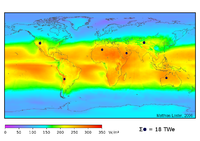
See how small the black dots are?
(And thus in the interest of future drumbeats having better topics than SSP, with the above data, I have slayed the beast dead.)
The peak microwave power-flux density at the rectenna site would then be 300 W/m2.
Yup. What a joke. And yet if even that weak beam drifts off course, get out of the way, because even 50W is high-ish for prolonged exposure (the microwave-oven standard presumes brief intermittent exposure.) See, after all that work TOD staff did a while back to banish the tinfoil topics, we'll all have to wear tinfoil hats - and tinfoil goggles - after all...
SSP does comes up regularly in the popular media, so now we have a repository of info and links.
G'nite.
so now we have a repository of info and links.
We (a royal we) got a good start. I'll plan on adding to my profile that way search engines will have something to trip over....there added.
Hopefully the people who know what to search for in the 'microwave damage to humans' end of things can add links to energy - damage tables thus the knowledge of how dangerous the 'downbeaming' of power would become known.
banish the tinfoil topics,
Glad to be of service.
(Oh, spaced based power gets better and better)
http://www.vnunet.com/business-green/analysis/2202907/space-solar-power-...
So we've went from 2 times the 'normal' PV to now 1/6th the energy density of normal sunlight.
Once again the question to ask is - why go through the hassle of putting collectors in space if land based PV collecting regular old sunlight at 6x times the energy density?
Hey, though the whole spaced out discussion reminded me of the perils we might face out there (like those wary travelers faced in "Amazon Women on the Moon"), after awhile I got kinda tired of the platitudes sans data, and I decided movie time was in order. Looking around I found a little corporate fantasy piece that at one point suggests that some smarter-than-average robots might spread photovoltaic cells all over a big net in space (1:50 into the film). They did a little test run already and one of these worked for 30 seconds before space interfered, though #2 didn't make it that long.
and the title is: Soccer robots in space, at http://www.youtube.com/watch?v=XSeZNjHE-xQ
Space based solar power could still make sense since it is a 24/364 power source that do not require storage. But it would not be viable untill we both get cheap solar power on the ground and learn to get to orbit and down as easily as we can fly.
The problem is not the energy cost for the fuel but the low development level of the space wehicles. Far to few smart engineering hours has gone into advancing spaceflight and to manny workhours goes into babysitting complex but primitive systems.
Hello TODers,
As posted many times before: "Is Cascadia ready?"
http://www.sfgate.com/cgi-bin/article.cgi?f=/c/a/2008/07/23/BAFJ11UH46.D...
----------------------------------------------
Governor, facing budget impasse, plans minimum wage for state workers
(07-23) 18:22 PDT SACRAMENTO -- Gov. Arnold Schwarzenegger plans next week to slash the pay of more than 200,000 state workers to the federal minimum of $6.55 per hour to deal with the state's budget crisis, according to a draft executive order obtained by the Chronicle today.
The governor also will order an end to overtime pay for all but critical services, a freeze on state hiring and the immediate layoff of 22,000 temporary, seasonal and student workers.
"As a result of the late state budget, there is a real and substantial risk that the state will have insufficient cash to pay for state expenditures," the executive order states.
----------------------------
The Terminator is for real!
Bob Shaw in Phx,Az Are Humans Smarter than Yeast?
Wow. The soverign blinks.
And if this sticks - it strikes me as a trend for other states to follow.
Now I wonder how many states doing things like this before FedGov follows suit?
Hello Eric Blair,
Thxs for responding. My Arizona has a big State budget deficit too--I would expect our Governor Napolitano to quickly follow with her own Executive Order to slash the wages of AZ State employees.
Let's hope that firemen & police are not included in this minimum wage group, otherwise the whole Southwest will soon be in flaming anarchy.
Let's hope that firemen & police are not included in this minimum wage group,
No, but support staff might just well be.
(insert something about how hope for more denser population areas exist as they may be the only ones that can obtain/afford police/fire support)
Hi folks, the minimum wage is temporary, and back salaries will be sent to all the employees once the budget is passed (I don't know if the cuts in temp workers would be permanent, they likely wouldn't get back wages). The cut is a gimmick to pressure the legislature to come up with a solution to budget shortfall. If I remember right, one of the last times it happened they just didn't pay workers till it was resolved, but that's a little foggy. Anyway, it's more a ploy that a belt tightening change of BAU.
Hello TODers,
Why would Morocco need military jet in-flight refueling capabilities? Recall my earlier postings on phosphate & sealane control for possible clues:
http://www.military.com/news/article/marine-corps-news/vmgr234-completes...
------------------------------------
VMGR-234 Completes Africa Deployment
NAVAL AIR STATION-JOINT RESERVE BASE FORT WORTH, Texas - The last of a detachment of Marines from Fort Worth, Texas-based Marine Aerial Refueler Transport Squadron 234 returned on June 25 from a deployment to Kenitra, Morocco, for bilateral training with the Moroccan Royal Air Force.
Exercise African Lion 08 included members from several different branches of U.S. and Moroccan military conducting both air and ground training. According to Master Sgt. Andrzej Wyszynski, VMGR-234's senior enlisted Marine for the deployment, the "Rangers," who fly the KC-130T Hercules, conducted low-level formation flying with Moroccan KC-130s and aerial refueling with Moroccan F-5s.
...The squadron's capability for aerial refueling provided invaluable training for the Moroccans, who are scheduled to receive in-flight refueling systems for their aircraft later this year...
----------------------------------------
Bob Shaw in Phx,Az Are Humans Smarter than Yeast?
Hello TODers,
http://news.yahoo.com/s/ap/cuba_russia;_ylt=AjP9yDMYlfnz4EutByGIuW4DW7oF
-------------------------
HAVANA - Ailing Fidel Castro said Wednesday that Cuba's president was right to adopt a "dignified silence" over a Moscow newspaper report that Russia may send nuclear bombers to the island, and said Cuba doesn't owe any explanation to Washington about the story.
...Moscow is angry about U.S. plans for missile-defense sites in eastern Europe and Izvestia cited a "highly placed" military aviation source as saying, "While they are deploying the anti-missile systems in Poland and the Czech Republic, our long-range strategic aircraft already will be landing in Cuba." Izvestia said this apparently refers to long-range nuclear-capable bombers.
---------------------------
Yikes! I don't know what to say....
...maybe use your bags of NPK to build a bomb shelter?
Bob Shaw in Phx,Az Are Humans Smarter than Yeast?
Deja-vu. Why do I feel like I'm 10 years old again?
Mississippi River at New Orleans shut down for days
A tanker full of bio-diesel and styrene cut a wayward barge full of 10,000 barrels of #6 residual fuel oil yesterday morning. As of 9 PM, 25 ships held up.
Water for Algiers (New Orleans West Bank), St. Bernard and Plaquemines Parish shut down and potable water will need to be trucked in today.
Alan