


DrumBeat: October 9, 2006
Posted by threadbot on October 9, 2006 - 9:16am
Asia-Pacific faces global warming disaster
Millions of people in the Asia-Pacific region could be forced from their homes and suffer increasing disease, cyclones and floods caused by global warming, scientists have warned...."Degraded landscapes and inundation of populated areas by rising seas may ultimately displace millions of individuals, forcing intra- and inter-state migration."
Oil prices advance as OPEC president proposes output cut
Uganda president: Oil reserves found
KAMPALA, Uganda - Oil has been discovered in western Uganda after years of exploration, the president announced Sunday, saying he expected production to begin in 2009.President Yoweri Museveni said the country plans to build an oil refinery, with Uganda initially producing between 6,000 to 10,000 barrels a day.
EU given reassurance over winter gas supplies
Chevron to invest $6 bln in Indonesia gas fields
JAKARTA (Reuters) - Chevron Corp. plans to invest about $6 billion to develop gas fields off the coast of Borneo, aiming to crank up flagging Indonesian gas output, a senior official at the country's oil watchdog said on Monday.Indonesia, the world's top liquefied natural gas (LNG) exporter, has failed to meet its contractual commitments to traditional buyers such as Japan, South Korea and Taiwan because of a slump in production.
Nippon Steel honors sanctions, halts North Korean coal imports
New policy on Russia splits German leaders
The German Foreign Ministry is preparing a new Ostpolitik, or policy toward the east, that aims to tighten ties between Russia and Europe just as President Vladimir Putin, who visits here next week, is under heightened international scrutiny on issues from energy to Georgia....While the paper is political in nature, the subtext is clearly energy and Europe's increasing dependence on Russia to meet its energy needs.
Chad settles oil taxes dispute
Chad has settled a dispute with two foreign oil companies after they agreed to pay the country more than $280m (£150m) in overdue taxes.
It seems a little too convenient. As the stretch run to the midterm Congressional election approaches, gasoline prices fall precipitously. The sudden shifts in prices seem to come out of the blue. And unlike copper or pork bellies, oil is a commodity always charged with political significance.
Pick up and go: Car sharing may be the answer to the urban dweller’s dream of having a car and not keeping it.
Inco blockaded in New Caledonia - while WWF signs a deal
Isn't it high time that mining critics spoke out about the consequences of massive tar sands exploitation in Canada and Venezuela? After all, much of it is mining under another name, requiring the extraction of huge chunks of land by shovel-and-truck.
With cheap gas, Venezuelans buy big SUVs
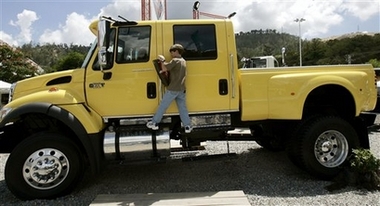
Venezuelans see cheap fuel as a birthright. Filling up an SUV's tank with high-octane gasoline costs roughly $3 — less than two jugs of drinking water.And as oil exports have boosted the economy, the country has experienced a boom in auto sales, including large four-wheel drives that have lost appeal elsewhere as fuel costs have soared.
Brazilian ethanol is sustainable and has a very positive energy balance - IEA report
Work starts on biggest land-based wind farm in Europe
Gas tumbles, but don't get used to it
Lundberg Survey: Pump prices fall nearly 15 cents a gallon, but colder weather will drive them back up.
Output from Exxon Russia field to decline from 2008
YUZHNO-SAKHALINSK, Russia - Oil output from the Exxon Mobil-led Sakhalin-1 project will peak in 2007 and start to decline immediately afterwards partly because it failed to agree with Russia to extend the field's territory, a project member said on Monday.
Contact
- Content: editors at theoildrum dot com
- Tech support: support at theoildrum dot com
License

This work is licensed under a Creative Commons Attribution-Share Alike 3.0 United States License.
http://www.forbes.com/2006/10/06/energy-oil-gasoline-biz-energy-cx_db_pm_energy06_land.html
I've only started digging into about 10 different stories over there.
The world will be flooded with new supply in a low oil price environment.
I want him to tell me how that's going to work. I want details. I want specifics. I want to know exactly where the oil will be coming from. I want to know where any substitutes will come from and by what dates. I do not want history teaches us, the markets will provide, technology will save us, etcetera.
I'm ready anytime.
You should see Deep Ocean Energy Resources -- A Critical Analysis also. Oh, this reminds me that there is a "Jack #2" appraisal going on at Orphan Basin off Newfoundland. If the test is "successful", expect a similar media blitz. Otherwise, you won't hear a thing unless you look hard.
Hope that helps...
But he asserts that while some regions will peak and decline, in effect the world will virtually never peak and decline, or the worst case is that the peak (or more likely plateau) is decades away. This is exactly analogous to saying that while individual oil wells will peak and decline, the total production from the field--which is the sum of production from individual wells--will virtually never peak and decline. Anyone else notice a flaw in this reasoning?
With apologies to Prodigal Son...
Step 2- ???
Step 3- Profit
With apologies to the underpants gnomes.
There are other touts and shills around. Note that the Hudson Institute, another recipient of Exxon funds, has been busy insinuating the Jack2 tall tale into various articles its retainers author.
Facts and logic will not dissuade Lynch or his ilk. Their progeny, however, are likely to remember them with little fondness.
- Some areas really don't ever decline (KSA)
- Enough new large fields are continually being found to offset the declining ones.
Come on, drink the kool-aid.No. And your point is?????
Tell how many millions of barrels a day we're going to be getting from tar sands, CTL, GTL, Venezuelan heavy oil, etc. by 2015. Include the economics with start up costs, long lead times to implementation, etc. for each. Think about the CTL & GTL throughputs. Think about Hugo Chavez. Think about the fact that tar sands development is in deep trouble right now, let alone 5 years or 10 years out.
And finally, think about how Robert or anyone else has calculated the EROEI. What is the precision of that?
Then get back to me.
Say what you will about how fast you think they will scale up. But it is fast enough that Canada will abandon their Kyoto commitments, and therein lies my point.
Finally, how I calculated the EROEI was merely a way of putting an upper bound on it. The lion's share of the energy going into extracting the tar sands will be direct natural gas usage. If we have a figure for natural gas, and a figure for how many barrels of oil was produced from the tar sands (which we did), I can rough out an EROEI. Also note that after I calculated that, someone linked to an article in which Suncor claimed the same EROEI as the one I had calculated. I am guessing they have a pretty good idea of their energy inputs and outputs.
And the reason it is important is that it tells you that we will continue to try developing tar sands, as opposed to something like oil shale where the EROEI is much worse. Money keeps pouring into tar sands. It will keep scaling up.
But PhilRelig and Michael Lynch are still learning.
As for the EROEI, the "lion's share ... will be direct natural gas usage." For PhilRelig & others -- and Lynch if he's eager and willing to learn about what he gets paid to do -- see my Oh, Canada! -- Natural Gas and the Future of Tar Sands Production and also Extreme Production Measures to see what a mess the tar sands production is in.
Re: EROEI was merely a way of putting an upper bound on it.
Right. Our readers need to understand that the world they inhabit was built on EROEIs of ≥ 20:1 -- and also
As you and I have both said, these "unconventional sources" will not scale up fast enough to avoid the peak. At the point where these sources become available on scales that make any difference, the world would just be managing the tail. Moreover, if the world decides to assign a cost to carbon (via cap & trade) as a first step or finally decides to do the right thing -- mandating sequestration of some % carbon -- then this changes any marginal costs calculation.
OK, fine, it will have adverse effects on the environment. But suppose TPTB chose to ignore that (which I expect will increasingly be the case in the long run anyhow). Wouldn't an all-out effort significantly ameliorate the decline to be expected in coming decades, possibly holding what would have been a 5-6% annual decline at a manageable 2-3%, thus successfully enabling the current growth-oriented economic paradigm to continue for a generation-or-so longer?
In fact, it's what has been going on from the time oil had a 100:1 EROEI, of course, which is now, let's say, 20:1, if that. That and using exponentially more of it. Work harder to get less result.
That's why we have climate change. 2nd law.
Hell, yeah! It would guarantee that the planet wouldn't be habitable for our grandchildren. OK, that may be a bit of an exaggeration. Still, it will be tough to locate the exact Beach Front Property line in Florida and Louisiana, not to mention Bangla Desh and a lot of other places.
Click to Enlarge
But seriously -- throwing money at the problem is not going to work. Believe me, Phil, we here at TOD do pay a lot of attention to unconventional subsitututes for crude oil.
Still, I like this -- a Manhattan Project effort to do exactly the wrong thing. But I'm not a well man.
I note, however, that he has significantly modified this in a post below by conceding more like a 3:1 EROEI when it comes to gasoline derived from tarsands.
I had also consistently used that 3:2 number, but could never find a source for it. Once I did find some sources, the numbers appeared to be quite a bit better than 3:2. This actually makes sense to me, because I don't believe things have gotten bad enough yet for us to start developing sources with a 3:2 return (unless it is subsidized).
I note, however, that he has significantly modified this in a post below by conceding more like a 3:1 EROEI when it comes to gasoline derived from tarsands.
That wasn't a concession, it was a clarification. Those who quote 3:2 are only talking about the oil extraction step. The 8:1 refers to the oil extraction step. If you want to take it all the way to gasoline, the numbers would be something like 4:1 based on my back of the envelope number, and the 3:2 number would drop probably down in the 1.3/1 range. (Don't have time at the moment to work it out exactly, but the refining step is going to be at least 10/1).
The Permian extinction happened when CO2 concentrations reached 1000ppm.
We are at 381ppm now, and going up by 2ppm a year, a rate which is accelerating.
On the 'business as usual' model of the IPCC, we are over 800ppm by the end of the century.
What we don't know is when, at what ppm, the process becomes self fulfilling, ie it gets warm enough that methane release and plant decay and death begin to accelerate the accumulation of CO2. At which point, human activity becomes irrelevant (turn up the air conditioner dear, it's hot out there ;-).
Scientists used to say that 550ppm was probably the maximum safety level. Now the consensus seems to be shifting towards 450ppm. We will be there before the half century is up. Some say 300 ppm ;-).
Just today, for example, Tom Whipple's weekly ASPO energy review repeated the canard that the EROEI for tarsands is 3:2 or thereabouts (if Robert Rapier and Suncor are indeed correct, that is). Since Tom Whipple is a well-informed commentator who does this full-time, one could consider this to be symptomatic of the movement as a whole not having done their homework.
The problem is that all these types of controversies are inherently complex, and therefore it is easy to obfuscate the truth with lines of argument having a high prima facie plausibility.
I didn't read that as them painting a rosy picture. It appeared to me that they were saying "Crap, our energy efficiency is lousy. We are only getting 8/1." Remember, these are oil guys. They are used to 20/1. The worst fields in the world get 10/1. Here they are getting 8/1, and admitting that they need to do better.
I would also add that this doesn't include the refining step. Add that and you are down to 3 or 4 to 1 from tar sands all the way to gasoline.
Thank-you for this injection of reality into the discussion.
Now where is it that the measurement of eroei for useful products exacted from the degraded tar pit hydrocarbon begins?
Hydrogen (stripped from natural gas) is added to the tar molecules as you know.
Is upgrading included in the 8:1 EROEI step or is it part of the "refining" step ?
Thanks,
Alan
If I understand their abreviations, then that is
800 cubic foot of gas per barrel of heavy crude oil produced. It doesn't include the further cost to refine it.
(I got that number from the publicly available data of one of the tar sands Income Trusts -- I think it was their 10K).
You are a true realist.
Keep up the good fight.
peace
Here's a shorter link, for those who don't want to click on the long one and screw up their formatting:
Forbes
Definitely worth a look.
Yes, thats an ad hominem arguement. Sometimes they're justified as an explanation!
In his own arguements he says the world has used half of the light, sweet crude and touts tar sands and oil shales as saviours without reguard to production costs or environmental costs, and uses this as an arguement that oil prices will decline in the future. This does not add up. But its what the Iron Triangle wants to hear.
They mention peak energy and oil but only as a way to frame solutions in a way to show they are non issues in the long run. The timing of this rosy outlook in Forbes (right before the elections) is suspect in my book. Why was this rosy outlook not presented in July when prices were sky high? More piling on for a downward price trend through early November?
I see collusion everywhere now! Paranoia or reality? Thanks a lot TOD:)
While a student at MIT during the Cold War, he studied national defense.
If we assume the Cold War started at about the time of Kennan's Long Telegram in 1947, and lasted through to the fall of the Berlin Wall in 1989 , then the intersection of...
(Cold War) && (Ancient University) && (Impressive-sounding course of study)
...must be pretty large. Plucky Underdog himself studied nuclear engineering at a university that started crumbling into dust long before the Cold War, but apart from a couple of lectures on energy economics (NPV, discounted cashflow etc.) it didn't qualify him to bloviate about oil reserves and production profiles. It was his subsequent decades in the oil business that qualified him for that, and if you ask him a straight question, you'll generally get a shrug.
"...Psychology is not inherently knowable," he says. "Geology is."
That's the giveaway. Clearly this guy has never looked at an electric log or seismic section, let alone a prospect map, or tried to work out why a late-life development well didn't flow to surface. I wonder if he even knows any geologists.
Dave Cohen wrote:
I want him to tell me how that's going to work. I want details. I want specifics. I want to know exactly where the oil will be coming from. I want to know where any substitutes will come from and by what dates. I do not want history teaches us, the markets will provide, technology will save us, etcetera.
That's the ticket. Field names, fluid specifications, locations, well numbers, dates, rates. Nothing less will do a thing for you in this market.
http://www.worldchanging.com/archives/005029.html
On a side note Florida is having a sales tax holiday on all energystar appliances, even CFL's, for a week. there's a $1000 or so limit though. So probably no whole home a/c units.
as part of today's Kunstler:
http://jameshowardkunstler.typepad.com/clusterfuck_nation/
There are plenty of other statistics available from the same page.
http://www.economagic.com/em-cgi/data.exe/doeme/paprbus
Is world energy production (by btu) flat or trendind downward:
http://www.economagic.com/em-cgi/data.exe/doeme/teprbus
too bad the data doesn't go back further.
So 6*10 to the 6th *21*10 to the 6th * 365 is 4.6*10 to the 16th or 46,000 trillion Btu's./yr for the US. I think its all hoky poky.
And looking at their numbers, they seem to simply be the EIA's numbers as they posted them in April. Take for instance Russia. Russia's numbers posted here are the exact numbers pasted by the EIA in April. They have Russia at 9.5 mb/d in December as the EIA did and the next four months exactly match what the EIA had for Russia in April. And they stayed that way before they were all revised downward by over .2 mb/d in the July numbers.
Russia numbers from the above link.
2005 12 9500.000
2006 01 9310.000
2006 02 9330.000
2006 03 9360.000
2006 04 9370.000
These were the same numbers published by the EIA earlier. The new revised numbers, through July, published in in the latest EIA release, in thousands of barrels per day.
2005 12 9240
2006 01 9030
2006 02 9040
2006 03 9150
2006 04 9170
2006 05 9160
2006 06 9260
2006 07 9260
However as you say, the monthly data on this site goes back a lot further than the monthly data from the EIA's International Petroleum Monthly.
Ron Patterson
http://environment.about.com/od/environmentallawpolicy/a/gasolinetax.htm
Not overhwelming support, but slim majorities (55%, 59%) to reduce oil imports or to reduce Global Warming.
I ses a niche for moving forward !
Best Hopes,
Alan
http://www.guerrillanews.com/articles/2601/Canada_Beyond_Kyoto
My theory is that if Kuwait actually had 100 billion barrels or more of actual proven reserves, the oil minister would have joyously announced that fact forthwith. But he has not. I think, and again this is only speculation, that the news the minister received was not good. Therefore there was no joyous announcement. Instead the news we get out of Kuwait that they have a plan to dramatically boost oil production to 4 million bpd by 2020 from about 2.6 million bpd.
But still no clarification of Petroleum Intelligence Weekly's estimate of Kuwaiti reserves. "Within days" has turned into almost three months and I'll bet it will be a lot longer before we get any official news from Kuwait on their actual reservs. What will likely come a lot sooner is an actual change in Kuwait's production numbers. And I am betting that it will not be an increase.
Ron Patterson
a) it does a little to keep prices up
b) the one with the last oil wins
I'm not sure what the recent OPEC "worries" about crude prices below $60 mean .. Apparently they did earn enough money even at $20. They would be wise IMO to stretch the route, instead of pumping at the limit.
BTW the german government yesterday announced to "double energy efficiency" until 2020 in comparison to 1990. So this could be a signal to oil producers as well.
We should not forget the statement on the Paris OPEC conference this spring, where some OPEC spokesman expressed doubts about future demand ..
Ethanol will be 40% of ADM's net income in 2007. And this while it's generally agreed that ethanol is not profitable without subsidies. Ergo: the percentage of ADM profits from ethanol subsidies is high. Not that they don't already get fortunes in agricultural subsidies.
ADM has established very close relations (an "almost merger", a joint ventures string) with Syngenta, formerly Novartis (formerly Ciba-Geigy) and AstraZeneca. Cargill has similar ties to Monsanto, and ConAgra with DuPont.
The world's largest food producers team up with the world's largest chemical companies. Clearly, the boys and girls are positioning themselves for the symbiosis of food, fuel and chemicals (and subsidies). All this, of course, will be achieved through the use of GMO seeds. Since there are patents on those seeds, they have the perfect tool to kill all competition. For food and fuel.
So, I maybe painting with too large a brush here, but I think there should have been and needs to be much greater discussion about the value of bio-fuels, which i think have a definite role, but the GMO of plants as an answer to car culture needs to be opposed.
http://gristmill.grist.org/story/2006/8/18/181741/364
The GMO thing is indeed named as once criticism.
Quote from the following FT article:
"The group has already trimmed some production in the last two months, so this cut could end up being more in the range of 500,000 b/d than the 1m b/d to be announced. Saudi Arabia will shoulder the bulk of the reduction"
Will they now? Thats very kind of them;)
http://www.ft.com/cms/s/49296ee0-56f6-11db-9110-0000779e2340.html
That's a 2.53mbd cut.
And there's the same question again: are these figures with or without Iraq?
http://www.msnbc.msn.com/id/15190745/
And today is World Overshoot Day:
http://www.energybulletin.net/21231.html
Maybe we should just call it we are FUBARED day.
;-)
Was the world paying any attention to the other nut job (lambasting the action by the N.Koreans) who has 3000+ nucelar warheads, running the only country to have used nuclear weapons against civilians. The warmonger who has single handedly destroyed foreign relations around the globe, waging illegal wars in the name of imperialism masqquerading as some anti-terror bulls**t. Has caused the destruction of hundreds of thousand of civial lives in the middle east. The regime which turned a blind eye when Isreal (the only nuclear armed middle eastern country) were acquiring nuclear weapons and not pushed into the nucelar non-prliferation treaty.
I'm sorry but the stench of hypocracy is sickening.
Marco.
No doubt about the stench. Somehow, the peasants of the world need to figure out some way to remove all the nukes from EVERY country. I have no viable ideas, but the current system where the powerful few [who have their fingers on the LAUNCH button], are the most likely to survive in well-fortified bunkers makes no sense whatsoever.
Bob Shaw in Phx,Az Are Humans Smarter than Yeast?
Anyone know of one?
And as I pointed out in a post a few days ago, the Dollar is at almost the exact same point it was ten years ago, measured against an index of all major currencies. However the Euro has existed only since January of 1999, a point at which the dollar index was down somewhat from its average in 1997.
At any rate, we do not need a chart, we can simply do the math. When the Euro was introduced in January of 1999 it was trading at about $1.15. Yesterday the spot price for the Euro closed at $1.26. That is a gain of 11 cents against the dollar over the last 6.5 years, or an average of about 1.5 percent per year.
In January 1999 oil was trading at about $12 a barrel. Right now it is trading around $60.50 a barrel, a gain of 404 percent for the holder of dollars. But for the Euro holder a barrel of oil would have cost, in January of 1999, about 10.43 euros. Today that same barrel would cost him 48.02 euros. That is a gain of 360 percent.
So the price of oil has increased 404 percent for those buying in dollars but only 360 percent for those buying in euros. He is better off, by almost 11 percent over six and one half years. Or, as I said earlier, about 1.5 percent per year.
Ron Patterson
Sorry, that's seven and one half years not six and one half. I forgot to count 1999 and should have because we started in January. At any rate that changes things very little. The Euro buyer would be better off by about 1.46 percent per year.
Ron Patterson
http://www.theoildrum.com/story/2006/10/2/111911/949#229
You keep talking nominal prices when we live in a fiat currency world denominated in deprectiating dollars. To be honest we should include Euro inflation, however it should be going up since it's only 7 years old. I suppose it's hard to get a real figure for the Euro side, but it's clear that the dollar in 1999 isn't worth what a dollar here in 06 is worth. So 1.15 dollars traded for Euro in 1999 trading for $1.25 today isn't good, it's pretty bad since the dollar lost 18% more of it's value. To stay even it would have to trade somewhere in the range of $1.40.
I think you are a little confused tate. We must talk nominal prices since one fiat currency is just as good as another fiat currency.
Tate, we do include Euro inflation. That is what the currency market does. The very reason one currency moves against another is because the difference in the inflation rate between the two currencies. If they both inlfated at the exact same amount, then one currency would never gain or lose against another. But when the inflation rate in the United States is greater than the inflation rate in Europe, then the dollar loses ground to the Euro. If the inflation rate is higher in Europe, then the opposite occurs.
Of course the currency market is not perfect and therefore there is always a lag effect and sometimes an overshoot. But in the long run, the movement of one currency against the other reflects the difference in the inflation rates of the two currencies. No one sets the rate of one (floating) currency against the other. And all major currencies float.
No, and neither is the Euro!
Tate, of course the dollar has lost 18%, or somewhere in that range. But you seem to think that the Euro has lost no value whatsoever. That would have to be the case if it took $1.40 to buy one Euro. But all the while the dollar was inflating the Euro was inflating also, but just not at the same rate. Again, that is what the market does! That is, the market tracks the difference in the inflation rate between all floating currencies. Again, it is not perfect. It sometimes lags and sometimes overshoots. But if you average out the lags and overshoots over the years, it will track the difference in inflation rates pretty damn close.
Ron Patterson
I also realize no one sets anything. This is a currency market dominated by central banks in all reality.
Do you have any formulas for the currency market such as a Long Run Suppy curve formula? You know like what is the underlying factors that affect it (ie taxes, labor, capital). Just curious to see ALL factors accounted for since I claim no expertise in currency markets.
Great because that is what it is all about, the purchasing power of one currency verses the purchasing power of the other.
I am not sure what numbers you are talking about. Perhaps if you explain it a little better I could help you out with those numbers. I could probably post you several URLs if you just tell me what numbers you are looking for.
No! That is where you have it dead wrong. The currency market is not dominated by central banks unless by "dominated" you simply mean making a market for others to trade. Of course virtually all currency trades go through central bank, FOREX member banks to be more specific.
Daily volume on the FOREX is about 1.5 trillion dollars. However 95% of that is trading by funds and speculators. The other 5 percent, or 75 billion, of daily volume consists of governments and commercial companies converting one currency into another from buying and selling goods and services.
That 95% is always trying to "guess" what the other 5% is going to do. They are often wrong and that is why you sometimes have overshoots and undershoots of one currency against another. But if the price of goods and services in one country gets too far out of whack with another, it is basically self-correcting. That is, if country A wishes to import product X from country B, but the currency of that country is so powerful that it cost twice as much to import product X from country B as from country C, then country B will get no business. The currency of country B then must deflate, against the currency of country C, until their goods and services are on parity with each other.
Speculators watch things like this like a hawk. If they think one currency is too powerful they will sell this currency and buy the weaker currency in anticipation that the gap between them will close. And that is why one currency can never get too out of whack with another currency. The speculators sense this and immediately close the gap.
No, I don't think such a formula could possibly exist. Basically what sets the value of one currency against another is just what I explained above. That is, it is the buying power of one currency verses the buying power of another. And that changes because of the inflation rate in one country verses the inflation rate in another.
One more point. The market always tries to anticipate what the currency of one currency is going to do against another. For that reason it seldom, if ever, tracks the exact value at the moment of one currency verses another. Therefore if the speculators senses that the dollar, or whatever currency, is about to tank, they will short it against a currency they expect to hold its value.
That is primarily the reason that the Dollar was very strong and gaining ground against the Euro during the Clinton administration and has been tanking under the Bush administration. Clinton balanced the budget; this meant a strong dollar. The Bush budget of massive deficit spending is an irresponsible monetary policy. Therefore the dollar has tanked under Bush. And this tanking, in my opinion, will continue though it did stop tanking about two and one half years ago. That was because it fell too fast and it has since been in a holding pattern, waiting for things to get back into sync with actual values. But I think it is due to start falling again. The dollar started to tank in 2002, the second year of the Bush administration, when it was clear that Bush was spending trillions we did not have while cutting the taxes of the rich and super-rich. Not a sound monetary policy.
Ron Patterson
The Euro was not introduced in 1999, other than as a paper tool.
Jan 1 2002: $US was 1.14 Euro
Oct 9 2006: $US is 0.7937 Euro
So in 02 - for $1 you got back EU1.14 but now it's you get back EU.79 for every $1? So the dollar is worth less today relative to the Euro.
Cheap oil in Euroland.
Ever think: maybe that's why they can live with higher gas taxes?!
Well, yes and no. The Euro was introduced on January 1, 1999 and the currencies of all 11 nations were locked to the exchange rate of the Euro until it became the sole currency in circulation of these, now 12 nations, on January 1st, 2002. So since these currencies were locked to the euro exchange rate, we can track the Euro from January 1st, 1999.
Ron Patterson
Sadly, because of our built environment, car sharing isn't viable for the places most people have chosen to live.
I'm in the process of giving my car to a charity and got my Flexcar card on Friday. I haven't taken one of the cars out for a spin yet but I am looking forward to the $150-$200 a month income from renting out my parking space.
Happily the neighborhood I live in is undergoing a rapid transformation into a high density pedestrian friendly environment. Right now I have to take the train or a car to get groceries but in a year or so, I'll have two grocery stores in easy walking distance. The same goes for places to eat, nightlife, coffee houses and other "third places".
Everyday when I come into work the main topic of discussion amongst my coworkers is how bad traffic was that morning. It conversations go on and on. Even in the afternoon it continues on, drifting into topics such as how stupid elected officials are for not building more roads and how stupid the DOT is for not building the country road they live on with ten lanes in the first place. It just amazes me how people will move into a horrible commute and not take a single lick of responsibility for it.
Any ideas on what the global powers should do to North Korea [NK]? Iran, and any other countries that might be considering joining the nuclear club, will be very watching very, very closely. The NK nuclear test was about the size of the Hiroshima explosion; roughly 15,000 tons of TNT, according to this link, but I bet every physicist in the world is busy right now trying to characterize this detonation down more exactly.
Doesn't our own Stuart Staniford have a Phd. in Physics? If he is looking for work--boomtimes in this field [sorry for the sad pun], but I bet the supercomputers are really smoking around the planet at this moment from all the data downloaded from satellites, airplane sampling flights, acoustic hydrosensors, radiotelegraphs, seismometers, and so on. He could really be of service to this new industry as I bet there is petabytes of info that needs filtering, statisical compliation, and then analysis.
I really think the world needs to draw the line in the sand and somehow overthrow the NK govt soon. Yep, it could be real ugly. Probably cost the world a couple trillion, and who knows how many lives around Northeast Asia, but I think this is far better than letting every Tom, Dick, and Harry getting his own nuclear weapon. That would be far worse, and ultimately much more expensive in lives, infrastructure, and ecosystem damage. Who knows, maybe this process might make Russia, China, US, and the other members of the Club, finally decide these badboy toys are too risky for anyone to possess in a postPeak world.
Bob Shaw in Phx,Az Are Humans Smarter than Yeast?
It will be interesting to see what comes out of the UN in the coming days; if Russia, China, and the US can somehow figure out a strategy. I keep thinking about that Ebaumsworld cartoon whereby nothing is ever done until it is far too late.
If I recall: A full-on nuclear gift exchange is what worried Jay Hanson the most. IMO, we seem to be heading increasingly in this direction. Sad.
If China invaded NK, then killed most of the NK males: it would help solve the shortage of female brides that arose from misguided Chinese female abortions and female infanticides.
Bob Shaw in Phx,Az Are Humans Smarter than Yeast?
North Korea's main example to the world so far is that if a country really does have nukes they can expect security. This is bolstered by the example of Pakistan. I'm reminded by the words of an old southern gentleman, James Maury (dec'd) who told me about 35 years ago "man has finally discovered how to set the world on fire, and I bet he'll do it."
Something to the effect, "If my ass is grass, then so is my neighbors." MAD is a reality and it makes the world such a small place.
Perhaps over throwing North Korea would serve as an example for other countries with nuclear ambitions but I doubt it. We didn't do anything significant about Pakistan, India, or Israel, so one counter example isn't likely to have the impact that you'd hope for.
I don't want to sound defeatist or overly passive but it might be that the reality of multiple third world nuclear powers is something we are going to have to accept and deal with.
So they assembled a nuclear bomb. They can't do much with it. Militarily, they would fold pretty quickly (I assume the US has a plan to neutralise their artillery, which could shell Seoul from over the border)
Could such a weapon already be there, sitting in a nondescript dwelling, waiting for the day when it is needed?
Which doesn't mean the south can't screw up the search, after all we did a horrible job of deploying similar detectors after 9/11.
If they have a working bomb (the consensus is this one was a 'fizzle') then I am sure they can get it to Seoul.
No doubt the US has a plan. Moreover, the State of Israel should be able to add to it with advice about shutting down the artillery of opponents, given the Israeli Offensive Forces recent success in Lebanon.
I can hardly wait. More shock and awe. It's just like free fireworks. And it won't cost a thing, especially not the lives of anyone I know.
This is the most paranoid, dug in society in the world. 1 million soldiers, another million militia. Deep bunkers everywhere. Almost daily training for war.
There is no, absolutely no, chance of a conventional assault on NK succeeding, without enormous military and civilian casualties (think 1 million or more). Pinned down in Iraq, the US doesn't even have the werewhithal to begin it.
A nuclear assault could not be assured of destroying their military, and the necessary groundbursts would spread fallout across the entire northern hemisphere.
Now the North Koreans have shown their warhead/bomb assembly actually functions as advertised.
This weekend Egyptian President Hosni Mubarak warned that the Middle East was on the verge of erupting into War (can't find link to article anywhere now//).
Good bye Israel. It's been nice knowing you... ;)
-------------------
But even during that rather benign T1, the unexpected might become the rule and the orderly 'Pre-Peak' rapidly give way to some chaotic 'Post-Peak.'
Dr. Bakhtiari, http://www.energybulletin.net/19701.html
----------------------
Rafsanjani, said in 2001: "If a day comes when the world of Islam is duly equipped with the... application of an atomic bomb, it would not leave anything in Israel, but the same thing would just produce damage in the Muslim world."
http://www.jpost.com/servlet/Satellite?cid=1154525797583&pagename=JPost%2FJPArticle%2FShowFull
-------------------------
Assad: We expect war any time, Oct 8
http://english.aljazeera.net/NR/exeres/3E755007-6081-4D68-A3A3-8F156ECCEAE5.htm
------------------------------
IDF prepares for possible Syrian attack, Oct 9
http://www.jpost.com/servlet/Satellite?c=JPArticle&cid=1159193397544&pagename=JPost%2FJPArti cle%2FShowFull
K-i-s-s-i-n-g
First comes Israel
Then the USA
Next comes Chaos in an Imam sorta way...
---------
U.S. fears North Korea-Iran Plutonium Deal
Jan. 29, 2006 at 10:09PM
Diplomats and intelligence services believe North Korea is negotiating to sell Iran plutonium from its newly enlarged stockpile.
The move would give Tehran a rapid route to the atomic bomb, The Sunday Times of London reported... The belief that Iran and North Korea are talking about plutonium stems from a recently reported offer of oil and gas from Tehran in exchange for nuclear technology....
http://www.washtimes.com//upi/20060129-095223-6535r.htm
------------------------------------
Iran: Tehran Has Stake In Success Of Korean Missile
http://www.rferl.org/featuresarticle/2006/06/B460560E-9A78-47F1-89FE-E00916C4600B.html
-----------------------
US Says Iranians Witnessed N.Korea Missile Test
WASHINGTON (Reuters) - One or more Iranians witnessed North Korea's recent missile tests, deepening U.S. concerns about growing ties between two countries with troubling nuclear capabilities, a top U.S. official said on Thursday.
Asked at a U.S. Senate hearing about reports that Iranians witnessed the July 4 tests, Assistant Secretary of State Chris Hill, the chief U.S. negotiator with Pyongyang, replied: "Yes, that is my understanding" and it is "absolutely correct" that the relationship is worrisome.
Hill's comments are believed to be the first public U.S. confirmation that Iranian representatives observed the seven tests, which involved one launch of a long-range ballistic missile, which failed soon after being fired, and six tests of short and medium-range missiles. Hill said the six succeeded in hitting their target range.
http://today.reuters.com/news/articlenews.aspx?type=topNews&storyID=2006-07-20T151923Z_01_WAT006 092_RTRUKOC_0_US-KOREA-NORTH-USA.xml
That option would be the worst possible option for the world right now. Isreal's Samson option would likely decimate every oil producing nation in the Middle East, have potential for direct damage against Europe(some analysts believe Isreal would target unfriendly European countries as well), and very likely indirect damage via fallout over a large swath of the Earth.
Given the end of ME oil production, regardless if we are at peak now or not, you would have a cliff in terms of energy production which would result in the decline of every industrial nation, and in turn the decimation of many third world nations as all foreign aid and food would likely cease.
And these are just the consequences of that action 1 or 2 steps removed from the conflict itself. Further problems could arise and be expanded depending on the moves other countries make during the time this chaos ensues.
The destruction of Isreal and Isreal's counter attack would very likely be the end of the world as we know it. Literally the Arab/Persian world are playing with nuclear fire, unfortunately, they may not just burn themselves, but a lot of the rest of world too.
You are arguing that Israel is OK to have nuclear weapons as a deterrent, but Arabs and Persians are not?
I don't think they will follow that logic ;-).
But in that vein...
I understand the Arab's feel they need Nuclear weapons. Problem is while Isreal has had them, they've never taken an offensive posture with them. In fact they've never declared they own them. Everyone assumes they have them, and its probably a good assumption. But you don't hear rhetoric coming out of Isreal from anyone in a serious position of authority about wiping Iran off the map.
Iran on the other hand who doesn't even have the weapons yet, (at least by current estimates) is already making promises with what they intend to do with them.
You can argue all you want whether Isreal should even have the nukes. Personally Isreal having them makes me nervous a bit also, but, in the end, they are the nuclear evil we know(and the nuclear evil that has remained dormant), Iran is the nuclear evil we don't know(and worse they don't even have the weapons yet, and are taking on an active offensive stance already).
In the end I think it is a fruitless course of action to try and prevent all of these nations from gaining these weapons. I think ultimately a stance of, an aggressor nation using nukes will result in the immediate and total nuclear destruction of that country. MAD on a micro-national scale.
Isreal appears ready to go nuclear in order to break a stalemate.
All of the tripe the Yerginz and Lynch types spout will be for naught. Planz on Drawingz Boardz are as good as the chaulk dust they were created with.
At least, that's what it feels like to me. The silence is entirely too eerie.
http://www.buzzflash.com/articles/contributors/461
Ya...can we get that message to the people that need to hear it, please?
Got a source for this bit of information chrisrob111? Seoul lies 37 miles south of the North Korean border. That is a very long artillery shot. The 16 inch guns on the big battleships could fire 28 miles overland, or at least that's what some old salts told me. Did you mean rockets perhaps?
The guns will be in tunnels too. They will open up the hatches, fire, and retreat before our air power gets to them. It will take days or even weeks to root them all out and silence them.
Seoul is all concrete, and I believe every South Korean home and office building has a bunker built into it. So in a purely conventional barrage, lots of people would die, but like Beirut and Sarajevo before it, (and Stalingrad), lots of people would live on. Reinforced concrete stands up to bombardment surprisingly well.
100,000 dead maybe, but probably not millions.
however if they used nerve gas, then millions might die, or at least hundreds of thousands (gas masks alone are not a protection). That would be unimaginable carnage.
I think in that latter situation the US might well use nukes.
Its at the maxiumum range for field artillry but its possible. the shells are rocket assisted to increase range but the size of the warhead is usually reduced.
The bigger threat to Seoul maybe underground tunnels dug by the north under the DMZ. These tunnels are to far from seoul to deliver a Nuke, however, a bomb could be transported to the city using soldiers. ie move the bomb through the tunnel, pop up in South Korea, aquire a truck or van to transport the bomb into the city.
When the US forces discovered part the tunnel network, they opted to pull back the majority of miltary assets 75 miles from the DMZ, to avoid letting NK set a nuke off in a tunnel and take out a large amount of military assets as a first strike attack.
The worst scenero with NK is that they give or sell a Nuke to a terriorist network that could use its network to transport it to the West. In such a situation it would be difficult to determine the point of origin and would probably take several weeks if not months to figure out who made the bomb.
Hopefully negotiations and sanctions will work, but at some point: it becomes a question of magnitudinal difference. A NK & SK reunification is possible if a localized conventional war is waged [yes, there will be loss of life]. But reunification is pointless if the whole area is glowing radioactive glass from a China, Japan, Taiwan, NK, SK, and even the US, in a nuclear gift exchange.
A bullet into Arch Duke Ferdinand spiraled out of control.
Bob Shaw in Phx,Az Are Humans Smarter than Yeast?
This is an interesting piece on the destruction of elephant societies across the planet and the resulting anti-social behavior of a very social creature.
A couple years back, I spent some time in Southern Africa and spent one week in Hwange park in Zimbabwe. It was quite spectacular and saw five or six thousand elephants. One fact is that the elephants had been cut-off from their traditional migrations routes to the Zambezi river. So in the dry season, they pumped, using diesel engines, water for the elephants, which is why if you sat around the watering holes for a week, you could see thousands of elephants as they all had to come in for water every few days. Watching a herd of a couple hundred elephants get water is endlessly interesting. Of course over the last few years, with the idiocy of Mugabe, many of the pumps have been low on diesel and many elephants have died.
Hard to imagine sitting in the middle of Hwange that's it really not wild, but such is the case across the planet. If you define wild as undisturbed by humans, there's really no wilderness left and that's a hell of a historical recognition. Anyway, the elephants revolt is too late, they needed to start at least a hundred years ago, but probably should have started a few tens of thousands of years ago, when they noticed some of those apes losing their hair and not using their front appandeges to walk.
Ok, I need to go back and watch our fearless leader talk about how we can have ten thousand nuclear bombs and no one else can have any. I say if customers want nukes and someone can build them, the market should decide. cheers
Thxs for this link! Reminds me of Hans Selye's General Adaptation Syndrome [GAS] whereby species become increasingly dysfunctional from environmental and social stress. Makes one wonder how many key animals will go extinct before mankind finally wises up. Polar bears, gorillas, chimps, elephants, tigers, hummingbirds...... can a cuddly cockroach ever replace a cuddly teddy bear?
Bob Shaw in Phx,Az Are Humans Smarter than Yeast?
Hah, probably only if your another cockroach.
website: www.energycabin.com
I would be interested in energy return facts concerning wood pellets. It would seem much energy would be wasted in the process of producing pellets. Am I wrong? What is the future of wood pellets?
Well, I used them for the last three years to heat my home with a free standing wood pellet/corn stove.
The last three years the wood pellets were $3.15 for a 40 pound bag. This year they were $4.69 to $4.99 per 40 pound bag. At 4.99 per bag they are more expensive per btu than propane at $1.62 (my contract price for this winter). I can not imagine anyone dumb enough to spend thousands of dollars on a pellet stove and then pay more per btu for the wood pellets than for the propane/natural gas that they are already setup to use. But then, a lot of people don't do the numbers.
But then, one of the local big box stores is advertising corn for corn/pellet stoves at $4.39 for a 40 pound bag. (4.39/40*56=6.146) So they are selling (or trying to <BG>) $2/bushel corn for $6.15 by putting it in a bag. Pretty good markup!
Make that "environmentally conscious enough". Some Europeans are ready to go green even when it doesn't make financial sense. They are actually ready to make personal material sacrifices to do the right thing.
Of course, when you factor in the environmental cost of making the pellet stove vs. letting the gas stove live out its days, the "green" solution might not be so green after all :-)
Thanks for sharing your pellet cost information. As always, the above system applies best to certain geographical locations, and as you can see, the pellet boiler is a backup to solar. It sounds like an integrated system which would work well near saw mills, or pellet producers. Since wood pellets are an important source of Sweden's energy independence from fossil fuels, it seems possible that sustainability in the US's future will involve more pellet producers and your costs may again go down in the future. IMO growing trees to produce pellets makes more sense than growing corn to produce ethanol.
http://www.theoildrum.com/user/Stuart%20Staniford
It links to his home page at:
http://invictaconsult.com/
It looks like he is perhaps trying to focus on his consulting business. He has an interesting idea of combining "Security of Networks and Energy". Prior to his interest in Peak Oil, Stuart had published some very well received papers in computer security. So now he is trying to combine his two areas of expertise. It's not clear to me that there is much overlap, but perhaps he is having some success and this has taken away from his time to post here.
I don't know what the financial arrangements are for the various contributors here. I doubt that any great fortune is rolling in to the Oil Drum coffers, but no doubt the advertising and links are bringing in a modest sum. Perhaps disputes occasionally arise among the principals as to how these funds should be managed and disbursed. I wouldn't be surprised to see financial constraints sometimes cause commentators to leave.
Nobody addressed this, but I did want to make it clear that contributors aren't paid for writing for TOD. I think that the ad revenue is being used for server costs, etc.
There's gotta be an alternative to this.
While this is hearsay, I take it to be fairly reliable. UIs there any evidence that "Large amounts of Clean Development Mechanism (CDM) carbon credits are going to the palm oil industry, to the biofuel industry which uses this palm oil, and into timber plantations."?
I agree that Indonesia deforestation is a crime and that biofuel production at the expense of these dwindling resource should not go forward.
tion of 300 million.Lester Brown projects
400 million by 2043.
peace
But Today is also Today is World Overshoot Day
Overshoot has been called `the biggest issue you've never heard of.' Yet despite its lack of publicity, its causes and effects are as simple as they are significant.In any given year, if trees are cut down faster than they grow back, then forests become smaller than the year before. If more fish are caught each year than spawn, there will be fewer fish in the sea. The consequences of our accumulating ecological debt also include global climate change, species extinction, insecure energy supplies, water shortages, and crop failure.
As humanity's consumption of resources increases, World Overshoot Day creeps earlier on the calendar. Humanity's first Overshoot Day was December 19, 1987. By 1995 it had jumped back a month to 21 November. Today, with Overshoot Day on October 9, humanity's Ecological Footprint is almost thirty per cent larger than the planet's biocapacity this year. In other words, it now takes more than one year and three months for the Earth to regenerate what we use in a single year.
What is Overshoot?
Today, humanity uses about 30% more in one year than nature can regenerate in that same year. This is called "overshoot". An ecological overshoot of 30% means that it takes one year and about three months for the Earth to regenerate what is being used by people in one year, creating an ecological deficit.
The world has had a population explosion that has put us where we are today. Like it or not we must accept it, and how we deal with it is another.
I think i need another beer while i put on my headphones and listen to The Doors singing.... This is the end, my only friend the end!
"Epitaph" by King Crimson is one of my
favorites.
peace
I think TODers would already be familiar with most of the PO-related information in the book, but what he is able to do really well as an engineer is to show the math involved. For non-technical types like me, it was like taking a refresher course in the basic principles of energy, work and power.
His book is a very good, and brief, primer that will help people to understand just how much energy is present in fossil fuels, and how difficult it is going to be to replace that energy once it has been dissipated. He also quickly debunks the most popular myths about alternatives and their ability to replace the abundance of concentrated energy in fossil fuels. It's useful to have around when you need facts to back up a point that you might be making during a dinner party or other get-together.
Here's an idea for TOD: How about creating a series of position papers, using the edited-down input of TOD contributors, about the most controversial claims surrounding PO? For example, it would be handy to have a one pager on why Jack won't be the panacea that some are claiming. Right now it's hard to get to a boiled-down, fact-based rebuttal to use against the cornucopians because the information is in the articles but also buried in all the comment threads.
It could be a good reference source for reporters, and TOD would get the attribution.
To wit: surely he would expect commentary and some possibly not real positive or even some negative on a forum?
His wifes response indicates she thinks darts were being thrown. Are they not familiar with conjecture and critiques on a website when information they have created is posted?
"See it to believe it."...All I could comment on was what I saw. I don't have the book.
What was presented was fine and I think he is doing a great job with his ideas.
But there are some problems IMO with the tractor I saw and the disk. I commented on that and was not trying to throw darts. Just discussion.
I would love to see his online book that was spoken of.
Last nite I broke open a cardboard box in the attic that had stacks of my old Mother Earth magazines. Mostly from the 70's.
Hard to believe the fever and zeal that was displayed back in the 70s during the 'back to the land' scene. The articles back then are and were just as valid today. Raising chickens, slaughtering beef, all with many instuctions and quite detailed. Even many homebuilt alternative energy vehicles.
Where one wonders, did all that vast energy and enthusiasm disappear to? Now 30-35 years later we are starting the same discussions and thinking once more about the survival of the planet.
We have all been here before..."Class of 57" and thereabouts.
Thats why I saved all of them. I knew one day I would have my retirement farm, loghouse, animals and do all those other things. Did some, want to do more but running out of lifetime. Chickens maybe and a milk cow or milk goats. Beehives yes. Get back to my blacksmithing if I can ever find more anvils and forges.
Those were great days back in those early 70's. I even lived for a time in Woodstock , NY(1970). As well as a year in Los Angeles(1969) back in those times, those great times of flower children and great expectations, peace and love. Where and when did the dreams die? Drugs? What? Commune life not that great? Will it be better now?
Its deja-vu all over again Yogi!!!! ....
..(but without the love,peace and flowers).
Thxs for the headup--I googled more info. It will be interesting to see if Gazprom can ratchet up this project by themselves. Seems more like an excellent delay strategy to maximize prices for their current exports. Must be great fun to have monopoly pricing power.
Bob Shaw in Phx,Az Are Humans Smarter than Yeast?
Then, they had Donald Trump and Robert Kiyosaki talking up their new book Why We Want You To Be Rich. The host asked Donald about gas prices, and Donald went off, in a very peak oil aware way. He basically said that anyone who doesn't feel that prices are going up are going to be in bad shape very soon. To me it sounded exactly like someone from the peak oil community talking.
Tony
Obviously this is the place for posting my ads on how You Too (Tube?) can become a Real estate tycoon for No Money down (Free Lunch! come and get it).
No slaves anywhere.
No one working the barn to feed our horses.
No one churning the well to bring us water.
No one down by the river washing our clothes.
And yet, we are all "rich".
Rich beyond our dreams (The Roman Empire Dream).
Lazying away every day, doing nothing.
All this because we each read a parchment.
Where do I sign up for the lovely dream?
Or better yet, can't I just cast a vote for it?
I should've read EB before posting.
John Michael Greer says it so much better.
We are a bunch of hallucinating school kids carrying wads of IOU's stuffed into our Pre-Depression Pants Pockets.
The Stuff of Dreams:

Oopsie Paris. Is that yours? I was only borrowing it. Honestly.
Here's some things on 87, if any repeat sorry.
First Mr. Kholsa has promised any profits from his bio-fuels investments will go to charity, don't know what to think of that.
Second a recent Field poll, usually reliable, has 87 taking a big dive where its now down to just 3 points ahead 44-41, from 52 to 31 in the summer. That's getting close to dead. Big oil strikes again!
Finally, Al Gore has done a Yes on 87 ad, which is unfortunate, because if 87 goes down, which looks likely, he and his message will take a hit with it.
This whole proposition has been terrible. It was too clever by half to begin with and if it goes down, it's going to put us back, unfortunate.
I think he ultimately thinks he is doing the right thing, and it's not like he needs the money. It is an attempt to deflect the criticism he has come under that his support is based on self-interest.
Second a recent Field poll, usually reliable, has 87 taking a big dive where its now down to just 3 points ahead 44-41, from 52 to 31 in the summer. That's getting close to dead. Big oil strikes again!
I still think it will ultimately pass, but the lead has been dramatically shaved as gas prices have come down. That was the worst possible thing that could have happened for Prop 87 proponents.
I know I have written a lot of negative stuff about the proposition, but I was looking forward to watching what happened if it did pass. I have some ideas about what's going to happen, and I already had spreadsheets set up to track them.
In essence, the effort is to maintain the status quo via AE.
At the same time, if it goes down, it will be spun for another billion dollars worth of bad PR, how people don't want to do anything. So, that's why I'm agnostic.
Another rule of thumb is that most California propositions don't pass. They all may sound good on paper but when you get into the voting booth and see one after another after another, most of which involve new ways of spending money and/or borrowing, people tend to become cynical and just vote no on everything. Not everyone does this, but enough do that it is a significant barrier to passage.
I don't know what the implications will be for an 87 loss but it might be interpreted as a part of an ethanol backlash. More and more I think ethanol is going to be seen as another boondoggle for corn farmers. Sure, it's popular in the midwest, but not in California. Out here the trend is towards hybrids and zero emission vehicles. California has a big new push to cut greenhouse gas emissions. Ethanol doesn't really take us in the right direction for that. California is looking elsewhere.
But you'r right about the poll numbers and the final nail in the coffin will be when people see its 32 pages in the voter guide.
This was all initiated by a bunch of people who think they're clever, which they maybe, but not very wise.
source
Whats this all about?
This is normal, Russia always reads like a Tom Clancy novel with bloody corpses in the snow, or in this case, a dead body in a spa.
Bob Shaw in Phx,Az Are Humans Smarter than Yeast?
Mexico Update:
----------------------------
Several thousand activists from a Mexican leftist movement that has largely taken over the colonial city Oaxaca arrived in Mexico City, following a 19-day march from the southern city to the capital.
The marchers gathered in Mexico City's main square Monday to hear speeches of support for their movement from radical farmers and some politicians, before heading to the offices of the Mexican Senate, where they mounted a sit-in protest.
Some of the marchers tried to break past police barricades to reach the Senate building, grabbing and dragging metallic barricades and engaging in a brief shoving match with security officials before they desisted.
---------------------------------
How about this next link on the high cost of road maintenance:
---------------------
Four killed, three injured in argument over repairing pothole in southern Mexico.
----------------------------
Mexico's Pemex is confident crude output to remain high even as Cantarell is down:
-------------------
Mexican state oil monopoly Pemex said on Monday that oil output from its promising Ku-Maloob-Zaap offshore field will almost double in the next three years, helping keep total output steady.
Carlos Morales, Pemex's head of exploration and production, told reporters the boost in output to 800,000 barrels per day from Ku-Maloob-Zaap will help replace production from the huge but aging Cantarell field in the Gulf of Mexico.
"It is going to help us keep a production platform of between 3.1 million and 3.3 million barrels per day," he said.
The Ku-Maloob-Zaap offshore oilfield is 65 miles (105 km) northeast of the Gulf of Mexico city of Ciudad del Carmen. Output at the moment is 426,000 bpd and Pemex is sinking $6 billion into the entire project.
Output at Cantarell dropped around 10 percent in first half of 2006, more than expected.
----------------------------------
These last link & link is about SuperNafta and the hoped for privatization of Mexican oil by financiers.
Bob Shaw in Phx,Az Are Humans Smarter than Yeast?
From the appropriately named album Let's Face It, Mighty Mighty Bosstones - Royal Oil
Royal Oil, come on bubble and boil
Stabs like dagger, make you stagger
On the hot tin foil
Mind your mind or it will surely spoil
then you sleep down in the soil
Nothing comes from nothing, come on Royal Oil
When you smoke or poke the poison
You lose the chance to be tomorrow
Look out on the horizon
And see the sadness, the pain and the sorrow
I can't say enough about the stuff
Or what it has in store
When you smoke or poke the poison
You won't be anymore
Royal Oil, come on bubble and boil
Stabs like dagger, make you stagger
On the hot tin foil
Mind your mind or it will surely spoil
Then you sleep down in the soil
Nothing comes from nothing, come on Royal Oil
Royal Oil has cut many down to size
Spikes gonna strike the weak and strong alike
And then forever, and ever close those eyes
Make up your mind to keep your mind up
And to your life be loyal
Nothing comes from nothing, come on Royal Oil
Royal Oil, big trouble brewing
Long, lonely road, long road to ruin
Wrong path to take, great big mistake
And then you sleep down in the soil
Nothing comes from nothing, come on Royal Oil
Mighty Mighty Bosstones Royal Oil lyrics
I am surprised no one has commented on the Conservative Party leader David Cameron and his speech last week at their Party Conference carried on CSPAN.
He embraced Al Gore's movie and here are a couple of sites you should check out. He may be leading Great Britain after the next election.
http://comment.independent.co.uk/commentators/article1311195.ece
http://uk.news.yahoo.com/04102006/143/david-cameron-conference-speech-full.html
As you might have gathered by now, I am passionate about our environment.
It's a very personal commitment.
I grew up in the countryside.
I've always loved the outdoors.
As you can see if you look around this conference, I'm quite keen on trees.
We saw in our debate on Monday the scale of the threat from climate change.
I know that we have within us the creativity, the innovation, the technological potential to achieve green growth - sustainable prosperity.
The Stern Report will tell us that the tools of success are in our grasp.
But it will also say that the price of inaction gets higher every day.
So I will not pretend to you that it will be easy.
That there will be no pain or sacrifice.
If you want to understand climate change, go and see Al Gore's film, An Inconvenient Truth.
Today, I want to tell the British people some uncomfortable truths.
There is a price for progress in tackling climate change.
Yes of course low-energy lightbulbs, hybrid cars - even a windmill on your roof - can make a difference and also save money.
But these things are not enough.
Government must show leadership by setting the right framework.
Binding targets for carbon reduction, year on year.
That would create a price for carbon in our economy.
May I suggest that "price" does not equate with costs.
Costs come in many hidden forms.
What is the cost of X number of coal miners killed every year and the devastation to their families?
What is the cost of Y tons of CO2 being dumped into the atmosphere every year?
What is the cost of Z soldiers dying in a vain attempt to "secure" energy reserves for our side so we can have a "free" economy?
Warning: too much of this kind of "thinking" may pain the brain. Do not try it alone.
Heck, this is a conservative. I think he defined himself as a liberal conservative somewhere!
I forgot, they're allowed to think irrationally.
Freedom to practice your religion, that kind of thing. :-)