


A Debate on the Substance and Timing of the Peak of Oil Production and Consumption, Part II
Posted by Robert Rapier on December 11, 2006 - 11:26am
Jeffrey and I agree on many things. We agree that some sort of revenue-neutral fossil fuel tax is needed to reign in our energy usage and encourage alternatives with low fossil-fuel inputs. We agree that transportation electrification should be a priority. We agree that once Peak Oil does occur, there will be an export crisis. We agree that regardless of whether the date of Peak Oil is today, or 5 years from now, we should have already gotten started on a major effort at moving away from fossil fuels. (Incidentally, even though a peak in the near-term is still a minority view, Global Warming has an overwhelming scientific consensus. So, if we can't make the case to move away from fossil fuels as a result of Peak Oil, there is still the need to do so due to Global Warming.)
That's an end to my digression, and now I will address the issue on which we disagree. First, I want to make it clear that I respect Jeffrey a great deal. I have learned much from his work, and I consider his contributions to be valuable. But I disagree with his interpretation of the export data. Jeffrey did make a prediction that we would see declining exports this year, and he predicted that this was because of a production peak in some of the major exporting countries.
This gets to the heart of my objection. I want the mainstream media, the politicians, and the public to listen to us and to understand the gravity of the situation we face. In order to gain credibility, we have to make very sound scientific arguments. Peer review amongst ourselves should be taken very seriously. If we don't police ourselves, then the media will do it for us. If we haven't done our homework we will lose credibility, the very thing we are trying to gain. When we formulate our arguments we need to put ourselves in the critics' seats, ask what the counterarguments will be, and then make sure we can address them. If we can't, we need to improve our argument.
So, when claims like "the net export crisis is upon us" are made, we need to ask some tough questions. We need to do some peer review. If we don't, and the argument turns out to be wrong, we will lose some credibility as a group. We will have cried wolf. We can't afford to cry wolf, because then we will have more trouble convincing people that the wolf is really coming.
Why Were Imports Down? Or Were Imports Down?
Jeffrey's prediction, made here on January 27th, was that "these factors [one of which was Saudi Arabia on the verge of a permanent and irreversible decline] could interact this year to produce an unprecedented--and probably permanent--net oil export crisis."
As stated here, he is making his case against a "12/30/05 index number of 12.8 mbpd." Imports into the U.S. did indeed start to fall in the first quarter. By March imports had dropped to just under 12 million bpd.
After the first quarter, much was said about this being evidence of the beginning of the permanent export crisis. However, as I pointed out at the time, refinery utilization during this time period was falling. I reiterated this point a week later. In December, refinery utilization averaged 89.4%. In March, refinery utilization was down to 85.7%. Refineries that are down for turnarounds will not be purchasing crude oil. The demand for imports drops. Turnarounds are planned months in advance, so it was well known by the refineries that they would not need oil during this time period. I think in this case a picture is worth well more than a thousand words.
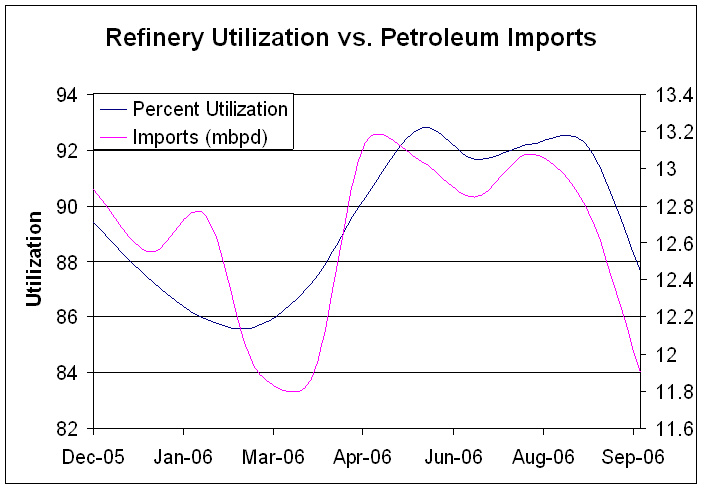
Monthly Average Refinery Utilization vs. U.S. Imports
Note what happened when the refineries came back up from their turnarounds. Utilization started picking back up in April, and reached a peak of 93.2% in June. Throughout the summer, imports were back up - well higher than the December 2005 benchmark - and exceeded 13 million bpd. As you can see, there is a strong correlation between the refinery utilization numbers and imports. In fact, I did a statistical analysis with Excel, and the correlation coefficient for imports and refinery utilization over the past year was 0.72. Therefore, the definitive answer as to why exports were falling in the spring is simply that refiners were in full turnaround mode. The first quarter wasn't about a permanent export crisis, even though at that time falling exports were used as evidence supporting the predictions.
But of course the U.S. is not the world. So, what was happening in other countries as imports started climbing in the U.S.? Were we outbidding other countries for dwindling available exports?
To my knowledge, there are no data on total exports. But we can account for a significant fraction by looking at total OECD net imports. Total OECD net imports in December 2005 averaged 27.52 million bpd. In January, imports did climb to 28.89 million bpd, and then started to fall as refinery turnaround season began. During the high driving season months in the U.S. (May-Aug.), when U.S. imports had climbed back up, total OECD net imports averaged 28.0 million bpd.
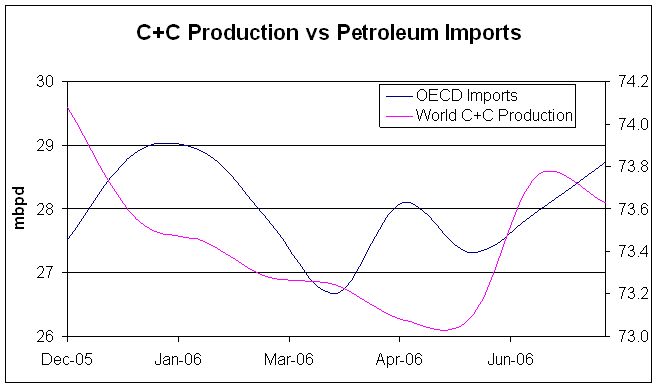
Crude Plus Condensate Production vs. OECD Imports
Note that C+C has a decent correlation (although with a time-offset) to OECD imports. That total imports were down slightly from January is not surprising given the high prices over the summer. But summer OECD imports were actually higher than the December baseline for making the import case. I would also add that total OECD stocks went up by almost 100,000 barrels during the same time period, implying that demand was softening and therefore the imports weren't needed.
I would note in addition that Saudi oil production started dropping in January just as OECD imports started to fall. We all know the story that Saudi Arabia's oil minister commented that they were having trouble finding buyers at the higher production volumes: "It's not just heavy oil. Even light oil is having problems." This prompted much speculation that he was lying to cover up the fact that oil production in Saudi had peaked.
Note the graph of crude stocks during this time:
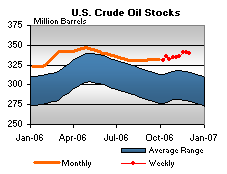
Past 12 Months of U.S. Crude Stocks
As you see, their story is consistent with inventory numbers. From January to April stocks were rising, as exports were falling. Doesn't this mean that the exports weren't needed, if inventories were climbing despite falling exports? This was one of the reasons given for Saudi cutting production: Inventories were full. Well, in the U.S., we can certainly conclude that this is fully consistent with their claims.
Also, as I have noted several times, if they say they have product for sale, and someone needs it, they are going to get phone calls. Just imagine if you claimed to have something for sale that was in demand. Don't you think people who need the item are going to call you? What are you going to tell them when they do if you don't really have the item?
What about Prices?
Again, the OECD is not the world, although it is most of the developed world. So, what of the theory that prices were being bid up, and therefore imports were being taken from 3rd world countries? Without question there has been demand destruction due to high prices. The EIA's World Oil Balance spreadsheet shows that demand in the second quarter dropped off as prices spiked up (again consistent with the Saudi claim). Demand was down by 2 million bpd - at 83.15 million bpd - over the previous 2 quarters in which demand had averaged over 85 million bpd. Of course oil prices had spiked over $10/barrel over this period of time. So, did prices spike because product was scarce? Did prices spike because demand was high? Was it fear and speculation? Or was it a combination of factors?
Those questions are difficult to answer definitively. Hurricane Katrina really shook up the oil markets by exposing just how little excess capacity presently exists in both oil production and refining capacity. A few short years ago, several million barrels of spare capacity were available. But by the time demand reached 85 million bpd, there was little excess capacity. This makes the markets nervous, and so geopolitical events have a disproportionate impact on oil prices.
So, what happened in the first quarter that might have caused oil prices to rise? In January, militants in Nigeria blew up some pipelines taking 220,000 barrels off the import market. At the same time, the Iranian president was making lot of threats which in my opinion were designed to keep oil prices high and help bring money into Iran. Shell decided to evacuate some workers in Nigeria during the turmoil, which prompted the Times Online to report on January 16, 2006:
The withdrawal, combined with Iran's threats to force up prices in response to threatened sanctions over its nuclear programme, prompted a rise in the cost of oil, up 93 cents to $63.18 a barrel this morning.
In February, militants in Nigeria launched their "dark February" campaign designed to make foreign oil interests leave the country. By March, exports from Nigeria were down 300,000 barrels a day over the 4th quarter of 2005. This was significant given Hurricane Katrina had taken hundreds of thousands of barrels of daily production offline. In February 2006, 362,796 bpd were still shut-in. Shell's Mars platform alone produced 140,000 bpd of oil production. This production wouldn't start to come back online until late May 2006.
Those geopolitical events, combined with lingering production upsets from Hurricane Katrina, drove oil prices to record levels. There was a threat from Iran, and actual production gone from Nigeria and the Gulf of Mexico. In a nervous market with little excess oil production capacity, one doesn't have to appeal to an oil production peak in order to explain why oil prices shot up.
Couldn't This still be Peak Oil?
I said I won't try to argue for a specific date on the peak, but I will argue that the import/price data are poor arguments in favor of calling the peak. This is not the case you want to present to the media. They will poke holes in it, and then if/when imports do climb back up, credibility is shot.
Back in the spring, when some others were calling December "the peak", I predicted that as long as demand stayed high we would set new production records in the summer. Well, demand did soften, but the EIA estimates that July 2006 will be higher than December's 84.5 million bpd at 85.2 million bpd. They also project August to be over 85 million bpd. The previous total liquids record was in May 2005 at 85.2 million bpd. (Stuart Staniford also discusses this issue here).
There is a lot of debate about total liquids, and whether it is an appropriate metric. There are two primary problems with total liquids. First, some production is double-counted. If liquid fuels are used in the production of ethanol - and they are - then the production gets counted twice. However, the majority input into ethanol is natural gas. In that case, even though the energy balance might be poor, you have a legitimate addition to total liquids, albeit an addition with a lower energy value. Second, total liquids include items like orimulsion which isn't a replacement for liquid fuels. On the other hand, if orimulsion is used in an application that displaces liquid fuels use, then you again have a legitimate addition to total liquids.
Without question the "purer" metric for predicting peak oil is crude plus condensate (C+C). December in fact remains the highest month on record for C+C at 74.1 million bpd. This summer, we reached an estimated 73.8 million bpd in August. However, a metric somewhere in between - like net total liquids - would be the most appropriate measure. You can't use just C+C because that overlooks the portion of ethanol that is a legitimate net addition to liquid fuels. But you can't use total liquids because it double-counts on the liquid petroleum inputs into ethanol (as an example). What is needed is a net total liquids metric that has subtracted out the double-dips. To my knowledge no such metric exists, and for now we have to live with the imperfect system we have. As it stands, the best we can say is that it is possible that a new record was achieved during the summer for net total liquids.
Conclusions
My intention here is not to "win" a debate. Jeffrey and I are in fact on the same side. My purpose is always to learn, educate, and generate food for thought. As I stated in the opening segment, I believe that credibility is crucial. However, to build credibility we have to build a strong case and be careful with data interpretation. If I argue that there is a problem because imports are down, I need to be prepared to answer the critics. I need to be sure that my case is objective and consistent.
If I use falling exports and rising prices as evidence that my prediction was accurate, then rising exports and falling prices should be evidence that the prediction was inaccurate. If I come up with some new reasoning that explains the latter, I must be willing to apply this reasoning to the former. Otherwise, the reasoning is ad hoc. If I say that A is like B because both are blue, but then I say A is not like C because C is heavy, this is an example of ad hoc reasoning. I can't use one metric in one case and a different metric in another case. When you do this, you make it impossible to falsify your argument. And an argument that is impossible to falsify is not an argument that will withstand scientific scrutiny.
As always, I invite comments, questions, or corrections. If Jeffrey wishes to continue for another round, I would be in favor of that. In that case, I would presume he would have a response up in a week or so.
A Debate on the Substance and Timing of the Peak of Oil Production and Consumption, Part II
PDF version
428 comments
A Debate on the Substance and Timing of the Peak of Oil Production and Consumption, Part II
PDF version
428 comments
Contact
- Content: editors at theoildrum dot com
- Tech support: support at theoildrum dot com
License

This work is licensed under a Creative Commons Attribution-Share Alike 3.0 United States License.
Question: you say:
"If liquid fuels are used in the production of ethanol - and they are - then the production gets counted twice.
I don't understand why people bring up only ethanol in this example.
What to do with the liquid fuels that are used in the production of liquid fuels?
Don't they count as "double-counted" just as much?
When oil's EROEI drops from 100:1 to 20:1, doesn't that simply mean you use a lot more oil to produce the oil, and you have to discount that 1 barrel in both cases? You use 5 times as much to produce the same.
I started to elaborate on this point, but yes, these liquids are also double-counted. Any liquid fuel inputs that go into producing a liquid fuel product get double-counted.
But I would also again point out that any portion of biofuels that is actually renewable would not get counted if one just looked at C+C. The relevant metric is somewhere between total liquids and C+C.
If 84 mbd is produced, with that 20:1 EROEI, you lose 4.2 mbd every day, so you have net production of 79.8 mbd. That is quite a difference.
And it would be less important if EROEI stayed the same, but it's getting worse all the time, so you lose ever more, and the numbers reflect reality ever less.
I understand that it would be hard to model, but still feel it's too easily neglected.
You biofuel comment is valid. I guess it would be too much of a stretch to look at natural gas use, like in the tar sands?! It may not be C+C (+NGL), but is sure is a waste of energy. Isn't it more appropriate to count these things in some kind of "energy" form, like calories, or joules, or......?
When the debate is about peak oil how can any biofuel be counted towrds production?
Because peak oil is not really the relevant metric. It is peak energy. One could say "Sure, we lost 1 million bpd of oil, but we gained 2 million bpd of ethanol." But an accurate metric has to account for the net of that 2 million bpd of ethanol.
Do you mean to say "peak liquid fuels"?
Peak energy is what we should be focussed on with PO (C+C+NGL) a subset of that broader debate - IMO.
http://www.energybulletin.net/16459.html
Published on 24 May 2006 by GraphOilogy. Archived on 25 May 2006.
Texas and US Lower 48 oil production as a model for Saudi Arabia and the world
by Jeffrey J. Brown & "Khebab"
These comments are based on the graphs, prepared by Khebab, in the captioned article.
At the end of 1972, Texas had produced about 35 Gb of crude + condensate (C+C). Khebab's plot showed that Texas had remaining estimated recoverable reserves of about 27 Gb at the end of 1972, with an annual production rate of about 1.25 Gb/year, resulting in a reserve to production ratio of about 22 years at the end of 1972. This implies that production had to fall, and since peaking at 57% of Qt in 1972, Texas has shown a long term decline rate of about 4% per year.
At the end of 2005, Saudi Arabia (KSA) had produced about 108 Gb (I believe C+C). Khebab's plot showed that KSA had remaining recoverable reserves of about 78 Gb at the end of 2005, with an annual production rate of about 3.5 Gb/year, resulting in a reserve to production ratio of about 22 years at the end of 2005. This implies that production had to fall, and since since (IMO) peaking at 58% of Qt in 2005, KSA has shown an estimated 4% decline so far this year (and about a 7% decline from 12/05 to 12/06).
I estimate that Saudi Arabia, in calendar year 2006, will have burned through about 4% of their remaining conventional crude + condensate reserves.
Unless someone has a question for me, I probably won't post any more comments.
I think that the reduced exports are not voluntary. Based on the 2004 to 2005 increase in consumption (about 22% for KSA) and assuming that we see something similar for 2006, and based on the reported production decline, I estimate that KSA's net exports fell by about 13% from 12/05 to 12/06.
I understand that the overwhelming bulk (> 90%) of their production has come from the 5 largest fields and perhaps a dozen or so smaller fields over the past 50 years. This still leaves 80 or 90 oilfields that are supposedly capable of producing oil. The 'rest' of the oilfields in KSA, as I understand and as Matt Simmons outlines in 'Twilight', are not only smaller than the super-giants and giants, but are potentially more problematic in terms of geology and the ability to produce at a high volume.
Nevertheless, if KSA has 80 untapped oil fields, and though 'small' by KSA standards, some are large by oil field standards in the rest of the world, it would seem that there remains potential in KSA that does not exist in Texas. How does one get large production from a slew of slow producing fields? By drilling many wells (look at Russia's 1,000,000+ wells), and, guess what? KSA is apparently in the process of drilling many new wells.
I know that the conventional wisdom is that these leased rigs are being used to upgrade and workover the existing producing fields, but to what extent do we really know this?
It may be true, if KSA's super-giants are in decline, that there is no way to reverse the production curve and that drilling several thousand more wells, whether in new formations or old, will only slow the decline. But, in reading 'Twilight' one keeps seeing the maps with these dozens of untapped fields which are barely even mentioned. Unless they are totally fabrications, they still represent a significant amount of reserves, however slowly their contents may be produced.
Hubbert's curves work because, when a region peaks, it becomes much more expensive to even maintain production, much less expand it, and not because a region has run out of oil. If ksa has in fact produced 58% of urr, we will never again see 9Mb/d, much less 10, 12, or 15.
The PO community, as pointed out, has put itself into the role of Cassandra. But Cassandra does not have any influence. She is a tragic figure, at best, a farce, at worst.
The world has entered the hydro-carbon endgame since the 1970s, when the US peaked. The only thing that matters now is solutions.
I would encourage to stop the bickering about the date of the peak and think ahead of mitigation strategies. The same amount of analysis that gets the peak nailed down to +- 5 years can also predict the economic impact of gas taxes, CAFE standards etc. We have seen enough linearizations. They are a bore. Lets talk solutions.
I don't know why I keep having to point this out, but 1 more time. From the 3rd sentence of the essay:
Some have misunderstood my long-running debate with Jeffrey to be a quibble about the timing of the peak. That is not the case.
If you think this is about nailing down the timing of the peak, you have missed the entire gist of the article.
You can broadcast the words.
But that does not mean that they were received in the sense of being understood or absorbed or believed.
Just to clue others on this insider observation, here is the exchange from the R^2 site:
"Why Were Imports Down? Or Were Imports Down?"
The analysis which follows is quite thorough and I agree with it. One of the arguments made is: "I would note in addition that Saudi oil production started dropping in January just as OECD imports started to fall...." implying that, if a downward trend in production exists, it is driven by demand, not by (geological?) supply. Maybe I was reading too much into this, in which case I apologize.
But in toto what I got from it was an overall attempt to moderate the discussion as in saying "Easy as she goes... Wait! Not, yet!... Not....yet...".
In my opinnion this is not a practical political argument. Well, actually, it is, if one does not talk about PO at all. I believe this is what most politicians do to avoid the Al Gore fiasko. I think we all can agree that this plitical micro strategy achives the goals of political survival of a few but does nothing to help the nation(s).
I liked the crying wolf analogy but also think one should go far beyond that by saying:
"Peak oil is a fact. It does not matter if it will hit us ten years from now or tomorrow. What matters is that we are prepared. The metric can not be to predict PO with absolute precision and start measures the day after or the day before. We have to start WAY BEFORE. And here is how we can prepare ourselves YEARS before the fact... Moreover, to be prepared for an event that will happen and that will happen SOON ENOUGH has the following economic advantages NOW... e.g. lower trade deficit, lower geopolitical risk, lower economic variance in primary energy prices etc."
I might be unrealistic in my expectations to shape the discussion completely like this and I admit that. But I also think that we can learn a lot from modern political campaigning, especially that those who steer the discussion usually win the discussion, even if they have the wrong arguments.
To put peak oil into the category of "it has yet to be mathematically proven before we can afford countermeasures" is a win for the other side (and thus a loss for everyone). And yet, we seem to put ourselves into that corner more than anyone else does. Am I completely wrong about this? Or maybe we really agree about much of it?
No. I believe it is not yet, but not on the basis of this. Saudi's moves could be dictated by the market, and yet they still could be peaking.
To put peak oil into the category of "it has yet to be mathematically proven before we can afford countermeasures" is a win for the other side (and thus a loss for everyone).
It is not about mathematical proof. It is about having the kind of evidence that will withstand scrutiny. If the evidence doesn't withstand scrutiny, then it won't be taken seriously.
Imagine you are Barry Marshall, and you believe ulcers are not caused by stress and spicy foods. You believe they are caused by bacteria. How do you convince people? You make sure your evidence withstands scrutiny, because the whole world and all the pharmaceutical companies are lined up against you. He isolated what he believed to be the bacterium responsible, but he then gave himself an ulcer by taking the bacterium. That's not the entire story, but it ended with him winning the Nobel Prize.
Imagine a different tactic. He believes this bacterium causes ulcers. He never does any actual tests. He argues by analogy. He says "I have an ulcer, and I am not stressed nor do I eat spicy foods. Therefore, it is probably the bacterium." Make that case, and you never convince anyone.
The point is, the case must be able to withstand critics poking holes in it. Even if the case is right, if the evidence is not substantive then nobody is going to give it the time of day.
Aside from this, the fact that SA production declined as prices climbed to a nominal record is IMO proof positive that they were producing at a max. To say that buyers on the NYMEX would pay $70+/b but would not buy from the saudis is absurd, regardless of stocks. And, if further proof of problems in the desert are needed, 3x rigs drilling for oil while output falls is damning evidence. Falling sa production does not prove po is at hand, but the naysayers, eg cera, go first to sa as our saviour, and the probability of this happening is IMO quite low.
You are grossly underestimating the speculative forves in the global markets. Part of the price, a part which can be in both direction is based on irrational factors like fear and greed. Both can lead to temporary fluctuations, but long term the prices seem to settle down at the balancing level (which is what is happening now). There is even the chance of the market going the other extreme and "undershooting" the oil price, but not very likely IMO.
I mean, Westexas does not make the point crucial for the whole debate, he just has a current bad feeling about KSA having peaked already. PO does not need this assumption to be true (enough).
Cheers,
Davidyson
Very true. We are still missing key pieces of the puzzle. Although, I have a feeling that in the end it won't matter. These are finer points on a very strong dynamic which allows only for logarithmic corrections.
I think I understand your argument about needing the evidence. I am a phsysicist/engineer and most of my life I would have argued the same way. However, I find that in "real life" the precision of arguments does not matter as much as their packaging. The sophist can win an argument over the philosopher.
This can be seen in politics as well as in economics. Often a business deal in publically traded companies is not all about absolute economic value but about visibilty to the stockholder. The important part there is to spin a story that is liked by the analysts, even if the fundamentals are not watertight. In the end trust in management's decisions is just as important as the bottom line to assess future outlook. And sometimes the bottom line is bleak, and yet, good managers can earn trust in the market. I am not talking about black sheep here but about CEOs who are struggling to create real businesses with products and real profits. To project a believable image where no data can give any outlook is an important part of the job description.
And in politics the timing and the verocity of an attack can be more of an issue than anything else... see "Swiftboat Veterans". Sad but nonetheless true.
IMHO we do not need to convince the experts any longer. They know the truth already. The management of BP and Aramco are not clueless about how much oil they have left and how much more they can find. How do we know? Because we look at every word of the Saudi's already as if they would be playing poker with us. We want to see their bluff... which implies that we know that they know.
The real problem now is to find language to sell to the public what needs to be done to minimize damage. I think that is much more a problem for ad agencies and campaign managers than experts.
Robert wants PO types to be able to make a strong, 'scientific' argument, and I see a great value in this, because:
In the case of human-induced global climate change (AKA "AGW"), a very strong case has been made, and when that case is put into the hands of CEO's and boards of directors, they have become subject to legal prosecution, jail and fines, if they continue to deny it and act in a way that adds to an event that decreases shareholder value.
Persons in government, or testifying in front of congress, can be prosecuted or fired for lying (unless you're president, I suppose).
Only private think-tank types (Yergin) will be able to glibly lie and not face very real serious consequences IF A STRONG/AIRTIGHT CASE CAN BE MADE.
OSHA is the area where criminal enforcement has been lax.
The fact is that if you are white and median income or above, you walk facing no more than probation if convicted of a non-violent crime.
True, but that awareness will not "suddenly appear" two years, or three years after the peak. That information, whether or not the peak date has passed, will come upon us very gradually. There will be subtle signs that appear from time to time, like Saudi cutting "allocations" to their customers. The point is, we become more and more aware as to whether or not the peak is now, or past, as time goes by.
And right now, most of the world says "no peak until 2030" or some far out date. The majority of "peak oilers" are saying, "peak by 2010 or 2015" or something similar. A very few are saying, "peak is past or right now." By this time next year I predict that the majority of peak oilers will cross over from the former to the latter group.
What an incredibly stupid thing to say! I will guarantee you if we are wrong, WestTexas, myself and the very few others who have the courage to stand by our convictions, will be dragged through the mud if we are proven wrong. You guys will never tire of pointing out how wrong we were if our predictions are premature and what damn fools we were to predict such an early peak. But....but....if we are right, we have the mind of a three year old if we dare try to take credit for our early insight.
God, there is just no damn way we can win is there? No wonder so many peak oilers are going with a more distant peak. It is a kind of "Pascal's wager" for peak oilers. We have nothing to gain but everything to lose by expressing our convictions of an early rather than late peak.
Ron Patterson
That being said....you are still wrong. This is very difficult to put into words and few people will understand. However I will give it a try.
Peak oil will happen, that is an indisputable fact as far as I am concerned. With that in mind, let's look at a few other facts.
- The world's population increases every day, therefore the later the peak, the greater human misery it will cause.
- More of the world's wild animals are going extinct every day, therefore the later the peak, the fewer species that will survive.
- More of the world's forest are being felled every day. More of the world's lakes are drying up and being polluted. More of the world's rivers are drying up, more of the world's land is being blown away, the world is getting warmer and the weather patterns are changing, and I could go on and on. The later the peak, the worse everything gets.
Bottom-line, the later the peak the greater the misery and suffering and the greater the destruction of the world's ecosystem. If we could just hold off peak oil for 50 to 100 years, the earth would be a choking, polluted and barren place.Peak oil? The only thing worse than peak oil would be no peak oil.
Ron Patterson
Youre children and your grandchildrens happiness and well being are by definition your own, as they are part of your life. Suffering by them translates to suffering by you. So unless you have your PO lifeboat and community completely setup, you should be hoping for a later peak, unless of course youre a group selectionist or youre leveraged to the gills in crude futures...;)But the point of my post was be careful what you wish for, you just might get it.
I think this is really a deep and recurring political question... what should we want in the area of PO?
And the answer I come up with is actually "a false peak, leading to a rush to invest in alternatives, followed by a few big discoveries that mitigate the pain while not being so big as to damage the investment program, followed about 10 years later by the actual peak."
And the reason for that is even though we should be investing in alternatives, it will probably take an actual crisis to get things rolling...
We shouldn't want a megacrash...
We shouldn't want a long delayed 20 to 30 year peakoil forced transition away from fossil fuels for all the global warming and environmental reasons outlined above.
Of course what we want has little to do with what we'll get in this case.... But if we imagine the reality that would be most likely to induce intelligent political/technological and economic response this is perhaps it.
We do want reality to shift people's awareness, and what we'd really like is for reality to give a little wake up knock before it smacks us on the head with a 2 x 4.
pdx - i completely agree this would be the best scenario, because it would kick in our evolutionary 'panic' response while still having time to be meaningul.
But this is kind of an unlikely scenario, is it not?
I don't know if y'all can remember the '70s, the panic, the embargos, the "demand destruction", the strangling of the oil market by OPEC.
That was the event and era that let us know that "oils-not-well". Some countries learned a bit from it and raised (and are still raising) taxes on petro-products. And in some areas of the world, society collapsed (Soviet Union/Cuba); besides, it was the shot to the bow which launched a scrambling to invent new technologies.
Wind and Solar have (probably) already come so far only because of the "first" peak.
From a technical trader's perspective, we are in the (possible) middle of a S-H-S (head + shoulders) pattern - late '70s peak was the left shoulder, we are in the middle of the head now, a (relatively) quick contraction will bring us back down to ca. 60 mbd like around 1980 but will then be able to be expanded again.
Maybe using the technical analysis would convince Martin Lynch of the reality of PO???
Hubbert Theory says Peak is Slow Squeeze
I've bookmarked Stuart's Plateau Background, which has a handy index to most of his posts.
So lets assume that the OECD procures energy supplies at the expense of the developing world, we end up with a developing world descending into chaos - their OECD markets may have declined, they will have extreme energy shortages and probably not enough food - cos its been converted to ethanol?
Against this background in the devloping world - I just don't see the OECD financial markets surviving as they are just now with dire consequences for pensioners and everyone else who holds a stake in these markets.
This is one way to look on my local Swedish arguing that we should invest heavily in peak oil preparations that arnt timing specific. Infrastructure that lasts for decades and pilot projects that lasts for manny years. When the peak is obvious market forces will increase the production of what already is being done and fill in the needs as the market prioritizes them.
Sorry sir, but I object to your contention. Single cell 'animals' are just fine, thank you.
BTW, many thanks for all time & effort put forth on this site, and that's even extended to Hothgor.
Byron
Are you referring to politicians?
(I don't know, I relayed your messages. That was his response. Something like that.)
Oh shit, when is that meeting in Nigeria?
FWIW: Declining production of conventional oil and gas is likely to accelerate destruction of the environment as people switch to burning wood and hunting. Rich countries will increase consumption of coal increasing pollution emmissions since businesses will most likely lack capital to build clean coal plants.
Of course this is true. People will hunt the songbirds out of the trees when things really get tough. But what would be worse, 6.5 billion people hunting animals and felling trees or 8 billion people hunting animals and felling trees?
Everything environmental will get worse after peak oil. But it is getting worse everyday anyway. It would be best to start now with fewer people than start much later, after much continued destruction and with many more people.
Ron Patterson
on peak oil much you have learned. the path you predict we will see maybe. but everything set in stone yet is not. else what good are these internets dialogues, hmmm?
p.s. nuclear, wind and reciprocal altruism surprise you they might.
I tell you GWB is our friend :-)
Although I agree with Ron on the early peak, and on this quoted statement, I wonder if he -- and I -- are biased in our cognition of the near-term peak due to our view that a later peak is worse. And I'd also mention the terrible suspense, waiting for the shoe to drop, so to speak. So if only the peak would come, soon, then we could at least break that suspense. (Although I'm sure there would be even worse suspense in that case, e.g., will there be a nuclear world war and when...)
In 'The Empty Tank' Leggett makes the point that if PO is now, renewables lack the credibility (in the eyes of public, politicos, VC-types) of proven coal 'technology' and in our panic we will turn to coal. If given just a few years' more time, many of the non-coal alternatives will have cleared the hurdle of general/public credibility.
I agree with you 100% though that the sooner the consumption/population juggernaut is derailed, the better.
I can change MY lifestyle. And I bet most evryone else who posts on TOD can.
I can't control the reaction of others. I can't contol the reaction of the elected leaders and their attempts to take my prep efforts and call it 'hording' or 'not supporting the war effort' or taxing the property.
How do I defend myself from the increases in robbery as others try to take whatever to pay their expenses? What arguments can be used to make my concerns the conserns of the people who make the laws? What arguemtns don't result in blowblack?
An interesting comparison between the USA and the USSR.
http://energybulletin.net/23259.html
There won't BE wildelife and plantlife to hunt/gather. In addition to the issue of being shot as a tresspasser on a hunt/gather misson.....The 'forage off the land' will end up as a strip the land bear operation.
I can almost certainly guarantee that you will be dragged through the mud, anyway, should your opinnion become a matter of public discussion. That is just part of the game. Look... I agree with you on basically everything. What I am concerned about is that someone needs to take this to the next level. And sometimes, in politics, if you want to achieve A but you can't sell A, you have to sell B which hopefully solves part of problem A. And once people see that the solution to A did not cause an economic collapse, they might even be willing to listen to you about the real solution to A...
Just recently I heard a story from someone who spoke to one of the top managers of NASA's science program. He was young and outspoken scientist at the time and, being asked by this superior what he thought about NASA policy, he let off the usual frustration about the waste on the manned space program vs. the unmanned and much more succesful science program. And the old guy just smiled and said "But young man, you are aware that without the manned program none of us would be here?".
It is the same here... we are hearing politicians talk about oil as a matter of national security. Maybe that is the only way to sell peak oil to the US population. I wouldn't be surprised if that was the case. This does not make anything happening on TOD false... it just puts a spin on it that might have a higher chance of success.
My only serious arguement is that the latest news that KSA is cutting its export allocations in Asia supports his theory And my only real problem with the debate is that the short-term noise obscures the truth-I think we won't be able to decide where the real peak happened until a couple of years have passed after the event. It could be that the Saudi's are avoiding cutting oil supply in the US while cutting Asia in order to prop up the dollar since so many of their assets are in dollars, or it might even be part of their machinations to keep the US in Iraq to protect the Sunni's. We just won't know for a while.
Robert, for clarification, what is condensate and where does it come from?
Is condensate one type of liquid from Produced water?
thanks
oilcan
OK, I am offline for a while. I have to get some actual work done. If a pressing question comes in and doesn't get answered, I will check in later today.
Condensate is easier to pour than oil-higher gravity-and is in essence partially refined by nature. In the Panhandle Field up north of Amarillo, Texas they called these liquids "white gas" and used to steal it off leases to burn directly in old Model A's and trucks. Its worth a premium to light sweet crude.
His argument could be right. The point of this essay was to show that some of the evidence he used to support his argument falls down upon inspection.
The allocation news is certainly interesting. I have surveyed some people this morning and most people think they are just trying to boost prices. But allocating product is a good way to alienate customers. I think the piece of information that would shed some light on this particular question is the inventory level of the Asian market (where they are cutting their shipments). If inventory levels are high, this could be a preemptive move. If inventory levels are low, then allocating product points to something like production problems.
When you have been too long in the House of Mirrors and cannot find the exit.
a) all we have in the absence of data disproving this, and:
b) is probably correct, or fairly nearly so.
The acid test will come when oil is again above $70, or maybe above $75 possibly in about 12 months. If KSA then cannot get production back up to 2005 levels and keep it there, then the argument that they are voluntarily restricting production, or nobody wants the extra light sweet oil at that price, will not be credible. We will then, surely, be on plateau and be on course to drop off it in a couple of years. If by some means they do then WT will have been proved wrong and peak may be around 2010-12.
Which unfortunately does not help us in the short term, but at least is better than the notion that we can only know the timing of the peak and issue credible warnings about it 2-3 years after it passes, which is a sure recipe for disaster.
Stuart, as I have argued recently, unable to, or never called upon to? I have seen no evidence that they were actually called upon to increase production. They said that they would do so if needed, but if I am a refiner I take my chances with the SPR rather than buy from Saudi while prices are shooting upward. I also looked recently, and if I am not mistaken OPEC production during this time was stable.
Prices are not an external force set by Martians. The price of oil arises from the balance of supply offered and demand expressed, and if the price is high despite available spare capacity, it's because some suppliers will withhold oil from the market rather than see the price drop. In response, some demanders have had to curtail plans to take trips they otherwise would have taken (as is very clear in the US VMT statistics).
As to stocks being high - last time I checked on a days-of-supply basis they were not historically anomalous. And the market is probably (and rightly IMO) demanding inventories at the upper end of the range due to increased perception of geopolitical risks to supply.
Days of supply is a completely irrelevant measure when talking about full inventories. If the tanks are full, they are full. It doesn't matter if that's only 1 days worth of supply. If the tanks are full then you aren't taking deliveries if your refinery is down.
Here's the actual data. First is OECD stock levels (from Table 1.5 of the EIA IPM) divided by both global production and OECD demand (through Aug 2006). The upper curve (OECD stocks/OECD demand) is probably more relevant.
As you can see, both the last two summers, when prices have spiked up (from an already very high base) have been associated with higher stocks. However, "higher stocks" is not very much higher at all. If we plot the "days of supply" as the number of standard deviations from the mean over this Jan 01-Aug 06 period, we can see that these are in the upper tail, but not outlandish compared to past behavior.
So to me, this is the fear factor in the market (as I assume you'd agree).
How long does it take an oil company to order and build a new storage tank?
You can't imagine what a low priority item storage tanks are. It drives the guys at the refineries crazy, but the guys doling out the capital don't like spending money on tanks.
Three to five years are needed to get any significant storage capacity on line assuming that you have to start from scratch, that is it is not pre-permited.
- Find and aquire land and right of ways.
- Get necessary zoning changes
- Do design work
- Do environmental assesment
- Finalize permits
- Let bids
- Actual construction
- Testing and acceptance by regulating authority
If any glitches try eight or more yearsInteresting project, though. There's a lot of heavy oil at shallow depths thats never been produced, as well as on several other piercement domes. Its very sour-the biggest onshore sulphur dome was Boling-but its real heavy, around 10-12 gravity. There are a number of domes with oil like that here on the Texas Gulf Coast. Won't be much production compared to US useage, but at $40-50 bbl would probably make a good living. Anybody want to drill some 400ft. wells?
Second, we've got to get some maps, preferably with good well data Tobin Map out of San Antonio makes some, but the old Zingery maps are the best, but they were purchased and put out of business about 25 years ago so they wouldn't compete with BACA Landata. Maybe some can be purchased, I don't know. The Railroad Commission of Texas has excellent field maps, but they are mostly good only after 1940. The county Tax Apraisal maps are good and cheap.
Third, we need to get some professionals interested in the possibilities. I am seriously looking for a geologist with some time to gamble and a good engineer. This is low volume and long lived production. The only two geologists who might know something about this stuff that I know are old-one's 86 and the other about 75. Nobody has messed with shallow salt dome production in years. The last person I know to try to get this stuff developed was Bob Garwick, the 86 year old geologist in the late 1980's at Moss Bluff in Liberty County. I know he drilled a couple of wells there. He also had a prospect at Hockley in Harris County, but its probably under a subdivision by now. The Moss Bluff prospect is I'm sure unleased by now and might have a reentry
The next step is raise some money and take a few leases. I've got some sources for the money, and I'm a good landman I'm getting a nice inheritance this year, and I think shallow oil production is a sure thing money-maker.
Then we need a good engineer to complete and produce the wells. I don't know any, but somebody does. There are also some excellent contract operators. They operate wells for a fee, and I have a couple of contacts there.
The next to last step is write and print a prospectus and raise the money. I've a few contacts for the money, and I plan to do a little gambling myself.
The last step is drill the wells and complete them and sell the oil. I could elaborate for hours, but you get my drift. Its not difficult, just tedious, and a process thats been going on here in Texas since about 1890. And, its in all areas of the state, I just happen to be more familiar with the Gulf Coast than other areas. I'm pretty sure that's what Jeffrey Brown is doing, although in a different area with different types of prospects. My uncle, Charles Passel made a wonderful living for over 50 years in shallow Ft. Worth Basin wells as a geologist, but he's dead.
As an investor, my first question is why hasn't this been done before. Its a function of opportunity costs. Why drill a well for a couple of barrels a day, when with virtiually the same effort you could drill a well making a lot better production. There haven't been many guys interested in shallow prospects in the last 50 years, and much of the areas have been literally forgotten. But I think that crude is going to get so tight in supply in the US that most anything will get drilled and produced. The other main reason is overhead. I office at home, work as contract labor on other people's prospects and am willing to gamble my time and labor. I don't need a fancy office and lots of employees for my ego, so I can make money on small production.
I was squeezed out of the oil patch about 15 years ago, and have just been back for a year and a few months, but I listened to the old guys and have a long memory. I thought after the Club of Rome report that this kind of prospect is worth remembering.And, I've got a dozen ideas worth looking in to, Boling is by no means the best. I keep my best ideas tight, but I'd sure like to hook up with some other professionals with the same interests. At any rate, email or call.
If the oil companies own a huge chunk of the oil inventory, wouldn't they be motivated to keep as low an inventory as possible in order to get as high a price as possible for themselves?
Anecdotal evidence tells me something different as well. I have this friend (working for a supermajor) who was in charge of supplies to the Pacific Islands. According to him, his main objectives were to a)minimise the inventory holding on hand to reduce inventory holding costs while b)ensuring that a stock-out situation does not arise. Due to the lead time in getting a vessel with the appropriate kind of products to the islands, he would normally have to keep 45-60 days of inventory on hand.
RR is the expert on this though
You have touched on a subject that is a great source of interest and mystery to me, and one that I am surprised has not been more heavily discussed here at TOD.
For years, KSA and OPEC generally controlled the flow of oil to keep prices from getting to low, but they seemed almost equally concerned about prices becoming too high. Now, they have totally changed their tune, and think that $60+/bbl is just right. What happened?
I can think of a number of possibilities:
- They just got used to the higher income, got greedy, and can't give up the extra cash even though it is likely to hurt them in the long run; apparently they have forgotten what happened the last time prices spiked.
- They are desperately trying to maintain production without letting the world know how hard they are working to do so. At that point, they want to destroy some demand, in order to rest their fields.
- They have realized that oil has entered the endgame phase, and are going to sell their remaining resources as slowly as possible, in order to maximize both value and timeframe of this income.
- They realize #3, and they are altruistically trying to help the world prepare for peak oil by jacking prices up before the geologic peak hits.
OK, I don't believe #4 either. But beyond that, it's a real mystery to me. Maybe there are specific political factors that have changed the equation. Maybe it's greed.Does any one of you gurus want to take a shot at this? It seems like a subject worth exploring in an article of its own, but I do not have the knowledge to even begin to do so effectively.
2)
And re #3, 'slowly as possible' might be a bit out of their control. 'As slowly as maintains the peace' might be more correct.
Happy days are here again! So, no reason to allow prices to hold under 60, maybe even 70 is ok now. I think they will pick some price but index it for dollar deflation against the euro (price in dollars with a constant euro equivalent.)
So, OPEC is reborn, as tod would like, cutting production and reducing gw. The question is, is this their last hurrah? And, how long will this round of cuts last before demand once again climbs past their ability to produce?
The blue line (right scale) is US ending month stocks of crude oil and petroleum products (exclusive of the SPR) divided by US consumption of crude oil and petroleum products that month. That axis is not zero scaled to better show changes (it runs from 40 to 60 days of supply).
The pink curve (left scale) is spot price.
As you can see, there is nothing anomalous about US stock levels on a days of supply basis. They are higher than in 03 and 04, but not as high as late 01 and early 02. So US commercial stocks are actually less high relative to their historical level than OECD stocks as a whole.
This whole "stocks are much higher than their average band" is, as far as I can see, a complete distortion perpetrated by the EIA because they are failing to divide by the obvious scaling factor in the situation (throughput of oil to the economy has hitherto generally increased year after year, with rare exceptions, and so we would expect, other things being equal, that stock volumes would need to grow in line with that.
- When stocks rose to the present level end 01, and remained there for several months (perhaps on account of the dotcom recession), prices fell maybe 40%. When stocks rose this high in sep, prices ultimately dropped 25% (this would be more visible if chart was log scaled and if prices were extended to today. Also, would have liked to enlarge the chart).
- I am continuously reminded that the market knows more than we do. Your chart is as of Sep, the market reflects refiner buys as of today. Considering that oil continued to fall, and has only reluctantly stabilized on account of opec cuts plus threats of more to come, one might infer that either stocks have statyed high, or perhaps climbed higher. For example, in feb stocks were nearly as high, drawing price down to the bottom of the band, but stocks immediately fell, encouraging price to resume its climb.
- From end 03 stocks climbed fairly continuously, possibly on account of high futures.
- It may be, as you suggest, that the days coverage is just keeping pace with increased use. BUt, have refiners increased storage capacity in line with the incrase in processing capacity? And, even if they have, perhaps 56 days is the point at which every tank is full, in which case refiners would have to refuse delivery and stop buying, regardless of how much higher futures have gone. Consider... if this is so, they would be enthusiastic buyers as long as futures are higher, but suddenly coming to a full stop when the last tank is full, increasing volatility. In this case, climbing stocks will not result in lower price, as was true in the past, until the tank is full, explaining the concordant rise of both price and stocks from end 03 to sep.
- Regardless of future prices, stocks were able to climb only because excess product was available to buy and store. Production and consumption are fairly stable, but the excess liquids had to come from somewhere, imo it is surging ethanol production. Much maligned at tod, the subsidy costs the us around $20/b or maybe $40M/d at current production. BUt, in addition to directly displacing 2Mb/d imports (gross), at maybe $120M/d, there is a case that this production has dropped the world price of oil from 78/b to 62/b, saving the us alone some $200M/d. OPEC's fall in revenue is around twice this and they are hardly amused, furiously meeting to cut production to shore up prices. Even if they are successful they will probably not jack up prices to where they were and, in any event, their revenues look to be down for some time. Accordingly, one might say that ethanol is one of the substitutues that economists predicted the hidden hand (itself visibly helped by farm subsidies) would produce in response to higher prices. How about a thread that looks at ethanol's role in
reducing pricesreducing US energy costs
rducing US BOP deficit
reducing OPEC production
gw
while ignoring, for the moment, eroei, scaleability, peak ng, etc.
6. I wonder if high ethanol production in late summer/early fall is seasonal, resulting from harvesting the corn? It can't be stored for long, right? Maybe supplies will decline until the next crop comes in?
But as I have argued, "days of supply" is pretty meaningless unless sufficient tankage has been installed. If not, days of supply could be down to 10, and yet inventories could still be full. It is not days of supply that anyone buying or selling crude is primarily worried about; they want to know "where can I put it?" And I can promise you tankage is a low priority expenditure.
When investment banks start buying up physical commodities, it's a sure sign of a commodity bubble.
How many barrels could you store in a warehouse? I doubt that it's anything significant.
I haven't been able to get any figures on how much physical oil was/is stored by financial institutions. It would be a very interesting number to track over the last few years.
Yeah, but why would oil companies want to maintain production levels and also incur the expense of storage, instead of simply cutting back production? I think cutting back production is the optimal decision for them, and has the same effect as arbitrage.
Oil companies have different business models to financial institutions, so I would expect them to make different operational decisions.
Building tanks is a pain. You have to do a lot of environmental footwork, get your permits done, etc. It takes a while. It's not that we are unable to expand storage capacity, it is just viewed as a low-priority item. The powers that be just say "Aw, you can get by with what you've got."
You have also not explained why, if storage capacity is the problem, crude prices are not at $22-$28 while storage rents are through the roof.
Stuart, I am just telling you what I know to be fact. Firsthand. I think sometimes you put a bit too much faith in price as an accurate indicator of what's what. Price doesn't tell you everything. Sometimes it lies. Often it is driven by psychology. In the case of oil, excess capacity has shrunk quite a bit. Why wouldn't this cause prices to rise? And how much should the price of oil be?
your graph looks far more volatile than I would have expected looking at how storage levels have changed over the past 3 years. See the link below.
http://www.energyeconomist.com/a6257783p/wpsr/graphs/WTESTUS1.gif
Inventories, short-term, influence price. Inventories, long-term, are a hedge against supply disruptions. In this regard, they matter not at all since 30 to 40 days of supply is nothing. Building up inventories only reflects greater insecurity but does little to alleviate it in any situation we might care about.
Getting to the point, Robert's argument (below) that Saudi Arabia was not "called on" to increase its exports holds no water. This is prima facie evidence that they can not do so, which I thought was common knowledge. They (and OPEC generally) can only cut production to prop up prices.
Having written extensively about the supply, demand & the oil price, I will say that, when history is written about this period, no one will have anything to say about inventories.
I find each and every post here about inventories, even my own, completely irrelevant to the peak oil problem. Some people say if we're at peak, inventories should be low. In fact, high inventories could easily indicate the opposite.
Sorry about the mistake.
Next time I hear one of you people talking about inventories, I shall remember to think about time scales that matter and time scales that don't. I hope you all see what I mean, here.
The first quarter inventory picture, though, supports the point the Saudis were making. Inventories were going up even though they had cut production. That does in fact tell you something.
I said: think about time scales that matter and time scales that don't. This peak oil problem has nothing to do with these ephemeral events in the oil markets, nothing at all.
I meant what I said: these meaningless fluctuations tell us nothing of interest in the bigger picture.
Well, here's what it tells me. When they said they were cutting production due to lack of buyers, they were probably telling the truth. The inventory data back them up, because they told that story as inventories were rising.
Now, if you are not one of those who said that they were lying when they claimed this is why they cut production, then perhaps this information is meaningless to you.
But the peak oil problem has everything to do with the Saudis, so I am very interested in figuring out if they are prone to lying, or if their statements are supported.
What if refineries were down 5% (seasonal maintaince and what no) and SA production was down 2% (PO).
Now in that case wouldn't inventories rise even if SA had peaked?
I'm not saying this happened, but just that you can't draw you conclusion as the only one.
Then imports wouldn't have returned to normal as soon as the refineries came back up. That's what a lot of you are missing. You are looking at one piece of a graph and drawing conclusions. Look at the rest of the graph and tell me how that fits your scenario. I know a number of others have tried to do that - find an explanation for the downslope while completely ignoring the fact that imports interestingly enough returned to normal as refinery utilization did.
/Please accept my apologies if you already explained this and I just missed it.
I distinctly remember it being pointed out in the past that the post Katrina imports were mainly refined products (gasoline etc) and not crude. Therefore you cannot directly link Katrina to the increase in imports in 2005.
I know this because I read the reply to your post where you said the above.
Also imports are down for the same period 05 and 06, this has nothing to do with seasonal cycles.
I can't wait till Prof Goose gets that troll button setup.
That should read
Therefore you cannot directly link Katrina to the increase in crude imports in 2005.
This discussion clearly shows that crude imports are not down, and only refined products are, for the reasons mentioned above. If that is a troll comment then god help all of us. I for one am thankful that Prof. Goose isn't one to act like a child and wouldn't implement a TOD wide popularity contest.
How is that for transparency, Rethin?
I'm not talking about WT. I was commenting on what RR said.
Go back and read the thread.
RR:The first quarter inventory picture, though, supports the point the Saudis were making. Inventories were going up even though they had cut production. That does in fact tell you something.
RR:Well, here's what it tells me. When they said they were cutting production due to lack of buyers, they were probably telling the truth. The inventory data back them up, because they told that story as inventories were rising.
Me:What if refineries were down 5% (seasonal maintaince and what no) and SA production was down 2% (PO). Now in that case wouldn't inventories rise even if SA had peaked?
RR: Then imports wouldn't have returned to normal as soon as the refineries came back up.
ME: But I thought imports were down?
From RR's article:
http://tonto.eia.doe.gov/dnav/pet/hist/wttntus2w.htm
Imports are down Nov 06 vs Nov 05. They are also down compared to Nov 04 (no hurricanes then).
I called you a troll because your comments were
I'm not debating RR, I'm trying to learn. I am asking him questions to increase my understanding of the issues.
RR is incredibly patient and has taken the time to answer me.
Thank You RR
Other people educated you as to why you Katrina import theory is inaccurate, not me.
I don't have to be a genius to see your post is a non-sequitor.
My underlying assumptions were correct, the wording was not.
What if refineries were down 5% (seasonal maintaince and what no) and SA production was down 2% (PO).
And since I was talking about Crude imports and stocks why would you be posting about refined products even after it was pointed out to you?
And even if it included refined products, acording to RR's link you'd still be wrong since Nov 06 imports were down vs Nov 05 (hurricanes) and Nov 04 (no hurricanes).
BTW, telling you something you don't want to hear is not "twisting the facts".
Perhaps its you who doesn't want to be told something aside from the usual doom and gloom.
Imports are down because refinery capacity is down several % from its usual average for this year. As RR stated, when the refineries are down, they aren't going to import oil. If the maintained the same % as before, we wouldn't be down. The entire years data to this point shows that our crude inventory is much higher than normal, and our refinery % is down below normal, leading to lower gasoline inventories but higher crude stocks.
WT on the other hand has stated repeatedly that net refined petroleum products are down, just as his ELM projected, but he fails to take into account Katrina and Rita.
Yes, imports were down because refiner utilization was down. But didn't it rise again to the low 90% in Nov? So why are imports still down? This is my question. Couldn't SA production have been dropping when utilization was low and thus masking the drop?
I am wondering if RR's correct that demand dropped but WT is also correct and that drop in demand is hiding a drop in production.
Down thread someone notes we will find out when demand rises this summer. And RR agrees.
You come charging in to the thread posting crap that has nothing to do with the question I asked RR. What was the point other than to muddy the discussion/spark an argument? Ie trolling.
I'm not comparing apples to oranges. I'm talking about apples, and you bring up oranges.
How can I be twisting facts to support my position when I have no position?
Why do I continue to respond to you?
But its not what RR implied in the post I was responding to.
RR:Then imports wouldn't have returned to normal as soon as the refineries came back up.
I read that as imports have already returned to normal. Hence my question to him
Me: But I thought imports were down?
Which they are in the data he linked to in his article.
Your reply was at best a non sequitor. What was the point in posting it? Especially since other more knowledgeable posters have pointed out it is inaccurate.
Don't you see?
Go re-read what he commented on.
Try thinking outside the box.
If you still don't understand, I'm sure he would be more then willing to point out what your missing.
I am truly humbled.
No, Dave, they have been criticized for not increasing production as promised after the hurricane. What they said was that they would help if needed. If nobody actually asked them for more crude, then you can't turn around and criticize them for not delivering. If we had said "By all means, we need more crude" and they didn't produce more, then there is a legitimate argument. Total OPEC production did in fact come up in the month following the hurricane.
So, you believe that, Robert?
Why would Katrina be different? For the first time we just forgot to ask SA for the oil? For the first time the SPR was more desirable?
RR, it doesn't pass the sniff test.
In other words, you, like everyone else who has brought it up, have no actual evidence that any of their customers asked for more crude and didn't get it? You are just jumping to a conclusion based on your preconceived notions. I don't know if they could or they couldn't. In fact, none of us do unless someone can show that Saudi turned down a request. Simple as that.
Sure its possible the US just forgot to ask SA for Oil this time around. But with the all the other evidence you've seen do you really believe that?
But yeah, its not proof beyond a reasonable doubt. But that's not the point I was making either.
Bingo !
But that's just another way to define demand destruction.
So to determine if we are at peak we need to do only two things.
Show obvious demand destruction at current prices.
Show that their is a good chance that supply will not increased significantly and indeed may have or will peak shortly.
Stuart, I understand how markets work. But the Saudis don't sell on the spot market. They have customers. Unless a customer requests more oil, or the U.S. requests oil from them to refill the SPR, then they aren't going to increase production.
I will point out that nobody has yet demonstrated that more oil was requested from them and that they didn't fulfill the request.
I guess I am not following the point you are trying to make. Could they have gone against the market after Katrina, lowered prices, and sold more oil? Well, sure, but that would have been an insane business move. And they never said they would do anything like that. They want market prices for their product, just like everyone else. But what they said is "If you need it, we've got it."
So unless someone can point to a case where someone had their request for product denied, then there is no case that they couldn't have produced more following the hurricane. That's the key here. Folks are looking at what they did, and saying they couldn't raise production when it was needed. That's an inappropriate conclusion based on the available data.
However, "And they never said they would do anything like that" I disagree with. In the past, they have explicitly said that they are the producer of last resort, that they maintain spare capacity in order to be able to stabilize prices in the event of an emergency. Not only have they said it, but they have done it (in the late 1970s and again during the first Gulf War). So, if they are acting entirely out of "us-first, jack the price as high as it will go" thinking, that is a new thing. Therefore, it is in need of explanation.
Overall, I think there are two possibilities that are hard to distinguish. Either they cannot raise production, or they could, but they haven't because they wanted to let prices rise. The rig counts tend to tip the balance of the evidence towards the "can't" explanation but I agree it's not conclusive at this point - more time will be needed before we can be sure that it isn't just due to delays in new production from all those rigs coming on stream.
I don't think there is any question that they have changed their attitude about pricing. At one time they were content to keep prices at $25. I think what's happened is that prices rose, and the economy was able to absorb the price rise. Hence, $60 became an acceptable floor that wouldn't destroy the economy. I know people personally who have gone through the same evolution of thinking.
But that is not what happened. It was the Saudis who told the Asians that they (the Saudis) can't fulfill their contractual obligation. In my opinion this - coupled with that fact that the price is close to nominal all time high - is clear evidence that the Saudis are unable to increase production.
In other words, they have probably peaked. And if Saudi Arabia has peaked, the world has peaked.
Suyog
I agree that this is the way it should work. But I think the Saudis are trying to tighten up the market to keep supply tight. Look at this article this morning from Iran on the same topic:
The fact that the Saudis can't meet their contractual obligation to Asian refinaries is a clear and unequivocal sign that the production decline is not voluntary.
Suyog
You are jumping to conclusions. First, allocation is written into contracts, so they are meeting their contractual obligations. Second, there are reasons for allocating other than you "can't" meet the demand. I have firsthand experience with some instances of this.
So, while the allocation issue is certainly something to keep an eye on, you can't concluded "can't" where you have chosen to. The vast majority of allocations are temporary, and this one may very well be driven by concerns about oversupply. The statements from other OPEC members tend to indicate that they all think the market is oversupplied.
The point is that if the Saudis had had the light sweet available to make up the shortfalls, they would have sold it on the market. But, they did not.
Could it be (he asked, speculatively) that the European oil/refined product imports here into the U.S. were a more reliable, easily-refined source than what Saudi Arabia could offer at that time and even now -- which was/is basically Spam in a Can?
Robert, it is high-time for you to show some skepticism toward what the Saudis say, on the one hand, and what they do, on the other. While I am not necessarily in the Jeffrey Brown camp about 50% QT and all that stuff, with Ghawar at peak, etc. -- I will say this: the KSA track record over the last year raises many doubts about whether what they say has any proximity to the truth. They put Haradh on-stream (300 mbd) but all I've seen since is production declines. Doesn't this create some doubt in your mind about what is going on there?
-- best (going to bed) -- Dave
It wasn't actually at that time. He made the statements about heavy crude in late spring.
Doesn't this create some doubt in your mind about what is going on there?
Of course it does, and if they were here I would be all over them with questions. My skepticism doesn't just run one-way. But they aren't here for me to question right now. What I can do is take their statements and see if I can find things that actually don't add up. That was my whole purpose of looking into what was going on with inventories when they said they couldn't find buyers. If inventories had been falling when they were saying that, their statements would have been much more questionable.
were loading terminals. Saudi crude would not arrive soon
enough to keep the refineries operating.
"unless something is in our refinery in a week or so, we're starved."
http://www.businessweek.com/bwdaily/dnflash/aug2005/nf20050831_0413.htm
(First post, I'm nervous, great debate folks, and TOD rocks).
Welcome, and thxs for the link to help refresh our memories. Don't be nervous, just realize that top-notch debate is hard work, and TOD ruthlessly works the data very hard and from every perspective. Just imagine what we could do if Simmons's data transparency wish came true.
Yep, TOD rocks: must be the beating on those empty oil drums that is drawing the crowds. So, welcome newbie TODer, grab your steel drum and start banging away with the rest of us. =)
Bob Shaw in Phx,Az Are Humans Smarter than Yeast?
Now that all is well, the exports are back down to status quo. Y'all are chasing the wrong rabbit...
We are doing fairly Ok at $60 per barrel, at least in western Europe and USA, even if some countries in Africa are struggling. When our economies start to creak under higher prices, there would be strong public pressure for governments to lean on the Saudi's to increase production if they then tried to say they were holding back. Then they would - presumably - either have to up production or come clean on their inability to do so.
The tax income could be invested in a more efficient fleet. I believe the US consumes some 380 million gallons of gas a day. So that makes for $140 billion annual tax income for every $/gallon of tax. That would be enough money to pay for no less than 6 million new Prius per year... and certainly enough to give very substantial tax subsidies for basically all new vehicle purchases. Such a consumption tax would allow Americans to replace their whole fleet within a decade and at the same time collapse the oild market. Not a bad idea, indeed. Certainly one that would almost pay for itself.
Sometimes the analogous case is simply a new iteration of the same case. Or call it a new example of a general case.
I can't make the call for which animal we're looking at here.
On this page the weak analogy is often argued. Then the same poster will put HL plots at the level of Laws.
It's disorienting.
I've personally become tired of the debating as to exactly when a peak in oil production will occur. It is an empty exercise that we all know will have little to no impact on the effectiveness of our response (or lack thereof) to the problem. It does however, seem to serve the needs of many an ego that feels it necessary to confirm their superiority via intellectual sparring over the minutiae of an overwhelmingly large problem.
It has been stated numerous times on this site and elsewhere that energy industry metrics are inherently flawed and opaque. I'm also a subscriber to the idea that such opacity serves the varying agendas of varying segments of human society. I applaud your suggestion for more transparent metric but somehow it reminds me of the represenation of "image enhancement techniques" used in movies. A digital picture is zoomed into a mess of pixels. These mysterious blocks of colour are run through some supergenius' algorithm and reveal perviously unseen pixels within unseen pixels exposing the killer/perpetrator/hero/detail vital to the plot. You can't enhance what isn't there - that's called drawing.
Short of establishing a group to rival Petroleum Intelligence wouldn't reinterpretation of opaque, skewed and inconsistent "Total Liquids" data simply be the statistical equivalent? A very difficult attempt to seperate signal from noise and reinterpret bad data to try and get good data?
I personally think that our metrics were defined before there were any positions on peak oil, and most of the experts didn't even know the questions we would be asking of the data. It would be more useful to use Roberts proposal.
I doubt we could get all of the worlds oil analystist to agree, and,change how the datum were gathered. Inertia is a heavy topic (yes, the pun is intentional, you humorless SOB's).
Thanks.
Once a grave insult, it has lost much of it's sting (although NOT a compliment).
Alan, your friendly acronym techer :-)
It's an acronym for a curse meaning "Son of a Bitch" and often used playfully in some English dialects amongst friends when they are trying to lighten the mood.
It can also be, like most curses, used in a very angry and provocational tone.
Side note, Explaining English sayings is such a pain. I always get blank stares when I try to interpret some things to my Indian, Vietnamese and Chinese co-workers.
Thx in all cases.
I of course mean it in a playfull sense. For some reason jokes don't work very well on blogs, people seem to always be misunderstanding them, so I try to label mine. It messes with the timing, and detracts from the humor somewhat, but I try to inject a little levity into our conversations because too much seriousness tends to put people off. Where are you from? I am really glad we get perspectives from all over the planet!
- Has almost as gold as the United States
- Let women vote in federal elections only in the 1970s
- Yet claims to be one of the oldest democracies in the world
- Can exist, if it has to, on almost no oil
- Is spending, if one adjusts for population, the equilavent of the US spending $1 trillion on improving their railroads
- Requires middle aged men to keep an assault rifle in their home, yet has few murders
- Manages to coexist peacefully with 3.5 languages and two religons
- That does not like Austrians (who does) :-)
Best Hopes,Alan
No wonder I'm onry and opinionated-its in my genes! Its why they keep me segregated in Texas!
In fact, i come from the french-speaking part of the CH, Geneva.
Alan, i'will respond u tonight on the house kept guns and the fact that democracy in CH is the best (maybe not the oldest though) in the world..
One word to oilmanbob. I think that if your ancestors emigrated, it's because the catholic people around in Switzerland were intolerant, so who's the most intolerant in final?
Then: I am for the guns kept in house, although i was being dismissed from the compulsory military duty, because it prevent a coup (is this word right??).
As you said, our crime rate is not as high as yours, so as long as this situation carry on, we should stay with this tradition. There's voice, however, that want a change..
About démocracy: we've got 2 tools that i think u (and the whole world) would envy: the initiative and the referendum.
With the first, if u collect a total of 100'000 signings, your proposition to modify the FEDERAL CONSTITUTION is submited to the WHOLE swiss citizenship. (our constitution is change fast each year).
With the second, if the federal parlement adopt a law, with 50'000 signings, you can make the swiss citizen to vote on.
The same tools exists in the States level.
And we all know that the oldest democracy is England..! (Or is it the Ancient Greeks??)
Cheers.
I think this and the point about pee-review are very important points. Much of what is posted on TOD is based on pre-concevied notions and frank emotionalism. Very few posters have the knowledge base and motivation to do true data analysis as Robert has done here. I try never to post an opinion about oil production, peak date, etc. bc/ I don't have the knowledge or expertise to do so, and all but a few of us here would be best to leave this type of analysis to those that do.
I have pointed out before the importance of accurate data with a classic medical case-in-point. Hormone replacement therapy for middle aged women was recommended for decades as a means to prevent heart attacks. Studies of hundreds of women, and then even thousands of women seemed to support that. Not until a study of over 17000 women was conducted over many years did we have the true answer- hormone replacement therapy was killing women! There is admittedly some gray area in defining whether a woman had a heart attack or not, but it is far, far less than our measurements of KSA's production and reserves. One of Matthew Simmon's big complaints about oil production is the lack of reliable data and transparency. It's hard to make predictions without reliable data.
Alan
Of course, KSA has reliable data and if the very public appearance of W and Crown Prince Abdullah holding hands is any indication, it would seem that Washington is getting accurate data on KSA production directly from the camel's mouth, as it were.
If we can infer KSA's probable state of production decline from actions taken by the Bush administration, then the supposition of an imminent decline is given further support.
By actions, I am referring to the timing of the invasion of Iraq and the behind the scenes preparation for civil unrest: Patriot Acts, Military Commissions Act suspending habeaus corpus, John Warner Defense Act of 2007 (followed by NorthCom excercises pairing military and local law enforcement), increasingly stricter travel regulations for border travel and overseas travel, etc.
The contrarian argument might be that while Bush et al are, in fact, getting accurate data from KSA, the unusual precautions taken by Washington are only steps taken in preparation for eventualities perhaps 20 years down the road. However, this is typically not how things have been done in the past. Katrina is a perfect example of the general lack of initiative to prepare for future hazards well in advance.
Scientifically speaking, patterns of behavior are not as tangible as hard data on production, but, nonetheless, when they are consistent we can use that information to bolster a point of view.
Sure you can mitigate the problem to a degree by producing liquid fuels from other sources (CTL, BTL, GTL, shale, tar sands, etc) we can mitigate the problem even more easily simply by increasing efficiency and by replacing the demand for liquid fuels with electricity (tip of the hat to Allan).
Just set all mitigation strategies aside and note that C+C is peaking. If we could just get the general public to accept the near term peak of C+C that would be a huge shift in public perception all by itself. The general public still thinks we can drill our way to energy independance if only we opened up more areas to drilling.
Since the affordability of crude and condensate is a heck of a lot better than any proposed substitutes, then its a lot more relevant to the economics. But I sure wouldn't try to explain that to Joe and Jane. Their eyes are going to glaze over and they'll dismiss you as a nerdy wonk, probably with good cause. EROEI is a wonderfull tool, the problem is that its boring and incomprehensible. So the way to talk to them is "The earth's running out of oil someday soon, and , or whats left is going to cost you more" or Arianna Huffingtons arguement that "every gallon of gasoline you buy puts anothe dollar in the hands of terrorists." In other words, people respond better to fear. I know, its shitty and manipulative and not very "scientific", but its also true
This discussion between you and Westexas is very educational...this is why I frequent The Oil Drum. I do have a couple of comments from my perspective as a scientist. You stated:
More important than seeing predictions fulfilled is an understanding of the mechanism by which they are fulfilled. A prediction can be fulfilled, and yet the underlying mechanism could be in error.
While I agree with this in principle, I also acknowledge that one test of a hypothesis is whether it accurately predicts future events. If the Export Land model failed to predict future events it could be rejected as false or needing revision. My training as a geologist included T. C. Chamberlin's notion of "multiple working hypotheses" which contends that many simultaneously considered hypotheses prevent elevating a favored or "ruling" hypothesis. A link to this: http://www.gly.uga.edu/railsback/railsback_chamberlin.html
Using this approach has saved me a good deal of fieldwork over the years by forcing me to observe rather than interpret what I see in outcrop.
Also:
correlation coefficient for imports and refinery utilization over the past year was 0.72.
As a veteran of misusing statistics, I always worry about correlation coefficients...high correlation coefficients are not necessarily causal. My age and the price of gasoline correlate quite well over certain periods, but my getting older, while regrettable, obviously did not cause gasoline prices to rise.
Thank you both for your hard work and dedication to enlightened discussion.
Hi
Which class, and where?
~Mike
The missing factor here, though, is not just the correlation. It is that I explained why there was a correlation before I ever even did the statistical analysis. The "why" has been pretty obvious to me. The correlation just says "how much."
How about this? Oil refineries that are down will not be purchasing crude oil, especially when inventories are full.
Feel free to refute the logic that went along with the correlation. I not only correlated, I explained the causation before I ever did so. I have been arguing this point since last spring. If anyone has a rebuttal, now would be the proper time to pull it out.
The oil refinery percent utilization levels are still significantly below average:
Do you know why? is it still a Katrina/Rita effect?
I suspect that adding support for increasingly heavy/sour oil is a factor.
2000 2001 2002 2003 2004 2005
16595 16785 16757 16894 17125 17335
in thousand barrels daily
Change
2005 over
2004
1.2%
For throughputs the story is a bit different
2000 2001 2002 2003 2004 2005
15067 15128 14947 15304 15475 15204
Change
2005 over
2004
-1.8%
again in thousand barrels daily
The capacity baseline in the past 12 months has increased slightly, from 17.129 million bpd to 17.390 million bpd. Actually refinery inputs are almost the same as they were this time last year.
More rigs = more production.
HIgher prices = higher sales.
Hypothetical case: I produce 1mbpd of oil and you purchase my 1mbpd. Now your refineries undergo maintenance reducing total refinery capacity by 5% just as my production drops by 2%. You don't even notice my production decline. You can't notice it because you are not buying the full 1mbpd any longer. You can only notice it if/when you get back to prior refinery levels if I cannot supply you with that same amount of raw material.
Now, what makes this worse is that the real world is not served by a single producer. Instead there are lots of producers. So KSA can start declining and if the decline is slow at first, you don't notice, and don't even really care because you can meet needs by buying from someone else, thus masking KSA's decline.
In other words, you are trying to make a causal assertion when I can demonstrate an equal scenario that answers the same situation with decline. All you've done is bounded the decline problem, not eliminated it. So for now we know total world decline has not exceeded seasonal fluctuations. And since we've just completed one full year since the 12/05 possible peak, it's going to be very hard to see that peak. As I've said before - go back and plot US production from a period around 1966-1975. Look at the peak years and look at the noise. It was not at all clear from the data that we were at peak, but nonetheless we were. Furthermore, as the EIA data shows, we have an exploding "other liquids" production that is also masking the total C&C production situation.
In my opinion, your position does not refute the notion of a near term peak. It does indicate that the early part of KSA's downslope will be very much as Stuart previously discussed - slow and gradual if this is the downslope. But you do not disprove the near term peak with what you've posted thus far.
Interesting, and taking your analysis a step further - if I import less due to maintenance but still import more than I use, total imports decline but inventories increase all while your production declines unnoticed. In such a case, peak oil could first appear as demand destruction without higher prices.
Yet inventories rose during this time, indicating the market was adequately supplied. Also, and perhaps more importantly, note what happened when the refineries came back up. The correlation isn't just on the downslope.
What you have said does not disprove peak.
If that's your perception of what I was trying to do, then you haven't read carefully enough.
In other words, you are trying to make a causal assertion when I can demonstrate an equal scenario that answers the same situation with decline.
But of course you did no such thing. Your hypothetical falls apart on several points. First, inventories rose during this time. And second, imports came back up and even exceeded the previous levels when the refineries came back up.
Please try again. Or admit that the refinery utilization argument explains the behavior of imports for the entire year (not just on the downslope).
OK, MBA textbook.
Most changes (by total volume) in refinery utilization (not all) are due to scheduled maintenance. Scheduled maintenance has a definite start date and a firm goal date for completion and re-start.
MBA solution is to stop crude deliveries BEFORE shutdown and draw on-site inventories down to a minimum at shut down date. Several days before scheduled start-up one or more tanker loads/barge loads etc. of crude would be scheduled and more to rebuild inventories around start-up date.
OTOH, finished product inventories are built up before maintenance and sold off during downtime.
This minimizies carrying costs of inventory and keeps sales inventories high enough to bridge gap in production.
Please note that the drop in crude imports should pre-date drops in refinery utilization, not be co-related to them.
My quite limited knowledge of industry practices would suggest that about a 30 day crude inventory should be worked down before maintenance, and this drawdown would be spread over 45 to 60 days. OTOH, there should be a large spike in crude imports just about the time that refinery utilization increases.
Given that there is a week plus delay between deliveries at LOOP and refinery gate delivery, this further offsets crude imports-refinery utilization corelation.
So I see your refinery utilization to crude import co-relation as being "better than ideal". Random luck ?
Is there another industry practice, and why if there is one ?
Best Hopes,
Alan
So far, so good.
This minimizies carrying costs of inventory and keeps sales inventories high enough to bridge gap in production.
Still OK.
Please note that the drop in crude imports should pre-date drops in refinery utilization, not be co-related to them.
Note the time-offset in the graph. If you corrected for known utilization cuts (maintenance) as well as unplanned (demand is down) you would have an even higher correlation.
So I see your refinery utilization to crude import co-relation as being "better than ideal". Random luck ?
Not sure what you mean by that. In fact, I would invite anyone to track this issue back for 20 years, and you will still find a very high correlation between utilization and imports. The logic is simple. We import most of our oil. Refineries that are down won't need as much oil. Imports will have to drop when refineries are down, or we will fill up the inventories.
So I see your refinery utilization to crude import co-relation as being "better than ideal". Random luck ?
rate really bites us.
My question is: instead of arguing for a discrete peak of "x bpd," at a distinct
date, shouldn't the argument to the press (and public) be: peak is temporally
indistinct, likely last years, and for all practical purposes, we have arrived?
Although I am primarily focused on mitigation and adaptation at present, I do
appreciate this debate, and both authors, very much.
That noise is all of the other world events that are taking place now and in the relevant future. The noise in this case is predominantly above ground.
There are far more people studying geopolitical events and economic events than peak oil, and the data they have to work with is extremely noisy. But in analyzing the actual noise enough of a pattern is emerging from the noise to cause credible people to fear a looming recession or even a severe economic collapse (sort of the powerdown versus collapse debate).
Even the "political speech" of good times is a form of noise from which a pattern can be derived. The more political speech per unit time, the more doublespeak and spin, the greater the information, although the information and the message are not the same. I tended to view CERA's pronouncements as political speech without the background to make a scientific judgement. It just seemed to fit the mold, but that is a political judgement.
Even though oil economics is a key contributor to what may become an economic collapse, actual peak oil need not be the cause of the collapse. If that is the case, the actual peak may be very difficult to pinpoint in some future past.
If there is in fact a collapse, and depending on the severity and length of the collapse, it might just be possible for a sobered world to get back to a pre-collapse production level, but the world may have moved on and never want or need to use oil to such a degree again.
In the meantime, I pour over the excellent charts and graphs available here and elsewhere in the oil industry. It would be our very good fortune if, someday in the future, we get a strong, clear signal of peak oil.
The strong, clear signal will probably come from KSA production (and all eyes
are on them now). Khebab's linearization below, with their recent production declines, and apparent water cut of over 50% in Ghawar makes me think that
skeptics like Simmons, Jeffrey Brown, and others are spot on.
Effective communication to the public (especially through the myopic mainstream media) is a huge problem, and obfuscations like CERA's are
horrible. I understand the trepidation of crying wolf, and being dismissed, but
changing the terms of debate - focussing less on the specific maximum. That seemed to be the real value of Hirsch et. al.'s report - that if P.O. is now, in three years, or ten - it is already time for a crash mitigation program.
I can understand KSA announcing a cut to China. China is in the process of filling their SPR, which is exactly what KSA says they are trying to mitigate.
But the co-announcement that they are ready to increase production to 12.5mbd would be redundant if the industry is completely confident in their ability to do so. The more KSA tells us they can dramatically increase production without actually doing so, the more it smells like propaganda.
There is an interesting undercurrent to the KSA allocation cut to China. China is using a merchantilist approach to energy security, trying to lock up long term delivery contracts for oil in much the way LNG has been secured by other nations.
China's approach leaves it vulnerable to targeted cuts, just as the US was in the '70s. The cut could be a not so subtle message to China to move to the open market, the same open market that the US would like (absolutely needs) LNG to move to.
The cut announcement looks innocent enough on its face, but there may be a lot of agendas and a lot of actors involved. That also means that it could be completely irrelevant to below ground issues.
I see Jeffrey (Westexas) as operating under a looser standard of proof and you, Robert, as demanding a stricter standard.
If one is in a threatening situation, the weaker standard applies towards precautions. "I smell smoke, lets leave the house and call 911 from our cell phone outside" only to find out that some toast had been burned by the neighbor.
If one is 99% sure, does one sound the alarm ? Of course !
95% ? Sure
80% ? {pause} Yeah
50% ? Maybe
20% ? I dunno
IM V HO, we will not know Peak Oil when it happens with even 80% surety. 50% will be a stretch. Your standard of proof will likely not be meet until at least 12 to 18 months post-Peak Oil. A poor time to sound the alarm !
Again, IM V HO, the risks, and consequences, of a late alarm outweigh the risks of a premature alarm. My judgment call.
Jeffrey is in a profession that has a unique requirement for acting upon poor information with a high degree of failure (independent geologist). His alarm now follows that same pattern. EVEN IF HE IS WRONG the consequences of a premature (not false) alarm are less serious than a late alarm, which your standard of proof seems to require.
IM V HO, A false alarm called 3 years before true Peak Oil/All Net Liquids/Exports (multiple peaks likely clustered together) will introduce the meme and start people thinking about alternatives/making adjustments. The damage to crediability will be small compared to the irrelavance of an alarm sounded 18 months post-Peak, when the effects will be obvious.
A tough call !
Best Hopes,
Alan
If CERA is right...
Why are we converting bitumen to oil?
Or, getting our shorts in a bundle when the Chinese sign another delivery contract in Venezuela?
Or, watching bankers speculating in oil futures?
Or, reading about the latest nationalization scheme where the IOC's get dis-invited?
Or, stuck with that tar-baby called Iraq and wondering how to leave it?
Or, pondering yet again the drilling of ANWR...
It doesn't matter whether the number is 84.5 mb/d or 85.4 md/d... that's noise. The next "sign" to watch is Mexico. As Canterell crumbles we're going to share a lot of their pain.
CERA's going to look mighty stupid when we have to build that wall.
I want a standard that withstands scrutiny. If it doesn't, then it doesn't matter how loudly you sound the alarm. More credible sounding voices will convince people it is a false alarm.
"I smell smoke, lets leave the house and call 911 from our cell phone outside" only to find out that some toast had been burned by the neighbor.
This is not the appropriate analogy. The appropriate analogy is the next time you do it, it won't have the same effect. The first time you cry wolf is one thing. But if there is no wolf, then people won't listen to you the next time.
The damage to crediability will be small compared to the irrelavance of an alarm sounded 18 months post-Peak, when the effects will be obvious.
Again, damage credibility and nobody is going to listen. That is the whole point.
What is the objective here? To educate and convince people that Peak Oil is to be taken seriously. If you are to be taken seriously, you had better be careful with the case you present.
Peak Exports/Oil/Net Liquids may sneak by us during a recession and no date can ever be set. Iraqi production may collapse, KSA production may surprise us by increasing by 600,000 bpd for 5 months and then dropping 1 million b/day (was it storage or production ?) When was Peak ?
We have, in essence, a one time event with massive uncertainity about the metrics. Your model on credability is suited for multiple events, not single events. Cassandra was right only once.
I, quite frankly, have told friends & family that we are on the cusp of Peak Exports with Peak Oil likely within a couple of years. "We" (oil importers) will have to reduce demand.
I am "splitting" the difference between Peak Exports (global, now) and Peak Oil (soon). Somehow Peak Exports is less threatening that Peak Oil. A tactical decision based upon the facts as I understand them and, more important, saleable.
I point to the Russian Minister of Economics (not Energy BTW) that predicted increased oil production and reduced exports for 2007-09.
We will not see a smooth transition into "T1", etc. but a bumpy one, driven by otherwise minor supply & demand events. Even a wrong prediction is likely to "feel" right.
Best Hopes,
Alan
Alan, it sounds like Bush & CO would tend to agree with you.
http://www.bloomberg.com/apps/news?pid=20601087&sid=aGPIIdq61Hdo&refer=home
``The American people are very interested in the leadership of our country figuring out a way for us to be less dependent on foreign sources of oil,'' Allan Hubbard, director of Bush's National Economic Council, said in a Dec. 8 interview. "
I am cursed with being able to see patterns and extrapolate into the future fairly accurately. This is very frustrating most of the time because you can't get anyones attention early on.
I always "live about 2 years in the future" based on this processing ability. It is never accurate enough to time markets, but my predictions usually come true within a few months or so. People that I make these statements to always ask what they are based on.
I usually cite numerous data bits I have scavenged over months or years to support my position. The position is logically sound (in my mind) but I rarely am able to convince others of the trends that I see. Too many complex things interacting with each other. Others reach different conclusions looking at the same data. My concerns are easily explained away by others.
I understood the peak oil debate instantly upon being exposed to the ideas and models. I also understand the limitations of the data sets. It is impossible to make accurate predictions using the data. Garbage in Garbage out problem. You make whatever prediction you want as because the data will support contradictory outcomes.
Having said all that, the simple concept of peak production is being strengthened daily. The peak is coming soon if not already here. There has been no news in the last 12 months that indicates there is plentiful oil just over the time horizon. All statements are that the delines are not going to be as bad as they could have been. That price won't support more oil production. That geopolitics is the problem.
It is all delaying tactics and putting the best face on poor production numbers. All of a sudden people are not geedy and won't sell all the oil they can pump at $60/barrel? These are not characteristics of an industry that is in growth mode.
Not only do I smell smoke, but I think there is a big fire raging because the door and walls are hot to the touch.
"I am cursed...It is not accurate enough to time markets..."
This is NOT a curse; you and I and others are the "personal computer" equivalent of the biocomputer featured in "Hitchiker's Guide to the Universe". So I'll tell you what "42" means; it means forget trading, just invest in fundamental trends you feel sure are right and hold for 2 to 10 years. Verily I say unto you, you shall be RICHLY rewarded.
Frankly, the main reason I lurk this site and others is to gather the many points of data I need to sucessfully make a staggering amount of money from the narrow-mindedness and groupthink of others. I now have enough data points to confidently place my bets; special thanks to Stuart Staniford for the graph of KSA production vs rig count over time, and to memmel for the link to the paper on the historical record of the other "peak oil".
I think I can stop visiting this site for a while, but I hope to come back after the End of the Era (2012) to say "Thanks a Million!"
Blessed Be,
Errol
I have missed out parts of the above paragraph, but it does seem from this paragraph that OPEC can see a case of Russia producing less oil next year, regardless of the Russian consumption denting oil exports.
You make it sound as though reasoning has to be bullet proof before one can say peak oil has happened or is immenent, that the arguements have to withstand stringent peer review etc. What makes you think that is going to make any bit of difference? Your country went into Iraq not on a bullet proof case of WMDs but on nearly the opposite. GW is the closest thing to proven that's out there at the moment and yet the world drags its feet. The MSM and the general public don't give a rat's a$$ about logic, proof or even plausibility until after the fact. The people with the bucks win the propaganda game because most people are too stupid or lazy to call bulls**t.
I gave up thinking that I could do anything to help the world understand any of these critical issues. Now I'm just working on my close friends. In the mean time, I'm building a life raft. When oil is $400/barrel, enlightenment of the masses may be possible.
Thank you for your work. I have no criticism of it otherwise.
The problem is if we don't follow scientific methods and confine our opinions to fact, we lose credibility. Think about the whole debacle about fats in our diet over the last 20 years. First fat was just plain bad. Then people avoided fat and as a result ate too many carbs and got even fatter. Then we said, ok it's not all fats, just saturated fats. Next thing we know, there are reports in the media that many foods that contain saturated fats such as peanuts and olive oils are not bad for you, and are probably even god for you. Now we say, OK, really it's only the trans type of saturated fats that are bad.
Through all this, the average consumer has been left completely confused. They end up saying something like, "well if even the experts can't figure out what kind of fat is bad for us, then why shouldn't I just eat whatever I want."
Too much contradictory information came out about fats bc/ too many scientists held too many press conference about their findings before the data was complete enough to know reliably what sort of recommendations could be made. That's not to say that we shouldn't say PO is very near and we need to do something now. We should say that. But we shouldn't pretend to a level of specificity that we don't have. When we say PO will be in 2000, oops I mean 2003, oops I mean 2005, oops 2008- we lose credibility and people decide they can just ignore us.
Furthermore, it is wrong to pretend to a level of accuracy that we do not have. I had a professor who used to criticize our reports when we reported too many decimal places. If your data set is 1, 2 and 4, you report an average of 2. You do not report an average of 2.33 bc/ your data set does not support the decimal points. If your data is accurate to the second decimal point (i.e. 1.00, 2.00 and 4.00) then you can report 2.33, otherwise you are pretending to a level of scientific accuracy that does not exist in your measurements.
$150/gallon? Sure. We could have that now. It is called a gas tax and would reduce the US trade deficit by close to $100 billion a year.
:-)
Robert, years of rigorous science and a now longstanding scientific consensus on global heating has amounted to what? Continued 'he says, she says', as though the deniers still deserve equal time.
Moreover, who exactly are you wishing to educate? If you expect media types, politicians or the general public to be concerned with the nitty gritty of technical analysis, you are indeed naive, as anyone of us who has been involved in the public policy process can attest.
I hope you're not spending all this time attempting to come up with a valid criticism of Westexas' commentaries because you're envious of the creativity he displayed by introducing the export land model.
Global Warming deniers have been completely marginalized. Global Warming is overwhelming scientific consensus. That's what years of rigorous science have done. There will be peak oil deniers for years after production has peaked, but rigorous science will ensure that they are marginalized.
Moreover, who exactly are you wishing to educate?
You first have to convince the scientific community. If you don't do that, they are the ones the media is going to call upon to refute you.
I hope you're not spending all this time attempting to come up with a valid criticism of Westexas' commentaries because you're envious of the creativity he displayed by introducing the export land model.
Darn, you found me out. That's the true motivation. It has nothing to do with my understanding of why oil imports were really up and down last year as refinery utilization was up and down. No, that wasn't it at all. It was just envy.
Putting this another way, if nothing is done about gw, it makes no difference what the scientific concensus is. And, the same can be said for PO and its consequences.
http://starbulletin.com/2006/12/10/editorial/special3.html
Why do you think that science has much influence in the formation of public policy? It appears to me that it is the growing consensus among economists regarding the costs of global heating which has politicians talking about eventually doing something.
Neither scientists, nor economists, appear to be making much headway across a broadswath of the media and even the most progressive media can't let the 'he says, she says' formula go, as far as I've noticed.
Honestly, I think you are raising barely significant details to try to counter a valuable, intuitive insight that Westexas has brought to the discussion.
I'm envious of the power of his imagination.
It's not even on their radar. It is not something a majority have taken a public position on. There is not remotely the consensus the scientific community has for GW.
Why do you think that science has much influence in the formation of public policy?
Without scientists and the work they have done - along with their willingness to be vocal about their conclusions - none of us would have ever heard of Global Warming.
It appears to me that it is the growing consensus among economists regarding the costs of global heating which has politicians talking about eventually doing something.
Appearances can be deceiving. It isn't economists who have provided so much testimony and data in support of Global Warming.
Honestly, I think you are raising barely significant details to try to counter a valuable, intuitive insight that Westexas has brought to the discussion.
Did you actually read my essay? You think that it is barely significant that someone argues that export data support the "peak is now" position, when the export data perfectly track refinery utilization (both up and down)? I am not concerned with convincing the people at TOD. I am concerned with putting together an argument that can't be easily falsified by skeptics. Right now, I can easily falsify most, if not all, of the current export argument. That isn't to say that when oil peaks, exports won't be down. But you won't see exports tracking refinery utilization, and you won't see inventories rise when exports are down.
I'm envious of the power of his imagination.
OK, so then you were just projecting earlier when you suggested that I might be envious.
False. People will shout down our conclusions no matter how correct, until we are so far post-peak that it can no longer be denied. And at that point they will turn on those who have been publicly vocal claiming that you never told them and thus it is your fault. Even pointing to your prior writings, no matter how strong, you will be vilified for not having been strong enough and stopping them from doing what they did. It's never "our" fault, Robert. It's always someone else's fault.
That is how humans are, Robert. The scientific mind is the exception, not the rule. Your standard of proof cannot save society. It cannot even help it.
An astronomical number of experienced advertisers are clamoring for the public's attention:
Peak Oil--Apply it directly to your Head On crash!!
Peak Oil--Apply it directly to your Head On crash!!
We are just a bunch of amateurs with no know-how and no financial resources. And despite that, we are getting noticed on the radar screen.
CERA would not have spent time & money with their "Myth Buster" campaign except for the fact that their secret sponsors are getting nervous. This Peak Oil thing seems to have legs of its own. It is spreading from blog to blog. From mouth to ear and then to another mouth.
You can GOOGLE search for Peak Oil blogs:
http://blogsearch.google.com/blogsearch?hl=en&client=news&ie=ISO-8859-1&q=Peak+Oil&b tnG=Search+Blogs
And if you do it now ... this Oil Drum debate will be NUMBER ONE on the Google list !!!
sorry then
we will whisper
we will keep peak oil as the biggest secret no one has ever heard of
shhh ....
do not ... repeat .. do not let any one know about Peak Oil
do not let any one know it is close
Best debate on the WWWeb, bar none!
Super G--raise the prices on those ad rates to SuperBowl levels!Hats off to TODers, and I echo Oilmanbob's downthread compliments to all TODers for civility and sheer intelligence.Bob Shaw in Phx,Az Are Humans Smarter than Yeast?
Nice try, but OLD Nov. 21 screen-snapshot. Try Google again
My cut + paste from my google of Peak Oil below:
----------------------------------------------
Sponsored Links
Peak Oil
How can you potentially profit?
Free report from GA Funds.
www.gafunds.com
More Important Than Oil
Free investment report on the one
resource more important than oil
www.oil.whiskeyandgunpowder.com
Peak Oil Theory Flawed
CERA's view of the Myths, Legends,
and the Future of Oil Resources
www.CERA.com
Peak Oil News/Discussion
The Oil Drum is the web's premier
peak oil and energy community
www.theoildrum.com
Why Invest In Oil & Gas?
High Financial Rewards, 100% Tax
Write Offs, Residual Income
www.mrcoxinc.com
------------------
Not sure what is causing the difference between your google and mine, but TOD is breathing down CERA's neck!
Bob Shaw in Phx,Az Are Humans Smarter than Yeast?
Shakespeare had great fun with this. Much ado about our adoings.
Are you "Googling" (verb) "Peak Oil" under the "Web" tag?
Or are you "Googling" (verb) "Peak Oil" under the "News" tab?
Or are you "Googling" (verb) "Peak Oil" under the "Images" tab?
Or are you "Googling" (verb) "Peak Oil" under the "Maps" tab?
Or are you "Googling" (verb) "Peak Oil" under the "Blogs" tab?
Or are you "Googling" (verb) "Peak Oil" under the "some other" tab?
Very few, however, made it out of the door. Sheer peer pressure.
And admit it, it's a big pill to swallow.
- Oil is declining
- Your life(style) depends on oil
- So completely change the way you live, OR YOU WILL BE FORCED to completely change the way you live
It's big, inevitable and scary.So the way to sugarcoat the pill may be communicating it anecdotically, offering choices, and point out positive change.
Not even hardcore environmenatalist like me believe that people will have to change their lifestyle. They just have to learn to make wise technological choices. Bit wisdom and poverty are not the same by a longshot.
Rampant consumerism and the ideology of growth are headed for the exit. At the very least we will have to change our mind from expansion to stability, resulting in a change of lifestyle. Why? Because unlimited growth is not possible with limited resources. New toys will not change that.
Unlimited economic growth is not needed. There are many ways to define growth, most of them have to do with quality of life, not quantity of consumption. The only people on whome this is completely lost are those who were deposited in front of the tv with an arsenal of plastic toys and junk food by Mom when they were three or four years old so she could have some time for herself. The resulting anal fixation leaves little room for creative thinking beyond the ownership of the largest SUV on the block.
WOW Alan that I think is very well put. Both these men are obviously very, very professional, and I think you hit the nail on the head.
IMO Jeffery always(!) comes from the HL point of view. I (finally) understand your disagreement. IMHO you can both be right(?). His arguement being HL and yours being - Not using these variables for these reasons at this time.
The PO will settle out only with time, however time is not on our side. The need for action IMO is clearly here.
I wish there was a way for the two of you to solidly join forces....how?...
I think the opposition (to PO) is better finnanced and is more warmly recieved by the MSM - this is a major problem.
The implications from PO are so overwhelming to me.
When things get way too tight- like our oil supply - then little things that wouldn't have been a problem become bigger and start to cause things to come apart. My prediction is there will be some crisis that will mask PO.(now that could be a very safe prediction):(.
I'm awed by the depth of knowldge and breadth of intellect on this blog! I'm in the business and have learned new facts on a consistent-no, constant-basis. Everybody deserves respect and admiration here for the way we deal with the problem and each other. I get answers to my questins without being made to feel stupid, wonderful perspectives from great people all over our beautiful earth, a captive audience for my stupid jokes-Thanks everybody.
...however, doesn't demand always go down in the second quarter, after the seasonally high demand of the northern hemisphere winter? the IEA graph is instructive:
second quarters are the lowest demand periods of the year.
The larger point, though, being that the demand numbers are consistent with the moves that the Saudis made at that time.
When I saw this deformed bell like shape (it includes also the 70 - 80 "siesta" :) )I had a sense of deja vu and I started to make a few analogies and connections.
So after the peak will come a night; we will feel sleepy, we will doze, maybe we will fall in a deep sleep, we will have lucid dreams, reveries, nightmares. But all have a thing in common they are a dream, they are volatile. And every time we will think that we are finally awake we will be just sleepwalking.
In the after peak time maybe a spiritual approach will do good, maybe yoga, maybe an orange clad... who knows ? Anyway.
Good luck and be cheerful!
http://yiedyie.googlepages.com/rhytms.PNG
sorry the image worked in preview mode
First as far as KSA not being able to sell oil. The question we have to ask is at what price. Even though they made these claims they never added the following "even after dropping the price".
So I suspect they actually found out that the market was well supplied they could not get the price they wanted and since then we have had our cuts.
Next demand destruction should take place predominantly in the third world it seems we don't have and easy way to track this.
Although 60bbl oil is cheaper than 78 its still very expensive.
Remember all we need to see is a world wide drop in demand of about 2-4 mbpd in oil production to move from scarcity to well supplied. This can be a combination of demand destruction and shut-in production coming online. Without good third world numbers we cannot easily gauge demand destruction.
The biggest problem I have with Roberts argument is oil is still very high. What we have is a probably temporary slight over supply of oil caused by demand destruction in regions we can not easily get numbers for and lack of supply disruptions. Remember the price of oil is sensitive to the condition of tight supply and excess for any reason is going
to reduce prices. Its like housing or rent.
But if we are not at peak then why is oil still 60 bbl ?
Next I'm not sure what you consider peak oil to be.
We will never have all production online perfectly etc etc
worldwide oil production is a very messy phenomena. Can you tell us what conditions would entail a peak.
My position is we are at the logistic peak now. Market conditions economics demand destruction etc are driving the price of oil. Depletion continues each year and over time this logistic peak catches up with the theoretical geologic peak and we actually never produce much more oil if any than we are doing today.
And finally you claim to have insider information that makes you feel that peak oil is a way off. That's fine but to overcome our current logistic peak and continue to grow our economies requires us to find the equivalent of a new Ghawar within the next few years. I don't think this has happened simply because determining the extent of such a large field would take a lot of time and it would be impossible to keep secret.
I do think you have done a good job of explaining the current market conditions but I see no reason for you to take the current situation which could deteriorate quickly and claim that we are not at a logistic peak right now and potentially a geologic peak soon or even now. The problem, if the world economy does slow down as it seems to be doing
we won't know that we peaked until the economy tries to rebound and we find out we can't increase production back up to the levels we have now or higher. So my position is we will never see the real geologic peak because of external conditions. By this lets assume for argument right now we have 10 mbpd of spare capacity next year its 9 and so on because of depletion even if we are not pumping at capacity it does not matter that much since it does little to change the depletion rates. Suddenly the economy rebounds and we find that all this spare capacity is actually no longer there. So I expect world peak production to be a messy situation with actual prices high but intertwined deeply with external factors and this seems to be the situation we are in why is it not peak oil ?
memmel...I've asked this simply question several times and so far, no answers have convinced me this is not somehow related to a supply issue.
Let me ask you this: If we are at peak, why isn't oil at $120/bbl?
The reason oil prices are higher is that there isn't as much excess capacity as there once was. This makes the markets nervous, and drives prices up.
Final question for anyone who wishes to answer: How high should oil prices be?
I think they should be worth thousands of dollars per barrel now (starbuck lattes are), but societies steep discount rate only cares about marginal unit, which now (and at peak) will be plentiful. But I doubt we will ever see thousands per barrel because geopolitics will trump market before that would happen.
You asked...!
(p.s. I know already you are going to razz me about my words 'approach infinity' as being meaningless, but it sounded better than 'really high')
Here are some figures for my own amusement. How expensive should oil be for us not to want it any more? Let's suppose we replace it with solar power. 1 barrel of oil has 6287000 BTU. This is 1800 kWh. Solar electricity is now about 37 cents per kWh but let's say it gets down to 20 cents. Then that is $360 to produce as much energy as in a barrel of oil via solar panels. Beyond that price we would have very little demand for oil and would no longer use it as a source of energy. Cars and such would all be electric, and the electricity would be produced by solar power.
Oil is currently about $60 so it needs to increase by a factor of 6. At 6% per year that would be about 13 years. That's how much time we should plan to finish off our supply of oil. However at current consumption rates there are more like 30 years of oil left, and we're actually supposed to be decreasing consumption over this time, so things are out of whack.
If oil were $30 then it would need to increase by a factor of 12, which at 6% per year would be more like 25 years, which works out a little better. Probably consumption rates would be higher today if oil were as cheap as $30, so this would put us on a pretty good track. We'd slowly decrease our oil consumption over the next 25 years as the price rises to $360, and we'd finish it just in time to switch to a 100% solar powered world (note that wind power is indirect solar power).
So the answer to your question is that oil is priced too high, probably due to under-investment in production. We should have drilled a lot more wells so we could start draining the oil that much faster. This would give us a lot of wealth today that could fund the conversion to a renewable solar powered world. Everyone would benefit in this scenario.
Don't forget the effect of quality of energy. Electricity is worth roughly 3x as much as heat, so the breakeven point in your example is closer to $120, even with $.37.
Wind, of course, is at $.06, and would be less than $.10 even adjusted for intermittency, which would suggest less than $40/barrel as a substitution point.
Why haven't we converted to wind? Well, we are converting as fast as we can - there's no question that wind is cheaper than nat gas for generation. Turbine suppliers are sold out more than a year in advance and building manufacturing capacity as fast as they can...
Its not just the cost of the energy, but the cost of replacing the infrastructure and fleet.
Oil will have to be significantly higher than the equivalent solar/wind energy before the world switches.
Eventually transportation battery problems might be a limiting factor for wind useage, but we're not really close yet: at the moment we're mostly replacing nat gas used currently for generation.
In order to get a factor of 6 growth at 6% per year, you need to compound for 30.75 years (1.06^30.75 = 6). A factor of twelve growth requires 42.65 years (1.06^42.65 = 12).
So, using your argument with correct math, $60 is about right.
But Robert at peak they will go up and down not just simply strait up economic factors will play a critical role as real demand destruction takes place. The key at the peak is that although prices go up and down each year the low price is higher than last years low.
No one responded to my assertion that we have noisy prices and spikes based on a stochastic resonance model at peak even though it fits the data perfectly. At some point we will see another peak or spike and then prices will say settle to 70 then agian and agian. The point at which prices finally begin the long march upward as supply hits inelastic demand is not the peak but post peak.
If you read this paper.
http://www.hubbertpeak.com/history/whaleOil20040913.pdf
You see price oscilations around the core upward trend.
Stochastic resonace is simply the model for the spikes.
The markets are behaving in exactly this manner.
Volatility with a raising floor price is the signature of peak oil.
I don't know what to say except I'm 100% certian oil prices will spike and a good chance they will go to at least 100 bbl and they won't drop below 70 till the next spike then the floor will be 80 .....
I guess I have to go out on a limb and predict the spike.
My best guess is September 2007 we will see 100 bbl+ and it will be blamed on hurricanes or ME unrest. And more important the new floor will be 70.
This is peak.
In addition to a number of secondary factors relating to economic mismanagement, the primary factor explaining the inability of the economy to pay $120/bbl is because declining eroei, in general, is not being matched by improvements in the energy efficiency of the economic process. And the declining eroei is of course a function of peak oil.
An increased allocation of oil to China, for example, may result in increased overall productivity of the world economy allowing for an increase in the world price of oil.
This does not bode well for the US, especially given the amount of social inertia in the US and the 'rate of infrastructural rust'. The individual and public entrepeneurship required for a productive transformation, such as that embodied in AlanFBE's vision, appears to exist more in historical narrative than in realtime. Though we can hope for a pleasant surprise.
Since the peak energy event began around the turn of the century, the US has been increasingly relying on an Asian welfare cheque. But the payer is necessarily going to have to shift more reward to the source of productivity growth.
Why is Oil not 120. Thats not they way peak works.
At peak prices are volatile trending up and down over a fairly wide range. In fact right now in a relatively stable world we are see 3 dollar price swings around 60. This volalitity leads to higher and higher chances for a upward swing or spike based on some trigger. The underlying forcing function is depletion.
Prices swing higher we have demand destruction then they swing lower. Understand the difference between 60 bbl oil and 120 bbl is only a few million barrels of oil or even the perception of the potential for the loss. Now world wide demand destruction will ensure that these high prices are just spikes at least for the next few years.
If we where not peaked outside of OPEC then other producers would be able to drive the price down they can't.
Instead we will probably set above 60 trending upwards till the next crises induces a spike and we get a new floor at 70
rinse and repeat.
Waiting till we are actually post peak to show without a fact that oil has peaked is not a good move. And again my position is the current price fluctuations with fear spikes is exactly the effect you get from peak oil. No one has refuted
this so far.
More than that, the Saudi's did say that they weren't willing to discount. They called it "leaving money on the table".
This is a world peak. Read the news for Africa and other third world countries. They are well into the effects of peak oil.
Again at the peak price volatility with spikes is the signal not steadily rising prices. This is proven. The 1-2 mbpd of excess production at 60 caused a generator to fail in a hospital somewhere in Africa for lack of diesel or a ambulance to not run because of fuel. Or a tree was cut down in bangladesh to save propane.
http://www.centralchronicle.com/20061211/1112162.htm
http://www.websitetoolbox.com/tool/post/leedstidal/vpost?id=1532093
http://www.iea.org/textbase/papers/2004/high_oil_prices.pdf
http://www.adb.org/documents/books/ado/2006/ban.asp
There are thousands of links like this.
Despite Roberts narrow view point we are already feeling the effects of peak oil.
What narrow viewpoint is that? That extraordinary claims need solid evidence or they will be swiftly demolished? That would be pretty much a mainstream scientific viewpoint. But again, as I pointed out already, if you are satisfied with mental masturbation, by all means no further evidence of your viewpoint is required. "Thousands of links" must prove your point. I am sure the choir will say "Amen". Now, those outside the church - well, they aren't going to take you seriously. Narrow viewpoints and all.
When Carl Sagan made the statement about "extraordinary claims" needing "extraordinary evidence," he was speaking in the context of alien abductions, etc.
WT's claims are nothing like that. They're quantitative, banal. They may be wrong, but they're not extraordinary.
They are extraordinary in the sense that they would overturn an entrenched reigning paradigm. They go completely against the status quo. Those claims do require extraordinary evidence.
I don't want to use this example to death, but when Barry Marshall said "I think ulcers are caused by bacteria." That was an extraordinary claim. There is a good reason he won a Nobel Prize for how he overturned the reigning paradigm.
Robert your ignoring the real effect of high prices on third world economies. The effect of peak oil is simple demand destruction at certain price levels certain oil users curtail usage. Thus their usage has peaked and therefore they are suffering the effects of peak oil. And for use we get their oil since they can now no longer afford it.
I'm for example priced out of the Ferrari market so you can be assured I won't buy your Ferrari thus their are more Ferris available.
No shortage therefore we have not reached peaked Ferrari's yet or have we ? How do you know ? I know for a fact I reached peak Ferrari's at zero but you don't know that.
Peak oil is both the maximum of production and demand.
That's it that all peak oil means nothing more nothing less.
Now at some point we can look back and see the real physical peak but how important is that ? And more important with the complex interplay of demand economics and politics in the world what are the chances picking out the geologic peak as a clear signal ? Does it matter ?
Eventually of course the impact is large enough to degrade the economy but this is not the primary effect of peak oil.
Next the effects start at the fringes and work towards the center. Your focus is on the center i.e the US. You see no peak oil effect at the center therefore you assume its not happening. Thus to look for peak oil you need to not look at US stocks its a waste of time or by the time in the sense that by the time the US is suffering oil supply problems the rest of the world will be toast.
Now back to demand destruction I mentioned on source but demand destruction happens globally. Its a hard number to get a handle on but we can and should try. I've suggested other indicators such as prices and supply in the bunker fuel market asphalt etc. This is where we will see peak oil not in US gasoline stocks.
Take a historical perspective the Roman Empire we can safely see the mistakes they made that eventually lead to the fall of the Roman Empire even though the mistakes in some cases took hundreds of years to play out. Why can we do this because we know that we need to look at the edges of the Empire to determine its fate not at the center. The center was rotten for centuries but it was events on the edge that caused the fall.
Another analogy. Take the housing market the price of homes is determined by the weakest seller thus agian the weakest link is the place to look.
I have no idea when demand destruction will finally reach the US but I see no reason to look at the US for signs of peak oil.
And I know I was a bit rough in my wording but your making statements about peak oil when the whole basis of your argument may be wrong.
The only thing that would change my opinion is if real oil production rose significantly and large real discoveries indicated we had the reserve growth to sustain and grow our economies. No one is suggesting this just from geologic evidence peak production may happen anywhere from 2005-2030.
Lets work the edges find good numbers show demand destruction in action and convince the wealthy countries that if they don't change their ways eventually peak oil will reach their shores.
One problem however, in sticking to facts in the PO debate is the fact that facts are thin on the ground. PO is of course mainly about geology and reservoir engineering, mixed with economics and politics. PO is about production rates and how much our economies are prepared to spend on sustaining production rates. Production rates are related to reservoir potential and that in turn is related to reserves and reservoir quality.
There has been a lot of debate about whether or not current falls in production in Saudi Arabia are voluntary or involuntary. The production profile of KSA shows 7 earlier tops followed by production decline. In each of these cases decline was the result of voluntary restraint or transient reservoir productivity issues of one form or another. How can any one be sure that the current decline from the 2005 top is not voluntary?
In response to this question I'm only interested in facts - not opinions or poorly attributed press releases. It is a fact that the Saudis are saying it is voluntary restraint.
I find HL very helpful in providing a framework for interpretation - it lets us know that KSA ultimate recoverable reserves are unlikley to be 120 Gb. equally, they are unlikley to be 500Gb. HL provides a useful framework and the reason I like it is that inferences can be made about reserves on data that is available and relativley reliable - i.e. production data.
Jean Laherrere has pointed out that HL should not be used indiscriminantly on areas such as KSA which have had a history of geo-political intervention - so the HL needs to be interpretted with extreme caution:
http://dieoff.org/page191.htm
The linear HL decline from 1991 to 2002 (dark blue line) represents production from only a handful of super giant fields that were not producing at capacity. Therefore, the Qt of around 180Gb indicated by this intercept is unlikely to fully reflect KSA reserves.
The line parallel to this (light blue) going through the capacity 2005 production figure with an intercept of close to 200Gb may provide a better guide to the Qt of these super giants. This however, still does not include production from the many other fields not yet on production.
The red line provides an alternate scenario for decline, drawn through 1991 and 2005 - two years that KSA may have been producing at or near capacity. With an intercept of 240Gb, this would suggest that KSA may be close to 50% Qt mark.
The grey line drawn through the last three years (infinite possibilities) is clearly misleading.
If I was to state a preference it would be for the red decline, suggesting that KSA may have around 120Gb of oil reserves remaining. This is a prefernence and not a fact. This information however, does perhaps point to the notion that KSA peak is close - it may be past, it may lie a few years in the future but IMO the data suggest it is unlikely to be 2015 or beyond.
Talking about "infinite possibilities", below is a chart that I'm currently working on for the next PO Update:
According to the IEA, we can expect dramatic changes on SA's HL plot!
The next PO Update will start tracking SA production and some available forecasts.
The only case is maybe the UK in 1990. I think we need to look at production profiles of countries that have passed their production peak and check the validity of statements such as "50% of Qt has been passed so production is peaking". I've noticed that the HL is not reliable if P/Q values are too large (i.e. most points with P/Q > 0.1).You can't be serious but, to quote Lyle Lovett --
I'm going to wait,
I'm going to wait,
Just a Little Bit Longer
'Till My Saviour Comes For Me
In any case, as I said before, why not use the prior swing producer as a model for the current (or now former, IMO) swing producer?
Jeffrey - they wouldn't be cutting production in response to high oil prices but to maintain them - and I think that has always been the reason behind KSA restraint. It is just in the past, with so much spare capacity else where, their price proping exploits failed. This time may be different. Here's some hypothetical sums. Lets imagine the Saudis were still pumping at 11 mmbpd and the price was now $30 / bbl:
11,000,000bpd * 365 * 30 = $120 billion
And the actual situation:
9,000,000bpd * 365 * 60 = $197 billion
Which one looks more attractive to you?
I think there may also be a major semi-voluntary element to this, with large poor quality reservoirs now in production that are quickly drawn down to bubble point - this is a good opportunity to give them a rest - allow the pressure to recharge - awaiting the next demand surge - when they may be switched on for another 400m run.
Lots of things are possible, but the debate has shifted dramatically--from when will Saudi Arabia decline, to why is Saudi Arabia showing lower production?
As they say, often the simplest explanation is the best. The simplest explanation is that Saudi Arabia, like Texas before it, is declining because they have no choice in the matter.
Yes, I like Occam's razor - and in this case applying Occam's Razor would say that on 7 previous occasions Saudi Arabian production declined because of voluntary restraint and that on this occasion the same reason applies. This is supported by a fact, that fact being that this is what Saudi Arabia says is the reason.
Your interpretation of the simplest explanation is that on 7 previous occasions Saudi Arabian production declined owing to voluntray restraint but on this occasion it is involuntary based on an analogy from another country and that the Saudis are lying.
Actually, it goes beyond that because the following regions have all shown lower production after crossing the 50% of Qt mark: Texas; Lower 48; Russia; North Sea; KSA and now Mexico (and the world).
Insofar as I know, no large producing region--say with a Qt of 60 Gb or more--has shown sustained higher production after the 58% of Qt mark. To expect to see KSA demonstrate higher production from here is to expect that which we have never before seen in a large producing province.
And there is the fact that I predicted a downturn in Saudi production, based on the HL method and the Texas model.
In regard to the Saudi's truthfulness, since they have never been at this stage of depletion before, nothing in prior years gives us much of a guide; however, a former senior executive with Aramco has strongly suggested that the Saudis are lying about their reserves.
Because their stated reserves determine their OPEC quota?
Also there is no rule which says people are always consistent.
As I said, they are not required to be consistent, so maybe yes, maybe no. I'm not a mind reader, I just know quotas are linked to reserves ;)
I'm not so sure they are lying about reserves, but I think they have a stated figure and no incentive to do any work to find if it is true or not. On production, I guess they are being optimistic, like everyone is.
Now I promised myself not to get involved in this debate! It's quite possible their cuts are involuntary, but the data is simply too murky to see clearly. Personally I don't have the obsession with dates that other people do, so I can wait and see. I subscribed to the idea of a bumpy plateau long before CERA ;) For practical purposes I believe we have effectively entered the "peak phase".
Sooner or later (probably this summer) demand will rise and the price of oil will move back into the 70s. If KSA production does not increase we can pretty much assume thier production cuts are involuntary. At this point there is some doubt whether KSA production cuts are involutary of if they are indeed trying to prevent the price from falling below $60.
That is absolutely correct.
It will if production declines above demand. A recession will result in some reduction, but probably non enough to have a major impact in prices. If the price of oil was to dip, China and the US would starting adding more oil to thier SPRs. Its likely that other nations would also used the opportunity to start their own SPRs.
We all have to pick and choose which statements to believe, and which statements are in best agreement with their past statements and actions.
Prices have declined.
SO, either they were lying when they said prices were too high (they really wanted them higher still) or they lied when they said they had no buyers and therefore had to cut production.
You saw the inventory graph. Inventories rose even after they cut production. What does that suggest?
It suggests that the capacity of the economy to absorb additional units of energy has been reduced. This reduction arises from a declining eroei, itself a function of peak oil.
In one quarter? Methinks you are reaching a bit there.
Meanwhile...
Prices rose steadily this year, continuously hitting new records, through the first week of aug.
Through the summer SA repeatedly said prices were too high.
Cartel members were free throughout the period to produce at max.
Since the fall of 04 SA has been steadily adding rigs, now up 3x, at a cost of billions/year.
Throughout the period sa output declined.
My point was that the decline in output through the summer is quite different from earlier periods where SA cut output following price declines in cooperation with the cartel, and different from the period following Nov 1 when the cartel again agreed to cut on account of low prices. I earlier warned WT not to conclude anything about SA reduced output following Nov. 1. I think you are well aware of the point I was making, and are deliberately trying to be obtuse.
Whatever, observors may either believe SA was lying that they wanted lower prices earlier in the year, or may believe that they are lying when they said nobody wanted their oil while NYMEX continued hitting new records. That they are liars is beyond dispute.
My own view is that they are in a blind panic because they are throwing the kitchen sink at their fields and can't stem the declines while meanwhile have no new fields/discoveries to replace their ancient fields, that they produced every barrel they could this year through Oct, that they welcome OPEC cuts to help disguise the problem, and that they will never get back to 9M/d.
You would lie, too, if you were in their position and wanted to hold onto power while adding a bit of useful padding to the swiss accounts for a bit longer. Whether you would lie if you were xom chairman is a different question, with a somewhat different risk/reward ratio to consider. SOme of the other, albeit more junior, major chairmen are beginning to assess the situation more cautiously.
THis whole discussion is not about PO. It is about whether a significant producer and the No. 1 exporter has, or has not, passed peak. The evidence, while obviously not conclusive, nevertheless indicates the positive. A further indication are the Hubbert curves, credit to WT/Khebab/Stuart. About all one can do to argue against the available evidence is to say that it is not conclusive, a point on which we might all agree.
Stock valuations are based on current revenues plus expectations for future growth. If the world is running out of oil, then oil companies that can't increase their reserves are worth the present value of their reserves and the profit margins on refining and petrochemicals. Big oil has the same wonderful reputation of tobacco companies. So the only way they can grow the stock is by giving folks the expectation of growth.
Also, CEO's at major companies are company men. Their whole ego structure is tied up in their job, and they want to do more for the company than anyone since the founder. So, they lie to themselves as well as they lie to the rest of us. They believe their own horseshit, and they hire consulting companies like CERA to confirm their illusions.
Enron is a case in point. Lay and Skillings truly believed they were building the "Exxon of natural gas". They thought they had done nothing wrong. Skilling still believes it, but the truth sank in enough with Lay that he is dead. They hired Arthur Anderson and Vinson Elkins and lying jerks like Fastow to confirm their opinions, not give them good advise.
I don't have a solution. Its not a new phenomina, Hitler probably believed he was saving the German people, not that he was a monster, and I can give you plenty of historical examples. I'm sure Jeff Davis thought he was defending state's rights and that God wanted him to beat other people and steal their labor. These are crazy people, and they all have the same lack of reflection and mindset.
On the upside, it does not matter because we alrady know that production will decline. We could use that knowledge to prepare and at the same time solve our national security problem.
Of course that ignores Euan's "dog leg up" chart. It presumes that the slope of that line won't change. That is not necessarily a good assumption. And if we get that dog leg up, then Saudi is not where Texas was.
We have all these charts and data showing production leveling off while prices are high. What more do people need? What do we expect them to do anyway? Stop driving cars? Stop having babies?
There is going to be a geat collapse and dieoff. We can't prevent it. Humans will continue to behave like humans no matter how air tight our data regarding peak oil is.
I'm inclined to agree. I think "crying wolf" is worth the risk.
Remember that Tom Whipple article a couple of weeks ago? The Peak Oil Crisis: The View from Capitol Hill:
Nobody's going to do anything unless the danger is imminent. Not because they're lazy procrastinators, but because they have a lot of other things to worry about. They have to prioritize.
What these guys have given us are the parameters in which we must work. We need to find the balance between pain-staking, time-consuming, overtly-obsessive analyses and ringing the bells to the high hills, panicking the entire village.
Well if that was the intent, then IMHO I'm afraid it did not hit the mark.
This essay would do more for the "Peak Oil Debunked" CERA case than it would for the Peak Oil case.
In fact, it has even 'fooled' a great many regular TODers today into thinking that RR doesn't believe in PO.
Yes, he has stated again and again that that is NOT his intent, but from where I'm sitting it looks like a duck, walks like a duck and quacks like a duck.
RR is not offering a "best case", he is merely playing the part of a film critic who lambasts a movie for having an unbelievable plot-line. All the while claiming that he has written a better movie, but he won't publish his script!
It is a great shame that RR can not (or will not) provide the evidence that he has for a near-term peak. I find it frustrating that there are some facts out there that could firm up our predictions of the Peak if we knew them, but we are just not allowed to see them. It must be fairly mind-blowing evidence if it gives us the 1-2mbpd that is required to continue our growth.
These arguments between the likes of WT and RR interest only those of us who are willing to take the HOURS to read them.
I think RR is overstating the case for appearing rational to a crowd that doesn't give a ------.
Which is why I now merely prepare. I don't argue anymore.
With consumption and demand pushing against production, the only way for prices to drop enough to thoroughly discredit PO would be a sustained rise in production above annual consumption. Not likely from the data we have. The only other reason for dropping price would be drop in demand from recession.
Peak Oil will be very real for us when Mexican production crashes. Not because we'll be scrambling to replace 2 mb/d, but because we'll have to deal with the consequences of an economic train wreck on our border.
Let me give you an example of what I am concerned about. Let's say that we actually do have a few more years before peak oil. Those years will give us a bit more time to make our case and a bit more time to prepare.
So, now imagine this. Next year, imports are setting new records, production is setting new records, and KSA production is back up. How much influence will WT, Deffeyes, etc. have now? None. They will be voices that have been completely marginalized, and yet voices that we needed in the debate. Furthermore, it then becomes more difficult for all of us to argue the case. It is an ultra high risk, high reward strategy. But that ultra high risk bothers me. If you are going to be wrong, and least make sure that when you are wrong you can't be accused of putting together a shoddy case, or one that is completely circumstantial.
You don't overturn paradigms by using evidence that is easily explained away by other factors.
I disagree. Campbell was wrong before, and journalists are still beating a path to his door. Daniel Yergin's prediction turned out to be a big joke, but he's still the go-to oil expert.
But who is taking his forecasts seriously? Certainly not the MSM. How many people have made a big deal out of his incorrect predictions, which certainly eat away at his credibility?
Daniel Yergin's prediction turned out to be a big joke, but he's still the go-to oil expert.
Yergin should certainly have his feet held to the fire over his missed predictions. But he did win a Pulitzer Prize for "The Prize", so many people are naturally going to listen to what he says. He can be wrong a lot, and they are still going to listen to him.
You said the other day that you hate being wrong. Could it be that you giving too much weight to the imagined consequences of being wrong? People are wrong all the time. They only lose credibility when they refuse to admit it. (See Bush, George W.)
I know that's what I said, but I meant it in the context of "I hate making a mistake." If my conclusions are wrong, but my analysis is error free, I am OK with that. If my conclusion is correct, but I made factual or math errors in my analysis, I am not happy about that.
"The operation was a success, but the patient died."
And not binary opposite in their truth values.
Let's look at them separately.
(1)
Real accuracy in Peak Oil timing & production capacity estimation is a field of oil experts, working with transparent data and peer-reviewing each others work.
If somebody wants to take part in that discussion, one has to throw data (incl. sources for it) & calculations on the table.
Then it's peer-reviewed.
Everything else is irrelevant WITHIN this discussion. Yergin and whonot can spout whatever dribble they want. Ideally ad hominems about somebodys credibility are just moved aside, as they should be in this kind of argumentation.
Each argument will ONLY be taken seriously IF it is based on proven data, everybody can verify it independently and then analyze the calculation logic for possible errors.
This is all within the confinements of this academic exercise. Nothing more.
(2)
And now we get to the second argument, about importance of public opinion and what will make it change (I'll leave out the "what will make public not only believe, but to start to act" part, as it is a separate discussion).
Changing public opinion is pure Public Relations.
It's an art completely onto itself.
It mostly completely removed from scientific peer-review discussion (although, it can utilize peer-review data, REGARDLESS of what the peer-review has concluded).
The unwriten no. 1 rule of PR is:
"Facts are NOT your friends."
It doesn't matter what science thinks.
It's about who puts forth the most convincing (in ordinary man's opinion) argument AND which is then repeated most often in every possible way through every possible channel.
"Repeating is the seed of shared truth."
Lets just look at how this process has worked in global warming.
For over ten years the scientific peer-reviewed consensus was mostly on the side of the current view of climate warming theory.
The big swing in public opinion last year and this year didn't come because of some "last" remaining small hole that was filled in the scientific theory about some obscure fluctuations of CO2 or temperature level models dating back a few thousand years.
Don't get me wrong, the science has become increasingly hard to refute. I'm not denying that. I'm just saying that the scientific evidence wasn't THE main factor in changing public opinion. It changed the last peer-review opponents. NOT the public opinion.
The average statistically and scientifically non-trained layman could not follow a peer-reviewed domain dependent scientific argumentation and even most science writers make mistakes when trying to follow the model's workings (realclimate blog is a good reminder of this when it comes to global warming!).
I'd argue that the swing in public opinion came, because:
- a few hot summers, Katrina & extremely mild winters (which, as any climate scientists would argue, are NOT on short term a proof of climate warming model being right!)
- tipping point of enough journalists starting to write, make films, blog & comment on global warming
- few important opinion leader figures coming out and gave their credence to the whole idea (for public at large Bono has much more weight than Hansen)
- political pressure becoming so bad (through advocacy, not through peer-review) that it could not be contained and damage controlled in Capitol Hill anymore (yes, 2006 was the year when USA caught up with the rest of the world on climate change public opinion and political acceptance)
- Inconvenient Truth
That is what changes public opinion.
Clever rhetorics (pathos+ethos, not proven logos). Repeat ad nausea.
Not model accuracy.
Not peer-review.
Not whether Yergin or Campbell is more credible.
No person from the street is going to know each model/person that was right or wrong at certain time.
Certainly they can't assess the arguments themselves accurately.
The point is, that the entities who put time & most money into funding "peak oil is a crackpot conspiracy" or "peak oil is 50 years away" type announcements, control the public opinion.
Facts be damned.
(I´m not saying they could not be right, but public opinion changes regardless of the facts)
If we accept (roughly) the above proposition that the two arguments are somewhat separated, because in public opinion facts can and will be distorted, then the questions remain:
- How to construct a proper stage for the peer review and include as many peak oil opponents and late peak proponents as possible (pro peak oil & early peak are easier to get into the discussion)?
- How to get organized and start participating in the PR fight for hearts & minds on the level that goes beyond some web sites, blogs, really esoteric quantitative discussions and half a dozen documentary films (not to belittle them, but they still are NOT enough, although a GREAT start).
1 and 2 are NOT mutually exclusive actions, but it is foolish to assume that public opinion will follow automatically (or swiftly) from peer-reviewed scientific consensus.How all too true.
The human brain is not "rational".
It is not "intellectual".
It does not respond to scientific "proofs".
How much "proof" do you need to see before you start understanding this?
Repetition makes the message familiar.
Repetition makes the message familiar.
Repetition makes the message familiar.
And it is the familiar that our brain learns to trust.
While I found this discussion between WT and RR (plus the many great subsequent comments by various TODers) very stimulating, I think this perceived need to prove one position or the other with air-tight scientific rigor reflects an unrealistic view of the very complex situation at hand.
Basically, WT has gone out on a limb, a place where RR does not want to be unless he can prove his case with absolute certainty. (I can appreciate that posture, as I also have a strong tendency to be the same way.)
The problem is that there is probably never going to be sufficient hard evidence until after the fact. Within that narrow perspective, RR, taken literally, is correct, in that the decline in Saudi exports need not be solely due to an inability to produce what it used to be able to produce and could just as easily be explained by other non-geological 'aboveground' factors.
Then of course we get to the other question: with inherently limited data (some of this stuff doesn't even really qualify as 'data' but rather just 'information', and dubious information at that), when should one sound the alarm?
WT has already sounded it; RR wants to wait until it is demonstably undeniable that SA has entered the peak (or plateau) of its oil-producing history. But then we have the question: what level of proof is enough? Do we need a transcription of a CIA bug in the Saudi Arabian Oil Ministers's office? Do we need production logs smuggled out of SA by a disgruntled employee? Chances are there will never be enough incontrovertible evidence until well after the fact. In which case, both arguments become moot.
Elsewhere in this thread mention has (yet again) been made of Occam's razor. As an aside, I think that Occam's razor has been one of the most incorrectly understood and misapplied principles of all logic and philosophy. It was originally intended mainly to be applied to questions of logic and reasoning, and not to every single area of human endeavor. Very often the simplest explanation is NOT the correct explanation, and, when you really think about it, there is no reason why it has to be. (And 'simplest' is often a very subjective concept in itself, but that's another subject.)
To illustrate in an admittedly crude way, let us take the example of that poor radar operator in Hawaii on the morning of December 7, 1941. His rudimentary radar set picked up a large group of flying objects approaching the island from the north. He became alarmed and notified his immediate superior, who dismissed the whole thing because he knew that there was a squadron of B-17 bombers from the States scheduled to arrive that very morning. Using Occam's razor, what is a simpler explanation of what he saw: A) those radar blips are just the scheduled US squadron of B-17s coming in, or B) it is a massive sneak air attack from an armada of Japanese naval vessels that have traveled over 5,000 miles across the Pacific to start a war with the US? This person correctly applied Occam's razor and was completely, and tragically, totally wrong.
So, I would maintain that there is just as much danger in being too timid in sounding the alarm than there is in sounding it too early.
Again, that's not what I want. I want evidence that isn't easy to falsify.
This isn't about proof. It is about the preponderance of evidence. Think about a trial. You want enough evidence to convict. You don't want a defense attorney who is able to show that others had the means and motive to commit the crime. In my opinion, that's what the import/utilization argument does.
Evidence does not convict.


A jury convicts.
Therefore you need to think first and foremost about what is going on in the heads of the jury persons.
We the jury, in the matter of Peak Oil Logistic curves, frankly don't give a darn. But if you talk about the end of our non-negotiable life styles, that is a whole different animal.
Robert we will never get this sort of evidence until its way to late. I'd not be surprised to see KSA claiming that they will increase production any day now till the drop below 5mbd.
Iran has been more transparent and they have not exactly given a rosy picture of production. Why is KSA somehow magically blessed over Iran ?
And one thing for KSA I think they believe if they ever admit to peaking or even limited reserves they feel rightly or wrongly that major internal turmoil will erupt.
Your asking for proof that will never happen so you have to make a informed educated guess.
And finally at the end of the day the oil economy is very wasteful and causes global warming moving to electrified transport is a good thing. It does not hurt us. It stabilized the world politically be removing the need to get deeply involved in the ME. Etc etc. their are plenty of great reasons to move of oil that have nothing to do with peak. Peak or even a possible peak simply alerts that the time to make this decision may be short.
Thus making a decision to move of oil does not need iron clad and probably unattainable proof of peak oil the information we have today is more than sufficient to make the case needed to justify moving to electric transport NOW.
If you want to take the court trial model, then WT has presented quite pursuasive circumstantial evidence, but perhaps not enough for a jury to convict. (Think OJ.) Again, by the time such evidence becomes readily transparent (if it ever does), it might be too late for it to matter at all.
Furthermore, I think you put too great a weight on the importance of the 'scientific community'. Each component of that so-called community has its own agenda, most of which is tied to funding, mostly governmental. Additionally, and more important, for the most part the general public doesn't give a flying fig about what the scientific community thinks. They are far more influenced by what they see and read as offered by the mainstream media. This is where people like Yergin are at a huge advantage; they have mastered the media. How worried is Yergin about peer-review and being accepted by the 'scientific community'?
In other words, by taking this super-rigorous posture and classical scientific attitude, you may, in the narrow sense, win your 'debate' with WT; but in the big picture you may be hurting the effort to get the message out that things ain't good.
My gosh, some of you are hard-headed. WT's circumstantial evidence on this year's export behavior would have convinced nobody that wasn't already predisposed to believe it. As soon as someone throws up a graph of refinery utilization versus imports, that's it.
My whole point is that things like that may do more damage than good. Yes, you are ringing the alarm, but you aren't taken seriously because of things like the first graph I posted. People will say "Sure imports were down, but so was refinery utilization."
Evidence has to be better than that. If it's not, then sorry, no skeptics (and most people outside of this group are skeptics) are not going to listen. But, if mental masturbation is your forte, and what you are interested in is spreading the message around TOD, then by all means continue accepting low standards for your evidence. My purpose is to make sure people take us seriously when we say thing ain't good. It is not to hear "Amen" from the chorus.
The irony is that everyone is lambasting CERA etc. for less than watertight arguments, but then we expect to put forward similar stuff and get away with it.
On what grounds do we exempt ourselves from such standards? No one else will.
Anyway, I want to thank you for your efforts with this. It has been particularly instructive, on an already highly instructive site.
Believe me, it's depressing for me as well. Very frustrating. I am about to call it a night.
Along the way, he insists that scientific standards must be met because scientists are the critical group in the public policy and public information process. This I believe reflects naivety regarding the influence of scientists in these processes, but if he wishes to insist on scientific standards, then fine.
Has Robert made a proper case for Peak Heavy? What use is the suggestion, even by implication, that the sky will fall because of a peak in some or all parts of the hydrocarbon resource if there is another plausible prediction for aftermath of said peak(s)?
Is the pot calling the kettle black?
If that is what you have gotten out of this discussion, how to put this delicately? You are either very stupid, incapable of reading comprehension, or you didn't read the essay. That does not remotely represent my position. My position is about using data improperly and having it easily falsified.
In the end I conclude that you suffer a blind spot, probably attributable to confusion about the economic process. In particular, you seem unable to comprehend that the coincidence of peak oil production and unused productive capacity is the most likely of all possible scenarios. You are a clever fellow with a practiced intellect, but you lack imagination.
Westexas on the other hand displays intellect and imagination. With these attributes, he has made a valuable contribution to the peak oil discussion, while you have yet to make a mark, though your work on ethanol, once you grasped Milton Maciel's case, is notable.
I find your troll-like behavior puzzling. I have explained my purpose now, what, a dozen times? The data are easily falsifiable. Imports track refinery utilization for reasons that are rather obvious. To suggest that imports being down means peak oil is clearly not supported given the utilization data.
You may choose to believe what you want, but I will guarantee you that >90% of the people on this board who know and follow the oil business agree with my conclusions. I have gotten many e-mails, including from TOD staff, who believe I have made my case. That you choose to believe otherwise is no longer of consequence to me.
Your contribution is invaluable and of course it is correct from the point of view of scientific knowledge and principles of how we arrive at that knowledge.
Still, we must all accept that there are at least two discussion going on here.
(1)
What is the scientifically most valid theory about the magnitude, shape and timing of the peak.
This IS important.
It is also a tough question in regards to improving the knowledge (due to lack of transparency, not having a proper peer-review forum to discuss all views, etc).
I don't think anybody denies the importance of trying to answer this. I certainly would not.
It's a worthwhile goal!
(2)
The second discussion is more about precautionary principle, trying to prepare humans for the inevitable peaking of oil & gas (which will happen at SOME point, one way or another) and more than anything else: winning the battle for hearts and minds.
This second PR debate should rhetorically work around the problem of shape/timing/magnitude of peak inaccuracies.
Why?
A. Because on the large scheme of things, it's not the most important thing for the PR discussion.
B. It is fairly likely (look at ASPO 2005 probability models for early/late peaking) that the peak will will arrive sooner than later (and even if not, look at D.)
C. And, taking into consideration that we need 10-20 years depending on field of infrastructure to prepare, we need to start early, not late.
D. And even if we are too early and the transition is managed even semi-well, the climate will thank us and runaway greenhouse gas emissions will be slowed down at least for a while.
What's there to lose?
I fully accept that unless there is solid, irrefutable peer-reviewed data on the accuracy of peak estimation, then it shouldn't be used in this second debate.
Because somebody will then use that as an ethos argument to shoot the whole camp down as "not credible." (double cry wolf, like you said).
But it doesn't make sense to wait to start the PR argument before we have all the peer-reviewed facts either (or does it?).
So, for the PR discussion, one needs to work around the facts that are still unclear, but which are not most important to the argument at large. There are enough pressing facts about the oil use and it's ramifications, even without the exact peaking data.
I would also like to point out that the PR argument is also very difficult discussion, but for wholly different reason than the peer-review argumentation. It's a dirty fight, with mostly no hard rules of argumentation.
So, the two arguments (peer-review and PR) are somewhat separate (joining at some time in the future, when consensus HAS been reached) and they should be partially treated as such, imho.
Not only, because mixing them will muddle up each discussion and confuse the main audience in both camps, but because timing MAY require starting them independently of each other.
Make any sense?
When it come to Peak Oil cries, the wolves have succesfully eaten the boys many times already. They ate the Pennsylvania (Quaker State Oil) boy. They ate the East Texas boy. They ate Purdhoe Bay. They ate the North Sea. And now they come a salivating for the globe.
So here we are having a time-consuming debate about when exactly the final pack of wolves will come (and how many "reserve" boys we have to sacrifice) rather than debates about how we should prepare.
Not everyone, in fact relatively few people among the general public, are scientists who rigorously come to their conclusions based on a purely objective analysis of the data. (In fact, it could be argued that even very few scientists truly come to their conclusions by an objective analysis of the data. It's usually the case that the conclusions are first arrived at and then data is sought to support the conclusion. Just look at all these clinical studies by Big Pharma.)
Again, the question of Saudi production (or lack thereof) is not as neatly contained as in a controlled laboratory experiment. There are many uncontrolable factors, some of which we are probably not even aware of. Thus, one cannot legitimately demand the same level of rigor and expect to come up with any meaningful conclusions.
Most of the world's major decisions have to be made with incomplete, ambiguous, and even conflicting data. Making such decisions is an art rather than a science. It is more a matter of wisdom than smarts.
So, in a way, it is sort of an inverse version of the Heisenberg Uncertainty Principle: If you have to wait till you have incontrovertable evidence, then that evidence will be too late to be of any use in any decision that really matters. If you make a decision without perfect evidence, then you run the risk of being wrong. Hey, that's life.
While we should not make predictions or sound warnings recklessly, neither should we shy away from making predictions or sounding warnings because the data or evidence is imperfect.
Very well said.
Also, a most excellant debate WT and RR.
I greatly respect you both and always look forward to
your posts.
Last night I emailed the host of the New Capital Show, Leo Gold at KPFT in Houston, plus he also has a public access TV show. I suggested he use peak oil as the idea for a show, and refered him to this blog and to the ASPO website. He wrote me back and is interested, said he already new something about the concept.
I've previously interested the editor of the Galveston Daily News at least enough to look at our blogs, plus several friends as well. We can all do this, its not difficult. If every one of us talked to one person today who became aware of the concept, the concept would grow exponentially like Alcoholics Anonymous in its early days.
Although I'm happy with the outcome, I'm not trying to boast(well, maybe a little) but rather to demonstrate that it can be done-change opinion, get people thinking. But its one person at a time. So my peakist friends, get off your butts and get just one friend to look into Peak Oil!
:-)
Your position implies that there is a debate to participate in that will significantly alter the outcome. That may or may not be true.
I am getting the sense that we have less time than needed to find enough alternative energy to match current oil use. If that is true, we will change when it becomes too painful to stay the way we are. What we change to is anyone's guess and the guesses range from powering down to massive violent outbreaks. Most of what I read suggests that many will die.
America has enough resources to buy our way through long enough to see the canary die. After that, I don't have a clue. However, I am not sure that convincing the powers that be will make much difference in the long term outcome.
Lonnie
There is plenty of photons hitting the planet to 'replace' the watts being generated by oil.
The present economic (and political) system is based on the heavly discounted (compared to capturing photons 'now') energy. Energy from old photons.
How do 'we' go from the 'old' to 'new'?
Which reasons beyond the emotional reality of your own fears and hearsay can you mount in defense of this hypothesis?
I always hear people talk gloom and doom, yet, nobody has been willing to tell me how it comes that the US spends $450 billion on this year's Christmas presents and only $300 billion on oil imports.
Because we spend a lot of money of xmas...
Peak oil won't happen?
Energy alternatives will emerge?
I only ask because you made this comparison in the past and I didn't get it then either.
I'm thinking its the nature of our credit system. People get a new credit limit on their Visa and continue to make their minimum payment-they think Xmas presents are being budget that way. But when their pump price increases, they've already maxed out the cards and they have to pay immediatelly through either cash or a gas company card. And gasoline isn't fun. Nobody tells their wife/husband I bought this $50 tank of gas just for you, honey. Call it unthinking, improvident, but its the way people think. They don't think.
No.
Frankly, that's exactly the kind of myopic narcissism that makes so many Peak Oil sites actively damaging to the goal of disseminating information about oil supplies: too many people are so convinced that their arguments are perfect that when they utterly fail to convince outsiders, the only conclusion those people can come to is that the problem lies with the outsiders to be educated, and not with the arguments.
Effectively, you're blaming the students for not learning, and never once thinking that the lessons might be the problem.
Well, guess what - it is the lessons. Most of the "arguments" for Peak Now And Then Dieoff are simply garbage - they're based on such a massive pile of assumptions that they're no more convincing than a novel or other work of creative fiction. The strength of your beliefs is no substitute for the strength of your arguments, regardless of how true those beliefs are.
Too many people associated with Peak Oil sound, frankly, like cultists deriding non-POers as "unbelievers", imagining themselves as somehow better or smarter than "the sheeple" who "just don't get it". That kind of behaviour just makes you look like a pack of fools, and is hardly indicative of the correctness of your beliefs; indeed, that kind of uncritical and blind faith is usually associated with ignorance.
And most people know that.
So most people write Peak Oil off as nonsense, because many Peak Oilers act nonsensical.
So you're having the opposite effect of what you say you want, and so totally predictably that one cannot help but wonder how many people here really care about spreading information about oil supplies and how many just want to feel like a member of an exclusive club of people who "get it".
Robert is absolutely correct when he says that solid arguments are necessary to convince anyone (and if you're one to whine about "proof", keep re-reading what he's written until you understand the vast difference there). If you want anyone outside the little backwater Peak Oil clique to believe anything you say, you'd do well to take this essay of his to heart.
Number one is simply this: if you don't question your underlying assumptions, then your reader will, and will find them foolish, and will write you off as a crackpot and safely ignorable.
Anyone spouting unsuported nonsense is directly undermining the efforts of anyone who is trying to educate. Which one is more important to the Oil Drum community?
Believe it or whatever, I'm going to agree with your above first point. We certainly don't win friends or empathy by calling others names.
I do not have X-ray eyes that allow me to peer through the underground geological formations of planet Earth to spot every pool of oil, large or small and neither does anyone else here at TOD --and neither does any one at that CERA-ptitious other organization.
Even if we had those magical X-ray eyes, we still could not predict how easy or hard it would be for oil extractors to get enough extraction equipment over each site and profitably extract as much of the oil as they can.
So we are blind.
But we do have past expereince to guide us in our blind groping around the elephant's body. We have Hubbert's curve.
OK. So Hubbert's curve is not applicable to every field, every country. But it is damn better than having nothing. And that is what people on the other side of this arguemnt have. Nothing but hot economic air.
However, on this secod part, I have to ask: Who is more "nonsensical," is it the PO'er's who have empirical data (Hubbert's curve) or the cornucopian's who worship the Invisible Appendage of Smith? I'm not saying I'm better than the sheeple. I am one of the sheeple and I am just as fallible to falling for one kind of nonsense or another. (There is a part of me that deeply hopes PO is some cultist loonie concept and this is all a bad dream to wake up from.)
However, after having taken a closer look at the freakonomics of the other side, I am led to the conclusion that the idea of Invisible Hands floating around and intelligently taking care of everything for us is the greater of the follies to start believing in. Sadly, it is what the vast majority of the human herd believes in and I as a lone cut-and-runner cannot alone change their pre-programmed mindset.
Sorry. All this 100% absolutism is too dense for me. My personal experience with the human race is that most of them are irrational, self-centered creatures that cannot see beyond the fronts of their noses. 98% of them in the USA are scientifically illiterate. Yes they can read. But they read Spider Man comics. They play video games where you can always hit the reset button if you guessed wrong.
This energy thing is not a video game. There is no reset button. So as between considering PO to be a big joke, or taking it seriously, I choose to take it seriously.
The "nonsense", sir Elder, lies on the other side of the chasm.
I am not out to "prove" myself right and them "wrong".
I am out to see if I can get them to somehow start thinking critically that maybe, even if it is a 1% chance of being true, that Peak Oil might be real and might be now. And given the dangers of that possibility, Oh My God, what are we doing wasting our time shopping for Christmas? Shouldn't we be brain storming night and day figuring how to get out of this pickle?
P the E sounds like he came from the powerline blog.
I agree. But, the media and the pols. maintain the status quo, life as usual, for many reasons.
Principally: a) change - difficulty, unrest - is not in their interest, will erode their position, power, the ease of scooting along smoothly, heedlessly;
b) a lack of education, democracies elect idiots who look good on TV to put it harshly;
c) humans in general, in the West today, are not inclined to long-term planning, and a technotopic / cornucopic mindset prevails, inherited from the post ww2 boom.
To be taken seriously, one needs to borrow from the pols. propaganda sheets - the topic has to get out there. Where I live, not one single mandatory or planned high-school course on energy exists. Individual teachers may address it.
.. there is plenty in the curriculum about ecology, biology, the environment - eg. the latest i saw that was proposed was lessons on bears, global warming, the ecological cycle, etc. right. teenagers want to save the whales, seals, and in my case the eidelweiss, it is considered that this will interest them, they love animals, etc. ..
(no caps indicates personal blah.)
What about the experts on this board collaborating to write a short, easy-to-read book on `peak oil'?
Low hanging fruit, all that? A best seller!
Pols do not listen to experts, they listen to the voters. (Say. For the moment...)
I'm not kidding, we need something that wil communicate easily with inarticulate people.
That would get all the handicappers pouring over oil production statistics! They'd discount Yergin et al as unlikely to help 'em win. Khebab would be on every Sunday news report, we'd see office pools at Exxon. ITS POSITIVELY SUBVERSIVE!
This isn't a problem in general. If the right idiot gets elected, things work out just fine. See e.g. Schwarzenegger in California. There seems to be relatively useful consensus among the Western States Governors that is workable for political purposes. Politics is the art of maximising the smallest common interest.
Very well put. I should add that I agree wholeheartedly with all of this. Credibility is a key issue, and pulling predictions out of our hats without data or sound reasoning to back it up makes us look like kooks.
This is in part why I always cringe a bit when people start trying to predict dates for when the absolute peak will be and all that. To an extent to me, it doesn't matter to me what the actual date will be. I suppose it gives us an idea of how much time we have to "prepare" and all that (not that the world as a whole is doing very much right now about it). But the time and energy spent on trying to predict the peak could perhaps be best spent on other things.
I dont think it matters much if the peak is in 2006 och 2012, it is still close enough that essentially the same investments needs to be done. What matters then is how quick the downslope will be, I realy hope we will get a slow post peak squeeze.
If we get a "CERA" peak in 2030 we can relax a little since that would give plenty of time to get stuff more efficient but its still highly relevant for city planning and other realy heavy and long lived investments.
But we probably anyway need to do something about global warming.
The "in-between" metric I have settled on is crude + condensate + natural gas liquids. Increasingly, Middle Eastern production includes the last term. I'm willing to add it in, not just there but everywhere. As for the ethanol, if somebody can give me a legitimate number on that, I'll add those volumes in as well. No argument, I'm sure you know what I mean here, Robert.
best --
The same applies to oil sands... except that their stranded ng is running out, don't see how they can even maintain production, much less increase it, unless they burn the oil for heat, in which case the whole thing goes uneconomic.
Robert said:
May, 2005 remains the record, according to EIA's December figures.
Westexas Export Land Model is a model, not a theory. I believe it is worthy for a model to be able to respond to ad hoc adjustments. If this was a theory, then it would need to be much tighter.
Your critique of the Export Land Model (ELM) also falls short because the export data isn't there and the import data is incomplete. Using OECD as a partial component and substitute for total import data falls short because OECD counties are the wealthiest, so will remain first in line for supplies in a bidding war.
If the ELM isn't an accurate predictor of the date of Peak, it certainly is a good tool in the box. I hadn't read a single line about oil producers keeping more and more of their oil until I read westexas work on this. It is reasonable, makes sense, but won't ever become a theory unless actual export/import data becomes available.
Also, I think the default default position that oil production is going to rise in the future requires some figures to back it up. Realize that the default default position is in 80% of media stories about oil, and is an assumptive mindest for most people out there on the highways these days.
When you start to ad hoc, though, you must be prepared to use these standards on earlier measures. You can't use one metric, switch to another, and then not be prepared to address the latter metric on the first case.
Your critique of the Export Land Model (ELM) also falls short...
I always get a kick out of someone writing something that demonstrates either 1). They didn't read the essay; or 2). They didn't understand the point.
My critique is not of ELM. I agree that once oil peaks that these will be the consequences. I disagree with using this year's export data to support the ELM, since the exports so perfectly track refinery utilization. That is the key point. If you don't take away anything else, take that one away.
Also, let me get this straight. The critique falls short "because the export data isn't there and the import data is incomplete." Then what does that say about the model itself, if export data aren't there and import data are imcomplete? That you wouldn't know if it was accurate or not?
The Rams have really let me down, though. What happened to the Greatest Show on Turf?
Geaux Saints ! :-)
Alan
I did laugh at the Saints fan in the stands who had the "Fall of the Romo Empire" sign. Maybe it'll keep young Tony from getting a big head, anyway.
Damn it.
That's right. It's Monday night.
I missed it.
Wasted my time reading about "evidence" and "science" and the search for "proof beyond a reasonable doubt" that "the" global Peak is here and now.
Who cares about that when I could have been watching large muscular men crashing into each other and oblong rubber balls spiralling through the air. Damn it.
The only rigor in that assumption is rigormortis of the brain cells.
Given a finite amount of oil, the only thing we can say about the production curve (rate curve) is that the maximum area under the curve cannot exceed the finite amount of oil currrently present underground. Period.
That does not constrain the shape (the wave form) of the curve. The curve can be one humped, or two, or ... etc. It can have a sudden and abrubt drop down to zero at its tail end. (For example because the human species was wiped out by a bird flu.)
It just turns out historically that this is what we have seen in one field after another. This is what we can reasonably expect in the future for one field after another. We cannot be more rigorous or more precise than that at the moment.
I think that hits the nail squarely on the head. We cannot produce a definitive proof. And even if we did, the Lynch's and Yergin's will get equal airtime. This debate is pretty irrelevant outside TOD.
Crying wolf will not compensate for being "too late", it will just label us as scaremongerers, lacking credibility. Like GW, PO will not gain acceptance until it starts to bite. We have to accept that's the way the world works, regardless of how important we think it is, an exception is not going to made for PO.
We have little choice but to wait until conditions are right for the message to be taken up. In the meantime, we should stick to verifiable data, and avoid supposition. And please, if you want to be taken seriously, don't start talking about die-off! That will immediately get you filed in the bin marked "lunatic fringe". People simply do not want to hear that.
I wish people would listen more closely to what bart (of energybulletin) says. His advice is always completely sensible.
Best Hopes for Good Math :-)
Alan
I am familar with data analysis and I have not seen such good work done !
However, he more important issue (IMHO) is not "when" but "how fast" will the decline be. We need to speculate more on that all important issue.
Best Hopes,
Alan
I think you do not make your point correctly, you're trying to find what the world exports capacity is by looking at the imports and stocks in a single country.
There's clearly a demand slowdown which doesn't tell you much about the future of exports. The question is: if demand hadn't slowdown, would exports have increased over 2005?
You can't answer that by looking solely at US demand and Saudi production.
Actually, no, I looked at OECD as well which covers the majority of the world export market. But estimating exports is not the key point. The key point is that exports dropped due to reasons that have nothing to do with Peak Oil.
Note that I had nothing to do with choosing the main titles (apparently PG picked them). Also, as I said before, insofar as I know, I don't think that I ever argued that declining exports, per se, meant that world production had peaked, so you are arguing against a position that I don't think I ever took. I think that exports are falling because of flat to declining production in the big exporting countries and/or rising domestic consumption. However, as Deffeyes predicted, I think that we did peak worldwide in 2005.
I had considered doing a second round primarily focused on the World Peak, but since you are now putting the world peak as soon as 2009, it seems kind of silly to dedicate two threads to arguing 2005 versus 2009.
Following is a copy of a post I did on the open thread:
From a (12/12/06) article that Neuroil posted:
http://www.latimes.com/business/la-fi-mexcolatax12dec12,0,5548785.story?coll=la-home-headlines
Unlike the operators of the other three fields, Saudi Aramco has not admitted to a decline at Ghawar, but their total 12/06 production is about 7% below their 12/05 production, and they seem to be coming up with a constantly changing set of reasons to explain their declining production. The absolutely best case for Ghawar is that it is producing one-third water--after being redeveloped with horizontal wells. This is not a stable situation. Once the water hits the horizontal wells, you are looking at a production crash. IMO, that is what is happening today at Ghawar.
Deffeyes estimated that the world had consumed half of its conventional crude + condensate (C+C) reserves as of 12/05. Therefore, the most likely decline year was 2006, and that is what we are seeing. Depending on how fast production is falling in the fourth quarter, world C+C production will probably be down by 0.5% to 1.0% (year over year average). 12/05 to 12/06 production will probably be down by close to 2%. Based on Deffeyes' estimate, the world, at the end of 2006, was about 53% depleted, and we consumed about 2.7% of all remaining conventional C+C reserves in 2006. Note that the initial Lower 48 decline, the first two years after it peaked, averaged less than 1% per year.
Based on Khebab's plots, I picked 2006 as the most likely year for the beginning of a production decline in Saudi Arabia. The year over year average decline will probably be about 4%, with the 12/05 to 12/06 decline being about 7%. I estimate that Saudi Arabia is now about 60% depleted, and I estimate that in 2006 they consumed about 4% of their remaining conventional C+C reserves.
Excluding the prior swing producer, Texas, insofar as I know no large producing region with a Qt of 60 Gb or more has shown sustained production increases after the 50% of Qt mark. Saudi Arabia is declining at the same point at which Texas started declining--after crossing the 57%/58% mark.
Those who are predicating higher world oil production and higher Saudi oil production are predicting that we which we have never before seen in any comparable large producing region, and the early production data are precisely supporting the HL models. Furthermore the data are showing, as I predicted, lower exports. Saudi Arabia alone is probably exporting 13% less oil in 12/06 than in 12/05.
Jeffrey, here is one example of some statements that you made in a Drumbeat back in June that I linked to in my essay:
The clear implication there is that you were arguing that import numbers supported the idea that oil production had peaked. My argument, understood so far by maybe half the respondents here, is that oil may have peaked, but the use of import data is a very poor argument in favor of a peak. Imports are closely tied to refinery utilization, especially when inventory levels are high. There is simply no place to put the product, so you aren't going to be buying it. My first graph above is an answer to your question: "why are you so certain that exports were not declining because of peak production?"
I am not arguing against your export model itself, nor am I arguing against an imminent peak. I am saying that we need to be careful when pointing to a data set and claiming it supports some hypothesis.
I had considered doing a second round primarily focused on the World Peak, but since you are now putting the world peak as soon as 2009, it seems kind of silly to dedicate two threads to arguing 2005 versus 2009.
That's fine, as it was never my intent to debate the timing of Peak Oil.
Really, I kid myself. I'm swinging from my balls. It hurts. I think the left one is gonna tear off.. I dunno. It's close. Robert keeps plastics close. Jeff is more fluid, bud not as steady
Example: "Why a hydrogen economy doesn't make sense"
Hat tip to The Energy Blog
Lots of talk in this thread about SCIENTIFIC methods and the value of SCIENCE and oh so very, very fine metrics.
Let me ask this question then.
Looking about at the world and this nation(USA) just what has the 'scientific method' given us?
A world on the brink of chaos. So many toys that we have forgotten what life is really about. A world that is pillaged, destroyed and shorn of all value. A world polluted beyond belief. Our aquifers depleting and our soil being put to death by wrongful cultivation. Hundreds of thousands are already dying(3rd world countries) and far more to come and so the Green Revolution , where science saves the day, what happened there? Oh..we just destroyed the life and culture of many indigenous races and cultures just so they could buy our smart toys,and join the Global weenie march to the cliff face?
What really went wrong? We forgot why we are here.To enjoy life and take care of our future generations. To spend it wisely or make it count.
Back in the 60's, a generation of younger folks got a clue. They saw what was happening and tried to do something. Instead our military shot them down on our campuses and for daring to protest in Chicago at a political convention, the piggish police beat them bloody and suspended their rights.
Oh the science of it all!
"Where have you gone Joe DiMaggio?"
What happened to that generation then? The ones willing to try to make a difference? I think it was beat to death, then the feminist movement , then the the final nail..the Sexual Revolution. We moved on to our toy culture, obesity , sexual drugs, road rage and the final killer,conspicuous consumption. Not to forget our lying , cheating politicans and asswipe corpo execscum.
Fat people walking , playing with their toys, hooked on bullshit. Whining for appeasement and watching Dr. Phil and Oprah with minds saturated with unconcern except the next McMuffin and Cheesedoodle and the next trip to Sam's Club to drive the motorized sled and haul more pallets of pizza and soda pops out the door to the Soccer Mom SUV.
I am not bashing Robert per se. I am bashing US.
We all know in our hearts that the end is coming else we wouldn't be here trying to find a clue and hoping that some magic twanger or hunkered down scientist will finally save the day. We know they won't.
The question is who will walk thru the valleys of dry bones and put forth the dna and genetic material that will keep life ongoing?
I read in suprise , shouldn't have suprised me though, of one survivalist who clearly stated "if they come I will have to kill them "...Hard words. True words I suspect yet many will try to dismiss those words as that of a madman or cultist.
The Four Horsemen are mounted. They are already traversing some lands. They will be coming to us soon thru our southern neighbor where many already flee to the north thinking we have the 'keys to the city' but we really have nothing coming online that will save us. Not a damn thing.
We few can only make plans and shape out the details of our various lifeboats and try to develop a mindset that will allow some to survive.
Nice try Robert. No brass ring. Many here are opposing your methodology it seems. You are a sincere young man who appears to have left this land of your birth. Possibly to a country which has retained something which we once possessed and were proud of. I salute you then if so. I often wished to vist Scotland, it was Scotland wasn't it? I have Scottish and Irish blood in my veins. I drink lots of their fine product as well.
Enjoy a nip, I bet you do. Glenfiddich for me or better fine wellmade white corn liquor if I can find it.
Keep up the work. I read all you post BTW time permitting.
I once worked hard at good programming and loved a smart neat algorithm as much as anybody or a well functioning mainframe hard at work for corporate Ahmurkah. Then it all went to hell and I saw many great companies trashed, offshored and outsourced to hell and back. The employees terminated with supreme indifference while the CEOs and execs laughed all the way to the bank while waving little 9/11 flags.
airdale--its over
"you know it, I know it and the Murkan people don't know it"
P.S. My alloted weekly rant. The reflections on what could have been drive me crazy sometimes.
As I have repeatedly pointed out, IMO all four of the current super giants--Ghawar; Cantarell; Burgan and Daqing--are in decline or crashing.
Science has never ruled this country (or any other). To say that would demand that the majority of people who vote are: 1) Scientifically educated 2) Make decisions based on logic, not emotion.
So what kind of information do we pass forward to the next generation?
Answer: Go to college. Get a job in the Stock Market. Make oodles of "Money". Buy a big car. Drive it around like there's no tomorrow.
If yer not joshing then I offer you my pity.
I think your just being facetious but would have to click on your 'comments' under ur userid to find out.
Do this now and immediately:
Sorry if I missed this in the comments that followed your post, but is there a reason that US import reductions preceeded utilization reductions at the inflections around April and Aug of 2006? I can understand and appreciate how the planned turnaround in the spring season caused imports to drop. However, if one naively looks at the inflections at April and Aug it appears that imports dropped before utilization, suggesting that utilization dropped due to lower imports rather than the other way around. Were the utilization reductions in April and Aug planned, and the imports reduced in advance of these utilization reductions? It would be interesting to see a longer history of utilization versus imports.
Thanks
The reductions in the spring were definitely planned as a part of spring maintenance. This maintenance was larger than is typical, because many refineries postponed Fall 2005 turnarounds due to Katrina.
There is also maintenance every fall that is planned. What would be unplanned is a utilization reduction due to lower than anticipated demand, which may have been some of the case in August. Then again, if some refineries started taking turnarounds in September, they would stop buying oil right before that time.
I would have graphed a longer history of utilization versus imports, but I think Fall 2005 is going to be really screwy because of Katrina. It would be interesting to plot other years though. I haven't done so, but I predict you will continue to see very high correlations between imports and utilization.
Heh I am making headway. This is a a tiny bit better.
Video games? No way. It is ssserious stuff; no one here would dispute that... The form, format, should reflect that.
OK, I'll re think.
Later.
I would rather call it a socio-economic geology simulation.
Anyone in for some good old software development?
Cheers,
Davidyson