


Peak Oil Overview - March 2008 (Pdf and Powerpoint available)
Posted by Gail the Actuary on March 13, 2008 - 10:57am
Preliminary data regarding oil production through December 2007 is now available from the US Energy Information Administration, so it is a good time to put together an updated summary of where we are now with respect to peak oil. The major themes of this presentation are
• The US oil story
• The world oil story
• Five myths
I have put this summary together in the format of a PowerPoint presentation plus notes. In this format, it is a multi-purpose document. You can
1. Read the post yourself, with or without my comments.
2. Use the presentation (PDF) as a handout, to give to one or two of your friends. My comments are intended to give you some more background, so you can better explain the presentation and answer questions.
3. Use the presentation for a group, using the PowerPoint format.
The PDF version of this presentation is available here. The PowerPoint version is available here.

Peak Oil Overview - March '08 Gail Tverberg
TheOilDrum.com
Outline
• The US oil story
• The world oil story
• Five myths
2
The US Oil Story 3
The US Oil Story
4
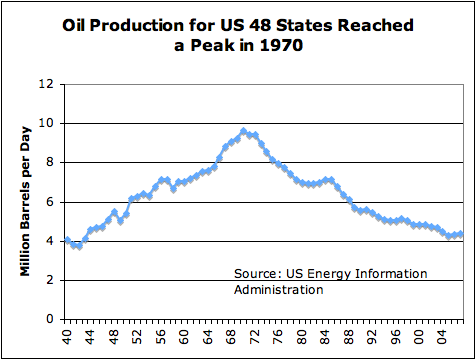
Comments: US oil production has been declining since 1970, in spite of technology advances and new drilling in the Gulf of Mexico. The recent dip and uptick reflects lower production in 2005 due to hurricane damage, followed by a bounce back in 2006 and 2007, as the damage was repaired.
US Peak in 1970 • US had been world's largest producer
• Peak came as a surprise to most
---Had been predicted by Hubbert in 1956• Precipitated a rush to find oil elsewhere
---Ramp up Saudi and Mexico production
---New production in Alaska and North Sea5
Comments: We were fortunate in 1970 to find other places in the world where oil was available, but had not yet been developed. There are still a few such sites available (for example, some US sites that have been placed off-limits for development), but they are much smaller in relationship to what was available in 1970.
M. King Hubbert had predicted in 1956 that the US production of oil would peak in 1970, but few believed him.
On page 22 of the same report, he predicts that world oil production will peak "about 2000". His prediction was made in 1956. As such, it did not reflect significant changes in the 1970s, including the significant recession of the 1973-1975 period, the switch to nuclear and natural gas instead of petroleum for electricity generation, and mileage improvements for cars. If these had been reflected, the predicted peak would have been several years later.
Saudi increases were quickest • Saudi oil company was run by Americans
---Able to ramp up quickly• OPEC embargo in 1973, however
---Oil shortages
---Huge oil price run-ups
---Lead to major recession 1973 - 756
Comments:
According to Wikipedia, Arabian American Oil Company (Aramco) was jointly owned by four US oil companies in 1970. In 1973, the Saudi Arabian government acquired 25% of the company. The percentage ownership was increased to 60% in 1974, and 100% in 1980.
OPEC began operation in 1965, but did not have pricing leverage until the United States could no longer produce the vast majority of its own oil, because of its decline in production. In Octover 1973, OPEC initiated an oil embargo against countries that supported Israel in the Yom Kippur War, particularly targeting the United States and Netherlands. The embargo lasted only a few months, until March 1974.
During this time, there was a sharp rise in oil prices, and a sharp drop in the stock market. In the United States, gasoline was rationed with people able to buy on odd or even days, depending on the last digit in their license plate number. According to Wikipedia, oil consumption in the United States dropped by 6.1% during this period.
The 1973-75 recession was the most severe recession since World War II. Merrill Lynch says it believes the current recession will be similar to that recession.
Other oil online by late 1970s
7
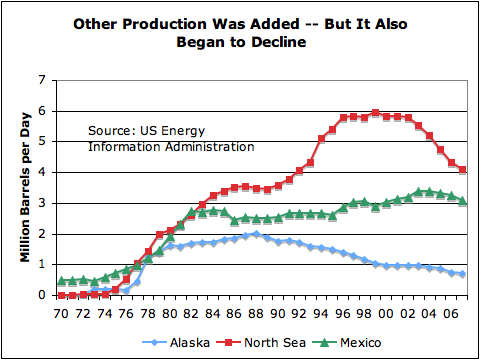
Comments: Even when an oil company wants to start new production quickly, it is difficult to do so. The ramp up in Alaska oil production had to wait until the Trans-Alaskan Pipeline System was completed in 1977.
It was known that oil was available in the North Sea prior to the oil embargo. It was not until the price run-up related to the embargo that it was economically feasible to drill there, however.
Production in all three of the areas shown is now declining. Alaskan production reached its peak in 1988; the North Sea peaked in 1999; and Mexico peaked in 2004. The shapes of the production curves vary for the different locations, depending on where the oil was located, and how it was produced.
Now the US is a major importer of oil
and a tiny user of newer renewables
8
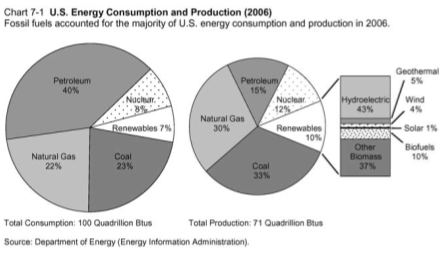
Comments: This figure is from Page 166 of the 2008 Economic Report of the President. The data shown are 2006 figures. Percentages for the newer renewables would be slightly higher for 2007.
The graphs are not as clear as I would like. The larger circle on the left represents consumption. It totals 100 quadrillion Btus. The smaller circle represents production. It totals 71 quadrillion Btus. Renewables are in the section pulled out. In total, renewables amount to 10% of production or 7% of consumption. The vast majority of renewables are hydroelectric and "other biomass" (wood used to heat homes and fuel some electric generating plants).
Reading Slide 8 • About two thirds of oil is imported
• Biofuels make up about 1.0% of energy production - a little less of use
• Wind comprises 0.4% of energy production
• Solar comprises 0.1% of energy production
9
Comments: We use a huge amount of oil and other fossil fuels. Even with big ramp up in alternatives, they are still tiny. If a cutback is made in fossil fuels, either because of shortages or because of a desire to reduce carbon dioxide, it seems clear that at least part of the response will have to be reduce total energy usage.
The World Oil Story 10
World Oil: Discoveries follow same pattern as US production
11
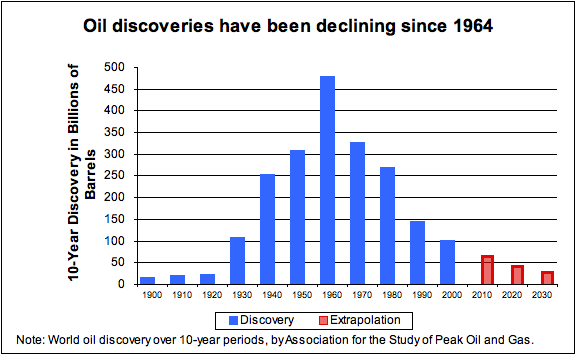
Comments: The discovery information is based on backdated information - what we now think old discoveries were worth. Some of the big oil fields in the Middle East were discovered about 1960. We are still discovering new fields, but they tend to be smaller and more difficult to extract. The discovery information includes only liquid oil, not oil in the form of tar or other solids.
The combination of discoveries which peaked many years ago, and oil extraction which tends to peak in individual areas, leads one to believe the eventually world oil production will peak. There will still be oil in the ground, but it will be difficult to extract. Eventually, we simply won't be able to keep extracting as much as we would like:
• As oil fields get older, the percentage of water extracted with the oil tends to increase. In some cases the water percentage exceeds 99%. Once an oil field's water production exceeds the installed water handling capability, production will need to be reduced. When the cost of additional water handling capability exceeds the cost of oil extracted, it stops making economic sense to extract the oil.
• Some of the oil will be mixed with toxic chemicals like poisonous hydrogen sulfide gas. Special techniques will be required to safely extract this oil. This process will be expensive and time consuming. A giant oil field discovered in Kazakhstan in 2000 has this problem and isn't expected to come on line until at least 2011.
• Some of the oil is found extremely deep beneath the sea. Special techniques need to be developed to deal with the high pressures and the temperature differentials encountered when drilling in these locations. Developing these new techniques takes time and is expensive. At some point, we will reach our limit on deep sea drilling.
• Some of the oil is very viscous, akin to tar. It can only be extracted by digging. Production requires inputs of fresh water and natural gas. Once limits on either of these are reached, production must stop. In some cases nuclear may be substituted for the natural gas, but this takes time, money, and agreement of the local population.
World oil production has stalled
12

Comments: Oil production on an "all liquids" basis was flat for the years 2005, 2006, and 2007. On an energy available basis, production actually declined. There are several reasons for this:
• The "All Liquids" summary includes lower energy products like ethanol and natural gas liquids. These have been growing, while crude oil production has tended to slightly decline since 2005.
• The oil produced requires more and more energy in extraction, because it is mixed with more and more water, and is found in deeper and deeper locations. More energy is required for extraction, leaving less for end users.
• If we look at oil available for imports, this has been declining since 2005. Part of the reason is the greater amount of oil used in extraction; part of the reason is that the standard of living in oil exporting nations is rising, so these nations are using more of the oil themselves, leaving less to export.
And prices are spiking
13
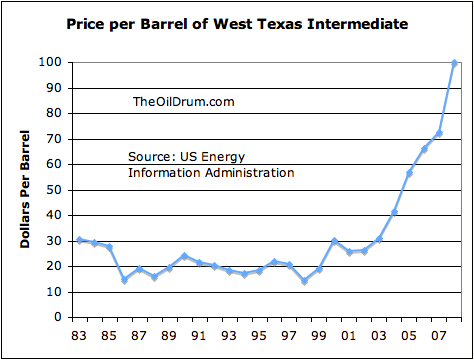
Comment: The fact that oil prices have been spiking since 2005 should come as no surprise. I show an estimated partial 2008 price on this graph, too, since we know the price spike has continued into 2008.
Given the shrinking supply and rising demand, the rise in prices was close to inevitable. Some of the poorer countries are being priced out of the market, and the use of coal is rising, particularly in China.
The higher prices have stimulated work on fields that were known, but not fully developed. Recent data compiled on oil megaprojects indicates that oil companies are now making a concerted effort to develop sites that may be available but have not yet been developed. Many of these projects are expected to begin production in 2008 and 2009.
It might be noted that in the 2000 to 2002 period, production stalled and even dropped a bit. Prices did not rise during this time period. They actually fell a bit. The reason for the decline during this period was lack of demand, due to recession. Now, many potential buyers are asking for more, but price does not seem to rise accordingly.
OPEC, particularly Saudi Arabia, has had
reduced oil production recently
14
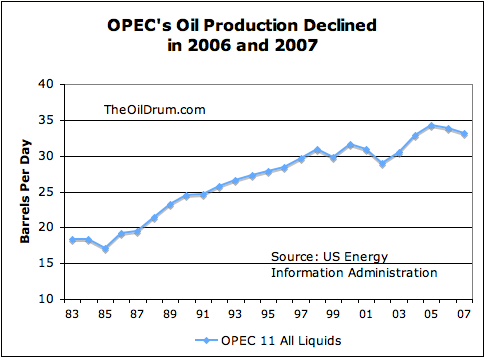
Comment: The oil production of Saudi Arabia and OPEC has been sufficiently variable over time that it is difficult to make predictions, simply based on trends. OPEC's production, and in particular Saudi Arabia's production, is down in both 2006 and 2007. It is hard to know exactly what this means.
According to the US Energy Information Administration, Saudi Arabia's highest oil production was in 1980, when it produced 9.9 million barrels a day. Its recent peak was in 2005, when it produced 9.6 million barrels a day. In 2006, Saudi production dropped to an average of 9.2 million barrels a day. In 2007, production from February to August was only 8.6 million barrels a day.
When OPEC agreed to raise quotas near the end of 2007, Saudi Arabia did in fact raise its production. Its highest single month of production in 2007 was 9.1 million barrels a day, in December 2007. This represented a 500,000 barrel a day increase over its earlier low production of 8.6 million barrels a day, but still left production below both the 2006 average of 9.2 million barrels a day and the 2005 average of 9.6 million barrels a day.
One question too is whether this increase will continue, or if it is just temporary. It is sometimes possible to squeeze out a little extra production for a while, but then production drops back to a more normal level. Saudi Arabia originally planned to have an upgraded field (Khursaniyah) on line by late 2007, which was expected to produce an extra 500,000 barrels a day of oil. It may have thought it could make a spurt of extra production until this field came on line. Now the Khursaniyah field upgrade has been delayed until late 2008. Will Saudi Arabia be able to continue the increase, without the assistance of the Khursaniyah field?
Another question is why OPEC refused to raise its quota further on March 5, 2008. Is Saudi Arabia now really at the peak of what it can produce? It claims to have more production available in reserve. We know that Saudi Arabia has some poor quality oil off-line because the oil requires special processing which is not yet available in any refinery. Is this the only Saudi production off-line? Are other OPEC countries also unable to produce more?
OPEC's true reserves are unknown • Published reserves are unaudited
• Last Saudi reserve while US involved was 110 Gb in 1979 (perhaps 168 at "expected")
---Production to date 81 Gb, implying 29 to 87 Gb remaining; Saudi claims 264 Gb remaining• Kuwait published 96.5 Gb - Audit 24Gb
• GW Bush says regarding asking Saudi Arabia for more oil
---"It is hard to ask them to do something they may not be able to do."15
Comment: If one analyzes the reserves for OPEC countries, one very quickly comes to the conclusion that the published numbers are unreasonably high.
This is the story: In the early 1980s, OPEC oil countries were all vying for high quotas. To get those high quotas, they believed that publishing high reserves would be helpful. One by one, OPEC oil countries raised their reserve estimates, in an attempt to make it look like they had more oil, so deserved higher quotas. To further this illusion, they kept the reserve numbers at the new high level, even when oil had been pumped out, and no new oil had been found.
The practice has continued for years. OPEC leaders found that by overstating their reserves, they gained new respect, both within their own countries and abroad. They also found that the practice was very easy to do, since no one is auditing the reserve numbers they provide.
A graph of OPEC oil reserves over time is as follows:
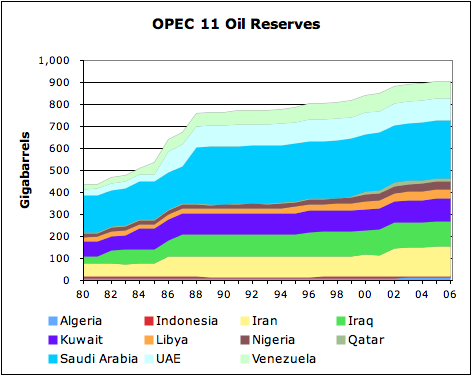
There are many other ways this problem can be seen. For example, OPEC's oil production is unreasonably low in relationship to its reserves, unless the countries are inept at production or are misstating their reserve amounts. I discuss this issue further in my post The Disconnect Between Oil Reserves and Production. "Ace" has calculated some much lower reserve estimates, based on industry estimated recovery percentages.
Another insight can be gained by looking at Saudi oil reserves, when Americans were involved in setting reserves. According to Matt Simmons' "Twilight in the Desert", Saudi oil reserves were 110 Gigabarrels (Gb or billion barrels in US terminology) in 1979, back when Americans were still partial owners of Aramco. If we subtract the 81 Gb pumped out since then, this suggests remaining reserves of 29 Gb.
If is possible (even likely) that the 1979 American estimate was low. If, instead, we use the Saudi published estimate of 168 Gb in 1980, and subtract from it production of 81 Gb to date, we get an estimate of 87 Gb. This is less than a third of the 264.3 Gb that Saudi Arabia is currently reporting as reserves!
Kuwait is another country where we have an alternate estimate of the proven reserves available. An analysis by the Kuwait Oil Company as of December 31, 2001, showed proven reserves for the country of 24 Gb. Their published reserves were 96.5 as of December 31, 2001, moving up to 101.5 as of December 31, 2006!
President George W. Bush seems to be aware of Saudi Arabia's production/reserve problems. In an interview on ABC's Nightline, when asked why he didn't pressure the king for more oil, George Bush said
If they don't have a lot of additional oil to put on the market, it is hard to ask somebody to do something they may not be able to do.
Somehow, US textbooks and newspapers have not figured out the problem with OPEC reserves. They continue to quote huge "proven reserves" for most of the OPEC countries. The word proven adds credibility to the numbers, suggesting that somehow, the reserves have been proven to some authority, when nothing could be further from the truth.
The United States Geological Service (USGS) has added further to the confusion. It has taken the absurd reserves published by OPEC, and made calculations based on US development patterns suggesting that OPEC reserves may, in fact, be low. USGS publishes its even higher estimates, confusing the situation further.
Fortunately, FSU production has increased recently
16
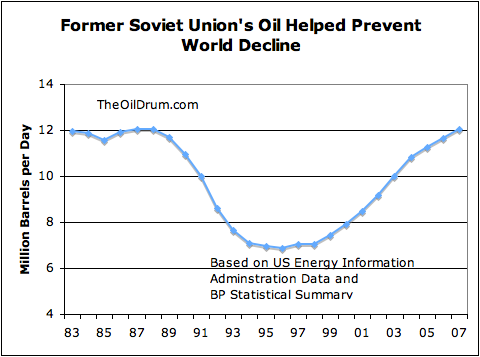
Comment: The Former Soviet Union saw a sharp decline in oil production in the late 1980s and early 1990s. With the adoption of modern extraction methods, they have been able to increase production again. There have even been some more recent discoveries brought on line.
Production going forward is uncertain • OPEC refuses to increase quotas
• Numerous reports say Russian production is likely to begin decreasing soon
• Little hope for US, North Sea, Mexico
• Canadian oil sands contribution is very small
• Recent discoveries have been small, relative to what is needed
• New production techniques can lead to sudden drop-offs
---Followed by small dribble for years from EOR17
Comments:We have problems almost everywhere we look. OPEC doesn't look like it is willing/able to increase production; Russia, which is the biggest part of the Former Soviet Union, looks like it is about to begin to decline; and there are a huge number of countries already post-peak, like the United States, Mexico, and the countries that make up North Sea production.
Even Canada, apart from the oil sands, is post peak. Canada depends on imports--heavily from Saudi Arabia--for its oil. While Canada has been exporting oil from the oil sands to the US, there are really two issues involved:
(1) The amount of oil from the oil sands is not likely to ramp up quickly.
(2) Canada is likely to need the oil itself, as its other production declines. This is especially the case if Saudi oil which it imports continues to decline. Under NAFTA, Canada is obligated to export a proportional share of its oil to the US, but this may be subject to renegotiation in the next few years.
There are really a couple of issues with newer technologies that are being used. One is that fancier and fancier extraction tools (such as horizontal wells and maximum reservoir contact wells) have been developed. These are able to suck out a greater percentage of the available oil, before production suddenly "hits a wall" when the layer of oil has been extracted, and the remaining oil is mixed with a huge amount of water and under little pressure. If this should happen on an enormous field like Ghawar in Saudi Arabia, we could very quickly see production drop by 2 million barrels a day, or more.
In recent years, quite a few "enhanced oil recovery" methods have been developed. Much of the impact of these methods is already reflected in the production data graphed. In some cases, like Mexico, it has permitted production to continue longer before the inevitable drop in oil production came. In others, it helps wells to continue to produce at a very low level after the vast majority of production is completed. It is doubtful that oil production will ever stop - a dribble that is nearly all water will continue indefinitely.
Projections of Future Production Vary Widely
18

Comment: The highest estimate in slide 18 is from the US Energy Information Administration. It is based solely on demand, under the assumption that OPEC can always provide additional oil if needed.
The next highest forecast is from the newsletter of the Association for the Study Peak Oil and Gas-Ireland, prepared by Colin Campbell. A link to it can be found here. It assumes that production will rise from its current level of 85 million barrels a day to a peak of 88 million barrels a day in 2010. After that, production will decline.
The next highest forecast is that of "Ace" of The Oil Drum staff. A link to his forecast can be found here. In this forecast, Ace considers the various Megaprojects, and when they are expected to go on line. He also considers expected decline rates on existing fields. He believes that we are on a plateau now that may last a few years. After that production will decline.
The remaining estimate is by Matt Simmons. In this interview, he mentions that he expects crude oil (not "total liquids") to drop to 65 million barrels a day by 2013. I have attempted to translate this comment into an equivalent projection, on a total liquids basis. It ends up being just a bit below Ace's projection.
World "All Liquids" Forecasts • "All Liquids" - Includes biofuels and "coal to liquid" fuels
• US EIA forecast - Based solely on demand
• ASPO Newsletter - Assoc. for the Study of Peak Oil and Gas Ireland, March '08
• "Ace"- Tony Eriksen, on The Oil Drum
• Simmons - Matt Simmons, recent interview on evworld.com
19
EIA expects biofuels, CTL,
and oil sands to remain small
20
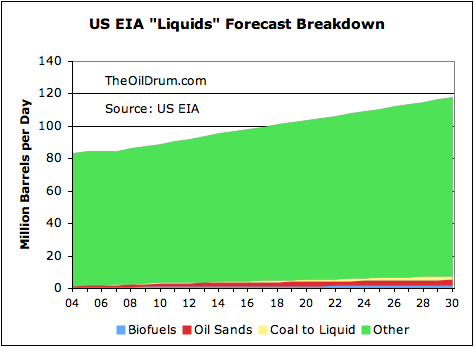
Comment: The US Energy Information Administration's current projections suggest that it does not expect any of these fuels to grow to be significant between now and 2030.
Five Myths 21
Myth #1: OPEC could produce more if it used current techniques • International oil companies use same service companies US companies do
• Most are using up-to-date techniques
• Expenditures often are high
• Problem is very old fields
• Overstated reserves raise expectations
22
Comment: It is easy to see how this myth might arise, if people believe published reserves.
Myth #2: Drilling in Arctic National Wildlife Refuge will save us 23
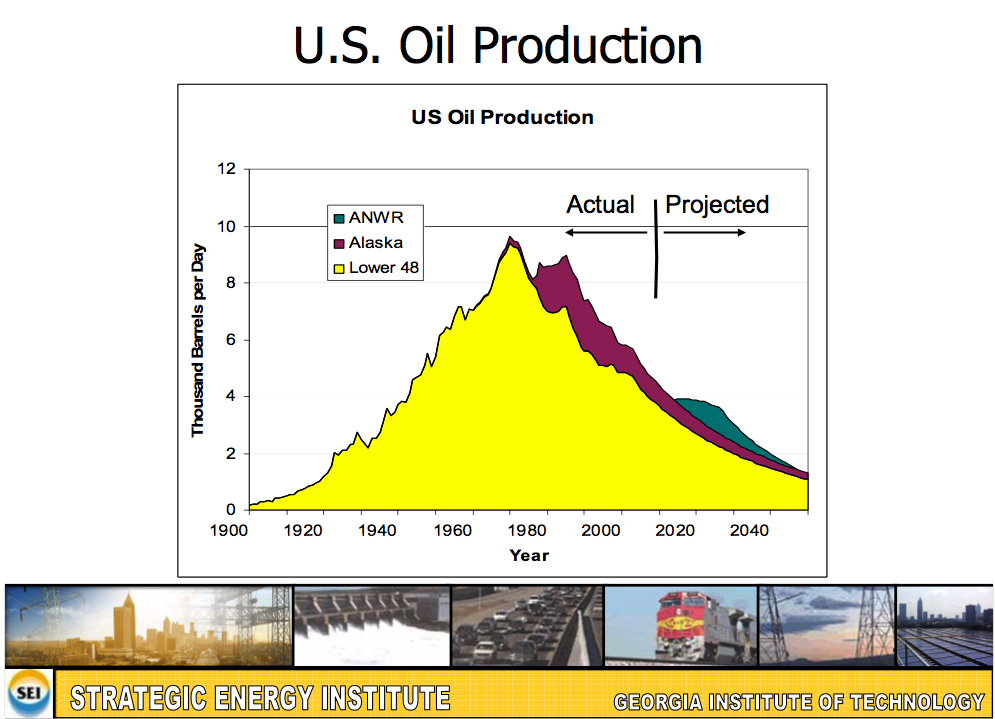
Comment: This slide is from a presentation of Dr. Sam Shelton of Georgia Tech. The oil from ANWR is expected to provide only a small upward "bump" to US production.
Quite a few of the other much-hyped solutions are expected to provide equivalently little benefit. We will likely need to reduce consumption to better match supply.
It might be noted that the Y scale on this graph should say million barrels a day, not thousand barrels a day. Since I did not make the graph, I can't fix it.
Myth #3: A small downturn can easily be made up with energy efficiency • The quickest impacts are financial
---Recession or depression
---Serious recession in 1973 - 75• Use of biofuels raises food prices
---Further increases recession risk• Don't need peak for recession
---Only need supply/demand shortfall
---Likely what we are experiencing now24
Comment: The connection between oil supply and the economy is not well understood by most. A shortage of oil very quickly leads to an increase in prices, and a cutback in the demand for other goods and services. The combination of these events tends to cause a recession. Cutting back on usage tends not to be sufficient to prevent the problem, because there are so many other users around the world, including in China and the developing world. They are likely to cause an increasing demand for oil, even if we try to cut back.
Myth #4: Canadian oil sands will save us • Hard to see this with current technology
---Technology known since 1920s
---Production slow and expensive• Requires huge amount of natural gas
---In limited supply• Most optimistic forecasts equal 5% of current world oil by 2030
---Even this exceeds available natural gas
25
Comment: There has been commercial development of the Canadian Oil Sands since 1967. Huge amounts have been spent, and there has been great damage to the environment. Even with this, production has remained small--only a little over 1% of world supply. Natural gas limitations suggest that we will never be able to greatly ramp up production.
It might be noted that a similar argument can be made as to why oil shale will not save us from peak oil. At this point, we don't even have an economic method of extracting oil shale. From what we know, extraction will require a large amount of water and considerable electricity. Finding adequate water for extraction is likely to be a problem. It is not clear that we will have extra electricity to spare either, for this large a project. Extraction is likely to be slow and expensive, since it will require moving large amounts of dirt around, plus heating and perhaps chilling the dirt. If we are able to extract oil shale, it will likely be in small quantities.
Myth #5: Biofuels will save us • Corn-based ethanol has many problems
---Raises food prices, not scalable, CO2 issues, depletes water supply• Cellulosic ethanol theoretically is better
---Still does not scale to more than 20% of need
---Competes with biomass for electric, home heat• Biofuel from algae might work
---Not perfected yet
26
Comment: Every study that has been done recently with respect to corn ethanol seems to come out with worse indications. Corn ethanol has virtually no benefits over petroleum. It uses huge amounts of fossil fuels as inputs, so it has most of the drawbacks of fossil fuels. It also has its own drawbacks, including raising prices, damage to the environment, high water usage, and possible CO2 and other global warming gas increases because of land use changes and nitrogen fertilizer use.
At this point, there aren't good alternatives to gasoline commercially available, however. Since there is great political appeal to growing our own fuel, corn ethanol is supported by most politicians, even if any reasonable analysis would say its benefit is very limited.
Longer term cellulosic ethanol may be a better solution, but at this time it is not commercially available. Even if we use wood and switchgrass as inputs, cellulosic ethanol will be difficult to scale up to provide more than a small share of the needed fuel.
Biofuel from algae looks to some like it might work. At this point, we do not have a commercial way of doing this and the cost would be extremely high.
Contact
- Content: editors at theoildrum dot com
- Tech support: support at theoildrum dot com
License

This work is licensed under a Creative Commons Attribution-Share Alike 3.0 United States License.
Hi, Gail. This is very good...well done.
In my presentations I handle the myth that any new technology or combination of technologies can make up for the decline in energy from oil. I do that by pointing out that we can never transition more than a fraction of our existing infrastructure because of the size of it — even with extremely generous (i.e. high) market penetration rates. I find that if I don't handle the general case in that way, someone always comes up to me with the "technology du jour" and misses the point that we are in for an unavoidable energy descent. Last night it was the recent breakthrough of creating synthetic gasoline that is chemically identical to that derived from oil that someone got hung up on at an event I attended (I wasn't speaking).
My goal is to leave people boxed in — to exhaust their "how abouts", "ya, buts" and "what ifs." If I don't move them past that stage, they won't start to look seriously at how they are going to deal with our inevitable future.
The relevant conversation starts on page 33 of my presentation here:
www.savinggreenbygoinggreen.com/downloads/SunSpeechWithSlides.pdf
Also, I believe one can make a stronger argument for peak economy coinciding with peak oil and the likely impacts of that. See my piece Estimating the Economic Impacts of Peak Oil, which uses the latest Hirsch Report in Energy Policy to make the case:
www.inspiringgreenleadership.com/blog/aangel/estimating-economic-impacts...
-André
www.InspiringGreenLeadership.com
This may sound a bit crazy for a primer. But I think adding in a little bit about error in measurement would be invaluable. For example our world production number have a +/- 1mbd error with unknown but potentially large systematic errors i.e a country reports or does not report a oil source that another country includes.
I would not go into to much detail but the average joe would claim peak oil is a hoax if they read a number that we produced one more cup of oil over a certain date.
I notice a lot of avid Oildrum readers fall prey to reading to much into the numbers so I think this might be a big issue for the public at large.
It is really easy to increase complexity in the whole subject. It doesn't seem to me that saying that we don't really know what the numbers are helps a beginner understand the situation that much better.
Gail,
Great work as usual.
Question: I believe you were working on a book on Peak Oil.
Have you finished that? If so, I'd like to buy one (I assume it will be available on Amazon, true?).
I probably should be, but there are several issues involved. One is that it takes a long time to get a book published, unless one self-publishes, and the field is changing rapidly. Another is that if one wants to put together a really good book, one has to devote a lot of time to it, and this would take away from my time writing on the web.
I have thought about having someone put together a compilation of some of my web posts and publish it. I could even write a few more posts to fill in the blanks.
One minor issue is that if one wants to keep publishing costs reasonable, one needs to only use black and white illustrations. On the web, color works better. With this particular post, I tried to make illustrations that would print out reasonably well in black and white. If one wants a book that would meet the standards of most "regular" publishers, all of the graphs would have to be reset in a manner that would make them look sort of OK in black and white.
A person can get to my Oil Drum posts on this link:
http://www.theoildrum.com/user/Gail+the+Actuary/stories
In November 2007, I put together a PDF of some of my posts. It is about 110 pages long. In some ways, it is a substitute for a book. It can be found here:
http://gailtheactuary.files.wordpress.com/2008/01/introduction-to-peak-o...
Quite a few of my earlier posts can also be found, in written out form, on that site. I have not been adding ones recently, because the Word Press site and The Oil Drum use different forms of HTML, and making the translation takes time.
Gail,
I want to complement you on your clear, uncluttered graphs. I think color is highly overrated. Especially on a low resolution medium like computer screen. Please don't make extra work for yourself. Timely access to clear information on an uncluttered display with evenly spaced grid lines is my strong preference.
Thanks.
Hi, memmel. Pleased to meet you.
I too think that reading too much into the numbers is a trap.
To handle that, I go the other direction than you are suggesting...I keep bringing the audience back to the big picture so that they don't get hung up on the numbers, margins of error, etc. etc. When making a public presentation, audience members with an analytical bent to them can derail a conversation with their questions if they are overly indulged. I redirect the conversation quickly away from the specific objection and point out its irrelevance in the bigger picture so that I can keep the other members of the audience focussed on the important bit: the inescapable nature of Energy Descent and how they are going to respond.
-André
Yes I agree either way the point is that detractors of peak oil often use "numbers" so no matter how you deal with it its not a numbers game. At best if your lucky and eventually get good real numbers it will help you decide the best approach to mitigating peak oil. Other than that the number don't matter.
lol you mean so they don't get hung up on the facts ...?
See the next sentence to see what I mean.
Andre,
I found your presentation interesting but not persuasive.
You mention a show-stopper: scale.
I'll come back with a single line reply: different peaks.
Peak oil is here about now, and will indeed have severe consequences.
However, although it may be in fairly short supply, peak gas is not here yet, and peak coal even on Dr Rutledge's estimates is come time away.
You then give the scale of substitution we need and declare it not possible:
To use the most developed of the alternatives, you mention that it would take 52 nuclear plants worldwide per year, presumably of 1 GW for a total of 52GW.
At the peak of the seventies build around 18 a year were built.
Present reactors are often of around 1.5GW, so we would need around 35 a year.
China alone plans to have the capacity to build 10 a year plus some pebble-bed reactors by 2020, and are ahead of plan.
So what is not do-able?
None of that is to detract from other sources of energy, as wind-power alone will make quite a contribution.
The second strand of your argument is that this is electricity, not liquid fuel.
This is a very valid concern, and will cause great difficulties.
However, oil supplies are not going to stop dead, but will certainly need to be used more wisely.
Natural gas, sometimes liquified can also be used for many of the things oil is, and coal can be liquified as you say, and by your own argument we appear to have at least some leeway in greenhouse gas emissions.
Of course, batteries and other storage mechanisms are the real long-term answer, but it is the fact that NG and coal are not peaking at the same time as oil that may allow us to bridge the gap.
Providing all the power a technological society needs seems eminently do-able.
Hi, DaveMart. That is a valid point of view that you are advocating. I'm choosing to disseminate the point of view I outline in my presentation.
Best,
Andre'
Actually Andre, you seek to present your case rather more strongly than you indicate:
Since there are other points of view which you characterise as valid, how and in what way is this a myth?
If you wished to make the rather weaker presentation that you thought it unlikely that we could ramp up in time due to crises points, well and good, although similar difficulties might also be encountered in the options you favour, but to seek to characterise the rather modest target of about doubling the yearly number of units of a non-fossil fuel alternative as a myth is surely a misrepresentation, and profoundly misleading to your audience.
Hi, DaveMart.
I understand that you don't agree with my line of thinking; let's agree to disagree on this because I'm not interested in exploring this with you. I'm very familiar with your writing from other posts and I think I have a good idea of what your opinion is. It is a valid opinion, I do not share it and I believe the points I raise stand on their own merits.
Best,
Andre'
Up to you, Andre, but to miss-state is to mislead, and it seems that you are prepared intentionally to present a case you cannot substantiate, which I would certainly not do.
You have actually made no attempt to demonstrate that your points stand on their merits - presumably you rely on your audience not being aware that the figures you give are not so very big or out of line with past practise at all, which since your argument is about scale will hardly do.
Unless of course you want to present your case as a myth.
Dave, I suspect that Andre wishes to encourage powerdown and a more "green", less energy intensive society for its own sake, and if advancing that goal requires intentionally misleading his audience about the scalability of non-oil sources of energy, he's more than happy to do that.
I certainly hope that you are wrong, and that upon reflection Andre will wish to give a more balanced presentation, and let the merits of his own case be only such as can be shown to be genuine - I would certainly wish to do that for any argument I wished to present, as is only fair to the audience.
People who seek to mislead usually do so because they are aware that their case is weak.
This seems quite rude Dave. Because Andre disagrees with you does not make him misleading. Perhaps he does not believe that nuclear power will scale rapidly enough to make up for falling supply. Or that promised technical advances will arrive on time.
The Hirsch report makes clear a 20 year head start is needed to avert economic difficulties. If peak oil is in 2010 then we don't have 20 more years.
Then why don't you put together your own presentation and offer it up.
It certainly is in no way intended to be rude.
I think if you re-read the argumentation in this thread you will see why this is phrased that way.
He may be correct that 52 nuclear plants or the equivalent in other power sources may not be possible to be built.
Alternatively, he may be correct that even if this can be done then as they would be producing electric, not liquids then it would still not be viable.
The point I brought up was that Andre presenting the possibility of such a build as a, in his words, 'myth', when in fact it is well within the same kind of order of build as that which has already been done in the past, which his audience may not be aware of.
And so, without in any way meaning this personally, I stand by my statement that this is grossly missleading.
He states clearly in his presentation that the problem is one of scale - please check back to it.
Had he presented the actual historic scale comparisons fairly his argument would not look very impressive.
DaveMart:
"The point I brought up was that Andre presenting the possibility of such a build as a, in his words, 'myth', when in fact it is well within the same kind of order of build as that which has already been done in the past, which his audience may not be aware of."
I would question your assertion that, because we once were able to build 18 nuclear power plants a year (back in the 70's when concrete and steel were much, much cheaper) that it is "well within" feasible limits to build 56 per year over the next decade or two.
I do not know your age or location, but I was college-aged and living in the heart of Commonwealth Edison territory (northern Illinois, USA) during their monumental nuclear build-out. I grew up about 10 miles from one of their plants, and within 50 miles of several more. It was fascinating, and horrifying, to watch the kinds of hiring practices they had to engage in to get enough workers to build their plants. Buying of union cards by unqualified workers was commonplace. Reports (from friends and neighbors who worked there) of on-the-job alcohol and drug-abuse were the norm. Short-cuts to keep on schedule were demanded, like the day my neighbor saw a 55-gallon drum slip and fall into a concrete pour of the containment vessel. He was told by his supervisor to "let it be, we have to stay on schedule". Perhaps you never read of the scandals regarding falsified QC x-ray records of welds...
My point is that it was very difficult then to get enough qualified workers to meet schedules in a safe and proper manner. I'd ask where you get the optimism to think we could do any better at 4 times the rate of construction.
That's always been my big concern with nuclear power plants: the need to execute to near-perfect standards (do you want a half-assed nuke near your house?) butting into the pressure to keep to tight schedules and avoid delays in getting them into the rate-base seems like a Really Bad Way to power our society. Well, that plus the market-distortions induced by the infamous Price-Anderson Act, of course :-)
Larry
Andre may be correct, my concern was solely that I felt that he is overstating his case - but I would point out that at the same time as the maximum nuclear build was taking place plenty of other sorts of plants were being built.
In an effort to avoid over-stating my own case I also gave the present Chinese coal build as the lowest I could reference, around the 52GW needed power per annum.
I have since checked more carefully and it last year it was around 90GW, admittedly that is a different technology but it perhaps goes to show that the size of the build needed is not unreasonable per se, especially considering we are talking about what is possible by the whole world, not just China.
To re-iterate, my comment is not about nuclear per se, but just to assess whether builds on the scale that Andre is talking about are as 'mythical' as he asserts.
Wind power, and perhaps solar and geothermal will take a fair chunk out of the needed build anyway, as will nuclear build in China, where regardless of what you or I think of safety they intend a build of around 10 reactors a year by 2020, and they are ahead of schedule - at 1.5GW a reactor that is over 25% of the specified build.
It is clear that he has greatly over-stated his case on the impossibility of a build on the scale needed.
For people who are following along, I'm going to point out that DaveMart is saying that it is within the realm of possibility that we (i.e. humanity) can build 52 nuclear reactors each year for 50 consecutive years for a total of 2600 nuclear power plants — all while we are experiencing Energy Descent.
For people who are REALLY following, I am talking not just about nuclear, I used the nuclear figure as it is convenient as it was given in the link in 1GW stations, so we actually need according to the presentation 52 GW of energy a year.
For reference last year China alone built around 90GW of all sources.
20GW of wind-power was built - the reason I did not use this is that you have to allow for capacity, so at, say, 25% that comes to 5GW of wind power last year in actual terms.
Nuclear reactors are now often around 1.5 GW, so you would only need 35 of them, even assuming no help at all from other sources.
At the height of the last nuclear build we were building around 18 nuclear reactors a year, so we would need about double that - minus help from other sources - and at the time they were simultaneously building plenty of other gas and coal stations and so on.
China alone plans to be building 10 nuclear reactors a year by 2020 - and they are ahead of schedule.
If the argument was that it will be difficult, especially in a world short of oil, that is fine, but to say that it is 'mythical' and it does not 'scale' clearly implies that we are attempting something way beyond anything which has been done before, which is clearly and simply untrue.
The presentation for that reason is tendentious and highly misleading.
I have over-stated things myself on occasion, we all do, it is human nature, but I always amend when this is pointed out, and present my case more conservatively.
I think Aangel has let his enthusiasm run away with him, to the extent of making unfair arguments without proper balance - trust your audience, and let them decide.
Hi, DaveMart.
I suggest that you're still not thinking through this.
Using an average build time of eight years, what makes it especially mythical is this:
Year 1: 52 starts
Year 2: 52 starts, 52 in progress = 104
Year 3: 52 starts, 104 in progress = 156
Year 4: 52 starts, 156 in progress = 208
Year 5: 52 starts, 208 in progress = 260
Year 6: 52 starts, 260 in progress = 312
Year 7: 52 starts, 312 in progress = 364
Year 8: 52 starts, 364 in progress = 416
Year 9: 52 starts, 52 completions, 416 in progress
The world would have to be building 416 nuclear power plants each year for decades if we were to go all nuclear and wanted to replace oil only through that means.
You are welcome to play with the numbers all you want (35 power plants per year instead of 52, etc.), you can throw in a few million wind turbines, perhaps a few tens of millions solar panels and I assert that any plan that you can come up with that would replace oil -- while oil itself is depleting -- will be mythical.
That's what I mean about not letting public discussions devolve into a battle of numbers. (Here is fine obviously.) There is no set of numbers grounded in reality that will have us avoid Energy Descent.
Hi Aangel,
I would like to emphasise that I simply feel that you have let your enthusiasm get the better of you, and no personal disrespect is intended.
The basic point is that you can fairly make the point that it will be a lot more difficult to carry out builds post peak oil, but as against that you have to take into account that they would be prioritising building power units much more than we had to in the past, when they did not really absorb a very substantial proportion of our efforts.
The build required, even on your terms, and I note that Nick, who is pretty well versed it seems in many engineering issues, has cast grave doubts on those, is really very modest compared to many past engineering efforts.
What you are essentially doing is just casting numbers in a fashion which says-'Wow! That's a big number!'
It is just as easy, in fact easier, to cast them in a light which would show them as being very small, for instance on the same numbers we could say:
'All we have to do, is for the whole world together to build around half of China's build for power, but move it across to other proven technologies like wind and nuclear - not to mention coming technologies like solar energy'
It really doesn't sound so daunting shown that way, does it?
The same thing applies to your 464 in progress numbers.
For a start, you have used build times which have some relevance to the west, as long as they are not in series production, but include lead-in times and preparatory work, when much of the build will happen in places like China, where periods like 4-5 years are more appropriate.
Secondly, you have assumed that the whole build is nuclear, when even at the moment around 10% of the build is wind power, where a time of two years or less is more appropriate.
Even using your figure of 464 under construction, with a population of 6.5 billion that would mean that one reactor would be under construction for every 13 or 14 million people on the earth - it doesn't sound so huge then, does it?
So there are plenty of numbers grounded in reality which would allow us to avoid energy descent.
The biggest obstacles are faulty risk assessment when the main problems are the lights going out and global warming, and even more importantly the fear held by many in the financial community that prices will suddenly drop for fossil fuels, as they did before at the end of the seventies, leaving them high and dry with expensive investments.
Your argument that the scale is too great simply does not hold water, and is well within previous construction experience.
Other arguments such as Gail or Leanan might argue (without putting words into their mouths) that financial breakdown and so on would prohibit it have much more substance, as does to some degree your own argument that shortages of fossil fuels will cause severe difficulties.
I look forward to seeing your comprehensive plan to address Energy Descent, then. Please submit it to the editors here and we can all study it.
Best,
André
This is to switch the grounds of the argument.
You have made specific statements that the needed build is 'mythical' and out of scale.
Myself and others have clearly shown that it is neither.
I have even suggested other lines of argument which are more soundly based.
All that I am asking is that you present your ideas fairly, and without unduly distorting reality to suit your case.
I find your case itself perfectly arguable, if perhaps somewhat unrealistic in it's assumption that we can cope by reducing consumption and switching to a new paradigm or whatever was the somewhat hazy end point, but dislike any misrepresentation at all as smacking of propaganda, and feel that we owe our audience the most moderate and conservative presentation of our case possible.
If you overstate and someone finds out about it they are very likely to dismiss your whole argument out of hand.
There is nothing wrong in saying that in your judgement such a build would not be possible, you know.
But of course the real problem is that you have overstated your case to yourself, as is clear from your statement that you would seek to drive interlocutor's from point to point, until there was no escape from your remorseless logic.
That is a problem when your case is based on assumption, not logic.
I don't know and neither do you for sure what is going to happen, nor are all the parameters which will influence it quite clear, and you are fooling yourself if you imagine that you have total insight.
Aangel, come back down to earth.
And it gets worse. All those "in progress" nuclear plants (or any other alternative power source) are pulling energy out of the economy. Build too fast and you don't have a power source, you have a power sink. Nuclear is estimated at a maximum build of 10% to just break even. To be a source of power, the growth rate would need to be lower. To supply anywhere near the percentage of power we get from oil, the growth rate would have to be a very low 1-3%.
Pearce, J.M. (2008)
‘Thermodynamic limitations to nuclear energy deployment as a greenhouse gas
mitigation technology’, Int. J. Nuclear Governance, Economy and Ecology,
Vol. 2, No. 1, pp.113–130.
Based on build time, wind is slightly better (very simple tech). Based on EROI, solar PV is far worse.
"All those "in progress" nuclear plants (or any other alternative power source) are pulling energy out of the economy. Build too fast and you don't have a power source, you have a power sink. "
You seem to be assuming a very low E-ROI. Everything I've seen has shown an E-ROI of 20-50 for wind, solar, nuclear. What numbers are you using?
I have been reading one paper after another on nuclear power and the EROI values are all over the map. Some are clearly biased low (they include things like interest which are not part of the construction cost) and some are biased high (they leave out steps of the fuel cycle). I recommend you read the paper itself, because he does a literature review and he uses a range of values for both the US and Europe.
Second, an EROI of 5:1 means that an energy source is consuming 20% of the energy it is generating. It does not take much growth in a capital intensive energy source to reach 20% even if the source initially has a 20:1 EROI (5% energy consumed in production).
Hall states that 5:1 is roughly the lowest that civilization can tolerate and this puts a cap on the investment rate.
Energy return of a fuel source is only the first steps in using a fuel, and margin must be left for all further steps. It could well be the margin that must be maintained is higher, like 10:1. I have some thoughts for how it could be calculated, but I have not done the math yet.
I don't really trust EROI calculations too much, it is too difficult to distinguish 2nd and 3rd order derivatives.
Fortunately, I don't really think it needs worrying about too much, as money is fungible and does a better job in the real world of showing costs, as no-one forgets to charge for their work.
In that connection it should be noted that fuel costs a small fraction of the power costs from a nuclear reactor, so providing no-one is giving away their services for free there would seem to be plenty of leeway.
So the worry would seem to be somewhere in the future, rather than in the present.
Should we be worried about that?
Not really, as we already have lots of ways to greatly increase the EROI of nuclear energy, which I won't insult your obviously considerable knowledge by belabouring, but include the obvious breeder reactors, the research at Idaho directed to raising fuel burn from 9% to 14%, annular fuel, re-processing, molten salt reactors which would increase fuel burn to around 50% from 1%, better conversion of the energy to electricity via thermionics,extracting uranium from seawater, or even the very low tech method of siting a buried reactor close enough to a town to pump the cooling water there and use it for heating, which if money is really tight and building a lot of reactors expensive in a constrained fossil fuel environment might be a preferred option.
You could also use a CANDU reactor or others to burn thorium.
Just like Hubbert, who felt that the answer to peak oil was to move on to nuclear generation, and that that power source is effectively unlimited, I don't think we need fear 'peak uranium'
" It does not take much growth in a capital intensive energy source to reach 20% even if the source initially has a 20:1 EROI (5% energy consumed in production). "
Well, it would take quadrupling the energy input. That's a pretty big change.
I've seen a lot of controversy over nuclear and solar PV (although I know enough about PV to confident that PV's E-ROI is high), but I haven't seen any suggestion that wind's E-ROI is not high enough. Have you?
It sounds an incredible stretch to me to worry about the EROEI of PV, but presumably solar thermal is safe just like wind from even the most fevered EROEI critique Nick, as it uses very similar materials to wind energy?
I would make a wild guess that CSP's E-ROI is roughly half of wind's, as wind costs about half as much per KWH, and they're roughly similar manufactured goods. OTOH, wind's E-ROI is pretty high, so I agree that CSP should be in good shape.
Yes, quadruple is a large change, but most assume that reinvestment can reach 100% It is a mistake to imagine energy source growth so fast it creates energy sinks and that society can survive in that fashion.
As for wind, I thought the TOD summery of wind EROI was quite good. Although no accounting was made for new transmission systems or load leveling costs.
I am not against any of these energy sources. I am in favor of finding the limits to how fast they can scale.
" most assume that reinvestment can reach 100%"
I'm not sure what you mean.
"It is a mistake to imagine energy source growth so fast it creates energy sinks and that society can survive in that fashion. "
I don't think anyone is proposing that.
Perhaps you're assuming that new forms of generation have to be powered by themselves. I can't see any reason to apply such a limit, when we don't apply that logic to existing infrastructure. We just ask: "how much is needed, and what forms of generation can provide it?"
Right now, for instance, electrical demand is growing at about 1.5% per year in the US, or about 7GW per year. In the past such new capacity would have come from fossil fuels as a normal part of reinvestment. That suggests a need for perhaps new capacity of about 15GW of wind, 4GW of solar, and 2GW of nuclear. At 30%, 20% and 90% capacity factors, respectively, that gives us our 7GW of average output, and at 15%, 75% and 95% peak capacity factors, respectively, that gives us our 7GW of peak output.
Pearce has placed his paper behind an internet wall, so we only judge it by what he tells us, and what he tells us sounds a lot like the often refuted "storm-smith" arguments. But in this case, I will simply refer to "storm-smith" who were unable, despite a who lot of fudging, to show that the Energy input for nuclear power came anywhere close to its outputs. You are not engaged in a serious argument, if you insist on using the title of an inaccessible paper, and saying the author argued such and such, if no one can read the paper. This is a black box approach to debate, and it is used by people who have contempt for rationality.
Hi Charles,
It has been my experience that State Universities are quite welcoming to the general public. There you may read the article in full.
My preference is to rely on peer reviewed literature where available. You are welcome to a different view.
JonFreise, we are talking about a highly obscure journal. What are the chances of finding it in the library of a second or third class university? No one seems to have actually read ‘Thermodynamic limitations to nuclear energy deployment as a greenhouse gas mitigation technology’. Basically we have a bunch of second hand reports that may or may not have originated from Pearce himself. We have no idea about what Pearce's sources are, what are the on which he based his analysis, or what conceptual tools he used. To argue that Pearce conclusions must be true on the basis of his unknown argument, is highly irrational. Nor is it rational to send me rummaging through university libraries, for a journal that may not even be in their holdings. If you know what Pearce actually argued, set it out. It is incumbent on you and Mr. Pearce to set out the case that he makes.
So far you appear to be arguing out of ignorance.
JonFreise, we are talking about a highly obscure journal. What are the chances of finding it in the library of a second or third class university? No one seems to have actually read ‘Thermodynamic limitations to nuclear energy deployment as a greenhouse gas mitigation technology’. Basically we have a bunch of second hand reports that may or may not have originated from Pearce himself. We have no idea about what Pearce's sources are, what are the on which he based his analysis, or what conceptual tools he used. To argue that Pearce conclusions must be true on the basis of his unknown argument, is highly irrational. Nor is it rational to send me rummaging through university libraries, for a journal that may not even be in their holdings. If you know what Pearce actually argued, set it out. It is incumbent on you and Mr. Pearce to set out the case that he makes.
So far you appear to be arguing out of ignorance.
The solution is quite simple, and I am sure that the Chinese already have a plan to do this. Build a very large factory. Im part of the factory build barges on an assembly line. Once the barges are complete float them over to another assembly line where you start ass4embling a reactr ib top of the barge, You move the barges down the assembly line as the reactor is assembled part by part. Once the reactor is finished it is floated out of the factory, and a tug boat pushes the barge to its final destination where it is moored and attached to the local grid. If the United States built 2750 Liberty Ships during world War II, The United States or China can build 52 reactors a year.
http://en.wikipedia.org/wiki/Liberty_ship
Picturing this requires vision. Vision is something that is in exceedingly small supply on The Oil Drum.
You mean Homer Simpson needs re-training? ;-)
Here, he is saying Andre is misleading when Dave has spammed this board with so many exaggerations about nuclear power he was finally asked to stop turning every thread into a campaign for nuclear power. All while refusing to consider the limitations others brought up with regard to financing and TIME. He blithely ignores the economic downturn and the fact that the preponderance of evidence suggests a near-term Peak.
But he's not misleading anyone.
The goose and the gander.
Cheers
I have already had enough samples of your idea of 'debate' ccpo. I really can't be bothered reading any more.
Enjoy your prejudices.
My post has nothing at all to do with the desirability or otherwise of using nuclear power.
It was convenient to use the numbers from nuclear power stations for illustrative purposes for two reasons, it comes in 1 GW lumps and considerations of availability are not so difficult to work out as wind or solar, and secondly it is a more mature technology and so it was also easier to illustrate that the rate of build needed was perhaps not so greatly ahead of what we had previously done that Andre's assertion that it was 'mythical' appeared unsustainable.
Both wind and solar might well be preferred alternatives in many parts of the States, and certainly there are good possibilities to greatly reduce solar costs in particular, in which case once again the build would appear very do-able.
It is becoming very irritating Dave to have to wade through your inane arguments about academic minutiae regarding the absolute accuracy of someones genuine attempt to advance teh general awareness of peak oil. Not all of us are university educated gits, some of actually have to work for a living, producing all the stuff like oh...food for example nd computers and keep the internet running. The question is not if we need 35 or 2 nuclear reactors, the question is how do safely power down our societies and somehow make the transition to a low energy sustainable futre without anihiliating ourselves, or destrying the life support system that is planet Earth. Your constant nitpicking and criticisms are irritating and detract from the useful debates that concentrate on proposed solutions and merits and drawbacks.
This assumes that your thesis is correct, and have identified the question correctly.
Conservation is indeed the first priority in my opinion too, but perhaps such a large power-down as you seem to be saying is needed can be avoided.
It remains possible that you are wrong, and so it is worth checking that we are assessing issues correctly.
I cannot see the utility of miss-stating issues, and would be equally concerned if a position that I supported were so miss-stated.
It is not nit-picking when it seems that whole chunks in the chain of reason presented are unsubstantiated or poorly stated - the whole shebang may be wrong.
In fact, on occasions when I have over-stated my case, which happens to all of us, I have withdrawn and tried to be more accurate in a re-formulation.
A lot of dumb decisions are made by people making what according to you are 'genuine attempts' to do this and that - I prefer that the genuiness is expressed through a devotion to accuracy in as far as is humanly possible.
BTW, your 'mythical' number of nuclear plants that you say the whole world can't build, around 52 a year, is about the same as the number of coal plants China alone is building every year.
If it is all a question of scale, you have got your scales wrong, and if you are aware of that and are still using it in your presentations are grossly misleading your audience.
Please don't compare building coal power plants with building nuclear power plants. If you do, you'll look silly.
Of course nuclear plants are more complex and expensive than coal, but we are talking about scale, and the world is also a great deal bigger than China, which anyway plans to build at least 10 nuclear plants a year by 2020 in addition to wind and coal plants.
Therefore the analogy I used helped to give a reference scale - a candid mind would also see that I had already offered others.
No, you are talking about coal plants and nuclear plants. They aren't the same in any way, shape or form. not in cost, not in structure, not in public perception.
You keep saying something like France built N plants in X years. Somehow that N (12? 17? Don't remember) magically becomes 52!
Get off it, Dave. You're repeating yourself, insulting people for no reason other than your love of your agenda and then acting like the school yard bully and blaming the guy you first attacked.
Yawn
Cheers
The biggest thing Dave is failing to acknowledge is that the world, as a whole, is at the limits of its ability to produce large things like power plants. There just isn't enough spare concrete and steel production to be turned towards building 52 nuclear reactors a year. There certainly aren't enough trained engineers to work on the projects, and I don't want wet behind the ears college grads doing design work that the whole world's life depends upon.
Even if, somehow, we are able to avert the immediate disaster of our primary transportation fuel declining in production, it doesn't remove the overall problem. Our world is finite. We cannot continue to expand and expect it to support that expansion forever. Unfortunately, there's a lot of inertia in the growth of the past 200 years, and when it reaches hard limits the impact is goign to spectacular.
Huh? Although the technologies are radically different, the concrete and steel and so on for a large coal plant aren't THAT far out of line with that needed to build a nuclear plant, and China alone managed to build 90GW of the things last year.
Wind power takes far more of both, but in any case I was not seeking to argue the case for nuclear power, just that a build of the size Andre specifies is by no means 'mythical'.
Now it will be a lot tougher with limited oil, but the case that it is entirely impossible needs to be argued, not assumed.
As for the second point, that the world is finite, sure it is, but the question is when we actually hit the buffers.
In that context it is perhaps worth noting that Hubbert himself, on whom so much of the intellectual foundation of this site is built, felt that although resources of fossil fuels and more particularly oil were so limited that we would have to move on, the resources of uranium and thorium are so great that we could securely base an industrial economy on them, without worrying about a Hubbert's peak.
It seems strange that so many disregard this element of his thinking.
I agree that going forward we are going to have more problems than we have in the past.
I also agree that we are reaching limits.
It is hard for me to imagine us building 52 nuclear plants, but I wouldn't rule out entirely the possibility of some source of energy/electricity that might be available on a widespread basis.
I seriously doubt all of this would keep us close to where we are now. Electricity is not a liquid fuel. It doesn't keep the roads paved. It doesn't make plastics. It doesn't maintain the electric grid.
I expect the world will change dramatically, if for no other reason than the fact that any change has a long lead time. Building 52 nuclear plants would take at least 8 years (including finding sites for the plants, finding people, finding materials, etc.) even if it were done on an expedited basis. If the finances of banks and the federal government are in disarray because of peak oil related issues, I would expect it to take much longer than 8 years.
"It is hard for me to imagine us building 52 nuclear plants,"
It's important to realize that we don't need to build that much - maybe 10, and that's if we did only nuclear.
First, the calculations are incorrect. It assumes that oil BTU's and electrical BTU's are equivalent, and they're not. One electrical BTU can propel a vehicle 4 times as far as an oil BTU. Thus, for vehicle fuels (which are 70% of the problem), the numbers are 4 times too high. For the remainder, that ratio varies between 2 (efficient thermal electrical generation) and 4 (residential heat pumps), and is perhaps an average of 3. 1/4 of 70% is 17.5%, and 1/3 of 30% is 10%, for a total of 27.5% of what the chart presents.
2nd, we already have much of the electrical infrastructure in place: more than 4/5 of the capacity needed to replace US cars with EV's already exists. That reduces the new construction needed by another 80%, reducing our need from 27.5% to 5.5%! Now, that's transportation, which is only 70% of oil consumption, but you get the idea...
We have plenty of steel and concrete to build nuclear reactors. They use much less steel and concrete than underground coal mines, after all. We aren't building a million extra houses every year and that's a lot of concrete and steel.
Building 52 nuclear plants would take at least 8 years (including finding sites for the plants, finding people, finding materials, etc.) even if it were done on an expedited basis. If the finances of banks and the federal government are in disarray because of peak oil related issues, I would expect it to take much longer than 8 years. - Gail the Actuary
Gail you assume business as usual. If you want to build a lot of Nuclear plants quickly, first you build a factory, than you build the plants on an assembly line, just like Henry Ford built cars. Before Henry Ford the auto manufacturers built car kits. When someone bought a car, the manufacturers shipped a kit by rail along with a team to assemble it. The cars were assembled at the home of the purchaser. The building method was expensive and time consuming. The workers were not very productive, but were highly skilled and highly paid. Ford used low skilled workers, who only knew how to attach one part to a car as it came down the assembly line. Why should we build reactors the way people built cars before Henry Ford?
Absolutely. His messianic belief in nuclear is astounding. A useful expense of his time and energy would be in defining where nuclear is THE answer and advocating for that. I am quite certain such places exist. This, "Nuclear can save us!" bit is OLD, BORING and highly, highly unlikely.
One more time: near-term peak *alone* destroys the fantasy of an Earth-saving nuclear build-out.
Cheers
I want more nuclear power since it can create lots of prosperity post peak oil for Sweden, Finland, Denmark and so on. There will probaly not be powerplants built everywhere but keeping the light on for myself, my neighbours, the nearest countries and exporting products across Europe and globally is a good thing. I wish that everybody who can invest in long term power sources and productive enterprizes do so.
What parts of the US are investing and will continue to be prosperous for decades and manny generations?
Yesterday I read a new open paper for planned nordic grid investments and one of the serious planning scenarios is to prepair for the grid parts needed around 2020 if global warming accelerates to utilize likely additional hydro power and power industry north of the arctic circle. And I know that this is not wishfull thinking since previous plans have been followed thru and since the investments are productive they are financed by their utility and not debt.
I think the early post peak times locally will be a time of economical growth and change if people react in a good way.
The global production in nuclear power plants peaked in 1984 with 29 reactor completions in that year. 27 in 1985. 22 in 1986. 20 in 1983.
Ultracapacitors combined with batteries look good for electric and hybrid cars. But those will take a long time to transition for new cars built. 60 million new cars and trucks each year and only 1 million or so hybrids and electric.
So there needs to be a program to address the efficiency and convert the 800 million cars and trucks already on the road.
Some big things like after market aerodynamic improvements to trucks and cars. Less than $1000 could provide 25% better highway mileage. Ultracapacitors can extend battery life and performance.
China has 60 million electric bicycles and scooters. Those are $200-300 devices that can enhance the convenience of mass transit. 20-30 million are being added every year and increasing. Electric bikes and scooters are an easier technology to enable. Electric bikes and scooters can achieve highway speeds but most are at city speeds of 40mph or for safety reason 25mph. Within 5 years, China could have converted most regular bike riders to electrics. 400 million electric bike riders.
The Aptera 300 mpg car is basically a three wheel scooter with a shell that can safely transport 2 people and a child and some groceries.
For regular oil, Bakken exploited with Stackfrac horizontal drilling ($1.7 million per well, many with payback in 11 months or less, light oil),
http://nextbigfuture.com/2008/02/multi-stage-fracturing-of-horizontal_29...
Thai/Capri drilling, tech for better oilsand recovery.
http://www.wcpipeline.com/article_1993.php
I agree that the economic impact is probably larger than I say in this post. A lot of people don't seem to get the connection at all, and I felt this is where I needed to start from. I need to do more writing about this subject, but I didn't think this introductory post was the place to do it. One issue is that the presentation/post is getting long; partly, I do not want to demolish all hope in possibly a person's first introduction to peak oil. Peak oil is hard enough to take on its own.
You do a good job of covering a lot of areas in your presentation. With respect to saying that nothing will work to avoid an energy descent, I think that the probability is 99% in favor of what you are saying. At the same time, I don't want to overstate the case, and I don't think an initial presentation is necessarily the place to completely box people in. It seems like as one learns more and more, the situation looks bleaker and bleaker.
Hi, Gail. Yes, it can be quite a shock to the mental system. When I give a talk, I come from the place that, rightly or wrongly, I'm the best person to introduce the topic AND give them openings for personal action. If the person learns of peak oil on the web often they get the importance of peak oil but there is no one beside them saying, "Ok, this does not mean we're all going to die. It does mean that we are going to live very differently, though, and if you take concrete steps now you'll be better off." My goal is to deliver both messages while I have their attention. After they leave my audience, I don't usually have a second chance to move them to a better line of thinking. Once they go out the door, my opportunity to impact them is over.
To be able to include the second part of the conversation in a limited amount of time I must box them in with respect to the first part or they won't be with me as I start to discuss what's still possible in the face of peak oil.
As for the 99% probability, you are technically correct but it makes no difference in the real world (I don't think you honestly believe the 1% chance of us avoiding Energy Descent will come true) and including the 1%, to my thinking, just dilutes the message and takes away valuable time.
I say box them in and get them to deal with it: some people are fragile, that's true, but the other 95% of the audience can be related to like they are powerful, competent adults who want the full story the first time. I'm not oblivious to the other 5% but time is short and I believe I can do the most good in the least time with my approach.
-André
This is an excellent point: "We can never transition more than a fraction of our existing infrastructure because of the size of it — even with extremely generous (i.e. high) market penetration rates. I find that if I don't handle the general case in that way, someone always comes up to me with the "technology du jour" and misses the point that we are in for an unavoidable energy descent." In addition, using oil to get electric power will accelerate oil depletion. The development of solar hardware uses much energy and yields only electric power that will not be useful for planting, harvesting, transporting, and heating. See pages 16 to 28 of the report below for a review of the literature that documents the lack of capacity for the so called alternatives to oil. Also, oil depletion means a collapse of the global economy and the systems that support life in the U.S., as discussed on pages 28 to 40: http://www.peakoilassociates.com/PeakOilAnalysisOctober6-2007.pdf
"In my presentations I handle the myth that any new technology or combination of technologies can make up for the decline in energy from oil. I do that by pointing out that we can never transition more than a fraction of our existing infrastructure because of the size of it"
This is unrealistic to the point of being dishonest.
I can think of 4 reasons why off the top of my head, and any one of the first 3 is adequate to refute this idea.
First, the chart you include in your presentation is incorrect. It assumes that oil BTU's and electrical BTU's are equivalent, and they're not. One electrical BTU can propel a vehicle 4 times as far as an oil BTU. Thus, for vehicle fuels (which are 70% of the problem), the numbers are 4 times too high. For the remainder, that ratio varies between 2 (efficient thermal electrical generation) and 4 (residential heat pumps), and is perhaps an average of 3. 1/4 of 70% is 17.5%, and 1/3 of 30% is 10%, for a total of 27.5% of what the chart presents.
2nd, we already have much of the electrical infrastructure in place: more than 4/5 of the capacity needed to replace US cars with EV's already exists. That reduces the new construction needed by another 80%, reducing our need from 27.5% to 5.5%!!
3rd, you say that the original projected level of investment over 50 years (2% per year) is impossible, and give no evidence at all. In fact, it's clearly wrong: most existing energy infrastructure has a lifetime of less than 50 years (light vehicles are 10-20 years), and the average is well below 50 years. Our energy infrastructure is replaced at well above a rate of 2% per year even now. This won't be significantly harder to do with non-oil infrastructure (coal/wind/solar/nuclear/PHEV/EV's, etc) - yes, wind/solar/nuclear are capital intensive, but they don't use fuel (except for uranium, which is cheap, and coal, which isn't that capital intensive), so they pay for themselves very quickly. Such a level of manufacturing and construction is a small % of our manufacturing and construction capability.
4th, even after 50 years we'll still have at least 30% of our current liquid fuels production, should we need it. Oil will still be around at least 20% of our current production (unless we've been smart enough to phase it out, as we probably will for everything but a minority of aviation needs), and other liquid fuels will be possible - heck, even now we produce more than 5% of US liquid fuels with ethanol (yes, it's low E-ROI, but we have plenty of coal for the energy input, if needed; and yes, it's low BTU/gallon, but appropriate compression ratios can solve almost all of that problem). CTL is available, if we're willing to put up with the pollution (which we would, before allowing an olduvai).
To scare people like that is just irresponsible, and probably ineffective, as it will reduce your credibility: some will go into denial, and some will recognize that you're misleading them.
Thanks for your comment, Nick.
I am going by the IEA's date of 2012 for a global oil shock, with the strong possibility of it occurring earlier if current oil depletion rates accelerate. The world has over 800 million machines (trucks, cars, cranes, bulldozers, cranes, dumptrucks, etc.) that all require liquid fuel. Once the liquid fuel starts to become scarce at a price the economy can tolerate, the money needed to transition those machines to other technologies will largely dry up because it will be (is already?) going to pay for energy — and the economy will be in a deep depression.
All your counter-points require a great deal of money (including $50B to $100B per 1,000,000 barrels per day of production for CTL (see the Hirsch [2008])).
I recommend that you read the latest Hirsch report in February's Energy Policy to get a sense of the economy we'll be operating in and you may come to agree with me that all those numbers you report may be true but will be completely irrelevant.
Best,
Andre'
hmmm. A lot of things to discuss. Well, here goes.
1st, wouldn't it be nice to nail down where we agree and don't? That way, we'd make some kind of progress in the discussion. It sounds like we agree on the points I discussed above, but I'm not sure. Perhaps they look plausible to you, but you haven't really run the numbers to be sure. Do we agree on them?
"Once the liquid fuel starts to become scarce at a price the economy can tolerate, the money needed to transition those machines to other technologies will largely dry up "
The money won't dry up, it will be going to oil exporters. They, in turn, will have to spend it someplace: either on imports, or on investments. Some of the imports will be from us, and some of the investments will be here. Already, some wind and solar investments in the US are owned in the Middle East. A logical endpoint, in fact, is for oil exporters to own much of the energy infrastructure here.
If they choose not to recycle petrodollars, we will all (including them) suffer for it - recession, and so on. OTOH, even if they try not to, investment flows to $ROI (and E-ROI), and that will exist in the US and elsewhere, even if the money gets there indirectly. Energy projects will be preferentially invested in, because the returns will be high, and safe.
Does that make sense?
Hi, Nick. It makes sense but it misses several fundamental underlying forces, in my view, so I think your predicted future is extremely unlikely to occur.
The money to transition the machines will dry up where it is needed — here in North America. The construction company down the street will not receive overseas investment so that it can keep operating, except in perhaps a very few instances if it is large enough (say Turner Construction). Neither will the local courier service, nor the bakery that needs natural gas to operate, nor the local glass installer, etc. etc. They will all go bankrupt long before even a mechanism could be established to get the money from the oil exporters to them and the necessary transfer of partial ownership could be executed.
I believe that we will enter Energy Descent largely with the infrastructure we have and it will stay that way. And building nuclear power plants or any other sort of large project will become unfeasible in that economic environment. The cost of nuclear plants has already started to skyrocket. From $2 to $3 billion, Progress Energy is now estimating $8 to $9 billion per plant.
http://www.electricityforum.com/news/mar08/Tworeactorsbudgetedat17billio...
At the same time, money will increasingly lose its worth (think of the wealth destruction currently occurring with the credit crisis but on a larger scale). The money you think will be recycled here won't go nearly as far once the world wakes up to the reality of a shrinking world economy.
Make sense?
-André
P.S. Forgive me if I don't respond...I'm about ready to stop monitoring this thread. Also, I invite you to read this so that you can understand what is about to happen to us:
www.inspiringgreenleadership.com/blog/aangel/estimating-economic-impacts...
"Hi, Nick. It makes sense but it misses several fundamental underlying forces, in my view, so I think your predicted future is extremely unlikely to occur."
OK, so we're agreed that 1) the investment needed to transition away from FF is not that big; that much of the infrastructure is already here; that if the investment is done over 50 years that it can be done in the normal cycle of replacement and involves nothing unusual beyond that; and not all oil has to be replaced.
So, you're arguing that it's not a technical problem, or even a capital investment problem per se, it's a problem of malfunctioning financial systems.
"The money to transition the machines will dry up where it is needed — here in North America. The construction company down the street will not receive overseas investment so that it can keep operating,"
I'm not clear what you mean. Most investment in the US comes from internal sources, so a lack of petrodollar recycling would cause recession, but by itself it wouldn't prevent most investment.
"They will all go bankrupt long before even a mechanism could be established to get the money from the oil exporters to them and the necessary transfer of partial ownership could be executed."
Many mechanisms exist. T-bills, banks, and direct investment by corporations or national investment funds in energy projects. Mortgage backed bonds were one mechanism which has broken down, but there are others. The simplest is deficit spending combined with selling T-bills, which we're starting to go back to.
"I believe that we will enter Energy Descent largely with the infrastructure we have and it will stay that way."
There's no sign of that yet. Investment in wind, solar and nuclear are all still accelerating.
"At the same time, money will increasingly lose its worth (think of the wealth destruction currently occurring with the credit crisis but on a larger scale)."
That's a loss of money, not a loss of money's worth. Inflation is up a bit to about 4%, but dollars still buy 96% of what they bought last year if you spend them in the US.
"The money you think will be recycled here won't go nearly as far once the world wakes up to the reality of a shrinking world economy."
Actually, no, I don't understand what you mean. If we have recession/depression, we won't have inflation in the form of general price increases. Now, some things are being rationed by extraordinary Chindia investment, but overall capital investment is still going up as measured by bricks and mortar. If that changes, the price of capital projects will fall.
Nice presentation
I started using a different slide to illustrate that all these other sources won't save the US.
When people finally grasp the magnitude (leaving no way out of the box as the previous commentor indicated), then they either feel resigned (which I counter as an opportunity to redesign and choose) or get so ridiculous in their claims that I ask them to gernate facts not wishful thinking.
Where do you get your Gulf of Mexico data? I know I have run across information mixed in with some state data before. The link I found when I looked now was this one, that only goes back to 1992. It suggests a peak of 2003 for federal offshore oil (unless the new platforms that are scheduled to go online shortly have a big impact.)
http://tonto.eia.doe.gov/dnav/pet/hist/rcrr10r3fm_1a.htm
I was surprised at how much oil was produced off-shore early on.
Gail:
I went to the MMS site for Federal waters data:
Here's the link:
http://www.gomr.mms.gov/homepg/fastfacts/pbpa/pbpamaster.asp
Earliest data is 11/1949, but it will give a month by month value delineated by West, Central and East (recent gas production) for both oil and gas (breaks out condensates a little later in the series).
Now if you try to match it up with EIA once the EIA data series starts, there is a slight mismatch in the quantities but not much of one. But the same type of mismatch occurs if you look at the Alaska data (looking at the Alaska sites and then looking at the EIA site). But in either case you get a GOM peak that occurs in the 2002-2003 timeframe.
If you really want to go crazy, you can get down to not only the field level (and company) but right down to the well-level.
If you wish to look some more detailed level (say by lease or by depth) you can go to and input your query data:
http://www.gomr.mms.gov/homepg/fastfacts/production/master.asp
Hope this is useful to you. When you plot the outputs (not stacked as in the graphic I supplied) you can see the three distinct "peaks" to GOM production as shallower water production declined and deeper water sites began production. Is it possible that ultradeep GOM will case another peak? Yes, it is possible. But how much of a difference will it and ANWR and polar oil, and.... (you know the drill) make in that big purple are above all the domestic production?
Not much!
Thanks! I always like to learn about new data sources. I don't think I will ever have the need to look at data by lease, but sometimes one would like to get information on things like when the peak occurred for different production depths.
Starship Trooper, your chart seems to prove one thing very clearly, with that giant purple mountain of imports, that being that we (the U.S.) will run out of money to buy oil way before the world runs of the oil! Of course, that's an argument I have been making here for a long time! :-)
RC
Gail, terrific summary - well done.
Thanks.
Excellent material as usual Gail.
One thing that it seems I constantly run into when having oil discussions with folks is the idea that oil shale will allow us a sort of seamless transition back to domestic production - and everything will then be A-OK. There is even a federal government office within the DOE that promotes this idea and is the backbone of most of the oil shale argument. While I understand the limitations of shale, conceptually anyway, I think it would be helpful if someone with concrete knowledge backed with empirical evidence could post a chart and a few dots points that debunks this myth.
I tend to say that oil shale is similar to oil sands, but worse. We don't have a reasonable technology to do it at this time, and it looks like the technologies that may work are very water and electricity intensive. Water particularly is a problem where the oil shale is located. The oil sands example shows that even if we had a good way of doing this, it is unlikely that it would ramp up very far, very fast.
Gail,
Superb work. Can you name which countries are being "priced out of the market"?
The standard explanation for the rise in price is the falling dollar and the flight to safety, i.e., commodities (oil being one)....thus driving up the price of oil.
While both are certainly factors, one of the first signs of peak oil will be poorer countries being priced out. Nigeria, of course, is a special case.
As prices rise, there will appear to be more than enough oil for the richer folks...the poorer ones will simply be forgotten.
I think the countries that are being priced out of the market are countries like Pakistan, Bangladesh, and quite a few of the African countries. Watch Drumbeat for articles about electricity disruptions. Very often, these countries use oil for electricity generation, since it is easy to transport (unlike natural gas) and the generating facilities can be built inexpensively.
Once oil goes up in price, it becomes a terribly expensive source of electricity. In the United States, before natural gas is about half as expensive as oil for electricity not factoring in recent cost increases, and coal is something like half the cost of natural gas (not factoring in recent natural gas price increases).
However unfortunate it may be from a global warming perspective, the US has vast reserves of coal, even if perhaps not so much as some think.
This perhaps gives some inkling of the likely limits to US decline.
A lot of nations, admittedly mostly ones with already weak currencies, would see their currency sink against the dollar.
Europe uses perhaps half the energy of the States, and prices are maybe twice as great.
If prices in the US doubled, presumably conservation would happen, which after some interval might mean consumption at around European levels.
It would be rather tougher for the already more efficient Europeans to halve their consumption.
America then might be running substantially on cheap coal, with some nuclear and whatever renewables could do for them.
Europe however would be running substantial proportions of it's supply on a lot of Russian gas, with doubtful security.
These are just a few thoughts to try to get some perspective, but in five years time perhaps America's situation might seem relatively less bleak.
I think the big issue for the United States is that we are importing such a huge percentage of our oil, and we aren't even able to pay for it. It seems to me that we are at high risk for having our oil imports drop in half overnight. This may look to us like a drop in the value of the dollar, or it may reflect some other mechanism that suddenly gets the balance of payments deficit back to a reasonable situation. Perhaps buyers will start looking for real goods, rather than IOUs.
If I were China ( or quite a few other countries), I would see that America is taking a disproportionate share of world oil, and start trying to figure out how I could get it -- perhaps by selling Treasury bonds, or dropping out of the market for new ones.
Let me just say first of all that I always enjoy your work, Gail. You do a very good job of performing complex analysis and making the results understandable for simple folk like me.
I think that even without a sudden currency devaluation, the situation for the United States is every bit as bleak as many of the worst pessimists say. I don't think coal will rescue us. My belief is based on the report by the German Energy Watch Group last year on world coal reserves, which concluded that those reserves, including those in the U.S., are vastly overstated.
I believe we are indeed past peak, although I think the IEA, and to a lesser extent the EIA, are under pressure to obscure this fact. I base my belief on the following reasons:
1. In a time of incredibly high prices, after pledging a 500 kbpd increase in October of last year, OPEC did not add a secondary increase this month - even though world leaders were begging for a production increase.
2. The latest EIA figures show that May 2005 still stands as the month for world C+C peak production.
3. The October 2007 German Energy Watch Group report on world oil supply concluded that the world had probably passed peak in 2006, and that production would decline by a significant percentage each year thereafter.
4. At least one tracking source indicated that OPEC production actually fell during February 2008.
5. The price of oil has risen drastically within the last month, and this increase cannot be explained numerically solely by the falling value of the dollar.
6. There are very, very few major oilfield development projects being planned after 2012, according to Chris Skrebowski.
What would convince me beyond doubt that we were past peak?
1. Continued feverish escalation of oil prices lasting more than 4 to 6 months.
2. A sustained weekly drop in petroleum inventories in the U.S. and/or the OECD, again lasting more than 4 to 6 months.
3. The appearance of widespread shortages of oil and petroleum products.
4. The shutdown and/or sale of existing refineries in the US, and the off-shoring of refinery production to the Third World, on a smaller scale - especially if that off-shoring involved no new refinery construction. BTW, Valero announced this week that it was selling a number of U.S. refineries, and would switch production to the Mideast.
Just some scattered thoughts. I apologize for my verbosity.
I agree that things don't look good.
Some of the things that scare me:
1. We have not been maintaining the grid, for the last 15 or 20 years. It is going to get harder, not easier, to do this. The lifespan of many of the components is 40 years, and this is also the average age. All of the fancy new electricity sources will not be much help with a grid that goes down all the time.
2. Even if it turns out we have adequate coal to ramp up production, we probably don't have enough rail capacity to do very much, very quickly. It is always the minimum resource that is the limiting factor.
3. Our balance of payment situation. Why should we be able to continue to import far more oil and other goods than we are exporting, when we really can't pay for the stuff? Our IOUs aren't likely to be worth a whole lot in the long run. While we theoretically could make a lot of goods here, we no longer have factories to do so. What good are our cars and airplanes, without imported spare parts?
It is more difficult, for me at any rate as an Englishman, to predict where the US will be than my own country.
If oil imports here dropped in half, it would not really bring the country to a stop.
A lot of things would go up in price, a lot of people would have to catch, more expensive, buses, or walk; in short there is enough discretionary use to pretty well cover it.
A bigger problem here would be the huge overhang of vastly overpriced housing, and much higher levels of UK personal debt than in the US.
With oil providing a shock on top of the normal economic cycle, which has become vastly over-extended without a recession for the last 17 years, then I could easily see a 40% fall in house prices, however that is split between inflation and monetary falls.
In real terms once the energy crisis bites I would look for perhaps a 50% fall in real income - back to maybe the 50's or early 60's, with very low discretionary spending but with far higher unemployment - and without chimneys on the houses to burn coal to keep you warm!
I can see their new terminals at the airports standing pretty well empty.
In my view after perhaps 10 years it should be possible to stage some sort of turn around, as hopefully we will finally get on with conservation and new energy sources, renewables, nuclear and probably coal coming on line, and plug-in hybrids may help to stretch whatever oil we manage to obtain.
So a grey, pinched, back-to-the-future world, but perhaps fundamentally running on the same lines, and not one with significant structural change.
I think what would come to a stop in Britain if oil dropped by half is the financial industry. With Britain heavily dependent on this industry, I think this would be disruptive. It would have a significant impact on Britain's balance of payments.
I think the information that Euan has been putting together suggests that natural gas and electricity might be a problem within the next few years in Britain. If this happens, elevator buildings and subways will be a problem.
I can't really see why it should stop the financial industry if oil dropped to half - it is pretty compact here, and most catch the train.
Why would you think that? Presumably because of electricity shortages fro the computers?
The natural gas and electricity industry here are in a total mess - they pretend that they are going to build off-shore wind, but I don't think they will be able to afford it, especially in the straightened circumstances to come - it costs around twice that of on-shore.
Nuclear will take a while to ramp up, and NG supplies doubtful, although they have spent billions on terminals - they have guaranteed the price, even if no ships ever use them! Good thinking!
I think we heard the real plan the other day - they will build coal plants, whilst proclaiming that they are leaders in climate change - and it does look as though they hope to help change the climate, so I suppose they are, in a sense.
The problem with the financial industries is that they depend on continued compound growth in the rest of the world. An actuary works with compound interest tables all the time, as do bankers.
Once you get a major disruption, the continued growth in investments that banks, insurance companies, pension funds, and hedge funds are counting on goes away, and so do their businesses. We would not have had all the growth in the financial sector in the last 60 years if it weren't for all of the petroleum-propelled growth. Once it goes away, the financial sector will need to become much smaller. There will be very few loans, and insurance companies will exist primarily to offer short-term coverages. Most of us will be working as long as we are physically able. I don't have much confidence in financial investments holding much real value.
Very good points!
I had not thought of that!
I do wonder though, presumably in some way financing for new renewables/nuclear plants will have to be found, as will the money for materials for conservation?
Perhaps what I am hypothesising here is a massive set-back, with maybe 80% of financial assets lost, but from that 'ground zero' real growth in the availability of energy on a sustainable basis, and hence after perhaps a decade real growth.
As you say though, most of that may be too late for the financial services industry, although it will doubtless continue in some form, as how else do you fleece the peasantry?
Our current monetary system is debt-based. It seems like we will have to figure out something else. For example, money might have expiration dates, if the supply of available goods to purchase is going down over time. The idea of a transition, and how it would be done, is mind-boggling.
It seems like such a transition would be impossible. Perhaps we will just use the fiat money system we have today, and loans will become very difficult to obtain. Many of the products we are used to obtaining from banks and insurers would go away.
I have written a little about some of these issues in these posts:
http://www.theoildrum.com/node/2983
http://www.theoildrum.com/node/2984
I found this comment of yours particularly valuable:
There have been quotes recently from people like Cheney indicating that they are well aware that peak oil may be here.
It is looking increasingly as though they simply do not know what to do, and are frightened to death that if they admit the real situation the whole pack of cards will fall.
Thanks. Most people don't understand the connection between peak oil and debt and the financial system.
One of the first articles I wrote on peak oil was for the actuarial community, in Contingencies Magazine, which is published by the American Academy of Actuaries. It is called Our Finite World: Implications for Actuaries. I later was asked to write an updated version of this article for a different actuarial publication.
I have written an article with similar themes for TOD. One version is Our World Is Finite: Implications of Resource Limitations. The last part of the article talks about financial implications.
Gail, I have posted in today's (14th) Drumbeat ' The Upside of Ethanol from Corn?' based on your insights - perhaps you would take a look to ensure that I have not misrepresented you!
Your actuarial experience would also be invaluable in assessing whether the conclusions I have drawn regarding the relative financeability of different forms of power generation and running the grid have any validity under the scenarios you have drawn.
I probably won't get a chance to look at it until later today. I presume you read my ethanol post. These are two:
http://www.theoildrum.com/node/2615
Also, part of this one:
http://www.theoildrum.com/node/3587
Hopefully I avoid your strictures on the limits of ethanol.
The case I was seeking to argue is much more limited than that we could power the whole of society on ethanol.
It is just that we already have land used for fuel, not crops, and that that might be useful to power agricultural machinery and perhaps produce biogas to balance a local grid in agricultural areas - a help to put food on people's plates, IOW, not a different way of running the SUV.
This fear is counterproductive. When the first shortages arrive at the filling stations motorists will think we have run out of oil, and that will cause REAL PANIC. While if everyone were educated in peak oil and that it just means oil production will decline and not run out immediately, public response could be more moderate.
I spoke to the president of the local automobile association here to prepare his members for peak oil but he won't do it. His newsletter is full of stories blaming oil companies for high petrol prices. In this way the crash is being pre-programmed.
Dave, we have been telling you this for weeks. We have told you you must consider where the money will come from in a massive economic downturn. (I'm sorry if I was not explicit enough, but Gail's comments are a given, I thought.) Etc. I have told you you must look at this situation as a total systemic problem.
This is why I suggest 3 billion be spent to bring solar and/or wind to every American household, done at a community level with community resources (recycling). This would have the short term effect of reducing consumption by a quite large amount within a period of years. It would not require nearly as much new materials production because so much of it would be built out of recycled/converted/re-used materails.
It would further provide every household with at least some degree of power/energy. It might serve as the "emergency ration" of energy till the grid can be converted to renewable/whatever.
The nuclear build-out? Never gonna happen, and for a number of reasons. Reason #1 is time. You can't build 1000 nuclear power plants/reactors in 5 - 10 years.
Cheers
As the banks write down their assets then the amount they can lend is reduced by a multiplier due to the reserves required. This is already being seen and it is now way harder to obtain loans. You will see a rise in the social lenders such as Proper, Zopa and the like.
So Gail if you doubt financial investments will hold much real value, what are the best investments?
Unfortunately, the only things that look to hold real value are solid things. I would see the most value in things you can actually use, or that other people can use, so you can trade with them. Some things may be improvements to your property, like planting fruit or nut trees. Of course, if you suddenly have to move, and you don't have a good transportation system, it will be difficult to take these things with you.
Precious metals like gold and silver have traditionally been used for money. These are another possibility. My view is to stick with coins that are clearly marked as to what they are. You don't want to have to get into the business of proving what you have is gold or silver of a certain quantity. One doesn't know for certain whether these coins will still be widely used, but it seems likely they well. Their concentrated value does increase the risk of theft, however. Silver in some ways may work better than gold, because the value of a single coin is more in the range of what a person might want to trade for goods or services.
Long term, we are going to find that we really cannot save as much for the future as we have in the past. We will have to depend more on relationships with people who can help us, such as our grown children and friends and neighbors, when times get tough.
Gail,
Thank you for your reply. Right now my view is that shares have a long way to go down but that there are opportunities to make money just as there have always been since the dawn of time. By the way making money is by far not my main priority.
Wanting to have silver coins to trade with implies that you think things will almost totally collapse and i really hope it does not come to that. At the moment I have no confidence our political leaders will be prepared to tell people that the easy days are over. I remember Jimmy Carter telling people they were going to have to cut back and he didn't get re-elected.
I would like to down-size my house and perhaps buy some land. The difficulty here is that I am a city boy so wouldn't have a clue how to grown anything other than weeds which seem to need no effort:-) Having a "can-do" mindset I can probably learn easily enough.
I think what you are saying is generally accurate and you are to be commended for it. What does Peak Oil mean, for the industrialized nations? It means coal plus nukes plus some degree of renewables. And let's fact it, that combination doesn't mean much in the way of 'doomer apocalypse' at all, does it. 'Energy descent' is shown up to be rather meaningless in such a situation. Industrial civ will get by quite nicely with coal and nukes (for a little while lol)...
So, cheer up! (down?) Peak Oil isn't the end of the world ... (oh, except in the literal sense, when we screw up the climate by having burnt too much coal ...)
(Relax, guys! See, we all get the doom fix anyway, only by a slightly more circuitous route ...)
One issue is that we need liquid fuels to run all of the cars, semi-trucks, and heavy equipment on the road today. There is also a lot of oil used by industry. Coal doesn't get us there.
Another issue is that it is not possible to ramp up coal use quickly. Coal needs to be transported by rail / barge, and we don't have the capacity to grow production that much. It would take many years to ramp up production. Coal use is small relative to oil in the US, so it would be difficult to ramp up as much as is needed. In Europe, there seems to be relatively little coal left, and imports are a problem (few boats to deliver it, if an exporting nation could be found).
At this point, we have a lot of folks who are worried about CO2. (I am not certain we can do enough to make a difference -- we would permanently need to decide not to use much of the fossil fuels that are available to us.) Ramping up coal use would only make the CO2 issue worse.
Cheap coal? You still do not seem to have understood global warming and its consequences. Who will pay for the damage caused by sea level rises?
ABC-TV: What are your particular fears with regard to the melting of the polar ice caps?
NASA climatologist JAMES HANSEN: Well, the problem is that the climate system in general has a lot of inertia and that means that it takes time for the changes to begin to occur but then, once they do get under way, it becomes very difficult to stop them and that is true in spades for the ice sheets. Once they begin to disintegrate it will become very difficult, if not impossible, to stop them and we are beginning to see now on both Greenland and west Antarctica disintegration of those ice sheets. They're both losing ice at a rate of about 150 cubic kilometres per year and that's still not a huge sea level rise. Sea level rise is now going up about 3.5 centimetres per decade. So that's more than double what it was 50 years ago. But it's still not disastrous; it's a problem, but it's not disastrous. But the potential is for a much larger sea level rise. If we get warming of two or three degrees Celsius, then I would expect that both West Antarctica and parts of Greenland would end up in the ocean, and the last time we had an ice sheet disintegrate, sea level went up at a rate of 5 metres in a century, or one metre every 20 years. That is a real disaster, and that's what we have to avoid.
http://www.abc.net.au/7.30/content/2007/s1870955.htm
Hansen on video:
"...... What's become clear, with global climate, is that the only way we are going to keep the climate within a reasonable range is if we phase out the use of coal except where we capture the CO2 and sequester
it. Because most of the carbon dioxide in the fossil fuels is in coal. So we could solve the problem, it would be 80% of the solution, but it does require that we have a moratorium on any new coal fired power plants. And over the next 25-30 years we are going to have to phase out those that exist. And this is going to become very clear within the next several years. So it is just plain silly to build a new one now because you are not going to be able to grandfather these in and say: oh we have got it so we can keep it. It's not going to work that way.Once the government really understands how serious the problem is these plants are going to have to go. So it just makes no sense to make another one now."
http://www.youtube.com/watch?v=gMDS5kEA2ZM
If geosequestration of CO2 is ever made to work commercially before we have wrecked our climate for good,it wouldn't be cheap. It requires 30% extra energy.
Read here why we must phase out coal:
Testimony submitted re coal-fired power plant in Iowa is available at:
http://www.columbia.edu/~jeh1/IowaCoal_071105.pdf
Net yet. watch this video, traffic in Dhaka
http://www.youtube.com/watch?v=pCZT2LTtVhA
posted 1 month ago.
http://www.youtube.com/watch?v=1GP6nz7i2KM
posted 3 months ago.
But irrigation for dry season rice (January - March) will become a problem. Many diesel driven deep tube wells. I expect Bangladesh to ask ME countries for special fuel supplies when the crunch time comes.
Look how manual pumping works from irrigation channels:
http://www.youtube.com/watch?v=SdIkHi0olJ8
Consumption in Pakistan has fallen; in Bangladesh, it has risen.
This is an excellent question which has not been addressed specifically on TOD since I've been coming here (that I know of). TOD has been more concerned with producers than consumers. I would like to see data over time on the quantities of oil imported by importing countries, at least the top 20. Right now I don't see a bidding war going on. The price of oil hasn't changed much in relation to other commodities and you would expect it to if it suddenly became more valuable due to it's scarcity.
Once a year in June, BP provides consumption data by country by product (oil, natural gas). At this point the last year is 2006. BP's data shows exports continuing to increase in 2006, which doesn't sound reasonable. It is possible this will be revised in June.
When 2007 data is out (presumably in June), it should be easier to see which countries are losing out on imports, since there will be both 2006 and 2007 when there has been pressure on imports.
I like the presentation very much. I wonder a little bit about this myth: "A small downturn can easily be made up with energy efficiency."
On its face, this seems very true to me. The U.S. in particular could achieve incredible energy savings by instituting energy efficiency and conservation measures. The way I look at it, 5% energy savings would be very doable without widespread sacrifices, 10% harder, 15-20% would require massive infrastructure investment and so on with eventual diminishing returns on further efforts.
This is not to say that energy supply constraints won't cause a severe economic downturn. It's just a quibble with the focus of this particular myth.
If the US were supplying its own oil, I would agree with you. We could reduce our energy use, and keep demand pretty much in line with the oil we can supply.
As it is, we only produce about one-third of our own oil. We have been fortunate enough to be able to buy a huge amount in the world market, without having exports to trade in return, The result is a massive balance of payments deficit. The balance of trade deficit keeps getting worse and worse. With peak oil, there is effectively no way that we will ever be able to dig ourselves out of this hole. You might read my post with "Shunyata" called Monetary Policy and Weaseling Out of Debt.
A 5% energy savings or a 10% energy savings on our part would be nice, but I don't think it would get us very far on our problem. The price of oil would still be very high, because there is little likelihood that others--especially developing economies--would do the same thing. We would still have the huge balance of payment problem, and the day of reckoning when we can no longer keep importing more than we are exporting would be approaching. In fact, with the run-up in oil prices, the likelihood things will fall apart would be higher.
This isn't to say that investments in energy efficiency wouldn't be a good thing. They would help what oil we have go farther. It is just that we may have a lot less oil, even when the world has a little less oil, because of our balance of payments problems and our continued imports of far more goods than we export.
Over the long term I agree with you. Your myth however is worded for the short term. A 5% energy savings would be easy. And though it maybe wouldn't get us very far on our problem, it might get us a year into the problem or two or three years into the problem. There are an incredible amount of low hanging fruit opportunities for energy savings in the U.S. When a crisis hits, those get implemented immediately.
Gail, I read the post with Shunyata. I don't see why the US can't rapidly inflate itself into the clear however. So long as oil bearing countries are invaded every time they threaten to sell oil in something besides the USD, the debts can be effectively set back to zero by inflation. Print ten times as much money as total debt, and stop. The USD is not a pure fiat currency, it is backed by oil and will remain so while other countries sell oil in USD. There will be hyperinflation, and then it will stop. Other countries will still require their oil, and they will require more USD to do so, but when the US stops printing new USD, the inflation will stop. Just print new bills with extra zeros, the math stays the same.
Of course, anyone holding cash or debt will get burned, not so other asset classes. Shares, property and gold will do fine.
I also think you understimate efficiency gains.
A national education program on learning how to drive properly for fuel economy would be an excellent start. For starters, when you see a red light, don't accelerate towards it. Anticipate stops, and coast towards them. Turn off engines at stop lights. Limit top speeds to 50mph. (Because force required to counter air resistance goes up by the square of velocity, lowering speed can drastically reduce the highway fuel economy.) Limit unecessary travel, move closer to work, make lists before you venture out, use bicycles for local trips.
Research the supercub. Popular all over South East/East Asia, the 100cc honda motorcycle uses about an order of magnitude less fuel than a car for the same distance.
All in all, a drastic and realistic reduction in fuel usage can be done within a year.
In a 5 year time period, an elevated grid of freeways for bicycles and velomobiles (basically weather proof vehicles capable of traveling 45km/h at cyclist effort or with 1/8 the effort at 25km/h), coupled with 30km/h speed limits in residential areas + traffic calming would eliminate most commuting via car. The elevated HPV freeway would be as quick as traveling by car because if you take out the frequent stopping that is involved in most roads, >30km/h from point to point is very comparable to a car in a congested city.
Goods would still be moved by truck, but a majority would be moved by more efficient rail.
Tradesmen could be forced by legislation to work in smaller geographical areas, preventing one tradesman from competing with a closer tradesman.
As far as heating and cooling, google Passivhaus. Real houses are being built in Europe that reduce heating and cooling costs by an order of magnitude, through a focus on insulation. A lot of retrofitting would have to be done, but at the very least, require it for all new houses. And people can do what they've always done when there is no heater... rug up with lots of blankets.
Do the same with your refigerator and deep freeze - just insulate with 6 inches of styrofoam on all outside surfaces, remount the radiator. You've just gone and reduced your refrigeration costs by an order of magnitude.
The technology is already here, it just needs dissemination and a firm governmental hand to push it through... or very high oil prices.
FWIW I'm an electrical engineer with a very good grasp of highschool physics.
I can't believe that someone is seriously advocating war and hyperinflation as a way out of this. Shares and property do not do fine. Take a look at countries that have gone down this route, the classic case is Germany or Zimbabwe today. Or maybe you want that sort of state? Maybe i missed it was a joke?
The US economy has been financed for years by selling debt to foreigners, mainly Japanese and Chinese, and this is becoming harder as the dollar depreciates. It is only held up by the exporters wanting the US to keep buying the "stuff" they produce. As soon as they think their debts will be purposefully and significantly devalued they will stop buying any more, sell of what they own thus driving the dollar down even more.
What the US needs is a very clear signal that it needs to significantly cut back on its oil consumption and wasteful consumption of "stuff". The best way would be for a real leader to make a speech explaining Peak Oil and implementing a plan to heavily increase oil taxes to European levels over a definite period say five years. The taxes raised should be used to quickly ramp up renewables, e.g. feed-in tariffs. Although Bush certainly knows about PO, somehow I just can't see it.
First of all, sorry for any spelling/grammatical errors in the previous post, I posted when tired.
I didn't advocate war anywhere in my post. I'm actually against it, but that doesn't stop me being a realist about who is in power in the US and what they will do to cling on to that power. I'm just describing the status quo.
The petrodollar hypothesis makes the most sense to me. Inside a sovereign state, a fiat currency can be made valuable by requiring all taxation to be paid in that fiat currency. Everyone needs to pay taxes or goes to jail, thus the currency has value.
Outside a sovereign state, intrinsic value or convertibility into something with intrinsic value is necessary for a currency to be widely used, because outside entities don't have to pay you taxes. They also need for a guard against you hyperinflating your currency, and in so doing, obtain goods of real value for nothing. This is why the US gold backed currency was a world currency for a long time, until the US started printing more dollars than it had gold.
France saw that the US dollar no longer had backing, and started a run on the US dollar, requiring gold until Nixon said no. That started the plummet of the US dollar, until the US made a deal with the Saudis to price their oil in USD. Then the plummet stopped.
That was the start of the petrodollar. You can think of it as a colossal reserve consisting of all the oil underground in oil bearing countries that the US feels it can invade if necessary and no one will say boo. That oil comes out of the ground relatively slowly in respect to how much total is there. The intrinsic value of that reserve was far greater than the previous gold backing of the US dollar.
The other great thing about it (from an imperial US point of view) was that countries kept needing oil, because it can't be hoarded easily - you need it to run an economy (cheaply and easily). And the only way to get it was with a US dollar. And though the US keeps inflating and creating more debt, the US is the only country that can actually create US dollars, and they can do it for nothing. Hence the skewed balance of trade, service economy, etc. etc.
The one thing the US still makes a lot of is weapons, and that is because without a massive bluewater navy and military, someone else might decide they want to get in on the action and invade a gulf state. Or the country itself might decide it wants to start selling oil in another currency, e.g. Euros. Saddam tried that and was promptly invaded. Iran has threatened to numerous times, which is why Bush is saber rattling.
Of course, this is too complex for most people to piece together, and until it is spelled out for them in a civics class or on the front page of the Federal Reserve website, nothing's going to change. And it suits the US to have this not be readily understood. If the rest of the world understood that the US was taxing them through inflation and their oil addiction, they might get angry about it.
So, the Germany and Zimbabwe situation is not analogous at all. Germany's currency was not backed by anything. Neither is Zimbabwe's. And everybody needs oil, which they must buy in US dollars. If suddenly the US prints enough money (and it can, it doesn't necessarily HAVE to be debt backed btw, Bernanke has alluded to this) such that the US dollars you hold are now worth 1/10 of what they used to be because there are 10 times as many, you still need oil. And the only way to get it is USD. Suddenly, you need to start producing something that the US wants, otherwise you won't be buying any oil at $1000 per barrel.
BTW I agree on the oil tax idea.
It seems like so many pressures are building that somehow this arrangement is going to come to an end. I am not sure how. We can't keep importing a whole lot more of oil and other goods than we can pay for, even if we have been able to get away with it so far.
The rising price of oil isn't making the problem better, because our balance of payments situation just gets worse. Perhaps a new Middle Eastern currency will be formed, and oil will be sold in that currency. Perhaps buyers will stop buying our debt, unless it yields a very high interest rate. Perhaps the value of the dollar will drop so low that our imports of all goods will drop dramatically.
Gail, this relationship could come to an end. Possibly.
For that relationship to end, a major power (e.g. Russia, China, the E.U.) would have to militarily back the decision of an oil bearing country to stop selling oil for USD. I don't think that's likely.
If the oil bearing country decided itself to stop selling in USD (doesn't matter what the currency is, all that matters is whether the US has a monopoly on printing that currency or not), then it will get invaded. This will likely have a negative impact on oil production in that country, not unlike what has happened in Iraq. This is a negative, however...
The leader of any other regime that decides to go the same route knows that both himself, his children and his relatives are likely to end up dead, and power given to an unrelated group of people in the same country (e.g. power transferred from Sunni to Shia). This is a serious disincentive to stopping the status quo, especially in the Saudi Kingdom. Probably not so much in Iran, because it appears to be less able to be governed by a single dictator. The US tried that with the Shah, he hasn't been back there in a long time.
The other thing to ask is, can the US prosecute something like a war in Iran? Maybe they can't, easily. Maybe they'd have to introduce conscription again. This would be unpopular. However, elections can be rigged. For a long time both candidates have been functionally very similar on most levels. This is not hard to accomplish if the correct candidate on both sides is given funding and air time, softball questions etc.
I suspect that as world oil supply declines, the US will be more and more greedy with the oil, and that will come at the expense of the rest of the world's share of oil. I don't think it's an accident that the SUV craze hasn't died down in the United States, while Europe has switched to small diesel cars and bicycles.
Please note that none of my conjecture about how I think the US government holds and wields power is an endorsement of that process, any more than a description of tectonic plates is an endorsement of earthquakes or tsunami.
I don't think hyperinflation works very well. If nothing else, other folks catch on, and that is the end of new debt. Stocks don't do well, because there is no way to roll over all of the debt that comes due, and earnings are down enough that it becomes difficult to pay down debt out of current income.
Future investment becomes a problem, because it has to be done out of cash flow. This is an issue for all of the new vehicles you are planning, and the adjustments to refrigerators and the like.
I expect that there will be a major reduction of imports of all kinds, if there is hyperinflation, because we have little to export in return, and countries will be unwilling to take our debt as payment. Without imports, it becomes difficult to get replacement parts for many of the things we use today. It would also be difficult to build all of the new factories that would be needed, partly to replace imports of basic goods, and partly to build all of the new things you talk about.
Some more articles to read:
http://www.theoildrum.com/node/2983
http://www.theoildrum.com/node/2984
"If nothing else, other folks catch on, and that is the end of new debt."
See my post above. Other economies don't stop needing oil instantly, and most of the oil producing countries sell oil in US dollars under threat of invasion. As long as the US keeps printing enough dollars to keep the system liquid, the economy rolls on. Some businesses may go bust though, as real earnings drops below real expenses.
We should remember that not all stocks are going to go down. Construction companies needed to build a more oil independent infrastructure won't go down. Railways won't go down. I'm sure there are other industries that won't go down.
Another commentor here said that finance companies will disappear because of negative growth. However, within an economy are many companies and not all will have negative growth. High oil prices change everything. ROI on insulation, highly efficient electric cars (e.g. aptera) and human powered vehicles and infrastructure will be excellent.
We also get a heap of free energy from the sun. There are deserts just sitting there with all that energy going to waste. This is a growth opportunity, and cheap energy has prevented alternatives from being explored properly.
All the trash where we have thrown out natural resources in stuff because it was cheaper to mine and make another one with free energy from oil and coal... can be sifted through and melted down.
Of course, there will be ripples because of overcompensation. Do enough of these things, and energy suddenly appears plentiful again because the rate of use goes down.
"Future investment becomes a problem, because it has to be done out of cash flow. This is an issue for all of the new vehicles you are planning, and the adjustments to refrigerators and the like."
The new vehicles are hardly more complicated than a bicycle. There is no reason why production can't be ramped up very quickly. Same with styrofoam. What will be difficult is infrastructure and retrofitting houses with insulation.
The other thing is that in order to get the money into the economy, the government can be financing these projects. And if the government doesn't start financing these projects... we have unrest and a threat to the government from the citizenry. The government sponsors many things that if left to private industry, would never get funded. e.g. darpanet, precursor to the internet, space programs, etc.
"I expect that there will be a major reduction of imports of all kinds, if there is hyperinflation, because we have little to export in return, and countries will be unwilling to take our debt as payment. Without imports, it becomes difficult to get replacement parts for many of the things we use today. It would also be difficult to build all of the new factories that would be needed, partly to replace imports of basic goods, and partly to build all of the new things you talk about."
If the government chose to inflate a large amount, rendering the cash deposits and debt of other countries relatively worthless, those other countries would still need oil. They have two options to get the oil.
1) Invade an oil producing country, and get attacked by the US.
2) Get more dollars to buy oil. How? By producing goods that the US wants to buy.
The latter is the only sensible option.
The problem is that the U.S. "produces" less and less, having hollowed its manufacturing--its companies off shoring, outsourcing, subcontracting abroad...chasing cheap labor. As a consequence, it relies more and more on credit to sustain itself. The housing bubble was, in a sense, a kind of "credit" bubble, exacerbated through few regulations and almost no oversight, encouraging predatory lending.
How has the U.S. sustained itself? Some economists use the term "offical inflows." By that they mean central banks--in China and elsewhere--purchases of T-bills, etc. These have to be repaid. In this way, the Fed has created a massive credit card debt.
There is no way out for the U.S. More education is no longer the answer; student loans are increasingly expensive...and disappearing. Municipal bonds are having trouble. Tax bases are eroding as housing prices plummet and as people walk away from mortgages they cannot handle.
From furniture to computers, from pharmeceuticals to computer chips...manufacturing has left the states...gone to developing countries for cheap labor, low taxation, and weak environmental standards.
With less and less to actually trade, what hope is there? Especially with a falling dollar and the rising cost of oil?
Daily the Fed is involved in new attempts to save the collapse of credit.
I have a hard time imagining how we can ever get the balance of payments to balance again, unless it is at a point near $0. We need real goods to trade, and we don't have many of these. If we cut down on our imports of oil and raw materials, we will have even less to export.
When we add peak oil and climate change to all of the other problems, it makes for a huge mess. We can't keep growing with debt. It is hard to imagine a nice way for things to unwind.
"We need real goods to trade, and we don't have many of these"
We have some - 2006 exports were $1.4T (granted, it was smaller than imports at $2.2T) . And a good portion of our exports is services.
"If we cut down on our imports of oil and raw materials, we will have even less to export."
Oil isn't all that important to manufacturing - electricity is much more important.
Good morning everyone here on this board.
I am a new comer to this site and the concept of peak oil. Never knew much about it until I watched a video online that had James Howard Kunstler among others describing peak oil. I probably remember him due to his language. I didn't object to it, I just know that it gets people's attention. It got mine. Best regards to the others on that video and my apologies for not remembering your names.
I read up here over the last few days and boy are my eyes tired. (Is that like the old joke about "Just flying in"??)
I'll be mostly reading as I do not have much to input. Thanks for all the VERY interesting chat and colorful prose. You've all got my attention.
Greg in San Diego, Ca.
Welcome, Greg, and thanks for taking the time to introduce yourself.
Please jump in at any time. I think you'll find that we relate to each other well even when we disagree, making TOD a welcome refuge from other places on the Net.
Best,
André
Welcome. I figure that we need a variety of different approaches to explaining peak oil. I probably come across more like a school teacher--my husband is a college professor. I have met Kunstler and he is a character. He gets attention with his style, so it has its place too.
My posts that are the scariest are the financial ones. This was my financial forecast for 2008.
http://www.theoildrum.com/node/3382
If you are looking more for the science behind peak oil, I talk about this in two posts I did for a university science course unit on peak oil:
http://www.theoildrum.com/node/3586
http://www.theoildrum.com/node/3587
Gail,
I agree with your comments, but what scares me (and I don't know why) is that the whole World seems to be following us on this proverbial lemming-like run into the sea.
I remember back in the 1970s where prominant figures in the U.S. (Jimmy Carter), China (Moa Tse Tung), India (don't remember names), etc. tried to implement long-term policies to wean their countries off of fossil fuel dependence. All were rejected. China plans to build a super-highway system that will be larger than what we here in the U.S. have. India is also persuing "The Car."
Whatever the reason, Humanity seems to have subconsciously made a collective suicide pact. As bad as our economic and energy policies are, the proverbial end seems to be the same for all nations... some are just trading off a bit more time.
How do I get out of this nut-house?
Ignorant,
I think Jeff Vail (who sometimes posts on TOD) gives a good analysis in the first part of a five part series: http://www.jeffvail.net/2008/02/hiearchy-must-grow-and-is-therefore.html
Todd
Todd,
Thanks.... But I still want to get out of this nuthouse.
;-)
I always make a point of reading your articles Gail, because they always proceed with a logical progression of ideas supported by well established graphs. very incisive and well summarised.
Really wondering what the IEA is thinking when they project 120 MBD production, which from the subsequent graph appears to be coming almost completely from oil extraction. My question is this: Is the IEA tied to the White House? In other words is it possible that they are unduly influenced by political pressure?
I think you mean the EIA, which is the US Energy Information Administration. It is a US governmental agency, and a lot of people think their projections are politically motivated. The data I show is from the EIA.
The EIA is having a convention in April in Washington DC, that I plan to attend. I expect some attendees will ask questions about things like political influence of projection.
There is also the International Energy Administration, which is headquartered in Paris. Their data is a little harder to use and some of it is not free. The international Energy Administration has started talking about being concerned about oil production not meeting demand, starting about 2015. Since it is sponsored by a number of countries, it is less influenced by any one country.
Maybe those of us whom are going to the conference should get together as a TOD contingent. I'm planning on going to. Hope to see you there.
Maybe we can arrange some sort of TOD tag to attach to our name tags.
One thing that I think needs to be addressed in this article is in the area entitled "World Oil Production is Flat 2005-2007" In that graph it is apparent that World oil production went down 2000-2002. What makes this 3 year trend any more significant than those three.
--
JimFive
I think Gail did a good job putting the price graph directly below the supply graph. As always, a better understanding comes with more complexity. If you put history, price, and supply onto the same graph the situation becomes both clearer and muddier. Stuart did a nice job with this graph:
I don't know how Stuart created this one but perhaps something similar could be created for oil prices?
I'll have to ask Stewart how he makes his graphs. I have just been using Excel. He may be using a fancier program.
The difference is that the drop in production in 2000-2002 came during an economic downturn, and price wasn't particularly high. This time, the price is high, and people are asking for more. I can perhaps add a sentence to my explanation. It might have been better if I plotted both production and price on the same graph, but some folks find such graphs hard to read. Another way is to have two graphs, one above the other, on the same slide. I don't think I know how to do that.
Just a couple of comments on two of the biofuel means available on which you commented.
You stated that there is no commercial algae process currently available. However, in 2007, a company named AlgaeLink N.V. announced that its algae to oil process is commercially available. This company is a subsidiary of BioKing B.V. which is located in the Netherlands. I don't know its cost, but as crude oil gets more and more expensive, algae will be relatively more cheap to produce, once the technology for growing the algae is worked out.
A phase-up of biomass to ethanol facilities would seem to be relatively slow process. However, there is another way forward. Biomass could be converted using a pyrolysis process to a ugly biocrude oil substance. This substance could then be transported, much more cost-effectively than the original biomass, to petroleum refineries where the pyrolysis oil could be converted to conventional oil products such as diesel fuel and gasoline. As crude oil goes away, the freed up refinery capacity can be used rather than relying on new capital at ethanol and other types of biomass to liquid plants. I recently saw presentations by UOP and PDVSA who are working on their own pyrolysis projects.
I am not suggesting that oil prices will be prevented from increasing because of these or other biomass to liquid projects. However, it is likely that the combination of reduced crude oil use due to lower supply and higher prices (causing increased conservation), combined with increased liquid fuel supply from other sources will limit the crude oil price increase to some higher level (i.e., $300 - 400/bbl), but be limited as other supply comes on line and transportation behavior changes (carpooling, more teleconferencing, people moving to live closer to work).
Another point to add is that a new in-situ process for producing oil sands, called TREAT, could increase oil sand production without the need for natural gas. This process is still being tested, but initial tests seem to be promising. However, the problem with oil sands is the climate change issues associated with them. It is likely that as we head into the future, that oil sands will be limited as much by climate change policy as by limits to their producibility because of water or natural gas.
Retsel
From what I can tell, AlgaeLink N. V. is selling the system of tubes to grow the algae in. This gets us a ways, but I am not sure the other steps have been done - especially in a cost-effective manner. Maybe I am missing something, though. Do you have some links?
With respect to biomass processed using pyrolysis, I would agree that this would make more sense than trying to store huge amounts of switchgrass in an unprocessed state. I think a variety of approaches are being tried. Some are using wood, because it is easier to transport and store. Some use enzymatic approaches, others use gasification. It is my understanding that pyrolysis can even be done in the field, so might help prevent the huge transportation and storage costs of green plant material.
I do have a question about actually taking the biomass to existing refineries. They are a great distance, and get their materials through pipelines now. It seems like we would have to transport them to a local processing unit of some type. Also, electric power plants would very much like plant material to burn. (Won't make a liquid fuel, however.)
I haven't run across the TREAT method. I would be interested in a link.
"From what I can tell, AlgaeLink N. V. is selling the system of tubes to grow the algae in. This gets us a ways, but I am not sure the other steps have been done - especially in a cost-effective manner. Maybe I am missing something, though. Do you have some links?"
The links for the AlgaeLink process I found was only through using Google. As an engineer, I believe that the separation of the algae from water is likely to be fairly straight forward as chemical engineering processes have existed for decades for doing this. It is possible that the method for separating the oil from the rest of the algae plant needs to be further developed. I suspect, though, that growing the algae is the most difficult of the steps. Given that they consider the process commercially available, and considering the price for oil, then they should have some interest in the technology. I will email them to find out what success they might of had so far in licensing the technology.
"I do have a question about actually taking the biomass to existing refineries. They are a great distance, and get their materials through pipelines now. It seems like we would have to transport them to a local processing unit of some type."
The pyrolysis crude oil can be moved over fairly long distances by rail car, which is fairly cheap and much cheaper than moving the biomass material. Even better, the pyrolysis oil could be produced in the Midwest, where there is lots of biomass, and barged down the Mississippi River to the Gulf Coast (many barges bring up material from the Gulf Coast and go back empty), which contains half the country's oil refinery capacity.
"I haven't run across the TREAT method. I would be interested in a link."
Sorry, I had the acronym wrong - it is the THAI process. What is interesting is that when I just referred to the article I printed out about this, you were the person who posted about the process. If you are aware of the process, do you believe that it will not pan out??? Why would you discount the oil sands so easily if this process could revolutionize it and reduce the outside (natural gas) energy required? Of course, I gave my reason - climate change....
Retsel
Have you got a link for the TREAT process?
About oil sands: I keep getting in arguments with Rei of http://www.daughtersoftiresias.org (a JD-type site) over at Dailykos about oil sands. Rei seems to think that we'll be able to pump water from nearby lakes (of which there are quite few large ones in Alberta) and mitigate natural gas depletion using CANDUs (nuclear reactors) to provide the heat needed to separate the oil from the sand. Rei sees no upper limit to production for this, since he (she?) has accounted for the three limiting factors: heat, water, and flow rate (since it's surface mined, not pumped). For the record, Rei is appalled at the environmental impact, but doesn't agree that there is a physical factor limiting production.
My arguments counter that we won't be able to scale that quickly (beyond the 5 mbpd by 2025 or so), as there doesn't exist the infrastructure or personnel to scale that quickly, and we'll be in a dire financial situation by then (it has already begun), which makes creating this vast infrastructure too expensive to implement. Also, experienced technicians for both the oil and nuclear industries are in short supply and aging (Rei argues that we'll just train more). And there will be massive environmental pushback. However, I don't have an answer for the physical limitations.
1. Is there some reason why Canada can't build a bunch of CANDUs to provide heat for creating oil from bitumen? (These occurred to me: cost, lack of personnel, and environmental group pushback)
2. Is there something preventing the use of lake water (in heated pipes)?
3. How does pumping water from lakes in heated pipes and building nuke plants affect the cost and the EROEI of oil sands?
4. Are there other physical limitations to how quickly bitumen can be turned into oil? It is obviously not subject to the limitations that exist for liquid crude, since it's mined not pumped.
5. Are there limitations to the type of products that can be produced from the oil sands oil? How does it compare to sweet light crude? Is it truly a replacement?
The article assumed tar sands extraction will always need natural gas. what is some system such as Thai becomes general? Othe roptions include Microwave and microbiol methods.
There are possibly even better ways of extracting oil from the sands than the use of CANDU - here is the Hyperion nuclear battery - all the fuel is contained and the whole thing is buried, and it doesn't use water:
Here is a whole bunch of information on this technology and others for recovering oil from sands and shales, including information on water use with various technologies:
http://nextbigfuture.com/search/label/oilsands
As you can see, they include ideas like using microwave power.
In my view the potential for substantial extraction is there, but we should not allow anything like the devastation that present methods use, and there is no need to do so, or burn natural gas - the CANDU idea for a start that you refer to would be far better than that.
It seems like eventually some method will come along for the oil sands that will work quite a bit better than the ones we are using now. It could be THAI, it could be something else. By the time whatever comes along, we will be well post-peak. The new method could help mitigate the downslope.
Regarding nuclear, I think the first obstacle is getting local people to approve having a nuclear plant near by. The next problem is funding and, like you say, lack of personnel. The bank situation and credit situation may have more impact on funding than we would expect based from our experience building nuclear plants in the past. The government may not be able/willing to guarantee the loan payments relating to the plant.
Canada actually has uranium mines, so I don't think lack of uranium will be a problem. It would seem like building nuclear plants would further increase the need for water, though.
Form the United States' point of view, a problem may be that we might not actually be able to buy the finished product. I expect NAFTA to be renegotiated. China would love to buy whatever Canada doesn't use itself. It would probably offer to come in and fund the nuclear plants, in return for getting the finished product, or most of the finished product.
The CANDU reactor is quite happy using thorium, Gail - and that is four times as abundant as uranium - the US alone has vast reserves already proven, and possibly another 600,000 tons at Lemhi pass - far more energy than in all the coal in the US.
You are correct that water would be needed for coolant, but that should not be confused with the very degraded water that has been used in present oil extraction - it is basically just water with a rather raised temperature.
It is thermodynamic suicide to produce high level, rather clean electric energy in a nuclear power plant and then convert that energy to low level, dirty fuels which burn at an efficiency of 10% in an internal combustion engine.
It is a desperate attempt which must fail or will be kept alive with massive subsidies, hidden or otherwise.
"It is thermodynamic suicide to produce high level, rather clean electric energy in a nuclear power plant and then convert that energy to low level, dirty fuels which burn at an efficiency of 10% in an internal combustion engine. "
I thought the proposal was to generate heat, not electricity.
OTOH, I agree, nuclear will take a while. Better to go to EV/PHEV's.
I don't know why residents of the US are excited about Canadian oil. It's still an import, and still has the same effect on the US balance of trade.
Good point. Canadian oil is still an import.
For the most part, uranium used in power plants is mostly imported also. We theoretically have uranium in the US, but we are no longer producing very much here. Right now, uranium isn't a major cost in nuclear energy, but this could change. We need to get our balance of payments problems fixed.
Rei of http://www.daughtersoftiresias.org (a peak oil debunking site) says,
Can someone expand on this? I've never heard of this before.
What's the cost?
What's the flow rate?
Here's an article by our very own Heading Out on in situ coal combustion:
http://www.theoildrum.com/story/2006/3/5/010/09681?
The Oil Drum | Burning coal in place or in-situ gasification
I know China is very interested in this, because it would allow them to use a lot more of their coal than they can presently. My impression is that it is still quite a ways away, but it is an interesting enough possibility that people who don't care much one way or the other about CO2 will work on it. There is the theoretical possibility of sequestering the CO2 as well. It will cost more to sequester CO2, so my guess is that most folks won't sequester CO2, even if the process is available.
If perfected, it might help solve the energy crisis, but would not replace liquid fuels.
There have been discussions on TOD as to whether or not Hubbert made true predictions for the world oil peak. During the 90's I got to know the late L. F. Buz (aka Buzz) Ivanhoe. He did not own a computer. I gave him some internet lessons but instead became his internet liaison when he started The Hubbert Center Newsletter. Buz insisted (personal communication) that Hubbert was too good of a scientist to make world "predictions". Hubbert was well aware of what he did not know. Buz had worked with Hubbert. According to Buz, Hubbert's only true prediction was for the lower 48 states, an area where he though he had sufficient data. Hubbert did make world projections using various estimates from other sources of the total world endowment, 2 trillion bbl for example. He made other projections using other totals. According to Buz he was pressured by publishers to be more specific. If memory serves National Geographic may have treated a projection as a prediction.
Demographers behave in a similar manner. There is no way that one can predict world population in 2050 if one does not know the birth and death rates in 2049 or earlier. One can use assumptions and make projections.
--Gail I had some conversations with you during the Houston ASPO social hours and would like to compliment you on your charm and friendliness.
Robert, are you aware of any predictions by Hubbert about natural gas, or estimates of reserves?
I don't recall Ivanhoe mentioning this. Ivanhoe did have an article on natural gas by Joseph P. Riva in the Hubbert Center Newsletter in 1997 http://hubbert.mines.edu 97-3. I have a vague memory of reading about difficulties Hubbert had evaluating natural gas, perhaps related to faulty or inadequate information??
According to the DOE, in 1980 Hubbert estimated remaining natural gas reserves at about 225 TCF, which would suggest that gas production was about fall off a cliff. Since then, the US has produced very roughly 500 TCF, and production is higher then it was then, though, of course, it's sustainability looks shaky. OTOH, everyone thought it looked mighty shaky back then, so gas appears to be hard to predict.
Hubbert also felt that the answer to energy needs was nuclear power, and that uranium and thorium reserves were so massive and so energetic per pound that they avoided the problems with fossil fuels, certainly on anything less than geological time scales - a judgement which does not seem to get mentioned very often on this forum.
One reason why people are having a hard time predicting how long gas will last is because natural gas has a number of different sources. Besides conventional gas, there is also coal bed methane, tight gas, and shale gas. Technology advances have made it possible to obtain more of these non-conventional sources. I believe they are something like half of US total production now. If people were predicting gas production from conventional sources, they were correct in saying it would decline.
Another issue is that economics seems to play a big role in what can be produced, more so than with oil. Some of the articles Heading Out has linked have suggested that shale gas may not really be economic at today's prices. That still leaves the issue open as to whether shale gas is economic at a little higher price, or if its costs will go up correspondingly.
Another thing about natural gas is that we tend to drill natural gas as we need it. We may know about a lot of shale gas, but even if it were economic, it would make no sense to produce it until we really need it. Gas is hard to transport and also to store, so extraction very much follows the needs of local markets.
" That still leaves the issue open as to whether shale gas is economic at a little higher price, or if its costs will go up correspondingly."
That would be the case if E-ROI was low (below, say, 2:1), but didn't the recent article about gas E-ROI suggest it was still around 20:1?
I believe Jon Friese is re-looking at the result, with the assistance of some of the professors who work on EROEI, to make sure they are in agreement with his methodology. You are right though - it was up there pretty high.
It seems like what kind of energy is used in extraction is to some extent an issue. If it is part of the natural gas extracted that is the main source of energy, clearly the EROEI needs to be less than 1.0. If the energy is from oil, the price of oil is currently about double that of natural gas. Even a 2.0 to 1.0 EROEI would be a problem for oil. If the energy is from coal or nuclear (perhaps through electricity), that the relationship would be different yet.
During the 70's there was also confusion and unwarranted pessimism regarding the future of natural gas resulting from the artifact produced by price controls.
http://www.econlib.org/Library/Enc/NaturalGasRegulation.html
Thank you. That is interesting.
It has struck me that with natural gas, probably more than with oil, the amount available varies with price. The rise of unconventional natural gas production is no doubt related to the higher prices now available for natural gas. If the price were to rise further, so that the price per Btu was close to the price of oil, there might be quit a lot of natural gas available.
Here is a logistic fit of world population which is not based on birth and death rates.
The chart shows a world population peak of 7.3 billion in 2025 and 6.2 billion in 2050.
Is this a prediction?
For the population logistic, I prefer the word guesstimate.
Here are some world population simulations using assumed parameters representing birth rates, death rates, pollution dynamics, resource utilization, food production, industrial investment, land fertility and many more.
The chart below shows peak population of about 8.5 billion in 2030.
World3 using Modelica/Dymola - click to enlarge
This chart shows peak population of 7.5 billion in 2030.
State of World using Stella - click to enlarge
Sources:
from TOD:Europe Dr. Francois E. Cellier
http://www.theoildrum.com/user/francois_cellier
http://www.modelica.org/events/modelica2008/Proceedings/sessions/session...
http://www.inf.ethz.ch/personal/fcellier/Pubs/World/modelica_08_world3.ppt
http://www.inf.ethz.ch/personal/fcellier/Lect/MMPS/Ppt/mmps_34_cast.ppt
Ace, Your graph showing world popualation peaking in 2030 is interesting. It seems obvious that oil discovery is followed some 40 year later by peak oil production, and some years later world population should peak. 2030 seems an optimistic estimate. I think it could come as early as 2020.
Thanks for your graphs!
It seems to me that population growth depends on the availability of food and water. This, in turn is dependent on climate change, depletion of fresh water aquifers, availability of fertilizers and other chemicals, and availability of diesel fuel for operating water pumps and farm equipment.
My guess with respect to population changes is that the shape of the curve will be generally be a bit upward sloping, with steps downward of varying sizes, as problems of different types are encountered. If populations are weakened by low food and water supplies, there is also more possibility of disease epidemics.
My guess on population peak would be on the early end--2020 say--because of climate change issues and the disruption of peak oil.
Agreed, thanks for those graphs.
It's possible that population might peak that soon, Gail, but oil would truly have to start declining at a significant rate soon. The situation would have to be dire for several years and for most of the planet before enough "market signal" gets to couples and they choose to have less children and that begins to show up in global birth rates.
I think the most important thing to get about those graphs is that things will be pretty bad long before the population peaks — at least a decade and perhaps more, is my guess.
I don't think that it is necessarily the world-wide decline in oil that is the problem.
I think that climate change could become an issue very quickly, especially in certain parts of the world. There could also be aquifers that run dry, reducing the amount of food that can be grown in parts of the world.
Also, even if there is enough oil, not all countries will be in financial position to buy the amount of oil needed to maintain agriculture, irrigation, transportation, packaging, etc.. Also, if the wealth of a country is concentrated in the ruling classes, the poor people may starve, even though there is enough food in total.
There have been any number of famines in the recent past (China 1958-61; India, 1943; Russia 1921-23). As we get away from the era where we have full control over irrigation, fertilizer, pesticides, etc., we can expect more of these natural/manmade events to happen again.
If things get as bad as you say and the financial system tanks and people are doing some kind of return to the land thing, then birth rates will shoot up - that is how poor agricultural people struggle to provide for their old age.
Of course, death rates would go up too, so it would be anyone's guess as to total population or whether it crashes immediately or peaks and then dives.
War zones always have very high birth rates, and even areas of depression like Argentina are well above replacement rates.
Previous population trends would mean nothing.
They won't be living in some nil growth hippie paradise, but very much involved in a boom and bust scenario.
You need pension funds and some sort of security before you can risk not having many children.
I would be willing to bet that over the history of the world, a huge percentage of children have died before ever reaching maturity. This could happen again--we hope not too soon.
Gail, a few thoughts.
I believe that when you say in slide 8 that " the US is a major importer of oil
and a tiny user of alternatives" you mean renewables, not alternatives. Coal, nuclear and even gas (arguably) are alternatives to oil.
For myth #3, you don't seem to present any arguments about efficiency. I would argue that efficiency/conservation is, technically, certainly possible. For instance, if two person carpooling were mandated for commuting, we could easily reduce oil consumption by 25% in 6 months - more serious and more general carpooling could reduce oil consumption by 40% in a similar timeframe. If US CAFE standards were raised by 5% per year starting immediately, and gas prices doubled with a fuel tax, that would clearly have an immediate impact, which would grow with time. These may not be politically possible, but they are technically possible. If we face a true oil import crisis, what is politically possible could change very quickly.
On the chart showing price vs oil production, dollars are misleading. 75% of world demand comes from other countries, and a falling dollar means that prices look much lower to them. More importantly, oil exporters think more in terms of Euros than dollars (they shop more in Europe), so they are not getting the price signal that this chart suggests. I think a more accurate chart would show a price that is adjusted by the dollar's adjusted value. Further, the use of West Texas Intermediate is a bit misleading, as the opec basket of crude prices has gone up substantially less - OTOH, I'm not sure how to find the data for this adjustment.
What do you think?
You are right that I mean renewables, not alternatives. I will fix that too. (See typo comment below).
Regarding efficiency, I think we have to do it, if for no other reason than to make our available oil go farther. I find it difficult to believe that we will be able to maintain our current level of imports - or even our proportionately lower level of imports, if the total volume of imports drops. The problem is our balance of payments situation. This is at least part of what is sending the value of the dollar down, and the cost of oil up. Thus, for a predominantly American audience, I don't see a problem with using the dollar cost of oil. I expect our imports will drop a lot--perhaps by half--because of balance of payment issues. I expect this problem to overwhelm any savings we get from efficiency.
I can see that carpooling could have a big impact on gasoline consumption, but a much smaller impact on total oil use. A lot of diesel fuel is used for semi-trucks and heavy equipment. It would be a lot more difficult to cut back on. There is also a lot of petroleum used for industrial purposes. Gasoline amounts to a little less than half of oil use, so we would still have to tackle the rest.
"This is at least part of what is sending the value of the dollar down, and the cost of oil up. Thus, for a predominantly American audience, I don't see a problem with using the dollar cost of oil. "
Hmmm. So you're including the chart comparing oil production to price simply to illustrate difficulties experienced by US consumers?
Traditionally, this chart is used to show that production is stagnating while price signals are demanding more production. The inference is that suppliers are unable to supply more. In order to draw such an inference, however, one must show prices as experienced by the suppliers, not by the consumers. Does that make sense to you?
" I expect our imports will drop a lot--perhaps by half--because of balance of payment issues. I expect this problem to overwhelm any savings we get from efficiency."
Right now the US is being complacent. Thus, we are doing nothing that will inconvenience consumers, such as lowering speed limits, raising CAFE quickly, mandating or even encouraging carpooling, or taxing or capping CO2/oil consumption. Such complacency could not survive a really serious supply shock, such as imports dropping by 50%. Thus, policies that cannot be heard today will be possible. Does that make sense?
"A lot of diesel fuel is used for semi-trucks and heavy equipment."
Have you checked on the actual amounts? IIRC, it's only about 10% of US oil consumption.
"Gasoline amounts to a little less than half of oil use"
IIRC, light vehicle transportation (cars, pickups, SUV's) accounts for about 55% of US oil use. The average light vehicle carries only about 1.15 people. If that number were doubled, we could save 27% of fuel consumption. Such an increase would be relatively easy under aggressive laws, such as one might see in a oil-supply emergency.
Carpooling in the 70's was quite cumbersome - only large employers had the necessary information to pair people up. Now, in the age of the internet, such pairing could be done quickly and dynamically for trips of all kinds. If we really needed to do it, it could be done in 6 months or less (roughly the breathing room provided by the SPR).
A greater increase in average car occupancy could increase fuel savings proportionately.
A lot of other conservation/efficency is very doable under emergency conditions: we have 215M light vehicles, half of them are above average fuel efficiency :) and many of those are very lightly used (dad uses the SUV, teenager uses the older Civic).
Similarly, significant savings are possible in other forms of consumption -industrial (move to electrical point heat from oil/gas process heat), chemical (thinner pop bottles), residential (turn down thermostats at night, buy space heaters for point heating) etc.
I would estimate that under emergency conditions we could reduce our oil consumption by at least 33% in 6 months (don't forget, we can get 27% with just relatively moderate carpooling of an average of 2.3 people per vehicle) without endangering any high priority/high value activities (such as getting to work, or stores, or not freezing at night), but simply reducing convenience/quality of life. That equals roughly half our imports. We could reduce substantially more over longer timeframes.
Does that make sense to you?
I looked up the numbers. Mine weren't IIRC's. Start getting acquainted with EIA data. It is easy to get the wrong impression, if all you remember is what some magazine article said, somewhere.
For example, look at Table 11 from this source;
http://www.eia.doe.gov/oiaf/aeo/aeoref_tab.html
According to Table 11, Total Liquids (Oil plus biofuels and such) supplied to the US population was 20.74 million barrels a day in 2007. Motor gasoline (including ethanol) amounted to 9.37 gallons per day. If we divide 9.37 by 20.74, the percentage is 45.2%. The amount of ethanol in both the numerator and the denominator is 0.44 gallons per day. If we subtract the 0.44 out from the numerator and the denominator, we get 8.93/ 20.30 = 44.0%, so I am correct in saying that gasoline is a little less than half of the total.
We have already done a lot of moving away from oil, after the crisis in the 1973-5. We get virtually no electricity from oil any more (except Hawaii, where it is the easiest thing to import). Most home heating is natural gas, since it is a lot cheaper than oil for heating. In the Northeast where oil is used for home heating, other options are not really available. Electricity is in fairly tight supply there (Maine was having supply problems this winter at one point, and very expensive (mostly natural gas). We don't really have natural gas to substitute either.
If you want your arguments to make any sense, you need to sit down and figure out what the numbers really are, and what substitutions are really feasible.
"I looked up the numbers. Mine weren't IIRC's. Start getting acquainted with EIA data. It is easy to get the wrong impression, if all you remember is what some magazine article said, somewhere."
That's funny, because I've often been tempted to say that on TOD discussions.
Well, 1st, I'm very familiar with EIA data. I didn't look it up again because it doesn't really matter. Whether light vehicles use 45% or 55% (and I wasn't just looking at gasoline, there is significant diesel used in light vehicles in the US, despite it being less popular than in Europe), the numbers only change from 27.5% to 22.5%. Actually, there's less precision in my estimate of carpooling savings, and more potential if the ratio of people to cars is increased. So, my point is the same: we can get a roughly 28% (or more) reduction in overall oil consumption (and more than 40% in imports) in just a few months, under emergency conditions.
Does the basic idea, that carpooling can give dramatic reductions in oil consumption quickly under emergency conditions, make sense to you?
"We have already done a lot of moving away from oil, after the crisis in the 1973-5. We get virtually no electricity from oil any more (except Hawaii, where it is the easiest thing to import). "
True. I wasn't assuming a significant contribution there.
" Most home heating is natural gas, since it is a lot cheaper than oil for heating."
True. I was indeed looking at the Northeast.
"In the Northeast where oil is used for home heating, other options are not really available. Electricity is in fairly tight supply there (Maine was having supply problems this winter at one point, and very expensive (mostly natural gas). "
Are you sure? I believe that the Northeast is only pinched for peak capacity. The kind of zone heating I was talking about could be done in the middle of the night, when there's plenty of capacity. Again, I'm talking about emergency conditions, when imports are curtailed, and convenience is out the window: thermostats are turned down, people wear coats & sweaters indoors during the day, and pay more attention to safety than comfort. In those emergency conditions, oil heating could be reduced greatly.
So, I think I've addressed your objections. Does this make sense?
This would need to be investigated. I understand that the Northeast's problems with electricity shortages are greatest when it is very cold, so I am not sure that using electricity for heat would make sense. The use of electricity for heat may be what is causing the shortages now. I am sure you have seen my chart of fuel sources by state for electricity generation. States with nuclear base loads (like Connecticut and New Jersey) would have a better chance of having extra electricity at night than a state like Maine, that burns wood or natural gas whenever electricity is needed (in addition to some hydroelectric), with little traditional base load capacity available.
Well, 1st, my estimate of emergency conservation/efficiency relies mostly on carpooling: 23 of the 28 percentage points come from carpooling.
The other 5 point contribution comes from a roughly 10% reduction of the remaining 55%. Under emergency conditions I'm sure those sectors could do that with simple things like lowering thermostats, let alone substitution with zone heating.
As far as the NE grid goes, I wonder how much long-distance interconnection there is? Exelon's nuclear generation got added to the NE grid last year - I wonder how far that power can go, as a practical matter with the existing lines?
hmmm. Perhaps I'm beating this horse to death, and we're in agreement.
Does it make sense to you that under emergency conditions the US could reduce oil imports dramatically, as I've outlined?
I think the issue is more the reverse. Oil imports will be reduced dramatically, whether we like it or not. The question is how far we can stretch what oil we the available oil to cover what needs to be done. I expect imports of goods of all types will be way down also, so part of what will need to do is replace those imports. That may mean using part of what oil we have to build factories and do other things we hadn't planned. If there is oil left over for cars/carpooling, that is a plus.
hmmm. Let me try again. Would you agree that at least 30% of our oil consumption is used for marginal uses, such as single occupancy travel, that could be eliminated relatively quickly and without direct harm to the economy (i.e., people are still able to get to work)?
Nick,
it may be possible to pick a small area here and there where there are substantial savings to be made. In any complex system it's almost always possible to pull out some evidence that is contrary to the big picture.
But it is the big picture that I assert you are not paying enough attention to.
Please see my post "Estimating the Economic Impacts of Peak Oil" where you will get to read reports on the economy-wide effects of oil, from the point of view of short-term shocks and demand elasticity. If you want to make the case that a decline in oil is going to be anything other than a calamity for the world economy, please point out the errors the authors of those papers have made. That would be a worthwhile conversation.
www.inspiringgreenleadership.com/blog/aangel/estimating-economic-impacts...
In the above quoted link
http://www.inspiringgreenleadership.com/blog/aangel/estimating-economic-...
one can find this sentence.
Very well said. I could not agree more. Behavioural change will have to start for further savings, e.g. car pooling. Motor clubs and associations should start with it now. It cannot be done over night.
hmmm. I've read Ayre's paper. It made perfect sense, and was not alarming. You have to keep in mind that Ayre's result breaks the link between BTU's and GDP with an intermediate factor: energy efficiency. That factor is flexible, and allows the economy to grow without additional BTU's, or be stable with declining BTU's. That actually is quite optimistic.
The Sill paper is optimistic. You should keep in mind that adaptation is always easier over longer timescales, so that the impact of depleting oil is lower over longer timescales. This result is entirely incompatible with a 1:1 ratio of oil to GDP.
The Hirsch paper seems to be the most alarming. It requires a fee, which I'm not quite ready to pay. I've looked at his previous work, and found numerous short-comings, so I wouldn't take his results as authoritative on their face.
For instance, his well known mitigation report was supply-side only - he didn't address such things as electrification of transportation; he didn't adjust in any way for intensity of use of passenger vehicles, i.e., new vehicles get much heavier use than old ones; He made basic mistakes in his analysis of commercial/industrial rolling stock: he said the average age is 7, and the median is 16, which makes no sense unless there were an enormous spike in sales for the last few years (say, 3 times normal), which was not the case; Similarly, Hirsch says that an average age lower than the median for heavy trucks suggests an excess of very old trucks. He appears to have it exactly reversed: a lower average suggests the distribution is skewed against older trucks which would weight the average more heavily than the median.
OTOH, if you believe he's an authority, it's worth noting that he (as well as Deffeyes, Goodstein, and Simmons) said explicitly that he thinks that renewables are perfectly viable - he just wants to make clear that the transition is a very large project, and needs to start now.
Finally, there's an enormous amount of evidence against a 1:1 ratio of oil to GDP. First, oil is only 40% of energy consumption, so that suggests that GDP would decline by 2.5% if overall energy declined by 1%. That doesn't fit with Ayre's results at all. It doesn't fit with Sill's results. It doesn't fit with current experience: oil production and consumption have been flat for the last 3 years, while world and US GDP have continued to grow: the US by a cumulative roughly 10%, and the world by about (IIRC) 15%. How could GDP grow so strongly with flat oil consumption if oil and GDP have a 1:1 ratio? It really is directly disproved by those numbers.
Those are macro numbers, but we can see the same thing at a micro level: the average driver could cut light vehicle oil consumption by 50% by carpooling with just one other person,and 75% with three. On a macro level we could increase the average passenger number from about 1.15 to 4.6, or 50% by going to 2.3. A 50% cut would cut overal oil consumption by about 23%, and that could be done in months. We're not doing it now, but it's perfectly doable in an emergency situation.
Also, in the slightly longer term (over a period of 5 years) drivers could move to vehicles with twice the fuel economy, and all of the same functionality (a Prius will get you to work just as well as any other car). In the longer term (10-20 years) we can go to PHEV/EV's, at no greater cost and no loss of functionality.
Does that make sense?
Hi, Nick.
This will be my last comment for this thread as I am going to stop monitoring it.
Thanks for giving us all details of your opinion. It is, as all opinions, valid and I wish you luck in propagating it.
Best,
André
Thanks.
I think we made progress, and came to agreement on some things. I hope if we pick this up again, we'll continue to make progress.
Nick
Typo, Slide 5, should be 1956, not 1958.
You are right. I will fix it.
Also, your "myth 2" chart of US oil production should have a Y axis label of millions bbl/day, not thousands.
That's hard to fix, since I copied someone else's graph. I could make my own, of course, but wanted to show I wasn't the only one who believed these things.I added a comment to the text noting the problem.
Great work, Gail! I think the awareness of Peak Oil is gathering more and more momentum everyday.
Here's IEA's World Energy Outlook 1998 forecast
http://www.iea.org/Textbase/publications/free_new_Desc.asp?PUBS_ID=1244
IEA is forecasting a peak in crude oil in 2013 of 80 mbd. The plug to meet increasing demand from 2015 to 2030 was an unrealistic hope on production from unconventional oil and NGLs - a huge 80 mbd in 2030.
Oil Supply Profiles 1996-2030 with Ultimate Conventional Oil Reserves of 2300 Billion Barrels - click to enlarge
Here's IEA's Energy: The Next 50 Years forecast (IEA didn't do a World Energy Outlook in 1999)
http://www.iea.org/Textbase/publications/free_new_Desc.asp?PUBS_ID=1309
IEA is forecasting a peak in crude oil in 2013 of 80 mbd, same as 1998.
World Supply of Oil 1996-2030, Jean-Marie Bourdaire, Director IEA - click to enlarge
Here's IEA's World Energy Outlook (WEO) 2000 forecast
No chart found, but the table below instead.
http://www.iea.org/Textbase/publications/free_new_Desc.asp?PUBS_ID=1459
The IEA has changed its forecast dramatically!
For 2020 only 4.2 mbd on unconventional oil is needed to meet demand of 114.7 mbd. According to the IEA in 1998 and 1999, a huge 40 mbd of unconventional oil was needed to meet demand.
World Oil Balance mbd - click to enlarge
What happened? The US Geological Survey World Petroleum Assessment 2000 was issued. The IEA believed the USGS and said in their World Energy Outlook 2000
In 1999, the IEA assumed URR 2,300 billion barrels and only one year later, the IEA has increased that amount to 3,345 billion barrels based on a USGS study.
I don't believe the increase. Neither does Campbell and Laherrere:
http://www.hubbertpeak.com/US/usgs/USGS2000.htm
Neither does Rembrandt (The Oil Drum Europe)
http://europe.theoildrum.com/story/2006/11/25/22361/503
Why did the USGS issue this optimistic assessment?
Oil prices were very low in 1999 about $12/barrel. In 2000, they doubled. Perhaps USGS issued this report in an effort to reduce oil prices. Perhaps the report was issued to delay customers from switching to renewable energy sources. OPEC and the big oil companies would not have liked to see a repeat of 1999 prices. I'm not sure.
Why did the IEA believe and accept the USGS numbers?
Perhaps some governments or companies pressured the IEA to use the USGS 2000 numbers. I'm not sure.
Thanks for posting all of these! I wasn't aware of them.
I read though Chapter 7 on Oil from the IEA's 1998 World Energy Outlook. It reads like something off of The Oil Drum. They even have a graph of the fake increases in OPEC reserves. It is hard to believe that someone who believed that could possibly believe the 2000 USGS reserve analysis.
Somehow, they didn't think oil would go above $25 a barrel. At that point, huge amounts of non-conventional liquids would come into play. That sounds like something to keep the report from sounding like Olduvai Theory.
I have no idea what happened with the 2000 USGS report. The USGS has a history of being optimistic, going back at least to 1972, when Hubbert's indications were substantially below its indications. See U.S. Energy Resources, A Review as of 1972.
I don't think the 2000 decision to fudge the numbers went as high as Bill Clinton--he seems to be peak oil aware now, and claimed not to be aware during his presidency. WIth the material out in the 1998 World Energy Outlook, it is hard to believe that those preparing the 2000 USGS report were unaware of what was going on. I wonder if one of us did a post on the subject, if we could get input from one of our readers on what happened. Sometimes we have some insiders reading.
With respect to the changes at IEA, I expect that there were personnel changes at IEA. There may also have been board changes. Here too we might be able to get some insight from readers.
Wonder if Bill Clinton had placed some pressure on the USGS to produce an optimistic assessment of expected resources of yet to be discovered oil?
(Conjecture warning for the following!)
Bill Clinton was at the end of his second term as president and 2000 was an election year with the election held on November 7. George Bush narrowly won, through a Florida recount, against Democratic opponent Al Gore.
http://en.wikipedia.org/wiki/United_States_presidential_election%2C_2000
Oil prices had risen from $10/barrel in 1999 to over $20/barrel in early 2000. A critical meeting for OPEC was on Mar 27, 2000.
http://www.wtrg.com/opec/OPEC2000/Spring.html
On Mar 17, Clinton was urging OPEC to increase production, presumably to decrease US gas prices and increase the democrat's chance of winning the Nov election.
http://archives.cnn.com/2000/ALLPOLITICS/stories/03/17/oil.reserve/index...
On Mar 22, just five days before OPEC's Mar 27 meeting, the USGS makes its press release on its overoptimistic USGS World Petroleum Assessment 2000.
http://www.usgs.gov/newsroom/article.asp?ID=636
The timing of this press release would probably have been selected so as to place downward pressure on the oil price and make OPEC's decision appear less relevant.
Colin Campbell's response on March 25 was insightful.
"It is ironic that OPEC puts out excessive numbers to discourage western investments in renewables, energy saving, etc., and the US does the same thing to try to undermine OPEC's confidence."
http://www.hubbertpeak.com/news/article.asp?id=848
Bill Clinton sent the US Energy Secretary Bill Richardson to visit 8 OPEC countries prior to the meeting to help increase production which would bring down US gas prices which were getting close to $US2/gallon. After the OPEC meeting, the White House tried to get non-OPEC countries to increase production. Unfortunately, for the Democrats, OPEC had set up a mechanism to keep oil prices between $22-$28/barrel at their Mar 27 meeting. Some have speculated that Kuwait and George Bush Sr had been partly behind this mechanism. Oil prices stayed high, keeping gas prices high in the US and potentially helped George Bush win the November 2000 election.
http://www.konformist.com/2000/bush-gas.htm
There may have been immense pressure by the US on the IEA for the IEA to accept the dubious world assessment by the USGS. The IEA accepted the USGS undiscovered oil estimates as stated in their World Energy Outlook 2000.
*******************
It's now 2008 and it appears that George Bush and the republicans are in a very similar position as Bill Clinton and the democrats in 2000.
George Bush is now at the end of his second term and oil prices have increased substantially from 2007 to 2008, just as they did from 1999 to 2000.
The current Energy Secretary Sam Bodman has been making repeated calls on OPEC to increase production. President George Bush has travelled to Saudi Arabia asking for increased production. Now for the last hope - vice president Dick Cheney is visiting the middle east and will probably be begging for increased production from Saudi Arabia.
http://www.ft.com/cms/s/0/7d4250a4-f3c4-11dc-b6bc-0000779fd2ac.html
If Saudi Arabia does not increase production and gas prices stay high, this will make it more difficult for the republicans to win this November 4 presidential election. Looks like the Democrats might win. President Obama & Vice President Edwards?
http://www.libertywatchers.com/liberty-blog/wordpress/2008/01/07/is-john...
The IEA World Energy Outlook 2007 press release was on November 7, 2007. IEA's World Energy Outlook 2008 press release will probably be released after the US election on November 4 this year, as IEA's outlook will probably not be optimistic and push oil prices up even higher.
I hadn't thought about all of those things. I suppose if Bill Clinton was not peak oil aware, manipulating the numbers would be a standard political thing to do. If he were peak oil aware, he might have had second thoughts about what he was doing - realized that there might be some adverse consequences of his actions. All of these things get to be much more political than people ever expect!
ace, thank you for posting this. It does fill in the picture quite a bit.
Perhaps one day we'll find out why the USGS apparently is making the same mistake it has made before. It will be small consolation when we get their second apology.
Thankfully the IEA is reassessing their reliance on the faulty USGS numbers.
The IEA World Energy Outlook 2008, to be released in November will be very interesting!
http://www.worldenergyoutlook.org/2008.asp
(Also Mar 6, 2008 video on the link starting at 2:09:00
http://media01.smartcom.no/Microsite/dss_01.aspx?eventid=2833 )
From the link above:
According to Matt Simmons' recent Feb 19 presentation to the US Pentagon
http://www.simmonsco-intl.com/research.aspx?Type=msspeeches slide 25-26
I wonder what data that Saudi Aramco is willing to release to the IEA?
I would also expect that the IEA will make a major downward revision to their 2030 production forecasts.
More info from Simmons's Pentagon presentation
Slide 31: Simmons is still forecasting world crude oil and lease condensate production of 69 mbd by 2012.
Slide 46: CERA says average decline rate of 4.5%/yr while many other experts think decline average is closer to 8%.
Slide 59: IEA member country crude oil import data suggests Saudi oil production is flat - Saudi Arabia Crude Imports to Member Countries (IEA OMR) in 2005 was 4.53 mbd; 2006, 4.45 mbd; 2007Q2, 3.96 mbd; 2007Q3, 3.94 mbd; and the lowest in a over a decade of 3.63 mbd for October 2007.
Thanks! We will have to be watching Saudi export data, in the months ahead. That, together with oil prices, may tell a story.
I would like to use parts of your power point in my undergraduate teaching. The updated figures and the 'myths' portion would complement my other lecture material.
Thanks!
You are welcome. I know some others are using them with governmental groups.
Much thanks for the overview, very useful.
I've lurked long enough and can no longer resist put in a comment
Gail, you mentioned the intractability of the US balance of payments deficit.
It's important to consider why countries are willing to go along with it. A standard reason given is that they have become dependent on producing exports and need the US to sell to. However with respect to China in particular, I speculate on another reason. Oil supplies are relatively predictable compared to the kinds of dramatic fluctuations that can occur in food production. China may be very vulnerable to a food crisis and the leadership there may be depending on being able to buy their way out of it.
That is an interesting idea. I wonder if at some point they will require food exports to pay for goods.