


Of Oil Supply trains and a thought on Ain Dar
Posted by Heading Out on April 3, 2007 - 11:44am
One of the critical factors in making sure that there is enough of an energy supply to meet the growing international demand lies in the logistics of the supply train that is going to have to provide it. When CERA and others point to the totality of the available resource, as Nate is pointing out in his series, they neglect the realities of that chain, and the parts that all have to work if the electric light is to go on the next time that you flip the switch on the wall.
Thus, if for example, Saudi Aramco tells Asian refiners that it is cutting supplies by 9% that does not mean that when a Japanese driver pulls into the gas station tomorrow that he will face a large EMPTY sign. Rather, in March Aramco tells the refiners that it will cut supply in later months, and thus the impact is not immediately evident. :
Saudi Aramco will cut exports of Arab heavy crude by as much as 20 percent to Japan, 9 percent to South Korea and 15 percent to China, refinery officials said. A Taiwanese refiner will receive a 10 percent cut in Arab heavy supply.
The gas that is in the pump came out of the oil well some time ago, and has had to pass though pipelines, storage, tanker shipment, refineries and additional storage before it actually leaves the pump nozzle to flow into the car gas tank. This takes away some of the immediate impact of the OPEC cut back in supply, and if this is, concurrently, occurring when the refineries normally reduce demand because of maintenance, then the impact can be further concealed.
Refineries in Asia typically close from April to June for repairs. Japan will see a peak of 26 percent of its capacity closed in May and South Korea will have 19 percent shut, mainly during the second half of June and the first half of July.
Unfortunately that “not-quite-just-in time-production” nature of the supply train also has a downside at the other side of this situation. When production increases again, if it does, then there will be an equivalent lag-time before our Japanese retailer can take down his EMPTY sign because the gas is back in town.
One way that individuals, companies and nations can protect themselves from the violent price fluctuations that usually occur during shortages it to provide themselves with a strategic reserve. Now I don’t call it that when I buy 4 cords of wood in the fall, so that I don’t have to struggle through the blizzard to the store for my daily wood supply, but I could. There was discussion on fluctuations in coal production a week or so ago, and part of that was because of the more common national strikes that used to occur in struggles between management and unions. With strikes lasting up to a year power stations would build stocks of coal ahead of time so that they could continue work during the strike, but this exacerbated the fluctuation. And power stations must now, because of the variable timing of coal by rail, have an operating reserve just to ensure stable operation over a month. And as a passing comment, driving down the Delta after Katrina I was surprised to see how little damage the coal stockpiles had suffered.
Nations and corporations normally have operational stockpiles for oil (and the relative state of these get posted and commented on fairly regularly). And beyond these short-term reserves the US has a Strategic Petroleum Reserve (SPR) which we are in process of enlarging. It proved useful after the Hurricanes of 2005, and China has built and filled some, but is, interestingly renting out space to Sinopec at the Zhenhai SPR. This does not seem consistent with plans discussed last year for China to build a reserve of 800 million barrels. If they are still waiting for the price to come down, they may have a long wait. India is also moving ahead with the creation of underground space.
It is the more normal stocks, however, that are first run down, should supply become inadequate, but since current U.S. stocks are at typical levels, around 22 days supply, this is still more of a conjectural scenario. However it is a point of vulnerability and is one place to see the impact of a prolonged OPEC reduction. OPEC, for example, see the size of these inventories as a sign of oversupply.
Moving further back along the supply train, and skipping the refining process itself, and recognizing that it takes several weeks to ship oil from Ras Tanura to Houston, or other distant destinations, one arrives back at Saudi Arabia, and two more points that I would like to interject into the debate on Aramco production. And they are more intended to be helpful to those who don’t know some of the language and technologies.
The first relates to the debate between Stuart and Euan on the decline in Saudi production. Foregoing, for now the intent of the Saudi Government (see reference above) and the sudden chilling we seem to be seeing in the U.S. relationship with them, the need for time in changing oil production should be recognized.
When Aramco decide to increase production from a field, or to add another field to their supply network, they cannot just drill another well, hook it into the line and see their exports increase. Because of the nature of the fluid that actually comes out of the hole, it has to be run, first through a GOSP , or gas oil separation plant. Here the oil, formation water and gas that come out of the well together are separated, so that they can be piped to the different treatment plants. (And as a side point readers might want to look at some of the articles on oil production from Saudi Aramco World since they are written more for a family audience than a technical one.) These plants are generally rather large, the one in the article treats 450,000 bd of oil, and they take considerable time to build, install and connect up. Thus when new production is planned one has to wait for the plant to be in operation before the wells themselves can be productive. The new addition that is planned for Khurais , for example, must also have a new central processing plant constructed, and when Haradh Stage 3 began, it had, first to have the new GOSP in place and running, which is was by the second quarter of 2006. Thus the production increments in the country are controlled by the rate at which these can be brought on line. In addition the older ones are being upgraded. (Side comment, though the KSA centralize their GOSPs they don’t have to be that big we have had an individual well unit hauled through our yard behind an SUV).
The final point that I wanted to slip in was to extend the "back of the envelope" type of calculation that I had originally done for Abqaiq (continued here and here ) to do the same thing for Northern Ain Dar, since this was the subject of the one of the papers that Stuart quoted the other day.
As you may gather from that post Ain Dar has been producing for some 50 years, and for the last 30 of these water has been injected around the edges of the field to gradually push the remaining oil up towards the crest of the anticline (fold) that caused the oil to be trapped there. And while the pictures that Stuart posted tell some of the story, it may also help to look at some numbers. If we begin by seeing how much oil that there can be in this part of the field, we can do this by calculating the total volume of the reservoir, and then seeing how much of this is not rock (the porosity).
This part of the field is roughly 7 miles wide, and some 20 miles long (from Greg Croft and is some 200 ft thick. This gives a volume of rock of some 836,000,000,000 cu ft. If this has a porosity of 25% then the volume of space that can be filled with oil is 209,000,000,000 cu. Ft. If it were all oil, then at 7.48 gal/cu ft this would be 37,237,000,000 barrels, or 37 billion barrels give or take. And I should, here, point out that this is only Northern Ain Dar, and that when larger figures are quoted I believe that they refer to the whole field, which extends about another 25 miles further South, and which is often combined with the adjacent Shedgum which, in 2001, for e.g. was producing about 2 mbd, to the roughly 0.5 mbd coming from North Ain Dar.
Now this is, at maximum, the total volume of oil. However there is, at Ain Dar, apparently a certain amount of water already in the formation with the oil, so this will reduce the total volume that can be recovered. At the same time, even with water flood only a certain fraction of the oil in the rock will be recovered. So that if we say. For example, that the oil filled about 80% of the space, then the total would drop to around 30 billion barrels. And of this one might, at best, anticipate recovering about half of it. So that the ultimate resource recovery might be about 50%, which would mean a total of 15 billion barrels. The reality is, however, of that ultimate potential resource we are only likely to produce a certain fraction. It is the value of that fraction that is often the subject of debate, since by increasing the number, without doing anything else, we can, apparently, increase the amount of oil that is available in a reserve.
Well let us say, just for the sake of creating an example, that the amount we can recover is 70%. (I am going to include in this the oil formation volume factor that plucky underdog explained.Then this drops the available oil down to around 10 billion barrels. Now of this, over the past 50 years they appear to have produced around 7 billion barrels (adding up the columns in the first graph of the paper Stuart used). Which would give them about 3 billion barrels left. If they are producing about 200 mb a year, then this would give the field a remaining life of around 15 years – which is the length of time that they say that the field can continue to produce in the paper. But then, of course, it will be all gone. And, considering the condition of the rest of Ain Dar and Shedgum, as Stuart pointed out, and the condition of Abqaiq, one may presume that they also, by that time will be out of oil also.
The other interesting thing, that I thought to note in the paper was that while they had drilled some horizontal wells in this field, they had only started to implement their use in water control in 2005, and the first MRC well had only been completed at the time of the paper and was not yet on stream. They will be used to produce relatively dry oil from the upper layers of the field, and to mix it with the oil and water coming from the rest of the field through the conventional vertical/inclined wells that go into the area that the water has already reached to maintain the overall water cut at around 42%.
Contact
- Content: editors at theoildrum dot com
- Tech support: support at theoildrum dot com
License

This work is licensed under a Creative Commons Attribution-Share Alike 3.0 United States License.
I don't really get this last part Heading Out:
"They will be used to produce relatively dry oil from the upper layers of the field, and to mix it with the oil and water coming from the rest of the field through the conventional vertical/inclined wells that go into the area that the water has already reached to maintain the overall water cut at around 42%."
Oh, sorry - basically (and you may need to go back to the pictures that Stuart posted ) the field is an inverted bow shape in section, and the water has come up on both sides so that only the center portion is still above the water flood. This oil is now being tapped using horizontal wells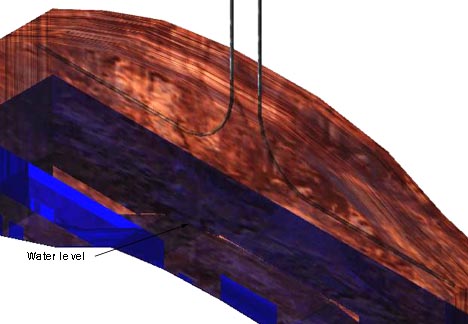 ,
,
as I tried to explain in the first Abqaiq post . The oil from those wells does not contain any water from the water floods, and thus I have called it "dry", while the water in the area where the wells go down into the water flood will also bring out some water (the water cut). Thus these are "wet" and it is by mixing the two that they are trying to stabilize their water cut at 42%.
Hi, HO. Here's hoping you're doing well.
I've got a source, a very prominent petroleum engineer (now retired), who kindly reviewed the SPE paper Stuart found and that you reference. I'm not ready to release the details — indeed, I don't have them all yet — but the upshot of his reading about North 'Ain Dar is this — what's all the fuss about? He expressed some surprise that SPE had even bothered to publish the paper since, I assume, he found little of interest in it.
I'll be publishing on this when I have all the data & interpretations I need. However, I myself was pretty convinced by the paper, especially the graphs showing how waterlogged the field was becoming. But, then I thought to run it by some people who know what they're talking about. So, mea culpa.
I think this should serve as a general warning to people here at The Oil Drum who have been especially eager to jump to conclusions about Saudi production, or have come up with some strange interpretations of the public record (what there is of it). This strikes me as grasping at straws.
It is hard to live with uncertainty. There's a lot we don't know about Saudi production. We all want to come to a conclusion. But sometimes, we can't.
best,
Dave
I can't comment on the expertise exhibited in these articles.
However, I do believe that it is likely that KSA will have to demonstrate some of that reserve production capacity this summer...so I guess we will have something to discuss as a group then. Perhaps with a little more certainity, one way or another.
Hi, Dave, glad to see you here!
My take on the paper were that it had three points of interest, the first of which was that they weren't using the rigless water shut-off (WSO) more frequently (this is where they seal the bottom part of a well that goes down vertically into the partially flooded zone where the water flood has reached, so as to reduce the water make in the well).
The second was that they had not started to use MRC in North Ain Dar yet - though they have started putting in the wells, and bearing in mind that the paper was written a while ago. Interestingly they had also put in the control valves on the laterals, so that they could control extraction as the water came nearer the well horizon.
The third was that (and this was partly why I made the calculation) it seems to suggest that in 15 years the field will be over.
There were some technical points also that were interesting - vide the success rate of the WSO, and the fact that they have been using more conventional horizontal wells (of the type I just illustrated) to revive some of the "dead" wells.
Dave,
I don't mean to quibble but your post says absolutely nothing about why Stuart's interpretation of the Saudi information is wrong. All you've done is cast an unspecific aspersion without any data other than an unnamed source with unnamed conclusions. In the computer world this is called "FUD" (fear, Uncertainty and Doubt) and is deeply, deeply frowned upon.
I'm sure you have interesting information on hand but please refrain from posting until you are willing to share.
Thanks,
Gary
I have things to do, and won't be hanging around here today. But, I said
And I will do this, so stay tuned. I'm sorry if you think my giving everyone "a taste" of what's forthcoming is inappropriate.By the way, just who is spreading "Fear, Uncertainty and Doubt" about Saudi Arabia's oil production? It isn't me. You might examine your own confusion around this point.
Dave: if you can get experienced people with no conflict of interest to discuss the issue in detail publicly, that will be valuable.
Did you get an email about demand/supply?
Subject: Saudi Oil Production
Even if there is a conflict of interest, but it is open and declared, then I'll be very interested.
But I do agree that it does little good to use an anonymous source to cast doubt on Stuart's and Euan's work. It's no answer to say that Stuart et al are doing the same: they laid out their case -- whether one finds it conclusive or not is a separate issue.
I'll send you some mail.
"I don't mean to quibble but your post says absolutely nothing about why Stuart's interpretation of the Saudi information is wrong. All you've done is cast an unspecific aspersion without any data other than an unnamed source with unnamed conclusions."
Dave does this all the time, and what he does produce in the end tends to be questionable and biased, doesn't actually address the issue or remains ambiguous.
I guess we should just all trust the professionals in the oil industry to keep production rising and prices stable, huh? I'm sure they all know what they're doing and we'd never see any problems with our energy supply. Oh, wait...
Stuart-
I am looking through your "nosedive" topic to see how much net oil you are missing with the additive effects of the new projects.
I think the after breakthrough cut in Ain Dar/ Shedgum should be about 90% water... so you should be missing 1.7 MMBOPD less the new oil on the SA total curve.
Production in Ain Dar/Shedgum is now 300,000 BOPD and 2.7 MMBWPD... from 2 MMBOPD and 1 MMBWPD in 2003 if the water has risen to the top of the crest. Until someone shows me different, I find it hard to see any other way.
No doubt confirmed by the announced export cuts.
If it helps I did a bit of digging into oil consumption in the KSA it looks to me like the numbers could easily be low.
By about 200-500kbd.
I sent the info to WT. So if your seeing say 2GB of oil missing it could have well gone into internal consumption.
I could find nothing that would justify the low average oil consumption for KSA compared to Kuwait for example.
The US is at like 0.08mbpd per million
And Kuwait is at 0.12mbpd per million
If you plugin 0.10 per million for KSA you come up with 2.4 mbpd.
The above is the historical flood front velocity in North Ain Dar.. it appears to be moving at 4.6 ft/day.
This cannot be the rate of vertical movement (the field would have watered out in 250 days) .... so it must be the horizontal movement towards the crest (or approximately east and west on both sides of the North South structure).
What we seek is the vertical movement associated with this horizontal movement. This is related to the dip angle of the structure. It appears from the Greg Croft structure that the dip angle of North Ain Dar is about 3 degrees, I have a reference which says it is 5 degrees.
But 3 degrees is the most conservative, and at this angle, things happen vertically at 1/20th the rate of the horizontal, at 5 degrees, it is 1/11th .
Now, it appears that we have a cut-off date of 1/1/04, so it has been about 1185 days since the cross sections of the water level in that reservoir were effective.
At a horizontal rate of 4.6 ft/day over 1185 days, what water front has converged a distance of 5450' on both sides towards the crest of that structure.
So, the water level has moved up 237 feet since that cross section in the paper was published.
I think the Western cross shows a water level on 1/1/04 of -5,900', based on a vertical scale off of the 1940 picture with the original water oil contact.
Now if I'm correct, the current water front is -5,900 + 237 = -5,663'. If you or your friend look at the Greg Croft structure, how much of that reservoir is left water-free??
Note that through the saddles between North Ain Dar, South Ain Dar, and Shedgum, all areas spill into each other and we would expect gravity equilibration. So the water level is likely consistent between all three. Now if we have 2 MMBOPD which is going to no water free (dry oil) area, could that not result in some production problems??
Look at the wet area % contribution graph and the oil production water cut curve for North Ain Dar. Note that if you factor out the increasing dry area contribution and take into account the 100,000 BOPD loss in production for the area, the true water cut in the wet area is 65%... despite all the horizontal schmontel WSO umbrella plug BS the prior historical trend in water cut behavior continued unabated.
You went from 42% water and 90%+ wet area in late 98 at 600,000 BOPD to 42% water 65% wet area at 500 KBOPD at 1/1/04. Do the algebra, the wet area is 65% water and plot it on Figure 1 of that paper.
And over the course of the last 3.33 years since that paper was written, the water cut in the wet area on the same trend has risen to 80.30%.
NC did a good translation for the mathematically challenged, confirmed by FF last time they talked about this:
NC on March 27, 2007 - 11:10pm | Permalink | Subthread
Fractional_Flow,
Wonderful set of information you have been posting the last few days. I have been struggling to keep up with the math posted. At the risk of sounding very stupid on this forum I will try and paint a picture of what I understand is happening in Gharwar. Helps me consolodate information and maybe it will help others.
I think 3-dimensionally and it seemed obvious to me after your's and Stuart's posts that what has happenning in Gharwar is that the water was "crowding" the oil into the top of the reservoir. The shape is a very gentle curved, elogated dome, think of just the top surface (with a bit of down curving sides) of a very large diameter pipe lying on the ground. The side go down a distance say 10-20 times the thickness of the wall. With this model only the thickness of the pipe wall contains oil.
The thickness of this wall (oil) region is very thin from outside to inside, but very thick when viewed in tangential section where a horizontal straight line would enter from the outside pass just above the inner surface and pass out the opposite side. By using water injection oil in the pipewall below this horizontal line can be "crowded" upwards from both sides where it is removed at the top.
By using horizontal wells placed at very strategic locations along the long axis of the pipe shaped field oil a constant flow of oil output can be maintained as long as the pressure is maintained and the water is below the level of the horizontal well. The Saudis can maintain essentially constant BPD from the field by capturing almost all the oil dispaced upwards by the water.
There will be mixing of oil and water near the contact point but if the rock is porous enough (and the water is injected at the bottom) most of this mixing will initially be well below the horizontal wells. Very little water/oil mixing will occur at the horizontal wells because they are reltively far away from the water front, hundreds of vertical feet and also "around the bend" of the curved wall.
All is fine until the water layer gets up into the flat, top part, of the imaginary pipe wall. At that point the water can race across the wide flat part of the pipe wall (top of the reservoir) and mix with the oil column which may be miles wide but only a few hundred feet thick. Again the Saudi's can work around this a bit by finding the high spots (after all it is not a smooth surface like our pipe wall) above the general top of the reservoir and lay in a bunch of horizontals to maintain extraction rates.
In this manner the oil is continually pushed (for decades) from the lowest part of the reservoir to the top with very little water mixed in at the well location. A very constant, high rate of extraction can be maintained that is all out of proportion to the amount of oil remaining compared to most reservoirs. This is due to the combination of horizontal wells, porosity and the unique shape of the reservoir.
The problem comes when the water finally gets to those last series of top level horizontal wells. By the time you get significant water mixed with the oil, the water % is going to increase very quickly. In my simplistic model and understanding there isn't really much oil left. It's all water below the mixed zone and that mix zone is now restricted to the very top of the reservoir.
If my overly simplistic model is even close to accurate you can't pump water in for another 30 years and get significant oil out like in Texas. All you are going to get is water, because the oil was washed out of the lower rock strata years ago.
All comments, clarifications and even hoots of derision (at my lack of understanding) are welcomed because Id like to be completely wrong so I can sleep at night.
Parent | Parent subthread | Reply | Start new thread
Fractional_Flow on March 28, 2007 - 7:39am | Permalink | Subthread
No your physical description is just about right.
The high rate of extraction up until the last possible moment is quite a reality of this type of geometry (I believe West Texas has shared some such experience).
We need someone with advanced imaged analysis capabilities to tell us everything there is to extract from the Ain Dar cross sections in that SPE paper.
Dave-
Tell your retired petroleum engineer that the impact of that paper is that if what I did above is correct or close to correct .... then 2 MMBOPD-- is essentially gone.
And I didn't correct it for contracting geometry- Stuart (and others) will know what I mean.
But I am looking for an error somewhere- it just cannot be.
"But I am looking for an error somewhere- it just cannot be."
Oh, yes it can. More important(as if this isn't bad enough news), how many other fields have used the same technology for how long? How many others are on the verge of collapse?
Thats in a sense what I'm asking in my other posts. I think I lack a perspective on Ghawar vs other fields.
This brings to mind another question; What if world crude oil production were down to 50 mb/d by 2010? What if we discovered we have just stepped off the cliff and are currently in in the freefall of a World Crude Oil Production Crash?
Cid,
This is extreemly sobering.
I'm reasonably certain that I followed how FF came to the conclusions he has. This only makes it worse. I read this mid-day and it literally sent a chill down my spine. I reread it tonight and I find that I didn't get my understanding wrong. I guess we really should be have been expecting this kind of post at some point from someone very knowledgeable, pragmatic, detailed, and willing to get the word out. I do notice a lack of credible or for that matter uncredible rebuttals to FF, this adds greatly to my fear. You can follow along, and know he is right. It has that ring of truth to it and it makes sense, friggin' deeply disturbing and unfortunate sense. I have been following this for over a year now, I think new readers are going to get a bigger shock to this kind of post. This is not good stuff.
FF's post would make sense and explain KSA's coolness toward the Bush Admin., that the US is pushing KSA and KSA is saying repeatedly that there is nothing they can do and are getting tired of being pushed to do what isn't possible. We are in the end game now.
Bush and Cheney cannot be ignorant or stupid on the topic of PO. Thier idea of handling this with the Iraq invasion will probably be looked back historically as the last nails in the coffin. I wonder if they had a chance for painful mitigation given the euphoric state of current lifestyles. I don't see people willingly powering down, and that is what's required. The people won't vote for it, and you won't get campaign contributions if ELP is your platform. Maybe later but not now and not for the last 30 years.
We live in temporary, unsustainable, high technological times, yet we haven't physically evolved into anything superior to what our most recient ancestors were. We are more advanced, better educated, have a greater understanding of many things but are still the same as they were. It's too bad I liked the startrek/starwars idea of some day long distance space travel. I see that it will never ever happen and I think that is very sad but also very fortunate for the rest of our solar system.
There was an article in Natl' Geo. about Disney in florida and how horrible the sprawl is down there. They had a comment from a dade co. commisioner "Just because we have destroyed 90% of everything doen't mean that we can't do something wonderful with the remaining 10%". We have trashed our planet. You hear people talk of limited nuclear war as if this is a solution to something. They want to mark nuclear waste sites with some sort of warning that will be able to be understood 25,000 years from now. This is the very best we are able to do collectively as a species - it doesn't really say much. "Here is the posionous leftovers from our "advanced" civilization" Oh BTW sorry we fucked up the place.
Watching how people work in groups makes the whole PO problem so very understandable. How our politicians are elected and the special interest money needed to run a campaign and the favors owed to people and companies that do not have the well being of the greater population at heart. and for what? Money for more plastic crap we don't need? More security? A way to look down thier noses at others? We are still so very primitive...
HO and FF - a heart felt thank you! Looks like we had better get prepared, this can only get tough, and alot sooner than I had hoped for.
Best of luck to you guys.
D
Thats me I assure I don't agree with the concept. But in playing devils advocate to explore the position I did not see that it was unreasonable for people to take this option.
I certainly don't agree with it in any shape or form.
Hi m,
re: "...playing devil's advocate...I did not see it was unreasonable..."
I had an exchange (began w. my reply to bunyon) w. Cid, which may also apply to what you say here. If you get a chance to read it, I'd appreciate it. http://www.theoildrum.com/node/2375#comment-169763. (and if you could also read down to my next reply. Thanks.)
Darn. I just wrote a response and lost it all and don't have time to re-do it.
Bottom line? You can't reason with this type of testosterone driven male thinking because it has NOTHING to do with reason. It IS a "failure of imagination and heart" as you so eloquently put it, but you will never be able to make them see that side. In simpler terms, it's that Alpha Male Syndrome and it dooms mankind (like the Chimp said). When was the last time we elected a nerd? As far as I can tell, every male politician is an Alpha Male. Our leaders are Alpha Males to the extreme and the solutions they choose will undoubtedly be very bad.
Cheryl
George Bush an Alpha Male? HA HA HA HA HA HA HA HA(falling to the floor)HA HA HA HA HA HA HA HA... ROTFLMAO
How about Nancy Pelosi for Alpha Female?
Thanks, Cheryl,
There is something to the idea that people approach things differently, and men and women often seem to.
In my post, I intended to discuss the ideas of reason and logic in relation to the argument (I mean "argument" in the sense of rhetoric - or a justification.)
I may not have said it as well as I could have. There's an inherent problem with the argument itself. (IMHO). Though it's quite good to take a look from "inside" what appears to be an unreasonable stance, in order to understand it, my
point was simply that the logic doesn't hold, as far as I can see. There's a kind of insularity to it.
It's difficult to talk about things like this, especially when we have a format where we tend to drop things after a day or two and it's hard to "finish" a conversation.
I was asking (and would still be interested) to see if the argument I presented was at least laid out well. Did Cid agree it represented his view?
Would memmel agree it is a fair re-statement of what he was looking at as "Devil's Advocate"? In other words, does the argument, just to begin with...represent the "Devil's" position, as memmel sees it?
I'm a little confused about whether memmel is/was referring to:
1) using nuclear weapons (and we may as well include conventional weapons) as "trade items" or
2) about the idea of reducing the population (or some part of it) in this way.
3) (Or both.)
In terms of the trade concept, Chalmers Johnson has written at length about this, as have others. If I may quote Johnson from memory "The US is the only empire in the history of the world to arm its colonies."
I believe memmel had another reply to his concern as well.
On the practical side, I wanted to encourage people to get in touch with some of the people who now work (actively) to prevent nuclear war. This might be a good "peak oil outreach" action item, if one is interested in some positive "networking". (www.idds.org, www.fas.org, www.cdi.org).
Memmel, I understand. There are those who view this an an option. After 9/11 there was some lady being interviewed on her way to work that wanted to use "small" nuclear weapons to get Ossama. "one or two" - " we have some don't we? small ones?" ( if I remember correctly this was the jist of what she said)
I think because of Japan and WWII there is a sense of limited use and survivability in many folks minds. I just think it would get completely out of hand.
By all means, throw in a little "X" chromosome for a slightly gentler touch and let's make it just "one or two, we have some don't we, SMALL ones?" as opposed to the Alpha Males who would choose to "juse a BIG one and just wipe them all off the face of the planet forever. Problem SOLVED." I can pretty much guarantee that the woman didn't come up with this on her own--she has been listening to the men around her, but she softened it with "small ones," which is what she has--no "female cajones" of her own (and trust me, they do exist).
No matter how advanced "civilization" becomes, humans seem unable to control, or even comprehend, their limbic instincts, which is why I'm not optimistic about the future.
Has anyone seen production figures for Burgan since the 1.7 mb/d stated in Nov 2005?
"I'm reasonably certain that I followed how FF came to the conclusions he has. This only makes it worse. I read this mid-day and it literally sent a chill down my spine."
It is interesting that as we followed it, we were able to see the conclusion it was leading to well before FF was willing to state it. That just shows he tried very hard to prove himself wrong and still didn't want to say it when he could find no where else to go.
"...he tried very hard to prove himself wrong..."
Yes, and it makes it all the more sobering. You can understand and see that he doesn't like his conclusions and would welcome someone to point out some error. I would like that as well. I just don't see it happening. Deep down you know that oil is finite and other places around the world are in undeniable decline so we are just getting another one. So, I sit here at my dinning room table wanting...what? The truth? I think I have it. The implications of PO are so staggering. I don't know what I feel, dread, remorse, defeat, foresight, understanding, motivation? People are going to be numbed by the multi-front way this hits.
Petroleum Economist (can't be sure of accuracy), was quoting 1.5 Mb/d figure in Sept 2006 for Burgan and claimed "Burgan field is maturing fast."
Yep, there she goes! Cantarell slips under the waves.
Cantarell´s daily production in February was 1.567 million barrels, an 18 percent drop from 1.912 million barrels in February 2006 and a 1.5 percent slide from 1.591 million barrels in January, according to the Energy Secretariat´s web site.
That isn't far off their projected 14% decline per year... not a good thought either way though, is it?
"You can never solve a problem on the level on which it was created."
Albert Einstein
I ran -18% for 6 years. Came up with .476 million barrels in 2013. A drop of over 2/3.
Was this part of their OPEC cut or a genuine production drop due to lack of drilling initiative or terminal depletion curve?
There is no question that Cantarell is in terminal decline. It is freely admitted.
Mexico is not an OPEC member.
My [mis-?] understanding is that it will very suddenly go to ZERO. Is this correct?
James Gervais
Near enough.
FF,
I have tried to follow you argument by referring to SPE paper 93439 and the Greg Croft Ghawar structure map.
You are the expert so I will have to assume you are right on the 5% vertical/horizontal water movement ratio - is there any equation etc you can point us to that substantiates this?
You refer to the "Western cross" - assume this is Figure 9(a) in SPE 93439?
The Greg Croft Ghawar structure map shows the high contour in northern 'Ain Dar at -5750 feet. You suggest the current water front is -5,663 feet. In other words, the water front is at the top of the structure....
The saddle area between north and south 'Ain Dar and Shedgum lies at -6250 feet, so asssuming homogenous porosity, all these areas must must have water at the top of the reservoir.
Is Figure 10 the "wet area contribution graph" you refer to? And the "oil production water cut curve " Figure 1?
What I don't understand is your statement "if you factor out the increasing dry area contribution and take into account the 100,000 BOPD loss in production for the area, the true water cut in the wet area is 65%" Can you explain how you got to that?
Also, Figure 2 of the SPE [paper appears to show a steady water cut of about 80% since 1999. I am not sure what the Y axis "Mstb/Day" is (guessing '000 barrels/day), but it shows approx 400 units of water production to 80 units of oil production per day.
According to the fractional flow curve you gave us for 'Ain Dar / Shedgum, this would represent about 58% water saturation...
I can undersrtand very clearly what point you are driving at, but I cannot follow your methodology in getting there... some elaboration would be very much appreciated.
I think we are taking a lot of what FF says as gospel truth, and it may be, but I also believe we need our "experts" to verify that they agree with FF or have some other form of confirmation here.
After all, this is pretty important information.
Look around you on this post and the previous posts. The data is all here. The math is all here. Each step has been presented and subject to "The Oil Drum" peer review. Stuart has weighed in throughout, Bunyonhead today. What 'experts' are you looking for? This doesn't have anything to do with HL or predictive modeling so Robert probably sees this as outside his domain. Prof. Goose usually sits on the sidelines and watches from his rocking chair, making a seperate post if the spirit moves him. Khebab and Engineer-Poet are probably defering to the obvious expertise already demonstrated here and would weigh in if they felt the need. No one is accepting this on faith. The case has been made. FF doesn't like the conclusion and would be more than thrilled to have someone prove the argument wrong. Both Stuart and Bunyonhead through their own analysis have supported the conclusions. Unless you are looking for a sign from heaven, you have what confirmation is available. Also, you have the fact that no one has come forward to show a flaw in the argument. We are waiting. Prove them wrong by addressing the argument directly, not by insinuation. Otherwise we already have the 'best available information'.
I guess my it is just such a hard pill to swallow when the reality of crude/gasoline prices are not showing many signs of impending spikes, US inventory data not showing horrific drops, and business as usual continuing here in the US.
I know there are signs of demand destruction in third world countries, but almost no signs here. I believe all our experts, but from the looks of what FF is saying...it is going to almost be one day, everything looks fine, and the next, news of shortages.
I guess what I'm saying above is...is there any reason for doubt in FF's data? If not, if we have all come to the conclusion that it's sound, then I think the near-term POers are correct.
Cid Yama...I just read all the comments further down this thread...I take it all back...FF is correct...and we are all fucked!!
Yikes.
It really does suck doesn't it. All I wanted to do is sit in front of my computer warm and fed for the rest of my life. My house has been paid for for years. I work at a job less than 4 miles away where I come and go as I please. Can work 2 hrs or 10 it doesn't really matter, my choice. I have the perfect life and now it's screwed.
Euan is back now and catching up and may post a dissent. Also there is a prospect of getting more meaningful input from the mysterious expert Dave Cohen referred to yesterday.
So there is still some hope that someone will show us the errors in our reasoning...
If our "hope that someone will show us the errors in our reasoning" is dependent on us getting "more meaningful input" from Euan or Dave, then we are screwed.
I've never wanted to be wrong about something as much as I've wanted to be wrong about all this.
Yeah, me too. Rather than be right, I'd much prefer to feel like an idiot in a world in which North Ghawar was not watering out while the Saudi's scrambled to cover up the fact
FWIW, I've been over the discussion between FF and Bunyonhead here in detail this evening. I kind of generally agree, with a couple of caveats:
Stuart-
You need to read about the "average water saturation at breakthrough" and the water cut at breakthrough.
You can throw the fractional flow curve away. The outlet end is either pre-breakthrough (100% oil)or post breakthrough (90% + water). Breakthrough trumps all.
And breakthrough or not breakthrough is the point of this whole discussion.
Ok, but if "post-breakthrough" meant 90% water cut, then in 2004, the wet area would have been producing 90% water cut, right? And that would imply, since 65% of the water production was from behind the flood front, that overall water cut would be 90%*65% = 58.5%. But it was 42%. So I don't see how the numbers can add up like this. (But feel free to point out how I'm looking at it wrong).
Stuart-
The "wet area" includes the well that has 1' producing 90% water and 203' producing 100% oil. The water is moving in from bottom to top in every practical way imaginable.
The only well(s) in the dry area produce 100% oil, no water.
Until you grasp the above you will not understand what a dramatic event the fillup of this reservoir is.
FF
Bunyon
Either the sine or tangent of 3 degrees gives the 1 to 20 ratio.
If the 4.6 ft/day is measured along the bedding plane use the sine, if it is referenced to true horizontal, it is the tangent. We have no way to know the reference dimension.
Note that I knocked nearly 50' of the true calculation- that is how bad I want this to not be.
You took the effort to look at the Greg Croft structure and verify what I said. You are to be commended. Now try to verify that Western Cross (figure 9a) position. The original water oil contact is -6450' ss. I have a 1951 study that has an excellent map of the WOC. Compare the thickness of the reservoir at the crest to the height above the Original WOC to determine what reservoir elevation you are viewing. Try to scale it vertically. I bet this is done 1,000 times in the next month by various people- you might as well do it now. It was the topic of my first post almost 2 weeks ago.
The reservoir appears to be thickening at the crest. It would be nice for someone to measure the thickness along the vertical grid lines and distribute it around the average of 204'.
The field was producing at 90%+ from the wet area in late 98 at a 42% water cut (it is the right scale). At 1/1/04 it produces 65% from the wet area at a 42% water cut. Aramco touts their water cut management skills but the governing equation is
Total Watercut= Wet Area % * Wet Area WC + Dry Area % * Dry Area WC
Since the Dry area WC= 0 by definition the equation becomes
Total Watercut = Wet Area % * Wet Area WC
So Aramco has controlled the total watercut by lowering the wet area %, pulling harder or drilling more wells in the dry area.
When they do this, they are sacrificing ultimate recovery to meet market demand.
ok....
I measure the total height of the cross section at about 760'
The top of the 1940 100% water saturation is approx 205' above the lowest point. I assume that is the original OWC?
Greg Croft has original OWC for 'Ain Dar at between -6430' and -6665'. Since we are discussing northern 'Ain Dar I assume we must be at the deeper end for the original OWC (ie closer to -6665' than -6430').
Moving along.... if I am correct in assuming that the 1940 OWC is the point where the dark blue (100% Sw) ends, I measure the distance from there to the top of the formation as about 555'.
This gives the top of the structure a depth of between -6110' and -5875'. Taking your original OWC of -6450', we get to -5895'. How do you know that original OWC for this cross-section is -6450'?
Looking at the Greg Croft Ghawar contour map, I think we are looking at a cross section somewhere around the northern tip of the -6000' contour.
As to reservoir thickening at the crest, I think this may be a trick on the eye caused by colour differences. It might be 5' thicker than at the bottom, certainly not much more.
You commented that "The field was producing at 90%+ from the wet area in late 98 at a 42% water cut (it is the right scale). At 1/1/04 it produces 65% from the wet area at a 42% water cut" Taking your equation TWc = WA% x WAWC%, we see that wet area water cut must have been 65% at 1/1/04, implying Sw at about 55%.
Taking your view of OWC at -5900' on 01/01/04 (my view betweeen -6110' and -5875') and your calculaton of vertical water movement of 237' to the preset day, you now get to OWC of -5663' (my range -5873' to -5638').
On your prognostic, there is no dry oil left in 'Ain Dar and Shedgum. By my guess, there may be 3 areas around the -5750' contours where there is still dry oil left in these fields. There is also potentially a very large area where the 'Ain Dar, Shedgum and Uthmaniyah fields converge around the -5750' contour that might still be dry. I guess this area at about 50 square miles.... but I have no idea whether that area is oil-bearing or not....
So, possibly the situation is not as dire as you initially thought, or, more likely, I have made a huge and obvious error somewhere.
Either way, you are right in your assertion that they have controlled the water cut by increasing the take from in front of the waterflood.
Great work.
Your analysis of the xsection confirms mine
Water oil contact data from Arab American Oil Study
Looking at the West Side Gradient, it may be down to -6,500' or so where they are at.
The huge transition is west to east and working the East Xsection now will reveal that. Are they in the same place?? Perhaps.
Note that 237' is 50' low for a 3 degree dip. That is my conservative factor. I believe the "large area" you refer to is a depression... Look at the 3d image Stewart had of the permeability field.
Thanks
FF
Absolutely right that the "large area" is a dip, contour is -6250' - what an idiot I am
Bunyon-
Don't be too hard on yourself.
If you had to run 4,600' on a 3 degree upslope... what would your final elevation be in reference to your starting elevation???
How would you figure it??
FF
About 240'? Using sine of 3 degrees=a/4600?
Just trying to brush up on my incredibly ancient trig class...
High school maths: 5.2336% of the horizontal distance travelled, ie 241'rise if the horizontal distance was 4600'
Looking at that I would SWAG original OWC at-6500', which would put it at -5945' on 01/01/04.
Using 237' since then, we get to -5708' (or -5658' with the extra 50')... so on that basis there would be very little, if any, dry oil left in AD/S.
One other point I noted. The flood front velocity appears to be decelerating substantially from 2002. Extrapolation of the linear "trend" from the last two points suggests velocity may have dropped to below 2 by now. Is this possible?
If the average velocity had dropped to 2.5 or less since 2004, this would imply a water level rise of almost 100' less than we have been discussing. Clearly flood front velocty from 2004 to present day is a very key part of the equation here.
Bunyon-
Excellent.
Work the East cross section- there is a lot less variation in the OWC data there. It appears solid.
What are the physics that would make that velocity drop... you are astute..
Certainly pulling harder on the dry oil area would have the inverse effect....
Look at the large crestal structure at Shedgum... Could that water be starting to spread across the base of that large crest during 2004, increasing the flow area and reducing the velocity.
Note the influx area (lengthwise) is always contracting as you move towards the crest of the dome.
But if the zone is thickening up at the crest, then the flux area is expanding in that dimension.
We await Aramco's update anxiously.
Why are they going to add 3 million barrel of injected water per day to this area???
FF
Eastern cross section: guessing original OWC -6650', height of structure 980'
Distance from Original OWC to top of structure - 530'
Crest therefore at approx -6120' and western edge of structure about 70' deeper at -6190'
I think this cross section is about 1.5 miles due north of the western cross section, which gives me a headache to understand why the 2004 section doesn't show a higher water saturation at the crest and west of the crest.
Probably made a mistake somewhere
Looks like the structure thickness may vary by 15 to 20'
Bunyon-
As you probably know...
the vertical exags on the 2 sections are different.... You relate the thickness of the pay at an average of 204 to the distance to the WOC. You cannot use the reference scale on one for the other.
But I believe the 2 sections are in the same place... as the water level in reference to the thickness/crest are identical... so perhaps an average of the 2 are the best we can do.
Note, however, if the interval thickness averages 204 but varies from 180 to 230 or some such things your error will be multiplied by nearly 3.
So it is difficult as hell to know for sure.
This is the ballgame... are we in the bottom of the ninth or the seventh inning stretch???
The production performance for the country, the increase in rigs, the announcement to increase water into these old areas, the acceleration of project timetables, the non-existent "heavy" oil cuts... that brought me out with this stuff after over a year.
FF
I have no idea what would make the velocity drop, physics not being my strong point....
Pure guesswork here: The 'Ain Dar crests are quite "pointed" due to the tight contours. My thought is that the horizontal flow has to slow and the vertical velocity increase assuming a constant rate of water injection.
For Shedgum with its more rounded crest I would think a similar process would occur but at a much lower rate of change.
As I said, this is pure guesswork on my part, and I am probably barking up entirely the wrong tree.
If I am right, it's a scary thought....
Think about filling a vessel with a narrow top with water. It accelerates towards the top as the volume to fill/level is less. Common sense. How could you be wrong?
N. Ghawar becoming all wet? This is what I think I read. Saw one color coded cross section a few days ago of the north end and a thin film of oil near the top becoming mixed with water. Am guessing the two anticlines have relatively flat crests and a saddle syncline in the middle. Cannot see if water injection in southern Ghawar might flow to the north or visa versa. Where there any lateral impervious zones to compartamentalize the reservoirs?
FF said:
Note that through the saddles between North Ain Dar, South Ain Dar, and Shedgum, all areas spill into each other and we would expect gravity equilibration. So the water level is likely consistent between all three.
Bunyonhead said:
The saddle area between north and south 'Ain Dar and Shedgum lies at -6250 feet, so asssuming homogenous porosity, all these areas must must have water at the top of the reservoir.
Based on measurements on the blue lines in this blowup of the Greg Croft contour map:
I make the angle on the west side as 4.4o, and on the east side as 2.3o. There would be slight variations at points north or south of here.
Indeed, what is the fuss all about. After all the Saudis have admitted that all their existing fields are declining by from 5% to 12% per year. The Saudis admitted, three years and three months ago that Ghawar was 48% depleted and that Ain Dar/Shedgum was 60% depleted. Do the math and that puts Ghawar way over the peak today and Ain Dar/Shedgum deep into the geriatic stage.
And realizing the Saudi predilection for painting everything in the very best possible light, I think we can safely assume that Ain Dar/Shedgum and the rest of Ghawar are in far worse shape than they were forced to admit. And if their depletion rate of existing fields are any worse than they admit, heaven help their poor souls.
So what's the fuss all about. The Saudi's are admitting things are are looking bad. However they believe that as soon as they tap into a bit more of those 260 billion barrels of proven reserves everything will be okeydokey. Of course they must locate them first. ;-)
Ron Patterson
URL, page 21, where Saudi admits to Ain Dar/Shedgum and Ghawar depletion status.
http://www.saudiaramco.com/sa/webServer/general/Presentation_Fifty_Year_...
URL where Saudi admits that all existing fields sustain a 5% to 12% depletion rate.
http://www.eia.doe.gov/emeu/cabs/saudi.html
One thing I don't quite understand is it seems other fields in other regions work just fine at very high water cuts 90% or higher a lot of the Russian fields for example and the US. Is it simply the shear volume of water that needs to be processed thats a big issue ? Or is it the nature of the field.
The field will work fine. The field doesn't just go zap, dead, gone. The problem is in the total volume of oil produced daily. Check out the old East Texas field for an extreme example. It still produces oil to this day despite its heyday being decades in the past and a 99+% watercut. But how much does it produce compared to before?
This is the overriding problem of peak oil - how much oil is available? We can produce oil from most of these fields for a century or more but not at millions of barrels per day. This is why so many people talk about flow rates when discussing peak oil. If our civilization needs 120 mbpd and we can produce only 50 mbpd, something has to give, doesn't it?
Ghawar Is Dying
The greatest shortcoming of the human race is our inability to understand the exponential function. - Dr. Albert Bartlett
I guess I should clarify. Other large land oil fields seem to decline gracefully while from what I read about Ghawar and KSA oil fields in general seems to indicate that they maximize production. I guess its the way they do water injection ?
It just seems that produce their fields somewhat differently from the way it was done both in Texas and Russia from what I can tell in reading. And it seems the way they produce allows the production rate to remain high till the bitter end.
No one with expertise in oil production has really talked about the pros and cons of how the large fields are produced.
For example KSA claims that they are very conservative in th e way they produce but outside of rotating wells they seem to me at least to be optimizing for maximum production rate for the longest period of time. Or maybe better a high constant rate of production. Maybe this is because of being a swing producer ?
I feel like I'm missing some of the big picture that discusses the history of the giant oil fields and how they where produced and most important why.
The sense that I'm getting is that they are conservative in the sense of producing in such a way that they minimize damage to the fields, and maximize the total lifetime production.
That seems to be compatible with production that produces relatively high production (though not maximum possible production) for a sustained time until water nears the top of the oil reservoir, and relatively steep decline of production after that.
Texas was produced in the olden days, when vertical wells went first. When they went dry, the fields were usually abandoned by majors, some are now being taken over by minors who are, for the first time, using water flood for secondary production. SA, on the other hand, is being developed with high tech that often brings in water flood from the very first day, then, later, when the oil column becomes fairly thin, say under 200ft thick, the begin to go to horizontals. These wells are great at allowing you to get the last bits from thin or thinning layers - this technique is being used in the us for new regions with very thin pay, as little as three feet; however, when the horizontal waters out, the field is dead... there is no secondary to resort to because secondary production was produced along with primary. All retrievable oil has been replaced with water... it is now past time to find a new field.
So WT is wrong in comparing Texas production to KSA...it's not a valid comparison at all. KSA is unique in that they have kept production high and skewed the curve to the right...KSA is trying to sell that the back end of the curve will mirror the front side. Instead, the back side has a much steeper negative slope...that's my guess anyway.
Not wrong but overoptimistic. And his results are alarmingly low to begin with. Its been recognized that HL should come in high on the backside of the peak depending on how the field is developed.
As far as I know almost all our methods come in with high predictions esp post peak.
But in this case you can just use actual production numbers.
Unless some miracle happens that disprove the models we are basically past the point of using models except perhaps WT export land model. Now if KSA does manage to sustain production rates over 9 mbd for three or more months we will need to re-evaluate the situation.
"Now if KSA does manage to sustain production rates over 9 mbd"
Dang, memmel, your're practically a cornicopian.(Sorry, don't hurt me.):)
I kept thinking that technology would make a difference in the models(texas vs. KSA). Here it is "overoptimistic"!
Texas is the best case for KSA. All the other options go downhill from there.
Ghawar Is Dying
The greatest shortcoming of the human race is our inability to understand the exponential function. - Dr. Albert Bartlett
Stuart said this in "Water in the Tank":
In a set of interconnected pores through which oil and water are being forced at pressure, the flow is too turbulent for large areas of the two fluids to separate out from one another. And yet, oil and water do not like to mix, and will tend to bead up in the presence of the other. If there is only a little water and a lot of oil, then the oil will form an interconnected network of fluid throughout the rock pores, whereas the water will tend to make small beads within the oil. Conversely, a little oil in a lot of water will result in a network of water throughout the rock, and small beads of oil within that network. Now, in either situation, the fluid that is interconnected can flow through the rock without making any change in the arrangement of beads and surfaces between oil and water. However, the fluid that is beaded up can only move by the beads physically moving around, and they are going to tend to get trapped by the rock pores.
So for this reason, in a mixture of almost all oil, the water cannot flow at all. Conversely, once there is almost all water, the oil cannot flow at all (which sets an upper limit on the amount of oil that can ever be recovered by a water flood). In between, there is a changeover in which the proportion of oil flowing to water flowing changes much more rapidly than the changeover of the actual mixing ratio. The curve that describes this is called the fractional flow curve.
For example, the tutorial I referenced earlier shows this picture for a typical fractional flow curve:
http://www.theoildrum.com/files/typical_ff_curve.jpg
So the way to read this is that when we are below 20% on the X-axis (less than 20% water in the oil), there is zero on the y-axis (the water will not flow through the rock at all). As we get above 20% water saturation, the flow of water increases rapidly, until above 80% water, there is no flow of oil at all. In the linear region at the center of the curve, the slope is about 3.6. That is, each 1 percentage point increase in water saturation results in a 3.6 percentage point increase in water flow in the rock.
Now, we do not have quantitative fractional flow curves for 'Ain Dar and Shedgum at the moment. However, we know one point on the curve for 'Ain Dar from Alhuthali et al (Paper #93439), which reports on measurements of rock right next to an abandoned water injector well. The pores of that rock had 21% oil, 79% water. Rock next to a water injection well is bound to contain only that oil which is never going to move under any further waterflooding, and so tells us that the fractional flow curve must reach the top of the graph (y-axis of 100%) when the x-axis is at 79% water saturation.
So the way to read this is that when we are below 20% on the X-axis (less than 20% water in the oil), there is zero on the y-axis (the water will not flow through the rock at all). As we get above 20% water saturation, the flow of water increases rapidly, until above 80% water, there is no flow of oil at all. In the linear region at the center of the curve, the slope is about 3.6. That is, each 1 percentage point increase in water saturation results in a 3.6 percentage point increase in water flow in the rock.
Well, yes and no. What actually happens is that saturations corresponding to low watercuts don't move stably. So in a 1-dimensional dipping system (think: a thin tilted column of perfectly homogenous rock flooding from the lower end) you get dry oil until about 60% (handwave) of the oil has been produced, at which point the watercut instantaneously increases from zero to something over 80% (handwave). It's explained here, if you're not afraid of the Greek alphabet and curly d's (PDF warning)
http://www.ipt.ntnu.no/~kleppe/TPG4150/BL.pdf
Tilted column shown on Page 1. Fractional flow curves shown on page 2. Breakthrough illustrated on pages 5 and 6.
If you think Ghawar is well-represented as a 1-dimensional dipping displacement then that's what it will do. Of course something that size has a lot of space and geometry for a much more gradual increase in watercut.
And for all those of you who think that waterflood is a desperate, aggressive, throw-everything-we've-got-at-it Peak Oil Era production technique: Buckley and Leverett wrote their seminal paper in 1942. They're the founding fathers of waterflood reservoir engineering.
Plucky-
Well stated.
It is hard to explain to people that most of the fractional flow curve is of no use...
given the SWc, Sor, Swbar behind the front, and water cut and breakthrough you throw the curve a way.
Note how a wide mobile oil saturation and low oil viscosity make Swbar very high (a large horizontal span).
I wish you would respond to the vertical advance analysis.
I'm not asking for anything but somewhat of an assurance that the technique appears approximately correct.... I surely understand all the heteregenous nuances.
FF
Another thing...
the flow is too turbulent for large areas of the two fluids to separate out from one another
Porous medium flow (Darcy flow) in petroleum reservoirs is nearly always laminar except for a small volume very near the wells (this applies mainly in gas reservoirs)
Re = rho d v over mu
Pretty much irrelevant to the discussion, I have to admit. Anyway, gravity will usually do a pretty good job of keeping the different fluids segregated, especially in something as large and permeable as Ghawar or Cantarell.
large has very little to nothing to do with anything
permeable definitely
other factors you fail to mention:
dip of the reservoir beds
density of the fluids
viscosity of the fluids
rate of extraction
well for one thing, the saudis have operated their fields in such a way as to avoid pumping and at high pressure. that is generally not the case in other regions (except offshore, in some cases).
the saudi's have done an excellent job of displacing oil with water so there is just not as much left behind. the day will undoubtedly come when the saudis have to initiate some means of artificial lift.
here in the good ole us of a, fields are operated competitively (that rule of capture thing) so to maximize production, operators will produce as much as possible by pumping ( keep texaco from "capturing" your oil). that means operating the wells at as low a pressure as possible. ie maximize your return and screw everyone else.
If this is true and doubtful it is. The US relationship with the Sauds, particularly the ruling family, is so intertwined as to be close to inseparable. Outside of Israel, the rest of the Middle East looks at the Sauds as US ally number 1. Much of Saud "authority" in the Middle East is based on the fact of unquestionable US backing.
Today, we have a failed US occupation of Iraq and ever increasing regional volatility. You have a lot of logical steps to be taken to decrease this volatility, such as all the actors talking to each other, but you have a doctrinaire and hubristic regime currently running the US, refusing to take them. Instead, they get the Sauds to do it, they lose no face and the Sauds get a little needed room between them and a very unpopular US.
The bigger question, could the current regimes in Saud, Egypt, and Jordan survive a US pullout from Iraq? The answer is probably not, which is why you have a good part of the bipartisan DC establishment in no way ready to abandon the Iraq project.
I'd say its still a good bet a political/economic caused peak will occur before a geological one.
I've been talking to a couple of "friends" I have in the Middle East. They are really worried that forces are being unleashed that cannot be controled and may have unimaginable consequences down the line.
It's important to realize that 9/11 was planned as revenge for all the damage the United States has rained down on the region over the years. This perspective is the normal consensus attitude among nearly everyone in the area. Both the masses on the streets and among the educated classes. The elites in the Middle East know this too, which is why they are tearing their hair out in frustration and fear. Why are the Americans pulling the rug away under us? What will come after us, if we fall from power?
Destroying Iraq, left a power vacuum. This vacuum will be filled by someone. Iran because of its size, is filling this gap. As one of my friends said to me, if the Americans pull out of the Middle East there are only two countries that can stop Iran. One is Israel, and Israel can never take on the role as the Great Protector. The next one is Eygypt. Only Eygypt has population comparable to Iran's. But the Big problem is, the masses in Eygypt don't see Iran as a problem, but a solution.
Well, the idiots who initiated the occupation here in the US wanted to pull the rug out from the Mid-East, that was part of the great "democracy plan." Seems to be going forward, just not quite the results sketched out on the planning board.
Iran has legitimate interests in the stability of Iraq, especially since with US backing, they were attacked by our then ally Saddam Hussein in 1980. Who has been the greatest opponent of the Taliban in the area - Iran.
This idea that the Iranians are out to overrun the Middle East is ludicrous, when were the Persians last expansionists, back around 400 BCE.
Hm. That's one theory, superficially plausible. But in fact it became the pretext for what the US was already planning to do: wage war for oil. So an alternative theory has to be considered also -- but not here.
Thank you davebygolly. I respect the wishes of the owners of this site that the truth not be discussed here. However, I refuse to pretend to believe such nonsense as the "revenge of the Arabs" theory either.
Micro: Just watched a pseudo documentary you would enjoy-"Death of a President". The plausibility of the whole thing makes it very creepy.
Apparently you desperately want someone to be in control. It can't be god so it has to be man, even if those men are evil devils in disguise. Apparently the notion of no control whatsoever, of a state adrift because the problem solving mechanics that spawned it no longer directly apply to real world problems is incomprehensible to you. Too bad.
Ghawar Is Dying
The greatest shortcoming of the human race is our inability to understand the exponential function. - Dr. Albert Bartlett
Hi Grey,
This is an interesting idea, though by saying "incomprehensible", I take this as sort of a put down of the above posters. Maybe they haven't looked at it the way you do.
There could also be a third alternative, namely the "problem solving mechanics" exist, and were/are/can be/might be (in any given situation) deliberately ignored. Or even other versions of this. In other words, different "factions" in partial control (or different variations of this theme).
Also, you seem to be talking about people (as individuals) on one hand, and some "rules" or "mechanisms" (might I call these "conventions"? "understandings"?) on the other.
In any case, the idea of no *one* in control could be seen as a plus on the side of coming up with a way to effect positive change, really. (I wouldn't rule it out.)
Aniya,
You've GOT to be a Gemini.
Hi Cid,
re: Grey's point: "Apparently you desperately want someone to be in control."
Question mark?
Absolutely, brutus: It's in the interests of TPTB to give every appearance that the imminent shortage is due to above-ground factors. Nor would I presume that the Iraq chaos is unintended or unanticipated. The people who sit on the boards of Halliburton or Gilead can't be morons utterly devoid of foresight, though their motives might be disguised as incompetence.
The US Army isn't leaving Iraq: That's their oil, and they paid for it. It's in their interest to keep it in the ground as long as possible, until they can no longer afford to pay retail for their fuel.
So the problem comes when the rising chorus of objections at home and abroad reaches a point where it can't be buried any longer, and the people can't be diverted by Anna Nicole or Paris. The solution will probably be another galvanizing event, another Pearl Harbor, because nothing else could bring us all together behind our leader once more.
Actually the board of Halliburton could be filled with idiots. They use Cheney don't they?
Many of the problems being discussed on this thread could, and possibly do, stem from the sheer ineptitude of America recently.
Saudi may be abandoning USA simply because American leaders are just too dumb to accomplish anything at all.
Hi nels,
I'd agree with oldhippie (perhaps phrase it a little differently) - sometimes people can have an agenda and not realize what it is. Sometimes the "agenda" is more a process - a way of acting out something, separate from the context. For eg., wanting to "win", it doesn't much matter at what.
This is why true leaders are rare, and checks and balances important.
It's entirely possible to lack both foresight and competence. In fact, I'd say - throw secrecy in the mix and you're almost certain to have a project end badly.
I wonder which is worse, a vast, dark conspiracy, or the mindnumbing "banality of evil?"
One thing about those corporate officers who are now "serving" in the Executive Branch: For a bunch of boobs they've been awfully successful at maximizing profits for the past six years.
No, I don't see it as incompetence. Insularity, yes, but their motives are often opaque to us simply because of the byzantine logic behind their machinations.
And I don't believe for a second that TPTB haven't foreseen PO for decades.
Yes. Given the power to initiate conflict at a particular timing, to disrupt (or improve) supplies from a particular sector, and to deflect responsibility toward a chosen national leadership it is most likely we are witnessing the attempt to manage PO in Enron-like fashion.
Don't know how many times we've been reminded in the last few months what 'Iran blocking the Straits' will do to the price of oil.
I think that if you examine the careers of most of the important members of the administration [Bush, Cheney, Rice, Bolton, Wolfovitz, Abrams, etc.], you'll find that they are bureaucrats who spent some time in business as a reward for services rendered.
James Gervais
"One thing about those corporate officers who are now "serving" in the Executive Branch: For a bunch of boobs they've been awfully successful at maximizing profits for the past six years".
When you operate "outside" the law, and claim you are the law, you have a very distinct advantage when the goal is to "maximize" profit.
They are not "boobs" they are criminals.
Quid Clarius Astris
Ubi Bene ibi patria
And when it comes to being criminals, they are damn good at it. Let's see:
1. They initiated a terribly expensive war at TAXPAYERS' expense (last number I read was about .5 trillion so far, remember when it was going to cost 70 billion?).
2. The money to wage the war went mostly into the pockets of cronies and friends of the Bush administration.
3. Once the Iraqis sign the oil contracts, Big Oil gets 70% of the profits, the Iraqis get the rest.
So, to review: Bush cronies and friends made a fortune off the war. Big Oil stands to make a fortune too. The rich got big tax cuts, so that leaves the little taxpayers to foot the bill---for a very, very long time. At least one of the criminals in the administration is no dummy, and is in fact a criminal genius, and it's probably NOT Bush.
Also, If they have been pumping Iraqi oil at 1.6 million barrels a day since early 2004 through the IPSA pipeline and laundering it through Saudi Arabia, you are talking over 4 trillion dollars.
HO,
This is a good summary of several of the important terms related to field recovery, etc.
A minor point: Using 3 billion bbls and 200 mb/yr production, that equates to a 15 year pseudolife, which is remaining reserves divided by current rate. In reality, due to the physics of it, the actual life will likely be considerably longer than 15 years as the 3 billion bbls must be recovered by an ever-declining field rate.
Piccolo
I agree, but, in self-defense I was just making a series of relatively reasonable assumptions to see if their 15 year anticipated life had a rational validity. I was going to put in some of the results they have got from pumping the dead wells at Abqaiq, which yielded some significant production for any well but one in Saudi Arabia. I think, however, I will hold that until another time.
The unspoken corollary to these thoughts is that it is unlikely that any of these mature fields can be anticipated to increase production, and are more likely to be difficult to hold at the 2% drop that has been mentioned, even with more widespread use of MRC.
Hit reddit, hit digg, hit your favorite link farm! :) Send it to slashdot, metafilter, del.icio.us, stumbleupon, etc.
If Iran were to strategically sink a few ships in the straits of hormuz so as to block passage of the straits,some sources say 40% of world oil passes through it, some sources say 25%. I can't seem to find any information on the shallowest part of the straits, but i am sure our military strategists have considered this. And the price of oil would probably double at a minimum. And it will probably take months for an underwater demolition crew to remove the ships.
anyone ever thought of this?
Of course they have. The Iranians have thought it through much more than you have. And had years and years to put the pieces in place.
Americans think about it and then put it out of their minds. Or decide that our super-duper weapons systems will cover every eventuality.
In the early 1990's the Iranians installed Chinese Silkworm Missiles along the coast at the narrowest part of the strait for just that purpose.
It ain't the Chinese missiles you need to worry about. It's the Russian ones.
The 3M-82 Moskit anti-ship cruise missiles (NATO designation: SS-N-22 Sunburn), a weapon for which the US Navy currently has no defense.
The Sunburn can deliver a 200-kiloton nuclear payload, or: a 750-pound conventional warhead, within a range of 100 miles, more than twice the range of the Exocet. The Sunburn combines a Mach 2.1 speed (two times the speed of sound) with a flight pattern that hugs the deck and includes "violent end maneuvers" to elude enemy defenses. The missile was specifically designed to defeat the US Aegis radar defense system.
http://www.rense.com/general59/theSunburniransawesome.htm
The SPR isn't always useful. After Hurricane Katrina the southeast coast ran short of fuel due to the two pipelines (Colonial and Plantation) being shut down, which supplied some areas with up to 90% of their finished fuel. In order for the southeast coast to use fuel in the SPR post-Katrina, it would have required:
1. Drawing oil down from the SPR sites, which all happen to be along the Louisiana/Texas coast that was hit by Katrina (and later Rita).
2. Refining that oil (again, in the area hit by hurricanes with many refineries out of operation)
3. Distributing the fuel (the pipelines to distribute the finished fuel were shut down).
The DOE had better plan more SPR sites since the very areas where they currently store their oil will be under water before too long, and could potentially be seriously damaged by another huge hurricane. Unfortunately it looks like it's going to take about 30 years to get more SPR sites up and running.
Oh dear, and I thought the April Fool stuff was over
Well, it has finally happened. In a set of posts, seperated by one day,
"Peak Oil" - Why Smart Folks Disagree - Part II” by Nate Hagens, April 2, 2007 and
“Of Oil Supply trains and a thought on Ain Dar”, Heading Out, April 3, 2007,
two of the steller thinkers of the Peak Oil Movement have finally done what no one thought was possible, and essentially made the remaining oil on the planet Earth simply disappear, and in only a couple of relatively simple equations and observations. “Reduction to infinitum”.
It’s over. For those who believed that changes in consumption, changes in energy usage patterns or alternatives could make any difference whatsoever, they have been put on notice that the game is over. Mathematics proves that the oil is gone. Despite some people in the Peak Oil community having asserted until recently that peak oil was “not about running out of oil”, we now have it on clear understanding that it is in fact about a situation even worse than just running out. We are beyond out, empty beyond empty. Even what oil remaining is declared essentially unusable on an EROEI basis, consuming more energy to use than it could possibly produce. There are some who are now doing studies to see if using oil in fact can now devour other non related energy. With the proper mathematical tools, who knows, it may be possible to prove that oil can eat sunshine.
We are not out. We are now demonstrating that we are so far into negetive territory that we are far worse than out. And who knows how long we have been worse than out?
It is not only bad, it is negative bad, bad squared, and will soon be bad cubed.
I would expand more on how it could possibly be worse, but I have to drive to work, and this army of SUV’s on Highway 31W outside of Radcliff always slow me down. I will study the cosmic mystery of how the land barges could still be out there on the highway lumbering along like a herd of turtles on less than no oil which disappeared long ago at a later date.
Remember, we are an infinity away from freedom, and backing up.
Roger Conner Jr.
“Oh dear, and I thought the April Fool stuff was over”
Well, the first of April may have come and gone, but it would appear fools are unbounded by a mere calendar.
Clearly, you object to any opinion that fails to mesh with your own. You carry on investigating the “land barge” phenomenon. While you do that, do you mind if some of us take a definite position? Seems a worthwhile effort, after all, you won’t. You’ll, without fail, sing the “we don’t have enough information” refrain until, well I don’t know what until looks like. Perhaps you do.
Of course, you are absolutely correct, we don’t know enough, full stop. About anything. But, so far at least, that hasn’t stopped us from stuffing genes from one species into another species. But, it’s all just fine, we don’t know enough. Since we don’t know enough we can easily carry on stuffing one gene from one species into another species. Until, of course, one day arrives when we do know enough. I wonder what we’ll be saying, come that day when we do know enough?
Of course, you are absolutely correct, we don’t know enough, full stop. About anything. But so far at least, that hasn’t stopped us from emitting increasing levels of the GHS that are suspected to be the cause of the current rise in global temperature. But, it’s all just fine, because we don’t know enough. Of course, one day we may know enough. I wonder what we’ll be saying when we do know enough?
Of course, you are absolutely correct, we don’t know enough, full stop. About anything. But so far at least, that hasn’t stopped us from pumping litre after litre from the underground aquifers around the world. From the Midwest to India, water is pumped out unrelentingly. Despite the understanding these aquifers take centuries to recharge. But, it’s all just fine, because we don’t know enough. Of course, one day we may know enough. I wonder what we’ll be saying when we do know enough?
The question isn’t how much do we know. The question is how little. We can blather on and on and on, but, in the end, whatever we know will forever be trumped by what we don’t know.
So carry on with the “we can’t be certain” rubbish, we already know that. Tell us something we don’t know. Give us something new to work with. And sorry, your virulent revival tent brand of scepticism doesn’t count. You’ve played that tune before. It sounds not only old, not only tired, it sounds, well, unoriginal.
Maybe, just maybe, these folks are correct. What then ThatsItImout? What then?
Thank you for saying in a much politer fashion what I've wanted to say to Roger "author of endless know-nothing spam" Conner for a while now.
Ghawar Is Dying
The greatest shortcoming of the human race is our inability to understand the exponential function. - Dr. Albert Bartlett
Ouch, ouch ouch!
As Andy Kaufman used to say, in his alter ego as the great philosopher Nick Ferrari, "Man, hard to get happy after that one."
All kidding aside, I probably had it coming. My post was a bit shall we say "grating"....well, I considered it ironic, but one man's irony is another man's irritating....I noticed that Greyzone found it along with the various parts of what he calls my "know nothing" string very grating....which is only patially my intent (playing the "gadfly" has a long and proud history....but some risks)
However, there is a serious side to it....which brings me to your first point,
"While you do that, do you mind if some of us take a definite position? Seems a worthwhile effort, after all, you won’t."
I would differ on that one. I have made the case many times that reduction of fossil fuel consumption is even more pressing given our lack of information, than it would be if we knew exactly what was going on. It has been my position from day one that we are runnng in the most dangerous of conditions, utter blindness. Getting away from fossil fuel as much as is possible is GOAL ONE, given that we cannot know if the cliff is a few feet ahead or miles.
The question is, how do you peddle the need for divorcing from fossil fuel to the public. Again, my position has been quite definite: You don't peddle it by marrying the need for it to a "catastrophic failure now" position, unless, and this is big, you can ABSOLUTELY PROVE the catastrophic failure is going to happen NOW.
"The question isn’t how much do we know. The question is how little. We can blather on and on and on, but, in the end, whatever we know will forever be trumped by what we don’t know."
No. In the end, the question of how much we know will be trumped by how much we DO. And this is where I allowed my irony to get a bit too pointed, because I was being carried away by what I see: "Peak oil billionaires" who fly from place to place preaching peak oil....but why do we never see them invest in "peak oil mitigation" efforts? Oh, they KNOW, they have the CHARTS, they have the DIAGRAMS, proving that the catastrophe is NOW. If that's true, that should make investing in peak oil mitigation, alternative energy, rail, absolutely sure fire bets! But they don't, do they? Pickens still invests in natural gas and tar sands that according to peak oil "experts" it will never pay to get out of the ground, Matt Simmons still invests in oil companies and oil mergers in companies that face only negative EROEI, and you couldn't get any of these folks to invest in a private for profit rail company if their life depended on it.
And NO ONE here gets at least the slightest bit suspicious?
You say, "Tell us something we don’t know."
Well, I don't know if you don't know this or not (unlike many here, I never assume the ignorance of others without evidence), but:
Do you know that the public sees right through this too? They see folks at Peak Oil get togethers driving sports utes and nice sedans. They see wealthy preaching to them about reduction, and about how (and this really sounds suspicious to them) although there is still billions of barrels of oil, it will not be obtainable to sell to the great unwashed masses. They see folks living in mansions and flying around in jet aircraft preach to them that they must give up the basics of life due to global warming.
They see a "game". You must conserve, you must cut back so that I can live large. And they ain't buying it, brother. Do you know that?
And they are expected to throw away the rights and freedoms they have, and go to be serfs on the farms or in the restaurants of the wealthy, based on some extropolation that not even even Euclid could de-cipher?
And if you think my brand of "virulent revival tent brand of scepticism" "sounds not only old, not only tired, it sounds, well, unoriginal", get out there and try to sell it the theory that the remaining oil, gas and coal on the Earth have some how magically and mathematically disappeared to the general public. As for my scepticism being unoriginal, it sure seems to be original here, where anyone will buy any theory, as long as it is catastrophic enough, soon enough, to force someone else somewhere else to suffer.
One more thing: TOD folks have now so married themselves to absolutely catastrophic collapse by the end of the summer 2007, that if it doesn't come to pass, you may see tumbleweeds blowing through here by autumn. Even the true believers who have an ounce of critical thinking left in their little heads will begin to wonder. Then when the real catastrophe does hit, when? 2012, 2015, there will be no one left to buy into any mitigation. The "seers" by "mis-seeing" will have done far more harm than Exxon/Mobil, CERA, and the rest of the cornucopian true believers ever could have.
"Maybe, just maybe, these folks are correct. What then ThatsItImout? What then?"
Then maybe, just maybe, it would have payed to actually sell the need for change on something broader than "CATASTROPHE NOW", because we have to consider the possibility that maybe, just maybe, these folks are not correct, and we would want a second or third point to have began mitigation and change efforts on.
Call me a sceptic.
Roger Conner Jr.
Remember, we are only one cubic mile from freedom
A question... Shedgum, Ain Dar and Safaniyah are light crude. The saudi's announced they were cutting heavy. How can this possibly be a production decline. Heavy crude production is falling?
Pschwartz-
Good to hear from you and good question.
http://www.theoildrum.com/node/2413#comment-174065
I am looking for Arab Heavy- where is it produced??
Surely you know.
FF
If the Heavy referred to sulphur content i would agree.... however they seem to be talking API...
30 API is not great, but certainly not "heavy" in global terms
So, I agree with FF... "Show me the heavy!"
The only heavy field I worked on was Safaniyah inland, that was a pretty small field and like I said, we shut it in. I can understand cutting heavy crude. Why sell heavy for $50 when you can sell light for $65. Actually, the wide light heavy spread hurts SA, since the real competition is for gasoline.
Actually, this is what they said. The move was because of the expanding crack spread.
But EIA was very explicit. US imports had to rise and refinery inputs had to go over 15mmbpd to ward off a summer gasoline shortage. This didn't happen.
In my days, SA could raise production by simply opening the wells. You could very well have an increase in light, a cut in heavy and SA making the same money. From their standpoint allowing light sweet to rise too high relative to heavy hurts them. They have two options. Raise light (but can they) or cut heavy.
But this is pure speculation on my part.