


Peak Oil Update - June 2007: Production Forecasts and EIA Oil Production Numbers
Posted by Sam Foucher on June 14, 2007 - 11:53am
 Slashdot It!
An update on the latest production numbers from the EIA along with graphs/charts of different oil production forecasts.
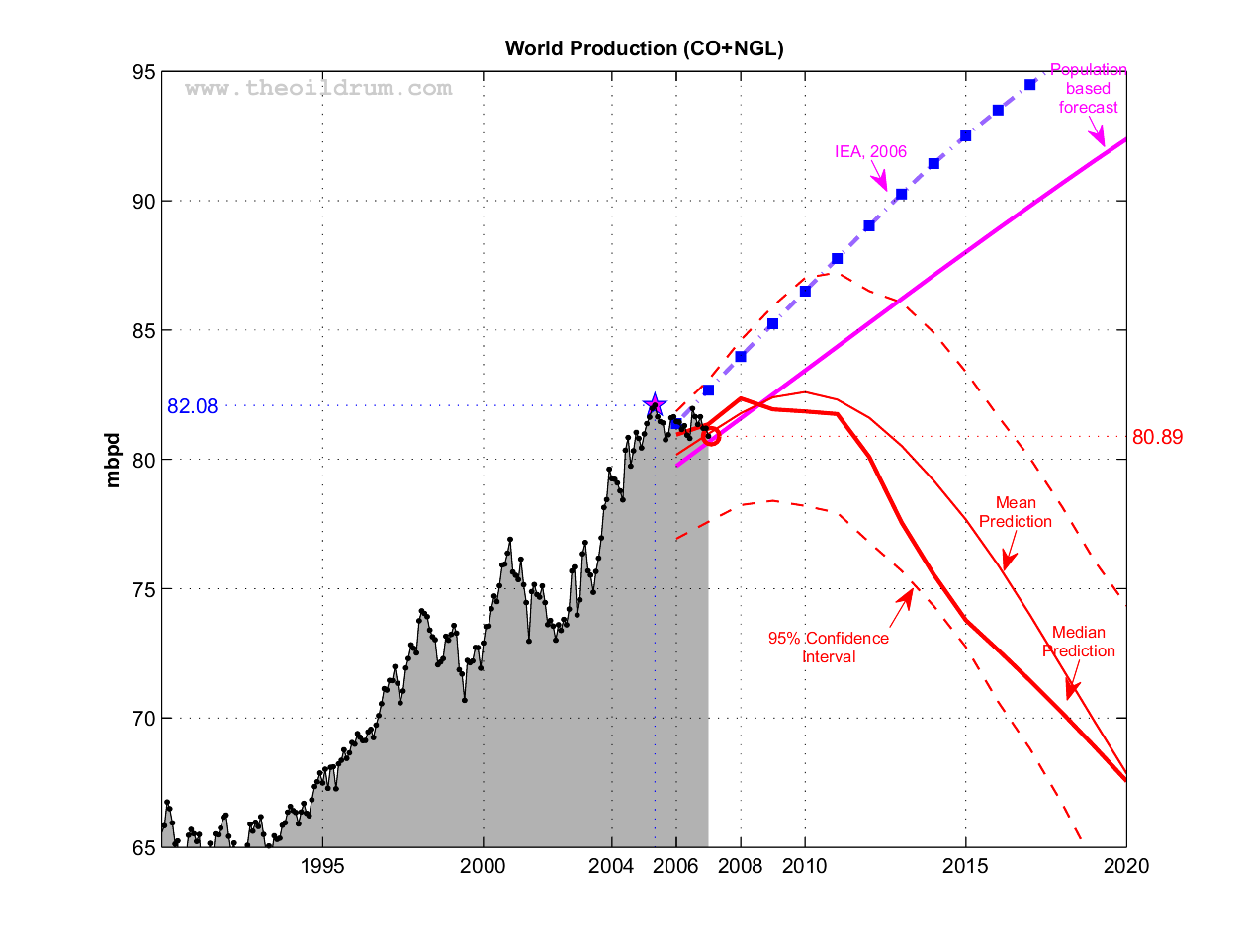
World oil production (EIA Monthly) for crude oil + NGL. The median forecast is calculated from 12 models that are predicting a peak before 2020 (Bakhiarti, Smith, Staniford, Loglets, Shock model, GBM, ASPO-[70,58,45], Robelius Low/High, HSM). 95% of the predictions sees a production peak between 2009 and 2011 at 78.23 - 87.12 mbpd (The 95% confidence interval is computed using a bootstrap technique). Click to Enlarge.
Executive Summary:
- Monthly production records are unchanged except for NGPL:
- All Liquids: the peak is still July 2006 at 85.43 mbpd, the year to date average production in 2007 (2 months) is 84.26 mbpd, up 0.2 mbpd from 2006.
- Crude Oil + NGL: the peak date remains May 2005 at 82.08 mbpd, the year to date average production for 2007 (2 months) is 81.24 mbpd, down 0.06 mbpd from 2006.
- Crude Oil + Condensate: the peak date remains May 2005 at 74.15 mbpd, the year to date average production for 2007 (2 months) is 73.09 mbpd, down 0.25 mbpd from 2006.
- NGPL: the peak date is now February 2007 at 8.24 mbpd, the year to date average production for 2007 (2 months) is 8.15 mbpd, up 0.19 mbpd from 2006.
- Decline in crude oil + condensate continues: February 2007 estimate for crude oil + condensate is 73.35 mbpd compared to 73.47 mbpd one year ago.
- New forecasts added: Projections from Frederik Robelius and the Hybrid Shock Model.
- Average forecast: the average forecast for crude oil + NGL based on 12 different projections is showing a kind of production plateau around 83 +/- 4 mbpd with a decline after 2010 +/- 1 year.
Notations:
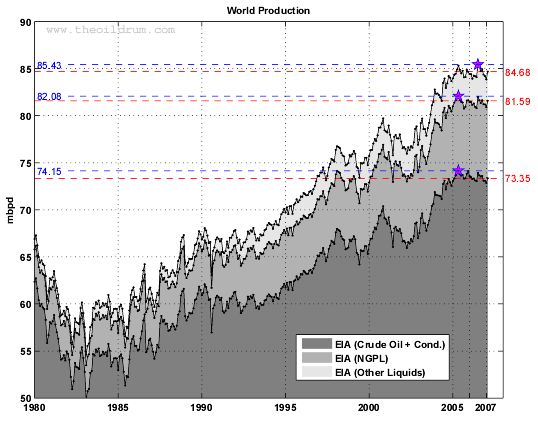
Fig 1.- World production (EIA data). Blue lines and pentagrams are indicating monthly maximum. Monthly data for CO from the EIA. Annual data for NGPL and Other Liquids from 1980 to 2001 have been upsampled to get monthly estimates. Click to Enlarge.
Table I - Production
estimate
(in millions of barrels per day (mbpd)) for February 2007 taken from
the EIA website (International
Petroleum Monthly). 1Moving Average
on the last 12 months.
The share of CO is now only 86.6% of the total liquid production.
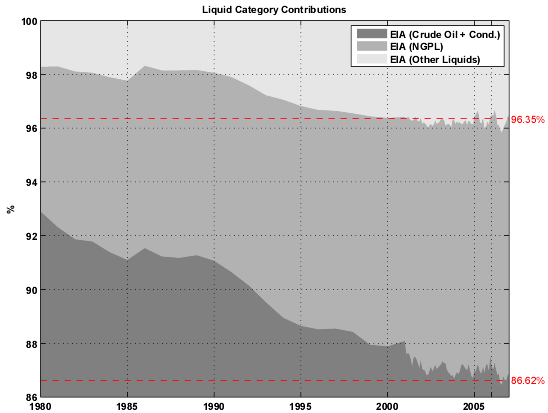
Fig 3.- Share of each liquid category to the total liquid production. Click to Enlarge.
The figure below is giving the general context where all the forecasts are situated, in the following we will focus on the 2000-2025 period shown as a gray box.
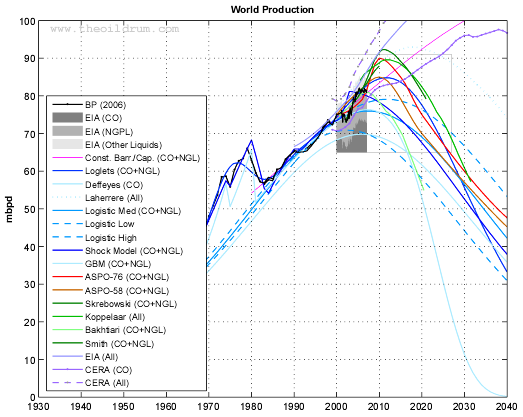
Fig 4.- World oil production (Crude oil + NGL) and various forecasts (1940-2050). The light gray box gives the particular area where the Figures below are zooming in. Click to Enlarge.
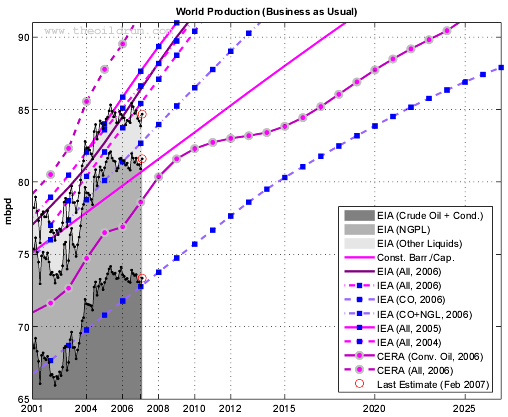
Fig 5.- Production forecasts assuming no visible peak. Click to Enlarge.
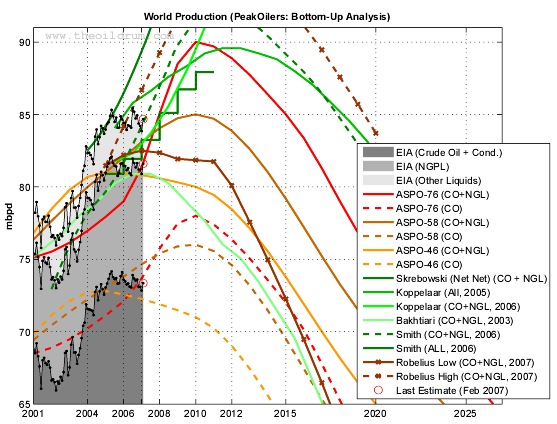
Fig 6.- Forecasts by PeakOilers based on bottom-up methodologies. Click to Enlarge.

Fig 7.- Forecasts by PeakOilers using curve fitting methodologies. Click to Enlarge.
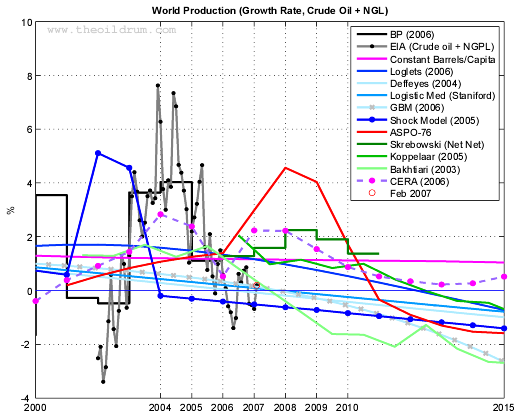
Fig 8.- Year-on-Year production growth. Click to Enlarge.
Table II. Summary of
all the
forecasts (figures are in mbpd) as well as the last EIA estimates.1Productive
capacities. 2Difference
between the observed production for 2007 and the predicted value (in
mbpd), the value in bold indicates the best forecast (i.e. the oldest
with the lowest difference.
January 2007
December 2006
November 2006
October 2006
September 2006
- mbpd= Million of barrels per day
- Gb= Billion of barrels (109)
- Tb= Trillion of barrels (1012)
- NGPL= Natural Gas Plant Liquids
- CO= Crude Oil + lease condensate
- NGL= Natural Gas Liquids (lease condensate + NGPL)
- URR= Ultimate Recoverable Resource
EIA Last Update (February)
Data sources for the production numbers:
- Production data from BP Statistical Review of World Energy 2006 (Crude oil + NGL).
- EIA data (monthly and annual productions up to February 2007) for crude oil and lease condensate (noted CO) on which I added the NGPL production (noted CO+NGL).
The All liquids peak is still July 2006 at 85.47 mbpd, the year to date average production value in 2007 (2 months) is down from 2005 for all the categories except for NGPL. The peak date for Crude Oil + Cond. is May 2005 at 74.15 mbpd (see Table I below).
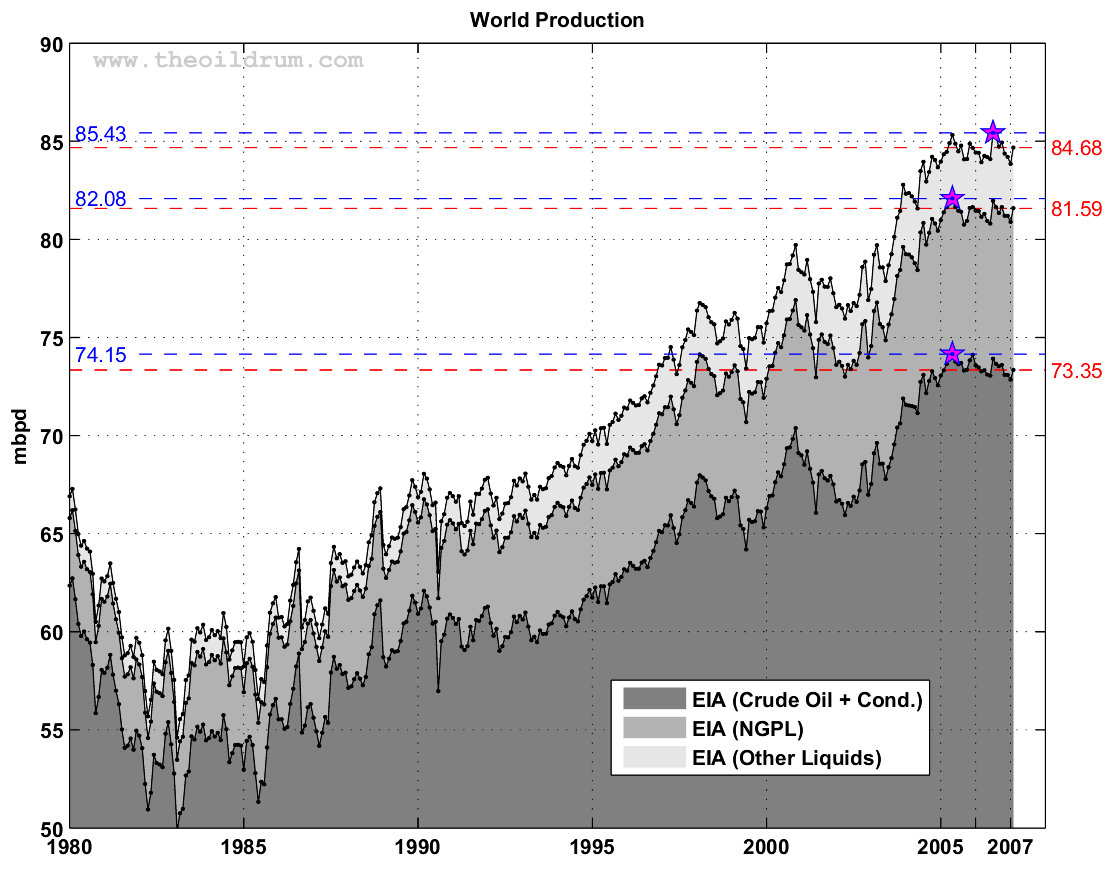
Fig 1.- World production (EIA data). Blue lines and pentagrams are indicating monthly maximum. Monthly data for CO from the EIA. Annual data for NGPL and Other Liquids from 1980 to 2001 have been upsampled to get monthly estimates. Click to Enlarge.
| Category | Feb 2007 | Feb 2006 | 12 MA1 | 2007 (2 Months) | 2006 (2 Months) | Share | Peak Date | Peak Value |
|---|---|---|---|---|---|---|---|---|
| All Liquids | 84.68 | 84.41 | 84.48 | 84.26 | 84.46 | 100.00% | 2006-07 | 85.43 |
| Crude Oil + NGL | 81.59 | 81.43 | 81.30 | 81.24 | 81.30 | 96.35% | 2005-05 | 82.08 |
| Other Liquids | 3.09 | 2.98 | 3.18 | 3.02 | 3.16 | 3.65% | 2006-08 | 3.54 |
| NGPL | 8.24 | 7.97 | 7.99 | 8.15 | 7.96 | 9.73% | 2007-02 | 8.24 |
| Crude Oil + Condensate | 73.35 | 73.47 | 73.31 | 73.09 | 73.34 | 86.62% | 2005-05 | 74.15 |
The share of CO is now only 86.6% of the total liquid production.
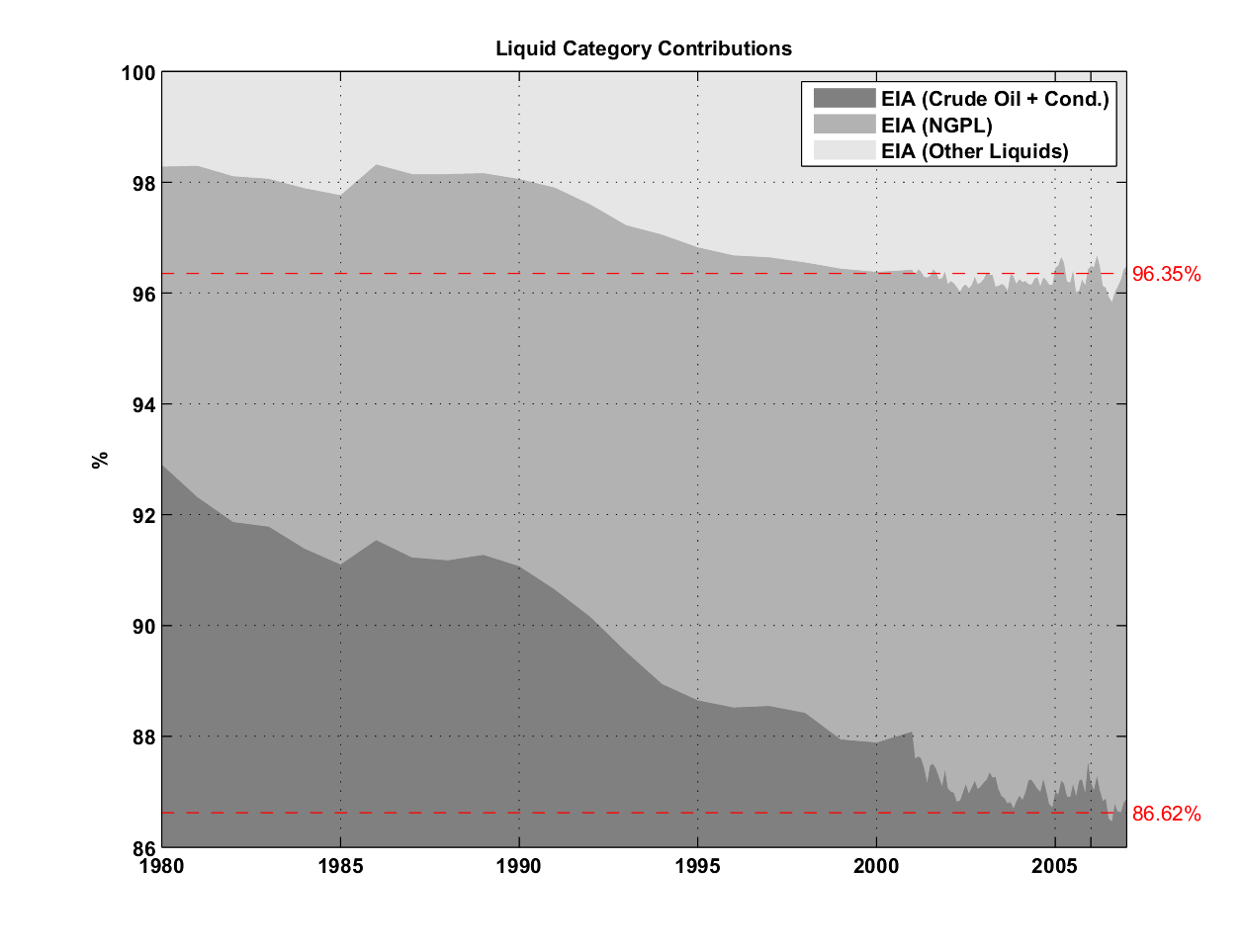
Fig 3.- Share of each liquid category to the total liquid production. Click to Enlarge.
The figure below is giving the general context where all the forecasts are situated, in the following we will focus on the 2000-2025 period shown as a gray box.

Fig 4.- World oil production (Crude oil + NGL) and various forecasts (1940-2050). The light gray box gives the particular area where the Figures below are zooming in. Click to Enlarge.
Business as Usual
- EIA's International Energy Outlook 2006, reference case (Table E4, World Oil Production by Region and Country, Reference Case).
- IEA total liquid demand forecast for 2006 and 2007 (Table1.xls).
- IEA World Energy Outlook 2006 : forecasts for All liquids, CO+NGL and Crude Oil (Table 3.2, p. 94).
- IEA World Energy Outlook 2005 : forecast for All liquids (Table 3.5).
- IEA World Energy Outlook 2004 : forecast for All liquids (Table 2.4).
- A simple demographic model based on the observation that the oil produced per capita has been roughly constant for the last 26 years around 4.4496 barrels/capita/year (Crude Oil + NGL). The world population forecast employed is the UN 2004 Revision Population Database (medium variant).
- CERA forecasts for conventional oil (Crude Oil + Condensate?) and all liquids, believed to be productive capacities (i.e. actual production + spare capacity). The numbers have been derived from Figure 1 in Dave's response to CERA.

Fig 5.- Production forecasts assuming no visible peak. Click to Enlarge.
PeakOilers: Bottom-Up Analysis
- Chris Skrebowski's megaprojects database (see discussion here).
- The ASPO forecast from April newsletter (#76): I took the production numbers for 2000, 2005, 2010, 2015 and 2050 and then interpolated the data (spline) for the missing years. I added the previous forecast issued one year and two years ago (newsletter #58 and #46 respectively). There was no revision since August 2006.
- Rembrandt H. E. M. Koppelaar (Oil Supply Analysis 2006 - 2007): "Between 2006 and 2010 nearly 25 mbpd of new production is expected to come on-stream leading to a production (all liquids) level of 93-94 mbpd (91 mbpd for CO+NGL) in 2010 with the incorporation of a decline rate of 4% over present day production".
- Koppelaar Oil Production Outlook 2005-2040 - Foundation Peak Oil Netherlands (November 2005 Edition).
- The WOCAP model from Samsam Bakhtiari (2003). The forecast is for crude oil plus NGL.
- Forecast by Michael Smith (Energy Institute) for CO+NGL, the data have been taken from this chart in this presentation (pdf).
- PhD thesis of Frederik Robelius (2007): Giant Oil Fields - The Highway to Oil: Giant Oil Fields and their Importance for Future Oil Production. The forecasts (low and high) are derived from this chart.
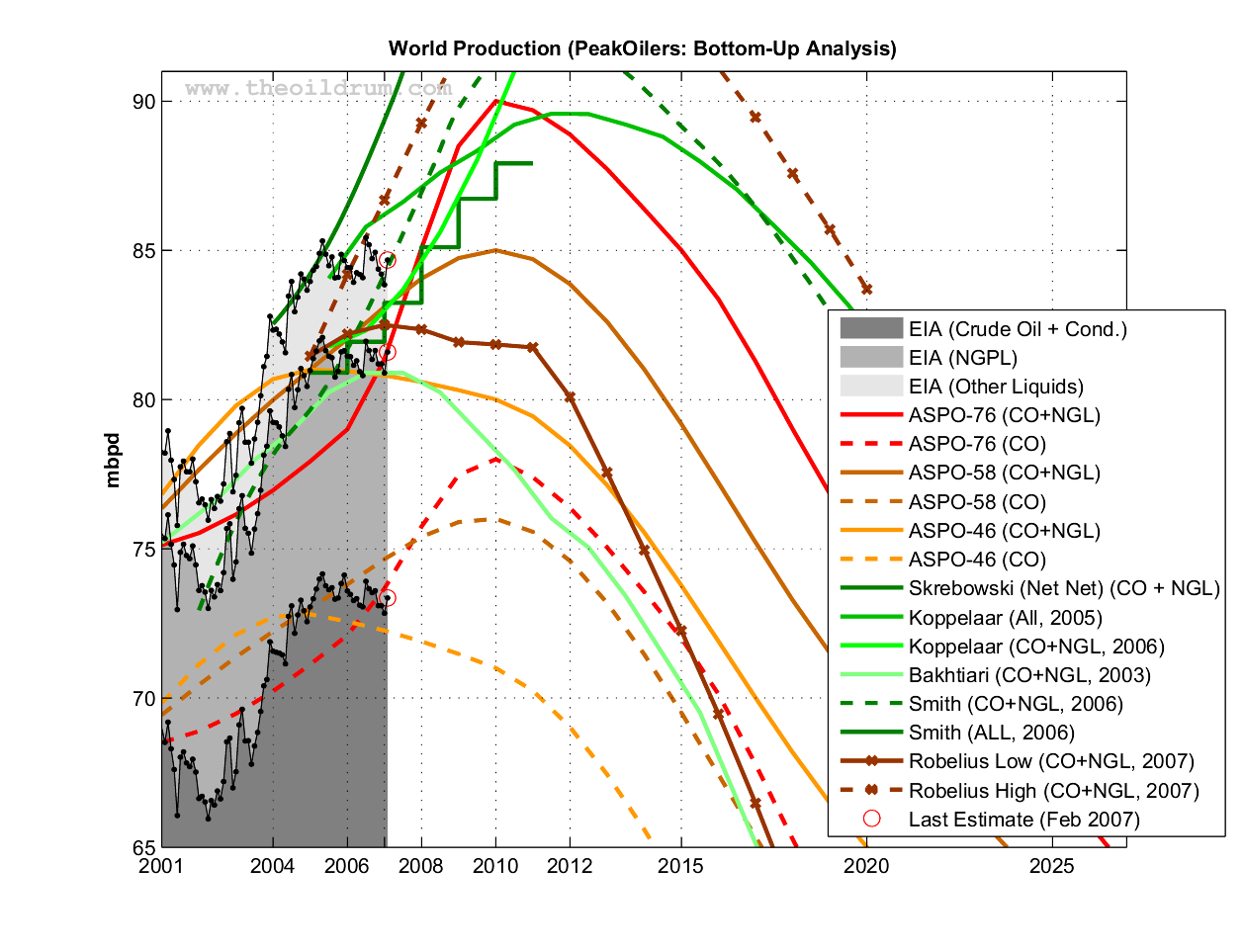
Fig 6.- Forecasts by PeakOilers based on bottom-up methodologies. Click to Enlarge.
PeakOilers: Curve Fitting
The following results are based on a linear or non-linear fit of a parametric curve (most often a Logistic curve) directly on the observed production profile:- Professor Kenneth S. Deffeyes forecast (Beyond Oil: The View From Hubbert's Peak): Logistic curve fit applied on crude oil only (plus condensate) with URR= 2013 Gb and peak date around November 24th, 2005.
- Jean Lahèrrere (2005): Peak oil and other peaks, presentation to the CERN meeting, 2005.
- Jean Lahèrrere (2006): When will oil production decline significantly? European Geosciences Union, Vienna, 2006.
- Logistic curves derived from the application of Hubbert Linearization technique by Stuart Staniford (see this post for details).
- Results of the Loglet analysis.
- The Generalized Bass Model (GBM) proposed by Prof. Renato Guseo, I used his most recent paper (GUSEO, R. et al. (2006). World Oil Depletion Models: Price Effects Compared with Strategic or Technological Interventions ; Technological Forecasting and Social Change, (in press).). The GBM is a beautiful model that has been applied in finance and marketing science (see here for some background). The estimation in Guseo's article was based on BP data from 2004 (CO+NGL).
- The so-called shock model proposed by TOD's poster WebHubbleTelescope . You can find a description of his approach on his blog here as well as a review on TOD. The current estimate was done in 2005 based on BP's data (CO+NGL).
- The Hybrid Shock Model is a variant of the shock model described here. The forecast is based on EIA data (up to 2006) for crude oil + condensate, the ASPO backdated disovery curve and assumes no reserve growth and declining new discoveries.

Fig 7.- Forecasts by PeakOilers using curve fitting methodologies. Click to Enlarge.
Production Growth
The chart below gives the year-on-year production growth (or decline) for each month. Growth has been weak (below 1%) since 2005..
Fig 8.- Year-on-Year production growth. Click to Enlarge.
| Forecast | 2005 | 2006 | 2007 | 2010 | 2015 | Diff2 | Peak Date | Peak Value |
|---|---|---|---|---|---|---|---|---|
| All Liquids | ||||||||
| Observed (All Liquids) | 84.56 | 84.51 | 84.26 | NA | NA | 2006-07 | 85.43 | |
| IEA (WEO, 2004) | 82.06 | 83.74 | 85.41 | 90.40 | 98.69 | -1.16 | 2030 | 121.30 |
| IEA (WEO, 2005) | 84.00 | 85.85 | 87.64 | 92.50 | 99.11 | -3.38 | 2030 | 115.40 |
| Koppelaar (2005) | 84.06 | 85.78 | 86.61 | 89.21 | 87.98 | -2.36 | 2011 | 89.58 |
| Lahèrrere (2005) | 83.59 | 84.47 | 85.23 | 86.96 | 87.77 | -0.97 | 2014 | 87.84 |
| EIA (IEO, 2006) | 82.70 | 84.50 | 86.37 | 91.60 | 98.30 | -2.11 | 2030 | 118.00 |
| IEA (WEO, 2006) | 83.60 | 85.10 | 86.62 | 91.30 | 99.30 | -2.36 | 2030 | 116.30 |
| CERA1 (2006) | 87.77 | 89.52 | 91.62 | 97.24 | 104.54 | -7.36 | 2035 | 130.00 |
| Lahèrrere (2006) | 83.59 | 84.82 | 85.96 | 88.93 | 92.27 | -1.70 | 2018 | 92.99 |
| Smith (2006) | 85.19 | 87.77 | 90.88 | 98.94 | 98.56 | -6.62 | 2012-05 | 99.83 |
| Crude Oil + NGL | ||||||||
| Observed (EIA) | 81.45 | 81.33 | 81.24 | NA | NA | 2005-05 | 82.08 | |
| GBM (2003) | 76.06 | 76.27 | 76.33 | 75.30 | 67.79 | 4.91 | 2007-05 | 76.34 |
| Bakhtiari (2003) | 80.24 | 80.89 | 80.89 | 77.64 | 69.51 | 0.34 | 2006 | 80.89 |
| ASPO-46 | 81.00 | 80.95 | 80.80 | 80.00 | 73.77 | 0.43 | 2005 | 81.00 |
| ASPO-58 | 81.00 | 82.03 | 83.10 | 85.00 | 79.18 | -1.86 | 2010 | 85.00 |
| Staniford (High) | 77.45 | 77.92 | 78.31 | 79.01 | 78.51 | 2.92 | 2011-10 | 79.08 |
| Staniford (Med) | 75.81 | 75.94 | 75.97 | 75.52 | 73.00 | 5.27 | 2007-05 | 75.98 |
| Staniford (Low) | 70.46 | 70.13 | 69.71 | 67.92 | 63.40 | 11.53 | 2002-07 | 70.88 |
| IEA (WEO, 2006) | 80.10 | 81.38 | 82.67 | 86.50 | 92.50 | -1.43 | 2030 | 104.90 |
| Koppelaar (2006) | 81.76 | 82.31 | 83.68 | 91.00 | NA | -2.44 | 2010 | 91.00 |
| Skrebowski (2006) | 80.90 | 81.42 | 82.59 | 87.32 | NA | -1.35 | 2010 | 87.92 |
| Smith (2006) | 80.53 | 82.81 | 85.45 | 91.95 | 88.60 | -4.21 | 2011-02 | 92.31 |
| Loglets | 81.12 | 82.14 | 83.02 | 84.65 | 83.26 | -1.78 | 2012-01 | 84.80 |
| ASPO-76 | 77.92 | 79.00 | 81.35 | 90.00 | 85.00 | -0.11 | 2010 | 90.00 |
| Robelius Low (2006) | 81.45 | 82.19 | 82.50 | 81.84 | 72.26 | -1.26 | 2007 | 82.50 |
| Robelius High (2006) | 81.45 | 84.19 | 86.67 | 93.40 | 92.40 | -5.44 | 2012 | 94.54 |
| Shock Model (2006) | 80.76 | 80.43 | 80.01 | 78.27 | 73.74 | 1.23 | 2003 | 81.17 |
| Crude Oil + Lease Condensate | ||||||||
| Observed (EIA) | 73.65 | 73.39 | 73.09 | NA | NA | 2005-05 | 74.15 | |
| ASPO-46 | 72.80 | 72.56 | 72.25 | 71.00 | 63.55 | 0.84 | 2005 | 72.80 |
| Deffeyes (2004) | 69.81 | 69.81 | 69.71 | 68.90 | 65.88 | 3.38 | 2005-12 | 69.82 |
| ASPO-58 | 73.00 | 73.80 | 74.65 | 76.00 | 69.50 | -1.56 | 2010 | 76.00 |
| IEA (WEO, 2006) | 70.80 | 71.78 | 72.77 | 75.70 | 80.30 | 0.32 | 2030 | 89.10 |
| CERA1 (2006) | 76.49 | 76.89 | 78.60 | 82.29 | 83.83 | -5.51 | 2038 | 97.58 |
| ASPO-76 | 71.11 | 72.10 | 73.66 | 78.00 | 72.00 | -0.57 | 2010 | 78.00 |
| HSM (2007) | NA | 73.56 | 73.53 | 72.82 | 69.53 | -0.44 | 2006 | 73.56 |
Next update probably in September.
Previous Update:
Februray 2007January 2007
December 2006
November 2006
October 2006
September 2006
OilWatch last issue:
Peak Oil Update - June 2007: Production Forecasts and EIA Oil Production Numbers
PDF version
166 comments
Peak Oil Update - June 2007: Production Forecasts and EIA Oil Production Numbers
PDF version
166 comments
“So one may almost say that the theory of universal suffrage assumes that the Average Citizen is an active, instructed, intelligent ruler of his country. The facts contradict this assumption.”
—James Bryce (1909, 35)
Contact
- Content: editors at theoildrum dot com
- Tech support: support at theoildrum dot com
License

This work is licensed under a Creative Commons Attribution-Share Alike 3.0 United States License.
Khebab: Great article. The way you lay it out with the summary drilling down to more and more detail is absolutely perfect.
An absolutely state of the art summary, thank you very much. What a pity the usual media (even sites such as The Nation or Die Tageszeitung) do not pay more attention to this.
ciao,
Bruce
Actually, Die Tageszeitung ran a longer piece on Deffeyes and the Thangsgiving Peak Prediction in November 2005 (which had the benefit of alerting me to the subject) but after that, they pretty much went back to ignoring the subject altogether. They have joined the Global Warming bandwagon in a large way, though, but most of their readers are greenish yuppies now, not Green radicals like 20 years ago, so they prefer to run stories about the Solar Future and our cars running on hydrogen instead of confronting depletion angst...
Well, the "bad" thing about PO is that the advocacy "cause" aspect of it always ends up shooting itself in the foot. The story never seems to get any traction because of cry wolf syndrome...
It is much easier for liberals and liberal publications to ride the GW train (so to speak) because the weather takes so damn long to change, and plus, it is a lot more excusable for some reason in the MSM to have all these wildly varying models for GW... but when it comes to PO it seems as if the interest wanes a lot more. I don't know why this is...
*But*, I do know that Democrats and liberals everywhere do not want to talk about PO... It is a political loser...
The propaganda mission for liberals seems to be use GW as an excuse to reduce fossil fuels use that way we don't even need to discuss PO!
I think the problem with trying to talk to the masses in the US about oil depletion is that most of them would either tell you the problem is "gouging" (the more suburban liberal bent), if not that then it is "they aren't allowed to drill" (the dyed-in-the-wool right-wing corporate apologist).
Then you have people like BenjaminCole, who agree PO is coming eventually, but modulate down into a no-brainer--ie, cow shit is gonna power our fleets of Boeings for the next 5 decades, etc etc...
Well, the cry wolf syndrome is a problem for more than just PO -- this is also true for the whole environmental movement. A lot of the stuff predicted back in the 70s was premature (but not otherwise wrong). I agree with you that GW and even the environmental movement are "safer" than PO. PO takes an axe to our whole way of life sooner than does GW. All you have to do about GW or the environment is send in a check to your favorite group. What does one do about PO? It's a statement that our whole way of life is becoming impossible in the next few decades.
One side note. I'm also one of those tinfoil hat guys on 9-11 (as is Colin Campbell along with some other PO people). The interesting part is that a lot of 9-11 people don't buy PO at all -- it's just a conspiracy by the oil companies to jack up prices. So while these people are able to adjust to the horrible implications of the 9-11 story, the idea that our whole way of life is not sustainable is somehow just too much to bear.
More, PO doesn't really seem to be a movement yet -- it's a research project. There's no simple set of answers to the problem. Even those who agree on PO do not agree on what it will mean and what's possible to do about it. The only thing PO does right now is say: do you see the freight train coming down the tracks?
This is mostly true except for the part that it was "premature", especially with respect to climate change.
The underlying cause for concern always was and still is that of run-away Climate Change. GW concerns really started in the 1980's. Twenty years later we are undergoing an anthropogenically enhanced abrupt and non-linear (unpredictable) climate change -- one that for all practical intents and purposes will likely be very soon humanly irreversible.
Was it really "premature" to warn of this then?
According to James Hanson, from an adaptation of a talk delivered in February, and printed in The Nation (May 7.2007 issue):
"There's a huge gap between what is understood about global warming by the relevant scientific community and what is known about global warming by those who need to know: the public and policy-makers. We've had, in the past thirty years, one degree Fahrenheit of global warming. But there's another one degree Fahrenheit in the pipeline due to gases that are already in the atmosphere. And there's another one degree Fahrenheit in the pipeline because of the energy infrastructure now in place--for example, power plants and vehicles that we're not going to take off the road even if we decide that we're going to address this problem.
"The Energy Department says that we're going to continue to put more and more CO2 in the atmosphere each year -- not just additional CO2 but more than we put in the year before. If we do follow that path, even for another ten years, it guarantees that we will have dramatic climate changes that produce what I would call a different planet -- one without sea ice in the Arctic; with worldwide, repeated coastal tragedies associated with storms and a continuously rising sea level; and with regional disruptions due to freshwater shortages and shifting climatic zones."
Had we thought to address this as a serious concern, worthy of the precautionary principle, even 15 years ago we wouldn't be faced with the dire problem we are today as Hanson (among many, many other scientists) now sees coming no matter what we do. For civilization as we know it it will likely prove to be an unstoppable disaster.
Once set in motion climate change is a beast and will not readily relent to our late and still haphazard efforts to mitigate it. The lesson is a tragic one, in that those who were accused of "crying wolf" back were not at all premature with such an intractable threat.
Instead of learning our lesson, today's PO promoters are in the same boat that CC theorists were in 20 years ago. There is another "freight train coming down the tracks", which according to the Hirsch Report (along with many, many other thinking people, like ourselves):
"The peaking of world oil production presents the U.S. and the world with an unprecedented risk management problem. As peaking is approached, liquid fuel prices and price volatility will increase dramatically, and, without timely mitigation, the economic, social, and political costs will be unprecedented. Viable mitigation options exist on both the supply and demand sides, but to have substantial impact, they must be initiated more than a decade in advance of peaking." {my emphases}
Among their quoted conclusions:
• World oil peaking is going to happen, and will likely be abrupt.
• Oil peaking will adversely affect global economies, particularly those most dependent on oil.
• Oil peaking presents a unique challenge (“it will be abrupt and revolutionary”).
• The problem is liquid fuels (growth in demand mainly from transportation sector).
• Mitigation efforts will require substantial time.
• 20 years is required to transition without substantial impacts
• A 10 year rush transition with moderate impacts is possible with extraordinary efforts from governments, industry, and consumers
• Late initiation of mitigation may result in severe consequences.
Gee, this all sounds awfully familiar.
By the time we do wake up to recognizing PO for what it is, like CC, it will be too late to do much to mitigate the worst of its effects upon civilization as we know it.
By my way of reckoning, this new crying wolf "research project" is only interesting in the same way that any of us cares to give studied witness to the progression of our ultimate demise. For myself and civilization as I know it, I've grown weary of this new yet same old drama.
Of course it ain't over til its over, but the plot is essentially the same and I see no reason to believe the outcome won't be any different than the CC one already set in motion.
It really is a once in a long historical lifetime we are stuck in, and all I can do is sit back comfortably while preparing as best I can to enjoy the show while it lasts. Tragically, so it goes...
Why do some of you seem to have this interminable need to refer everything back to climate change or, amazingly enough, 9/11 theories?
For goodness sake, show some respect!
Khebab has spent a hell of a lot of time putting together a really good, professional post on peak oil and you precious ponies what to hijack the thread to talk about your pet subjects.
If you want to spout about those sorts of things, there are plenty of other forums to do it in (including the daily drum).
Please, stop polluting the research and analysis threads with this sort of stuff.
I absolutely agree concerning the 9/11 stuff, but you must know the climate change story started in scientific circles and has always been run by professionals. Any indication to the otherwise has always been, and still is, industry disinformation.
Want to _really_ know about climate change? Read the scientific literature. There is no substitute.
ciao,
Bruce
Critical_Mind, I hope you weren't referring to me. I was simply offering my opinion, not trying to be disrespectful of Khebab (who's work I not only respect, but thoroughly appreciate.)
I was just responding to a comment... I thought that's what the comment section was for. Comments and discussion. I hate to be smug, but I think I'm right (like most people).
Sometimes when someone responds to a comment I've posted I feel the need to engage the person's comment further so as to expound my analysis and/or position. And I think I have done so, now let my text speak for itself.
There is a disconcerting tendency for people that accept peak oil being a reality to concurrently hold unfounded conspiratorial beliefs about 9/11.
This is a problem for the TOD community, and the "movement" as a whole as it discredits much of the hard work that you are imploring us to respect. I humbly believe it is important for anyone who takes peak oil seriously to vocally distance themselves from the the so-called "theories" of the 9/11 truth meme. It needs to be stated that 9/11 may have been taken advantage of (to invade Iraq) on dubious premises, but that does not in any way somehow implicate Dick Cheney in giving Mr. Atta the "go" command (and don't ask my opinion of Cheney...) It needs to be stated in somewhat arguably-important venues that this is uncalled for, and damages not only the Left, but peak oil awareness as well. A quick google of "peakoil" and "9/11" will come up with some pretty discrediting stuff and is a superficial and easy (yet effective) way for propagandists to filter and diminish *critical* thought when it comes to "energy and our future", as the TOD masthead says.
I do preemptively apologize for adding yet even more clutter, but this is the goddamn internet--give me a break!
In my opinion, 9/11 is not an appropriate topic for this blog but climate change is because climate change is intimately tied to fossil fuels.
Additionally, I didn't see where Professor Goose made you a moderator of TOD. Oh he didn't? Then why are you worrying your head about it? The editors and contributors of TOD will police it (or not) as they see fit.
Ghawar Is Dying
The greatest shortcoming of the human race is our inability to understand the exponential function. - Dr. Albert Bartlett
Grey: Neither topic is appropriate here IMO but most 9/11 bloggers do specifically relate the events to fossil fuel depletion (necessitating Iraq oil grab).
I believe that you are flatly incorrect about climate change as there have been many main articles on TOD itself in the past on that very topic but none, ever, about 9/11 conspiracy theories. If Professor Goose has allowed articles about climate change here and if those articles have been posted (both of which are true) then discussion of climate change is part of this blog.
Ghawar Is Dying
The greatest shortcoming of the human race is our inability to understand the exponential function. - Dr. Albert Bartlett
I've also noticed the stark absurdity of the 9/11 "truth" demographic when it comes to acknowledging elementary geology. Obviously an interesting psychological phenomenon--or, more realistically, *problem*. I don't know if this is the appropriate place to ask, but when you say tin-foil-hat-wearing do you mean the the government had prior knowledge of 9/11? I always tended to think that our government is way to inept to organize such a murderous conundrum, but I know history has a lot to say in opposition.
Regarding the cry wolf syndrome being indicative of the problems of environmentalism, you are certainly right that the massively incorrect predictions emanating from the late '60s and early '70s gave ample firepower to propagandists in the opposing camps (Hoover, Heritage, Hudson et al). But in reality, there is no big conspiracy. Just a government that Madison set up to keep the wealthy business classes--now morphed into corporate descendants--in power over the economy. In the early 20th century this just became an industrialized version of Madison's experiment, and along with industrialism came an explosion of media, almost entirely corporate owned. So, to sum up, our society's psychological fabric consists of private interests and propaganda--the two pillars standing in the way of, for lack of a better term, the "awareness train". Entertainment is the best propaganda you can buy. These pillars have been in place since slavery, and they still impede consciousness raising to this very day... However, in addition to private interests and propaganda, we can also throw in the sheer imaginative ability of the Homo Sapien. We may be sick little monkeys but we're also quite stunning in our abilities of invention (think religion, for a good sprawling anthropological example) and intelligence (think math, science).
Point is...
I'm sure that even if the horrendous predictions made by prominent academics in the 70s were never made--that "environmentalism" still would be probably right where it is today... Which is to say, nowhere.
davebygolly, you succinctly wrote:
"The only thing PO does right now is say: do you see the freight train coming down the tracks?"
And the amazing thing is that many people do not--or they claim it's moving at .001mph and won't hit us for at least 30 years, and by then we won't even be standing on the tracks anymore... (We'll be living in our "sustainable" [subsidized] corn stalk homes!)
I don't know if this is the appropriate place to ask, but when you say tin-foil-hat-wearing do you mean the the government had prior knowledge of 9/11?
It's not the right place to ask or answer, so I will only say: I mean a lot worse than that.
This is one of those issues that is impossible to speak about in person to anyone, including liberals. I've seen the videos and I must say that at the very least, the government has to answer some major questions. I believe "Popular Mechanics" ran a rebuttal to many of the points, but even that left me unsatisfied. Where was NORAD? Why was Building 7 in particular the third steel-structured building in world history to fall due to fire (the first two being the ones that airplanes hit). I know there are many questions I'd like my government to answer, and put me at (somewhat more) ease.
It seems quite apparent to me by now, however, that the main reason for going into Iraq (which 9/11 enabled) was an oil-grab. I would just like some of these questions to be taken seriously instead of dismissed offhand. Funny how the only people who dare ask important questions are seen as traitors. To me, as teachers have told me before, "there is no stupid question".
davebygolly wrote,
"One side note. I'm also one of those tinfoil hat guys on 9-11 (as is Colin Campbell along with some other PO people). The interesting part is that a lot of 9-11 people don't buy PO at all -- it's just a conspiracy by the oil companies to jack up prices. So while these people are able to adjust to the horrible implications of the 9-11 story, the idea that our whole way of life is not sustainable is somehow just too much to bear."
Well, in this particular case (again, it changes form if you shift to another part of the political spectrum) it is an ability to over fantasize. There is no direct link, to the extent that PO is related to 9/11... In my view the status quo explanation is correct. Government incompetency coupled with the blow back of a determined fundamentalist suicidal death cult. National security, to the extent that it works, is *supposed* to protect us. The 9/11 truth people seem to go the hot air route of BenjaminCole (just to continue upon my assault on him throughout this thread!) They say something is true--but do so without the backup of sensible argument coupled with hard evidence. They hem and haw for their "beliefs" in the the presence of devastating arguments against holding them (much like heavily religious, personal-god type people).
To the extent that there are questions about collapse, I don't believe they hold up. When the buildings began construction in the mid-60s they were a totally original design, no building of that stature had ever been constructed where essentially the exterior of the building would be holding together the structure. They used an entirely new system of building a skyscraper to... By the time they were finished, in the 70s the buildings were relics of an bygone era of building--but they obviously stood intact perfectly fine (that is until jetliners were flown into them at high speeds). That they collapsed, to me, is unsurprising and I don't believe one needs to imagine thermite in the staircases, etc etc, to conclude that they collapsed as a result the complicated physics of massive jet-liners slamming into very experimentally gargantuan buildings. Given how, and when the they were built, in addition to recognizing the immensity of them, it doesn't surprise me.
It is just inconceivable that my own government would "plan" the attacks--and that type of thinking gives the far left (of which I would count myself) a very bad name and makes me ashamed to be a liberal (as do very many other things purported "liberals" say and do.) I might also note here that there is probably some cognitive dissonance amongst those that can't believe that they came down as a consequence of the physics resulting purely from the impacts. I remember on that day, during the "event", while the two towers were will still standing--I don't think anyone imagined (or wanted to) that they would fall... Maybe this is part of it? I'm unsure, but I think there is some type of relation between the "truthers" and an inability to grasp, perhaps, American descent, failure, collapse (ironically enough), etc--ie, "it is all just the big corporations controlling us! But, everything will keep on going fine, we just hate them controlling us!" Of course strikingly, there are people on the otherside, who are evangelical about corporate benevolence and sacredness... Two sides of the same hysterical coin?
However, given all this (you started it, tin-foil-wearer! :-] ) I still wholeheartedly agree that our government did and has exploited 9/11 to the fullest extent allowable by human consciousness and has inexcusably whitewashed it--but that is just realpolitik. Iraq is clearly the manifestation of Hawkish tendencies in AEI and it's swarm of bees. And yes, that hive is essentially a strategic planning unit for US Imperialism and control of the world's economy, and energy reserves (not surprisingly--we've gotta use our half a trillion dollar military budget doing something!)
And when do we start to lose our grasp? Iraq is a harbinger of our inability to control a world that we have become dependent on.
It is very dismaying to me that people involved in the peak oil issue would traffic in the absurdities of 9/11 conspiracy theory. I suppose it shows that the delusional thinking endemic to highly-stressed societies is not limited to evangelicals, CNBC-cheerleaders, Nascar morons, and White House policy aides.
Jim Kunstler
Saratoga Springs, NY
I agree completely. Absolutely amazed that the 9/11 conspiracy movement has any traction among otherwise reasonable people (in my institute there are at least two true believers... these guys are scientists but it is impossible to shake them... the underlying reason is perhaps that physicists don't know anything about the physics of buildings... the only way to learn the relevant stuff is to read what building engineers have to say about the subject and then the silly nature of the 9/11 "theories" becomes clear).
ciao,
Bruce
Bruce: Personally, I am amazed that you guys are so convinced that you know exactly what happened on 9/11. I have no idea what exactly happened, but I would say that the probability is that the official conspiracy theory as relayed by the MSM is inaccurate (it almost always is).
Logic problem also relevant to Peak Oil (the only reason I respond): of course I don't know _exactly_ what happened. But preposterous claims made by the conspiracy crowd are not an appropriate response. It is like the believers in endless oil, who try to force the rest of us to predict, _exactly_ when the oil peak (or population crash, or other problem) will take place. If we cannot (of course we cannot), then they claim their position is justified. It is what I mentioned earlier about false premise. The fact that no human has been to the far side of the moon does not make it likely aliens have built buildings there now does it.
If we incorrectly claim oil will peak on 21 July 2007, and we are found to be wrong, then there will always be oil, right?
ciao,
Bruce
The reason the scientists (physicists?) are "unshakable" is because it is absolutely impossible to simultaneously believe both in Newton's laws and the gov't story. The gov't story also defies the laws of probability. Once again a choice is forced. I'm a math and physics guy. No one will survive a debate with me on the issue if they restrict themselves to logic and the known facts -- and foreswear ad hominens. But it can't be here -- I agree -- even though there is a very definite connection to PO. That's why Colin Campbell devotes a whole chapter in the middle of his book OIL CRISIS to the topic. But this topic, unlike GW, generates enormous amounts of heat in comparison to the amount of generated light, which is a distraction from the main issue of this site.
Wow, I always thought you were just a tiny bit on the nutty side (not that you care, I know, and I applaud that), but you are 100% correct (IMO) on this 9/11 issue. Peak oil is a logical intuitive resource constraint issue. But 9/11 conspiracies are almost entirely fantasy.
Unbelievable! Mr. Doom himself. Mr. The suburbs are the greatest waste of America, Mr. I live in upper state New York and will survive, thinks that conspiracy theories are hokum. Wow! Did you wake up one day and see how close you are to the edge and say "I better distance myself or no one will buy my books or book anymore talks"? Oh well. I guess the kooks have to draw a line somewhere. Or are you a kook?
What gives? You think WTC7 fell because of a little fire? You think that Bush lying us into Iraq was a simple mistake? You think that the nose of a plane would have made it through the second twin tower intact? Three towers fell on 9/11. How many people even know that?
By the way, I am half the time a great fan of your monday blog. But you seem to have a blind spot. Why is that? Do you close your eyes at videos like "loose change"?
I can read about 9/11 theories and climate change disasters in any number of other places.
However, I can only read about Khebab's analysis of oil production history and future scenarios here - on this thread.
You get a daily drum every day where you can discuss this other stuff.
On "specialist" threads, I'm more interested in reading about how others view the specialists' analyses.
I don't want you to stop discussing these other issues, however I do find it distracting when threads such as this one end up with large chunks of totally off-topic comments.
The EIA's May International Petroleum Monthly is just out. Late but it finally arrived. It has the March production data.
http://www.eia.doe.gov/ipm/
Ron Patterson
thanks, I was expecting it earlier.
The updated version of the IPM only changes your numbers slightly (they are still playing with the 2005 data to get it into final form, I expect similar revisions in the monthly energy review next month as they had finally gotten the numbers to "match" for 2005).
A slightly higher value for May 2005 (C+C) and a lower value for NGL's (7.9 MMBPD) for Feb 2007 but it's still the maximum.
Maximum liquids reduced a little (to 85.38 MMBPD) in July 2006 and the crude plus NGLs creeps up to 82.20 MMBPD in May 2005.
Of course they would release it just after you've completed you work!
Good job!
Update of Bottom Up Forecast for EIA March 2007 data
First, as usual, excellent work, Khebab! Every key post should have an executive summary like yours.
The updated world total liquids supply forecast shows a peak plateau from 2006 to 2009 with production between 85 and 86 mbd. This plateau is the result of decreased production of crude oil and lease condensate (C&C) being offset by increasing production from natural gas liquids and biofuels (mainly ethanol). The fall in total liquids production from 2009 to 2012 is similar, in magnitude, to the rise in production from 2002 to 2006. As supply falls short of demand, prices will continue increasing.
Fig 1 – Peak Oil Plateau – click to enlarge
The figure below shows crude oil and lease condensate (C&C) production declining at a rate of 1%/yr until end of 2008. Afterwards, the decline rate is 4%/yr from 2009 to 2012.
World C&C for Feb 2007 was 73.49 mbd. In Mar 2007, it was 73.36 mbd, a small drop of 0.13 mbd. Significant falls over the same time period include Nigeria down 0.21 mbd, due to militant attacks and the North Sea (primarily UK, Norway, Denmark), down 0.13 mbd. The North Sea produced 4.30 mbd in Mar 2007. Unfortunately, as this decline rate continues, the North Sea will be probably be producing less than 4 mbd by late 2007. Other significant sources of decline include China, down 0.05 mbd; Australia, 0.07 mbd; and Canada, 0.05 mbd.
Offsetting significant production increases include 0.06 mbd from Venezuela; USA, 0.08 mbd; Angola, 0.04 mbd; Azerbaijan, 0.06 mbd; Iraq, 0.05 mbd; Kazakhstan, 0.04 mbd; and UAE, 0.04 mbd.
Fig 2 – Crude Oil & Lease Condensate to 2012 – click to enlarge
One of the key drivers of the above forecasts is Saudi Arabia’s production forecast. It is assumed that Saudi Arabia has total ultimate recoverable C&C of 175 Gb and that the C&C production rate does not cause the depletion rate of remaining reserves to exceed 5.3%/yr. The blue line in the figure below shows Saudi Arabia’s C&C production decline curve.
Fig 3 – Saudi Arabia to 2020 – click to enlarge
The figure below shows Saudi Arabia’s C&C production since the late 1930s forecast to 2080. Saudi Arabia has probably passed peak production as the production from the scheduled megaprojects and infill drilling will probably be insufficient to create a new production peak.
Fig 4 – Has Saudi Arabia passed Peak C&C? – click to enlarge
Ace, is it my imagination or is your peak liquids date creeping forward a bit at a time? I seem to recall early 2009 previously as being your peak liquids date but now it looks like mid-2008.
And thank you for the update! You compress a massive amount of information into your graphs!
Ghawar Is Dying
The greatest shortcoming of the human race is our inability to understand the exponential function. - Dr. Albert Bartlett
Greyzone, peak total liquids is creeping forward slightly due to downward forecast revisions to the North Sea, Mexico and Saudi Arabia. As more years pass from the 1999 North Sea peak, production decline rates could increase for the mature North Sea region.
In addition, NGL production showed a big drop: Feb 2007 NGL production was 8.24 mbd in the EIA Feb 2007 data and Mar 2007 NGL production was 7.88 mbd. This is a drop of 0.36 mbd! My forecast for NGL is shown below.
Natural Gas Plant Liquids to 2012 – click to enlarge
The forecast for Ethanol and XTL is below. (XTL means BTL, CTL and GTL.)
Ethanol/XTL to 2012 – click to enlarge
Both of the above forecasts contribute to total liquids forecast being on a plateau until 2009. If these NGL and ethanol/XTL forecasts are too optimistic, then total liquids production could come off the plateau earlier.
As more awareness of peak oil occurs, some countries may decide to voluntarily cut production to conserve their valuable hydrocarbon resources for the benefit of future generations or for economic reasons. Brunei currently has an oil conservation policy as described by the EIA:
Equatorial Guinea also has a production limiting policy:
Brunei and Equatorial Guinea are small producers but world total liquids production would come off plateau tomorrow if a big producer such as Russia decides to adopt a production limiting policy. Douglas Low makes some important observations in his article titled Is Russia about to cap its oil production?
The next six months may hold many surprises in the oil market as the supply demand balance is very tight. There are many factors which could reduce supply this year. There are very few factors which could increase the supply.
I think your slightly optimistic if you factor in EROI issues especially with ethanol and also the age factor ( 20 years no investment) in the oil industry. If you add in these two factor you get the beginning of real peak effects in 2008 for sure i.e you should be post peak enough to have real pricing pressure. This means I think we get the first peak oil price shock Sep 08 not in 09 like you have it. A saving factor may be a slowing economy which will reduce demand. But I'd say from basically summer of next year on we could easily see a bidding war start between the wealthier countries and this is the major short term problem. A few externals such as hurricanes ME conflict which cannot be predicted but can be assumed to be 100% probable over a three year period will ensure that we will probably enter into post peak conditions sooner than a bottom up analysis would indicate. Finally a lot of our recent production is from fairly small offshore projects these have very steep decline rates in general and "swarms" of offshore production should deplete rapidly of the next few years. This additional effect that I don't think anyone has really modeled should also be considered.
Overall since most of the factors your not considering are negative we should expect your forecast or more correctly the monetary effects we expect once we get the demand/peak oil wedge to happen sooner than later. The only positive is a slowing economy.
memmel, I am trying to be optimistic. I don't include projects that produce under 40,000 barrels/day in my forecast. However, IMHO, the potential forces pushing total liquids supply lower are currently much greater than the forces which could push supply higher. I sincerely hope that the total liquids plateau extends to 2009.
Please consider looking at what I call the swarm effect from the large number of small offshore projects that will begin declining about the same time. Most of the offshore fields where discovered about the same time exploited and then will begin decline about the same time. Its more diffuse but small fields are a big contributor and overall as far as I can tell by looking at the status of the large number of small offshore wells we should see them collectively act as another giant or two going into decline of the next few years.
The problem is these fields are about the same size and where discovered and exploited about the same time thus the "swarm". The giant fields are the backbone and in many ways they allow other discoveries to increase or stabilize world production. Since it seems they are all in decline the actual world wide decline rate becomes sensitive to the decline rate of the other smaller fields which in aggregate are obviously important. And since so much is offshore from the last twenty years expect steep declines from this type of production that will not be made up.
What got me thinking about this was realizing the North Sea and GOM represented the leaders for these types of fields and with these two in decline we must be having aggregate steep declines from effectively all the offshore wells.
This is important.
Excellent work. The first chart reads as if CERA's prediction is excluded from the average. Is this the case? Also, are Freddy Hutter's numbers banned as well as his comments? Seems like he used to be part of theses summaries.
Re: The first chart reads as if CERA's prediction is excluded from the average
Well, it's hard to take an global average on a bunch of forecasts based on totally different assumptions (i.e. straight lines versus bell curves), the result would be meaningless. Consequently, I chose to consider only forecasts who are predicting a peak before 2025. Of course, you can call this result biased :).
Re: Also, are Freddy Hutter's numbers banned as well as his comments? Seems like he used to be part of theses summaries.
To my knowledge, Freddy compiled also a least of forecasts but he's focusing more on the URR estimation which does not necessarily relate to the actual maximum production rate. I don't think Freddy published a forecast of his own.
You might call the results biased. A poster comments are "banned?" That is not good. I thought this was a forum, not propaganda venue. I noticed one of my posts was erased, which also mentioned the shrinking increases in world demand for fossil crude. From 3.4 % in 2004, to 1.4% in 2005, to 0.7 percent in 2006. See a pattern?
By the way, a Peak Oiler, Chris Skrebowski, issued what he thought was a gloomy forecast. In fact, it didn't make sense much, except to say not much to worry about. Skrebowski says world supply will grow to 92-94 mbd by 2011-12. We now are consuming at 83.7 mbd. He is forecasting a 12 percent increase in fossil oil output. In just five years. Then, a peak.
Meanwhile, at $60 a barrel and above, we see oil demand slowly growing, perhaps moving to negative growth. World demand up in 2006 by only 0.7 percent. This year could be a flatline. Check out BP stats, just released.
It looks like we are setting up for a glut — capacity will be far in excess of demand, even using Skrebowski’s numbers, at current prices.
Prices will have to come down, maybe way down, to sop up that level of supply by 2011-12.
Maybe we hit a peak in 2011. If so, and if prices hold, we will have Peak Deman perhaps four years before that.
BenjaminCole, please explain how you can tell a peak in demand from a geologic peak in supply.
We all await some useful discussion on this instead of your endless assertions without basis.
Ghawar Is Dying
The greatest shortcoming of the human race is our inability to understand the exponential function. - Dr. Albert Bartlett
Greyzone: Right now, I can see why both sides think they are right. We had a rapid run-up in oil prices, followed by shrinking increases in demand.
Obviously, to really know who is "right' we may have to wait a few years. I suspect a glut will come, unless OPEC cuts and cuts and cuts. So the argument may, in fact, continue for years.
I don't think there is a practical "geological" peak in fossil crude supply. At what price? What about tar sands? Venezuela heavy oil? Huge supplies in kook-nations, such as Iraq, Iran, Libya, Nigeria, not being exploited now? Mexico's chronic buffoonery? At $60 a barrel incentives are pretty good to go after the oil (I understand certain light oil deposits crater, no matter what).
My point is that there may be a Peak Demand, and, even more importantly, there may be serious bottlenecks amplified by the fact that unstable, hostile nations control so much of the oil.
We are wise to quickly ramp-up alternative liquid fuels, PHEVs, and conservation measures of every stripe. Solar, wind, everything.
The good news is that we know what price will cut off the growing demand for fossil crude – it appears to be more than $60 a barrel – and that said price need not necessarily lead to global recession.
I still say the future is better than it has been in a long time. The new technologies and alternative fuels coming online are wonderful. Solar power making progress. Rapier now says he is workng on terrific ethanol process. Big wind farms going up. Huge jatropha plantations in Indonesia. The progress being made is just starting.
Most of my assertions rest on data from EIA, BP, EIA. They are generally accepted figures pertaining to consumption. I think I am fairly factual, when not extolling the merits of pig oil.
I hope differences of opinion are welcomed, not resented. Every forum is richer for openess, not censorship.
You have twice now made statements about Robert Rapier with which I do not believe he would agree. He is not working on ethanol. He was critiquing someone else's work. He has not claimed it will make a significant dent in fuel supplies but rather that it will be an efficient process for producing the ethanol we use for things like additives.
I strongly suggest that you reconsider the statements you are making about Robert Rapier as he may not find your statements correct. In fact, if your statements are sufficiently wrong, they could be actionable in a court of law, seeing how Robert works for a large oil company and false information being fed to his superiors could cause him significant problems.
Also, thank you for admitting that unlike peak oil proponents who have a huge body of theory and data from which to work, that you instead have nothing but your opinion. I think that difference speaks for itself.
Ghawar Is Dying
The greatest shortcoming of the human race is our inability to understand the exponential function. - Dr. Albert Bartlett
BenjaminCole
If you go to RR's website, r-squared, you will see he talks very positively about the new process....I don't think it is a secret....since he says he is planning to help the company involved, I gather he is impressed. I have actually downtoned how positive he was in his latest posts....he says it is the best process yet for ethanol....he started a whole furor on TOD by saying it might provide up to 50 percent of US liquid fuel supplies....
...but Peak Oilers have only opinions, as do I. No one has "the facts" when it comes to future output. Why do you think rational, intelligent people disagree?
I happen to fall a little north of Peak Oilers and south of CERA.
Are you trying to shut down any commentary you do not like?
A little north of Peak Oilers and a little south of CERA is as wide as the Pacific Ocean. Can you, perhaps, be a little more precise.
No, I am trying to make sure that other readers realize that you have nothing but hot air for your positions whereas others have extensive research for theirs.
Further, I do not believe that Robert Rapier ever claimed that this new ethanol process would provide 50% of the US liquid fuel needs. That is very unlike Robert. I demand a reference and I have searched both this site and his blog (which I regularly read) and not found this statement that you claim he made.
My understanding after reading Robert's blog is that he is very positive about this new process but on a small scale to replace that subset of ethanol used as additives in gasoline and a small amount more for some small percentage of fuel but nowhere do I recall him claiming 50%. So I demand either a citation that shows this quote or if he did not make that claim, then I think you owe him an apology.
Trying to shut you down? No, this is a website that focuses on reality, not wishful thinking. If you are going to bring numbers to the table do as Dezakin or other proponents of alternatives have done and demonstrate that you have a credible position. We can then argue the details of that position but at least we will know you are not blowing smoke.
Ghawar Is Dying
The greatest shortcoming of the human race is our inability to understand the exponential function. - Dr. Albert Bartlett
Actually, he didn't say that. He said it would not provide 50 percent. He pointed that out fairly forcefully in the comments to that article when people began to take him to task for their (mis)understanding of what he really wrote.
My reading of his article and comments is that he thinks this process will make a big difference, but only in the form of a larger silver BB than most.
BenjaminCole, you wrote ,
"kook-nations, such as Iraq, Iran, Libya, Nigeria, not being exploited now? Mexico's chronic buffoonery?"
What? "Kook-nations"? "Mexico's chronic buffoonery"?
Then you write, "Are you trying to shut down any commentary you do not like?"
I don't want to "shut [you] down" but I do want to state for the record that I think you are balmy, and *sound* like a racist to boot (even though I'm sure you're not one). Give it a break and go back to the WSJ comment pages, please for the love of a non existent god!
Just so we're all clear:
"I think this technology could be used to realistically displace a fair fraction of our gasoline usage. But we are still talking about less than 50% in all probability (20% was my back of the envelope calculation"
To quote RR:
"a promising cellulosic ethanol technology...they have asked for my assistance in developing a business plan and helping work through technical hurdles."
Helping with developing the business plan and tech? One could be forgiven for calling that "working on".
Quoting RR again:
"I think this technology could be used to realistically displace a fair fraction of our gasoline usage....20% was my back of the envelope calculation"
So somebody has made two incorrect statements about RR here, but evidence suggests you're looking a little too far afield for the culprit.
And I strongly suggest you take the time to check your facts before you start ranting.
Unless you wanted to look like a fool.
Spare us your pathetic attempts at internet bullying. Nobody's impressed.
I would turn that around and say there is certainly a very *practical* geological peak - meaning that extraction becomes increasingly dificult, making it very imPRACTICAL to extract. Whether this happens on a global scale in the same year as the "theoretical" peak will be interesting.
Ohio, the home of Standard Oil, peaked in 1893.
Was that practical or theoretical; geological or economic??
The USA lower 48 peaked in 1970/1.
Was that practical or theoretical; geological or economic?
I would contend that geology PREDETERMINED the limits to extraction rates. Or would you claim that a theoretical peak date was greatly different than the practical one?
Just concerned about comparing apples and oranges here..
There are many people that believe that the '70 lower-48 US peak was economic (mostly hardcore conservatives, fiscal and social)... I dunno about finding someone that would argue Ohio '93 in the prior century though! ;]
For instance, I and others argue with some of them here:
http://www.econbrowser.com/archives/2007/06/post_mortem_on.html
http://www.econbrowser.com/archives/2007/05/peak_oil_in_ame.html
I'm commenter "Hsapien", and then when I realized I didn't want to be mistaken for hits on google that weren't me, I changed my econbrowser handle to "executive_hsapien" (just in case you wanted to know, not that you did!)
Anyway, amazingly enough BenjaminCole isn't the only delusional economic-commentator! As you can see, there is ample evidence that there is a wide spectrum of delusion, of varying types of intensities...
(Hamilton of econbrowser, however, is relatively upstanding, bright, responsible economist--which is saying a lot!)
If there is less of the stuff even though the demand is still rising, then prices will rise.
If there is less demand for the stuff even it is there to be had, then prices will fall.
Actual demand will always be the same as actual production (with the reserves as a buffer). Price is the variable to look for.
Guess what has been happening in these last 5 years.
It may surprise you to learn that the terms "supply" and "demand" have been used by these folks called "economists" for a while now.
According to these "economist" guys, a situation with too little demand should involve low prices, and a situation with too little supply should involve high prices.
So telling the difference between peak demand and peak supply should be pretty easy. I have no idea why you keep insisting it'll be hard. Perhaps you could, y'know, offer us a little evidence to back up your claim?
A matter on which you are a known expert.
Can you precise what comment you are talking about? I have no idea.
Fair enough but demand growth is still positive, I see also the following pattern for crude oil + condensate: +4.3% in 2004, +2% in 2005, -0.4% in 2006 and -0.4% so far in 2007.
Many are predicting an oil glut in the near future (even the ASPO). It's possible that the observed plateau is due to a lower demand rather that a supply problem however prices have averaged 65$ in 2006 despite a lower demand and record inventory levels. Notice that I'm not drawing any conclusions (yet) from this analysis, I personally think that it is too early to say whether or not the current production peak in 2005 for C+C is a global peak or a temporary fluctuation. The big test will be probably this year with the international pressure on OPEC to increase its production.
Khebab-
Judging from an above post, evidently there was someone named Freddy Hutter, who had his posts banned. I know one of my posts was deleted, and, on another occasion, I was asked to reconsider posting until I read the archives. I have never posted anything obscene or offensive, or even insulting.
Just my usual commentary that I think things are somewhat better than most TOD'ers, somewhat less happy than CERA.
But then, we do not have transparency on how TOD is funded, or what its agenda is. There is no disclosure about financial resources, or possible conflicts of interest editors may have. I am deeply skeptical about the motives and agenda of TOD, but find it a good source of information. I think the CFTC should take a long hard look at PO websites, to see if any may have ties to hedge funds which have gone long on oil. There is $15-20 of fear in every barrel of oil, and billions riding on keeping that fear intact. I am making no accusations, but the plain facts are that there is no transparency.
Those are fascinating figures you provide on crude oil and condensate. If the figures are cirrect, we are already seeing declining consumption of crude oil and condensate, in this price regime.
Are we seeing Peak Demand? I think so. That is the big story: We have Peak Demand at more than $60 a barrel, and the trend is our friend. It is only going down from here.
Thank you for not insulting me.
Ben: After reading a few of your posts, I start to miss Freddy Hutter. I don't remember why he got banned, but unlike yourself he would sometimes write posts that were worth reading, IMO.
Mr. "Cole,"
I wanted to give you an advance warning. We have begun monitoring your comments due to many reader complaints about the tone and content of your posts to The Oil Drum that have come in to our editors' box.
If you persist in this course of action, your account will be deleted without further notice.
Cheers,
The Staff of The Oil Drum
--
The Oil Drum
See the above. Maybe it is a joke, or maybe TOD believes in censorship. It came to my e-mail box.
To TOD'ers: Maybe you disagree with me. That's great. But do you really want to read a censored forum?
You don't have any "rights" here, only privileges.
You contribute absolutely nothing here except frivolous banter that belongs in a first year undergraduate economics course (or maybe worse).
If TOD does decide to axe your privileges, good riddance.
I'd happily read this forum with your comments censored--go get your own blog you crank! Although I'm sure you think we're all the cranks, right? The irony of it all...
BeenJammin Coal.
That's his agenda evidently.
You provide what you claim to this board is an email from TOD staff.
You think maybe it was a joke. But ... YOU DON”T KNOW ???
This is incredulous to me. Do I understand this correctly ?
Where IS that 'Theory of Everything' ?
Here
it is !
BenjaminCole
This will be the last time I respond to you thus, as you obviously have ignored my previous remarks.
Ive been contributing here for two years and am actively involved in discussions with the editors of TOD. This website has ZERO funding (though in my opinion it sorely needs it, in order to make more of an impact and reduce the burden on its core volunteers time). The revenue we get from the ads on the side is a pittance and goes right back in to pay for servers/bandwidth. This is a volunteer community and at least 2 of the editors have put more time into this site, 'for free' than most people put into full time jobs.
Regarding transparency, the editors hold academic positions, and it is much safer for their careers to do this, at least for now anonymously - they receive NO funding from any outside source and if the ad revs come up short one month, they pay for the bandwidth out of their own pockets.
I cant speak for other editors and contributors, other than to laud them as a group for the contributions of their time, since the ONLY compensation they get is out of possible recognition that their research is correct and making meaningful impacts on policy. But since you ask about 'our motives and agenda', I can offer you mine:
I write here because it COULD matter. I am a Phd student in ecological economics. Economics has dictated the direction of our country and world for two hundred years. But I believe it is based on faulty premises - that in a planet filling up with people who have insatiable demand drives, the supply curve of finite resources will eventually become inelastic. The demand curves are not based on rational consumers but on biological drivers. In effect, I believe the current system is fatally flawed and economics needs to be rewritten. This cannot be done using conventional methods because they are too embedded in the 'no limits' culture. I contribute time here to share my knowledge and viewpoints, and to learn from this community, which for the most part is a wonderful thing, and has itself grown organically since we started, with very few problems. I think TOD is special, and possibly revolutionary, both in its ideas and in its structure, and Im proud to be a part of the volunteer team. My views on the planet or humanity may be proved wrong, but not my views of TOD. Ive met most of the people involved and talked with all of them. This place is run by high quality people with no 'secret motives' other than doing the right thing because they see a need for such a venue. And I used to work for a hedge fund so I feel qualified to comment on who I think is selfish and who is selfless.
Similarly, your viewpoints are your own, though they have been empirically lacking. But your suggestion that the CFTC should look at PO websites, is ignorant at the least and actually quite insulting. For the record I DO trade oil futures, and right now I happen to be short, though I change pretty frequently. Boy do I wish the large hedge funds would read and understand what we discuss here, and verify it with their own research. The best thing to happen on all fronts would be higher oil prices. Reduces consumption and accelerates paradigm shift.
Please recognize that unless you engage people here with insights backed by credible research, you are not advancing anyones agenda but your own. Long term readers know the above commentary to be true. It is MUCH more likely that you are diverting attention from the possibility that YOU are the one working for a hedge fund who is short oil, though I put the odds of that under 10%.
Nate-
I am banned from posting anymore, but I skulked in under a fake name.
I appreciate you may be an honest netizen, hoping to help avert world disaster.
But look at from an outsider's perspective. You have editors operating under aliases. You say yourself you have futures positions in crude. Your bio says you are a former Lehman Bros. man. There are regular "scare stories' on this site, sometimes picked up by broader media (Storm Gonu anyone?).
There is zero financial disclosure. Would you even know if another editor had been hired by a PR firm, on a monthly retainer? And that PR shop worked for a hedge fund?
Are hedge funds stupid? They have billions riding on their long positions. There is $10-$20 of fear in every barrel of oil. What happens if that fear goes away?
Given these realities, if I were running the CFTC, I would place a gimlet eye on Peak Oil sites. They are a perfect venue for jiggling crude oil futures. If I were a hedge fund, I would try to "get to" a TOD editor. It is a perfect set-up, as the reading audience appears rabid for bad news. The Energy RoundUp, in the WSJ, seemed enchanted with TOD (perhaps not anymore).
Remember: If you want to be perceived as an honest journalist you have to not only be honest, but bend over backwards to show you are honest, and every day. Not only probity, but the appearance of probity.
That means complete financial disclosure, and transparency.
You cannot expect to have editors who post under aliases and not invite skepticism. The fact that you trade futures is another red flag. Jeez, I am a gullible guy, and even I don't like the smell of this.
Don't worry, I won't post anymore. If anyone is reading, see you later TOD'ers.
Elocne: The classic "fear" premium. Some MSM mouthpiece started this around Iraq I-its original meaning was fear of supply issues caused by military/political conflicts. Now it has morphed into: oil supply problems of any type that are reported on cause a $15-20 "fear" premium. BS. If the customer didn't want the stuff or have the money to buy the stuff the price goes down, fear or no fear, period.
BenjaminCole/ElocneB, this is just one man's opinion but, man, geez, you've got it all backwards.
"PR" firms? Guahaha, you are truly absurd. See, TOD is just a 'lil website forum--with crappy bandwidth (no offense to the admins/"personnel"). Just another website with people linking to a whole bunch of blogs, run by an intrepid crew of smart, well-research, dedicated people. As Nate already said, he is a volunteer--and if you were actually intellectually honest, which you aren't, you would know that by listening to various publicly available interviews on the internet and reading the archives. Instead, you *repeatedly* make unsubstantiated arguments and ignore good faith discussion.
"scare stories"? Peak oil is a scare story! Every story on here is a scary story... This is a peak oil website, deal with it. Go long oil! Come on SEC, come get me!
You write,
"Not only probity, but the appearance of probity."
Well, you know what Ben? First off, that doesn't even make sense. Not only that, it is redundant. Secondly, CERA not only has "probity" but guess what it also has? It also has the "appearance of probity"! You know what else has that too? That's right, the markets... The joy! You've found your mate, mate.
Adios, take care.
Is the world stupid? We have trillions riding on an interdependent oil economy. There is a $100-$1000+ reality discount in every barrel of oil. What happens if reality shows up?
So?
As I understand it, blogs are held to different standards than the press because (generally) blogs are not considered as reputable as accredited press.
Newspapers and television news have built up a reputation over time, and hence are often given the benefit of the doubt when they claim something to be true. Blogs, generally, have not and are not - unless they present solid and compelling evidence, the skepticism with which they are viewed prevents them from being believed by anyone who doesn't already agree with them.
(Which, incidentally, is probably part of why blogs tend to get so insular.)
So it matters less what the background and financial/political ties of bloggers are, since they tend to have a substantially lower ability to influence large numbers of people. I'm sure there are bloggers running fear-based sites for personal gain - indeed, a few peak oil websites have always struck me as being predatory that way - but that isn't against the law, as I understand it; convincing people they'll die without your books may be underhanded, but it's the buyer's free choice.
None of that applies to The Oil Drum, though - there's no pimping of merchandise here - and an insular-community website is hardly the optimal venue for pump-and-dump stock manipulations.
So in most cases - and certainly here - there's no reason for the people running the site to disclose personal or financial information. And there's very little call to suggest they have hidden agendas.
Sometimes.
Remember Amaranth going under due to a failed bet on natural gas last year? It's not like that's the first, either - I think it was a copper bet gone out of hand - and a single rogue trader - that sank one of the old British banking firms in the 90s. I'm sure you'd find more if you dug.
People can be wrong. Even people in control of lots of money.
Convincing people something is scarce and valuable when it's really abundant and less-valuable - on a long-term, societal level - doesn't appear to be illegal, even when it's done in bad faith. (deBeers is often accused of this, purportedly manufacturing a market for diamonds with their ad campaigns.)
So even if peak oil sites are wrong, know they're wrong, and are trying to mislead people, it's still not likely to be a legal matter.
(At any rate, TOD appears much more honest, open, and above-board than many other sites - PO and otherwise - so that's hardly a pressing concern for the staff here.)
Yes, Freddy Hutter used to comment on some of my past PO updates but he has never been part of my analysis simply because he never produced any original forecast. Freddy got banned simply because he has crossed the line many times with ad hominem attacks and insults.
Regarding your deleted comment, I'll try to find out why.
I have never posted anything obscene or offensive, or even insulting
I took umbrage to one of your posts.
I did not lodge a complaint, but I did post my displeasure.
Alan
Just imagine that Oil is a non-renewable resource/substance. What would the price of a bbl oil be if that were suddenly realized in society?
Cheers, Dom
In other words, we are trading at a $300-500/barrel 'reality discount', not a $15-$20 fear premium..;)
Well, that would explain a lot. Or, perhaps the Export Land Model is too scary for even some of the Peak Oil crowd.
We have apparently been disinvited to present a paper on Oil Exports for the ASPO-USA conference in Houston this fall, if I insist on using the HL method. Perhaps I am missing something, but if one uses a technique that accurately predicted the decline in net exports in 2006, why wouldn't one use it to predict future production and exports? I told them I wouldn't be doing a paper without using the HL method to predict future production. You might talk to Rembrandt about a joint paper if you are interested.
In any case, I would like to proceed with a HL based paper (for Graphoilogy/TOD/EB), focused at least the top five. Can you get historical Total Liquids production for the top five exporters? I'll delve into the EIA data set to get recent consumption numbers for the top five.
Export Land in action: Some recent monthly crude oil data, from Pemex, for the period from 1/06 to 4/07:
Nothing to worry about here, just one of the top 10 net oil exporters in the world, and the #2 source of imported crude oil for the US.
FYI--using the HL method, Khebab predicted the decline in Mexican production (and warned about falling exports).
A quick look at the top five net exporters (accounting for half of net exports in 2006, annual average numbers, Total Liquids, EIA), from 2005 to 2006:
WesTexas
"We have apparently been disinvited to present a paper on Oil Exports for the ASPO-USA conference in Houston this fall, if I insist on using the HL method."
this is the most surprising thing I have read.
Are you serious? HL can't be the reason.
Let's just say that I am exchanging some tense emails with them, and yes, HL is the reason. To be very precise, I said that I am not presenting the paper if I can't base it on HL.
The crux of the problem is that a HL based prediction of production and exports for the top exporters is going to be beyond scary. It's going to be off the scale. Unfortunately, I think that it is probably more or less correct.
IMO, we need an emergency crash wind/nuclear power program combined with Alan Drake's Electrification of Transportation proposal, if we are going to have some chance of having some semblance of a civilized society left.
Very likely that HL heuristically shows the actual trend, but that's the problem. If the ASPO conference has a scientific or academic bent to it, they might want something more than a set of heuristics empirically fit from data.
Could that be one of the fundamental issues? And not necessarily that the outlook is scary?
He could use the Hybrid Shock Model and that would scare the bejezus out of them because it appears to drop off faster than the HL curve. If they complain at that point, he could tell them that the HL method says things will be a wee bit better. ;)
Ghawar Is Dying
The greatest shortcoming of the human race is our inability to understand the exponential function. - Dr. Albert Bartlett
I find the response to the H-L method interesting, particularly since there is a relative wealth of data to work with and indications in the H-L method of the signs of systems of fields "dying."
I recently cranked the EIA predictions for the "Reference Case" from International Energy Outlook (2007) into the H-L curve and the ran the regression from 1982 to present, 1982 to 2035, and 2007 to 2035, through the model. Right now the H-L curve 1982 to present is "pointing" straight at 2200 GB +/- 35 GB and the little dog-leg right in the past couple of years is an ominous sign.
Plugging the Reference Case (for Crude + Condensate) into the model distinctly bends the curve from the last 25 years (wishful thinking?) and pushed the URR from the H-L to just over 3000 GB.
But if you look at JUST the EIA data for the Reference Case and see where it would point to, you get something around 4300 GB (notice for the last years of the Reference Case there is an even stronger dogleg right). If you really want an interesting comparison, take the 2006 version of the IEO, interpolate between the years for THAT reference case and compare it with the current one (2007).
Someone, has a strong wishful thinking viewpoint when they created that one and previous versions. Maybe a discussion of the departure from real data is in order.
Here is the point, the point where a man grows two large brass dangly things and struts up on stage after telling the people in Houston you have changed your mind and will not be using HL in your presentation, and that EIA data is sufficient!!!
THEN YOU GET UP ON STAGE AND GIVE YOUR ORIGINAL PRESENTATION. If you believe strongly in your paper/report, you LIE to get in a position to explain it, and you had better be able to VERY CLEARLY explain your position.
Start off with an analysis of how accurate a logistic modelling approach is. Give many examples, of many oil fields.
Then break out the simple concept of growing consumption, cite numbers for China, Russia, and India about the # of cars being purchased every month.
Finally combine the two ideas into one super big knockout. Show where China, Russia, India get their oil from (major importers), do Russia last probably.
Then generalize the idea.
Blam, game over audience.
Now if you will all excuse me, I have to go write some extensions for bit-wise similarity searching using hashed chemical strings.
I told them that I plan to put the paper together (based as usual, on Khebab's superlative technical work) and then they can decide what they want to do with it. Maybe we can call the paper the "Export Brief." (Just don't send it to the White House.)
And then nobody listens to you ever again. I'd prefer that not happen to WT.
Unless some measure of accuracy over all fields is given, that will be seen as cherry-picking data, and will not help matters.
Which has nothing to do with HL.
Russia is a major exporter.
But not in a way at all positive for WT's argument.
There's plenty of material to write about regarding the rapid increases in consumption in major producing areas and in minor consumers, and about how exponential growth can rapidly turn a minor consumer into a major one. HL isn't necessary - much the same arguments can be made from EIA data.
Considering how hard it can be to present an idea to an unwilling and hostile audience - such as one that was just lied to - forcing a HL argument on people like that might be counterproductive.
Khebab:
Thanks for your excellant efforts.
West Texas:
Please email me directly. I am an analyst covering energy in the financial markets and I would like to discuss with you market signals regarding production.
I will be In Houston as well, but perhaps we could have a dialouge before hand.
I dont think the market is pricing in an oil glut anytime soon.....WTI
Cal 2008 strip $72.44
Cal 2009 strip $72.81
Cal 2010 strip $72.25
Cal 2011 strip $71.76
Cal 2012 strip $71.50
although futures prices are not a good predictor of reality only what you can trade forward today, if a glut is around the corner then you would see a much steeper backwardated curve. Indeed with balance of 2007 trading at $69.77 and price is an indicator of supply imbalance you could argue the glut is now!
DocScience
I feel that most futures traders do not have much clue as to what is going to happen , and so futures markets are mostly useless for any foresight.
Back in 2004 as prices were just beginning to rise, I told quite a few people that I expected crude oil prises to be rising very soon. One person pointed out to me how all the futures markets were showing much lower prices for future contracts, and that these people (futures traders) should know.
Those futures contracts did not show much increases until several months later , until after the price of oil had already risen considerably higher.
I think I said something along the lines of.. 'forward curves are not a good predictor of reality, only what you can trade today'... traders base their trading decisions on what they 'think' will happen not on what they 'know' will happen because of course the future is uncertain. Given the forward curve the market thinks there is no glut in the near future. The forward market is the amalgemation of all the analysis of the buyers and sellers to make the market. The market players will do research in order to form their opinions which will dictate their market direction. Very few traders turn on their screens in the morning and flip a coin as to whether they buy or sell..decisions are based on what they feel and think....so I think the futures market is good way to view how the market is thinking but of course their 'call' is not necessarily correct since the future is uncertain.
Back in 2004... how much did you buy?? There's the rub. I hope you made a stack..my guess is you did nothing and so your acurate foresight and sharp acumen was wasted...your perhaps in the wrong job. Your opinion has no bearing on the market, only if your prepared to participate. Even if your view is the same as the majority of the market it has no bearing. One final point before you re mortgage the house and sell the family silver in order to trade oil.... The market can stay irrational longer than you can stay solvent.
DocScience
Your guess is correct there, except that I felt positive enough that I was going to max my credit cards, but I still was a bit short of the 15,000 needed to open a futures account .
I did not want to mortgage the house, so had I maxed the credit cards, I would have just transferred that house into someone else’s name, if things did turn out wrong .
At the moment in the markets, I have not seen what I would consider a good time for a futures purchase, this year.
Very sad. From your clearly evident character I expect that you will not be discouraged from publishing your views to the widest possible audience.
We can probably work something out. But, if I am participating, the HL projections (or at least the HL based predicted decline rates) will be part of the paper.
As I noted on the Drumbeat thread, even if we assume flat production forever by the top exporters, we would still see declining net exports as long as their internal consumption is increasing.
If we assume a 5% decline rate in production and a 5% rate of increase in consumption, exports by the top five net exporters (accounting for half of current net exports) will be down to zero in 14 years.
Because of its tendency to give false positives - i.e., frequently predict imminent declines, regardless of whether they actually will be happening.
HL's predicting that Russia should crash tomorrow, and has been predicting that for at least a year and a half, with an utter lack of success, and no indication it'll be any more right in the near future. RR showed that HL predicted early peaks both for the US and for the world, and has a strong tendency to offer early and frequent peak predictions for a range of inputs.
As Laherrere noted, HL "works well only where applied to a natural domain, unaffected by political or significant economic interference; to areas having a large number of fields; and to areas of unfettered activity", and the only one of those conditions the entire world satisfies is "large number of fields". I'd also question whether it could accurately capture the effect of "new" resources, such as tar sands or (effective) biofuels.
It's great for lots of things, but it's just not a reliable method for predicting world oil production.
WT the shock model or modified shock model is a much better model than HL. The results seem to be the same :)
Next your Export Land model is robust against the method used to calculate depletion so I don't see it as important.
HL is empirical and reasonably correct but I think the shock model is vastly superior as a model. The fact it seems to vindicate the HL method just means HL works but this does not make it a better model. I think with work you can integrate your export land model fairly easily into the shock model.
For what I call serious modeling I think HL should be retired and the shock model used going forward where possible. We should continue to do HL in conjunction with shock and I expect them to be in agreement 99% of the time.
Its just shock has better properties as a model and is extensible and closer to bottom up type analysis so that your can compare the two.
Not sure what the latest preferred version of the shock model is its still being tweaked but the last modified one that was posted seemed correct.
The only problem with the shock model is the code is dependent on having a advanced math package. But this could be fixed by rewriting it in C/Java python etc or god forbid fortran.
"Meanwhile, at $60 a barrel and above, we see oil demand slowly growing, perhaps moving to negative growth. World demand up in 2006 by only 0.7 percent. This year could be a flatline."
Wow, that's a pretty strong case you just made... Keep in mind that China has trillions of dollars of trade-surplus reserves and is unlikely to go into "negative growth" anytime soon, Mr. Cole. Ditto, India, Japan, and Europe.
On top of the fact that if you would just listen to Exxon Mobil you might perhaps learn something. You see, Exxon Mobil says "fuck you, ethanol, biodiesel, solar, wind..." etc.
Why is this? Well, perhaps it is because Standard of New Jersey and New York appreciates the fact that *OIL* drives the US economy (not to mention the global economy). Perhaps it's also because Exxon realizes that:
A) Acknowledging peak oil (or the threat thereof) would mean foreign assets that Exxon owns the rights to would be all the more easier for central governments to seize--not a good thing.
B) Exxon knows that if they play their cards right, and that PO really is a threat (which they obviously must know) then it is simply a fact that prices will go up--nothing to worry about here as that's a wonderful thing for an oil company's bottom line... Particularly when the economy is based on driving to and fro to consume and all the ancillary energy dependence involved therein. In other words, the day you have net consumption declining then you have a net stock market decline (or a something along those lines.) This is why conservatives talk down conservation. They understand Jevon's Paradox.
C) They don't care about truth or honesty. All they care about, like any "responsible" corporation, are profits.
Sorry Ben, but Exxon just says piss up a rope to your "cow-shit-is-gonna-save-us" fetish... Not me! Exxon. It may help save some corrupt senators that suck on the teat of agribusinesses a few vacations to the Bahamas, but that is about it.
http://money.cnn.com/magazines/fortune/fortune_archive/2007/04/30/840539...
Then you brilliantly continue your dim prognostication...
"It looks like we are setting up for a glut — capacity will be far in excess of demand, even using Skrebowski’s numbers, at current prices. Prices will have to come down, maybe way down, to sop up that level of supply by 2011-12."
First off, let me be the first to humble you, Chris Skrebowski and all here at TOD:
No one knows when oil will peak.
From my readings it *could* be anywhere from right now to 2030+. It seems prudent to mention here that it would be unwise to discount a possible imminent peak--which seems to be the most irresponsible behavior of our time. Of course, everyone must evaluate the evidence themselves, the actors involved and try to make an educated guess on what they think. I'm open to being incorrect about my "guesses" on who is right or wrong and on what basis...
I've personally come to the biased conclusion that we are probably up shit's creek with a turd for a paddle... but of course, that's probably just my psychological/political/scientific bias.
In the end, if one is optimistic about man and thinks everything is great and constantly improving than one's perspective on peak oil will probably be optimistic and will seek all evidence supporting that conclusion as ample indication that everything-is-fine.
Whereas, someone who is more pessimistic, has a Hobbesian view of Human Nature, believes that corporations and industrialism (while producing many of "positive" contributions of modern life) have at the same time raped and pillaged not only the earth's ecosystems, but the actual people inhabiting them too, will decide that we are in for some rough territory.
I think you can either flat out deny peak oil as true (hardcore cornucopian)
Or you can accept that peakoil is a reality, and then it is just a question of ones technical knowledge (which, lets admit, most people don't have) and psychological dispositions...
For all your talk about "No one knows when" the excellent summary indicates the 95% confidence limits. Perhaps if you ask nicely you can get some 99% confidence limits, will this satisfy you?
Remember that these results are a composition of analyses of people in the heart of the oil industry. If they are wrong and unknowning, who is capable of being trusted?
Gilgamesh,
I put most of my confidence in dissident opinion on oil forecasts, so don't sarcastically ask who is capable of being trusted. This is an absurdity. On an individual basis there are plenty enough people worthy of trust. On institutional, large, varied, stochastic levels it becomes practically impossible. The problem of evil (or shall I say politics?)
I think (from my non-technical observation) there is a strong case for peak right right now--the global economy can do its own Lorentz jig--I don't think anyone knows how the markets will "take care" of the problem. Many people say coal and tarsands and NGL, and if that is the case then I'm not entirely optimistic about the future. The reason I like TOD is because there is much in depth discussion of tiny slices of the energy game, plus broad encompassing analysis of the big picture predictions.
You're right, I shouldn't have said 2030+, that put a bad spin on my actual position on the matter =]
I mostly think Robelius is right on the peak date, which means I'm allowing for peak right now and am thus extremely interested in discussing "energy and our future". Will this satisfy you?
Sounds like business to me!
True; however, those confidence intervals are computed via a bootstrap method, and hence have the limitations associated with such methods. In particular, a systemic bias in the data would not be corrected for.
In other words, we have 95% confidence intervals assuming the included predictions do not substantially share flawed assumptions, methods, or biases. Hence, our confidence in the set of predictions is itself dependent on our confidence in the methodology that produced those predictions, and that's something we can't easily compute a measure of.
So the 5%/95% lines are descriptive of the predictions, and are not necessarily descriptive of the actual probability of oil production remaining within that band.
Umm no mathematical method can do discover systematic problems by definition. Only a bottom up theory or independent approach with its own and hopefully different systematic bias can detect the difference which is correct is unknown. This makes your authoritative comment a bit funny. Needless to say I disagree with several of your posts but I'll refrain from commenting but I'm not impressed. I hope less mathematically inclined readers take your comments with a grain of salt.
Suffice it to say their is nothing wrong with HL. The shock model is a far better model and should be adopted as the standard but HL continues to be a robust and simple empirical model thats useful where it has been used and especially for WT use case. And I've not seen the results from the shock and HL differing significantly even though the shock model is far easier to verify from first principals.
If you want to trash HL for real then you need to show where it and the shock model give widely varying results until then I hope again other readers will realize that the disparaging remarks about HL are just that with no sound mathematical basis.
I agree. In short: garbage in, garbage out.
I would like to see where this numbers come from, and how they are calculated. Demand numbers are very suspect to me. How do you know whether it is demand slowing down or supply peaking?. At a particular price, demand always equals production (minus stocks fluctuations).
Your slowing growth could just be showing a peaking. In fact it is exactly how a peaking could look like.
Go to BP's website. Statistical Review. In economist parlance, consumption equals demand. I know that rings false in current context. I surely sympathize with people who cannot afford oil. Like the Republicans, I am a huge proponent of income redistribution, I just think it should be spread down, not up.
But, to give BP its due, they compute how much demand there is, as there usually is a little extra capacity on the market. The demand does not sop up all the supply.
Really, though. Would you say oil should be free, so everybody's demand could be accommodated? Or even more expensive, for various worthy reasons?
I sense demand is down in the face of higher prices, while supply is getting ready to surge. Actually, that makes sense, when you triple prices in a few years.
Maybe we have hit Peak Oil already. I doubt it. Even some dedicated Peak Oilers says in 2011 or later. I am pretty certain we have hit Peak Demand. The numbers posted above on oil and condensate use are fascinating. Two years back-to-back of dropping consumption.
At this price, demand will never go back up. The Big Story: Peak Demand. You read it on TOD first. Lucky you.
Peak Demand is impossible. For a yeast, a leopard and especially for a human.
Care to back up that claim? 'cuz demand in Germany has been falling since the late 90s, and is lower now than it's been in 30 years.
What with Germany's population declining and expected to continue to do so, it is almost certain that Germany saw peak demand a decade ago.
And before you talking about "exporting industry", employment levels in Germany's manufacturing industries are - other than a 1-year blip just after reunification - about the highest they've been in 30 years.
So, basically, you're wrong.
If by some odd stroke of fortune your "sense" is correct and a wave of oil hits the market, demand will begin to rise again as the price drops.
In my opinion your badgering about whether this is peak oil supply or a peak in demand is just semantics and doesn't bring anything to the discussion. The rising cost of oil will price customers out of the market... the CAUSE for this will not be a "peak in demand." In fact a peak in demand due to rising cost is nothing but a symptom of a depleting resource, so why even talk about it when you could talk about the root issue of depletion?
By the way,
- http://news.independent.co.uk/sci_tech/article2656034.ece
The only position you argue that even means anything is that alternatives will make up for the loss of available oil... and on that point, what many people are telling you is true- you aren't adding anything to the table to support your position. If you don't bring anything to the debate than why post? I try to keep my own posts to a minimum since I have very little in the way of true information to add. As they say, opinions are like assholes...
Furthermore, in my opinion, there is a quality to your writing that suggests to me that you have an agenda as opposed to an open mind. Your writing uses a lot of the same turns of language and devices as political writing, and that makes me wonder why you are here.
You wrote,
"In my opinion your badgering about whether this is peak oil supply or a peak in demand is just semantics and doesn't bring anything to the discussion. The rising cost of oil will price customers out of the market... the CAUSE for this will not be a "peak in demand." In fact a peak in demand due to rising cost is nothing but a symptom of a depleting resource, so why even talk about it when you could talk about the root issue of depletion?"
Ah, precisely!
Misuse of linguistics to advance an argument by the means of ignorantly based semantic rationalizations (propaganda)--made for mass consumption, is one of the great downfalls of man...
DocScience
Someone made the point earlier, that demand can be different from supply.
I believe that it is a valid point, that could be possible, so I give an example.
We should not just ignore that possibility outright, without comparing it to the situation, if we really want to investigate possible outcomes.
Example-
Suppose that the oil supply remained exactly constant for a long period, with supply matching demand, and the price remaining exactly constant.
Then suppose that demand started rising, but the supply remained exactly unchanged.
Prices would rise. This is not showing depletion, but price rise caused by increased demand.
Of course , some consumers that can’t afford the price, are priced out of the market, as the oil goes to those that can afford it.
I am not saying that this is the case here, but I am saying that we investigate different possibilities.
A suggestion: If you see a recurring theme, outlined by "different" posters, you might want to click on their name and see how long they have been on TOD. For example, "Docscience" has been a member for one day and 15 hours.
ROTFL !!
WT,
That is such a knee-jerk behavior for
me that I thought everyone did it, and it would not have to said.
Where IS that 'Theory of Everything' ?
Here
it is !
DocScience
I have been reading theoildrum for more then a year.
I just finally decided to sign in to make a posting.
Did I post some heresy ?
I think mencial (some posts above this) put it nicely--I'll just paste it again verbatim:
"If there is less of the stuff even though the demand is still rising, then prices will rise.
If there is less demand for the stuff even it is there to be had, then prices will fall.
Actual demand will always be the same as actual production (with the reserves as a buffer). Price is the variable to look for.
Guess what has been happening in these last 5 years."
Did I miss something, or did mencial cover all the bases? Someone let me know.
I'll just add another rejoinder saying that world oil demand is not going to disappear when we do peak (whenever that is) whether now, or 2010--I don't know. People need oil. People will just be priced out of the market. I agree with GreyZone, that whatever you want to call this is semantics in my view. Demand destruction, etc. Fact of the matter is the demand is built into the system. The fact is the global economy runs on oil, period. Demand for oil is explosive right now, countries are moving the political chess pieces today, in anticipation that there will not be enough to go around. Companies and the agents of various governments are scouring the earth trying to tie up oil/NGL deals so as not to be left standing without a chair... Even Dick Cheney made the rounds recently when he flew to the Caspian Sea to scold disobedient vassals.
Demand is here to stay. Like others have said in this thread, now it is up to OPEC to either put up or shut up, and it seems so far they are shutting up. Time will tell.
cole
You are right at demand tapered down in last few years.
But the reason for it is nthat 2004 was an exceptional year.Interest rates were at 1%in US and all time low for others. auto sales blossomed around the world. And there was electricity shortages in china that led to operating
diesel plants to produce electricity. that's why 3.4% demand in 2004. chinese vehicle sales in 2004 grew at 50%
In 2005, the extra diesel used for producing electricity was not used and thus overall growth in 2005 was less than 2004 in china due to new coal plants added.
yes certainly 2006 demand fell due to US demand falling but
chinese demand rebounded in 2006 but demand in oecd countries reduced due rising interest rates and thus falling auto sales.
But that is not going to continue ie falling demand in oecd countries but will remain stable to little growth.
chinese demand will grow at 9% if you annualise growth from 2001 to 2006 in line with economic growth.
brazil, russian,indonesian, phillippines demand will grow at higher rates due to falling interest rates thus boosting auto sales contributing to higher demand for oil.
Thus your hypothesis of tapering demand growth is totally false and as highlighted by iea forecasting higher
demand.
>You might call the results biased. A poster comments are "banned?" That is not good. I thought this was a forum, not propaganda venue. I
Freddy wasn't banned. If you go to his website, he stated that he abandoned TOD because the discussion of human manore came up.
http://trendlines.ca/energy.htm
"Well, last week "humanure" was the topic of the day by the lunatic fringe that has hijacked that once excellent forum..."
>I noticed one of my posts was erased, which also mentioned the shrinking increases in world demand for fossil crude. From 3.4 % in 2004, to 1.4% in 2005, to 0.7 percent in 2006. See a pattern?
I also see prices rising during that period. Econ 101 Price vs Demand. The higher the price, the less demand there is for that product.
>It looks like we are setting up for a glut — capacity will be far in excess of demand, even using Skrebowski’s numbers, at current prices.
Highly unlikely. The only way demand will fall is if there is a severe global recession. The Asian consumer gene has been let out of the bottle. There are now two billion more people who have a craving for consumerism and petroleum based products.
>Maybe we hit a peak in 2011. If so, and if prices hold, we will have Peak Deman perhaps four years before that.
We hit Peak in 2005.
2006 demand has just been revised up substantially (IEA), and is now just under 1.2% higher than 2005 demand.
In general, trying to extrapolate a trend from a handful of data points is tricky, and trying to extrapolate a growth trend is even worse - you're effectively estimating a second derivative numerically, which tends to be incredibly noisy.
So it does indeed look like demand has been lowered in the face of higher prices - 1.4% and 1.2% are lower than the long-term trend - but that doesn't indicate demand is likely to start falling of its own accord any time soon.
I guess I don't understand the discrepancy between the consensus peak, which points to 2010, and the existing actual peaks-to-date in 2005 and 2006.
this implies the belief that many large projects are still coming on line over the next few years
at what point do we change our minds and say those new projects are not going to impact the overall peak?
DocScience
My take is that it is a toss up as to which is the greater, of accelerating depletion of the existing wells, compared to the number of new projects that are being developed and schedualed to come on line between now and 2011.
Chris Skrebowski has listed Megaprojects that have been scheduled to come on line for the next several years.
Check this file:
http://www.odac-info.org/bulletin/documents/MegaProjects_Feb2007.pdf
Bakhtiari still looking good.
The link to "Statistical Review of World Energy 2006" does not work. This might have to do with the fact that Statistical Review of World Energy 2007 is out.
I like that the main graph reflects the mean and median predictions (it was getting kind of crowded). Also, since I read The Wisdom of Crowds I think that it makes a lot of sense to aggregate somehow all the predictions. The author would say that, in order to obtain a meaningful result, it is important that the predictions are diverse, independent and decentralized.
Good work!
Good catch, they probably moved the 2006 edition.
I also like the consolidated graphs as it is much less confusing to a casual reader than the more cluttered graph showing many predictions. I think the importance of presentation is a little underestimated here occasionally.
When I speak to my brother (mathmatically literate but a non-scientist) about peak oil, he basically wants to know when it will happen. My only truthful option previously was to say there are many varying predictions. Now I can also state that the consensus of imminent peaking proponents is that it will occur around the year 20XX and point him to the graph in this post. This is much better as he's an impatient man and wouldn't be bothered making sense of the detailed graph himself.
Richard C
This extract from The UK Independent by Daniel Howden: "BP's Statistical Review of World Energy, published yesterday, appears to show that the world still has enough "proven"reserves to provide 40 years of consumption at current rates."
Now there's a chilling thought: AT CURRENT RATES. Given that rates are increasing rapidly, is BP really saying that we've got only about 25 years before all the oil is gone?
Bob in D.C.
http://livingwithoutoil.blogspot.com
BB: I don't know why they keep using these headlines. It makes about as much sense as saying that a 200 pound human who loses a pound a week will weigh 0 pounds in 3.84 years. Obviously the global economy has the use of oil for at least 100 years, but not at anywhere near this rate of use.
There may exist be an equilibrium point, which when crossed will render investment in oil extraction too competative.
I have a feeling that when we hear of near surface abandoned fields being MINED for oily rock, to increase the URR then we are well and truely screwed.
Just over 30 years (at 1.774%, the average increase seen over the past 5 years).
(FWIW)
A glance shows that, for actual values and their trend, good old ASPO-46 rules for (Crude oil + Lease Condensate) and ties with HSM(2007) for (Crude oil + NGL).
Regarding All Liquids, I think none of the forecasters (EIA, IEA, CERA, Lahèrrere, Koppelaar) is in a position of advantage for insight in the development of biodiesel production. So I don't see the estimations for All Liquids as particularly important.
BTW, EIA's definition of "other liquids" ("Ethanol, liquids produced from coal and oil shale, non-oil inputs to methyl tertiary butyl ether (MTBE), Orimulsion, and other hydrocarbons") does not specifically mention biodiesel. It should be assumed to go there, though.
Very nice analysis as usual.
I'm trying to understand the separation between the mean and median prediction curves on the first graph at around 2015. It looks like your mean and 95%CI are from your bootstrapped sample of the models. Is the median simply the median of the 12 models, without any resampling?
Re: It looks like your mean and 95%CI are from your bootstrapped sample of the models
correct.
Is the median simply the median of the 12 models, without any resampling?
yes.
Excellent comprehensive work, Khebab. Will Digg, forward to my Congressmen, and forward to my few energy analysist friends who only occasionally go to TOD for information.
Somewhat related, on the "business as usual" demand side:
http://www.boeing.com/commercial/cmo/
Boeing forecasts 6.1% growth per year over twenty years - that's a factor of 3.27
Airline traffic is expected to grow by 5.0% per year, a factor of 2.65 over 20 years.
And the fuel for those planes will be coming from.... ?
Just: OTOH, I remember forecasts that $65-70 oil would kill all the airlines. They appear to be more resilient than first thought.
Houston, we are missing half a billion barrels of crude oil (C+C).
Through March, the cumulative shortfall between what the world would have produced at the 5/05 C+C rate and what we actually produced is about 490 mb (EIA).
The GBM model backcasts very accurately, and has a very sharp decline forecast. The write up mentions the peak being delayed 10 years due to the oil shocks. My gut feel is that some of the delay and a major reason for rapid decline could be technology (eg MRC wells) in the real world. Comments from the technologists?? Murray
In the first graph there are two lines labeled "median prediction" which appear to my semi-color blind eyes to be the same color. Is this a mistake? or if not I don't understand the labeling.
The caption copy refers to a "median forecast" but there is no line on graph labeled as such... I'm confused, could someone clarify?
There is one mean and one median predictions. Both have the same color.
yep, see that now, sorry, my mistake...
Figures 4, 6, and 8 are in my opinion too cluttered to be readable in the areas of interest. Would it be possible to adopt a "style rule" of say no more than 4 lines on a line graph?
I agree, I'm in the process of reformatting the different charts but it takes time.
Khebab,
Excellent work, along with your loglet analysis which was simply outstanding.
I wanted to vote for this concept of spaghetti plots, or ensemble plots, which are used mostly in meteorology and which are used specifically to compare model runs over time.
Hoping for the dense yet beautiful presentations,
NR
p.s., These data make me nervous.
Good idea. I hadn't heard of this terminology before. Is the premise that you generate or collect many models and overlay them (much as Khebab does)?
I am seriously thinking about doing this with discovery curves from various sources, which show a significant amount of noise. I would hazard to guess that we could reduce the noise and allow better modelling if we average over a set of curves.
http://mobjectivist.blogspot.com/2007/06/discovery-curves.html
I should know this by now, but is the tar sands and Orinoco production counted in crude or other liquids. If it is not crude oil (since it isn't liquid), it would be nice to break that out from things like ethanol and orimulsion.
Production from the Canadian tar sands are included in crude oil + condensate but orimulsion production from Venezuela is counted in other liquids. It's hard to track production from Canadian tar sands because some is directly upgraded into syncrude (with a loss of around 80%) and the rest is raw bitumen. It's in my plan to try to separate the different sources using numbers coming from Canadian agencies.
check your @TOD email.
Khebab - thanks for this update. Figure 1 for me is the most interesting for two reasons. The first is the fact that demand has now drifted side ways for almost 2 years so we are now back in touch with the long-term population demand curve which is rising at around 2% per annum. There is still scope for us to drift below this by moving sideways or down, but inevitably demand will rise again - wanting to move production up to a new level.
The second is your mean and median compilations - I think I understand how to compile a mean compilation - but how is the median constructed? At any rate both these have a realistic feel - though I wish they were in the currency of C+C+NGL that I have a better feel for. At any rate the population based forecast, and the mean and median compilations all cross at the same point - some time next summer - can you give us the date cos this is whe the swhtf when notional population driven demand cannot be met by supply.
As a final comment - most PO forecasters keep forecasting productive capacity and not demand - future oil production will be determined by demand for so long as there is productive capacity to meet that demand.
The median is applied on the 12 forecasts for each given year.
Somewhere in 2008 but that crossing happened several times in the past so I'm not sure of its meaning, this is the data:
(1) (2) (3) (4) (5)2006 79.73 80.95 80.17 76.89 81.83
2007 80.66 81.35 80.98 77.82 83.15
2008 81.58 82.35 81.77 77.76 84.55
2009 82.50 81.92 82.39 78.17 85.77
2010 83.42 81.84 82.59 77.97 87.04
2011 84.34 81.74 82.30 77.63 86.84
2012 85.27 80.08 81.60 76.54 86.57
2013 86.19 77.55 80.52 75.48 86.00
2014 87.11 75.54 79.18 74.32 84.75
2015 88.01 73.77 77.66 72.45 83.13
2016 88.90 72.62 75.91 70.85 82.05
2017 89.79 71.43 73.97 68.85 80.02
2018 90.67 70.18 71.91 66.23 77.95
2019 91.54 68.88 69.86 64.03 76.49
2020 92.38 67.55 67.84 62.04 74.90
(1) population based
(2) median
(3) mean
(4) confidence interval lower bound
(5) confidence interval higher bound
I agree, that's why some forecasts seem to be so optimistic (Smith, Skrebowski, Koppelaar).
Here is a new result obtained from 13 forecasts (I've added Stuart's low and high logistic fit) and based on yesterday EIA data release (i.e. with the March 2007 estimate).
The median line has been pulled down a little bit and is forming a downward slope instead of a plateau.
I have also another recent forecast in the pipeline that will be added.
Khebab,
I'm hoping that your IEA forecast line is a simplification - not their actual analysis.
Can you imagine that?:-
[IEA Headquarters]
"Gee, Jim. I'm not quite sure how we're going to model the next few years' production. I mean, look at that historical graph - it looks like a hedgehog."
"Well, Buck. How much are we paying you, here at the IEA?"
"Around $100,000 a year, Jim. Plus, health insurance benefits, retirement benefits...oh, and I get to keep the air-miles benefits when I travel for the organisation."
"OK, now...did we give you a ruler?"
"Hmm...yes, I believe you did."
"Alright. Now, I have a BA, an MBA and a PhD. That means that I know there are only three directions in which a ruler can point - across, down and up. Now, Buck, for $100,000 per year, which way is your favourite direction?"
"Up, Jim. Up!"
{Seriously, now, Khebab is that line a simplification?}
You are not going to like Khebab's answer...
;)
Ghawar Is Dying
The greatest shortcoming of the human race is our inability to understand the exponential function. - Dr. Albert Bartlett
No, it's not a simplification. The IEA always give straight line (or exponential like) projections. But to be fair, their 2004 forecast for 2007 (85.41 mbpd, all liquids) is not too much off of actual levels (84.26 mbpd). So I believe it's too early to tell them to throw away their rulers.
Brilliant bit of work there, Khebab! Thanks for another excellent contribution.
Euan - I'm also interested in population-driven demand.
I have been looking for a simplified chart (like that of oilposter.org but without all the other data) that just plots world oil consumption to date against global population.
If anybody has a pointer to such a chart, please lay it on me.
Thanks,
--Chris
Energy consultant, writer, blogger GetRealList
DocScience
Have you checked this page on theoildrum ?
There is some per capita graphs.
http://www.theoildrum.com/story/2006/3/6/135437/7111
-
I hadn't. That's helpful, thanks.
I did however find this excellent thesis paper by one Graham Zabel:
Population and Energy
(Also found here in proper HTML format)
...which contains several great graphs, including this one--even better!
Figure 3: Sum-of-Energies model of World Population
Now, if I could just find a version with the second half of that graph...;-)
--C
The interesting thing that first caught my attention is in Fig.8, where the "shock model" looks to be lagging by about two years. Shift it two years and it seems (to my untrained eye) to match the production curve (fig.7) better than it did.
No, I'm not saying that there's any great truth there. (Though this forecast certainly doesn't provide us with a glut in the near future. ;> )
Probably this is just the human mind seeing a correlation that may not be there. It did capture my interest, though.
Thank you for producing this excellent work, Khebab.
Khebab has pointed out that the shock model has the property that production starts dropping at the current date of analysis. As the analysis took place somewhere around 2 years ago, the shift by two years does not surprise me. But I also see what you mean by the misalignment (it looked like a fit from 10,000 feet in retrospect, as I only roughly estimated the extraction rates to fit the curves).
Khebab and I probably agree that the missing ingredient to the shock model is an extrapolator which somehow predicts either (1) future depletion rates or (2) future reserve or discovery additions.
Khebab believes the hybrid shock model (HSM) provides a good extrapolative forcing function.
I have been toying with a better discovery model, fit to historical data, that includes a stochastically derived reserve growth. This will at least allow one to extrapolate future discoveries a bit better.
and I agree that Khebab does excellent work.
The last time the HSM was presented we where lead to believe a more refined version was going to come out some time in the future. I think HSM alone is good enough for the data quality we have but I was hoping to see the next iteration of the model. I'm very interested because its a model which allow inclusion of above ground effects in a manner similar to the way discovery is used. The biggest effect is of course WT export land model and this should be included in one iteration of the model. Opposing in a sense ExportLand is ImportLand in recession->depression as the debt driven fiat currency based economies first slow then shrink. We have good data on the implosion of modern economies so it should be easy to do ImportLand. With this said I don't see demand elastic enough in ImportLand to keep us from going through a price spike since all the demand reduction will be via demand destruction not increased efficiency because of the time scales. It should however delay the ExportLand crunch by a year or so simply because the bad economic news will cause FUD in the markets which will induce price swings. The modeling I've seen indicates you go exponential in price once demand exceeds supply by 5%. So we need only focus on the time when supply and demand diverge by 5% since after that I don't feel any of our models are correct for a world that is facing exponential increases in oil prices.
We can model to the cliff but its impossible to model the fall since political factors will predominate.
I know this is getting into economics but thats the beauty of the Shock model we should be able to overlay economic factors for a complete model giving us a complete Oil Scenario or OS or ( Ohh S*&$t)
Gang-
I see the idea of a forthcoming “glut” of oil supply being tossed around all over this discussion. Obviously, when I look at a colorful graph of production estimates, each of which has a positive slope, it’d be easy to draw that conclusion. At the same time, I think that’s a lazy conclusion.
Where is this huge uptick in production going to come from?
Mexico/Cantrell? Obviously not.
The North Sea? No.
Hugo Chavez / Venezuela? Please… they’re pedaling the bike backwards…
Saudi Arabia? Could be – no one knows for sure…
Texas? Ha.
So, in order to have a “glut”, there will have to be lots of new capacity coming online (obviously). Assuming that currently declining fields maintained their current rates of decline (e.g., rates of decline do not accelerate in the next 3, 4, or 5 years), where is all this new production capacity going to come from? Keep in mind, it has to not only offset inevitable and indisputable decline that is occurring in many places, but it also has to add 3 – 6 MBPD to current production.
Again, I saw the same graphs you did. Tell me where (geographically speaking) this windfall of production is going to come from?
Later,
Mike
Kuwait is running jobs ads for professionals in upstreamonline.com. In the job ads they say they want to increase production to 4 mbd from 2.5 mbd. Canada says they want to do the same thing. KSA says the want to go to 12 mbd capacity. Others spending heavily too. (Sakhalin Island)
Difficult to tell if new capacity will offset declines in mature fields. For oil plus consensates, we may have already seen Peak Demand however. A key question: Can we keep demand falling faster than ability to produce Crude.
I think so. Conservation and alternative fuels are booming. Jeez, if you plot alernative fuel to an exponential curve, you reach nirvana. Same with solar and wind power output levels.
Unfortunately, anybody who uses exponential curves (also known as annually compounding, or some other time interval) to make predictions will be cruelly disappointed.
Jesus. You are an incorrigible troll, if I've ever seen one...
khebab - great work!
in this graphic:
you show that crude oils % of all liquids is declining. Consistent with what we've discussed before, the definition of Peak Oil will change over time, when people include other things that originally werent included, to make it appear that oil supply is still flat or growing.
Do you have data on what % of crude oil is of the light sweet quality and could you show it in a graphic like the one above?
thanks for keeping all this data updated. And what does Khebab stand for, out of curiousity.
And what does Khebab stand for, out of curiousity.
[shish] .. please be quiet, it's a secret.
Re: Do you have data on what % of crude oil is of the light sweet quality and could you show it in a graphic like the one above?
No, unfortunately, I don't know if such data exists.
Re: And what does Khebab stand for, out of curiosity
I don't myself, I chose this nickname a while back and I don't remember what was in my mind back then, maybe I was hungry :).
Whenever you post at first I always get hungry for some Mamoun's, and then have to forge onward, staving off hunger, to read about teotwawki. =]
I always assumed it was a reference to Kaibab, as in the Kaibab Plateau...a most instructive example of ecological overshoot...Hey Bob Shaw, are humans smarter than deer?
Nate:
This isn't exactly what you're looking for, but it shows the general trend.
From http://www.eia.doe.gov/oiaf/aeo/conf/pdf/saunders.pdf:
--Chris
Energy consultant, writer, blogger www.getreallist.com
Khebab: I have been following this series of posts since you started and Stuart S’s before that, and have come to the following conclusion.
The flat spot at the top of the chart, encompassing the past two years of data, has not previously occurred anywhere over the past 27 years. All the previous data had much larger swings month to month.
This change in variation of output of crude had been driven by demand due to political, economic, or weather related events, however during the past two years IMO crude world output has been controlled by production and not demand. Control has been accomplished by both voluntary (restricted production?) and involuntary (max production!).
I have noticed the same thing. What's really interesting is that for any large scale system (e.g., the US or the subset of Texas oil production) you notice that there is lots of variation on the upside of the production curve, very little on the other side of the peak. If you go back even further to the 1970's you see strong monthly changes.
Some of it may be better accounting, going to a system that is more JIT, or there is simply less margin for capacity swings availabale.
Great work, Khebab - thanks! I have been using ASPO-76 numbers recently when quoting an average decline of -1.4% from 2010 to 2050. Eyeballing the slope from your Fig 6, it seems more like -2% (1.8 Mbpd per year) for the years 2015 to 2025. Truth in advertising :)
Assuming this does play out more or less along the lines of the mean or median predicted paths, and assuming that it does play out in a more or less gradueal decline and not an Olduvai collapse:
Anyone care to make a prediction about prices?
Just eyeballing the mean curve, it looks like after 2012 we are looking at an annual decline of ~15%.
Demand is going to be somewhat inelastic at least for a while. There is also WT's hypothesis on exporters retaining production for domestic needs, thus reducing imports at a greater rate.
Putting all of these together, might annual mean price increases of 25-50% after 2012 sound like a realistic figure for planning purposes? Or are we looking at something higher?
50%/yr is pretty disastrous, we probably are looking at collapse scenarios at that rate.
The Mexico Case History (top 10 net exporter, #2 source of imported oil into the US):
Some recent monthly crude oil data, from Pemex, for the period from 1/06 to 4/07:
Annual decline rate in production: 4.6%
Annual rate of increase in consumption: 10%
Annual decline rate in exports: 16%
So what are their prices doing?
Not that I don't believe you, WT, but could you link to that Pemex data, please?
The most recent IEA OMR gives Mexican oil consumption as 2.08mb/d in both Q1 2006 and Q1 2007 - i.e., no increased consumption at all - and is giving only a 5.1% rate of export decline (1.36mb/d vs. 1.29mb/d Feb06-Feb07) for the 1.3mb/d of Mexican exports it tracks (total net exports should have been about 1.5mb/d), with production down 5.6% on the year.
It seems very odd that different sources would be giving such different data.
You don't need a collapse to get into an Olduvai situation. All you need is a small energy production decline rate (much much less than 15%) and normal population growth. Given that energy use per capita (on average) falls to pre-industrial levels (less that 30% of the peak) in 25 years.
If energy production starts falling at 1% starting in 2008 we could get there by 2030. No disasters or collapses needed. Not that I think it will be that gentle.
DocScience
I had just written my own composition talking about the loss of the Grid (Olduvai).
I wrote it for the purpose of encouraging people to prepare to modify their homes for peal oil.
My tittle is “When the GRID dies” It is on my website-
http://www.angelfire.com/in/Gilbert1/grid.html
I had just submitted it to the energybulletin.net and they inserted the first half of my article, which appears at
http://energybulletin.net/31090.html
It in a sense coming down to the wire. What you have to remember is pricing is set on the margin and it depends on how much money the bidders have to spend. They key is when the wealthy countries begin bidding for oil against each other in earnest the absolute amount is not relevant as long as supply cannot meet relatively inelastic demand. I think this will start in summer 2008 and by 2009-2010 we will be deep into this post peak bidding war. The key is it does not require production decline just that supply is insufficient for the wealthy countries. Decline simply makes matters worse.
At this point the issue is how demand is destructed outside the US people have a choice of public transport or private cars this will allow non-US economies to continue to function and maintain a standard. My model for the US is different in the case of the US I feel we won't or more correctly cannot change behavior since we don't have the infrastructure instead I model it as 1 in 10 then 2 and 10 Americans falling into abject poverty and thus no longer using a lot of oil. So in the US we will continue our current lifestyle at the expense of increasing the percentage of desperately poor people.
Anyway its pure economics shortly past peak and has little to do with supply.
Thanks Khebab,
I always look forward to your posts.
Actually I'm rather impressed by the resilience of the world economy to this plateau in oil production.
The total world economy has grown in total by around 10% these past two years while oil production has essentially not grown at all.
I did not expect this. It looks like our civilization may cope with declining oil production rather well.