


World Oil Forecasts Including Saudi Arabia, Kuwait and the UAE - Update Oct 2007
Posted by ace on October 16, 2007 - 10:00am
PLEASE NOTE: click on the link below for the most recent oil forecast update
http://www.theoildrum.com/node/3623 which includes forecasts for Kuwait and the UAE.
Executive Summary
- World total liquids production (Fig 1) remains on a peak plateau since 2006 and is forecast to fall off this peak plateau in the middle of 2009. According to the IEA, the current peak production of 86.13 mbd occurred on July 2006 and only one year later, June 2007 total liquids production fell to an unexpectedly low 84.50 mbd. A good increase up to 85.10 mbd occurred for September 2007. As long as demand continues increasing then prices will also continue increasing.
- Forecast world crude oil and lease condensate (C&C) production retains its 2005 peak (Fig 2). The forecast to 2100 shows declining C&C production, using a bottom up forecast to 2012 (Fig 3). The forecast to 2012 shows a 1%/yr decline rate to 2009, followed by a 4%/yr decline rate to 2012.
- World oil discovery rates peaked in 1965 (Fig 4) and production has exceeded discovery for every year since the mid 1980s. Discoverable reserves in giant fields also peaked during the mid 1960s (Fig 5). The time lag between world peak discovery in 1965 and world peak production in 2005 of 40 years is similar to the time lag of 42 years for the USA Lower 48 (Fig 6).
- World C&C year on year production changes to June 2007 and July 2007 (Figs 7,8) show significant declines for Mexico, North Sea and Saudi Arabia and significant increases for Russia, Azerbaijan and Angola. As Russia is likely to be on a production plateau and Saudi Arabia, Kuwait and the UAE have probably passed peak production, the world C&C production will continue to decline slowly.
- Saudi Arabia retains its 2005 C&C peak (Fig 10), which is the same as the peak year for world C&C (Fig 2). Saudi Arabia C&C production has dropped to 8.6 mbd which is 1 mbd less than its peak in 2005. It is now almost a certainty that Saudi Arabia passed peak C&C production of 9.6 mbd in 2005 (Figs 9,10).
- Kuwait retains its 2006 minor C&C peak (Fig 12). Kuwait C&C production has now dropped to 2.5 mbd which is less than its peak in 2006. There is a strong likelihood that Kuwait has passed its minor 2006 peak (Figs 11,12). Kuwait’s major peak was 3.3 mbd in 1972.
- UAE retains its 2006 C&C peak (Fig 14). UAE C&C production has now dropped to 2.6 mbd which is just less than its peak in 2006. Once again, there is a strong likelihood that UAE passed its 2006 peak (Figs 13,14).
- World natural gas plant liquids is forecast to increase due to new OPEC projects (Fig 15). World ethanol and XTL production is forecast to double by 2012 (Fig 16). World processing gains are forecast to decline slowly to 2012 (Fig 17).
Major Changes from the Previous Update Aug 2007
The major changes from the previous update are the additions of forecasts for Kuwait and UAE, and the inclusion of a forecast using Colin Campbell’s URR estimate in Fig 2. Minor changes have been made for the increase in OPEC production quota by 0.5 mbd starting 1 Nov 2007 and for the UAE maintenance shutting in 0.6 mbd for Nov 2007. Consequently, Saudi Arabia production has been increased slightly due to the recent OPEC quota increases and increases are also assumed for the maximum depletion rate and total ultimate recoverable oil reserves.

1. World Total Liquids Supply & Demand
Although crude oil & lease condensate (C&C) production is forecast to continue declining, the total liquids supply remains on a plateau until 2009 (Fig 1), due to offsetting production increases from natural gas plant liquids (NGPLs), ethanol and XTL (BTL - biomass to liquids, CTL - coal to liquids and GTL - gas to liquids). The main causes for the end of the total liquids plateau in 2009 (Fig 1) are that the C&C production decline rate changes from 1%/yr to 4%/yr in 2009 (Fig 3) and the production growth from natural gas plant liquids stalls (Fig 15).

Fig 1 - Total Liquids Supply & Demand to 2012 (bottom up forecast) - click to enlarge
Is future total liquids production likely to exceed the current peak of 86.13 mbd on July 2006? It might be possible but it appears unlikely. Maintenance in the North Sea would be mainly responsible for the big drop in Norway’s production. After the maintenance is finished, North Sea production should increase in the next few months but then North Sea production should resume its decline. Mexico's production is in decline now. Former USSR production might increase by a small amount. Canada's production should increase slowly but the oil sands are experiencing production constraints and despite claimed reserves of up to 315 Gb (billion barrels), the oil sands will probably produce, at best, a maximum of only 2.5 mbd (million barrels/day). Biofuels production should also continue increasing. Non OPEC total liquids production might increase slowly, assuming that no unexpected disruptions occur.
The challenges of increasing world production are highlighted by the former Saudi Aramco exploration and production head, Sadad Al-Husseini, who made this recent statement regarding the new sentiment of oil producers:
There has been a paradigm shift in the energy world whereby oil producers are no longer inclined to rapidly exhaust their resource for the sake of accelerating the misuse of a precious and finite commodity. This sentiment prevails inside and outside of OPEC countries but has yet to be appreciated among the major energy consuming countries of the world.
Al-Husseini also made this statement in 2005 about the physical ability of the world to increase production:
‘‘You look at the globe and ask, ‘Where are the big increments?’ and there’s hardly anything but Saudi Arabia,’’ he said. ‘‘The kingdom and Ghawar field are not the problem. That misses the whole point. The problem is that you go from 79 million barrels a day in 2002 to 82.5 in 2003 to 84.5 in 2004. You’re leaping by two million to three million a year, and if you have to cover declines, that’s another four to five million.’’ In other words, if demand and depletion patterns continue, every year the world will need to open enough fields or wells to pump an additional six to eight million barrels a day — at least two million new barrels a day to meet the rising demand and at least four million to compensate for the declining production of existing fields. ‘‘That’s like a whole new Saudi Arabia every couple of years,’’ Husseini said. ‘‘It can’t be done indefinitely. It’s not sustainable.’’
It is possible, but unlikely that world total liquids production will exceed the current peak of 86.13 mbd because this would require simultaneous and significant production increases from both OPEC and non-OPEC countries.
As world total liquids production is forecast to decrease to 2012 (Fig 1), two important consequences are likely to occur. First, as demand is forecast to increase, prices are forecast to rise, using short and long run price elasticities, which will force demand downwards to equal supply. Second, the decreased available supply may invoke the IEA Response System for Oil Supply Emergencies. Unexpected supply reductions could trigger oil rationing among the 26 countries which are signatories to this IEA Response System, but unfortunately China, Russia, India and Brazil, which are not signatories, are highly unlikely to agree to the IEA’s rationing method. The resulting tensions, from oil supply shortages, among the signatory and non-signatory countries could lead not only to continued competitive oil bidding, but also to continued conflicts and violence in order to secure vital oil supplies.
2. World Crude Oil & Lease Condensate Production
The largest component of world total liquids production is world C&C production. The first part, 2007 to 2012, of the forecast to 2100 (Fig 2), is created using a bottom up forecast based on over 300 continuously updated regions/projects from 2007 to 2012 (Fig 3). After 2012, two scenarios are shown.
The first scenario, shown by the red line, is based partly on BP reserves data, but large downward revisions are made to OPEC reserves and small upward revisions are made to the reserves of many countries to derive a more accurate estimate of proven and probable reserves. Yet to find C&C reserves are added to this estimate of proven and probable reserves to give world total ultimate recoverable reserves (URR) of 1.83 Tb (trillion barrels) including remaining URR of 0.79 Tb as at end 2006.
The second scenario, shown by the green line, uses Colin Campbell’s URR estimate from his October 2007 newsletter. His URR estimate is equal to 2.23 Tb, excluding natural gas plant liquids. His estimate is higher than the first scenario estimate of 1.83 Tb due to an additional 0.23 Tb URR from the UAE, Iran, Iraq, Kuwait and Saudi Arabia, and higher URR estimates from heavy oil and polar oil. The green line forecast shows what might be possible if the middle east gulf countries really do have the reserves close to what they have claimed, if promised production increases from heavy oil occur and if additional significant polar oil is discovered.

Fig 2 - World Crude Oil & Lease Condensate Production, including OPEC Core, to 2100 - click to enlarge - (the reserves and production of the Neutral Zone are shared equally between Saudi Arabia and Kuwait)
The production from OPEC Core countries of Saudi Arabia, Kuwait and UAE is shown by the blue line and retains its 2005 peak (Fig 2). These three countries are labelled as Opec Core because these countries have over 50% of proven reserves of OPEC-12 total proven reserves, (according to BP statistics) and produce almost 50% of the OPEC-12 total C&C production. Gately also labelled these countries as core potentially due to similar reasoning. There is a strong correlation between the production from the OPEC Core and the world.
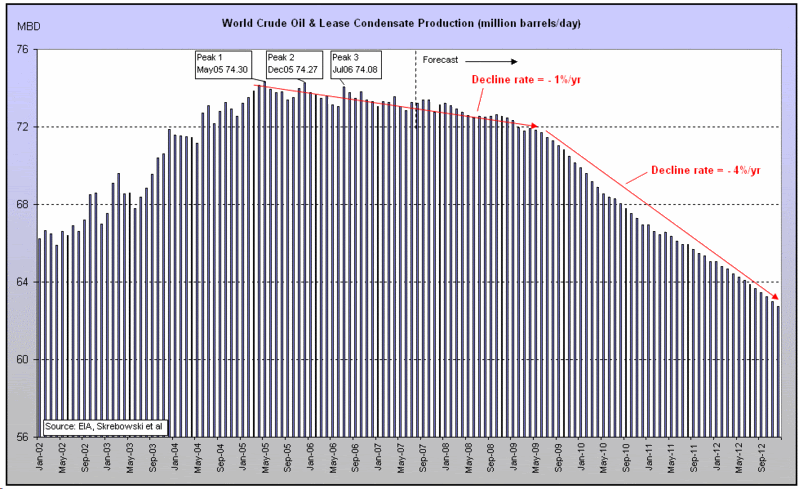
Fig 3 - World Crude Oil & Lease Condensate Production to 2012 (bottom up forecast) - click to enlarge
World C&C production retains its May 2005 peak and is forecast to decline by 1%/yr until 2009. The decline rate steepens to 4%/yr until 2012.
3. Peak Production and Peak Discovery Time Lags
Although the forecast production decline rate in Fig 2 appears high, it is a natural time lagged response to the peak year for discoveries as shown in this section. Fig 4 shows the peak discovery year in 1965, followed by a steady decline in the discovery rate. For every year since the mid 1980s, annual production has been greater than annual discoveries. This is not sustainable and it is inevitable that world annual production will start to decline. This timing of peak production and rate of decline is forecast by Fig 2.
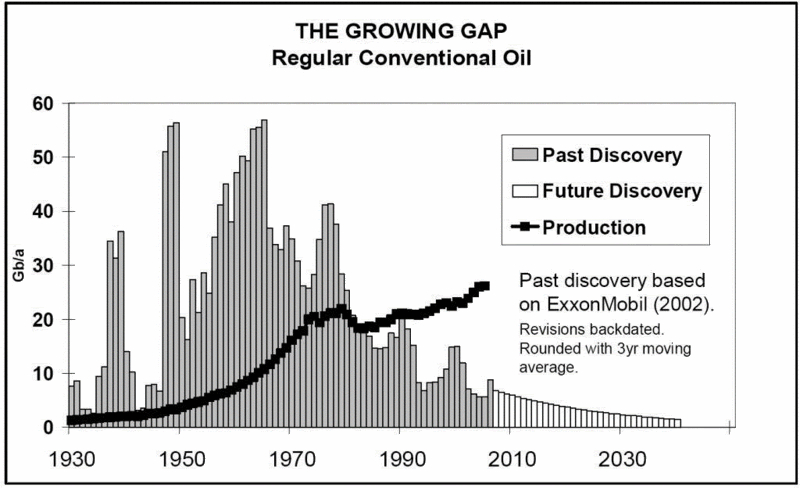
Fig 4 - World Discoveries (source ASPO Ireland Newsletter No. 80, August 2007) - click to enlarge
The figure below focuses on giant oil field discoveries and shows a similar shape to the figure above. The number of giant oil fields discovered peaked in the 1960-69 decade and both the number of giant fields and their respective recoverable reserves have declined steadily. The shape of the discovery decline curve below from 1960 to 2006 is similar to the production decline curve (Fig 2) from 2005 to 2100.
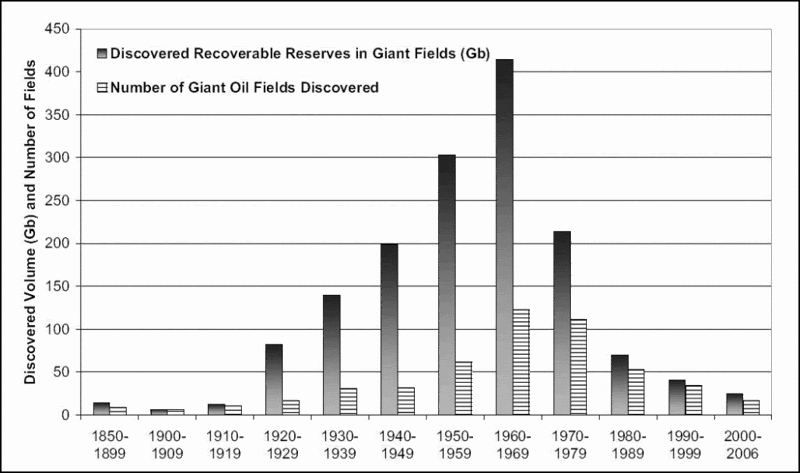
Fig 5 - World Discoveries, Giant Oil Fields (source Giant Oil Fields – The Highway to Oil, Fredrik Robelius, March 2007) - click to enlarge
A very good example of the time lag between peak discovery and peak production is the USA (Fig 6). Peak discovery was 1930 and peak production occurred 42 years later in 1972. Fig 4 shows peak discovery for the world occurred in 1965. Fig 3 predicts that peak production occurred in 2005, which is 40 years later than peak discovery, a similar time lag to the USA.
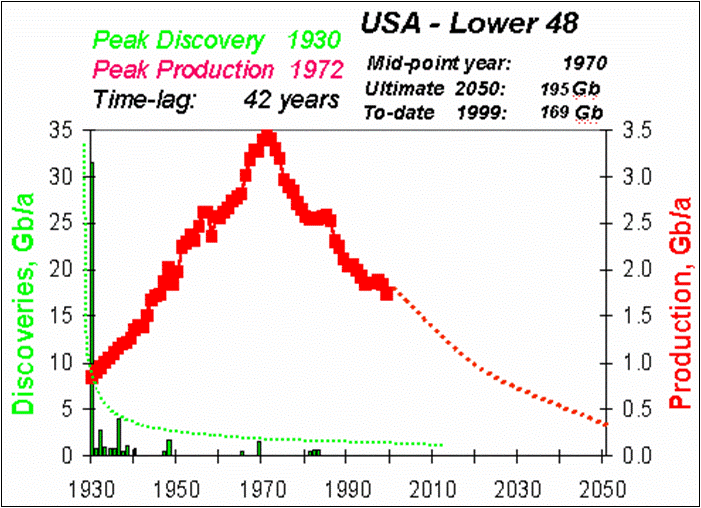
Fig 6 – USA Lower 48 Peak Discovery and Peak Production (source Peak Oil: an Outlook on Crude Oil Depletion, Colin J.Campbell, February 2002) - click to enlarge
4. World Crude Oil & Lease Condensate Production Changes
Year on year production changes, represented by the green bars in Figures 7 and 8 below, show the biggest declines for Mexico, North Sea and Saudi Arabia and the biggest increases for Russia, Azerbaijan and Angola. Angola has many projects which should increase its production capacity but actual production rates may be limited to OPEC quota targets of about 2.5 mbd. Russia’s mature field production will probably limit Russia’s future production growth.
Month on month changes from May 2007 to Jun 2007 (Fig 7), represented by the light blue bars, indicate stable Nigerian production but a steep fall in North Sea production due to summer maintenance. Over the same time period, Russia and Mexico showed small increases in production while Iraq and the USA showed small decreases.
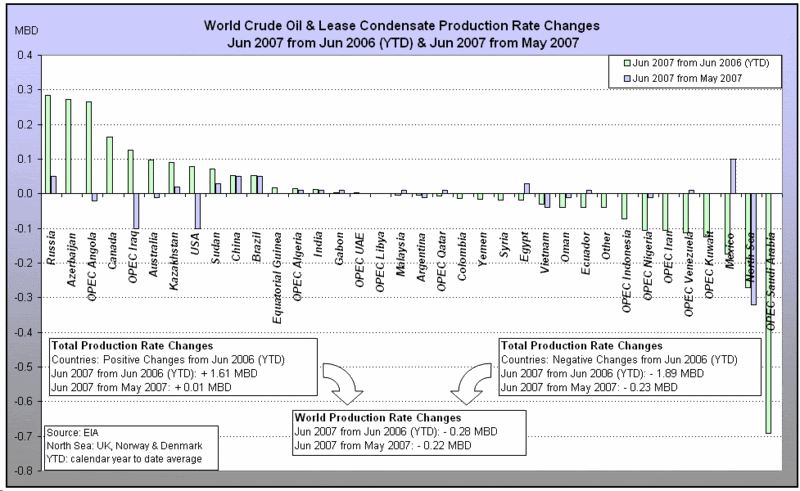
Fig 7 - World Crude Oil & Lease Condensate Production Changes to June 2007 - click to enlarge
Month on month changes from Jun 2007 to Jul 2007 (Fig 8) show a good increase in Nigeria’s production due presumably to reduced militant action. North Sea production increased significantly due to completion of maintenance, but production is still down from last year. Production fell for China which could be the start of a downwards trend. The production drop for Mexico is due mainly to continued geological decline as PEMEX announced that “oil reserves may run out in seven years”. Also from Jun 2007 to Jul 2007, Canada production fell slightly, despite the optimism about oil sands. Russia showed a small increase in production. Could this mean that Russia’s C&C production is on a plateau?
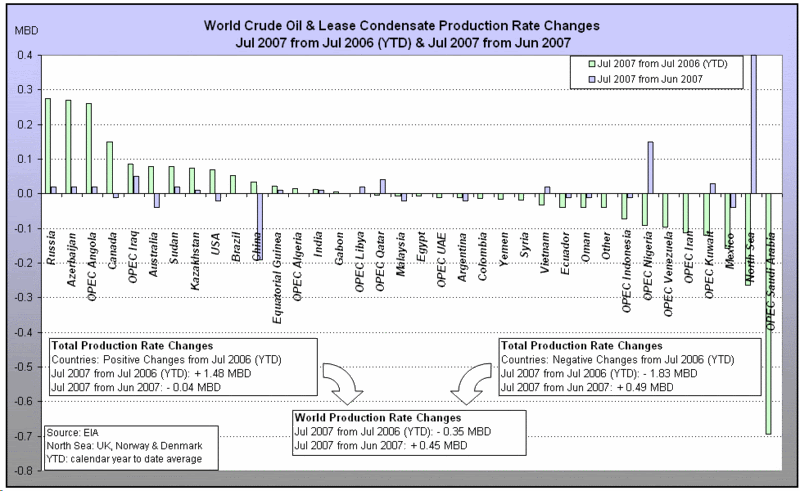
Fig 8 - World Crude Oil & Lease Condensate Production Changes to July 2007 - click to enlarge
World C&C production is dropping, on a year on year basis, by about 0.30 mbd (Figs 7 & 8). This is not a high decline rate but given that Russia is probably unable and unwilling to increase production and that Saudi Arabia, Kuwait, the UAE, the North Sea and Mexico are unlikely to reverse their decline rates, the world C&C production rate is forecast to continue its decline (Fig 3).
5. Saudi Arabia Crude Oil & Lease Condensate Production
Saudi Arabia remains a key producer in the world and continually reminds the world of its enormous reserves and surplus production capacity. This paragraph on capacity in IEA's 12 June 2007 Oil Market Report, page 15, explains Saudi Arabia’s current surplus capacity situation within an OPEC context.
Notional spare capacity stands at 4.0 mb/d, while our measure of effective spare capacity (excluding Indonesia, Iraq, Nigeria and Venezuela) stands at 2.85 mb/d. Although these volumes are physically producible, even this lower figure likely overstates what OPEC could actually shift onto the market given current prices and shortages in refinery upgrading capacity. Heavy, sour Saudi Arabian and Kuwaiti crude accounts for 88% of the effective spare capacity figure. In the absence of substantial discounts, these volumes might struggle to find buyers while sizeable amounts of refinery upgrading capacity remain offline for scheduled and unscheduled maintenance. Readily marketable spare crude capacity may therefore be much lower, and a more accurate reflection of current market tightness.
In other words, this IEA paragraph says that the world has only 0.35 mb/d spare capacity of readily marketable light sweet crude because the spare capacities of 2.20 mb/d from Saudi Arabia and 0.30 mb/d from Kuwait are hard to sell heavy sour crudes. In August 2007, energy analyst Bill Herbert reaffirmed IEA’s views when he said that “even if OPEC decides to open the spigot a bit more, it’s hardly a guarantee prices would stay in check. Most of OPEC’s spare capacity is in heavy sour crude oil, which must be processed in types of refineries that already are running at full capacity. There’s very little ability on the part of the supply system to respond to more demand”. Furthermore, the EIA Short Term Energy Outlook, 7 August 2007 stated that “The low level of surplus OPEC oil production capacity, which is primarily in heavy crude oil, remains a key reason for the continued tight market conditions…Further, the apparent unwillingness by OPEC to use available surplus capacity in the face of rising crude oil prices reduces any downward price impact that additional surplus capacity might have.” Given these statements by the IEA, Herbert and the EIA, the following forecast assumes no effective spare capacity of easily marketable Saudi Arabia crude.
It is also assumed that Saudi Arabia will produce their fields while maintaining the annual depletion rate, which is annual production as a percentage of ultimate recoverable remaining reserves, at less than 5.5%/yr. This should ensure that reservoir damage does not occur due to overproduction from their fields. The figure of 5.5%/yr was selected because the annual depletion rate of remaining reserves reached a peak of 5.3%/yr in the third quarter of 2006 (Fig 9), based upon estimated ultimate recoverable reserves (URR) of 185 Gb for Saudi Arabia. This figure of 5.5%/yr could be too optimistic. Tariq Shafiq, a petroleum engineer who was Vice President and Executive Director of the Iraq National Oil Company (INOC), said that a depletion rate of 4-5% is well within good reservoir management for large fields. In addition, Colin Campbell stated on page 7 of his ASPO Ireland Newsletter No. 80, August 2007 that “a Depletion Rate of 4.2%...sounds quite reasonable for a mature country like Kuwait, compared for example with 6.5% in the United Kingdom or 4.5% in the US-48”. If a lower forecast annual depletion rate is assumed then Saudi Arabia’s production rate would drop faster than is forecast (Fig 9).
The estimated URR of 185 Gb is equal to 150 Gb of non heavy crude plus 35 Gb of heavy crude. The 35 Gb includes the heavy sour crude fields of Safaniya and Manifa, which is slightly less than Horn's 2006 estimate of 37 Gb. The non heavy crude URR of 150 Gb includes 75 Gb for Ghawar (light) which is greater than Horn’s estimate of 66 Gb, 13 Gb for Abqaiq (extra light), 9 Gb for Berri (extra light), 6 Gb for half of the Neutral Zone and the remaining URR is assigned to Aramco’s other non heavy crude fields including Marjan, Qatif, Khurais, Zuluf, Shaybah, Abu Safah and Khursaniyah. The estimated URR is based on the information sources about Saudi Arabia, located at the end of this article and the previously mentioned Horn's 2006 paper. Furthermore, this estimate of URR 186 Gb, from this source, gives good support for the estimated URR of 185 Gb.
The possibility of a lower Saudi Arabia total URR exists. Based on this mathematical technique, this recent research “suggests that the Saudi Qt (or total URR) is only 150 Gb, which in turn suggests that Saudi Arabia is now over 70% depleted, with about 40 Gb in remaining recoverable reserves.” A 2006 research paper, using the same method, estimated a total URR of 160 Gb, as shown in this plot. Another source of oil reserves, prior to nationalization of Saudi Aramco in 1980, is a report titled “Critical Factors Affecting Saudi Arabia’s Oil Decisions”, published by the US General Accounting Office in 1978. As referenced on page 72 of Twilight in the Desert, this report stated that the remaining proven reserves as at the end of 1976 was 110 Gb with 70 Gb in the four super giants of Ghawar, Safaniya, Abqaiq and Berri. Cumulative production from these four giant fields was 26 Gb and cumulative production for all Saudi Arabia was 29 Gb. Thus, total proven reserves (produced and remaining) at the end of 1976 was equal to 139 Gb (29 Gb plus 110 Gb), of which 96 Gb (26 Gb plus 70 Gb) was attributable to the four super giants and 43 Gb (3 Gb plus 40 Gb) was attributable to the rest of the fields. This figure of 139 Gb does not include probable reserves, unlike total URR, and is less than the total URR estimates of 150 Gb and 160 Gb from the two research sources above. Allowing for the inclusion of probable reserves, heavy oil reserve upgrades and only small discoveries since the last giant field Shaybah was found in 1968, an appreciation from 139 Gb to the total URR of 185 Gb appears reasonable.
As of September 2007, Aramco’s total cumulative C&C production was 112 Gb, being 61% of the URR 185 Gb. Over half of the 112 Gb has been produced from the super giant Ghawar. Abqaiq, Berri and Safaniya have also been significant producers. It is assumed that Aramco will increase their production during this winter according to recent OPEC quota increases . Aramco has produced over half of the estimated URR and the production curve is forecast to follow a typical post peak decline curve, shown by the red line in Fig 9. Unfortunately, the new production capacities from AFK, Shaybah expansion, Nuayyim and Khurais are not enough to offset decline from existing fields. Aramco has probably scheduled Manifa last because it will produce heavy oil which is less marketable than lighter grades.
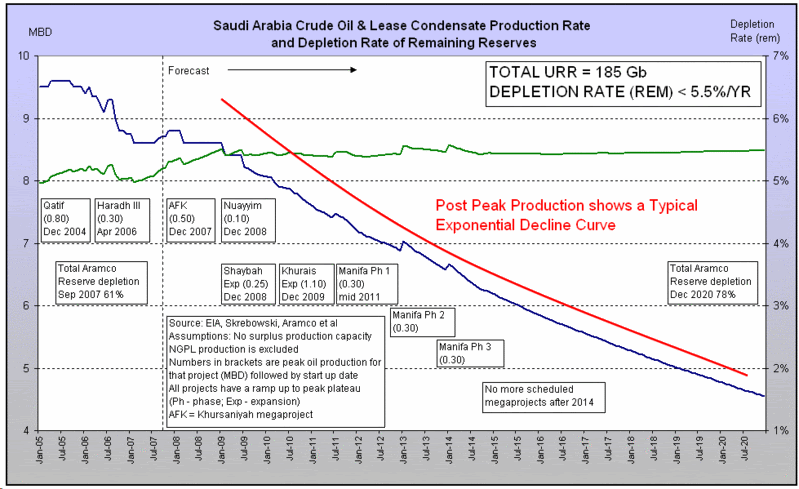
Fig 9 - Saudi Arabia Crude Oil & Lease Condensate Production to 2020 (bottom up forecast) - click to enlarge
Figs 9 and 10 have been updated for Aramco’s most recent project schedule, released in June 2007, which no longer includes originally scheduled expansion from both Al Khafji (Neutral Zone, 0.30 mbd, 2011) and Shaybah phase 2 expansion (0.25 mbd, 2010). Furthermore, Aramco’s recent project schedule showed Khurais start-up on June 2009, but now a recent press release dated 25 July 2007, on Saudi Aramco’s website states that Khurais is “scheduled for the end of 2009”, which is assumed to be December 2009 for Figs 9 and 10. Although Khurais is forecast to produce 1.1 mbd, Matt Simmons doubts that Khurais will produce 0.8 mbd. This report stated that the “Khurais field west of the giant Ghawar field could potentially increase Saudi production by a further 800,000 b/d” and another report made a similar statement “Another potential project, at the Khurais field, could increase Saudi production capacity by 800,000 bbl/d”. These statements indicate that the forecast production of 1.1 mbd from Khurais might be too high.
There are three forecast scenarios from 2007 to 2080, shown in Fig 10. The solid red line shows a “Do Nothing” forecast scenario. This represents a production decline rate of 8%/yr which is equivalent to ultimate recoverable reserves of 148 Gb (billion barrels). This scenario is highly unlikely but serves as a useful lower bound for the forecast production profile. The “New Peak?” dashed red line represents a scenario for which another peak is attained. However, the inset in the chart explains that another 1.75 mbd would be required from other projects and infill drilling. This is highly unlikely and predicts that a peak in 2005 has passed. The “Bottom Up” dark blue line in Fig 10 represents the most likely scenario and includes the bottom up forecast to 2020 from Fig 9, followed by an annual production decline rate of 4%/yr.

Fig 10 - Saudi Arabia Crude Oil & Lease Condensate Production to 2080 - click to enlarge
Saudi Arabia has never directly admitted that it has passed peak C&C production, but in August 2004 a former OPEC president, Purnomo Yusgiantoro, admitted that “oil prices were at crazy levels, but that OPEC was powerless to cool the market…There is no more supply”. Thus, based on Yusgiantoro’s statement, in August 2004, Saudi Arabia’s C&C production was at maximum capacity of 9.5 mbd, up by a significant 1.1 mbd from April 2004 (EIA). Furthermore, on 11 April 2006, according to this source and requoted here, Platts quoted a Saudi Aramco spokesman saying that “Saudi Aramco’s mature crude oil fields are expected to decline at a gross average rate of 8%/yr without additional maintenance and drilling” and that “This maintain potential drilling in mature fields combined with a multitude of remedial actions and the development of new fields, with long plateau lives, lowers the composite decline rate of producing fields to around 2%.” Therefore, as of April 2006, Aramco’s crude oil production was forecast by this Aramco spokesman to decline at 2%/yr which means that Saudi Arabia has passed peak crude oil production.
These three sources provide additional information about Saudi Arabia’s production decline rates. Aramco Senior Vice President Abdullah Saif admitted that “One challenge for the Saudis in achieving this objective is that their existing fields sustain 5 percent-12 percent annual "decline rates," (as reported in Petroleum Intelligence Weekly and the International Oil Daily) meaning that the country needs around 500,000-1 million bbl/d in new capacity each year just to compensate”. The Schlumberger CEO said that “the industry is dealing with a phenomenon that is exaggerated by the lack of investment over the past 18 years. This phenomenon is the decline rate for the older reservoirs that form the backbone of the world’s oil production, both in and out of OPEC. An accurate average decline rate is hard to estimate, but an overall figure of 8% is not an unreasonable assumption.” The EIA also stated that a “challenge for the Saudis in achieving their strategic vision to add production capacity is that their existing fields sustain, on average, 6 to 8 percent annual "decline rates” (as reported by Platts Oilgram) in existing fields, meaning that the country needs around 700,000 bbl/d in additional capacity each year just to compensate for natural decline.”
Saudi Arabia C&C production was 9.5 mbd in August 2004. According to the previous EIA statement, Saudi Arabia needs 0.7 mbd additional capacity each year just to compensate for natural decline. Therefore, three years later, by August 2007, additional capacity of 2.1 mbd (3*0.7 mbd) would have been required just to compensate for natural decline. Since August 2004 there was a total capacity addition of only 1.1 mbd from these two projects as stated by Saudi Aramco’s Press Kit on their website. In late 2004, Qatif (including Abu Safah) began operations with production capacity of 0.8 mbd and in early 2006, 0.3 mbd capacity from Haradh III, 0.3 mbd (Fig 9), which leaves a shortfall of 1.0 mbd. This implies that Saudi production in August 2007 is 8.5 mbd, 1.0 mbd less than the 9.5 mbd production in August 2004, excluding capacity additions from infill drilling. Accordingly, this number of 8.5 mbd is slightly less than the number of 8.6 mbd for July 2007, from the EIA Short Term Energy Outlook, Table 3a, 7 August 2007. Based on the quotes and statements in this and the previous two paragraphs, it is highly unlikely that capacity additions from new projects, including infill drilling, are sufficient to compensate for existing production decline, and consequently the “Bottom Up” scenario in Fig 10 remains the most likely scenario.
6. Kuwait Crude Oil & Lease Condensate Production
It is assumed that Kuwait will produce their fields while maintaining the annual depletion rate below 4.5% which is slightly higher than its peak depletion rate of 4.1% on Oct 2006. The URR of Kuwait, including its share of the Neutral Zone, is assumed to be 60 Gb. This is based partly on Colin Campbell’s August 2007 newsletter which states that the balance of evidence points to a total URR of 53 Gb for Kuwait only (excluding the Neutral Zone - NZ). Adding in 6 Gb for half the Neutral Zone and rounding up gives a total URR of 60 Gb. This research estimates Kuwait URR to be 75 Gb, but if the most recent data point is treated as an outlier then the URR could drop to about 65 Gb. Furthermore, in January 2006, this surprise downgrade of remaining proven reserves to only 24 Gb, 25% of the BP Annual Statistics official figures of 99 Gb, with 15 Gb in its biggest field Burgan, adds further support to a URR of 60 Gb. The accompanying reserves data table shows the total produced and remaining proven reserves to be 60.2 Gb, including the NZ. This figure may indicate that the above URR might be too low, but given the insignificant new scheduled production capacity by KOC (Fig 11), the URR of 60 Gb will be assumed for forecasting the production rates.
As of September 2007, Kuwait’s total cumulative C&C production was 38 Gb, being 63% of the URR 60 Gb. Over half of the 60 Gb has been produced from the super giant Burgan. It is assumed that Kuwait will increase their production during this winter according to recent OPEC quota increases. Kuwait has produced over half of the estimated URR and the production curve is forecast to follow a typical post peak decline curve, shown by the red line in Fig 11. Unfortunately, the insignificant new scheduled production capacities from GC-14 and Sabriya GC-24 are not enough to offset decline from existing fields.
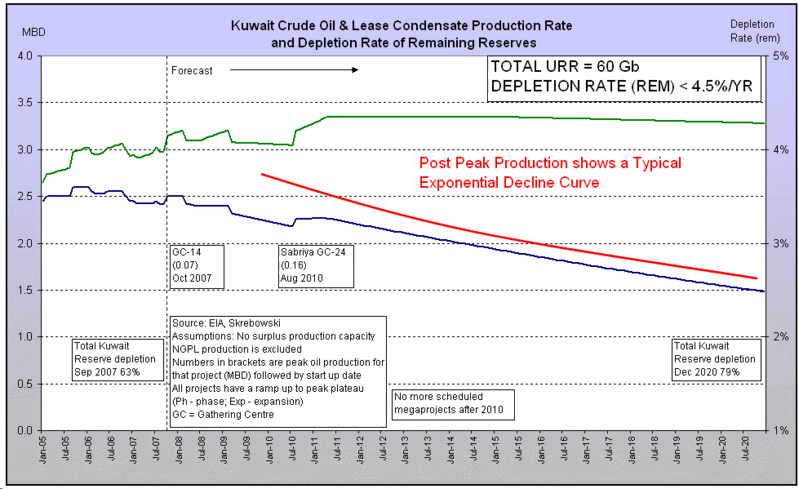
Fig 11 - Kuwait Crude Oil & Lease Condensate Production to 2020 (bottom up forecast) - click to enlarge
There are only two new projects shown in Fig 11, GC (Gathering Centre) -14 and Sabriya GC-24, according to OPEC’s upstream investment plans. The Al Khafhi expansion (NZ) was a potential project but as stated in the previous section on Saudi Arabia, it is no longer shown on Aramco’s project schedule. GC-14 is only contributing 0.07 mbd capacity and GC-24 was originally scheduled for 2008, according to OPEC, but it is now been delayed until 2010. Project Kuwait, costing $US8.5 billion, which has been discussed in Kuwaiti parliament for ten years has still not been approved as of October 4, 2007. This extensive delay probably means that Project Kuwait’s key assets are difficult reservoirs similar to heavy oil which will comprise a large part of Kuwait’s future oil production.
The unsubstantiated production targets of the Kuwait Oil Company (KOC) are partly explained in their publication, The Kuwaiti Digest, on KOC’s website. The Jan-Mar 2006 issue stated that the KOC’s production target is 4 mbd, up 1.5 mbd from their current 2.5 mbd production at that time. However, the only significant project mentioned is the $US8.5 billion Project Kuwait which aims to raise production by only 0.37 mbd, over a 20 year period, which is small relative to the required 1.5 mbd increase. The Jul-Sep 2007 issue stated that “There may be surprises for our general readers – that we cannot reach our 4 million barrels per day strategy for 2020 without unlocking the potential partnerships of International Oil Companies (IOC).” In other words, the KOC is struggling to increase their output without assistance from the IOCs. However, even if an agreement can be made with the IOCs to start Project Kuwait and identify other projects, the time to first oil could be several years which means that decline rate in Fig 11 may only be a little less than forecast and that the minor peak of 2006 would not be exceeded.
There are three forecast scenarios shown below. The solid red line shows a “Do Nothing” forecast representing an equivalent URR of 53 Gb, which serves as a lower bound. The “New Peak?” dashed red line represents a scenario for which another minor peak is attained. However, the inset in the chart explains that at least another 0.47 mbd would be required from other projects and infill drilling. This is highly unlikely and predicts that a minor peak in 2006 has passed. The “Bottom Up” dark blue line in Fig 12 represents the most likely scenario and includes the bottom up forecast to 2020 from Fig 11, followed by an annual production decline rate of 4.5%/yr.
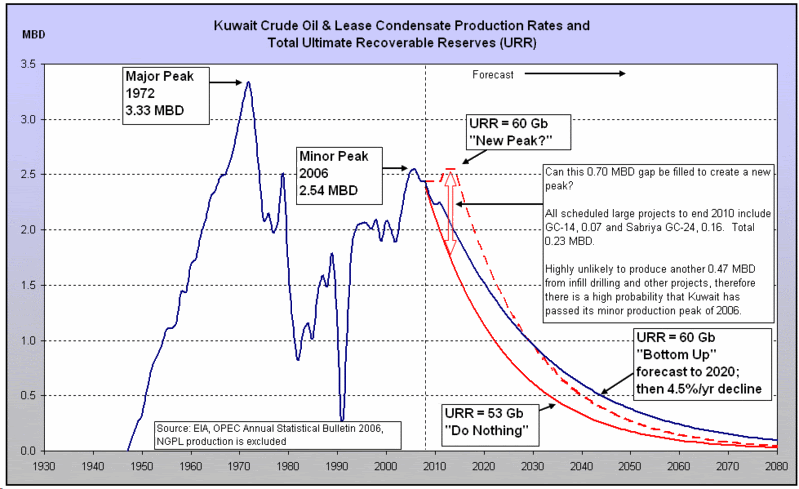
Fig 12 - Kuwait Crude Oil & Lease Condensate Production to 2080 - click to enlarge
Like Saudi Arabia, Kuwait has never directly admitted that it has passed peak C&C production. However, in November 2005, the Kuwait Oil Company admitted that Burgan, Kuwait’s biggest field and the world’s second largest, had passed peak. This admission is further supported by EIA data showing that Kuwait C&C production fell off a 2.6 mbd peak plateau in February 2006. As Burgan is Kuwait’s largest field, comprising at least 60% of the total URR, the Kuwait Oil Company admission provides strong evidence for Kuwait having passed its minor peak C&C production in 2006.
7. UAE Crude Oil & Lease Condensate Production
It is assumed that UAE will produce their fields while maintaining the annual depletion rate below 5.0% which is the same as its peak depletion rate of 5.0% on Oct 2006. The URR of UAE is assumed to be 45 Gb which is between the two following estimates. This chart predicts that the total URR is just over 43 Gb. Page 49 of this MIT source from August 1977 stated that the URR of Abu Dhabi, which holds almost all the oil of the UAE, was 49 Gb.
As of September 2007, UAE’s total cumulative C&C production was 26 Gb, being 57% of the URR 45 Gb. It is assumed that UAE will increase their production during this winter according to recent OPEC quota increases. However, this may not occur as a planned production decrease of 0.6 mbd, due to maintenance, will occur in November 2007 as shown by downwards spike. UAE has produced over half of the assumed URR and the production curve is forecast to follow a typical post peak decline curve, shown by the red line in Fig 13. Unfortunately, the new scheduled production capacities do not start until 2010 and are not enough to offset decline from existing fields.
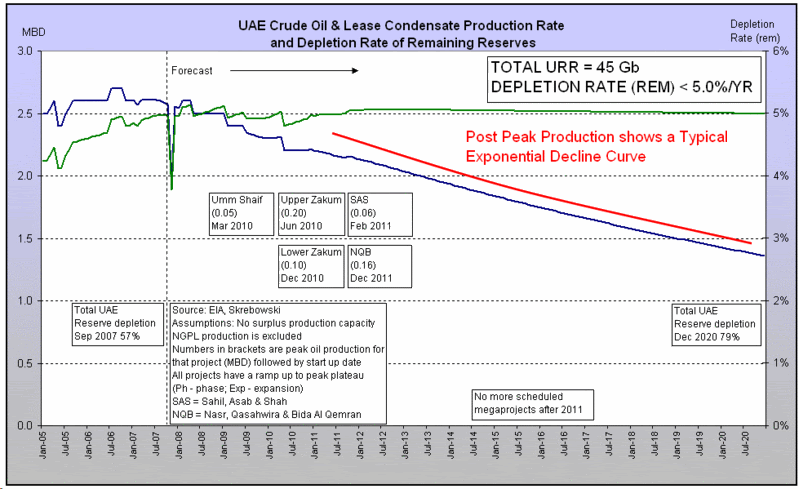
Fig 13 - UAE Crude Oil & Lease Condensate Production to 2020 (bottom up forecast) - click to enlarge
There are three forecast scenarios shown below. The solid red line shows a “Do Nothing” forecast representing an equivalent URR of 40 Gb, which serves as a lower bound. The “New Peak?” dashed red line represents a scenario for which another peak is attained. However, the inset in the chart explains that at least another 0.23 mbd would be required from other projects and infill drilling. This is highly unlikely and predicts that a minor peak in 2006 has passed. The “Bottom Up” dark blue line in Fig 14 represents the most likely scenario and includes the bottom up forecast to 2020 from Fig 13, followed by an annual production decline rate of 5.0%/yr.
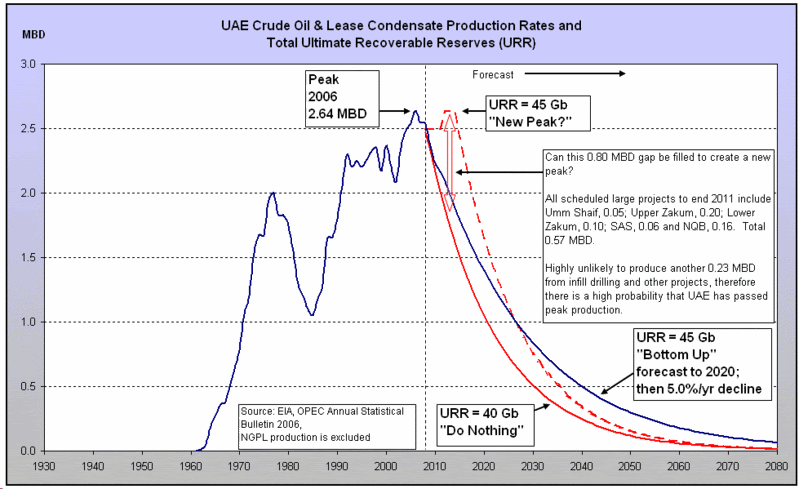
Fig 14 - UAE Crude Oil & Lease Condensate Production to 2080 - click to enlarge
Also like Saudi Arabia, UAE has never directly admitted that it has passed peak C&C production. The scheduled maintenance in November 2007, reducing production by 0.6 mbd, may only serve to ensure that production remains at about 2.5 mbd for 2008, as there has been no disclosure by UAE about the impact of this maintenance on future production rates. As UAE does not have any projects scheduled until 2010, it is likely that UAE has passed its peak in 2006.
8. Other Components of Total Liquids Production
Natural gas plant liquids show an increase in production due to OPEC projects from Saudi Arabia, Algeria, Iran and Qatar. Saudi Aramco’s most recent project schedule, released in June 2007, shows two significant NGPL projects to be completed within a year: Hawiyah at 318,000 barrels/day and Khursaniyah at 290,000 barrels/day.
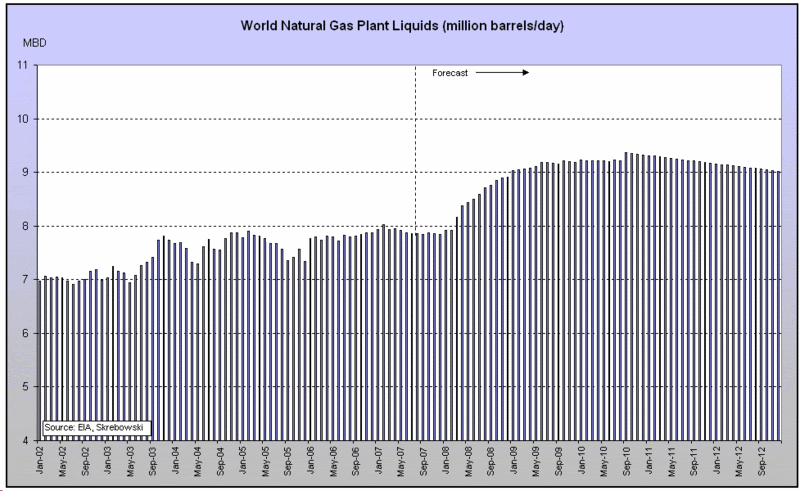
Fig 15 - World Natural Gas Plant Liquids Production to 2012 (bottom up forecast) - click to enlarge
Ethanol and XTL (BTL, CTL and GTL) production is forecast to double to 2012. Unfortunately, the increased production of government subsidised corn based ethanol in the USA is increasing the prices of many other food products.
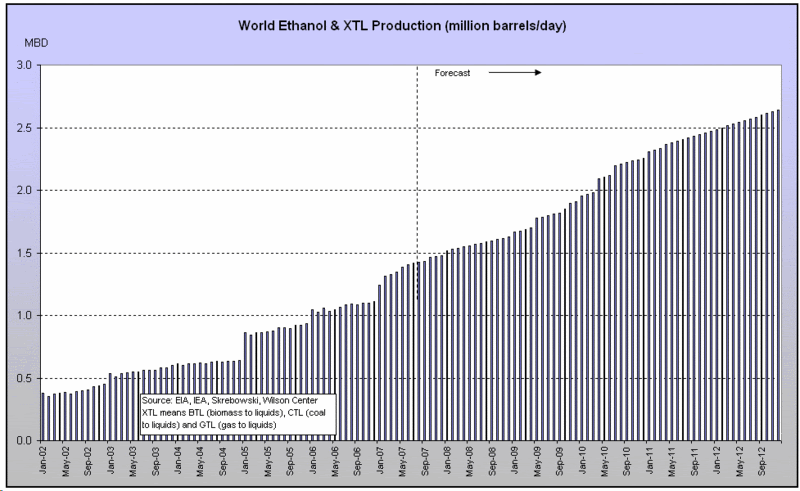
Fig 16 - World Ethanol & XTL Production to 2012 (bottom up forecast) - click to enlarge
Processing gains are defined by the EIA as “The volumetric amount by which total output is greater than input for a given period of time. This difference is due to the processing of crude oil into products which, in total, have a lower specific gravity than the crude oil processed.” These gains are forecast to decline slowly based on the decline in C&C (Fig 3).

Fig 17 - World Processing Gains to 2012 (bottom up forecast) - click to enlarge
8. Additional Information Sources
For more forecasts please refer to this article by Khebab, Peak Oil Update - September 2007: Production Forecasts and EIA Oil Production Numbers and to Peak Oil Media Redux by Prof Goose, including this lecture by Dr. Albert Bartlett.
Further articles about Saudi Arabia, Kuwait and UAE:
by Stuart Staniford
- Saudi Arabia and Gas Prices
- Depletion Levels in Ghawar
- The Status of North Ghawar
- Further Saudi Arabia Discussions
- Water in the Gas Tank
- A Nosedive Toward the Desert
- Saudi Arabian oil declines 8% in 2006
- What would we have predicted for Kuwait?
by Euan Mearns
- Ghawar reserves update and revisions (1)
- GHAWAR: an estimate of remaining oil reserves and production decline (Part 2 - results)
- GHAWAR: an estimate of remaining oil reserves and production decline (Part 1 - background and methodology)
- Saudi production laid bare
- Saudi Arabia and that $1000 bet
- IHS Data Suggest Kuwaiti and Global Proved Oil Reserves Significantly Lower Than BP Estimates
by Heading Out
- Simple mathematics - The Saudi reserves, GOSPs and water injection
- Of Oil Supply trains and a thought on Ain Dar
by Khebab
- The Hubbert Linearization Applied on Ghawar
- An Attempt to Apply The Parabolic Fractal Law to Saudi Arabia
by Ace
World Oil Forecasts Including Saudi Arabia, Kuwait and the UAE - Update Oct 2007
PDF version
102 comments
World Oil Forecasts Including Saudi Arabia, Kuwait and the UAE - Update Oct 2007
PDF version
102 comments
Contact
- Content: editors at theoildrum dot com
- Tech support: support at theoildrum dot com
License

This work is licensed under a Creative Commons Attribution-Share Alike 3.0 United States License.
Your UAE plot is interesting. It's quite close to what Khebab came up with.
Needless to say, I agree with your reserve and production estimates.
Also, the UAE was the only top five net exporter to show an increase in net exports from 2005 to 2006 (EIA). When both the Russian and UAE net export declines kick in (perhaps happening right now), the top five net export decline will really start to accelerate.
From what I have read, some of the UAE production will be down in Nov. for maintenance, yet due to planned EOR projects the UAE fields might peak 2010-2012 then decline without any significant plateau. Saudi Arabia stated peak forward capacity will occur in 2009. Kuwait has not announced recent plans to increase oil production, but warned that $100 a barrel oil might happen in two years, then in a later statement that the fundamentals were such that it might occur at any time.
Mexican production from Cantarell will continue a rapid decline. The ramping up of the KMZ fields might be over within three-four years, then KMZ will go into decline. Other Mexican projects were not on the scale of Cantarell or KMZ in the Bay of Campeche and were in either deep water or technically difficult strata/structure.
Alaskan production is declining. The Federal Govt. stopped Shell's Alaskan offshore exploration and a large block of leases west of Prudhoe were recently released and abandoned by a partnership due to no commercial discoveries after years of exploration.
GOM property up to 30,000 feet deep in subsalt areas has been of interest. The deep offshore drilling fleet is rapidly expanding, yet there were problems with some of these deep structures showing signs of compartmentalization; meaning there was not free movement of oil across large areas.
Nigeria was slowing in reserve growth, yet is expected to grow in production.
Angola and now Ghana have been sites of numerous successful discoveries. Brazil was yet growing reserves and production.
Chevron has reserves in Kazakhstan, but was unsure of pipeline capacity. Azeri ACG production might peak about 2010 to 2011 taking up most of the BTC pipeline. There might be satellite fields and other Caspian production to fill it after that. There was a discuss building a pipeline across the Caspian to the BTC. No known financial commitments for it at this time.
Ecuador increased taxes on oil production chilling interest in developing that area.
Canada was studying increasing royalties ... that might slow growth as some companies have incurred expensive debt obligations to develop expensive projects and might be contrained in further development.
China grew oil imports on the order of about 500,000 barrels from Aug 2006 to Aug. 2007.
U.S. liquids consumption was slightly down year on year in recent EIA reporting.
Higher prices are likely to bring some conservation measures, else prices will go higher until more conservation occurs.
Ecuador is demanding 99% of proceeeds above the cost of oil at the time contracts were signed (around $35/barrel) in addition to the 25% of gross production they receive off the top.
This amounts to nationalization as it totally kills any chance for an outside the country corporation to make a profit.
One must remember that production costs go up as the price of oil and fuel rise. The two are highly interrelated.
My family owns City Oriente in Ecuador. Or did, before this.
I now expect that our investment there will be taken (stolen).
I did inhale.
http://science.reddit.com/info/5yezq/comments/
thank you for your support.
Thanks for compiling this.
I'm sure it represents a lot of hard work.
I did inhale.
I'm inclined to believe you're understating the problems with BTL growth, especially ethanol. I would be very surprised to see much more growth from corn ethanol production, with the ongoing droughts and the floods in various parts of the world this year, I think we are just beginning to see the first impacts from climate chaos. It comes down to a choice between food or fuel; while people want to drive, they need to eat.
Otherwise I think you're right on the mark.
Yes, but I think he is on the right track with Oil sands.
Many factors will NEVER allow them to get to 4MMBPD. (eg. EROEI, Natural gas supply, water supply, pipelines...etc, etc)
With Mexico declining, Canada not changing much, and Venezuela become more antagonistic, it is obvious why the US keeps pushing Artic oil.
Nothing else growing in this hemisphere! (of significance)
I agree, there is a strong chance that ethanol production will not grow at the same rate, especially if the US takes away government subsidies.
Ace...that is a lot of work.
This quarter will be interesting!
Thanks!
I think it will be apparent with in DAYS(30-60 day window) that KSA cannot/will not EVER increase production again.
If it is voluntary, they aren't acting like they have such a great hand (to use a poker simile).
500 KBPD of *new* production(if it materializes) will not go far in closing the coming 1.87MMBPD DEMAND GAP.
So, voluntary or involuntary...an oil crunch of significant impact is coming to a gas station/furnace near you soon!
If there is a normal cold winter, a big blame game is likely to emerge. Customers will blame OPEC for not supplying enough oil. OPEC will blame its customers for not being clear about demand. Big Oil will say there are not enough skilled people to do projects...
Ace, could you please prepare a graph showing declining and growing production as Gail and me did in this post: http://www.theoildrum.com/node/3052
If 2009 is the end of a plateau - as shown in your Fig. 1 - then the growing group should peter out to zero growth in that year, with total production sliding down at the rate of the declining group, which is now 4% but could be higher in 2009.
Hi Matt,
No thanks, I think your chart combined with the charts above are sufficient.
In regards to KSA, I'm amazed that the analysis failed to take into account the increase in oil production that will occur in November. Not only that, but KSA increased their shipment allotments to all Asian refineries back to 100% of their contractual obligations, with no cuts planned for anyone else. In light of these facts, it is almost equally certain that things are not as they seem in KSA, and that they do indeed still have some spare capacity.
But making statements like 'they have almost certainly past their peak' really only stakes out an aggressive close-minded position regarding their production. At the very least, you should include the 'possibility' that their production will increase this year, and next year 'as they said it would if oil remained above $80, which it has'.
Using the same logic, i.e. increases in production following declines, Texas and the Lower 48 have not peaked.
In any case, IF Saudi Arabia averages 9.0 mbpd in the fourth quarter, their 2006 to 2007 decline rate will be -5.6%/year (C+C), versus a -4.3%/year decline rate for 2005 to 2006. If they maintain 8.6 mbpd for 2007, their decline rate would be -6.7%/year.
Meanwhile, just the top five net exporters will probably consume an additional 500,000 bpd or so in 2007 versus 2006.
That is not the logic that I used, WT, and that is a blatant mis characterization of what I typed. No one is denying that Texas and the Lower 48 peaked. The question is has KSA peaked, which I do not believe, nor do several other contributors of this site.
Actually, the Texas State Geologist is talking about the possibility of Texas matching its peak production.
In any case, I didn't express an opinion about Saudi Arabia until I saw the HL plot.
Again, you go about trying to compare me with some crack pot Texas State Geologist. Shame on you sir! And they say that _I_ am the one who makes the Ad hominem attacks here!
KSA's HL is too noisy to make accurate predictions. If you weren't blinded by your rhetoric, you would agree with Stuart on that at the least.
Will occur? That would be allowed by the recent increase in their quota, is more like it. I am not sure KSA has even promised that increase or promised to try for that increase.
Apparently you've missed all the news about this little fact over the past month :P
I have heard about the raising of the quota and I have heard all the speculation in the business press that this would certainly mean that KSA would be raising their production in November. What I have not heard is direct promises or assurances from the Saudis that they would do so. The clueless business press assumes that it's no problem and that they will certainly do so. But there are a lot of people on this site who think they do not know what they are talking about. That KSA is incapable of raising their production and have been just hiding behind the quotas.
Perhaps you can give me a link to a quote from KSA where they make such a promise. I will admit that they might either lie about it or may be deluding themselves. I would be interested to see what they have said about it because I do not follow it that closely.
When was the last time Saudi Arabia failed to fulfill an increase in its production quota?
Do you really think an increase in its quota could have been announced by OPEC without the express permission of Saudi Arabia? Why would they announce an increase they were unable to provide? How would that possibly benefit them more than continued platitudes of "the market is well supplied, it's just speculators driving up the price"?
What more of a promise from Saudi Arabia do you want than OPEC announcing a production increase which is widely described as "Saudi Arabia Wins OPEC Increase"? How much more official does it get?
So you agree with me that the Saudis have made no such commitment? The business press is just interpreting what they think happened at the OPEC meeting.
Maybe the Saudis are trying to hide the fact that they can no longer raise production but OPEC had to do something. They had to raise the quotas to satisfy the consumer countries and the Saudis were the logical ones, based on the story they have been telling, to take the quota increase.
You tell me. They are down a million barrels a day but they are still producing at their quota?
Sorry but I could not tell if your comment was serious.
Of course not. The OPEC announcement is a Saudi commitment.
Why did OPEC have to do something? Who would make them? How would announcing an increase and then failing to provide it be in any way better than not announcing an increase?
How would that make any sense?
Yes.
And, to the best of my understanding, they've successfully fulfilled all of their assigned production increases for years. Why should we assume they'd announce an increase now that they couldn't fulfill?
How would that possibly be in their best interests?
In your purely rational world, maybe OPEC didn't have to do anything, Pitt. But homo sapiens are not strictly rational. Heck, we're not even consistently rational. OPEC claims to be sitting on vast reserves of oil. Oil has been part of the causes of both WWI and WWII (not the only causes but part). If the rest of the world cannot increase production but needs additional production, how far down do you think they will allow their own economies to fall before they decide to take what they need from OPEC? Clearly, the Bush administration has demonstrated that at least one great power is willing to use force over oil. Will Russia? China? Europe? On the political side OPEC must take that issue into consideration, especially since threats have been made in that direction in the past (see Carter Doctrine, etc.).
Further, OPEC just stated yesterday that pumping more oil will not help bring down the price. This statement comes before the production increase is supposed to kick into play in full. Such a weasel statement gives OPEC room to back out of the production increase by claiming that they have already concluded that more oil will not help prices.
Finally, the ability of KSA to increase production temporarily does not refute an assertion of an earlier peak. Please go review the US production numbers from 1969 through 1973 and you tell me exactly how you would have been sure that the US had peaked when it actually did. Here's the data graphically (click on the thumbnails for the full graphic):
Or as a simpler graph:

The only way we will ever know that KSA peaked is in hindsight. All we can do now is guess but as Stuart has pointed out, there's pretty convincing data that KSA has peaked.
"The greatest shortcoming of the human race is our inability to understand the exponential function." -- Dr. Albert Bartlett
Into the Grey Zone
Thanks for a good explanation which I do not have time for right now.
You're being absurdly melodramatic about the fact that OPEC decided to wait a couple months after prices rose before increasing production.
If OPEC said "the market is well supplied" in September and didn't announce an increase, nobody would have invaded them. Nobody would have done anything except grumble, bid up the price of oil, and try convincing OPEC to change their minds. The idea of taking the oil by force is utter nonsense - the US would bomb the hell out of anyone who tried, and the US's own military is in no shape to try taking oil from anyone...not that an invasion would boost oil production even if one were possible (see Iraq).
So OPEC didn't "have to do" anything in September. That they announced a production increase therefore suggests that they want to increase production, intend to increase production, and almost certainly can increase production.
But if you have an alternative explanation that you believe is consistent with the facts and doesn't revolve around waving your hands wildly while talking about vague threats, please be my guest and explain it.
Why would they announce an increase and then rescind it? Wouldn't that just bring more resentment their way than simply not announcing it in the first place?
Moreover, the new quotas go into effect in 2 weeks, and there's no OPEC meeting between now and then. When was the last time OPEC cancelled a quota change on short notice without calling a meeting? Have they ever done that for a production increase in the face of high prices?
That would be a very strange thing for OPEC to do, which raises the question of why they'd possibly want to do that. It's usually unwise to assume someone is lying and insane unless there's good evidence to back that up, and you haven't given any such evidence regarding OPEC.
No, but it is evidence against such a peak, and it's strong evidence against an assertion of KSA being in permanent decline.
I'm not saying Saudi Arabia will exceed its prior production maximum; all I'm saying is that (a) Saudi Arabia is likely to fulfill its quota increase, and (b) Saudi production does not appear to be undergoing an irreversible decline characteristic of being "post peak".
Not really - we can also evaluate the hypotheses made at the beginning of the year.
Some hypotheses were that Saudi production was involuntarily declining, and that they'd be producing about 5% lower by now. Those hypotheses were wrong.
Some hypotheses were that Saudi production was voluntarily declining, and would not decline any further once oil prices stopped falling. Those hypotheses were right.
Examining the past performance of certain groups of hypotheses is potentially useful if the same people are making the same hypotheses now as they did then. If someone keeps insisting that something is true, even when it keeps being false, that person may not be reliable. Even if - like a stopped clock - what they're insisting will eventually come to pass, their current insistence offers little or no information.
Are you sure that's what he's said?
"But really, there is a lot of oil left. South Ghawar alone has huge reserves remaining, and the only reason production there is not larger is because of relatively conservative development practices (eg peripheral waterflood, rather than infield). If they were to change their philosophy and go all out for short term production, they could go pretty high."
That seems, to me, to suggest that Saudi Arabia could surpass their prior peak if they wanted to, but may or may not choose to develop their (ample) resources in such a manner.
When "peaked" is usually understood to mean "Hubbert Peak", or geologically-based limit on production rate, then I would argue that SS's statement, above, suggests Saudi Arabia has not "peaked", even while it suggests that their production may never surpass its highest recorded level.
So the fact that OPEC increased KSA's quota proves that Saudi Arabia is not in decline? Hmmm. There is no other possible explanation?
I am not getting why you are so emotional about this.
Why makes you think I've suggested that?
The fact that Saudi Arabia allowed OPEC to increase its quota strongly suggests that Saudi Arabia will be able to provide that increase. That doesn't tell us that Saudi production is not declining, but - if they fulfill their quota - it puts an upper bound on their level of decline.
If Saudi production meets the quota, it'll be at 8.95mb/d. As compared to 9.5mb/d in March06 (IIRC), that would suggest the decline rate could be no higher than 3.3% per year. The longer they fail to decline, of course, the lower the maximum decline can be.
Huh? Why do you think I am?
You conveniently ignore the fact that even Alan Greenspan now admits that Iraq was primarily about oil. So, therefore, we have proof that at least one great power already has been willing to attack an OPEC nation over oil. Your refusal to accept this fact is your problem, not mine. All your ad hominem blathering does nothing to refute that fact, no matter how polite you try to make your remarks sound.
As far as KSA's actual production goes, let's see what happens in November with OPEC and KSA production. As you point out, it should begin in two weeks and be visible in a few months, right? Right?
And as far as peak goes, Stuart mentions that they can go "pretty high" but doesn't give a number or define a timeline. What is "pretty high"? Surely you know that overproducing a field damages it. And overproducing it in large amounts for long periods damages it very greatly. As for Stuart's statements, I refer to his original papers on Ghawar and KSA, where it was pointed out (last summer) that I was incorrect in assuming that he restricted his prediction to Ghawar and instead he said that KSA as a whole was in decline. So far I have not seen Stuart retract that prediction. If you are aware of a post where he specifically retracted that prediction, please point me to it. If you cannot, then perhaps your understanding of what Stuart meant is the one that is in error.
"The greatest shortcoming of the human race is our inability to understand the exponential function." -- Dr. Albert Bartlett
Into the Grey Zone
No, I just don't think it's relevant, for lots of reasons:
a) Your misinterpretation - confirmed as so by Greenspan himself - of one sentence in a financial guy's book is hardly "proof".
b) Why would you expect people to repeat a failed strategy? Do you really think anyone thinks attacking OPEC would increase their access to oil right now?
I do hope you have better evidence than that for your claim that OPEC "had to" promise an increase because of military threats.
Did you have any particular statements you object to? Or did you just want to describe me as "blathering"?
Absolutely. As I've already said, we should know by the February Oil Market Report whether Saudi Arabia was able to meet the increase, and people can feel free to say "I told you so" if the Saudis can't...provided they're also willing to say "I was wrong" if it turns out they were.
Greenspan said the war was important because of oil, not undertaken because of oil.
That's splitting a hair.
No, not at all.
Let's suppose, for the sake of argument, that the Iraq war was started because Hussein tried to kill Bush's daddy. That's why the war was undertaken. If it had been some podunk little country in the middle of nowhere with no resources, the war wouldn't be that big a deal (other than the deaths and fraud involved, of course; geopolitically speaking).
But Iraq has oil, and is near lots of other oil.
Greenspan is saying that the war is important because of that oil, regardless of the reason the war was initially started. Whether the reason for the invasion was that (a) Bush wanted Iraq's oil, (b) Bush was drunk, (c) Bush really thought Iraq had WMDs, or (d) something else, Greenspan is saying that the reason the war matters is the oil in and around Iraq.
Now, that doesn't mean Greenspan is right. It's still possible that oil was the cause of the war, or that oil doesn't matter as much as he thinks it does. But the fact remains that there's a very substantial difference between "the war was started for oil" and "the war matters because of oil".
It's not a war, it's an occupation. The USA gas asserted squatter's right to the oil.
Your argument would be much more convincing if Greenspun was left unto thee English fiat monarchs for a second knighting. Otherwise, I consider you 2B sharp and enjoy your input greatly.
The pissing matches tend to revolve around mankinds' currency source without the energy or labor behind it. The real duping stems from that and the continuance will proceed until the obvious outcome represents little in ways of forward adjustments.
We have plentiful waste to extract, and we have young minds to re-teach...Hope is never lost unless we pronounce our worth with ongoing leaders whom of which will destroy value by infinite dillution of stored labor and thus infinite destruction of the "will" of the populace.
Right now we are experiencing the late stages of "sumthin' fer fiat nothing with easy liquid energy" If that is not the case and the wizards of technology no longer need energy inputs to secure growth---Big crow pie for me. And a bigger hip hip cheer for being obtusely so wrong :o)
Takecare
So "quota" in the story you linked, which in the past has been a production ceiling, becomes "assigned production increases". Could you document that they have always fulfilled their assigned production increases? There has long perceived to be a problem with taking the Saudi's word on these issues.
Are you claiming that in spite of all the variability that Ace shows in KSA production that they are always producing at their quota (commonly understood as a ceiling)? Does their quota change every month? I do not have time to look it up but I think that they have been well below their quota often in recent months (which they are allowed to be since it is a ceiling).
What? Where'd you get that idea? A country's quota is a theoretical limit, but that limit has been regularly breached in the past.
You're the one making the claim - that OPEC and Saudi Arabia cannot be trusted - so it's up to you to back it up.
I'm just using EIA's production data. If you have a better dataset, feel free to share it.
No. And neither are quotas what you seem to think - they're treated as more of a suggestion than a hard limit.
And that's what happens when you don't take the time to check your facts - you end up wrong.
According to this, the Saudi quota for most of the year has been 8.616mb/d. According to IEA data, Saudi production has been within 0.1mb/d of that figure all year, and has averaged slightly higher than the quota level. Moreover, the production data appears to show a slight rise recently, with the highest level (8.70mb/d) coming in the latest month for which data is available (August).
That's data cherry picking worthy of George Bush. Look what happened in 2006. All those months where production was declining about 1 million barrels a day, you are apparently claiming that they were producing at their quota? Or are you going to say in 2006 those were quotas and not assigned production targets?
All we have is pronouncements from OPEC officials (not Saudis) that the Saudis support a raise in their quota. You apparently agree that a quota is a ceiling and not an assigned target. And you take that as a binding commitment from KSA to raise their production that we can take to the bank and end our speculation about Saudi decline?
Matt Simmons raised the issue of Saudi transparency and I am with him.
You may not think you are being over the top about this but I agree with GreyZone about "ad hominem blathering". You are defending KSA like they are your client.
We were talking about 2007, due to your (incorrect) claim that Saudi production in 2007 had been well below its quota, so I have trouble seeing your sudden complaint about 2006 as anything but an attempt to change the subject.
You apparently failed to read what I wrote, as I say precisely the opposite of that in the post you're responding to.
No, I'm simply questioning shoddy reasoning, which unfortunately is rampant here.
Fig 9 shows an increase in Saudi production in line with quota increase.
Saudi does have spare capacity as stated above fig 9
"In other words, this IEA paragraph says that the world has only 0.35 mb/d spare capacity of readily marketable light sweet crude because the spare capacities of 2.20 mb/d from Saudi Arabia and 0.30 mb/d from Kuwait are hard to sell heavy sour crudes."
There is a 100% probability that Saudi production will increase this year. According to the IEA, Saudi production, excluding the Neutral Zone, has increased from 8.35 mbd in Jun 07 to 8.42 mbd in Aug 07.
I make the statement that Saudi has almost certainly passed peak, measured on average year's production Fig 10, because production for 2006 and 2007 is less than 2005. To surpass the 2005 peak, Saudi would have to produce more than 9.6 mbd for the whole year. Even if they could, why would they want to when they could get a higher price later.
As stated by Al-Husseini, just under Fig 1
"There has been a paradigm shift in the energy world whereby oil producers are no longer inclined to rapidly exhaust their resource for the sake of accelerating the misuse of a precious and finite commodity. This sentiment prevails inside and outside of OPEC countries but has yet to be appreciated among the major energy consuming countries of the world."
Also, this statement by Libya today
Opec 'has done all it can'
"Opec cannot do much now," Libya's top oil official Shokri Ghanem told Reuters. "Opec did all that it can."
http://www.upstreamonline.com/live/article142428.ece
Part of me wonders how much of the increase in the price of oil, is simply due to the declining value of the dollar.
Well,
Oil keeps going up, but the USD hasn't been moving that much in the last week or so...
http://www.fxstreet.com/rates-charts/usdollar-index/
So, it's definitely NOT directly correlated.
Fundamentals(tomorrow report), some fear (Turkey) might be driving some of the short term upside. But if you watch more than the WTI, you see there must be a supply squeeze beginning.
Just like coal freighters from China rushing to buy coal for the winter from Australia, I suspect the bidding and hording war is just beginning for this NH winter's oil.
If the US dollar had held its high against the Cdn dollar reached in 2002, oil would be $53 currently.
Can you please explain why CDN is the benchmark currency here? You've made this argument before with regard to the DOW/S+P. It doesn't stack up. Why not choose the Yen? Or the Euro? Or the Zimbabwe Dollar for that matter?
Cuchulainn
It doesn't look any better if you use the Euro. Japan actively suppresses the value of the Yen.
You could also use gold or silver as a guide. Just reminding you that there is nothing at all special about the US dollar (just paper like all currencies).
At risk of belaboring points already made at too great length, I'd like to point out the discussion of Saudi Arabian reserves in these reports is biassed very negative, probably picks a value that is too low, and makes no adequate reference to the fact that there are still huge uncertainties based on publicly available material. 185gb for EUR is around the "Hubbert Linearization if you throw away the last four years production data" value. I am not aware of any other way of justifying such a low number, and it is much more likely wrong than not. As a summary and forecast, I don't find this section of the report credible at all.
Furthermore, the constant depletion rate basis for forecasting doesn't strike me as very likely. Historically, Saudi Aramco, like other producers, has attempted to stay on plateau as long as possible, giving a flatter profile with a sharper fall off at the end.
http://www.energybulletin.net/16459.html
I think that we used 186 Gb (C+C) for URR for Saudi Arabia in the Texas/Lower 48 article, which used all production data through 2005.
You missed the memo. According to WT and company, its alright to discount the last 5 years of production as a 'dog leg up'. Amazing how he massages the data to fit his opinion, isn't it?
PartyGuy,
I find your ad hominem attacks offensive and degrading to the site. Jeffry is a gentleman, and you sir, are not.
You aren't even identifying which piece of data you claim he is massaging and giving a corrected piece for us to consider. We're entitled to know if you've channeled it from god or the Crude Oil Fairy.
Bob Ebersole
You have a good point - it's very important to recognize that having a problem with someone's argument is not the same as having a problem with that person.
If there is a flaw in someone's argument, pointing out that flaw, giving evidence for why that flaw is incorrect, and offering an alternative is vastly more helpful than simply offering an insult.
That we disagree with someone doesn't make them a bad person, or even, necessarily, wrong.
See his 100 or so posts where he mentions the 'dog-leg up' production of Texas then compares that with KSA. That wasn't and ad hominem attack. Your just a band-wagoner that will ignore other peoples opinions in your blind defense of Mr. Jeffery Brown.
The May, 2006 paper, link shown above, used Saudi production data from 1990 to 2005, inclusive, to warn of an imminent decline in Saudi production.
You posted the following:
My question remains. What production data did Khebab and I discount in the Texas/Lower 48 article?
Saudi HL plot: http://static.flickr.com/52/145149302_924470eaa7_o.png
(From Texas/Lower 48 article)
You have referred to the past 4-5 years of KSA data as the 'dog leg up' and it was 'similar to Texas before it peaked' on numerous occasions. You have also stated that if we ignore the 'dog leg up' that increased the URR by 25% in those same 4-5 years, the HL then shows them to have produced 57% of their URR, and would most likely be past their peak. As Stuart CORRECTLY points out, you can't pick and choose the data, and because their URR has increased by 25% since 2002, their HL is too 'noisy' to make any predictions from.
I suggest that you read the linked article. Using the 1990 to 2005 data, inclusive, Saudi Arabia appeared to be about 58% depleted (C+C) at the end of 2005, with nothing discounted, with a C+C URR of about 186 Gb.
Including NGL's, I think that Khebab is showing a URR of about 224 Gb.
This year, I did observe that the most accurate pre-peak estimate of Texas production came from discounting the pre-peak dogleg up. But our 2006 warning was based on the inclusive data set.
If we look at the 1990 to 2007 (year to date) Saudi HL data points, inclusive, we have 18 points. Looking at the C+C HL plot, really only three points are off trend, and they are the points leading up and including the apparent peak, which is the same pattern that Texas showed.
In any case, for the hundredth time, the Texas/Lower 48 article discounted nothing. And the 2006 and 2007 data are supportive of our warning of an imminent peak. Could we still be wrong? Of course. But we would need to see 9.6 mbpd (C+C) for a full calendar year.
Party Guy,
I suggest that you read the above Texas/Lower 48 article and then please tell me what part of the Saudi production data set that you allege that Khebab and I discounted.
This May, 2006 article used the complete Saudi production data set through 2005. If we add in the 2006 and 2007 (to date) production data, the additional points would fall along the projected linear HL plot that Khebab showed.
So again, precisely what did we discount?
I think Stuart summed it up very well below. Perhaps YOU should go and take a look at it :P
Hi Stuart,
(Love all the stuff you've written. Thanks.)
I did an HL Plot using monthly EIA Data for KSA C+C from Jan 1991 to May 2007. The URR was 191 GB with a 95 % confidence interval of 172 to 212 GB. I recognize that the HL method is far from conclusive and I agree that we know very little about the true situation in KSA. My point is that if we are going to use HL at all, the 185 GB estimate is not far off for C+C. I also did a HL for C+C+NGL for the same period for KSA which can be found here:
http://www.theoildrum.com/node/2910#comment-233510
For those who prefer not to click these links: URR=217 GB, 95% confidence interval 196 to 241 GB. Bottom line, adding in NGL adds 26 GB to the URR. Maybe Stuart is thinking about an HL that includes NGL. Upon further reading I realize that Stuart thinks the HL is not stable due to KSA's role as swing producer. This makes the prediction of a peak impossible without further information. I am inclined to agree with Stuart in this case, if I am stating his position correctly.
Dennis
My feeling for a while is that we have veered off into absurdity regarding the debate over the meaning of the 2003, 2004 and 2005 Saudi data points on the HL plot, as the world consumes the energy equivalent of the Prudhoe Bay Field about every sixty days.
In any case, Saudi Arabia was showing about a 7.5%/year production rate increase from 2002 to 2005, which would indicate a doubling in about 10 years, with no large recent discoveries.
Texas production increased at 4.3%/year in the three years from 1969 to 1972, similarly with no large recent discoveries. The Texas peak, in 1972, corresponded to the final East Texas Field peak.
The Saudi HL plot is remarkably stable from 1990 to 2002, when it showed the same type of pre-peak HL and production behavior that we saw in Texas, right before we peaked.
In any event, as I noted above, our Texas/Lower 48 article was based on the 1990 to 2005 Saudi production data, inclusive. And the two recent data points have fallen back along the HL intercept shown in the Texas/Lower 48 article. So, as we warned in the May, 2006 article, we have seen a near term production decline. The question from here is will Saudi Arabia ever match its 2005 C+C production rate of 9.6 mbpd for a given calendar year? IMO, the answer is no.
Saudi HL plot: http://static.flickr.com/52/145149302_924470eaa7_o.png
Stuart, you have made this criticism before of his work. I see your past work as the most powerful supporting the notion that Saudi Arabia has already peaked, or is getting there now. For clarification, in criticising his reserves number are you still thinking that SA is about at or past peak?
I think the picture is complex. I continue to think that the decline last year was probably by and large involuntary in the sense that they were producing as much as they could at the time, and how much they could produce got less and less. The form of the production curve and the price curve doesn't support any other interpretation to me. Obviously, they have now managed to stabilize production and even increase it a tiny bit, though not back to the levels achieved in 2004-2005.
However, I also think it's most likely they have a lot of oil left. The basis for this view is that in 'Ain Dar/Shedgum there was no way to reconcile the production history with the current seeming location of the oil level without assuming that Saudi statements on the amount of OOIP in the field were roughly correct (ie that there's 68gb of OOIP in ADS). I couldn't make the analysis work without that assumption. In short, we found evidence for overstatement of ultimate recovery factors there (Euan and I ended up at about 52% recovery in ADS versus official 60-75% recovery numbers), but not for overstatement of OOIP growth.
If you assume that the situation in the whole country is similar to the situation in Ain Dar/Shedgum, then there's 700gb of OOIP in the whole country (see the 2004 Baqi/Saleri CSIS presentation). Probably recovery won't be quite so good for the whole country, but a reasonable guess might be median recovery for giant oilfields worldwide which is 40%. So that gives you a 280gb EUR (with big error bars). If you want to get really conservative, you could assume we are wrong in crediting Saudi OOIP growth and take the 1979 Aramco estimate which is 530gb. That would give you 210gb. I think that's probably too low, but of course when we are trying to apply global recovery averages the error bars are very big so it's hard to rule it out. On the plus side, if you assume there's going to be further OOIP growth, you could potentially get over 300gb before it's done.
So my synthesis of these views is that the most likely thing is that they believed their own inflated recovery factor claims, and were complacent (hence only 15-20 rigs in country to late 2004). Euan makes the excellent point that places like the UK and Norway with far more transparancy than KSA have completely been surprised by declines in their oilf production. So perhaps KSA got surprised in North Ghawar, and maybe other fields too, and started to struggle to increase and even maintain production hence the inconviently timed decline last year. In response to this they've done more and more drilling in existing fields, and started all kinds of megaprojects to bring on new or very underutilized fields. This activity will compensate, at least in part, for declines, but there's a lot of decline still to come in Ghawar, and, I would speculate elsewhere too.
But really, there is a lot of oil left. South Ghawar alone has huge reserves remaining, and the only reason production there is not larger is because of relatively conservative development practices (eg peripheral waterflood, rather than infield). If they were to change their philosophy and go all out for short term production, they could go pretty high. I don't see any reason at present to suppose that is happening, and it would not seem to be in the Saud family's interest. At this point, the finiteness of the resource is probably pretty clear and making it last would seem to be pretty important - my impression is they've always seen it that way.
And finally, the issue with HL in Saudi Arabia is that it's not stable. I find that the URR has increased by 25% from 2002 to 2006 (using BP numbers). Clearly, an extrapolation that is changing so quickly cannot be relied on not to continue changing.
Thank you so much for your clear and lengthy reply - more than I could have hoped for.
In essence they may have inadvertently fallen behind on the production curve, and then to try to make up for this may require more resources than they have available, and/or a rapid development strategy at odds with their long-term interests. Not necessarily a geologic peak, but a combination of geologic/political/logistical constaints. Makes sense to me.
I share your reservations about HL being able to predict anything definitive.
I agree...the picture is complex...BUT...the fact remains that for some odd reason crude is trading at almost $88 a barrel...people inside/outside and all around the industry ARE nervous.
There is LOTS of oil left yes, BUT at what cost, Stuart? Do not tell us that SOMETHING big is not going on here. I'm a bit taken back your recent posts in the later part of this year, Stuart. Mostly, it is to shore up comments by WT. Are you afraid that he is too reactionary here? Do you not like the way he is portraying TOD? I'm just curious because your tone has changed this year and I am a bit confused as to why. I'm sorry for being a bit blunt, but I don't understand what is going on with you these days.
It also makes me a uneasy that you seem to be supporting PartyGuy's comments in this thread mostly because he is one of more rude posters around.
Personally, I don't think I'm being anywhere near as inflammatory towards people as these random pot shots towards me have been. Nothing I said today was a lie or even a misrepresentation of the facts. They may be inconvenient for some peoples rhetoric, but they are valid.
If you want to engage in a conversation or friendly argument with me, by all means, bring up a point and we can have a debate. But there can be no debate when people have already made up their minds 'both about me and KSA' and they stick to their guns no matter what facts are presented.
They call that group-think...
It doomed the Challenger, as I'm sure you are aware...
While perhaps true, it's generally best to go the extra mile of politeness, and meet someone not halfway but 75% of the way. Partly because all of us are foolish enough occasionally that sometimes what we see as 75% of the way is only halfway, and is seen as only 25% of the way by the person we're reaching out to, so each person needs to do "more than their share" to have a reasonable discussion.
That, and refraining from being insulting makes things look much more compelling when you complain to the editors about disrespectful behaviour, as the Reader Guidelines say one should. If you refuse to be baited - and have the editors give a quiet talking-to to anyone particularly persistent - then the tone of discussion here is likely to stay pretty good.
What I try to do, in so far as I am able, is follow the facts wherever they lead. I don't like seeing positions that don't seem to be very well substantiated being advanced repeatedly without challenge, and I think the very low Saudi URR position is very poorly substantiated. While it's impossible to rule it out altogether, I think the best evidence supports a higher central estimate (with a significant spread), and so those who present KSA URR = 180gb as gospel are not doing us a service IMO.
That said, I continue to think the globe is at peak production more or less now (which explains your $80 ish oil, along with a weak dollar), but also that production declines are more likely than not to be moderate - well within our capacity to adapt if only we would make a serious effort. Our problems in adapting are cultural far more than they are technical. The growth in consumption by exporters is likely to make life a little worse for importers, but I think has been greatly overexaggerated at times - exports are not going to go near zero any decade soon because oil exporters need food and a host of other products from importers, and will need to trade enough oil in order for those things to be produced and shipped back.
So my views are not simply either pessimistic or optimistic, but rather a mixture depending on whatever I think evidence and logic suggests. My position is not influenced much one way or another by rudeness or otherwise of posters (though of course I prefer that everyone be tolerably civil).
Thanks, Stuart. Sometimes I get bogged down so far in your analysis and just would like to hear your "boiled down" take on things. You provided this and most eloquently. I apologize for my bluntness up top.
I question all URR estimates made to date as probably to high and potentially by quite a bit 20-50%. This includes HL results.
So at least for me I'm fairly convinced that all the ways to calculate URR to date overestimate it. What would be nice to see is a good simple and reasonable approach that gives a good lower bound for URR. I don't think HL does this. The shock model with a certain set of inputs might.
Until we get a good lower bound I have a tough time believing any of the estimated URR's for KSA especially the higher ones. In my opinion for KSA in particular the real URR probably will turn out to be much lower than whats been predicted to date. HL well post peak does seem to give a good lower bound URR estimate so it may just be a matter of waiting.
The assertion that URR's may be overestimated means that global oil production is significantly distorted from a Gaussian because of the nature of the oil extraction process especially if technology changes over time are included.
Exports don't have to go near zero to cause very serious problems, and consumption growth in vibrant economies has its own momentum which you have not shown a mechanism for halting.
The growth in consumption by exporters is likely to make life a little worse for importers, but I think has been greatly overexaggerated at times - exports are not going to go near zero any decade soon because oil exporters need food and a host of other products from importers, and will need to trade enough oil in order for those things to be produced and shipped back.
I agree that exports will not fall to zero. But at $400/barrel, exports can fall to one fifth of today's value and the exporters in aggregate will earn the same amount of money as today. What does $400/barrel oil do to the importer's economy and society? Even if exports don't fall to zero, we (importers) are looking at a massive, imminent crisis with no solution in sight.
Hi Stuart, And thanks to ace,
re: "Our problems in adapting are cultural far more than they are technical. "
Perhaps I've missed it, but sometime when you might have the time, I'd be very interested to hear your thoughts and ideas for approaches to dealing with the ramifications and implications of all this excellent work.
Do you see any practical things to do? I mean, given the excellence of contributions (such as yours and ace's) do you see any positive actions possible that might address these cultural (or other?) factors?
What do you see as the best energy policy on the part of the US?
(And along these lines...)
Examining the week-by-week price for Saudi oil suggests - to me, at least - that the 7 quota changes they made in 2006 were due to price changes. See here for a link to the data, as well as my take on it.
It's far from iron-clad evidence, of course, but the production cuts all came just before or just after a multi-week decline in oil price, and the lone production increase came in the midst of a multi-week price increase. On the surface of it, that's just what you would expect - decreases in price lead to decreases in production - and it's certainly the simplest explanation for what Saudi Arabia's oil production level did in 2006.
That certainly fits. They still consider themselves as the swing producer, and are applying their spare capacity as required to smooth the oil price. Pretty successfully, judging by this year's record. They anticipated the current increase in demand, and are increasing supply accordingly.
This says little about their underlying production capacity; except that if it were in steep decline, then they couldn't mask it for long.
Re: biased very negative, probably picks a value that is too low
Ditto for the UAE.
Dave, as you are surely aware, Hubbert's own projection for the US covered a large range, with max reserves being 33% larger than minimum reserve estimates. Yet the larger reserve number only delayed peak by a few years. So even if KSA has a great deal more oil it does not mean we will ever see them producing 9.6 mbpd again for a year. Once a peak is reached, what more oil changes is the shape of the tail.
"The greatest shortcoming of the human race is our inability to understand the exponential function." -- Dr. Albert Bartlett
Into the Grey Zone
Please refer to the green line forecast in Fig 2.
This green line assumed Colin Campbell's URR of 2.23 Tb.
From his Mar 2007 newsletter
http://www.aspo-ireland.org/contentFiles/newsletterPDFs/newsletter75_200...
he assumes, on page 5, that the URR for Saudi is 280 Gb, depletion rate(DR) 1.9%; Kuwait 80 Gb, DR 1.7%; Abu Dhabi 65 Gb, DR 2.0%; and Neutral Zone 13 Gb, DR 3.7%. However, he then says
Colin Campbell and I both use depletion rates to assist forecasting. You choose not to - that's OK. I am assuming URR 185 Gb for Saudi - you choose not to. Based on my assumptions my world C&C forecast is the red line in Fig 2 - you can choose the green line - that's OK.
Whether the world URR is 1.83 Tb (red line in Fig 2) or 2.23 Tb (green line), world peak C&C production rates have most likely passed and decline has started.
Do you think that world C&C production will exceed 73.8 mbd (Fig 2), on a year average basis? Do you think that Saudi production will exceed its peak in 2005 (Fig 10), and if so, on what basis?
Peak, Plateau...pretty much the same to the economy.
You may be right they(KSA/UAE) have a greater URR. But if they will not or can not increase production in the near AND continuing future WE HAVE A PROBLEM.
Our economy isn't designed for steady state.
So again, we are debating fine points beside the 800lb gorilla.
There is only one condition that allows for the BAU economy...oil production GROWTH!
Actually, a Plateau is the BEST possible PO scenario, as it gives the economy, and the world, the best chance to adapt to a world with declining oil production by switching to Solar, Wind, Geothermal, Tidal and Nuclear power so that we can electrify our transportation network 'both cars and light rail' and cut the majority of our consumption. Biofuels could probably keep the Aviation industry a float too.
Hi PartyGuy,
re: "...gives the economy, and the world, the best chance to adapt to a world with declining oil production by switching..."
How do you see this change coming about?
What signal, sign or trigger event, along with what mechanism, do you see as facilitating this change?
Given the scenario of a plateau, what is it, exactly, that propels, impels, compels or otherwise brings about the switch?
Why are you assuming that the depletion rate remains constant at ~5%? I would expect it to continue increasing slowly. Isn't the depletion rate roughly equivalent to the inverse of the reserve to production ratio. Some countries have reserve to production ratio of ~10 roughly equivalent to a depletion rate of 10%.
I think this is more for simplicity. Also although you will have to look at the number Export Land will be a bigger factor than geological depletion over the next couple of years. Even if production held steady we will be down quite a bit by 2009 in exports.
Since its fairly safe to assume next exports are the big issue over the short term and production post global peak is tied to a complex feedback problem. I think its better to keep it simple and lets just collect the data.
In general one expect the rate of production decline to accelerate post global peak but its almost impossible to figure out what the rate of acceleration is.
Finally for the US lifestyle the ability for most people to drive large cars at will will be basically gone by 2009 and the whole expansionist economy will probably be pretty shaky at that point.
So projects beyond 2009-2010 don't make a lot of sense the whole basic assumptions change over that time period.
And of course if we pull out of Iraq we can expect a regional war in the area. If we stay then we need to move to a genocide policy to subdue to population. This will also lead to instability. I just can't see the situation in Iraq/Iran staying like it is now through 2010. This above ground issue will probably lead to large production losses.
What is your definition of "depletion rate"?
Here is mine
http://www.theoildrum.com/node/2716/215418
If I read it correctly depletion rate is the fraction depleted from remaining reserves. This is equivalent to the extraction rate from remaining reserves as there are new reserves constantly coming on line. So technically I would refer to it as an "instantaneous depletion" rate.
Ace:
IIRC, in one of your previous posts you predicted an oil price shock in October 07. $88 should qualify. Congrats on a good call.
Exactly. Ace, why did you leave out the "Price Shock Bands" in this version? The previous diagram is a bit difficult to read, but $88 seems to top even your own prediction from the last post.
I think people seem to be forgetting that there is a very large confrontation looming between the Kurds in northern Iraq and Turkey. Seeing how Turkey is a conduit for Caspian AND Iraqi oil, the market is 'spooked'. I do not believe this price will hold for much longer, but who knows :P
I deleted the price shock bands because it made the chart look simpler and also that instead of being short term price shocks, we will probably have just one long neverending price shock until demand slows due to slowing economic growth.
OPEC quota increase, which of course was written by and for SA, for nov would not have occurred if sa did not think they were about to produce more oil. Echoing this, they announced to asians they would return to normal allocations, whatever that means - it certainly does not mean that they wil go back to 9.5 or above that they were at during 2005.
They are at 8.6 now, I would bet they will ramp up to 9.0 asap, and hold at least thru 1Q08... project due in dec, quota increase as of nov, it will happen. THe question is how long they hold at 9.0. IMO your chart is too pessimistic for dec and at least a few months following. So, take the 9.0 in dec as a given, factor in their announced new production plus modest overall decline, say 2-4%, but not starting for a few months as the new project ramps up to 100%.
If 9.0 is true for SA for, say, 1Q08, maybe declining slowly until the next project, then your world number should rise accordingly.
Thank you for posting this. It is highly useful and informative.
Associate Professor of Geophysics
Hi ace,
Great post as usual. I'm wondering about your Figure 3 chart which shows C&C out to 2012.
Strebowski publishes his megaprojects but they run out about 2010/11. Fact is, we don't know what is coming on stream in 2012 and beyond, if anything, so I'm thinking there may be a data artifact in your chart. If the data horizon for new projects stops in 2011 then all you will see is depletion after that date. Is there a sampling error here?
We simply don't know what happens beyond the data horizon so the transition from 1% to 4% decline after 2011 in your chart may be from a lack of data.
Other than this minor point, we will definitely see absolute oil shortages in 4Q07 and 1Q08 so the oil price will have to step in and destroy some demand. It looks like it is doing so. WTI is $87.61 as I speak. You can tell the traders are reading TOD :-).
That's it from me tonight. I won't be able to reply until tomorrow.
Thanks! Skrebowski's megaprojects list was a starting point for my list which is now updated continuously from various internet sources.
I only use production from projects/region until 2012 (Fig 3). There are projects coming on stream after 2012 - for example proably phase 3 of Kashagan but this is excluded from my project based forecast, it is however indirectly included in the URR of Kazakhstan which is the forecast in Fig 2.
From 2013 to 2100, the forecast relies upon an exponential fit to a world URR (Fig 2). I use a project based forecast until 2012 which must be joined by the URR based forecast at the end of 2012 to give a continuous line.
Does peaking of Oil production not also mean that consumption has peaked? If so will this delay ‘Oil Crunch’?
Ace, yet again, a very thorough, extensive, and useful exercise, which I join with others in thanking you for.
There are a couple of thoughts that this triggers:
Consumption model issues:
The point made by your figures, but not by your discussion, and not getting much mention on TOD, is that, given that changes in oil storage around the world are relatively small, a fall off in total world PRODUCTION since circa May 2005 requires that there must also have been a fall in total world oil CONSUMPTION. I would like to suggest that your forecast for ‘inherent’ consumption’ does not take the price effect of demand sufficiently into account, for the period 2006-2011.
The big price ramp up that we are witnessing started in 2004 from about $30 a barrel, to the current price of about $80 a barrel. The price elasticity for demand for fuel for transport is limited and it takes a decade or two for a new price to substantially modify the nature of the transport fleet. However, replacing oil used for heating and electric power generation is much more responsive to price, although it still takes a number of years for the required projects to come to fruition.
According to the thorough and knowledgeable analyses by Henry Groppe (ASPO 2005 Denver www.evworld.com/evworld_audio/aspo_usa05_hgroppe.mp3, a surprising 50% of the total world consumption of oil in 2005 was still for Non-Transportation Use (NTU). At some point the increasing price of oil will have triggered replacement projects for a significant fraction of this 37 million barrels/day of NTU. The developed world has relatively little NTU of oil, as we initiated projects for a major change to the use of other fuels for heating and electricity generation after the 1980 oil price shock. Thus most of the 37 mb/d of NTU is in the developing world.
It is likely that starting in 2004/5, and increasingly since then, most users of oil in the developing world, except those sheltered from the world price, have put similar NTU oil displacement projects in place, however inefficiently.
If one made the assumption that at half of the world's 2005 NTU would be displaced, that would amount to say 18 mb/d., compared to Business As Usual consumption growth (BAU). There is probably quite a lag in the projects coming through - most planning probably did not start until say mid 2005, once it had become sufficiently clear that high oil prices were here to stay. A worldwide demand for replacement equipment and expertise will have occurred all at the same sort of time, adding further delays, as has been the case for resource availability for oil exploration and development. Thus it is quite possible that that if there is a major impact on NTU as I am suggesting, most of this impact might still be ‘in the pipeline’.
In addition, models of consumption should allow for some price elasticity relative to BAU for the use of fuel for transport use (as we seem now to be seeing for the USA). An assumption might be that this would amount to another 5mb/d worldwide over a 5 year period, starting again from about mid 2005. Together, these two impacts of past price increases would amount to a reduction of demand of 23mb/d from BAU. This is a huge number.
Assuming that worldwide BAU demand increase is 2 mb/d, this would mean that we have already seen about a 6 mb/d reduction in demand relative to BAU since a May 2005 peak in demand. On these calculations this would leave 17 mb/d of demand reduction ‘in the pipeline’, to come through in the next 5 to 10 years.
Thus taking your model of supply reduction as accurate, this would suggest that a permanent ‘Oil Crunch’ (the point in time that ‘inherent demand’ is no longer able to be met by supply), is some years away, given future oil prices similar to the average of the last couple of years.
Having said that, given the lags in the reduction in demand in response to price increases, and using your supply model, it does look as if we are already going through a period of temporary ‘near Oil Crunch’, and this might develop into a real but temporary full ‘Oil Crunch’ over this winter.
I fully accept what I think is the fundamental issue highlighted by the ELM model of westexas and Khebab, which is that there are, and will continue to be, some major net oil exporters who are sheltering the consumers of oil and other energy in their own countries from the increases in world oil price, and that these sheltered consumers will not only follow their own country BAU growth in consumption, but in fact their own GDP and fuel growth rates are being accelerated by the revenues coming from the high oil price itself! However, if the assumptions I have made above are correct, I imaging that this ‘anomalous’ consumption change is most important for its impact on the balance of supply and demand in the next few months, in terms of bringing us to a temporary actual or near ‘Oil Crunch’. After that I think that worldwide demand reduction projects coming to fruition will 'swap' this anomalous demand growth.
Production model issues:
I think that the sorts of issues I have mentioned above, will also have been considered by the major OPEC producers, in particularly by the experts in KSA. If so, the result would be to make them very worried about a possible (if not definite) ‘collapse’ in the price of oil in the next few years, as has been the case after all previous historical large increases in oil prices. If so, this will have made them less motivated to make exceptional efforts to increase their sustainable production capacity above current rates, even if it were possible to do so.
Any such reluctance will have much amplified by the fact that, until the last couple of months, the high oil prices have arisen, not as a result of real shortages, but as a result of an absence of reserve capacity. Thus if I were in the KSA, I would be unsure of the wisdom of increasing capacity, and if I did increase capacity, I would be absolutely determined not to let the world become confident that I had done so.
Lastly, I should point out that most of the ideas above are not original, but are adaptations of the points made by Hugh Groppe, and I strongly recommend to people interested in the demand picture to listen to the mp3 of his talk.
Good points!
Forecasting price is as much of an art as it is a science. The reference shown in my story above and shown again here (64 page pdf)
Costs of U.S. Oil Dependence:
2005 Update
January 2005
David L. Greene
Corporate Fellow
Sanjana Ahmad
Research Associate
http://www-cta.ornl.gov/cta/Publications/Reports/ORNL_TM2005_45.pdf
I use short and long run price elasticities for forecasting price. If prices become too high then the higher long run price elasticities can move forward which create significant demand destruction. For example, Prof Goose posted a story on a four day work week recently. If this were to occur, there could be a serious drop in demand and cause a large price drop.
OPEC, I think, would prefer a gradual increase in prices, without shocks.
"While the organisation (OPEC) does not favour oil prices at this level, it strongly believes that fundamentals are not supporting current high prices and that the market is very well supplied," secretary-general Abdullah al-Badri said in a statement.
http://www.upstreamonline.com/live/article142428.ece
Many thanks for your reply.
I accept entirely that OPEC would prefer gradual increases in prices. However two points:
Firstly the track record shows that OPEC have rarely have as much control over price as they would wish.
Secondly, the picture has got more difficult for them - In the past, there was always a substantial reserve capacity, so OPEC 'needed' only to control one variable, and at least in theory one which was under their short term control, which was overall stock levels in the consuming countries.
However, The prices that they have recently experienced, and I suggest future oil prices, have been and will be (I think) determined much more by worldwide reserve capacity of sustainable production. A relatively moderate increase in (real or percieved) reserve capacity would significantly reduce prices, and a 'negative reserve capacity' would , as we may be about to witness, cause a sike in oil prices.
Your assumption that a significant NTU oil can be displaced by other products to lower world demand is wishful thinking. Much of the NTU is for petrochemicals (plastic resins, herbicides, pesticides, solvents, etc), asphalt, lubricants, boiler fuel and a little (3% in US) for electricity generation. Some is also consumed by refineries as a heat source for cracking crude. Most of these uses do not have ready and cheaply implemented substitutes. For example, as oil has risen in price so has coal (and coal company stocks - check out CNX).
Many less developed countries have large uses of oil in industry (NTU) but not so much in domestic transportation, as is the case with Mexico. But this situation is changing as the wealth from oil trickles down to the emerging middle class and they buy more cars.
Outside of a recession lessoning the demand, the amount of NTU used by developed countries will not decrease much when prices slowly rise.
Mark in St Louis, USA
As you say the price of oil 2004 was 30 USD/barrel and now it is about 88 USD/barrel.
2004 as i recall it the gasolineprice in Sweden was about 10 kronas/litre, and now it is 11,39 kronas/litre and that is cheaper than last summer when the price was 12 kronas/litre.
Odd isn´t it that the gasoline price has eccentialy remained the same during the time oil prices have nearly three doubled. The dollar has fallen in value, but not that much.
BTW i am waiting for the first modern electrical car to appear on the market for sale here in Sweden, then i will buy it hand over fist, and other people will do that also.
Most car manufacturers are developing EV:s and PHEV:s, and they appear to come on stream from about 2010. That could make a big dent in the doomers crash scenarios, well that is what i hope anyway.
Best hopes for higher oil prices and an electrical future.
This excellent presentation lacks only one thing: any discussion of the non-geological forces currently holding back potential production growth in Nigeria, Iraq, and Venezuela (although there is one passing reference to the fact that Nigeria seems to be producing more now due to less fighting there). In combination and under ideal political conditions, these three countries might be capable of increasing production by nearly 10 mb/d - roughly 3.x mb/d each. Obviously the amount of their potential production increases is not knowable exactly. But statements from and about each country indicate the 3.x m potentials of each. Moreover, Iraq has not been thoroughly explored and may actually contain vast potentials beyond the exploitation of known reserves on which their 3,x mb/d potential increase is based.
When and if any of these three countries will be able to increase production is also not knowable, but that it could happen if political conditions change (or if Venezuela simply obtains the skills to develop its reserves) is a certainty. Thus, this microscopic and thorough analysis of all the rest of the world, as excellent as it is, becomes only a background for the main event of global oil production: the vast potential for increased production from Iraq, Nigeria, and Venezuela.
No evidence for these wild assertions in the history of these countries' output.
"vast"
Leaders of each of the three countries have stated publicly in the past few months (Chavez within the last couple of weeks) that they aim to produce at a rate of 5 mb/d or greater in the foreseeable. That does not guarantee that any or all of them possess that capability. On the other hand, production in all three countries is undenyably being limited by "above ground" considerations and thus could certainly attain higher production. Nothing I know makes a goal of 5 mb/d inherently unrealistic for any of them. Iraq and Nigeria have young oil industries that have never had even a semblance of modern oil discovery technologies applied. Venezuela has clearly been hobbled by the exit of majors.
"young"